Culinary Crossroads: A RAG Framework for Enhancing Diversity in Cross-Cultural Recipe Adaptation
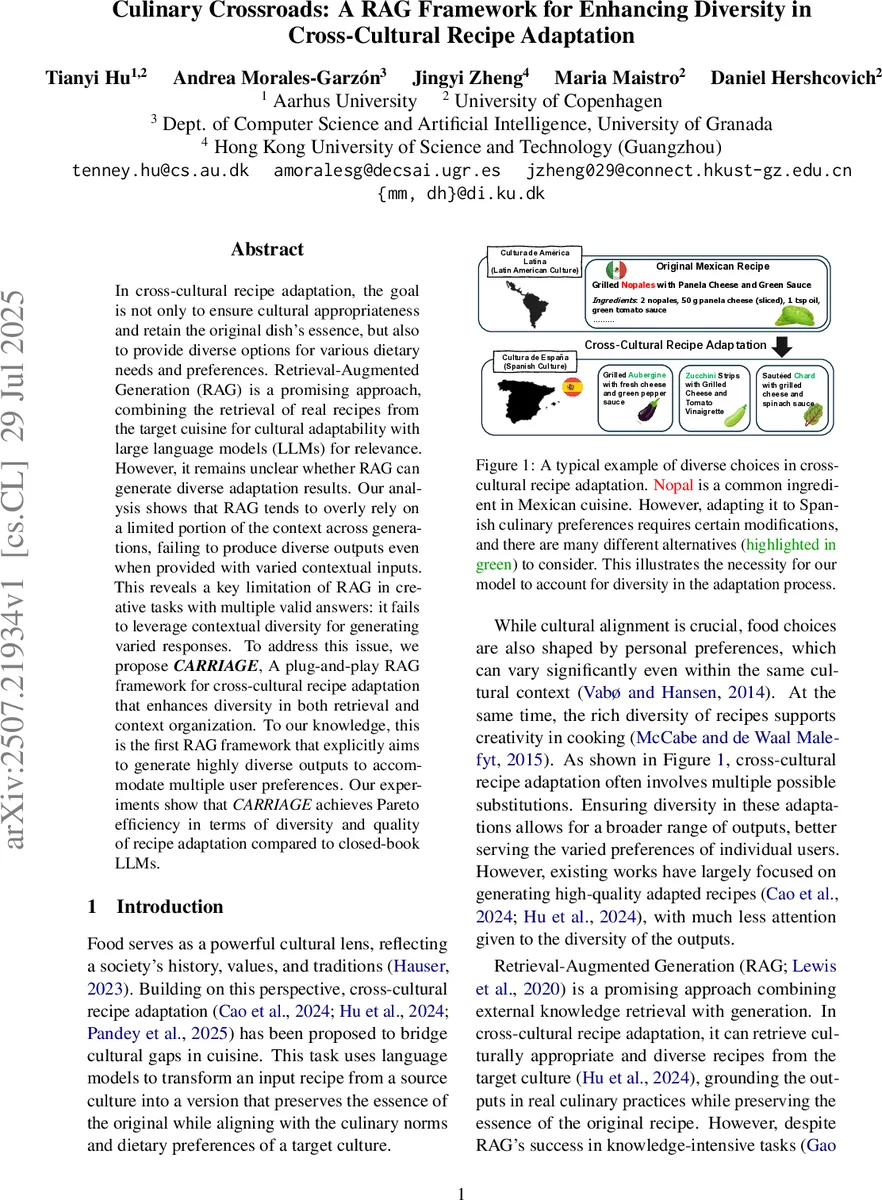
In cross-cultural recipe adaptation, the goal is not only to ensure cultural appropriateness and retain the original dish’s essence, but also to provide diverse options for various dietary needs and preferences. Retrieval Augmented Generation (RAG) is a promising approach, combining the retrieval of real recipes from the target cuisine for cultural adaptability with large language models (LLMs) for relevance. However, it remains unclear whether RAG can generate diverse adaptation results. Our analysis shows that RAG tends to overly rely on a limited portion of the context across generations, failing to produce diverse outputs even when provided with varied contextual inputs. This reveals a key limitation of RAG in creative tasks with multiple valid answers: it fails to leverage contextual diversity for generating varied responses. To address this issue, we propose CARRIAGE, a plug-and-play RAG framework for cross-cultural recipe adaptation that enhances diversity in both retrieval and context organization. To our knowledge, this is the first RAG framework that explicitly aims to generate highly diverse outputs to accommodate multiple user preferences. Our experiments show that CARRIAGE achieves Pareto efficiency in terms of diversity and quality of recipe adaptation compared to closed-book LLMs.
💡 Research Summary
The paper investigates the problem of generating diverse cross‑cultural recipe adaptations using Retrieval‑Augmented Generation (RAG). While RAG has shown strong performance in knowledge‑intensive tasks, the authors find that standard RAG pipelines fail to produce varied outputs even when supplied with diverse retrieval contexts. They identify four core failure modes: (C1) missed adaptations due to cultural naming differences, (C2) lack of diversity‑aware ranking that returns overly similar recipes, (C3) limited contextual variation because IR systems return the same results for repeated queries and LLMs focus on a narrow subset of the retrieved material, and (C4) generation that does not explicitly discourage repetition of previously generated adaptations.
To address these issues, the authors propose CARRIAGE (Cultural‑Aware Recipe Retrieval Augmented Generation), a plug‑and‑play framework that introduces diversity‑enhancing components at both retrieval and generation stages. The framework consists of four sequential modules:
- Query Rewriting – transforms the source recipe title and key terms into culturally adapted variants, enabling the retrieval engine to surface recipes that differ only in naming or cultural phrasing.
- Diversity‑Aware Re‑ranking – extends the classic Maximal Marginal Relevance (MMR) algorithm by incorporating similarity to both already selected results and previously generated adaptations, balancing relevance (λ) against diversity.
- Dynamic Context Organization – partitions the top‑k retrieved recipes into sliding windows of size w, feeding a different subset to the language model for each generation pass, thereby forcing the model to attend to varied information.
- Contrastive Context Injection – supplies the model with its own prior outputs as “negative” context, explicitly instructing it to avoid reproducing similar recipes.
The authors also introduce a new evaluation metric, the Recipe Cultural Appropriateness Score, alongside standard diversity measures: lexical diversity (Unique‑n across unigrams, bigrams, trigrams), semantic diversity (average pairwise cosine distance of Sentence‑BERT embeddings), and ingredient diversity. Quality is assessed via preservation of core steps/ingredients and cultural fit.
Experiments on a multilingual recipe dataset demonstrate that CARRIAGE outperforms both a vanilla RAG baseline and closed‑book large language models (e.g., GPT‑4) across all diversity dimensions, achieving 15‑20 % higher lexical and semantic diversity while maintaining or slightly improving cultural appropriateness and source‑preservation scores. Pareto analysis shows CARRIAGE occupies a region of simultaneous high quality and high diversity, effectively mitigating the traditional quality‑vs‑diversity trade‑off.
Ablation studies confirm that each module contributes positively: query rewriting improves retrieval recall of culturally relevant items; diversity‑aware re‑ranking expands the semantic space of retrieved contexts; dynamic context organization forces the generator to use different evidence; and contrastive context injection most strongly reduces output duplication.
The paper concludes that for creative tasks with multiple valid answers, RAG systems must incorporate diversity‑aware mechanisms throughout the pipeline. CARRIAGE offers a modular, training‑free solution that can be attached to existing retrieval engines and language models without retraining. Future work is suggested on adaptive λ tuning based on user dietary profiles, multimodal integration of recipe images/video, human evaluation of cultural nuance, and extending the approach to other domains such as music or design.
Comments & Academic Discussion
Loading comments...
Leave a Comment