Entanglement Halos
We introduce the concept of entanglement halos, a set of strongly entangled distant sites within the ground state of a quantum many-body system. Such halos emerge in star-like systems with exponentially decaying couplings, as we show using both free-fermions and the spin-1/2 antiferromagnetic Heisenberg model. Depending on the central connectivity, entanglement halos may exhibit trivial and non trivial symmetry-protected topological features. Our findings highlight how geometry and connectivity can generate complex entanglement structures with rich physical content, which can be experimentally accessible via state-of-the-art technologies.
💡 Research Summary
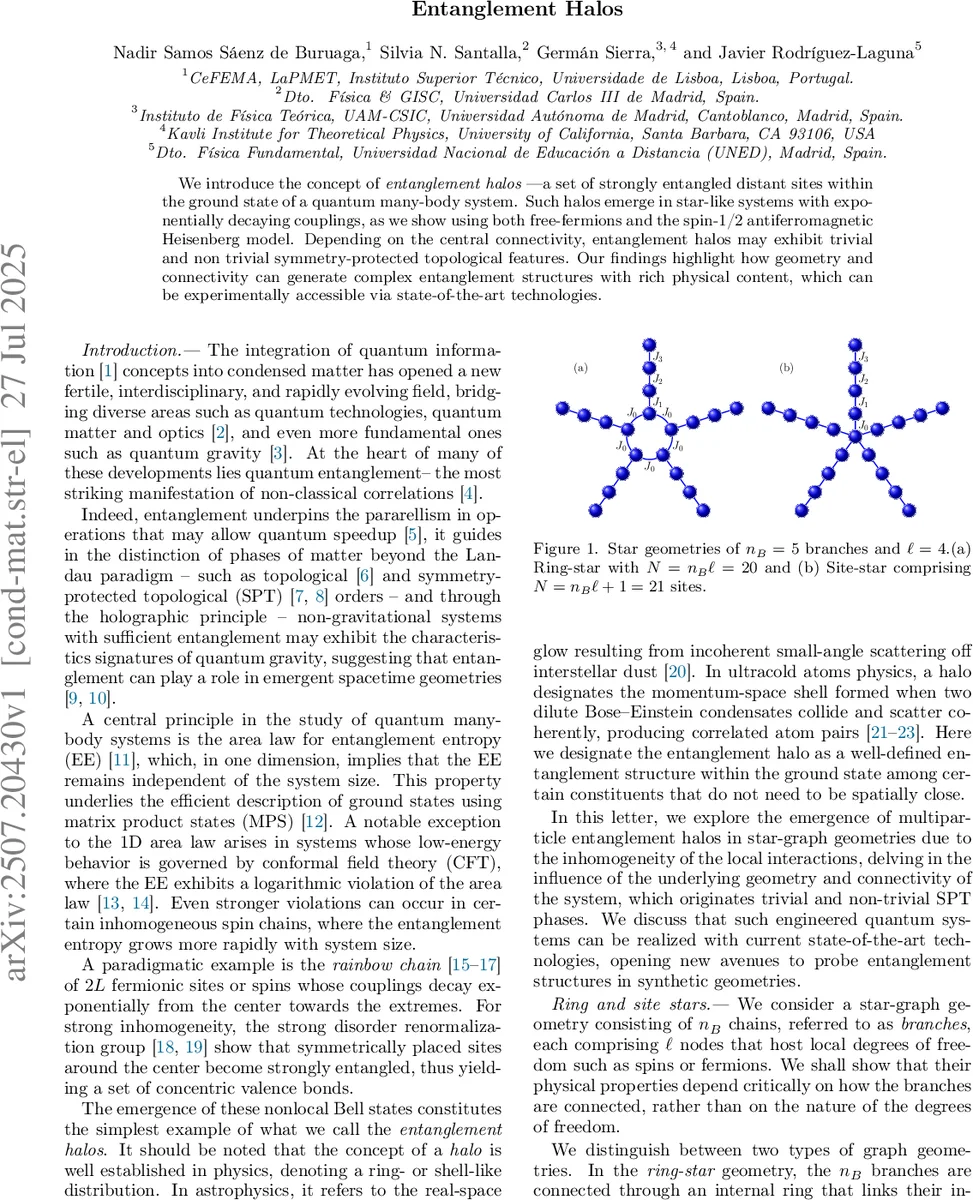
In this paper the authors introduce the notion of “entanglement halos,” a set of distant lattice sites that become strongly entangled with each other in the ground state of a quantum many‑body system. The phenomenon is investigated on star‑shaped graphs, which consist of n_B branches (or “legs”) each of length ℓ, and two distinct ways of connecting the branches: a ring‑star where the inner sites of all branches form a closed ring, and a site‑star where an extra central site couples to every branch. The couplings are taken to decay exponentially with the distance from the centre, J_r = e^{-hr} (h>0), creating a strong hierarchy J_0 ≫ J_1 ≫ … ≫ J_{ℓ‑1}. In the limit of large inhomogeneity (h≫1) the system exhibits a clear separation of energy scales that makes the strong‑disorder renormalization group (SDRG) an accurate analytical tool.
Two paradigmatic models are studied on these graphs: (i) a particle‑conserving free‑fermion Hamiltonian (Eq. 1) and (ii) the spin‑½ antiferromagnetic Heisenberg Hamiltonian (Eq. 2). For both models the SDRG proceeds by iteratively “decimating’’ the strongest bonds, which isolates the innermost ring (or central site plus first ring) as an effective subsystem described by a unique ground state |ψ(1)⟩ when the number of branches satisfies certain parity conditions (even n_B for Heisenberg, n_B ≡ 0 (mod 4) for free fermions). Because the next‑nearest couplings are exponentially weaker, the inner subsystem detaches from the rest of the lattice, leaving the outer rings essentially untouched. Repeating the procedure yields a ground‑state wavefunction that factorises into a product of independent states associated with each concentric ring:
|Ψ_GS⟩ ≈ ∏_{r=1}^{ℓ} |ψ(r)⟩.
Each factor |ψ(r)⟩ constitutes an “entanglement halo.” When the inner subsystem is degenerate (odd n_B in the Heisenberg case or n_B ≡ 0 (mod 4) in the fermionic case), the degeneracy is transferred to the next ring, producing a double‑halo structure. The ground state then takes the form of a product of paired halo states, e.g. |ψ(1,2)⟩ ⊗ |ψ(3,4)⟩ ⊗ …, and the entanglement entropy (EE) of blocks that contain successive rings displays an alternating pattern: zero for even‑r rings and log 2·n_B for odd‑r rings. This pattern is clearly visible in the numerical data (Fig. 3, 4).
The site‑star geometry behaves qualitatively differently. The central site couples to each branch with strength J_0, generating a single‑particle spectrum consisting of two non‑zero levels ±J_0√{n_B} and n_B‑1 zero modes. The many‑body ground‑state manifold is therefore highly degenerate (dimension 2^{n_B‑1}). The SDRG pushes the zero modes outward, so that odd‑indexed blocks (containing rings 1,3,5,…) have EE ≈ n_B‑1, while even‑indexed blocks have EE ≈ 1. The free‑fermion site‑star belongs to the BDI symmetry class and can be mapped onto a Su–Schrieffer–Heeger (SSH) chain; the alternating entanglement pattern is thus a manifestation of a non‑trivial symmetry‑protected topological (SPT) phase.
For the Heisenberg site‑star, the SU(2) symmetry allows the Hamiltonian of the central cluster to be written in terms of total spin operators. Energy minimisation forces each ring to form a maximal total spin S = n_B/2. The effective low‑energy description becomes a chain of composite spins S_r that alternate between S = (n_B‑1)/2 (odd r) and S = 1/2 (even r). Using Wigner‑Eckart theorem, the renormalised couplings acquire simple prefactors, and the whole structure can be expressed as a matrix‑product state (MPS) with alternating virtual bond dimensions 2 and n_B. The resulting MPS is precisely the one describing the Haldane phase of a spin‑1 chain (AKLT‑type). Consequently, pairs of neighbouring rings behave as effective spin‑1 objects, and the system exhibits a non‑trivial SPT order characterised by a non‑zero string order parameter (SOP). Numerical calculations of ⟨S_r^2⟩, SOP, and EE (Fig. 5) confirm the convergence to the Haldane fixed point for large h.
The authors also discuss experimental feasibility. The required exponential coupling profile can be engineered in ultracold‑atom setups using spatially varying optical lattices, in superconducting qubit arrays by designing capacitive or inductive couplings, or in photonic waveguide arrays with tailored evanescent overlaps. The site‑star geometry is especially amenable to implementation because it only requires a single central qubit coupled to several peripheral qubits. Entanglement halos could be probed via quantum state tomography, measurement of two‑point correlators, or randomized measurements that estimate Rényi entropies.
In summary, the paper demonstrates that geometry (star‑graph topology) combined with strong spatial inhomogeneity can generate rich entanglement structures—single‑halo, double‑halo, and twisted‑halo patterns—each associated with distinct topological characteristics (trivial product states, SPT phases, Haldane phase). The concept of entanglement halos provides a unifying language for describing non‑local Bell‑pair formation in inhomogeneous many‑body systems and opens new avenues for designing synthetic quantum matter with controllable entanglement patterns.
Comments & Academic Discussion
Loading comments...
Leave a Comment