A Generalizable Physics-Enhanced State Space Model for Long-Term Dynamics Forecasting in Complex Environments
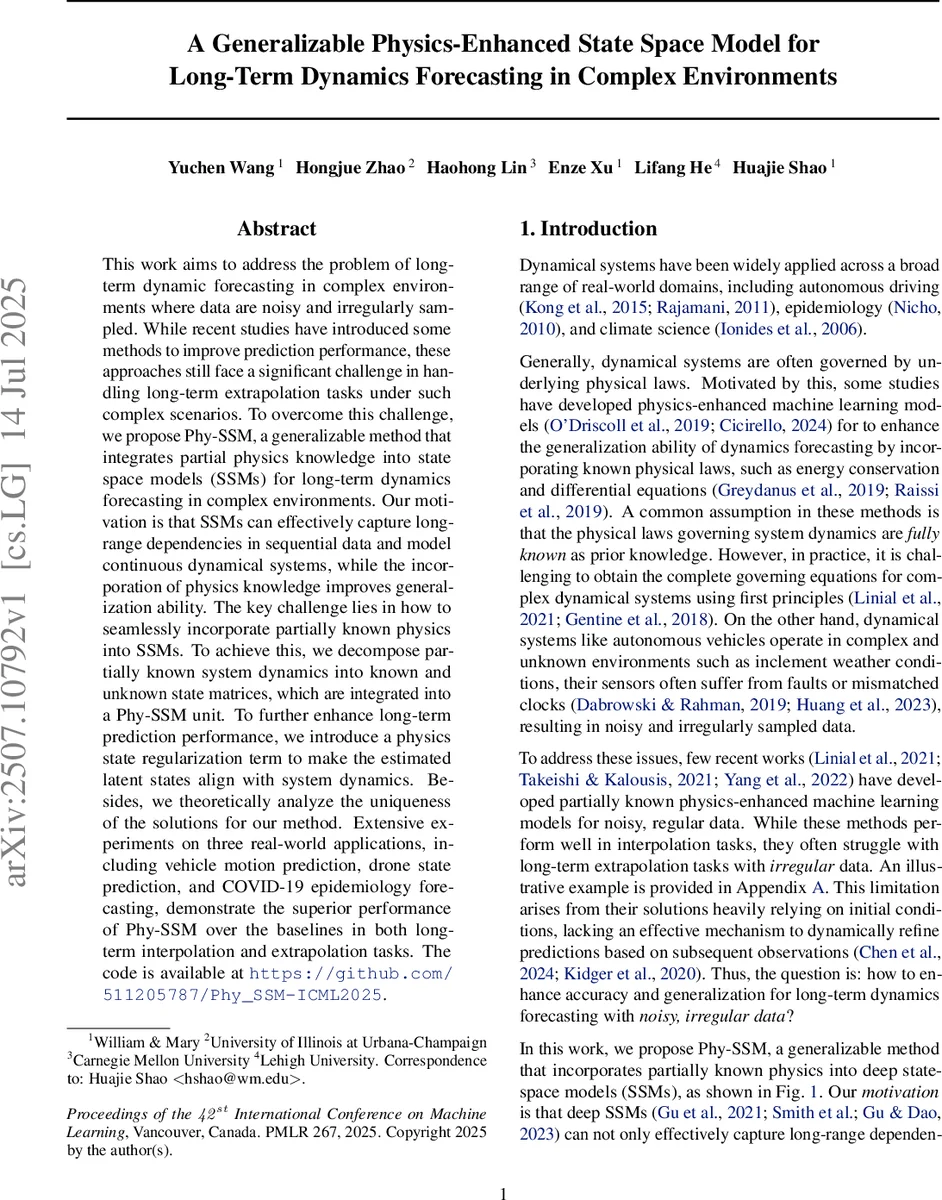
This work aims to address the problem of long-term dynamic forecasting in complex environments where data are noisy and irregularly sampled. While recent studies have introduced some methods to improve prediction performance, these approaches still face a significant challenge in handling long-term extrapolation tasks under such complex scenarios. To overcome this challenge, we propose Phy-SSM, a generalizable method that integrates partial physics knowledge into state space models (SSMs) for long-term dynamics forecasting in complex environments. Our motivation is that SSMs can effectively capture long-range dependencies in sequential data and model continuous dynamical systems, while the incorporation of physics knowledge improves generalization ability. The key challenge lies in how to seamlessly incorporate partially known physics into SSMs. To achieve this, we decompose partially known system dynamics into known and unknown state matrices, which are integrated into a Phy-SSM unit. To further enhance long-term prediction performance, we introduce a physics state regularization term to make the estimated latent states align with system dynamics. Besides, we theoretically analyze the uniqueness of the solutions for our method. Extensive experiments on three real-world applications, including vehicle motion prediction, drone state prediction, and COVID-19 epidemiology forecasting, demonstrate the superior performance of Phy-SSM over the baselines in both long-term interpolation and extrapolation tasks. The code is available at https://github.com/511205787/Phy_SSM-ICML2025.
💡 Research Summary
The paper introduces Phy‑SSM, a physics‑enhanced state‑space model designed to improve long‑term dynamics forecasting in environments characterized by noisy, irregularly sampled data. The authors observe that existing approaches—such as physics‑informed loss functions (e.g., PINNs), physics‑informed architecture designs (e.g., NODE‑based models), and fully physics‑driven methods—either assume complete knowledge of governing equations or struggle with extrapolation beyond the training horizon, especially when observations are sparse or corrupted.
Phy‑SSM addresses these gaps by integrating partially known physics directly into a deep state‑space framework (built on S4/S5/Mamba). The core idea is to decompose the system dynamics ( \dot{z}=f(z,u) ) into a known component ( f_{\text{knw}} ) and an unknown component ( f_{\text{unk}} ). By extending the latent state to (\bar{z}=
Comments & Academic Discussion
Loading comments...
Leave a Comment