Synthetic Mutual Gauge Field in Microwave-Shielded Polar Molecular Gases
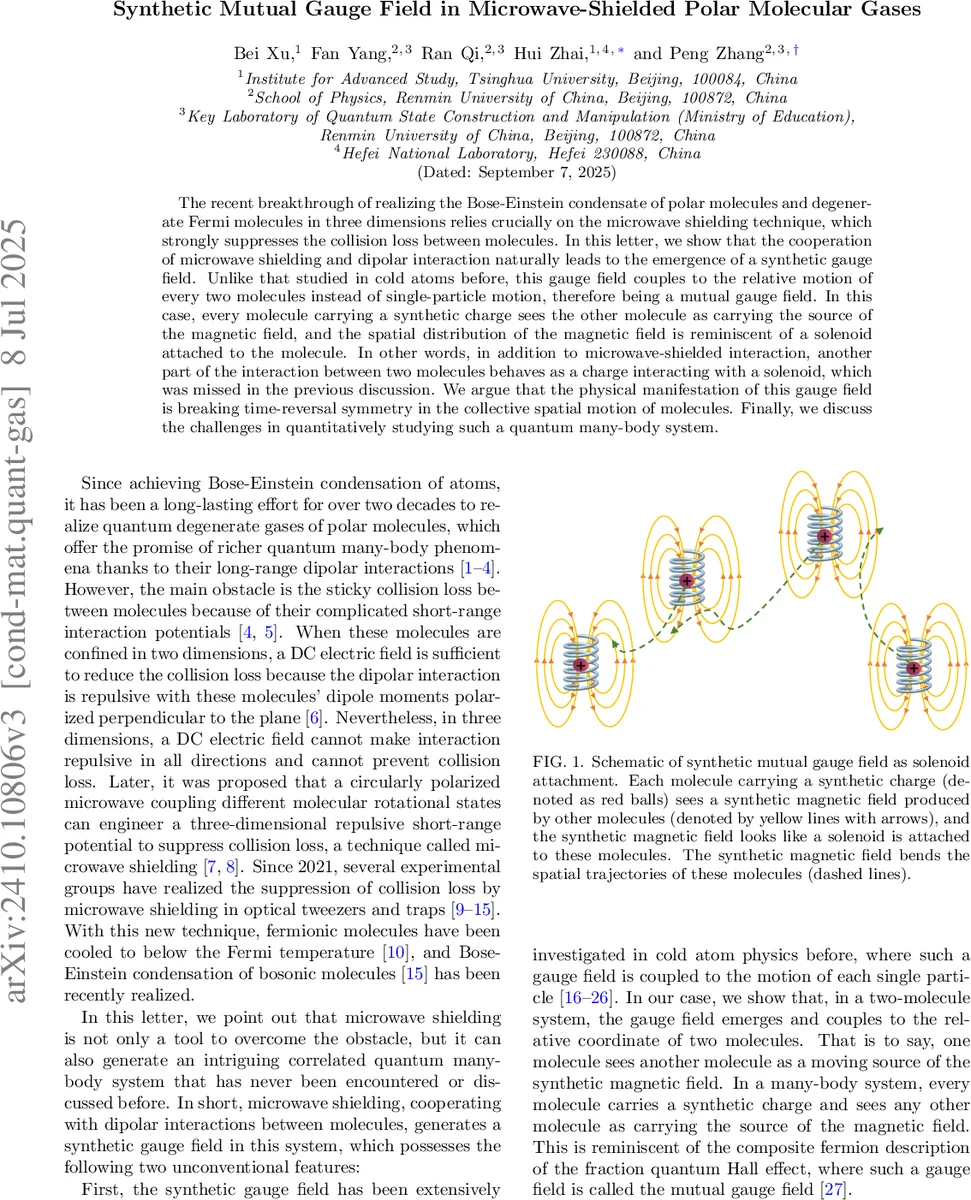
The recent breakthrough of realizing the Bose-Einstein condensate of polar molecules and degenerate Fermi molecules in three dimensions relies crucially on the microwave shielding technique, which strongly suppresses the collision loss between molecules. In this letter, we show that the cooperation of microwave shielding and dipolar interaction naturally leads to the emergence of a synthetic gauge field. Unlike that studied in cold atoms before, this gauge field couples to the relative motion of every two molecules instead of single-particle motion, therefore being a mutual gauge field. In this case, every molecule carrying a synthetic charge sees the other molecule as carrying the source of the magnetic field, and the spatial distribution of the magnetic field is reminiscent of a solenoid attached to the molecule. In other words, in addition to microwave-shielded interaction, another part of the interaction between two molecules behaves as a charge interacting with a solenoid, which was missed in the previous discussion. We argue that the physical manifestation of this gauge field is breaking time-reversal symmetry in the collective spatial motion of molecules. Finally, we discuss the challenges in quantitatively studying such a quantum many-body system.
💡 Research Summary
**
The paper uncovers a previously unnoticed consequence of microwave shielding in three‑dimensional gases of polar molecules. While microwave dressing (σ⁺ circular polarization) together with the long‑range dipolar interaction is already known to produce a repulsive short‑range “shielding core” that suppresses inelastic collisions, the authors show that the same ingredients also generate a synthetic gauge field that couples to the relative coordinate of any pair of molecules. By projecting the dipole‑dipole interaction onto the four relevant rotational states (|g⟩, |e₀⟩, |e_{±1}⟩) and performing a rotating‑wave approximation, the interaction acquires phase factors e^{±iϕ} and e^{±2iϕ} that depend on the azimuthal angle ϕ of the inter‑molecular vector. A unitary transformation U(ϕ)=exp
Comments & Academic Discussion
Loading comments...
Leave a Comment