Dirac charge in antiferromagnetic topological semimetals
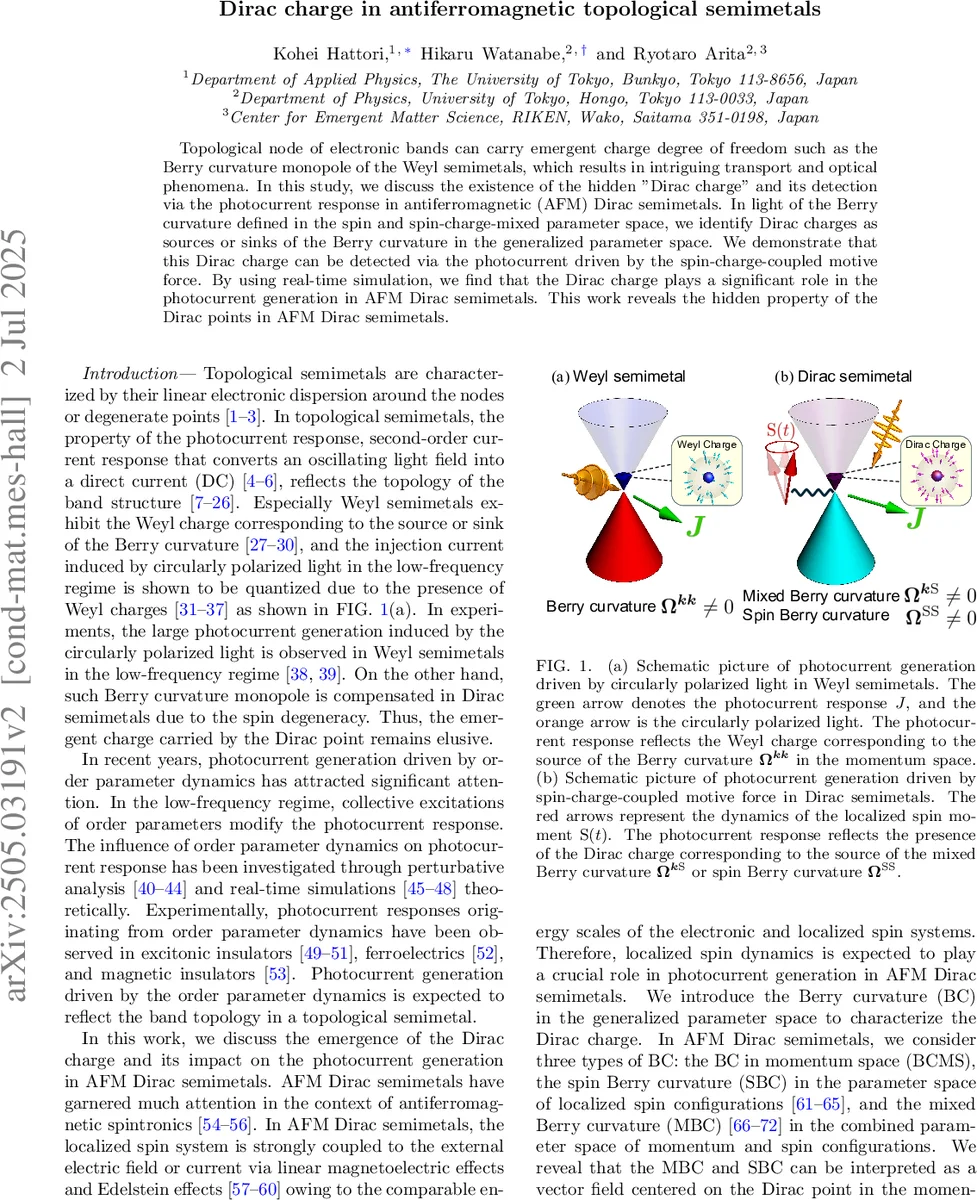
Topological node of electronic bands can carry emergent charge degree of freedom such as the Berry curvature monopole of the Weyl semimetals, which results in intriguing transport and optical phenomena. In this study, we discuss the existence of the hidden “Dirac charge” and its detection via the photocurrent response in antiferromagnetic (AFM) Dirac semimetals. In light of the Berry curvature defined in the spin and spin-charge-mixed parameter space, we identify Dirac charges as sources or sinks of the Berry curvature in the generalized parameter space. We demonstrate that this Dirac charge can be detected via the photocurrent driven by the spin-charge-coupled motive force. By using real-time simulation, we find that the Dirac charge plays a significant role in the photocurrent generation in AFM Dirac semimetals. This work reveals the hidden property of the Dirac points in AFM Dirac semimetals.
💡 Research Summary
In this work the authors investigate a previously unrecognized topological charge associated with Dirac points in antiferromagnetic (AFM) Dirac semimetals and propose a concrete experimental protocol to detect it via nonlinear photocurrent measurements.
The central conceptual advance is the extension of Berry‑phase geometry from the usual momentum‑space description to a generalized parameter space that includes both crystal momentum k and the collective orientation of the localized AFM sublattice spins S. By defining a Berry connection ξ_X^{ab}(R)=⟨u_a(R)|i∂X|u_b(R)⟩ with R=(k,S) and extracting its imaginary part Ω{XY}^a(R), the authors identify three distinct curvature tensors: the ordinary momentum‑space Berry curvature (BC_MS), the spin‑space Berry curvature (BC_S), and the mixed curvature (BC_M) that couples momentum and spin. In the vicinity of a Dirac node the mixed and spin curvatures acquire a universal ρ/|ρ|³ profile, exactly analogous to the monopole field of a point charge. This allows them to define a “Dirac charge” C_D as the source (positive) or sink (negative) of the generalized Berry curvature, despite the fact that ordinary momentum‑space curvature vanishes for a Dirac point because of spin degeneracy.
To make the idea concrete, they study a two‑dimensional tight‑binding model on a bipartite lattice with nearest‑ and next‑nearest‑neighbor hopping (t₁, t₂), staggered spin‑orbit coupling λ, and an exchange coupling J between itinerant electrons and localized spins on the two sublattices. An easy‑axis anisotropy K_x stabilizes a collinear AFM order S_A=−S_B=(1,0,0). For realistic parameters (t₁=1, t₂=0.08, λ=0.8, J=0.6) the band structure hosts two symmetry‑protected Dirac points D₁ and D₂ located at k‑vectors
Comments & Academic Discussion
Loading comments...
Leave a Comment