A variational view on constitutive laws in parabolic problems
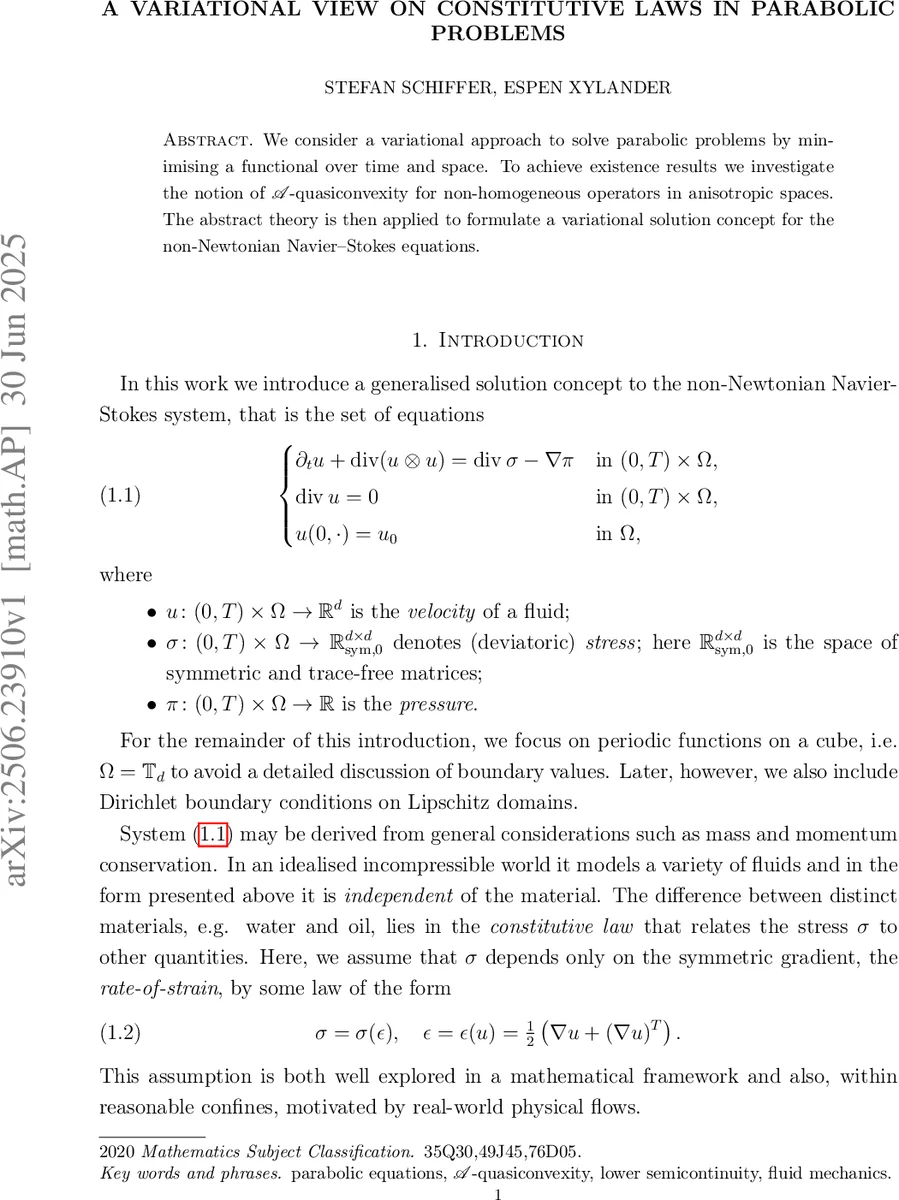
We consider a variational approach to solve parabolic problems by minimising a functional over time and space. To achieve existence results we investigate the notion of $\mathscr{A}$-quasiconvexity for non-homogeneous operators in anisotropic spaces. The abstract theory is then applied to formulate a variational solution concept for the non-Newtonian Navier–Stokes equations.
💡 Research Summary
The paper develops a variational framework for solving parabolic partial differential equations, with a focus on non‑Newtonian Navier–Stokes (N‑S) systems. Instead of prescribing a constitutive law σ = σ(𝔻(u)) a priori, the authors introduce a non‑negative loss functional f(𝔻,σ) that measures the deviation of a strain‑stress pair (𝔻,σ) from a given data set D (e.g., experimental measurements). The functional satisfies three structural assumptions: (A1) p‑q growth, (A2) coercivity, and (A3) 𝒜‑quasiconvexity, where 𝒜 is a non‑homogeneous linear differential operator containing one time derivative and two spatial derivatives.
Using f, they define a global space‑time functional
I(u,σ) = ∬_{(0,T)×Ω} f(𝔻(u),σ) dx dt,
with the convention that I(u,σ)=∞ unless (u,σ) satisfy the N‑S system (momentum balance, incompressibility, and the initial condition). Minimising I over admissible pairs (u,σ) yields a “variational solution”: the flow that best fits the data while exactly satisfying the governing equations.
The main mathematical challenge is to prove the existence of minimisers. To this end, the authors extend the theory of 𝒜‑quasiconvexity—originally developed for homogeneous constant‑rank operators—to the non‑homogeneous, anisotropic setting required by parabolic problems. They introduce anisotropic Sobolev spaces W^{1,2}_{p,q} that allow different integrability exponents in time (p) and space (q), and they analyse the Fourier symbols of 𝒜, its potential operators, and the associated pseudo‑differential constraints (notably the divergence‑free condition). They show that under (A1)–(A3), the integrand f is weakly lower semicontinuous with respect to the natural topology of these spaces, which guarantees that any minimizing sequence has a convergent subsequence whose limit is a minimiser of I.
The existence results are split into regimes for the exponent p. In the “high‑regularity” regime p ≥ 3d + 2 (or p ≥ 3d + 2d + 2 as written), the functional is coercive and lower semicontinuous, leading to full energy inequalities and a variational solution that coincides with the classical Leray–Hopf weak solution of the non‑Newtonian N‑S equations. In the “intermediate” regime p > 2d + 2, lower semicontinuity still holds, but the energy inequality is not automatically granted; an additional a‑priori energy bound must be imposed to obtain a minimiser. The paper also provides an alternative proof of Leray–Hopf existence that avoids the traditional Lipschitz truncation technique, relying instead on the developed variational machinery.
Conceptually, the approach treats the constitutive law as an unknown to be identified from data, rather than a fixed model parameter. By minimising I, the method simultaneously solves the PDE and selects the constitutive relation that best matches the experimental observations. The authors acknowledge that a global space‑time minimisation may violate causality (the solution on a shorter time interval need not be optimal when considered within a longer interval). They suggest that incorporating a time‑weighting factor (as in the WIDE functional) or a time‑discretisation scheme could restore causality, leaving this for future work.
Overall, the paper contributes a rigorous variational existence theory for parabolic problems with non‑homogeneous operators, introduces a novel data‑driven formulation for non‑Newtonian fluid mechanics, and bridges the gap between abstract functional‑analytic techniques (𝒜‑quasiconvexity, anisotropic Sobolev spaces) and practical modeling of complex fluids.
Comments & Academic Discussion
Loading comments...
Leave a Comment