A new Surrogate Microstructure Generator for Porous Materials with Applications to the Buffer Layer of TRISO Nuclear Fuel Particles
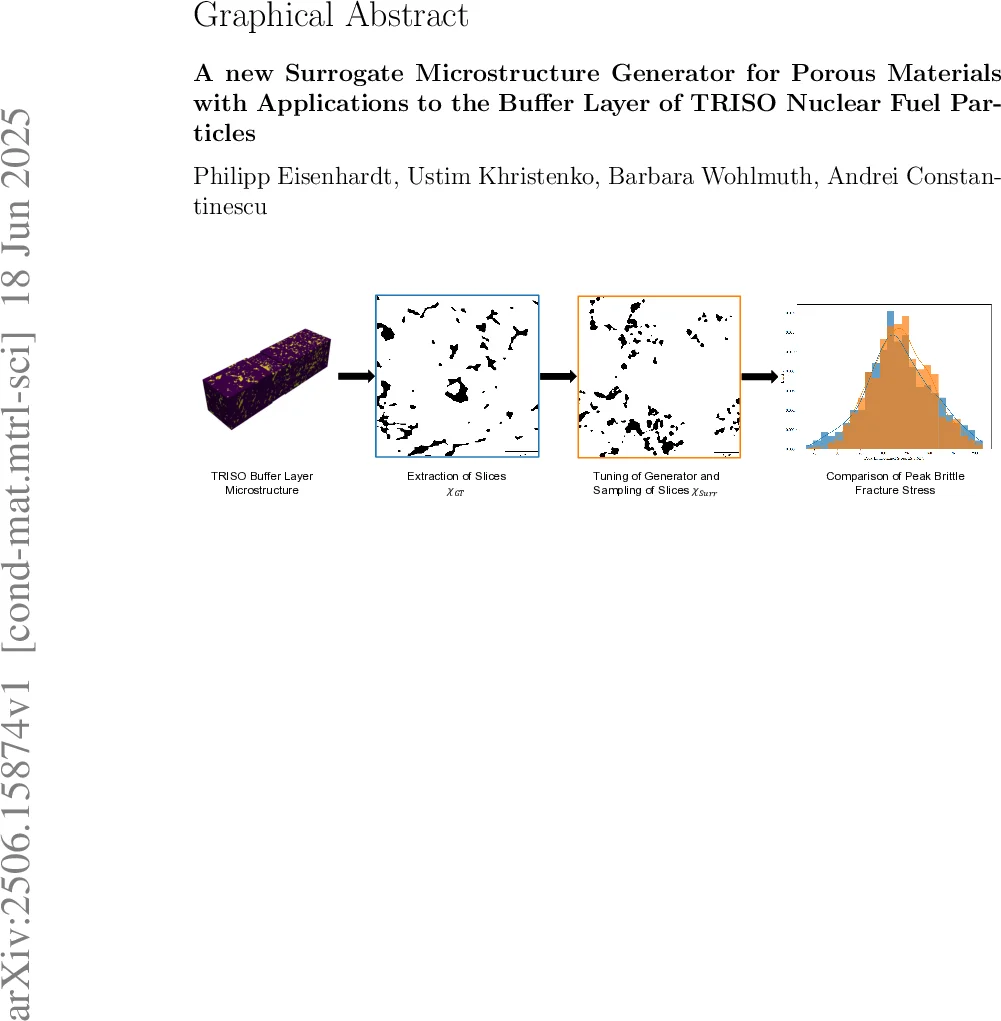
We present a surrogate material model for generating microstructure samples reproducing the morphology of the real material. The generator is based on Gaussian random fields, with a Matérn kernel and a topological support field defined through ellipsoidal inclusions clustered by a random walk algorithm. We identify the surrogate model parameters by minimizing misfits in a list of statistical and geometrical descriptors of the material microstructure. To demonstrate the effectiveness of the method for porous nuclear materials, we apply the generator to the buffer layer of Tristructural Isotropic Nuclear Fuel (TRISO) particles. This part has been shown to be failure sensitive part of TRISO nuclear fuel and our generator is optimized with respect to a dataset of FIB-SEM tomography across the buffer layer thickness. We evaluate the performance by applying mechanical modeling with problems of linear elastic homogenization and linear elastic brittle fracture material properties and comparing the behaviour of the dataset microstructure and the surrogate microstructure. This shows good agreement between the dataset microstructure and the generated microstructures over a large range of porosities.
💡 Research Summary
This paper introduces a stochastic surrogate microstructure generator tailored for the porous buffer layer of TRISO nuclear fuel particles. The generator combines two level‑set fields: a topological support field built from ellipsoidal inclusions placed by a random‑walk clustering algorithm, and a Gaussian Random Field (GRF) with a Matérn covariance kernel that adds controlled stochastic perturbations. The topological support captures the elongated, clustered pores observed in the buffer layer, while the GRF controls smoothness and variability through its smoothness parameter ν, correlation length l, and a mixing weight α that determines the relative contribution of noise versus deterministic geometry.
A parameter vector θ (including ellipsoid aspect ratios, orientations, cluster statistics, random‑walk step length, forking probability, Matérn parameters, and α) is identified by minimizing a weighted sum of distances between real microstructure descriptors and those of generated samples. Descriptors span global two‑point correlation functions, lineal‑path functions, and local pore metrics such as area, size distribution, ellipticity, and connectivity. The optimization problem is tackled with Efficient Global Optimization (EGO), a Bayesian surrogate‑model‑based approach that iteratively proposes promising θ candidates by maximizing expected improvement, thus efficiently navigating the high‑dimensional parameter space despite the limited amount of FIB‑SEM tomography data available for the buffer layer.
Once calibrated, the generator can produce virtually unlimited surrogate realizations across a range of porosities (approximately 10 %–30 %). The authors evaluate these realizations through two mechanical analyses. First, linear elastic homogenization is performed using FFT‑based periodic boundary conditions to extract effective Young’s modulus and Poisson’s ratio. Second, a linear‑elastic brittle fracture model (energy release rate based) is applied to compute peak brittle fracture stress. Comparisons with the original tomography‑derived microstructures show that the surrogate samples reproduce the effective elastic moduli and fracture stresses within about 5 % error across the investigated porosity range.
Key contributions of the work are: (1) a hybrid level‑set formulation that retains physical interpretability of parameters while delivering rich morphological variability; (2) the use of EGO for global stochastic optimization, enabling reliable parameter identification from a modest experimental dataset; (3) a thorough validation that links statistical microstructural fidelity to mechanical response, demonstrating that the surrogate captures both elastic and fracture behavior of the real material; and (4) a framework that can be extended to other porous nuclear materials or to multiscale design studies where rapid generation of statistically representative microstructures is required.
The paper also discusses limitations. The current implementation operates on two‑dimensional slices; extending to full three‑dimensional volumes would increase computational cost, especially for the random‑walk clustering and level‑set minimization steps. The forking mechanism is fixed to a 90° turn, which may not fully represent the complex three‑dimensional connectivity of real pores. Future work is suggested to incorporate anisotropic Matérn kernels, multi‑scale topological supports, coupling with radiation‑induced pore evolution models, and integration of machine‑learning surrogates for real‑time parameter tuning. Overall, the study provides a robust, interpretable, and computationally efficient tool for generating realistic surrogate microstructures of TRISO buffer layers, facilitating more accurate and cost‑effective mechanical modeling of nuclear fuel performance.
Comments & Academic Discussion
Loading comments...
Leave a Comment