Nonlinear Optimal Control of DC Microgrids with Safety and Stability Guarantees
A DC microgrid is a promising alternative to the traditional AC power grid, since it can efficiently integrate distributed and renewable energy resources. However, as an emerging framework, it lacks the rigorous theoretical guarantees of its AC counterpart. In particular, safe stabilization of the DC microgrid has been a non-trivial task in power electronics. To address that, we take a control theoretic perspective in designing the feedback controller with provable guarantees. We present a systematic way to construct Control Lyapunov Functions (CLF) to stabilize the microgrid, and, independently, Control Barrier Functions (CBF) to enforce its safe operation at all times. The safety-critical controller (SCC) proposed in this work integrates the two control objectives, with safety prioritized, into a quadratic program (QP) as linear constraints, which allows for its online deployment using off-the-shelf convex optimization solvers. The SCC is compared against a robust version of the conventional droop control through numerical experiments whose results indicate the SCC outperforms the droop controller in guaranteeing safety and retaining stability at the same time.
💡 Research Summary
The paper addresses the critical challenge of ensuring both safety and stability in DC microgrids, which are emerging as a promising alternative to traditional AC power systems. While DC microgrids offer advantages such as higher efficiency and easier integration of renewable sources, they suffer from a lack of rigorous theoretical guarantees, especially when constant‑power loads (CPLs) are present. CPLs introduce strong nonlinearities that can destabilize the bus voltage and violate safety limits.
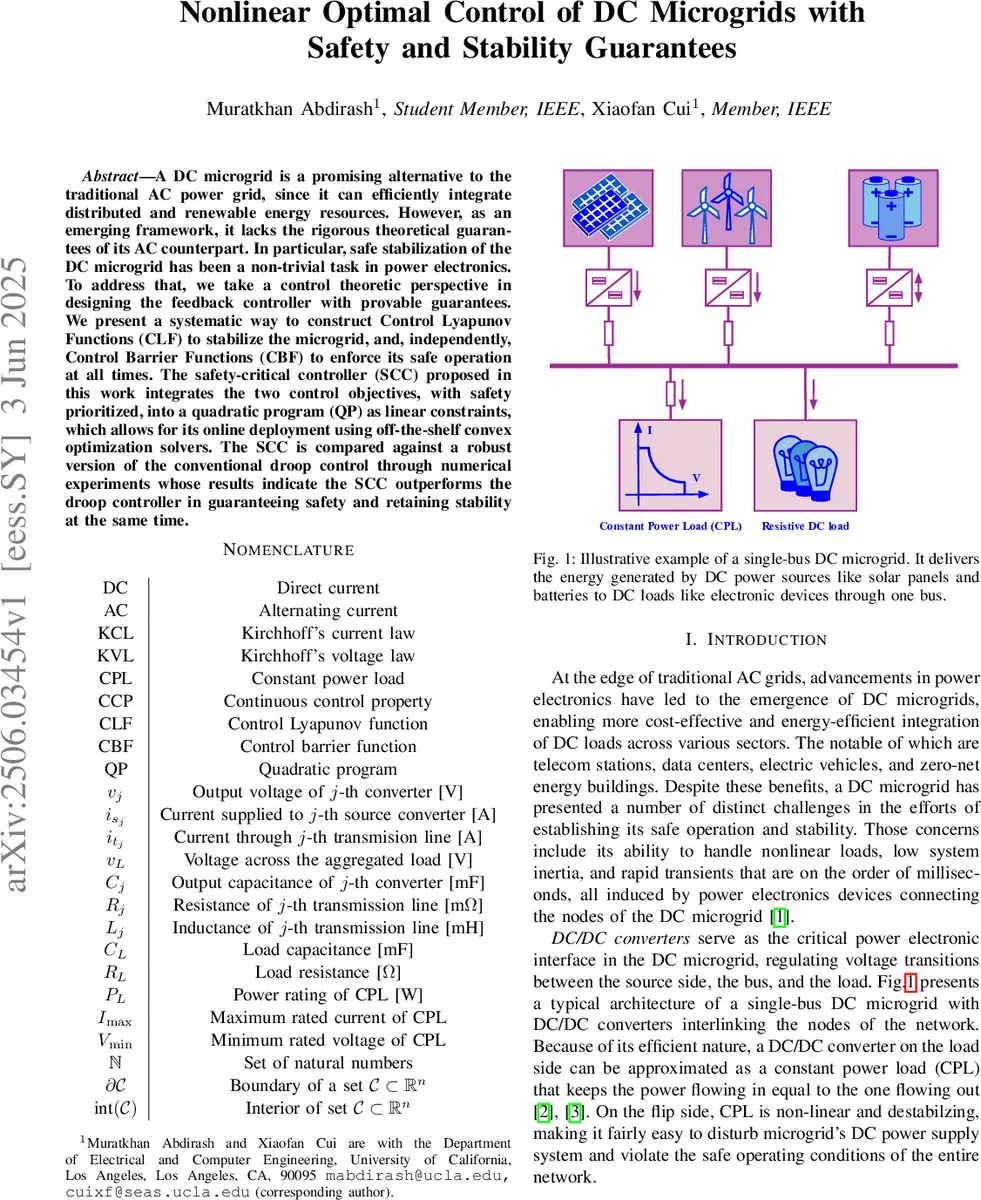
To overcome these issues, the authors adopt a modern control‑theoretic framework that combines Control Lyapunov Functions (CLFs) for stability and Control Barrier Functions (CBFs) for safety. The microgrid is modeled as a single‑bus network where each DC‑DC converter is abstracted as a controllable current source. The state vector comprises converter terminal voltages, line currents, and the bus voltage; the control input consists of the converter current commands. The dynamics are expressed in the affine form ˙x = f(x) + g(x)u, with f and g continuously differentiable.
A unique equilibrium is selected by solving a convex optimization problem that minimizes steady‑state power loss while enforcing a desired bus voltage. This yields a closed‑form expression for the equilibrium currents and voltages, ensuring a well‑defined operating point for the subsequent controller design.
The authors define output functions that capture the bus‑voltage error and the voltage differences between neighboring converters. By analyzing their relative degrees (three for the bus voltage, one for the inter‑converter differences), they construct an output‑plus‑zero‑dynamics representation that satisfies the conditions for feedback linearization. A linearizing controller u_FL(x) is derived, and the linearized output dynamics are stabilized via a quadratic Lyapunov equation A_clᵀP + PA_cl = –Q, producing a CLF V_η(η) = ηᵀPη that guarantees local exponential stability of the original nonlinear system.
For safety, a barrier function B(x) = (V_max – v_L)(v_L – V_min) is introduced, which grows unbounded as the bus voltage approaches its prescribed limits. By enforcing L_g B(x) = 0 ⇒ L_f B(x) – βB(x) < 0 (β > 0), the safe set C = {x | B(x) ≥ 0} becomes forward‑invariant.
Both CLF and CBF conditions are embedded as linear constraints in a quadratic program (QP). The QP minimizes the squared deviation from the nominal stabilizing control and a slack variable δ, while satisfying (i) the CLF constraint γ(L_f V + α‖η‖²) + L_g V (u + δ) ≤ 0 and (ii) the CBF constraint L_f B + L_g B u – βB ≤ 0. Here γ(·) is a hinge‑type function that activates the CLF constraint only when needed, and m is a penalty weight on the slack. The authors prove that this QP is always feasible, its solution is Lipschitz continuous on the interior of the safe set, and that when the barrier constraint is inactive the controller reduces to the standard CLF‑based stabilizer, preserving exponential convergence.
Numerical experiments on a five‑converter microgrid with a CPL demonstrate that the Safety‑Critical Controller (SCC) maintains the bus voltage within the safe band under severe load transients, while quickly driving all states to the equilibrium. In contrast, a robust droop controller—augmented with voltage, current, and power limits—fails to keep the voltage within bounds for the same initial conditions and exhibits slower convergence. The SCC therefore achieves a larger region of attraction while guaranteeing safety, something droop control cannot provide.
Key contributions include: (1) a systematic CLF construction for large‑signal exponential stability of a nonlinear DC microgrid, (2) the first application of a CBF to enforce voltage safety in an islanded DC system, (3) a unified QP‑based safety‑critical controller that can be solved online with standard convex solvers, and (4) a thorough performance comparison showing superior safety‑stability trade‑offs relative to conventional droop control.
The paper also acknowledges limitations: the approach assumes full state measurement and a centralized architecture, is demonstrated only on a single‑bus topology, and relies on a simplified CPL model (fixed current, voltage limits). Future work is suggested to extend the framework to distributed implementations, multi‑bus networks, and more accurate load representations.
Comments & Academic Discussion
Loading comments...
Leave a Comment