Concentrating solutions of the fractional $(p,q)$-Choquard equation with exponential growth
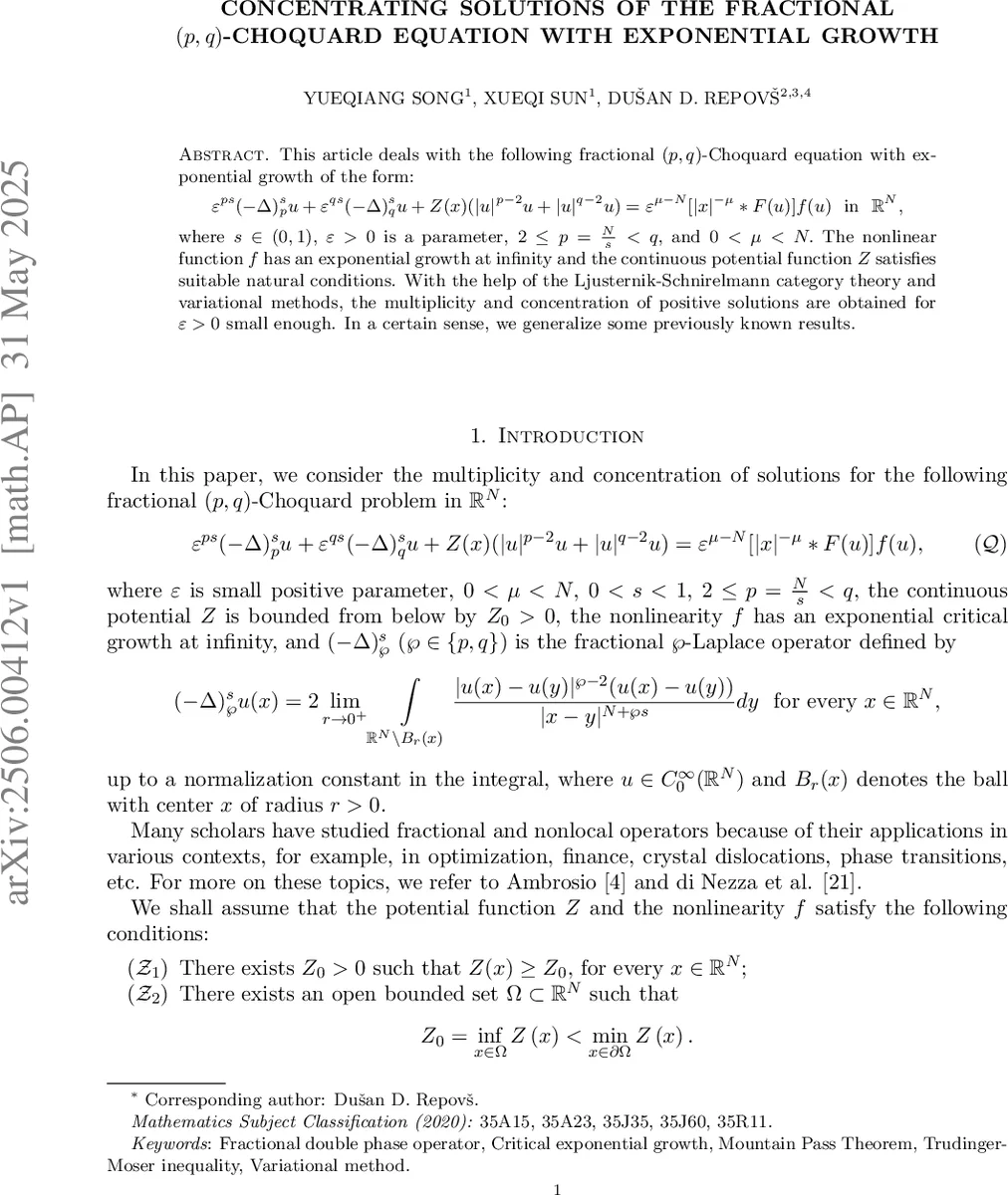
This article deals with the following fractional $(p,q)$-Choquard equation with exponential growth of the form: $$\varepsilon^{ps}(-Δ)_{p}^{s}u+\varepsilon^{qs}(-Δ)_q^su+ Z(x)(|u|^{p-2}u+|u|^{q-2}u)=\varepsilon^{μ-N}[|x|^{-μ}*F(u)]f(u) \ \ \mbox{in} \ \ \mathbb{R}^N,$$ where $s\in (0,1),$ $\varepsilon>0$ is a parameter, $2\leq p=\frac{N}{s}<q,$ and $0<μ<N.$ The nonlinear function $f$ has an exponential growth at infinity and the continuous potential function $Z$ satisfies suitable natural conditions. With the help of the Ljusternik-Schnirelmann category theory and variational methods, the multiplicity and concentration of positive solutions are obtained for $\varepsilon>0$ small enough. In a certain sense, we generalize some previously known results.
💡 Research Summary
The paper investigates a singularly perturbed fractional (p,q)-Choquard equation in ℝⁿ with exponential critical growth. The model reads
ε^{ps}(−Δ)^{s}{p}u + ε^{qs}(−Δ)^{s}{q}u + Z(x)(|u|^{p‑2}u + |u|^{q‑2}u) = ε^{μ‑N} (|x|^{‑μ}∗F(u)) f(u),
where s∈(0,1), p = N s, q>p, 0<μ<N and ε>0 is a small parameter. The potential Z is continuous, bounded below by a positive constant Z₀, and attains its minimum on a non‑empty closed set M = {x : Z(x)=Z₀}. The nonlinearity f is continuous, vanishes for non‑positive arguments, and for t>0 satisfies a Trudinger–Moser type estimate: its derivative is bounded by a sum of a polynomial term and an exponential term involving the function H_{N,s}(β₀|t|^{N/(N‑s)}), with β₀ strictly below the critical constant α* (s,N). Additional hypotheses (f₂)–(f₅) guarantee a sub‑critical behavior near zero, an Ambrosetti–Rabinowitz type condition, a lower power growth at infinity, and monotonicity of t↦f(t)t^{1‑q}.
The authors first reformulate the problem via the scaling x↦εx, obtaining an equivalent equation (Q_ε) whose weak solutions belong to the Banach space
W_ε = W^{s,p}{Z,ε}(ℝⁿ) ∩ W^{s,q}{Z,ε}(ℝⁿ),
equipped with the natural norm combining the fractional p‑ and q‑seminorms and the weighted L^{p} and L^{q} terms involving Z(εx). Because p = N s, the usual Sobolev embedding into L^∞ fails; instead, the paper relies on the fractional Trudinger–Moser inequality (Lemma 3.1) which guarantees that for any α<α* the functional
v ↦ ∫{ℝⁿ} H{N,s}(α|v|^{N/(N‑s)}) dx
is uniformly bounded on the unit ball of W^{s,p}(ℝⁿ). This inequality is crucial for controlling the exponential nonlinearity and for establishing the Palais–Smale condition for the associated energy functional I_ε.
A key technical difficulty is that f is only continuous, so the Nehari manifold is not differentiable. The authors bypass this obstacle by working directly with the Mountain Pass geometry and by employing a constrained minimization on a suitable subset of the functional space, exploiting condition (f₅) to obtain monotonicity of the associated fibering maps. This allows them to construct a sequence of critical points without invoking the differentiability of the Nehari manifold.
The multiplicity result is obtained through Ljusternik–Schnirelmann (LS) category theory. Let M_δ be a δ‑neighbourhood of M. For any δ>0 there exists ε_δ>0 such that, for every ε∈(0,ε_δ), the perturbed problem (Q_ε) possesses at least cat_{M_δ}(M) positive weak solutions. Each solution w_ε has a global maximum point ζ_ε; as ε→0⁺, the points ζ_ε converge (up to a subsequence) to some y∈M and Z(ζ_ε)→Z₀. This “concentration” phenomenon shows that the solutions localize near the minima of the potential.
Finally, the authors perform a blow‑up analysis. Defining the rescaled functions
u_ε(x) = w_ε(εx + ζ_ε),
they prove that {u_ε} converges strongly in W^{s,p}(ℝⁿ)∩W^{s,q}(ℝⁿ) to a ground‑state solution u of the autonomous limit problem
(−Δ)^{s}{p}u + (−Δ)^{s}{q}u + Z₀(|u|^{p‑2}u + |u|^{q‑2}u) = (|x|^{‑μ}∗F(u)) f(u) in ℝⁿ.
Thus the limiting profile is independent of the spatial variable and solves the equation with constant coefficient Z₀. The paper also treats the limiting case s→1⁻, showing that the results recover the corresponding integer‑order (p,q)-Choquard equations with exponential growth.
In summary, the work extends previous studies on fractional Choquard equations by allowing critical exponential growth, a double‑phase (p,q) operator, and merely continuous nonlinearities. The combination of the fractional Trudinger–Moser inequality, a novel treatment of the Nehari manifold, and LS category theory yields both multiplicity of solutions and precise concentration behavior as the perturbation parameter ε tends to zero. This contributes a significant advancement to the variational analysis of nonlocal, critical growth problems.
Comments & Academic Discussion
Loading comments...
Leave a Comment