Characterizing the interplay between information and strength in Blotto games
In this paper, we investigate informational asymmetries in the Colonel Blotto game, a game-theoretic model of competitive resource allocation between two players over a set of battlefields. The battlefield valuations are subject to randomness. One of…
Authors: Keith Paarporn, Rahul Ch, an
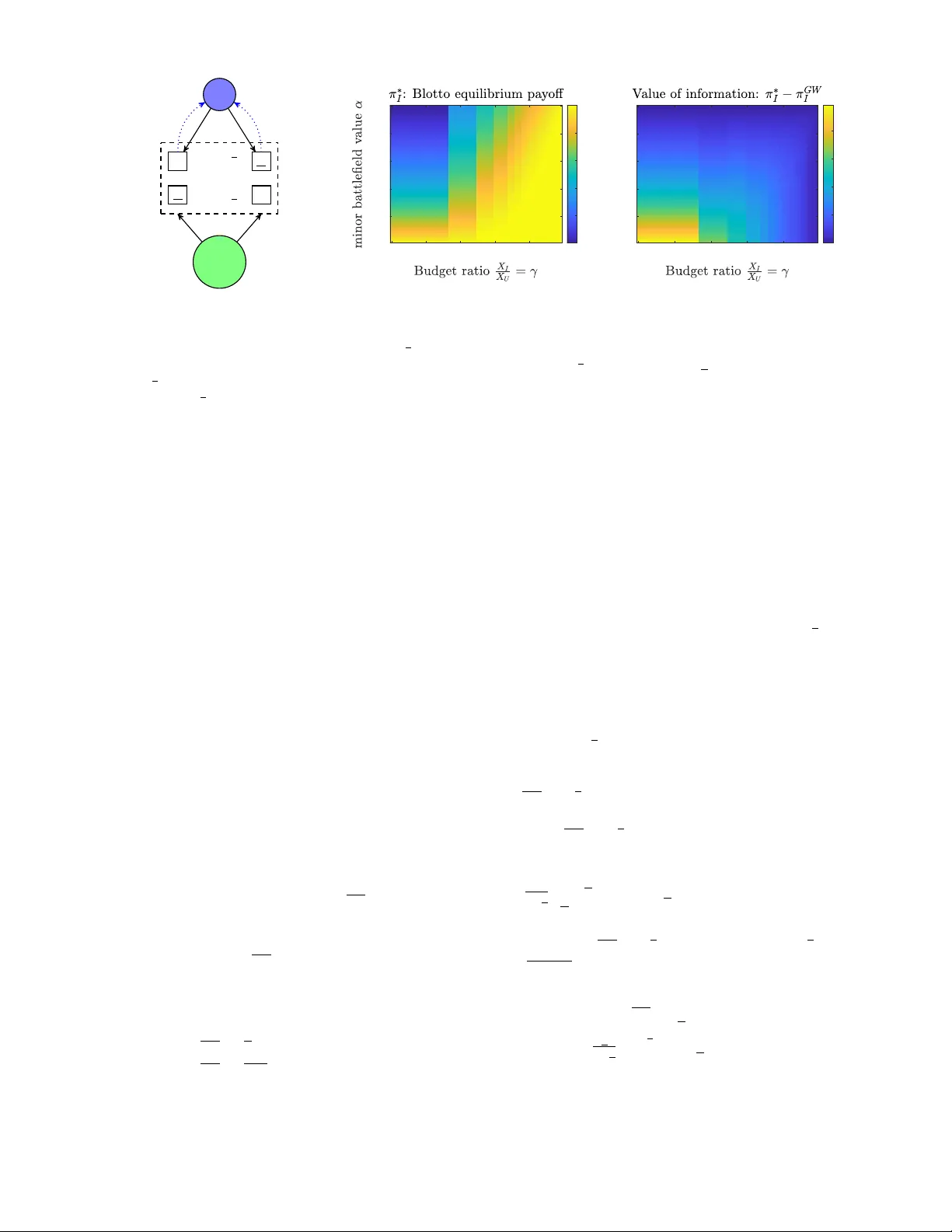
Characterizing the interplay between inf ormation and str ength in Blotto games K eith Paarporn, Rahul Chandan, Mahnoosh Alizadeh, and Jason R. Marden Abstract — In this paper , we in vestigate inf ormational asym- metries in the Colonel Blotto game, a game-theoretic model of competitive resour ce allocation between two players over a set of battlefields. The battlefield valuations are subject to randomness. One of the two players kno ws the valuations with certainty . The other knows only a distrib ution on the battlefield realizations. Howe ver , the inf ormed player has fewer resources to allocate. W e characterize unique equilibrium payoffs in a two battlefield setup of the Colonel Blotto game. W e then focus on a three battlefield setup in the General Lotto game, a popular variant of the Colonel Blotto game. W e characterize the unique equilibrium payoffs and mixed equilibrium strategies. W e quantify the value of information - the difference in equilibrium payoff between the asymmetric inf ormation game and complete inf ormation game. W e find inf ormation strictly impro ves the informed player’ s performance guarantee. How- ever , the magnitude of improvement varies with the informed player’ s strength as well as the game parameters. Our analysis highlights the interplay between strength and inf ormation in adversarial en vironments. I . I N T R O D U C T I O N In adversarial interactions, informational asymmetries may provide an adv antage to one competitor over the other . Adversarial contests appear in a wide range of applications, such as political campaigns [1], [2], security of cyber - physical systems [3], and competitiv e advertising [4]. Rigor- ous studies on the interplay between asymmetric information and strategic decision-making in adversarial settings has receiv ed attention in the recent literature [5], [6]. Though these works analyze general zero-sum game settings, another popular framew ork for analyzing such contests is the Colonel Blotto game. T wo players strategically allocate their limited resources ov er a finite set of battlefields. A player secures a battlefield if it has allocated more resources to it than the opponent. Each player aims to secure as many battlefields as possible. The goal of the present paper is to quantify the performance improv ements one player in the Blotto game may experience when it possesses system-level information while its opponent does not. Though simply posed, the Colonel Blotto game features highly complex strategies. The established literature on the Colonel Blotto game and its v ariants primarily focuses on characterizing mixed-strate gy Nash equilibria, due to non- existence of pure equilibria in most cases of interest. First K. Paarporn ( kpaarporn@ucsb.edu ), R. Chandan ( rchandan@ucsb.edu ), M. Alizadeh ( alizadeh@ucsb.edu ), and J. R. Marden ( jrmarden@ece.ucsb.edu ) are with the Department of Electrical and Computer Engineering at the University of California, Santa Barbara, CA. This work is supported by UCOP Grant LFR-18-548175, ONR grant #N00014-17-1-2060, and NSF grant #ECCS-1638214. introduced by Borel in 1921 [7], researchers ha ve incre- mentally contributed to this body of w ork over the last one hundred years [8], [9]. In 1950, Gross and W agner [8] provided an equilibrium solution of the two battlefield case with asymmetric values and resources, as well as for n homogeneous battlefields and symmetric resources. In 2006, the work of Roberson [9] generalized the solution to n battlefields and asymmetric forces by le veraging the solutions of all-pay auctions and the theory of copulas [10]. There recently has been rene wed interest in the Colonel Blotto game, along with its many variants and extensions [2], [11]–[15]. Notably , results for heterogeneous battlefield valuations ha ve appeared in Colonel Blotto as well as the General Lotto v ariant, which admits a more tractable analysis [13], [14]. Blotto games ha ve also recei ved attention in engineering application areas such as the security of cyber- physical systems [3] and the formation of large-scale net- works [16], [17]. The vast majority of these studies assume the players hav e complete information about the opposing player’ s resource budget and the values of each battlefield. Few works ha ve considered the Blotto or Lotto game with incomplete information. In [18], the authors study a Blotto game in which players have incomplete information about the other’ s resource budgets. In [19], the players are subject to incomplete information about the battlefield v aluations. In both of these works, all players are equally uninformed about the parameters, and hence symmetric Bayes-Nash equilibria are provided. T o the best of our knowledge, one-shot Blotto games where the players possess asymmetric information has not received attention in the literature. In this paper, we formulate a Bayesian game framework in which one player is completely informed and the other does not recei ve any side information about the battlefield valuations (Section III). Our main contributions characterize unique equilibrium payoffs and strategies in representativ e scenarios of this frame work. W e first analyze the Colonel Blotto game with two battlefields (Section IV). W ith three battlefields, we are able to solve for unique mix ed-strategy equilibria in a representati ve General Lotto game under the same informational asymmetry (Section V). W e do this by lev eraging established results on all-pay auctions with asymmetric information [20] (Section VI). W e can then quantify the dif ference between the equilibrium payoff in this game and the scenario where both players are uninformed. These characterizations allow us to determine conditions under which the informed player has an advantage in the Lotto game, despite ha ving fe wer resources to allocate. As an illustrati ve analysis, we consider a scenario where both players are uninformed and the option of purchasing information with a fraction of its b udget is available only to the weaker player . W e quantify a measure of informational value determined by the largest proportion of resources the player is willing to give up in exchange for information (Section V). I I . M O D E L T w o players, I and U , allocate their non-atomic forces across n battlefields simultaneously . In each battlefield j ∈ { 1 , . . . , n } , the player that sends more forces wins the battlefield and receives payoff v j , while the losing player receiv es − v j . In the case of a tie on a battlefield, both players receiv e zero payoff. The utility to each player is the sum of payoffs across all battlefields. The players have a budget on their forces, X I , X U > 0 . W e assume X I < X U . The budgets and battlefield v aluations v := { v j } n j =1 are common knowledge. For z ∈ { I , U } , a pure strategy is a non-negativ e vector x z = ( x 1 z , . . . , x n z ) ∈ R n + . W e call x z an allocation . The payoff to player z is u z ( x z , x − z ; v ) := n X j =1 v j sgn ( x j z − x j − z ) , (1) where we follow the conv ention sgn (0) = 0 . This defines a zero-sum game since the payoff to player − z is the negati ve of the above. A mixed strategy for player z is an n -variate distribution function F z on R n + . That is, an allocation x z is drawn from the distrib ution F z . A distribution F z has n univ ariate mar ginal (cumulativ e) distributions { F j z } n j =1 , specifying the allocation distributions to each battlefield. Extending the definition of (1) to mix ed strate gies, the expected payoff for each player can be expressed as u z ( F z , F − z ; v ) = Z R n + Z R n + n X j =1 v j sgn ( x j z − x j − z ) dF z dF − z = n X j =1 v j Z ∞ 0 (2 F j − z − 1) dF j z . (2) A. The Colonel Blotto game In the Colonel Blotto game, a feasible allocation x z for player z ∈ { I , U } lies in the set B ( X z ) := ( x z ∈ R n + : n X j =1 x j z = X z ) . (BC) Furthermore, the support of a mixed strategy F z is contained in B ( X z ) . Thus, an allocation x z drawn from F z belongs to B ( X z ) with probability one. W e denote the set of all such feasible mixed strategies with B ( X z ) . W e refer to the Colonel Blotto game with CB ( X I , X U , v ) . B. The General Lotto game The General Lotto game relaxes the support constraint in the Colonel Blotto game, requiring each player’ s allocation budget to be met only in expectation with respect to their marginal distributions. That is, L ( X z ) := ( F z : n X j =1 E F j z [ x j z ] = X z ) (LC) is the set of such feasible mixed strategies. Note that both the budget constraint (LC) and expected payoff (2) only depend on the univ ariate marginal distributions and not the joint n - variate distribution F z . Hence, a player’ s choice amounts to selecting n independent univ ariate mar ginals that satisfy (LC). W e specify General Lotto game with GL ( X I , X U , v ) . I I I . B L O T TO A N D L OT T O G A M E S W I T H A S Y M M E T R I C I N F O R M A T I O N Using a standard Bayesian games framework, we wish to model a situation in which the battlefield valuations are subject to randomness. Suppose there are m possible sets of battlefield valuations, labeled by the states Ω = { ω 1 , . . . , ω m } . The state ω i is realized with probability p i > 0 , and the probability v ector p ∈ ∆(Ω) satisfying P m i =1 p i = 1 is common knowledge to the players. Given state ω i is realized, battlefield j is worth v j i > 0 , and we denote V as the m × n matrix with elements v j i . W e consider the setting where player I observes the true state realization, and player U does not receiv e any side information about the realization 1 . W e call U the “unin- formed” player . Specifically , player I has m distinct types T I := { t 1 , . . . , t m } , receiving type t i whenev er state ω i is realized. That is, I kno ws the realization with certainty . W e refer to T I as its type space. Player U has a single type, and hence infers the realization (and I ’ s type) according to the common prior p . The information structure is known to both players. A strategy for player I consists of n -variate distributions { F I ( t i ) } m i =1 , one for each type t i , i = 1 , . . . , m . W e refer to the collection F I = { F I ( t i ) } m i =1 as I ’ s strategy . Player U ’ s strategy F U is a single n -variate distribution. For the Lotto game, F I ( t i ) ∈ L ( X I ) for each t 1 , . . . , t m , and F U ∈ L ( X U ) . For the Blotto game, they belong to B ( X I ) and B ( X U ) , respecti vely . W e denote { F j I ( t I ) } n j =1 as the univ ariate mar ginals of F I ( t I ) for each t I ∈ T I , and F j U the univ ariate marginals of F U . All of these components specify a Lotto or Blotto game with incomplete information, which we denote as GL ( X I , X U , V , p ) and CB ( X I , X U , V , p ) , re- spectiv ely . The expected utility of player U is π U ( F U , F I ) := m X i =1 p i u U ( F U , F I ( t i ) , ω i ) (3) where with some ab use of notation, we use ω i to refer to the battlefield valuation set in state i . The ex-interim utility for player I , giv en type t i is the expected payoff π I ( F I ( t i ) , F U | t i ) := u I ( F I ( t i ) , F U , ω i ) . (4) 1 A more general framework of asymmetric information may be formu- lated with Bayesian games. That is, arbitrary partial information structures may be assigned to the players. Since our focus is on one informed and one uninformed player , we leave such generalizations to future work. ¯ v v v ¯ v Play er I Play er U Pr= 1 2 Pr= 1 2 v 1 v 2 x 1 I x 2 I x 2 U x 1 U (a) 0.5 0.6 0.7 0.8 0.9 0.2 0.4 0.6 0.8 1 -0.5 -0.4 -0.3 -0.2 -0.1 (b) 0.5 0.6 0.7 0.8 0.9 0.2 0.4 0.6 0.8 1 0 0.1 0.2 0.3 0.4 (c) Fig. 1: (a) A diagram of the Colonel Blotto game with tw o battlefields and asymmetric budgets and information. There are two possible battlefield valuation sets, each realized with probability 1 2 . Player I has fewer resources than player U, b ut knows the true realization. (b) The equilibrium payof f (8) to the informed player in the Blotto game CB ( X I , X U , V , 1 2 ) , where ¯ v = 1 and v = α ∈ (0 , 1) . It is negati ve when γ ∈ ( 1 2 , 1) and α ∈ (0 , 1) . (c) The value of information, π ∗ I − π GW I , is non-negati ve. Information offers the most improvement for low budget ( γ near 1 2 ) and when there is higher priority in the diagonal battlefields ( α low). A Bayes-Nash equilibrium (BNE) is a strategy profile ( F ∗ I , F ∗ U ) satisfying F ∗ I ( t i ) ∈ arg max F I ( t i ) π I ( F I ( t i ) , F ∗ U | t i ) , ∀ i = 1 , . . . , m and F ∗ U ∈ arg max F U π U ( F U , F ∗ I ) . (5) An equiv alent BNE condition is that ( F ∗ I , F ∗ U ) satisfies the best-response correspondences in ex-ante payof fs, giv en that each p i > 0 [21]. That is, F ∗ U ∈ arg max F U π U ( F U , F ∗ I ) and F ∗ I ∈ arg max { F I ( t i ) } m i =1 π I ( F I , F ∗ U ) , where I ’ s ex-ante payoff is π I ( F I , F U ) := m X i =1 p i π I ( F I ( t i ) , F U | t i ) . (6) W e note that since the underlying complete information game is zero-sum, the games with asymmetric information are also zero-sum with respect to ex-ante utilities (3), (6). This allows us to speak of a unique equilibrium ex-ante payof f π ∗ I = − π ∗ U of the Blotto and Lotto games with asymmetric information. I V . C O L O N E L B L OT T O R E S U L T S In the follo wing structural result, we characterize suf ficient conditions on the budget ratio γ := X I X U such that the stronger player U is guaranteed a positi ve equilibrium payoff regardless of the information asymmetry . Pr oposition 1 . Assume X I X U < 1 . Consider the game CB ( X I , X U , V , p ) where V ∈ m × n , i.e. there are n battlefields and m possible state realizations. A suf ficient condition for which π ∗ U ≥ 0 is ( X I X U < 2 n , if n is e ven X I X U < 2 n +1 , if n is odd (7) Pr oof. Denote E j = P m i =1 p i v j i as the prior expected value of battlefield j . W ithout loss of generality , assume the n battlefields are ordered according to E 1 ≥ E 2 ≥ · · · ≥ E n . For n ev en, consider player U’ s deterministic strategy that places 2 X I /n to the first n/ 2 battlefields, and the remaining resources allocated arbitrarily . This guarantees U attains at least half of the total a vailable value. That is, U’ s security value for this strate gy is at least zero. Similar reasoning applies to the case of n odd. For two battlefields, the weaker resource player I never wins the game, despite having better information. The following analysis focuses on the two battlefield case of CB ( X I , X U , V , p ) under the uniform prior p = 1 2 1 2 . Al- though I nev er wins, we quantify how information improves its payoff relativ e to when both players are uninformed. A solution for a general prior p = [ p, 1 − p ] remains a challenge in this analysis, due to the complexity of finding suitable equilibrium distributions. Hence for the rest of this section, we assume p = 1 2 . A. T wo battlefields case If X I X U < 1 2 , player U can secure both battlefields re- gardless of what I does. W e thus restrict our attention to the regime X I X U ∈ ( 1 2 , 1) . W e state the main result of this section, which characterizes the equilibrium payoff to I . Here, we assume a symmetric structure on the battlefields V = 1 ¯ v + v ¯ v v v ¯ v for ¯ v > v > 0 . Figure 1a illustrates the setup of this game. Theor em 1 . Let X I X U ∈ ( 1 2 , 1) , and assume p = 1 2 . Define q = b X U X U − X I c . Then the ex-ante equilibrium payoff to the informed player I is π ∗ I = − 2 P q − 1 2 k =0 ( ¯ v/v ) k − 1 − 1 if q odd − v ¯ v + v P q 2 − 1 k =0 ( ¯ v/v ) k − 1 if q even (8) W e provide the proof in the Appendix, which details a set of equilibrium mixed strategies. When both players are uninformed, i.e. both have a single type, we have a complete information game where the two battlefield valuations are their expected values, 1 2 . The equilibrium payoff is then giv en by an application of Gross and W agner’ s solution [8], which yields π GW I := − 1 q . The following result verifies the equilibrium payoff improves when I obtains information. Cor ollary 1 . W e hav e π ∗ I > π GW I . That is, information strictly improv es the equilibrium payoff for I . Pr oof. Consider the q ev en case. Since v ¯ v + v < 1 2 and ¯ v v > 1 for ¯ v > v , from (8) we get − v ¯ v + v P q 2 − 1 k =0 ( ¯ v/v ) k − 1 > − 1 q . Similar arguments apply in the q odd case. W e may quantify a value of information in this setting as the payoff difference π ∗ I − π GW I . Setting ¯ v = 1 and v = α ∈ (0 , 1) , we plot the equilibrium values π ∗ I in Figure 1 , as well as the v alue of information. In the two battlefield Blotto game, an informed player still cannot gain an advantage, as π ∗ I < 0 for all parameters ( α, γ ) ∈ (0 , 1) × (0 , 1) . Information offers the most payoff improv ement when I ’ s budget is low and the minor battlefield α is worth less (Fig. 1c). In the next section, we consider the three battlefield case in the General Lotto game. In general, equilibrium solutions for n ≥ 3 heterogeneous battlefields ha ve not been characterized in the Colonel Blotto game, due to the complexity of finding suitable copulas for the mar ginal distributions [2]. The Lotto constraint relaxation allows for analytic tractability in cases of more than two heterogeneous battlefields [14]. V . R E S U L T S O N G E N E R A L L OT T O W e restrict our attention to a representativ e three- battlefield Lotto game GL ( X I , X U , V αβ , p ) , where p = ( 1 3 , 1 3 , 1 3 ) , and V αβ = 1 1+ α + β 1 α β β 1 α α β 1 . where 1 > α ≥ β > 0 . In each set of battlefields (rows), the total valuation is normalized to one. Though this formulation may be quite specific, the representati ve game serves as an illustrativ e and tractable scenario highlighting the informational asymmetry between players. Intuitively , for small α, β values, the v alu- able battlefield is worth 1 b ut sits at a different location in each realization. An informed player would be able to take the most advantage by focusing its resources on this battlefield without wasting resources on the other battlefields. A. Main r esult: characterization of equilibrium payoff Theor em 2 . Let γ = X I X U ≤ 1 . Then player I ’ s equilibrium payoff, π ∗ I ( α, β , γ ) , for α, β , γ ∈ (0 , 1) takes the values 3 γ 1+ α + β − 1 , if γ ∈ (0 , 1 3 ] 1 1+ α + β h 1 − 1 3 γ (3 γ α + (1 − α )) + 1 i − 1 , if γ ∈ ( 1 3 , 2 3 ] (9) and 1 1 + α + β h 2 − 1 3 γ + α 2 − 1 γ + 3 β γ 1 − 2 3 γ i − 1 (10) if γ ∈ ( 2 3 , 1] . A plot of π ∗ I is sho wn in Figure 2a for the special case α = β . W e provide the details of the proof in Section VI, where we draw upon known results in asymmetric information all-pay auctions. An iterative algorithm is formulated in [20] to construct mixed equilibrium strategies. T o verify that the set of constructed strategies indeed is a BNE of GL ( X I , X U , V αβ , 1 3 1 3 ) , the constraint (LC) must be met. B. The value of information in the Lotto game In the follo wing analysis, we consider a scenario in which both players are uninformed, and the option to purchase information with a fraction of its budget is av ailable to player I . W e quantify a value of information as the equilibrium payoff gain or loss in purchasing information, and specify the maximal cost I is willing to pay before it experiences a payoff loss. In the case both players are uninformed, we may use the algorithm of [20] to solve the Lotto game. In this setting, we arriv e at the equilibrium payoff γ − 1 for I . W e first highlight some immediate consequences of Theorem 2. Cor ollary 2 . W e ha ve that π ∗ I ( α, β , γ ) > γ − 1 for ( α, β , γ ) ∈ (0 , 1) 3 . That is, information strictly improv es the equilibrium payoff for I . Additionally , π ∗ I is strictly decreasing in α and β , and strictly increasing in γ . Pr oof. The first claim follo ws from comparing the expres- sions (9) and (10) to γ − 1 . The second claim follo ws by showing the respectiv e signs of partial deri vati ves hold. W e also characterize the parameter region in which an informed I wins the game for the special case α = β . Cor ollary 3 . Fix a budget ratio γ . Then π ∗ I ( α, α, γ ) > 0 if and only if α < 1 3 − γ 3 γ 2 − 4 γ + 1 3 . Pr oof. Player I cannot win in the first region γ ∈ (0 , 1 3 ] , as π ∗ I ≤ 0 . W e find that the second expression of (9) is equiv alent to (10) when β = α . W e then solve the equation π ∗ I ( α, α, γ ) = 0 for α , from which we obtain the result. W e now provide a general quantity of describing the value of information. In particular , we consider a scenario where both players are uninformed. Player I , with the budget ratio γ , has an opportunity to purchase information with a fraction c I of its budget. The value of information quantifies the equilibrium payoff gain or loss in purchasing the information at the budget fraction cost c I . Formally , the value of information is the quantity V oI ( α, γ ) := π ∗ I ( α, α, (1 − c I ) γ ) − (1 − γ ) . (11) An instance of the value of information is plotted in Figure 2b, when the cost is c I = 1 5 . W e note there is a regime in which information is not worth the cost, i.e. V oI ( α, γ ) < 0 . W e also seek to find the highest cost on information that I is willing to pay before it experiences an equilibrium payoff loss. T o quantify this cost, let γ e be defined as the v alue that satisfies π ∗ I ( α, α, γ e ) = γ − 1 . Such a v alue is unique and well-defined for any α , since π ∗ I ( α, α, γ ) > γ − 1 and is strictly increasing in γ , by Corollary 2. Then C I ( α, γ ) := γ − γ e γ is the largest fraction of resources I can giv e up. That is, for all c I ∈ [0 , C I ( α, γ )] , we hav e π ∗ I ( α, α, (1 − c I ) γ ) ≥ γ − 1 , with equality if and only if c I = C I ( α, γ ) . Then, 0 0.5 1 0 0.2 0.4 0.6 0.8 1 -1 -0.5 0 0.5 (a) 0 0.5 1 0 0.2 0.4 0.6 0.8 1 0 0.2 0.4 0.6 (b) 0.2 0.4 0.6 0.8 1 0.2 0.4 0.6 0.8 1 0 0.1 0.2 0.3 0.4 0.5 0.6 (c) Fig. 2: (a) The equilibrium payoff π ∗ I to the informed player in the Lotto game GL ( X I , X U , V αβ , 1 3 1 3 ) , under the special case α = β . The dashed line are the points ( γ , α ) for which π ∗ I = 0 . That is, for parameters below the line, the informed player “wins” the game and “loses” for parameters abov e the line (see Corollary 3). (b) The value of information, or payoff gain or loss to player I from purchasing information at the cost c I = 1 5 . The dashed black line in Figure 2b indicates the parameters for which V oI ( α, γ ) = 0 . (c) The maximal cost (12), or the largest fraction of its resource budget γ that player I is willing to give up in exchange for information before it experiences a payoff loss. Information is more valuable in lower α ranges - when the battlefield rewards are concentrated at diverse locations. Cor ollary 4 . Fix a budget ratio γ . Then C I ( α, γ ) = ( 1 γ ( γ − γ e ( α, γ )) if ( α, γ ) ∈ B 1 − 1 3 c α if ( α, γ ) / ∈ B (12) where γ e ( α, γ ) := − (2(1 − α ) c α − γ )+ √ (2(1 − α ) c α − γ ) 2 +4 c 2 α α (1 − α ) 6 αc α , c α := 1 1+2 α , and B := { ( α, γ ) ∈ (0 , 1) 2 : γ e ( α, γ ) ≥ 1 3 } . Pr oof. W e solve the equation π ∗ I ( α, α, γ e ) = γ − 1 for γ e . Recall the second e xpression of (9) is equi valent to (10) when β = α . The resulting value is valid only if γ e > 1 3 . If not, we solve for γ e using the first entry of (9). Figure 2c plots C I ( α, γ ) . As an example, when γ = 1 and α = 0 , player I can exchange up to 2 3 of its budget for information and still obtain a payof f greater than γ − 1 = 0 . When α is high, player I cannot afford to gi ve up resources, as information is less valuable in this regime. V I . P R O O F O F T H E O R E M 2 W e sho w that the equilibria in the Lotto game GL ( X I , X U , V , p ) coincides with equilibria of n independent all-pay auctions with asymmetric information and valuations. The work of Siegel [20] provides an iterative algorithm for which to construct equilibrium mixed strate gies in the all-pay auction. W e leverage this procedure to construct proposed equilibrium distributions in the Lotto game, and verify that they satisfy the constraint (LC). A. T wo-player all-pay auctions with asymmetric information and valuations Here, we specialize the setup of [20] to our setting of an informed player I and an uninformed player U . Assume the two players compete in an all-pay auction over an indi visible good, where the players I and U hav e the same type spaces as before. When type t i ∈ T I is realized ( i ∈ { 1 , . . . , m } ) with probability p i > 0 , player I ’ s valuation of the good is ν I ( t i ) and player U ’ s valuation is ν U ( t i ) . Assume the types in T I are ordered such that ν I ( t i ) ≥ ν I ( t k ) (13) whenev er i < k , i, k ∈ { 1 , . . . , m } . In the two player all-pay auction with asymmetric information and valuations, player I selects the distributions of bids F I : T I × R + → [0 , 1] contingent on its type. W e write F I ( t i ) to refer to the distribution of bids in type i , F I ( t i , x ) to refer to its value at x ≥ 0 , and f I to refer to its density function. As player U has a single type, it selects a single distribution of bids, F U : R + → [0 , 1] . The best-response problems for each player are max F I ( t i ) i =1 ,...,m m X i =1 p i Z ∞ 0 [ ν I ( t i ) F U − x ] dF I ( t i ) max F U m X i =1 p i Z ∞ 0 [ ν U ( t i ) F I ( t i ) − x ] dF U . (14) B. Algorithm of [20] An iterativ e procedure is formulated in [20] to construct equilibrium mixed strategies satisfying the correspondences (14). W e note that this procedure handles general player information structures in the two-player all-pay auction. In this paper , we restrict our attention to its application in our informed-uninformed setting. In particular, the constructed marginals are prov en to be piecewise constant functions with finite support, with the possibility of ha ving point masses placed at zero. W e do not give further details of this algorithm due to space limitations and for ease of exposition. W e refer the reader to [20] for a general proof that the output distributions satisfy (14). C. Connection of General Lotto to all-pay auctions In the game GL ( X I , X U , V , p ) , player U ’ s Lagrangian at both ex-ante and interim le vels may be written as n X j =1 max F j U " m X i =1 p i Z ∞ 0 2 v j i λ U F j I ( t i ) − x ! dF j U # (15) where λ U > 0 is the Lagrange multiplier on U’ s expected budget constraint (LC), and we have removed constant additiv e and multiplicative terms in the expression that do not depend on the decision variables { F j U } n j =1 . In a similar fashion, player I ’ s Lagrangian maximization at the interim lev el may be written max F j I ( t i ) j =1 ,...,n λ i I n X j =1 Z ∞ 0 2 v j i λ i I F j U − x ! dF j I ( t i ) (16) where the multiplier λ i I > 0 corresponds to the budget constraint (LC) in type t i . When two sets of battlefields contain the same valuations, we can deduce equiv alence between the corresponding Lagrange multipliers. Lemma 1 . Consider the game GL ( X I , X U , V , p ) . Suppose the rows i and k of V hav e the same elements, each with identical multiplicities. Then the equilibrium e x-interim payoff to player I for type t i is equiv alent to that of type t k . Furthermore, λ i I = λ k I . Pr oof. An equiv alent formulation of (16) in type i is max F I ( t i ) ∈L ( X I ) π I ( F I , F U | t i ) (17) The corresponding problem for type t k is identical to the abov e, because the valuations in both ro ws are the same (possibly with some permutation of indices j ), and the optimization for player U remains (15). This sho ws the equiv alence of interim equilibrium payoffs. T o show λ i I = λ k I , let F ∗ I solve (17) for both types t i and t k . Any allocation x I j ∈ R + to battlefield j in the support of F j ∗ I solves the one-dimensional problem max x 2 v j i λ i I F j ∗ U − x as well as max x 2 v j i λ k I F j ∗ U − x . Therefore, the first-order necessary condition for optimality that holds is λ i I = 2 v j i f j ∗ U ( x I j ) = λ k I . T o solve for a BNE, we write the best-response corre- spondences at the ex-ante level. Player U’ s e x-ante best- response problem is giv en by (15), while Player I’ s ex-ante optimization problem may be written n X j =1 max F j I ( t i ) i =1 ,...,m " m X i =1 λ i I Z ∞ 0 2 v j i p i λ i I F j U − x ! dF j I ( t i ) # (18) after removing additi ve constants. Under the conditions λ i I = λ I > 0 for all i = 1 , . . . , m (by Lemma 1), each battlefield j is an independent all-pay auction, whose problem is max F j U " m X i =1 p i Z ∞ 0 2 v j i λ U F j I ( t i ) − x ! dF j U # (19) max F j I ( t i ) i =1 ,...,m " m X i =1 p i Z ∞ 0 2 v j i p i λ I F j U − x ! dF j I ( t i ) # (20) which coincides with (14) with auction valuations ν U ( t i ) = 2 v j i λ U and ν I ( t i ) = 2 v j i p i λ I . Here, we have multiplied each max- imization problem of by p i > 0 , which does not change the optimal solutions. In this setting, mixed-strategy equilibria of the Lotto game are equiv alent to that of n independent two-player all-pay auctions with asymmetric information and valuations. W e may then apply the algorithm of [20] to construct equi- librium distributions F j U and { F j I ( t i ) } m i =1 for each battlefield j . The constructed distributions are functions of the known parameters as well as the Lagrange multipliers. If there e xists unique multipliers λ ∗ I , λ ∗ U > 0 such that the Lotto constraints (LC) is met for all types { t i I } m i =1 for I and for type t U for U , then it is clear the n constructed strategy profiles constitute a BNE for GL ( X I , X U , V , p ) . Indeed, we hav e applied the algorithm to obtain a set of distrib utions, and verified there is a unique λ ∗ I , λ ∗ U > 0 such that (LC) is satisfied. The details of this calculation are outlined as follows. Pr oof of Theorem 2. In GL ( X I , X U , V αβ , 1 3 1 3 ) , we deduce from Lemma 1 that λ i I = λ I for all i = 1 , 2 , 3 . Hence we need only apply the algorithm of [20] to a single “column” of the game to obtain all marginals of the BNE since the v aluations are identical in each battlefield, i.e. the correspondences (19), (20) are the same for all battlefields j , with a permutation of indices i ∈ { 1 , 2 , 3 } . Denote the constructed marginal distrib utions as F U for player U and { F d I , F α I , F β I } for player I , where “d” is for the diagonal battlefield value 1. W e find that depending on whether λ I λ U ≥ 1 , λ I λ U ∈ ( 1 2 , 1) , or λ I λ U ∈ ( 1 2 , 1 3 ) , the algorithm determines three distinct sets of marginal distributions for I and U . In each case, there are unique λ I , λ U > 0 such that the constraint (LC) is met. For bre vity , we illustrate the calculation for one such case, as the other two follow similar methods. If λ I λ U ≥ 1 , the algorithm of [20] giv es F U ( x ) = 3 λ I 2 c x, x ∈ 0 , 2 c 3 λ I (21) F d I ( x ) = 3 λ U 2 c x + 1 − λ U λ I , x ∈ h 0 , 2 c 3 λ I i F α I ( x ) = 1 , x ≥ 0 F β I ( x ) = 1 , x ≥ 0 (22) The constraint (LC) requires that E F d I + E F α I + E F β I = X I and 3 E F U = X U , from which we obtain the unique solutions λ I = 1 X U (1+ α + β ) and λ U = 3 γ λ I . This solution implies the budget ratio satisfies γ ∈ (0 , 1 3 ) . Using these marginals, we calculate the equilibrium ex-ante payof f (6) as 2 1 + α + β Z ∞ 0 F U dF d I + α Z ∞ 0 F U dF α I + β Z ∞ 0 F U dF β I − 1 . (23) From this, we obtain (9). The other cases λ I λ U ∈ ( 1 2 , 1) and λ I λ U ∈ ( 1 2 , 1 3 ) correspond to the budget ranges γ ∈ [ 1 3 , 2 3 ) and γ ∈ [ 2 3 , 1) , respectiv ely . For completeness, we present the marginals for the other two cases. When γ ∈ [ 1 3 , 2 3 ) , the unique solution of the multipliers are λ I = 1 X U (1 + α + β ) h 1 − α 9 γ 2 + α i and λ U = 3 γ λ I . Denote the intervals I 1 = h 0 , 2 c 3 ( α λ I − α λ U ) i and I 2 = h 2 c 3 ( α λ I − α λ U ) , 2 c 3 ( α λ I + 1 − α λ U ) i . Then the equilibrium marginals are F U ( x ) = ( 3 λ I 2 αc x x ∈ I 1 3 λ I 2 c x + (1 − λ I λ U )(1 − α ) x ∈ I 2 (24) F d I ( x ) = 3 λ U 2 c x − α λ U λ I − 1 x ∈ I 2 F α I ( x ) = 3 λ U 2 αc x + 2 − λ U λ I x ∈ I 1 F β I ( x ) = 1 , x ≥ 0 (25) When γ ∈ [ 2 3 , 1) , the unique solution of the multipliers are λ I = c X U h β + 1 9 γ 2 (1 + 3 α − 4 β ) i and λ U = 3 γ λ I . Denote the intervals I 1 = h 0 , 2 c 3 ( β λ I − 2 β λ U ) i , I 2 = h 2 c 3 β λ I − 2 β λ U , 2 c 3 β λ I + α − 2 β λ U i , and I 3 = h 2 c 3 β λ I + α − 2 β λ U , 2 c 3 β λ I + α − 2 β +1 λ U i . Then the equilibrium marginals are calculated to be F U ( x ) = 3 λ I 2 β c x x ∈ I 1 3 λ I 2 αc x + 1 − 2 λ I λ U 1 − β α x ∈ I 2 3 λ I 2 c x + (1 − β ) + (2 β − α − 1) λ I λ U x ∈ I 3 (26) F d I ( x ) = 3 λ U 2 c x − β λ U λ I − 2 − α x ∈ I 3 F α I ( x ) = 3 λ U 2 αc x − β α λ U λ I − 2 x ∈ I 2 F β I ( x ) = 3 λ U 2 β c x + 3 − λ U λ I x ∈ I 1 (27) V I I . C O N C L U S I O N In this paper , we e xtended the Colonel Blotto and General Lotto games to a setting where players ha ve asymmetric information about the valuations of the battlefields. W e focused on the case when one player is completely informed about the valuations but has fewer resources to allocate, and the other player is uninformed. Our analysis on the two battlefield case in the Colonel Blotto game sho ws an informed player still cannot defeat its opponent in a mixed-strate gy Nash equilibrium. W e find a three battlefield scenario presents enough complexity such that the informed player in the General Lotto game can attain the advantage for certain parameters. A direction of future research in volv es generalizing the connection of the all-pay auctions with asymmetric infor- mation to the General Lotto game. This will allow us to in vestigate General Lotto games where the players hold arbitrary information structures. A P P E N D I X Pr oof of Theorem 1. Let d := X U − X I and q := b X U X U − X I c so that X U = q d + r , where 0 ≤ r < d . Denote a delta mass function centered at y ∈ R by δ y . Define c := ¯ v /v . W e prove the Theorem by proposing a set of mixed strategy distributions F ∗ I = { F ∗ I ( t 1 ) , F ∗ I ( t 2 ) } , and F ∗ U each satisfying (BC), and showing the strategy F ∗ z is a best-response to F ∗ − z , z = I , U . For brevity , we prove the case when q is odd, as the ev en case provides similar mixed strategies and follows similar arguments. Let e ∈ ( r, d ) , and consider the strategies F ∗ U = 1 s A q − 1 2 X k =1 c q +1 2 − k δ e +( k − 1) d + δ e + q − 1 2 d + q X k = q +1 2 +1 c k − q +1 2 δ e +( k − 1) d ! (28) F ∗ I ( t 1 ) = 1 s B v c q − 1 2 ¯ v + v δ q − 1 2 d + q − 1 X k = q − 1 2 +1 c q − 1 − k δ kd ! F ∗ I ( t 2 ) = 1 s B q − 1 2 − 1 X k =0 c k δ kd + v c q − 1 2 ¯ v + v δ q − 1 2 d ! (29) where s A := 1 + 2 q − 1 2 X k =1 c k , s B := v c q − 1 2 ¯ v + v + q − 1 2 − 1 X k =0 c k (30) are normalizing factors. Before proceeding, we make a few remarks. These strategies are similar in nature to the strategies provided in Gross & W agner [8]. There, the authors show that a strategy composed of equally spaced delta functions with geometrically decreasing weights equalizes the payoff of the other player , and vice versa. In a similar fashion, the strategies (28) and (29) equalize the ex-ante payoffs in certain intervals of the players’ allocation space. Any allocation in these intervals gi ve a best-response to the other player’ s equilibrium strategy . Let x U ∈ [0 , X U ] be an allocation to battlefield 1, lea ving X U − x U to battlefield 2. The payof f u U ( x U , F ∗ I ( t 1 ) , ω 1 ) (2) of any allocation x U against F ∗ I ( t 1 ) in battlefield set 1 is 1 s B q − 1 X k = q − 1 2 + 1 c q − 1 − k ( ¯ v sgn ( x U − k d ) + v sgn (( k + 1) d − x U )) + 1 s B " v c q − 1 2 ¯ v + v ¯ v sgn x U − q − 1 2 d + v sgn q + 1 2 d − x U # (31) For notational purposes, let H U ( ¯ v, v , x U ) denote the above quantity . Then against F ∗ I ( t 2 ) , u U ( x U , F ∗ I ( t 2 ) , ω 2 ) = H U ( v , ¯ v , x U ) in battlefield set 2. Gi ven p = 1 2 , the ex-ante utility is π U ( x U , F ∗ I ) = 1 2 u U ( x U , F ∗ I ( t 1 ) , ω 1 ) + 1 2 u U ( x U , F ∗ I ( t 2 ) , ω 2 ) . After some algebra, we arriv e at π U ( x U , F ∗ I ) = ( ¯ v s B if x U ∈ (0 , q d ] 0 if x U ∈ ( qd, X U ] (32) Any mixed strategy F U with support on the interval (0 , q d ) is a best-response to F ∗ I , and hence F ∗ U ∈ BR U ( F ∗ I ) . Now , any pure allocation x 1 I ∈ [0 , X I ] of player I against F ∗ U in type t 1 giv es the ex-interim utility π I ( x 1 I , F ∗ U | t 1 ) (4), as − 1 s A q − 1 2 X k =1 c q +1 2 − k ¯ v sgn ( e + ( k − 1) d − x 1 I ) − v sgn ( e + ( k − 2) d − x 1 I ) + ¯ v sgn e + q − 1 2 d − x 1 I − v sgn e + q − 1 2 − 1 d − x 1 I + q X k = q +1 2 +1 c k − q +1 2 ¯ v sgn ( e + ( k − 1) d − x 1 I ) − v sgn ( e + ( k − 2) d − x 1 I ) (33) For notational purposes, let H I ( ¯ v, v , x 1 I ) denote the above quantity . One can list all possible values this takes as a function of x 1 I (not shown due to space constraint). This is increasing in x 1 I , and attains the maximum value when x 1 I ∈ ( e + q − 1 2 − 1 d, X I ) , giving max x 1 I π I ( x 1 I , F ∗ U | t 1 ) = − v s A (1 + c ) . Any pure allocation x 2 I ∈ [0 , X I ] of player I against F ∗ U in type t 2 giv es ex-interim utility π I ( x 2 I , F ∗ U | t 2 ) = H I ( v , ¯ v , x 2 I ) . Through a similar analysis, we find the max- imal value − v s A (1 + c ) is attained for x 2 I ∈ (0 , e + q − 1 2 d ) . Hence, any mixed strategy F I ( t 1 ) with support on ( e + q − 1 2 − 1 d, X I ) and F I ( t 2 ) with support on (0 , e + q − 1 2 d ) is a best-response to F ∗ U . Consequently , F ∗ I ∈ BR I ( F ∗ U ) . The quantities v s B and v s A (1 + c ) coincide, giving the value of the game. R E F E R E N C E S [1] S. Behnezhad, A. Blum, M. Derakhshan, M. HajiAghayi, M. Mahdian, C. H. Papadimitriou, R. L. Rivest, S. Seddighin, and P . B. Stark, “From battlefields to elections: W inning strategies of blotto and auditing games, ” in Pr oc. of the T wenty-Ninth Annual ACM-SIAM Symposium on Discr ete Algorithms . SIAM, 2018, pp. 2291–2310. [2] C. Thomas, “N-dimensional blotto game with heterogeneous battle- field v alues, ” Economic Theory , vol. 65, no. 3, pp. 509–544, 2018. [3] A. Ferdowsi, W . Saad, B. Maham, and N. B. Mandayam, “ A colonel blotto game for interdependence-aware cyber -physical systems secu- rity in smart cities, ” in Proceedings of the 2nd International W orkshop on Science of Smart City Operations and Platforms Engineering . A CM, 2017, pp. 7–12. [4] A. Fazeli, A. Ajorlou, and A. Jadbabaie, “Competitive diffusion in social networks: Quality or seeding?” IEEE T ransactions on Contr ol of Network Systems , vol. 4, no. 3, pp. 665–675, 2017. [5] L. Li and J. S. Shamma, “Efficient strategy computation in zero-sum asymmetric repeated games, ” arXiv preprint , 2017. [6] D. Kartik and A. Nayyar, “Zero-sum stochastic games with asymmet- ric information, ” arXiv preprint , 2019. [7] E. Borel, “La th ´ eorie du jeu les ´ equations int ´ egrales ` a noyau sym ´ etrique, ” Comptes Rendus de l’Acad ´ emie , v ol. 173, 1921. [8] O. Gross and R. W agner, “ A continuous colonel blotto game, ” RAND PR OJECT AIR FORCE SANT A MONICA CA, T ech. Rep., 1950. [9] B. Roberson, “The colonel blotto game, ” Economic Theory , vol. 29, no. 1, pp. 1–24, 2006. [10] A. Sklar, “Random variables, joint distrib ution functions, and copulas, ” K ybernetika , vol. 9, no. 6, pp. 449–460, 1973. [11] S. Hart, “Discrete colonel blotto and general lotto games, ” Interna- tional J ournal of Game Theory , vol. 36, no. 3-4, pp. 441–460, 2008. [12] S. T . Macdonell and N. Mastronardi, “W aging simple wars: a complete characterization of two-battlefield blotto equilibria, ” Economic Theory , vol. 58, no. 1, pp. 183–216, Jan 2015. [13] G. Schwartz, P . Loiseau, and S. S. Sastry, “The heterogeneous colonel blotto game, ” in 2014 7th International Conf. on NET work Games, COntr ol and OPtimization (NetGCoop) , Oct 2014, pp. 232–238. [14] D. Kov enock and B. Roberson, “Generalizations of the general lotto and colonel blotto games, ” 2015. [15] A. Ferdo wsi, A. Sanjab, W . Saad, and T . Basar , “Generalized colonel blotto game, ” in 2018 Annual American Contr ol Conference (ACC) . IEEE, 2018, pp. 5744–5749. [16] E. M. Shahriv ar and S. Sundaram, “Multi-layer network formation via a colonel blotto game, ” in 2014 IEEE Global Conference on Signal and Information Pr ocessing (GlobalSIP) . IEEE, 2014, pp. 838–841. [17] S. Guan, J. W ang, H. Y ao, C. Jiang, Z. Han, and Y . Ren, “Colonel blotto games in network systems: Models, strategies, and applications, ” IEEE T ransactions on Network Science and Engineering , 2019. [18] T . Adamo and A. Matros, “ A blotto game with incomplete informa- tion, ” Economics Letters , v ol. 105, no. 1, pp. 100–102, 2009. [19] D. Kov enock and B. Roberson, “ A blotto game with multi-dimensional incomplete information, ” Economics Letters , vol. 113, no. 3, pp. 273– 275, 2011. [20] R. Siegel, “ Asymmetric all-pay auctions with interdependent valua- tions, ” J ournal of Economic Theory , vol. 153, pp. 684 – 702, 2014. [21] F . V ega-Redondo, Economics and the Theory of Games . Cambridge Univ ersity Press, 2003.
Original Paper
Loading high-quality paper...
Comments & Academic Discussion
Loading comments...
Leave a Comment