Chiral Gravitons on the Lattice
Chiral graviton modes are elusive excitations arising from the hidden quantum geometry of fractional quantum Hall states. It remains unclear, however, whether this picture extends to lattice models, where continuum translations are broken and additional quasiparticle decay channels arise. We present a framework in which we explicitly derive a field theory incorporating lattice chiral graviton operators within the paradigmatic bosonic Harper-Hofstadter model. Extensive numerical evidence suggests that chiral graviton modes persist away from the continuum, and are well captured by the proposed lattice operators. We identify geometric quenches as a viable experimental probe, paving the way for the exploration of chiral gravitons in near-term quantum simulation experiments.
💡 Research Summary
This paper investigates the persistence of chiral graviton modes—elusive spin-2 excitations arising from the quantum geometry of fractional quantum Hall states—in lattice systems where continuous translational symmetry is broken. The authors address the open question of whether such modes can survive in lattice models, which introduce additional quasiparticle decay channels.
The work centers on the bosonic Harper-Hofstadter model with hardcore interactions at filling factor ν=1/2. The researchers first establish a connection to the continuum field theory of the fractional quantum Hall effect (FQHE). Through a low-density expansion and Holstein-Primakoff transformation, they derive an effective continuum theory featuring covariant derivatives and an isotropic pseudopotential interaction within the lowest Landau level (LLL). In this continuum description, chiral graviton operators are associated with the holomorphic and anti-holomorphic components (T_zz, T_z̄z̄) of the stress tensor, derived from momentum conservation Ward identities.
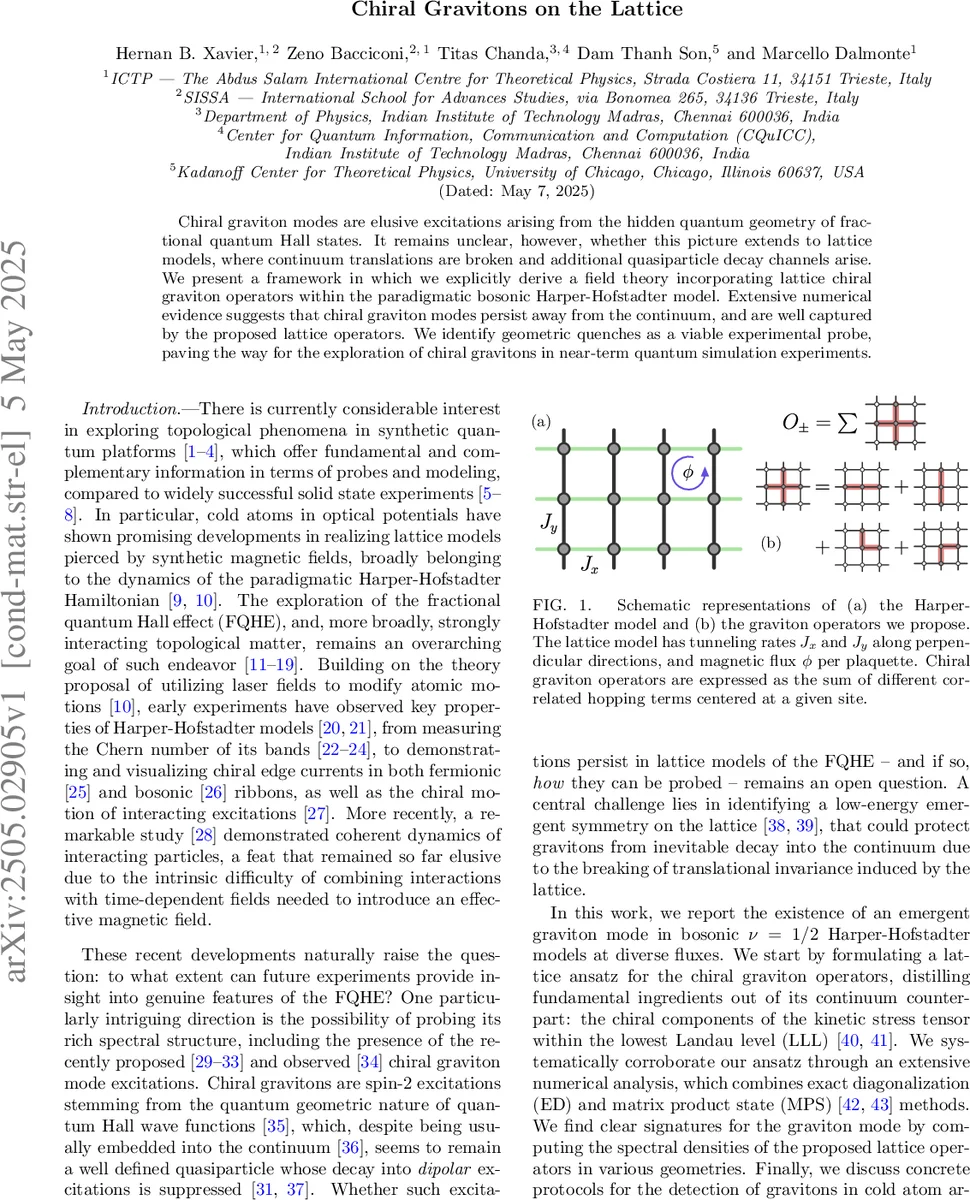
The core theoretical contribution is the explicit construction of lattice operator analogs for these chiral stress tensor components. By matching the lattice current operator and using a combination of symmetry considerations and a decomposition of the Hamiltonian, the authors identify the diagonal components (T_xx, T_yy) as specific “correlated hopping” terms. The off-diagonal component (T_xy) is constructed as an L-shaped correlated hopping term that breaks parity. From these, they define the lattice chiral graviton operators O± = Σ_r
Comments & Academic Discussion
Loading comments...
Leave a Comment