Core partial order for finite potent endomorphisms
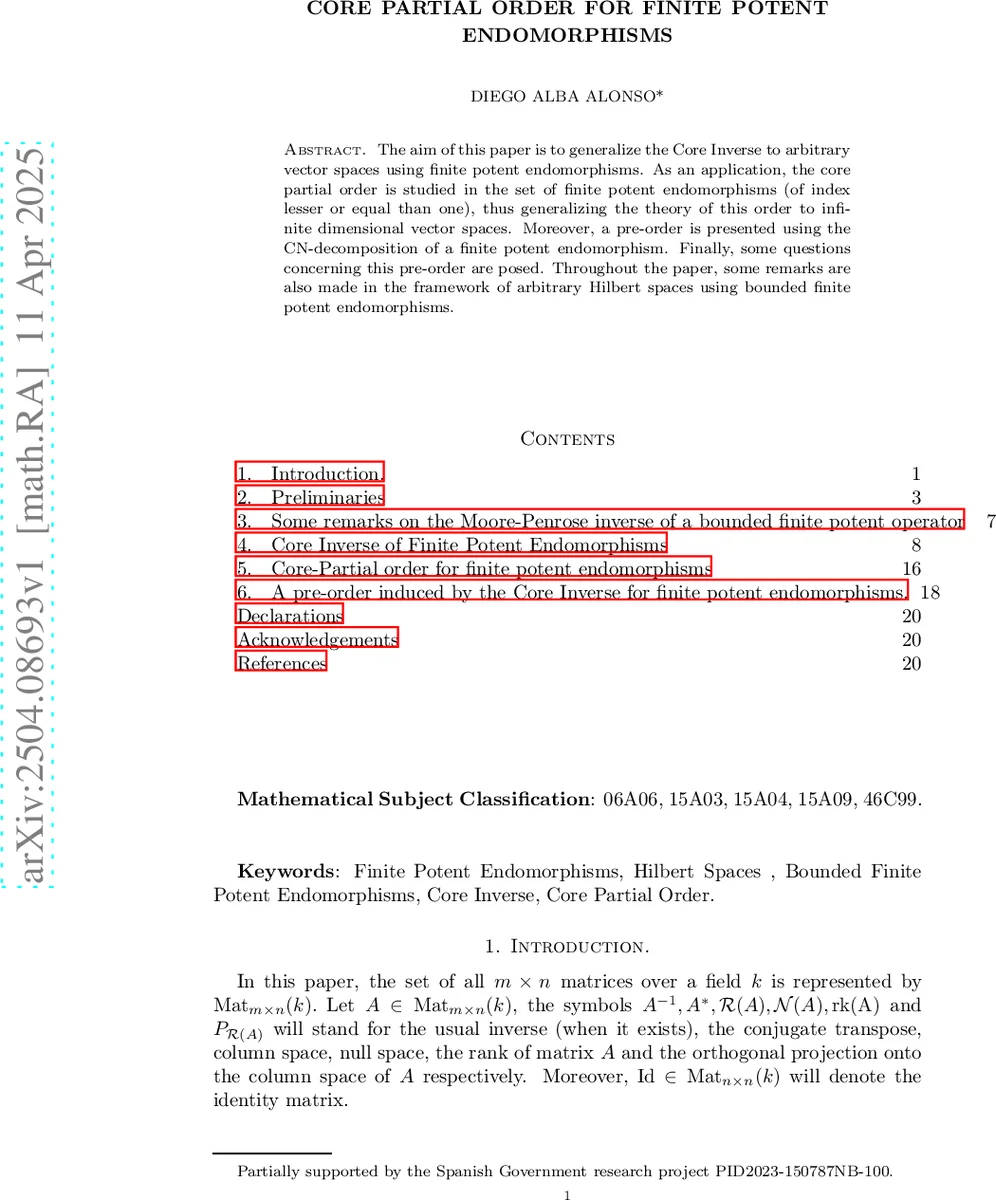
The aim of this paper is to generalize the Core Inverse to arbitrary vector spaces using finite potent endomorphisms. As an application, the core partial order is studied in the set of finite potent endomorphisms (of index lesser or equal than one), thus generalizing the theory of this order to infinite dimensional vector spaces. Moreover, a pre-order is presented using the CN-decomposition of a finite potent endomorphism. Finally, some questions concerning this pre-order are posed. Throughout the paper, some remarks are also made in the framework of arbitrary Hilbert spaces using bounded finite potent endomorphisms.
💡 Research Summary
The paper “Core partial order for finite potent endomorphisms” extends the theory of the core inverse and the associated partial order from the classical setting of square matrices (finite‑dimensional vector spaces) to arbitrary vector spaces, possibly infinite‑dimensional, by employing the notion of finite‑potent endomorphisms introduced by John Tate. A linear map ϕ on a vector space V over a field k is called finite‑potent if there exists an integer n such that the image ϕⁿ(V) is finite‑dimensional. This property allows one to treat many infinite‑dimensional operators (e.g., finite‑rank, nilpotent, or compact operators) within a unified framework.
The authors first collect necessary preliminaries. They recall the AST‑decomposition V = U_ϕ ⊕ W_ϕ, where U_ϕ is a ϕ‑invariant nilpotent part and W_ϕ is a finite‑dimensional invariant subspace on which ϕ acts as an automorphism. They also introduce the CN‑decomposition ϕ = ϕ₁ + ϕ₂ with ϕ₁·ϕ₂ = ϕ₂·ϕ₁ = 0, i(ϕ₁) ≤ 1 and ϕ₂ nilpotent. These decompositions are unique and play a central role throughout the paper.
A substantial part of the work is devoted to the Moore–Penrose inverse of bounded finite‑potent operators on Hilbert spaces. The authors show that a bounded finite‑potent operator ϕ is admissible for the Moore–Penrose inverse precisely when its image is closed, which in turn is equivalent to the existence of a bounded {1}‑inverse. They prove that the adjoint of a bounded finite‑potent operator remains bounded finite‑potent, preserving both the AST‑ and CN‑decompositions, and they give explicit formulas for the Moore–Penrose inverse in this setting.
The core inverse, originally defined for matrices of index ≤ 1, is generalized to arbitrary finite‑potent endomorphisms. The paper proves that the core inverse exists if and only if the index i(ϕ) ≤ 1 (Proposition 4.2). When it exists, the core inverse is unique and can be expressed algebraically as \
Comments & Academic Discussion
Loading comments...
Leave a Comment