Majorana Flat Bands in the Vortex Line of Superconducting Weyl Semimetals
We report the emergence of Majorana flat bands (MFBs) in the vortex line of superconducting (SC) time-reversal-symmetry-breaking Weyl semimetals. By considering a Weyl semimetal as a stack of Chern insulators with varying Chern numbers along one ($z$) direction, we decompose the vortex bound states of SC Weyl semimetals into those of $k_{z}$-resolved SC Chern insulators. Through analytical and numerical calculations of the topological phase diagram of the SC Chern insulators, we explain the appearance of MFBs and determine the exact boundaries of them. Notably, the tuning of chemical potential or pairing strength results in the MFBs along the entire $k_{z}$ axis. To characterize the MFBs, we propose a $k_{z}$-resolved $Z_{2}$ Chern-Simons invariant as the topological indicator. Finally, we take an attractive Hubbard interaction into consideration, and the aforementioned SC Weyl semimetal with BCS pairing can be realized under appropriate parameters.
💡 Research Summary
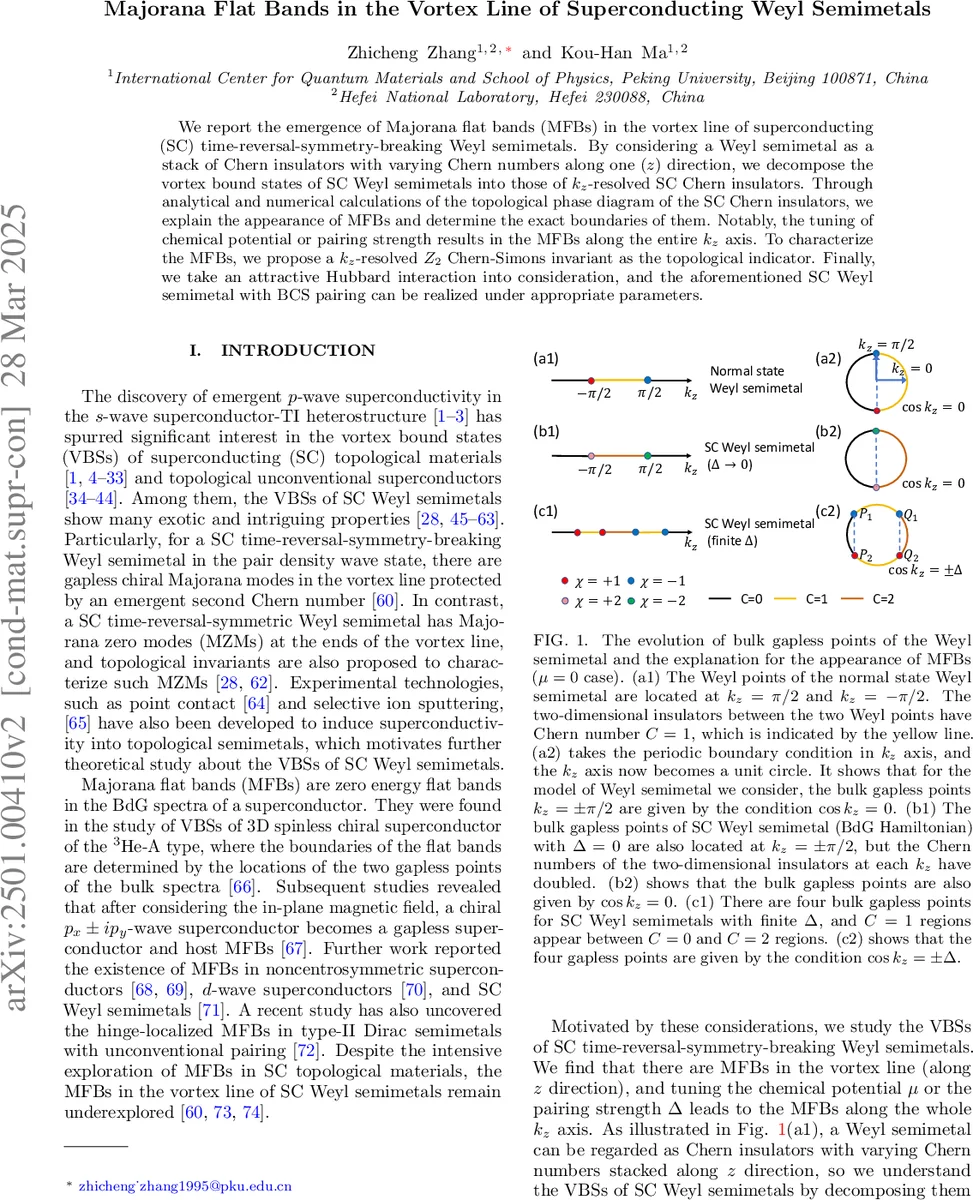
In this work the authors investigate the emergence of Majorana flat bands (MFBs) along a vortex line in time‑reversal‑symmetry‑breaking superconducting Weyl semimetals (WSMs). The central conceptual step is to view a three‑dimensional WSM as a stack of two‑dimensional Chern insulators indexed by the momentum k_z. Using the Qi‑Wu‑Zhang model for a Chern insulator, they show that fixing k_z reduces the WSM Hamiltonian to a 2D Chern insulator whose Chern number C(k_z) equals 1 for –π/2 < k_z < π/2 and 0 otherwise. This mapping allows the vortex‑bound states (VBSs) of the full 3D superconducting system to be decomposed into the VBSs of a family of k_z‑resolved superconducting (SC) Chern insulators.
The superconducting state is introduced via a conventional s‑wave BCS pairing Δ and a chemical potential μ, leading to a Bogoliubov–de Gennes (BdG) Hamiltonian. For μ = 0 and Δ = 0 the BdG Hamiltonian splits into two identical 2 × 2 blocks, each inheriting the Chern number of the normal‑state insulator; consequently the BdG Chern number is simply doubled. When a finite pairing Δ is turned on, the twofold degeneracy of the Weyl points at k_z = ±π/2 is lifted, and the bulk gap closes at four points determined by cos k_z = ±Δ. In the resulting phase diagram the BdG Chern number takes the values 0, 1, 2 as k_z moves across the gap‑closing points. Crucially, the region where the BdG Chern number is odd (C = 1) corresponds to a 2D chiral topological superconductor that hosts a single Majorana zero mode (MZM) in the vortex core. Because k_z is a continuous parameter, these MZMs form a dispersionless band at zero energy when the system is viewed along the vortex line—this is the Majorana flat band.
The authors analytically derive the exact boundaries of the MFBs. For μ = 0 the condition is simply cos k_z = ±Δ; for finite μ the generalized condition becomes Δ² + μ² = (m − 2n)² (n = 0, 1, 2), where m = 2t_z cos k_z plays the role of the mass term in the Chern‑insulator model. They construct the full topological phase diagram in the (m, Δ) plane, identifying six regions (A–F) with distinct BdG Chern numbers. The phase boundaries are obtained from bulk gap‑closing conditions sin k_x = sin k_y = 0 together with Δ ± m(k) = 0, leading to three families of lines Δ = ±m, Δ = ±(m − 2), and Δ = ±(m − 4). Numerical evaluation of the Chern number via the Berry‑curvature formula confirms the analytical results.
To provide a topological invariant that directly signals the presence of MFBs for each k_z, the authors introduce a k_z‑resolved Z₂ Chern‑Simons invariant I_CS(k_z) = (1/2π)∫ A∧dA (mod 2). I_CS equals 1 precisely in the C = 1 region, thereby serving as a practical diagnostic for experiments.
Finally, the paper addresses the microscopic origin of the pairing. By adding an attractive Hubbard interaction (−U ∑ n_{i↑}n_{i↓} with U > 0) and treating it at the mean‑field level, they show that a self‑consistent BCS gap Δ can be generated for realistic parameter choices (t_z, μ, U, electron density). The resulting self‑consistent Δ can be tuned such that the entire k_z axis lies within the C = 1 region, yielding a vortex line that hosts a full‑length Majorana flat band. This demonstrates that the proposed MFBs are not merely theoretical curiosities but could be realized in materials where superconductivity is induced (e.g., via proximity effect or pressure) in a Weyl semimetal with broken time‑reversal symmetry.
In summary, the paper offers a clear and comprehensive framework: (i) decompose a 3D SC Weyl semimetal into k_z‑resolved SC Chern insulators, (ii) map out the BdG Chern number phase diagram analytically and numerically, (iii) identify the exact k_z intervals where Majorana flat bands appear, (iv) propose a Z₂ Chern‑Simons invariant as a topological marker, and (v) show that an attractive Hubbard interaction can naturally produce the required BCS pairing. The work deepens our understanding of vortex‑line physics in topological superconductors and points toward experimental routes for detecting and exploiting Majorana flat bands.
Comments & Academic Discussion
Loading comments...
Leave a Comment