Divergence-free drifts decrease concentration
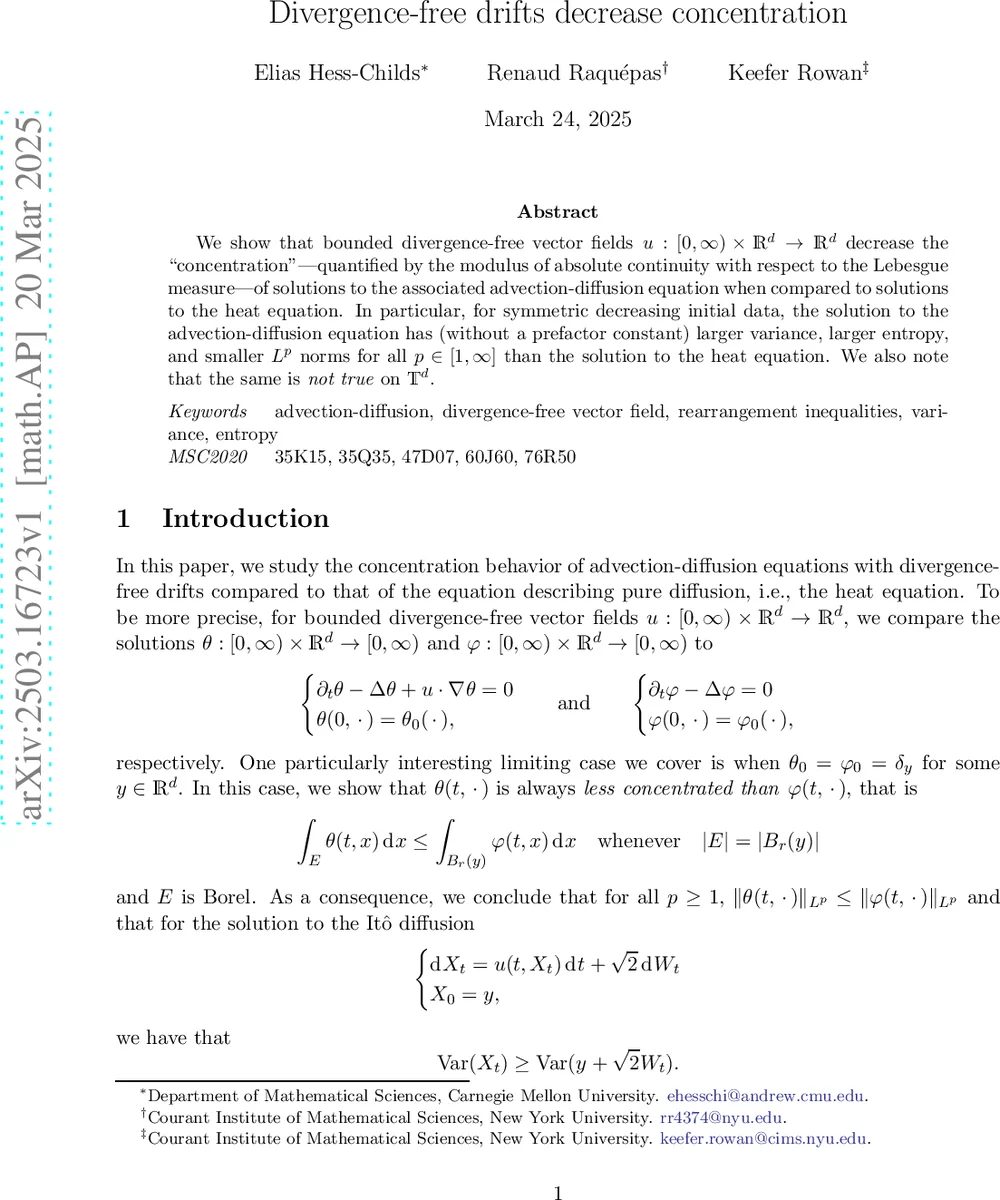
We show that bounded divergence-free vector fields $u : [0,\infty) \times \mathbb{R}^d \to\mathbb{R}^d$ decrease the ‘‘concentration’’, quantified by the modulus of absolute continuity with respect to the Lebesgue measure, of solutions to the associated advection-diffusion equation when compared to solutions to the heat equation. In particular, for symmetric decreasing initial data, the solution to the advection-diffusion equation has (without a prefactor constant) larger variance, larger entropy, and smaller $L^p$ norms for all $p \in [1,\infty]$ than the solution to the heat equation. We also note that the same is not true on $\mathbb{T}^d$.
💡 Research Summary
The paper investigates how bounded, divergence‑free vector fields influence the spreading of a passive scalar governed by the advection‑diffusion equation compared with the pure diffusion (heat) equation. The authors introduce a quantitative notion of “concentration” based on the modulus of absolute continuity of a measure μ with respect to Lebesgue volume:
C_μ(α) = sup{ μ(E) : E ⊂ ℝ^d Borel, |E| = α }.
They define a preorder μ ≼ ν (μ is less concentrated than ν) if C_μ(α) ≤ C_ν(α) for every α ≥ 0. A function or measure is called symmetric decreasing if its level sets are Euclidean balls centered at the origin and the values decrease with radius. This class provides extremal objects for the preorder: any measure is less concentrated than its symmetric decreasing rearrangement.
The central result (Theorem 1.7) states that for any bounded, measurable, divergence‑free drift u(t,x) and any pair of finite non‑negative measures μ, ν with ν symmetric decreasing and μ ≼ ν, the solution of the advection‑diffusion equation with initial data μ is always less concentrated than the heat‑flow solution with initial data ν:
P_u^t μ ≼ e^{tΔ} ν for all t ≥ 0,
where P_u^t denotes the solution operator for ∂_t θ – Δθ + u·∇θ = 0 and e^{tΔ} the heat semigroup. The proof combines three classical tools: (i) the minimality of the symmetric decreasing rearrangement, (ii) the Riesz rearrangement inequality for convolutions, and (iii) the Trotter product formula that splits the advection‑diffusion generator into a pure diffusion part and a transport part. The divergence‑free condition guarantees that the transport part preserves volume, which is crucial for the rearrangement comparison.
From Theorem 1.7 the authors derive several sharp functional inequalities (Corollary 1.10). For any p ∈
Comments & Academic Discussion
Loading comments...
Leave a Comment