Heat-to-motion conversion for quantum active matter
We introduce a model of an active quantum particle and discuss its properties. The particle has a set of internal states that mediate exchanges of heat with external reservoirs. Heat is then converted into motion by means of a spin-orbit term that couples internal and translational degrees of freedom. The quantum features of the active particle manifest both in the motion and in the heat-to-motion conversion. Furthermore, the stochastic nature of heat exchanges impacts the motion of the active particle and fluctuations can be orders of magnitude larger than the average values. The combination of spin-orbit interaction under nonequilibrium driving may bring active matter into the realm of cold atomic gases where our proposal can be implemented.
💡 Research Summary
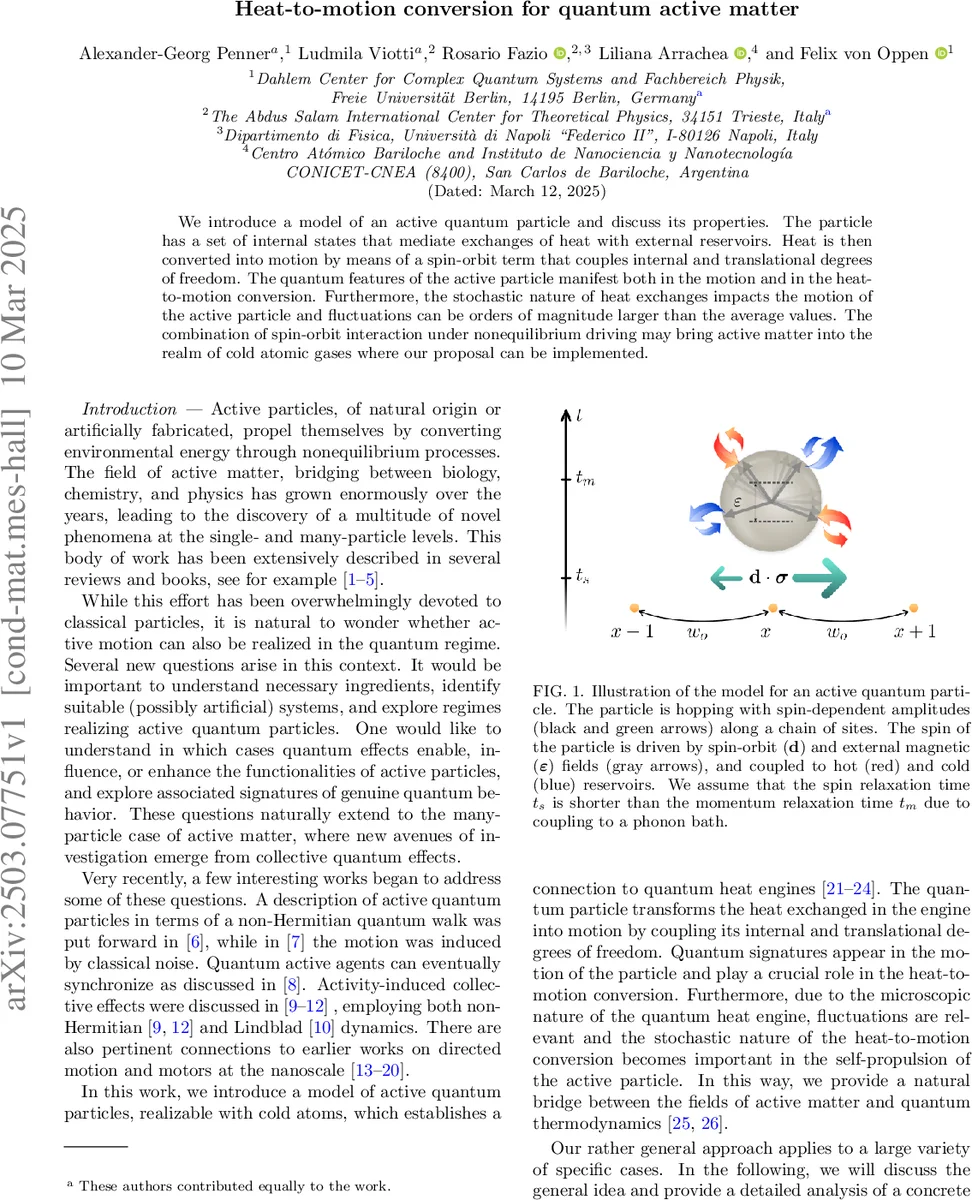
In this work the authors develop a theoretical framework for realizing active matter in the quantum regime. Classical active particles self‑propel by converting environmental energy into directed motion, but most studies have been confined to classical descriptions. Here a single quantum particle is engineered whose internal (spin‑½) degrees of freedom are coupled to its translational motion via a spin‑orbit interaction. The particle is placed on a one‑dimensional lattice and interacts with two thermal reservoirs at different temperatures, providing the nonequilibrium drive required for activity.
The total Hamiltonian consists of three parts: (i) the particle Hamiltonian Ĥ_p, which includes a Zeeman term ε·σ that breaks time‑reversal symmetry, a spin‑independent hopping amplitude w₀, and a spin‑dependent hopping (spin‑orbit) term i d·σ; (ii) the bath Hamiltonian Ĥ_B describing two sets of harmonic oscillators at temperatures T_h = T + ΔT/2 and T_c = T – ΔT/2; and (iii) the interaction V̂_I that couples the spin operators to the baths, allowing spin flips accompanied by energy exchange.
In the weak‑coupling limit the dynamics of the reduced density matrix ρ̂_k for each momentum mode k obey a Lindblad master equation. Two dissipators appear: D_s, originating from the spin‑bath coupling, introduces a fast spin‑relaxation time τ_s; D_m, describing coupling to a phonon bath, yields a much slower momentum‑relaxation time τ_m (τ_s ≪ τ_m). This separation of time scales is central to the analysis.
When the two baths are at different temperatures, the spin transition rates Γ_{ℓ,α,k} depend on both the Bose occupation at the transition energy 2Δ_k and on coupling strengths ξ_{α,k}=γ_α|⟨↑|τ_{α,k}|↓⟩|². Because the spin‑orbit term ties a spin flip to a hop on the lattice, each spin transition imparts a momentum kick, thereby converting heat into directed motion.
The authors compute the steady‑state average velocity ⟨v̂⟩ in linear response to a small temperature bias. The result (Eq. 4) shows that ⟨v̂⟩ ∝ (ΔT/T) ∑k r{0,k} (ξ_h,k − ξ_c,k) Δ_k·∂_k d_k / cosh²(βΔ_k). Consequently, a non‑zero velocity requires (i) non‑vanishing spin‑orbit coupling d, (ii) a Zeeman field ε, (iii) a finite spin‑independent hopping w₀, and (iv) asymmetric coupling to the hot and cold reservoirs (ξ_h,k ≠ ξ_c,k). The velocity vanishes if any of these conditions is not met.
Temperature dependence is explored in detail. At low temperatures the transition rates are exponentially suppressed, giving ⟨v̂⟩ ∼ e^{−2βε}. At high temperatures the velocity decays as 1/T³. Between these limits an optimal temperature exists (≈ 0.83 ε for w₀≫d,ε) where the conversion efficiency is maximal. This non‑monotonic behavior persists beyond the linear‑response regime.
Momentum relaxation is introduced via a phonon bath with Hamiltonian Ĥ_r. Tracing out the phonons leads to a drift‑diffusion equation for the momentum distribution r_{0,k}. The drift velocity v_D(k) and diffusion coefficient D(k) depend on the instantaneous spin polarization r_k, creating a feedback loop between spin dynamics and momentum diffusion. For a phonon density of states ν(ω) ∝ |ω|^p (p = 1,2,3) the stationary momentum distribution can be obtained analytically (Eq. 8). Numerical simulations (Fig. 3) show three dynamical regimes: (a) an initial transient (t ≲ τ_s), (b) a plateau where the velocity matches the no‑relaxation prediction of Eq. 4, and (c) a long‑time steady state where momentum relaxation reshapes the velocity, sometimes even reversing its sign. Remarkably, for certain bath spectra the magnitude of the steady‑state velocity can increase after momentum relaxation sets in.
Quantum signatures are highlighted through the velocity‑velocity correlation function g(t,τ) = ⟨δv̂(t) δv̂(t+τ)⟩. Using the quantum regression theorem the authors obtain an analytic expression (Eq. 10) featuring damped oscillations at frequency 2Δ_k, directly reflecting coherent Rabi oscillations of the internal spin. These oscillations survive even when ΔT = 0, i.e., in equilibrium, demonstrating that the particle remains “active” in the quantum sense. The oscillation period is set by the Zeeman field, while the decay time is governed by τ_s. The correlation amplitude is highly sensitive to the relative orientation of the spin‑orbit vector d and the effective field Δ_k; when d‖Δ_k the oscillations disappear because incoherent transitions dominate.
In the concluding discussion the authors emphasize that three ingredients are sufficient to engineer a quantum active particle: (1) spin‑orbit coupling linking internal and translational degrees of freedom, (2) a magnetic field breaking time‑reversal symmetry, and (3) an imbalance in the coupling strengths to two thermal reservoirs. All of these can be realized with current cold‑atom or trapped‑ion technologies, for example by using Raman‑induced spin‑orbit coupling and engineered reservoirs via optical pumping. The paper thus bridges quantum thermodynamics and active matter, opening a route toward experimental studies of quantum heat engines that directly power self‑propulsion, and suggesting rich many‑body extensions where collective quantum effects could further enrich active‑matter phenomenology.
Comments & Academic Discussion
Loading comments...
Leave a Comment