Causal language jumps in clinical practice guidelines for diabetes management
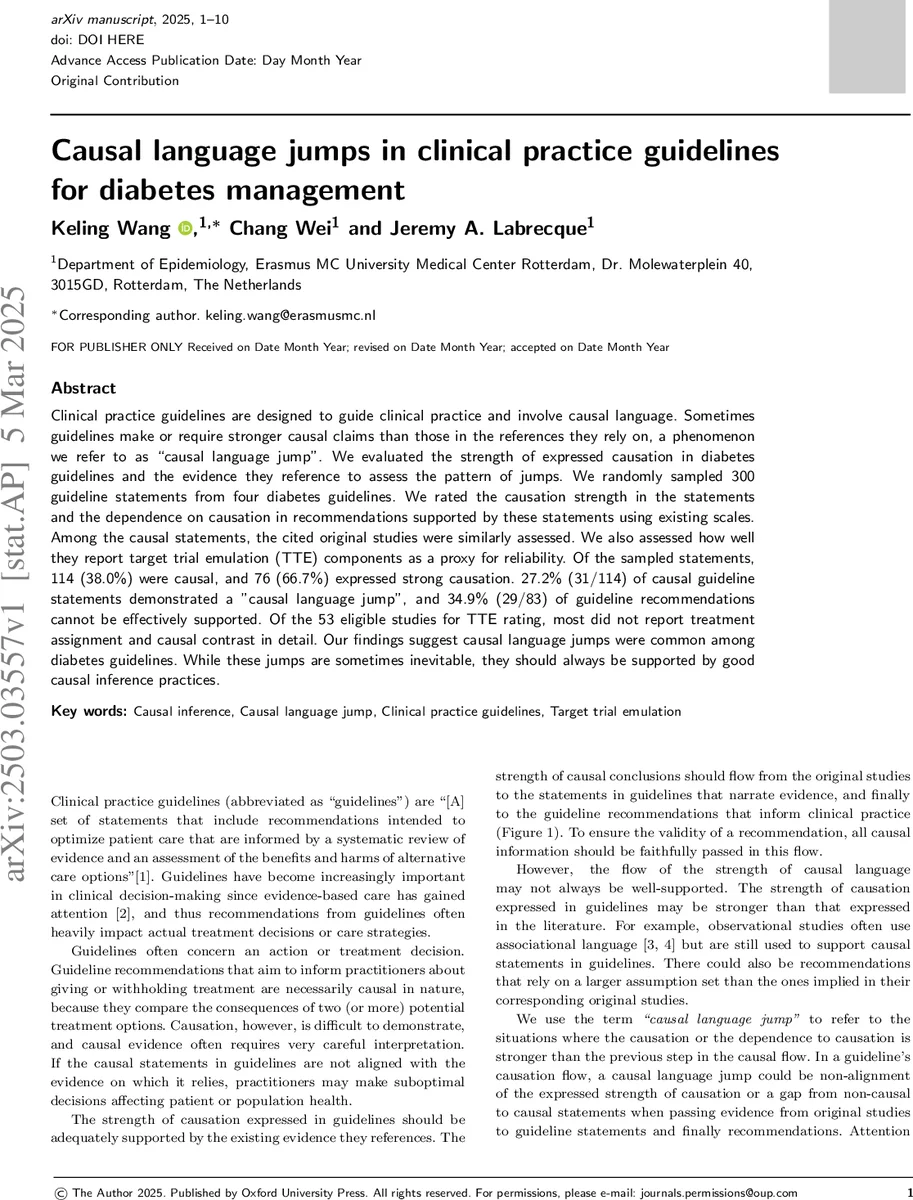
Clinical practice guidelines are designed to guide clinical practice and involve causal language. Sometimes guidelines make or require stronger causal claims than those in the references they rely on, a phenomenon we refer to as ‘causal language jump’. We evaluated the strength of expressed causation in diabetes guidelines and the evidence they reference to assess the pattern of jumps. We randomly sampled 300 guideline statements from four diabetes guidelines. We rated the causation strength in the statements and the dependence on causation in recommendations supported by these statements using existing scales. Among the causal statements, the cited original studies were similarly assessed. We also assessed how well they report target trial emulation (TTE) components as a proxy for reliability. Of the sampled statements, 114 (38.0%) were causal, and 76 (66.7%) expressed strong causation. 27.2% (31/114) of causal guideline statements demonstrated a “causal language jump”, and 34.9% (29/83) of guideline recommendations cannot be effectively supported. Of the 53 eligible studies for TTE rating, most did not report treatment assignment and causal contrast in detail. Our findings suggest causal language jumps were common among diabetes guidelines. While these jumps are sometimes inevitable, they should always be supported by good causal inference practices.
💡 Research Summary
This study introduces and empirically investigates the concept of “causal language jump” (CLJ) within clinical practice guidelines (CPGs), focusing on diabetes management. A CLJ occurs when a guideline statement or recommendation expresses a stronger causal claim than the evidence it cites can support. The authors selected four internationally recognized diabetes guidelines that emphasize non‑pharmacological interventions for adult type‑2 diabetes. From these, 300 guideline statements surrounding actionable recommendations were randomly sampled. Each statement was rated for causal strength using the established Causal Implication Strength Rating Scale (levels: weak = 1, moderate = 2, strong = 3). Recommendations were similarly rated for their dependence on causal evidence (0 = none to 3 = definite).
Among the 300 statements, 114 (38 %) were deemed causal; of these, 76 (66.7 %) were classified as strong. Comparing the causal rating of each statement with the ratings of the original studies it cited revealed that 31 statements (27.2 %) had a higher causal rating than any of their references – a direct illustration of a CLJ. When the alignment of content between statements and cited studies was also considered, 54 statements (47.4 %) could not be effectively supported, indicating a broader pattern of mis‑alignment.
The authors extracted 191 original studies referenced by the causal statements (after excluding two unavailable papers). The majority were randomized controlled trials (27.2 %) and systematic reviews (20.9 %); observational studies were scarce (7.9 %). For each study, a single conclusive sentence was rated for causal strength, and an “alignment” score (not aligned, partially aligned, completely aligned) was assigned. Only 34.9 % of the 83 actionable recommendations could be effectively supported by the surrounding statements; the remaining 29 recommendations (34.9 %) lacked sufficient causal backing.
To assess the methodological robustness of the cited evidence, the authors applied a Target Trial Emulation (TTE) framework, rating six key components (eligibility criteria, treatment strategy, assignment procedures, follow‑up period, outcome definition, causal contrast, and analysis plan) on a 0‑2 scale. Across the 97 studies selected for detailed TTE appraisal, most failed to fully report treatment assignment and causal contrast, suggesting limited reliability of the causal claims they underpin.
Key insights:
- CLJs are common in diabetes CPGs, occurring in over a quarter of causal statements and in roughly one‑third of actionable recommendations.
- The problem is not merely lexical; many statements lack substantive alignment with the underlying evidence, potentially leading clinicians to act on overstated causal inferences.
- Even when the cited evidence comprises high‑quality RCTs, inadequate reporting of TTE components undermines confidence in the causal interpretation.
- Non‑pharmacological interventions, which often rely on observational data, are especially vulnerable to CLJs because the underlying studies may use purely associational language.
Limitations include the focus on non‑pharmacological diabetes care (reducing generalizability), reliance on expert judgment for causal rating (introducing subjectivity), and potential translation nuances from English source material.
The authors recommend that guideline developers adopt systematic checks for causal alignment, explicitly document the causal inference assumptions, and prioritize evidence that meets TTE reporting standards. Future work should expand the analysis to other disease areas, incorporate automated natural‑language processing tools for large‑scale detection of CLJs, and develop standardized reporting guidelines that integrate causal inference principles. By curbing causal language jumps, CPGs can better ensure that clinical recommendations are both evidence‑based and transparently justified, ultimately improving patient care and public health outcomes.
Comments & Academic Discussion
Loading comments...
Leave a Comment