Unitarity of minimal $W$-algebras and their representations II: Ramond sector
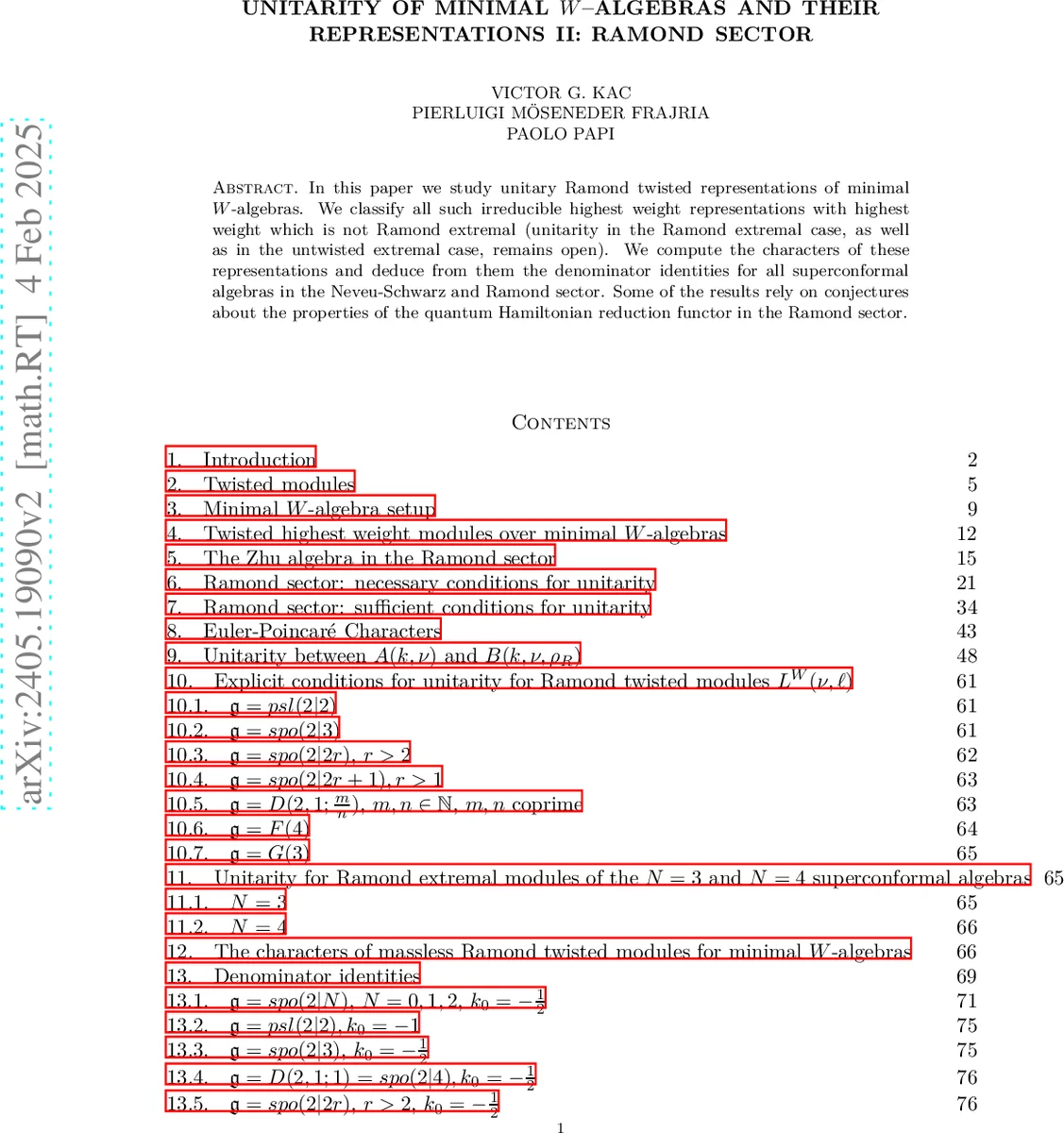
In this paper we study unitary Ramond twisted representations of minimal $W$-algebras. We classify all such irreducible highest weight representations with a non-Ramond extremal highest weight (unitarity in the Ramond extremal case, as well as in the untwisted extremal case, remains open). We compute the characters of these representations and deduce from them the denominator identities for all superconformal algebras in the Neveu-Schwarz and Ramond sector. Some of the results rely on conjectures about the properties of the quantum Hamiltonian reduction functor in the Ramond sector.
💡 Research Summary
This paper investigates the unitary Ramond‑twisted representations of minimal W‑algebras (W_{\min }^{k}(\mathfrak g)), extending the authors’ earlier work on the Neveu–Schwarz (untwisted) sector. The setting is a simple finite‑dimensional Lie superalgebra (\mathfrak g) with an even reductive part (\mathfrak g_{\bar0}) and a minimal (sl_{2}) subalgebra (\mathfrak s=\operatorname{span}{e,x,f}\subset\mathfrak g_{\bar0}). For a complex level (k\neq k_{\mathrm{crit}}=-h^{\vee}), quantum Hamiltonian reduction produces the universal affine W‑algebra (W^{k}(\mathfrak g,\mathfrak s)); its unique maximal ideal yields the simple minimal W‑algebra (W_{\min }^{k}(\mathfrak g)).
Unitary structures are defined via a conjugate‑linear involution (\phi) of (\mathfrak g) fixing (\mathfrak s) and inducing a (\phi)‑invariant Hermitian form on modules. Prior results (
Comments & Academic Discussion
Loading comments...
Leave a Comment