Robust Stability of Discrete-time Disturbance Observers: Understanding Interplay of Sampling, Model Uncertainty and Discrete-time Designs
In this paper, we address the problem of robust stability for uncertain sampled-data systems controlled by a discrete-time disturbance observer (DT-DOB). Unlike most of previous works that rely on the small-gain theorem, our approach is to investigat…
Authors: Gyunghoon Park, Chanhwa Lee, Youngjun Joo
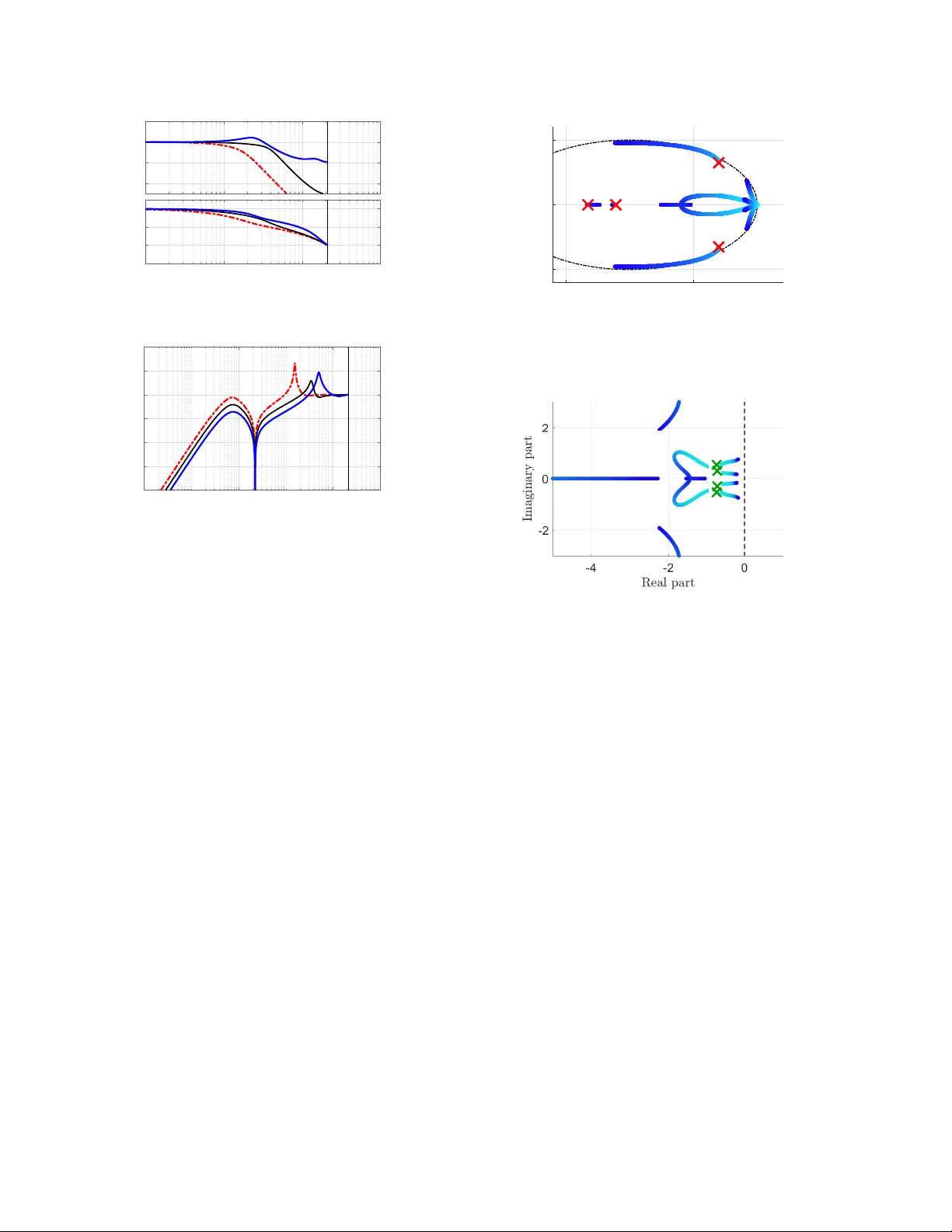
Robust Stabilit y of Discrete-time Disturbance Observ ers: Understanding In terpla y of Sampling, Mo del Uncertain t y and Discrete-time Designs ? Gyungho on P ark a , Chanh wa Lee b , Y oung jun Joo c , Hyungb o Shim a a ASRI, Dep artment of Ele ctric al and Computer Engine ering,, Se oul National University, Kor e a b R ese ar ch & Development Division, Hyundai Motor Comp any, Kor e a c Dep artment of Ele ctric al Engine ering and Computer Scienc e, University of Centr al Florida, USA Abstract In this pap er, w e address the problem of robust stability for uncertain sampled-data systems con trolled by a discrete-time disturbance observ er (DT-DOB). Unlike most of previous works that rely on the small-gain theorem, our approac h is to in vestigate the lo cation of the roots of the characteristic polynomial when the sampling is p erformed sufficiently fast. This approac h provides a generalized framew ork for the stability analysis in the sense that (i) many popular discretization metho ds are tak en into account; (ii) under fast sampling, the obtained robust stability condition is necessary and sufficient except in a degenerative case; and (iii) systems of arbitrary order and of large uncertain ty can b e dealt with. The relation b etw een sampling zeros—discrete-time zeros that newly app ear due to the sampling—and robust stabilit y is highligh ted, and it is explicitly rev ealed that the sampling zeros can hamp er stability of the ov erall system when the Q-filter and/or the nominal mo del are carelessly selected in discre te time. Finally , a design guideline for the Q-filter and the nominal mo del in the discrete- time domain is prop osed for robust stabilization under the sampling against the arbitrarily large (but bounded) parametric uncertain ty of the plant. Key wor ds: Robust stabilit y; sampled-data systems; disturbance rejection; uncertain linear systems; robust con trol 1 In tro duction As a simple and effectiv e to ol for robust con trol, the disturbance observ er (DOB) has received considerable atten tion ov er the past decades. Since its inv ention b y Ohnishi (1987), the DOB sc heme has b een successfully emplo y ed in man y industrial problems, and in turn a ? This w ork was supp orted by the National Research F oundation of Korea (NRF) gran t funded b y the Korea go vernmen t (Ministry of Science and ICT) (No. NRF- 2017R1E1A1A03070342). The material of this paper was partially presen ted at the 54th IEEE Conference on Decision and Control, Osak a, Japan, December 15-18, 2015 (Park, Jo o, Lee, & Shim, 2015), and partially at the 15th In ter- national Conference on Control, Automation and Systems, Busan, Korea, October 13-16, 2015 (P ark & Shim, 2015). Corresp onding author: H. Shim, T el. +82-2-880-1745. Email addr esses: gyunghoon.p@gmail.com (Gyunghoon P ark), chanhwa.lee@gmail.com (Chanh wa Lee), Youngjun.Joo@ucf.edu (Y oung jun Jo o), hshim@snu.ac.kr (Hyungb o Shim). large num b er of studies hav e b een carried out to under- stand the underlying rationale b ehind its ability . (See Sariyildiz & Ohnishi (2015); Shim, Park, Jo o, Back, & Jo (2016); Li, Y ang, Chen, & Chen (2014) and the ref- erences therein.) It is worth noting that a ma jority of the theoretical re- sults on design and analysis of the DOB w ere developed in the con tinuous-time (CT) domain, while in practice the plan t is usually con trolled in the sampled-data fash- ion with a holder and a sampler. Th us ev en if a DOB is w ell-designed in the CT domain, one would face an additional problem of implementing the DOB in the discrete-time (DT) domain. At first glance, this imple- men tation issue may seem less imp ortant by the pre- sumption that, as the sampling is p erformed sufficiently fast, any discretization of a CT-DOB will approximate its CT counterpart sufficien tly well. Y et interestingly , this is often not the case, and as rep orted in Go dler, Honda, & Ohnishi (2002); Bertoluzzo, Buja, & Stampac- c hia (2004); Uzuno vic, Sariyildiz, & Sabanovic (2018), Preprin t submitted to Automatica 20 Decem b er 2024 a naive conv ersion of the CT-DOB into the DT domain ma y significantly degrade the tracking performance or fail to stabilize the ov erall system in spite of sufficiently fast sampling. In this context, subsequen t research efforts hav e b een made to design a DT-DOB with a particular attention to the effect of the sampling on the ov erall stability . While most relev ant w orks share the common structure of the DT-DOB depicted in Fig. 1 (or emplo y its equiv alent blo c ks), there hav e b een diverse wa ys of constructing the comp onents of the DT-DOB; the DT nominal mo del P d n and the DT Q-filter Q d . On the one hand, the DT nominal mo del has b een obtained b y discretizing a CT nominal model of the actual plant in a num b er of meth- o ds. A frequen tly used metho d for its discretization is the zero-order hold (ZOH) equiv alence (or, exact dis- cretization), because the ZOH is usually utilized in the sampled-data setting and thus an y discretization meth- o ds other than the ZOH equiv alence inevitably intro- duce additional model uncertaint y to be comp ensated b y the DOB (T esfa y e, Lee, & T omizuk a, 2000; Kempf & Koba yashi, 1999). Y et this exact discretization often forces the inv erse of the DT nominal mo del in the DOB lo op to be unstable, because a ZOH equiv alent model m ust hav e at least one unstable DT zero whenev er the relativ e degree of the CT plant is larger than t wo and the sampling perio d is small. T o av oid this problem, ap- pro ximate discretization methods ha ve b een preferred in some cases at the cost of discrepancy b et w een the ac- tual and nominal mo dels in high-frequency range. P os- sible candidates include the forw ard difference metho d (Lee, Jo o, & Shim, 2012), the bilinear transformation (Y ang, Choi, & Ch ung, 2003; Lee & T omizuk a, 1996), the optimization-based techniques (Chen & T omizuk a, 2010; Kong & T omizuk a, 2013), and the adaptiv e algorithm- based approach (Choi, Choi, Kong, & Hyun, 2016). On the other hand, the design metho dologies for the DT Q-filters presented in the literature can be categorized mainly into tw o groups. One approach is to select a CT Q-filter a priori based on the CT-DOB theory , and to discretize it by taking in to account the sampling pro- cess (Y ang et al., 2003; Chen & T omizuk a, 2010; T esfa y e et al., 2000; Kempf & Koba y ashi, 1999; Lee & T omizuk a, 1996). Motiv ated by the w orks of Go dler et al. (2002); Bertoluzzo et al. (2004), the discretization in this case aims to limit the bandwidth of the resulting DT Q- filter far b elow the Nyquist frequency , by which (roughly sp eaking) the DT-DOB do es not conflict with the sam- pling pro cess of the plant in a sense. Another stream of researc h dealt with the direct design of the Q-filter in DT domain (Kw on & Ch ung, 2003; Chen, Jiang, & T omizuk a, 2015; Kong & T omizuk a, 2013; Choi et al., 2016). In these w orks, a wa y of discretizing the CT nom- inal mo del w as first determined, and then the DT Q- filter w as constructed using the classical robust control theory developed for DT systems. Despite increased in terest, ho w ev er, there is still a lac k ZOH Sampler Fig. 1. Ov erall configuration of sampled-data system con- trolled b y DT-DOB (dotted block) of understanding of the robust stability of the DT-DOB con trolled systems in the sampled-data framew ork be- cause of the follo wing reasons. First, the previous w orks listed abov e mainly emplo y the small-gain theorem or an approximation of the plan t to b e controlled in their stabilit y analysis. Thus (p ossibly conserv ative) sufficien t conditions for robust stability were obtained, while it re- mains ambiguous how and when the sampling pro cess leads to the instability of the DT-DOB controlled sys- tems. Next, the stabilit y analysis was mostly performed “after” the discretization method for the DT nominal mo del is given, so that the effect of the selection of the DT nominal mo del on the o verall stabilit y is also un- v eiled. Finally , man y earlier works fo cused only on the second-order systems (e.g., mechanical systems) or on limited size of uncertaint y (because of the use of small- gain theorem), which restricts the class of CT plants of in terest. In this paper, w e address the problem of robust stabilit y for uncertain sampled-data systems controlled by DT- DOBs from a different p ersp ective. Unlike the previous w orks that rely on the small-gain theorem or the approx- imate discretization of the plan t, the approac h of this w ork is to express the DT-DOB in a general form and to in v estigate where the roots of the c haracteristic p olyno- mial are lo cated when the sampling proceeds sufficiently fast. As a consequence, the prop osed approach pro vides a generalized framework for the stability analysis in the sense that (i) v arious types of DT-DOB design methods in the relev ant works are co vered; (ii) under fast sam- pling, the stability condition is necessary and sufficient except in a degenerativ e case; and (iii) systems of arbi- trary order and of large uncertaint y can b e dealt with. This is done in Sections 4 and 5 on the basis of the re- view on the sampled-data systems in Section 3. This wor k confirms that there exists a strong relation b e- t w een the sampling pro cess, the design of the DT-DOB, and the uncertain t y of the plan t in the stabilit y issue. T o gain further insight in to the role of the sampling pro cess, w e re-interpret the rules of thum b that hav e b een re- ferred to in the usual DT-DOB designs mentioned ab ov e. Our results highlight that the sampling zeros (i.e., extra DT zeros of the sampled-data mo del that are generated b y the sampling pro cess) may hamp er the stability of the 2 o v erall system unless the DT Q-filter and the discretiza- tion metho d for the DT nominal mo del are carefully se- lected (Section 6). T o tac kle the stability issues caused b y the sampling pro cess as well as to ensure robust sta- bilit y against arbitrarily large but bounded parametric uncertain t y , in Section 7 we provide a new systematic guideline for the direct design of the DT-DOB based on the theoretical result. In Section 8, it is sho wn through some simulations that, compared with a discretization of a CT-DOB, the prop osed design guideline in this pa- p er can allo w relatively larger bandwidths of the DT Q-filter with stabilit y guaranteed, which ensures b etter disturbance rejection p erformance. Notation : W e denote the co efficient of s m in the p oly- nomial ( s + 1) n as ( n m ). F or a CT signal a ( t ), L{ a ( t ) } stands for the Laplace transform of a ( t ). Similarly , the Z -transform of a DT signal a d [ k ] is denoted by Z { a d [ k ] } . (Hereinafter, w e shall use the sup erscript “ d ” to indi- cate that a parameter or a v ariable is asso ciated with the DT domain.) The sets of the real num b ers, the p os- itiv e real num b ers, and the complex num b ers are de- noted by R , R > 0 , and C , respectively . F or t wo v ectors a and b , we use [ a ; b ] to represent [ a > , b > ] > . The sym- b ols Re( ξ ? ) and Im( ξ ? ) indicate the real and the imagi- nary parts of ξ ? ∈ C , resp ectively . If all the co efficients of a p olynomial N( z ) (and a rational function P( z )) are functions of a v ariable ∆, the p olynomial is usually writ- ten as N( z ; ∆) instead of N( z ) (and similarly , the ra- tional function as P( z ; ∆) rather than P( z )). F or tw o sets V and W , C W ( V ) stands for the set of con tin u- ous functions from V to W . T o shorten the notation, let C R := C R ( R > 0 ). The set of p olynomials of z with co ef- ficien ts in R is denoted b y R [ z ]. In a similar manner, we use the notation C R [ z ] to indicate the set of p olynomi- als (e.g., N( z ; ∆) = N n (∆) z n + · · · + N 1 (∆) z + N 0 (∆)) whose co efficients are in C R . 2 Problem F ormulation Consider a single-input single-output (SISO) contin uous- time (CT) plant y( s ) = P( s ) u( s ) + d( s ) (1) where u( s ) is the input, y( s ) is the output, d( s ) is the disturbance, and P( s ) = g Q n − ν i =1 ( s − z i ) Q n i =1 ( s − p i ) =: N( s ) D( s ) (2) where ν ≥ 1 is the relative degree of P( s ), and z i ∈ C , p i ∈ C , and g 6 = 0 are the CT zeros, the CT poles, and the high-frequency gain of P( s ), respectively . Without loss of generalit y , assume that the polynomials N( s ) and D( s ) are coprime. It is also supp osed that the plan t (2) has b ounded parametric uncertaint y of arbitrarily large size and the sign of the high-frequency gain g is known, as stated b elow. Assumption 1 The CT plant P( s ) in (2) is c ontaine d in the set of unc ertain tr ansfer functions P := g s n − ν + β n − ν − 1 s n − ν − 1 + · · · + β 0 s n + α n − 1 s n − 1 + · · · + α 0 : (3) 0 < g ≤ g ≤ g , α i ≤ α i ≤ α i , β i ≤ β i ≤ β i wher e the b ounds g , g , α i , α i , β i , and β i ar e known. In this pap er, we are interested in the situation when the CT plan t (1) is controlled in the sampled-data frame- w ork, together with the following tw o comp onents. • Zero-order hold (ZOH): u ( t ) = u d [ k ] for k ∆ ≤ t < ( k + 1)∆ where ∆ > 0 is the sampling p eriod, u ( t ) is the CT input of the plant (i.e., u ( t ) = L − 1 { u( s ) } ), and u d [ k ] is the DT control input generated b y a DT con troller. • Sampler : y d [ k ] = y ( k ∆) in which y ( t ) is the CT out- put of the plan t (i.e., y ( t ) = L − 1 { y( s ) } ), and y d [ k ] indicates the DT output to b e measured at eac h sam- pling time. As a particular DT control scheme, this pap er considers the DT disturbance observer (DT-DOB). Overall config- uration of the DT-DOB-based controller (DT-DOBC) is depicted in Fig. 1. In the figure, the DT transfer func- tions Q d ( z ; ∆), P d n ( z ; ∆), and C d ( z ; ∆) (whose co effi- cien ts are p ossibly dependent of ∆) stand for the DT Q- filter, the DT nominal mo del, and the DT nominal con- troller, respectively . The DT signal r d [ k ] is the reference command for the sampled output y d [ k ]. The main purp ose of this pap er is to derive a robust stabilit y condition for the DT-DOB controlled sampled- data systems. In particular, we aim to clarify how the sampling pro cess (as w ell as the DT-DOB design and the parametric uncertaint y of the plant) influences the sta- bilit y of the o verall system, and to express their relation in an explicit manner. Based on the stabilit y analysis, it is also desired to provide a systematic design guideline for the DT-DOBC to ensure robust stabilization against b oth sampling pro cess and parametric uncertaint y . 3 Basics on Sampled-data Systems This section summarizes some inheren t natures of the sampled-data system. Let us begin with a minimal real- ization of the CT plant (1) in the state space given by ˙ x ( t ) = Ax ( t ) + B u ( t ) + d ( t ) , (4a) y ( t ) = C x ( t ) (4b) 3 in which the matrices A , B , and C satisfy P( s ) = C ( sI − A ) − 1 B . Then the corresp onding sampled-data system with the ZOH and the sampler can be written in the DT domain by x d [ k + 1] = A d x d [ k ] + B d u d [ k ] + ˆ d d [ k ] , (5a) y d [ k ] = C d x d [ k ] (5b) where x d [ k ] := x ( k ∆) is the DT state, A d (∆) := e A ∆ , B d (∆) := R ∆ 0 e Aρ B d ρ , C d := C , and the DT distur- bance ˆ d d [ k ] is of the form ˆ d d [ k ] := Z ( k +1)∆ k ∆ e A (( k +1)∆ − ρ ) B d ( ρ )d ρ ∈ R n . (6) F or each P ∈ P , let T P , 1 b e the set of ∆ ∈ R > 0 suc h that ∆( λ − λ 0 ) = 2 π j k holds for a nonzero integer k and some distinct eigenv alues λ and λ 0 of A . One can readily see that eac h T P , 1 has the measure zero and inf {T P , 1 } > 0. It is well known in the literature that if the triplet ( A, B , C ) is con trollable and observ able, then the corresp onding ( A d (∆) , B d (∆) , C d ) is also con trollable and observ able for all ∆ ∈ R > 0 \ T P , 1 . No w define u d ( z ) := Z { u d [ k ] } , y d ( z ) := Z { y d [ k ] } , and ˆ d d ( z ) := Z { ˆ d d [ k ] } . Then we obtain a frequency-domain expression of the sampled-data system y d ( z ) = P d ( z ; ∆)u d ( z ) + W d ( z ; ∆) ˆ d d ( z ) (7) where P d ( z ; ∆) := C d ( z I − A d (∆)) − 1 B d (∆) = Z {L − 1 { (1 − e − ∆ s ) /s × P( s ) }| t = k ∆ } and W d ( z ; ∆) := C d ( z I − A d (∆)) − 1 . Since P d ( z ; ∆) and W d ( z ; ∆) hav e the same denominator D d ( z ; ∆) := det( z I − A d (∆)), they can b e expressed as P d ( z ; ∆) = N d ( z ; ∆) / D d ( z ; ∆) and W d ( z ; ∆) = (1 / D d ( z ; ∆))[N d w , 1 ( z ; ∆) , . . . , N d w ,n ( z ; ∆)] with some polynomials N d ∈ C R [ z ] and N d w ,i ∈ C R [ z ], i = 1 , . . . , n . In addition, for all ∆ ∈ R > 0 \ T P , 1 , there is no p ole-zero cancellation in b oth P d ( z ; ∆) and W d ( z ; ∆) (so that the ro ots of D d ( z ; ∆) do not coincide with any ro ots of N d ( z ; ∆) nor N d w ,i ( z ; ∆)). In the remainder of this section, we discuss the DT trans- fer function P d ( z ; ∆) in (7) from u d ( z ) to y d ( z ). Since P d ( z ; ∆) “exactly” represents the input-to-output rela- tion of the sampled-data system with the ZOH, it is of- ten called the ZOH e quivalent mo del of P( s ) ( ˚ Astr¨ om, Hagander, & Sternb y, 1984). The following lemma de- scrib es a w ell-known fact on the ZOH equiv alent model. Lemma 1 ( ˚ Astr¨ om et al., 1984, The or em 1), (Y uz & Go o dwin, 2014, L emma 5.10) F or e ach P ∈ P , let T P , 2 := { ∆ ∈ R > 0 : C d B d (∆) = 0 } . Then T P , 2 is a me asur e zer o set and the ZOH e quivalent mo del P d ( z ; ∆) of P( s ) has the r elative de gr e e 1 for al l ∆ ∈ R > 0 \ T P , 2 . Mor e pr e cisely, for al l ∆ ∈ R > 0 \ T P , 2 , P d ( z ; ∆) has the form P d ( z ; ∆) = N d ( z ; ∆) D d ( z ; ∆) = g M d ( z ; ∆) Q n − ν i =1 z − z d i (∆) / ∆ Q n i =1 z − p d i (∆) / ∆ (8) wher e z d i , p d i ∈ C C R > 0 \ T P , 2 and M d ∈ C R [ z ] is a p olynomial of or der ν − 1 . In addition, as ∆ → 0 + , • p d i (∆) → 1 for i = 1 , · · · , n , • z d i (∆) → 1 for i = 1 , · · · , n − ν , • M d ( z ; ∆) → B ν − 1 ( z ) /ν ! =: M ? ( z ) wher e B ν − 1 ( z ) := b ( ν − 1 ,ν − 1) z ν − 1 + · · · + b ( ν − 1 , 0) is the Euler-F r ob enius p olynomial of or der ν − 1 , with the c o- efficients b ( ν − 1 ,j ) := P ν − j l =1 ( − 1) ν − j − l l ν ν +1 ν − j − l for j = 0 , . . . , ν − 1 . Among the DT zeros in (8), z d i (∆) are asso ciated with the CT zeros of P( s ) in the sense that each can b e ap- pro ximated b y e z i ∆ with sufficien tly small ∆ ( ˚ Astr¨ om et al., 1984; Y uz & Go o dwin, 2014). F or this reason, we call z d i (∆) as the intrinsic zer os of P d ( z ; ∆). On the other hand, the other zeros (i.e., the ro ots of M d ( z ; ∆) = 0) newly app ear due to the sampling pro cess, and so they are often named the sampling zer os . The ab ov e lemma also p oints out that, unlik e the intrinsic zeros, the limit of the sampling zeros is solely determined by the Euler- F rob enius p olynomial B ν − 1 ( z ), which is indep endent of the plant’s c haracteristics. Some imp ortan t prop erties of the p olynomial are summarized as follows. Lemma 2 ( ˚ Astr¨ om et al., 1984; Y uz & Go o dwin, 2014) The Euler-F r ob enius p olynomial B ν − 1 ( z ) in L emma 1 satisfies the fol lowing statements: (a) b ( ν − 1 ,i ) = b ( ν − 1 ,ν − 1 − i ) for al l i = 0 , . . . , ν − 1 , and b ( ν − 1 , 0) = b ( ν − 1 ,ν − 1) = 1 ; (b) B ν − 1 (1) = ν ! ; (c) F or ν ≥ 3 , ther e is at le ast one r o ot of B ν − 1 ( z ) = 0 outside the unit cir cle; (d) Al l the r o ots of B ν − 1 ( z ) = 0 ar e single and ne gative r e al. A natural consequence from Item (a) is that B ν − 1 ( ζ ) = 0 for some ζ ∈ C implies B ν − 1 ( ζ − 1 ) = 0, and that B ν − 1 ( − 1) = 0 when ν is even. It is obtained from Lem- mas 1 and 2 that with high relativ e degree ν of P( s ) (that is, ν ≥ 3) and fast sampling, the sampled-data model P d ( z ; ∆) is “inheren tly” of non-minim um phase in the DT domain (even in the case when the corresp onding CT plant is of minim um phase). W e will sho w shortly that this nature of the sampled-data model incurs a sig- nifican t difference b et w een the stabilit y conditions for the CT- and the DT-DOB schemes in the end. 4 F or further analysis, the follo wing lemma on the uncer- tain sampled-data systems is needed. Lemma 3 ∆ ? P := inf S P ∈P T P is nonzer o wher e T P := T P , 1 S T P , 2 and P is given in Assumption 1. PR OOF. The pro of is provided in App endix. According to the ab o v e lemma, it can be concluded that the explicit form (8) of P d ( z ; ∆) is v alid for all ∆ ∈ (0 , ∆ ? P ) and for all the CT plants (2) in P , without any (unstable) p ole-zero cancellation. 4 General Expression of Discrete-time Distur- bance Observ er-based Controllers As an in termediate step, this section in tro duces explicit forms of Q d ( z ; ∆), P d n ( z ; ∆), and C d ( z ; ∆) comprising the DT-DOBC in Fig. 1. It should b e noted first that most of the previous analyses are based on a sp ecific design of the DT-DOB, which possibly brings conserv atism. In this context, a particular interest here is to present a “general expression” of the DT-DOBC, in the sense that a v ariet y of design metho dologies for the DT-DOB can b e dealt with at once. W e start with the DT nominal mo del P d n ( z ; ∆) and the DT nominal con troller C d ( z ; ∆). The usual wa y to obtain them is to discretize a CT nominal mo del P n ( s ) = g n Q n − ν i =1 ( s − z n ,i ) Q n i =1 ( s − p n ,i ) =: N n ( s ) D n ( s ) (9a) of P( s ) and a CT nominal controller C( s ) = g c Q n c − ν c i =1 ( s − z c ,i ) Q n c i =1 ( s − p c ,i ) =: N c ( s ) D c ( s ) , (9b) in which g n > 0 and g c 6 = 0 are the high-frequency gains, z n ,i and z c ,i are the CT zeros, p n ,i and p c ,i are the CT p oles of P n ( s ) and C( s ), resp ectively . It is as- sumed that P n ( s ) b elongs to the set P in (3), and C( s ) is selected such that there is no unstable p ole-zero can- cellation in P n ( s )C( s ) / (1 + P n ( s )C( s )). At this stage, w e should emphasize that even if P n ( s ) and C( s ) are fixed, their discretized transfer functions P d n ( z ; ∆) and C d ( z ; ∆) ma y not b e unique, as sev eral discretization metho ds are a v ailable. Keeping this in mind, the follo w- ing assumption is made in order to represent a large num- b er of the discretization results into a unified form. (T o pro ceed, we represent P d n ( z ; ∆) and C d ( z ; ∆) as the ra- tios of t wo p olynomials: P d n ( z ; ∆) = N d n ( z ; ∆) / D d n ( z ; ∆) and C d ( z ; ∆) = N d c ( z ; ∆) / D d c ( z ; ∆).) Assumption 2 The DT tr ansfer functions P d n ( z ; ∆) and C d ( z ; ∆) ar e such that N d n , N d c , D d n , D d c ∈ C R [ z ] . Mor e over, ther e is a me asur e zer o set T nc ⊂ R > 0 such that ∆ ? nc := inf {T nc } > 0 , and for al l ∆ ∈ R > 0 \ T nc , P d n ( z ; ∆) and C d ( z ; ∆) have the form P d n ( z ; ∆) = N d n ( z ; ∆) D d n ( z ; ∆) (10a) = g d n (∆)M d n ( z ; ∆) Q n − ν i =1 z − z d n ,i (∆) / ∆ Q n i =1 z − p d n ,i (∆) / ∆ , C d ( z ; ∆) = N d c ( z ; ∆) D d c ( z ; ∆) (10b) = g d c (∆)M d c ( z ; ∆) Q n c − ν c i =1 z − z d c ,i (∆) / ∆ Q n c i =1 z − p d c ,i (∆) / ∆ wher e M d n , M d c ∈ C R [ z ] ar e p olynomials of or der n mn ≤ ν and n mc ≤ ν c , r esp e ctively, g d n , g d c ∈ C R ( R > 0 \ T nc ) , and z d n ,i , z d c ,i , p d n ,i , p d c ,i ∈ C C ( R > 0 \ T nc ) . As ∆ → 0 + , g d n (∆) → g n , g d c (∆) → g c , (11a) M d n ( z ; ∆) → M ? n ( z ) , M d c ( z ; ∆) → M ? c ( z ) , (11b) z d n ,i (∆) − 1 ∆ → z n ,i , z d c ,i (∆) − 1 ∆ → z c ,i , (11c) p d n ,i (∆) − 1 ∆ → p n ,i , p d c ,i (∆) − 1 ∆ → p c ,i (11d) wher e M ? n , M ? c ∈ C R [ z ] ar e p olynomials of or der n mn and n mc satisfying M ? n (1) = 1 and M ? c (1) = 1 , r esp e ctively. Roughly sp eaking, the statement of Assumption 2 is an extension of that in Lemma 1, from the ZOH equiv a- lence metho d to other appro ximate discretization meth- o ds widely emplo yed in the literature. As a matter of fact, Assumption 2 is satisfied with the forward differ- ence metho d (FDM, s = ( z − 1) / ∆), the bac kw ard dif- ference metho d (BDM, s = ( z − 1) / (∆ z )), the bilinear transformation (BT, or T ustin’s metho d, s = (2( z − 1)) / (∆( z + 1))), and the matc hed p ole zero metho d (MPZ) (F ranklin, Po well, & W orkman, 1998), as sum- marized in T able 1. (W e note that the ab ov e appro xi- mate metho ds result in T nc = ∅ .) On the other hand, as usual in the literature, the DT Q-filter Q d ( z ; ∆) in Fig. 1 is selected as a stable DT low- pass filter. Particularly , in order to gain additional design freedom, it is further supp osed that the coefficients of Q d ( z ; ∆) are p ossibly dep endent of the sampling p erio d ∆. Thus Q d ( z ; ∆) is of the form Q d ( z ; ∆) = N d q ( z ; ∆) D d q ( z ; ∆) (12) := c d m q (∆)( z − 1) m q + · · · + c d 0 (∆) ( z − 1) n q + a d n q − 1 (∆)( z − 1) n q − 1 + · · · + a d 0 (∆) where c d i , a d i ∈ C R ( R > 0 ) satisfying that c d i (∆) → c ? i and a d i (∆) → a ? i as ∆ → 0 + , c d 0 (∆) = a d 0 (∆) for all ∆ ∈ 5 FDM BDM BT MPZ g d n (∆) g n g n Q n − ν i =1 (1 − ∆ z n ,i ) Q n i =1 (1 − ∆ p n ,i ) g n Q n − ν i =1 1 − ∆ z n ,i 2 Q n i =1 1 − ∆ p n ,i 2 g n Q n i =1 e ∆ p n ,i − 1 ∆ p n ,i Q n − ν i =1 e ∆ z n ,i − 1 ∆ z n ,i M d n ( z ; ∆) 1 z ν ( z + 1) ν 2 ν ( z + 1) ν 2 ν z d n ,i (∆) 1 + ∆ z n ,i 1 1 − ∆ z n ,i 1 + ∆ z n ,i 2 1 − ∆ z n ,i 2 e ∆ z n ,i p d n ,i (∆) 1 + ∆ p n ,i 1 1 − ∆ p n ,i 1 + ∆ p n ,i 2 1 − ∆ p n ,i 2 e ∆ p n ,i T able 1 Comp onen ts of DT nominal models P d n ( z ; ∆) in (10a) obtained from t ypical discretization methods; forward difference method (FDM), backw ard difference metho d (BDM), bilinear transformation (or T ustin’s method, B T), and matc hed pole-zero method (MPZ). R > 0 , and c ? 0 = a ? 0 6 = 0. (The second condition is needed for the unity DC gain.) The degrees n q and m q of the denominator and the n umerator of Q d ( z ; ∆) are c hosen to satisfy n q − m q ≥ max { ν − n mn , 1 } , by whic h the blo c k P d n ( z ; ∆) − 1 Q d ( z ; ∆) in Fig. 1 is prop er (and th us implemen table) and Q d ( z ; ∆) itself is strictly prop er. A t last, w e conclude this section by reminding that the DT-DOBC of our interest is constructed as in Fig. 1, with the DT nominal mo del P d n ( z ; ∆) (10a), the DT nominal con troller C d ( z ; ∆) (10b), and the DT Q-filter Q d ( z ; ∆) (12). Remark 4 As is se en in Fig. 2, another widely-use d way of r e alizing the DT-DOB is to r e define the DT nominal mo del as ˜ P d n ( z ; ∆) := z q P d n ( z ; ∆) with a p ositive inte ger q ≥ ν − n mn (and a r e designe d DT Q-filter ˜ Q d ( z ; ∆) whose r elative de gr e e c an b e fr e ely chosen), so that the inverse of the nominal mo del c an stand alone (Chen & T omizuka, 2012; Chen et al., 2015; T esfaye et al., 2000). Even though the two structur es in Figs. 1 and 2 might se em dif- fer ent fr om e ach other, they ar e in fact e quivalent in the input-to-output sense under Q d ( z ; ∆) = z − q ˜ Q d ( z ; ∆) . Ke eping this e quivalenc e in mind, this p ap er mainly dis- cusses the DT-DOB structur e in Fig. 1. 5 Robust Stability Condition for Discrete-time Disturbance Observ ers under F ast Sampling Based on the general expression of the DT-DOBC, in this section w e present a robust stabilit y condition for the DT-DOB controlled system in Fig. 1, which is the main con tribution of this pap er. T o introduce the notion of ro- bust internal stability , define the Z -transform of e d [ k ] := r d [ k ] − y d [ k ] as e d ( z ) := Z { e d [ k ] } . With this sym b ol, ZOH Sampler Fig. 2. Another realization of DT-DOB sc heme the transfer function matrix from the external inputs [r d ( z ); ˆ d d ( z )] to the in ternal signals [e d ( z ); u d ( z ); y d ( z )] is giv en as follows: (In what follows, we often drop ( z ; ∆) or ( z ) if trivial.) 1 Q d (P d − P d n ) + P d n (1 + P d C d ) (13) × Q d (P d − P d n ) + P d n − P d n (1 − Q d )W d P d n C d − (P d n C d + Q d )W d P d P d n C d P d n (1 − Q d )W d . Then the DT-DOB con trolled system is said to be in- ternal ly stable if all of the transfer functions in (13) are Sc h ur stable. The closed-lo op system is said to b e r obustly internal ly stable if it is internally sta- ble for all P( s ) ∈ P . It is then clear that for giv en ∆ < min { ∆ ? P , ∆ ? nc } , the closed-loop system is robustly in ternally stable if and only if the c haracteristic poly- nomial Ψ d := D d D d c + N d N d c N d n D d q + N d q D d c N d D d n − N d n D d (14) 6 of (13) is Sc hur for all P( s ) ∈ P . It is noted that for all ∆ < min { ∆ ? P , ∆ ? nc } , the degree of Ψ d ( z ; ∆) is fixed as deg Ψ d ( z ; ∆) = n + n c + n q + ( n − ν + n mn ) =: n . As aforemen tioned, the k ey idea of analyzing the robust in ternal stabilit y is to in v estigate the “limiting” lo cation of the ro ots of Ψ d ( z ; ∆) as ∆ is taken sufficien tly small. In the analysis, the following technical lemma will play a crucial role. Lemma 5 L et X d ∈ R [ z ] and Y d ∈ C R [ z ] wher e deg(X d ( z )) = n and lim T → 0 + Y d ( z ; T ) = 0 . Also let η ? i , i = 1 , . . . , n , b e the r o ots of X d ( z ) . Then ther e ar e n r o ots of X d ( z ) + Y d ( z ; T ) , say η d i ( T ) , i = 1 , . . . , n , such that lim T → 0 + η d i ( T ) = η ? i (even if X d ( z ) + Y d ( z ; T ) may have mor e than n r o ots for al l T > 0 ). PR OOF. The lemma is a natural extension of Shim & Jo (2009, Lemma 1) and can b e prov ed by the Rouc he’s theorem (Flanigan, 1983). W e omit its detailed deriv a- tion due to page limit. As the first step of the analysis, the follo wing lemma sho ws the limiting lo cation of the ro ots of Ψ d ( z ; ∆) = 0 in the z -domain. Lemma 6 Supp ose that Assumptions 1 and 2 hold. L et N ? q ( z ) := lim ∆ → 0 + N d q ( z ; ∆) , D ? q ( z ) := lim ∆ → 0 + D d q ( z ; ∆) , h := 2 n − ν + n c , and Ψ d fast ( z ) := M ? n ( z ) D ? q ( z ) − N ? q ( z ) + g g n M ? ( z )N ? q ( z ) . (15) Then as ∆ → 0 + , h r o ots of Ψ d ( z ; ∆) appr o ach 1 + j 0 , while the r emaining ( n − h ) = ( n mn + n q ) r o ots c onver ge to those of Ψ d fast ( z ) . PR OOF. Without loss of generality , let ∆ b e smaller than min { ∆ ? P , ∆ ? nc } , and define t w o p olynomials Ψ d 1 := D d D d c + N d N d c N d n and Ψ d 2 := N d D d n − N d n D d D d c . Then Ψ d ( z ; ∆) in (14) is decomp osed by Ψ d ( z ; ∆) = Ψ d 1 ( z ; ∆)D d q ( z ; ∆) + Ψ d 2 ( z ; ∆)N d q ( z ; ∆). By m ultiply- ing ∆ h to these components of the right-hand side, one obtains ∆ h Ψ d 1 = (∆ n D d )(∆ n c D d c )(∆ n − ν N d n ) + ∆ ν + ν c (∆ n − ν N d )(∆ n c − ν c N d c )(∆ n − ν N d n ) and ∆ h Ψ d 2 = (∆ n − ν N d )(∆ n D d n )(∆ n c D d c ) − (∆ n − ν N d n )(∆ n D d )(∆ n c D d c ). F rom Lemma 1 it directly follows that ∆ n D d = Q n i =1 z − p d i (∆) con v erges to ( z − 1) n as ∆ → 0 + . By repeating similar computations to the comp onents of ∆ h Ψ d 1 and ∆ h Ψ d 2 (together with Assumption 2), w e ha ve lim ∆ → 0 + ∆ h Ψ d 1 ( z ; ∆) = g n M ? n ( z )( z − 1) h and lim ∆ → 0 + ∆ h Ψ d 2 ( z ; ∆) = g M ? ( z ) − g n M ? n ( z ) ( z − 1) h . These limits yield lim ∆ → 0 + ∆ h Ψ d ( z ; ∆) = lim ∆ → 0 + ∆ h Ψ d 1 ( z ; ∆)D d q ( z ; ∆) + ∆ h Ψ d 2 ( z ; ∆)N d q ( z ; ∆) = g n ( z − 1) h M ? n ( z )(D ? q ( z ) − N ? q ( z )) + g g n M ? ( z )N ? q ( z ) = g n ( z − 1) h Ψ d fast ( z ) (16) where the degree of Ψ d fast ( z ) is given b y n − h . Noting that the ro ots of ∆ h Ψ d ( z ; ∆) are the same as those of Ψ d ( z ; ∆) for an y ∆ > 0, the proof is concluded from Lemma 5 where X d ( z ) and Y d ( z ; ∆) are set as X d ( z ) = g n ( z − 1) h Ψ d fast ( z ) and Y d ( z ; ∆) = ∆ h Ψ d ( z ; ∆) − g n ( z − 1) h Ψ d fast ( z ). Let us now denote the ro ots of Ψ d ( z ; ∆) as z = ζ d i (∆), and rearrange them to satisfy lim ∆ → 0 + ζ d i (∆) = 1 + j 0 for all i = 1 , . . . , h . F rom the p ersp ective of the singu- lar p erturbation theory (Kok otovic, Khalil, & O’reilly, 1999; Litk ouhi & Khalil, 1985; Y un, Shim, & Chang, 2017) (esp ecially in the DT domain), we call the first h ro ots (which conv erge to 1 + j 0) as slow mo des of the DT-DOB con trolled system, while the remaining ones as fast mo des . As seen in Lemma 6, for the limiting case (i.e., ∆ → 0 + ) the stabilit y of the fast mo des is equiv- alen t to that of the p olynomial Ψ d fast ( z ). On the other hand, whether or not the slo w mo des are stable is still unansw ered, b ecause the lemma tells only that the slow mo des con v erge to 1 + j 0 without sp ecifying the direc- tion of the conv ergence. F or further discussion, the fol- lo wing lemma is also required. Lemma 7 Supp ose that Assumptions 1 and 2 hold. Then for al l i = 1 , . . . , h , the c omplex variable ξ d i (∆) := ( ζ d i (∆) − 1) / ∆ c onver ges, as ∆ → 0 + , to the r o ots s = ξ ? i of the p olynomial Ψ slow ( s ) := N( s ) D n ( s )D c ( s ) + N n ( s )N c ( s ) (17) in which deg Ψ slow ( s ) = 2 n − ν + n c = h . PR OOF. F or the pro of, we employ a complex v ariable γ := ( z − 1) / ∆ which asso ciates with the “incremen tal” op erator and appro ximates the differential operation s of the CT domain (Y uz & Goo dwin, 2014). With this sym b ol, the c haracteristic polynomial Ψ d ( z ; ∆) of our in terest is rewritten in the γ -domain as Ψ i ( γ ; ∆) := Ψ d (1 + ∆ γ ; ∆) . (18) The pro of is complete by showing that as ∆ → 0 + , the ro ots γ = ξ d i (∆) of Ψ i ( γ ; ∆) = 0 approac h ξ ? i for i = 1 , . . . , h . F or this, let N i , N i n , N i c , N i q , D i , D i n , D i c and D i q b e the p olynomials of γ corresponding to N d , N d n , N d c , N d q , D d , D d n , D d c and D d q , resp ectively , defined in a similar wa y of (18). (F or instance, N i ( γ ; ∆) := N d (1 + ∆ γ ; ∆).) Then after some computation, one can readily obtain that Ψ i ( γ ; ∆) = (D i D i c + N i N i c )N i n D i q + N i q D i c (N i D i n − N i n D i ) . 7 Under Assumption 2, it follows that as ∆ → 0 + , N i n ( γ ; ∆) → N n ( γ ), D i n ( γ ; ∆) → D n ( γ ), N i c ( γ ; ∆) → N c ( γ ), and D i c ( γ ; ∆) → D c ( γ ). In addition, b y defini- tion one has N i q ( γ ; ∆) → c ? 0 = a ? 0 , and D i q ( γ ; ∆) → a ? 0 . On the other hand, the DT sampled-data mo del P i ( γ ; ∆) := N i ( γ ; ∆) / D i ( γ ; ∆) written in the incremen- tal form conv erges to the corresp onding CT plant P( γ ) under the fast sampling (Y uz & Go o dwin, 2014, Lemma 5.11): to b e more sp ecific, as ∆ → 0 + , N i ( γ ; ∆) → N( γ ) and D i ( γ ; ∆) → D( γ ). Finally , putting all the limits to- gether, we ha ve lim ∆ → 0 + Ψ i ( γ ; ∆) = (DD c +NN c )N n a ? 0 + a ? 0 D c (ND n − N n D) = a ? 0 N(DD c + NN c ) = a ? 0 Ψ slow ( γ ). The remainder of the pro of can be deriv ed in a similar w a y of Lemma 6, with the help of Lemma 5. F rom the result of Lemma 7, it is exp ected that for suffi- cien tly small ∆, eac h of the slo w mo des of the DT-DOB con trolled system is approximated by 1 + ∆ ξ ? i , and thus they are located inside the unit circle even tually as long as ξ ? i is in the op en left-half plane. Summing up the ob- serv ations so far, we presen t our main result on the sta- bilit y . Theorem 8 Supp ose that Assumptions 1 and 2 hold. Then ther e exists 0 < ∆ < min { ∆ ? P , ∆ ? nc } such that for al l ∆ ∈ (0 , ∆) , the DT-DOB c ontr ol le d system is r obustly internal ly stable if the fol lowing c onditions hold: (a) C( s ) internal ly stabilizes P n ( s ) (that is, N n ( s )N c ( s )+ D n ( s )D c ( s ) is Hurwitz); (b) P( s ) ∈ P is of minimum phase; (c) Ψ d fast ( z ) in (15) is Schur for al l P( s ) ∈ P . Mor e over, the c onverse is also true exc ept the mar ginal c ases (i.e., ther e is ∆ ◦ > 0 such that for any ∆ ∈ (0 , ∆ ◦ ) , the close d-lo op system is not r obustly internal ly stable if some r o ots of N n ( s )N c ( s ) + D n ( s )D c ( s ) or some zer os of P( s ) have p ositive r e al p art, or some r o ots of Ψ d fast ( z ) ar e outside the unit cir cle). PR OOF. The claim follows from Lemmas 6 and 7. In particular, the sufficiency and the necessity of Item (c) for robust stability follo w from Lemma 7 with the fact that, given a function γ ∈ C R suc h that lim ∆ → 0 + γ (∆) = γ ∗ where Re( γ ∗ ) < 0 (or, > 0), there exists ∆ γ > 0 suc h that k 1 + ∆ γ (∆) k < 1 (or, > 1, resp ectively) for all ∆ ∈ (0 , ∆ γ ). And, the sufficiency and the necessity of Items (a) and (b) follow from Lemma 6. W e emphasize that, except in the degenerative case when a ro ot of Ψ slow ( s ) or Ψ d fast ( z ) lies on the marginally sta- ble region in the CT or the DT domains, the stability condition presen ted in Theorem 8 is both necessary and sufficien t under fast sampling. Moreo v er, our result is ob- tained based on the general expression of the DT-DOBC in Section 4 and the CT plants of interest are supp osed to ha ve general order and the size of uncertain ty is not restricted, from whic h a wide class of the DT-DOB con- trolled systems can b e dealt with. Theorem 8 clarifies the relation b etw een the sam- pling process, the mo del uncertaint y , the discretization metho d for the DT nominal mo del, and the stabilit y of the DT-DOB controlled system. Among these factors, the sampling process plays a crucial role in determin- ing the stabilit y , b ecause it introduces an “unstable” sampling zero whenever the sampling is sufficiently fast and ν is equal to or larger than 3 (Lemmas 1 and 2). At first glance, these unstable sampling zeros seem to b e a fundamen tal obstacle for robust stabilit y if one recalls the corresp onding robust stabilit y for CT-DOB (Shim & Joo, 2007). Y et interestingly , in Theorem 8, there is an opp ortunity to robustly stabilize the DT-DOB con- trolled system ev en with the unstable sampling zeros of the DT plan t. A reasoning for this is that the sam- pling zeros are sufficiently fast in the sense that they are lo cated a w a y from 1 + j 0. As a result, they ap- p ear in Ψ d fast ( z ) unlike the intrinsic zeros that app ear in Ψ slow ( s ), and therefore, their effect can b e comp ensated b y a prop er selection of the DT Q-filter. Indeed, we will show shortly that one can alw ays construct a DT Q-filter (and a DT nominal mo del) that makes Ψ d fast ( z ) alw a ys Sc hur against unstable sampling zeros (as w ell as model uncertaint y of interest). Additional remarks on the stability analysis will b e presented in Section 6. Remark 9 When the discr etization metho d for P d n ( z ; ∆) and C d ( z ; ∆) is p articularly chosen as the FDM, the same r esult of The or em 8 c an b e derive d in the state sp ac e. In fact, Y un, Park, Shim, & Chang (2016) pr esente d a state sp ac e analysis for the DT-DOB c ontr ol le d systems by employing the DT singular p erturb ation the ory with a DT sample d-data mo del obtaine d by the trunc ate d T ayler series, which de c omp oses the over al l dynamics into slow and fast subsystems under fast sampling. It is r ather in- ter esting that the stability of e ach slow and fast subsys- tem (and thus that of the over al l dynamics) is deter- mine d by the slow and fast mo des pr esente d in this p a- p er, r esp e ctively. F r om this asp e ct, the r esult of this p ap er c an b e viewe d as a fr e quency-domain c ounterp art of Y un et al. (2016) with an extension: c omp ar e d with Y un et al. (2016) wher e only the DT-DOBC obtaine d via the FDM is c onsider e d, the stability analysis in this p ap er hand les a lar ger class of the DT-DOB c ontr ol le d systems due to the gener al expr ession of the DT-DOBC. 6 F urther Remarks on Stability Analysis 6.1 Sele ction of P d n ( z ; ∆) Similar to the CT-DOB cases, P d n ( z ; ∆) used in the DT- DOB is usually regarded as a nominal counterpart of the actual sampled-data mo del P d ( z ; ∆) in the ZOH equiv- alen t form. Obviously , even small mismatch b etw een P d ( z ; ∆) and P d n ( z ; ∆) yields additional mo del uncer- tain t y to b e compensated b y the DT-DOB. F rom this p oin t of view, the b est candidate for P d n ( z ; ∆) might b e the ZOH equiv alen t mo del of P n ( s ), so that P( s ) = P n ( s ) 8 implies P d ( z ; ∆) = P d n ( z ; ∆). How ever, our stabilit y re- sult sho ws that such exact discretization of P n ( s ) m ust b e av oided as long as the CT plant P( s ) has high relative degree, even if there is no uncertaint y on the CT plant. (In what follo ws, w e will write “ ZOH ( FDM , BDM , BT , and MPZ , respectively)” in the subscript of P d n ( z ; ∆) to indicate that P d n ( z ; ∆) is obtained b y discretizing P n ( s ) via the ZOH equiv alence method (FDM, BDM, BT, and MPZ, respectively). In addition, similar notations will b e used for C d ( z ; ∆).) Corollary 10 Supp ose that Assumptions 1 and 2 ar e satisfie d with P d n ( z ; ∆) = P d n , ZOH ( z ; ∆) and ν ≥ 3 . Then for any Q d ( z ; ∆) in (12) , ther e exists ∆ ◦ > 0 such that for any ∆ ∈ (0 , ∆ ◦ ) and for any P( s ) ∈ P , the DT-DOB c ontr ol le d system is not internal ly stable. PR OOF. Under the hypothesis, Ψ d fast ( z ) in this case is computed by Ψ d fast ( z ) = (B ν − 1 ( z ) /ν !) D ? q ( z ) − N ? q ( z ) + ( g /g n )N ? q ( z ) . The corollary then directly follo ws from Lemma 6 and Item (c) of Lemma 2. Hence in accordance to Corollary 10, in the design of the DT-DOB for high-order plants, we recommend using “appro ximate” discretization of P n ( s ), e.g., those listed in T able 1. Then, another question arises: which dis- cretization metho d w ould b e suitable for the DT-DOB designs to guarantee the robust stability? As a partial answ er to this question, the following proposition sug- gests to use the FDM or the BDM rather than the BT or the MPZ in discretizing P n ( s ) b ecause the latter tw o ones may simply violate the stabilit y of the ov erall sys- tem regardless of not only the quantit y of mo del uncer- tain t y but also the bandwidth of the Q-filter. Prop osition 11 Supp ose that Assumptions 1 and 2 hold and the fol lowing statements ar e additional ly satisfie d: (a) ν = 4 l + 3 or ν = 4 l + 4 with a nonne gative inte ger l ; (b) P d n ( z ; ∆) = P d n , BT ( z ; ∆) or P d n ( z ; ∆) = P d n , MPZ ( z ; ∆) ; (c) The DT Q-filter Q d ( z ; ∆) is the form Q d ( z ; ∆) = Q d 1st ( z ) := a ? 0 ( z − 1) + a ? 0 . (19) Then for any a ? 0 > 0 , ther e exists ∆ ◦ > 0 such that for any ∆ ∈ (0 , ∆ ◦ ) and for any P( s ) ∈ P , the DT-DOB c ontr ol le d system is not internal ly stable. PR OOF. Note that M ? n ( z ) = ( z + 1) ν / 2 ν b y the as- sumption. Then the polynomial Ψ d fast ( z ) is computed b y Ψ d fast ( z ) = ( z − 1)( z + 1) ν / 2 ν + a ? 0 ( g /g n )(B ν − 1 ( z ) /ν !). If an op en-lo op transfer function is given by L( z ) = K B ν − 1 ( z ) / ( z + 1) ν ( z − 1) with K = ( g /g n )2 ν (1 /ν !) a ? 0 , then Ψ d fast ( z ) coincides with the characteristic polyno- mial of the unit y feedbac k system of L( z ). W e now show that the unit y feedbac k system is unstable “for all” K > 0. F or simplicit y , for now let ν = 4 l + 3. Then L( z ) has 2 l + 1 unstable zeros and 2 l + 1 stable zeros, all of which are real and negativ e (by Lemma 2). The largest among the unstable zeros is denoted b y z = φ < − 1. It is then ob vious that the num b er of all the p oles and zeros whose real part is larger than φ is 2 l + 1 + ν + 1 = 6 l + 5 (and th us it is odd), and the smallest among them is the p ole at z = − 1. Therefore, according to the ro ot lo cus tech- nique, for each K > 0 there alwa ys exists a pole of the unit y feedback system L( z ) / (1 + L( z )) that is real and is lo cated b etw een the p ole z = − 1 of L( z ) and the zero z = φ of L( z ) (so that it is unstable). It has b een ob- serv ed so far that Ψ d fast ( z ) with ν = 4 l + 3 is not Sch ur for an y a ? 0 > 0, while one can readily obtain the same result with ν = 4 l + 4. F rom this, the proposition is concluded with Lemma 6. Remark 12 The findings in Cor ol lary 10 and Pr op osi- tion 11 p artial ly supp ort the claim of Kong & T omizuka (2013) that it may b e b eneficial for stability to cho ose the nominal mo del P d n ( z ; ∆) differ ently fr om the ex- act discr etization P d n , ZOH ( z ; ∆) (so that mismatch b e- twe en the DT plant P d ( z ; ∆) and its nominal mo del P d n ( z ; ∆) inevitably app e ars even if P( s ) = P n ( s ) ). In fact, Kong & T omizuka (2013) claim that it is enough for P d n ( e j ω ∆ ; ∆) to r epr esent P d n , ZOH ( e j ω ∆ ; ∆) only for low fr e quencies wher e Q d ( e j ω ∆ ; ∆) ≈ 1 , and they avoid using P d n ( e j ω ∆ ; ∆) that vanishes ar ound the Nyquist fr e- quency ω = ω nyq (which is the c ase for P d n , ZOH ( e j ω ∆ ; ∆) when ν is even) to guar ante e stability mar gin under mo del unc ertainty. In the same dir e ction, Cor ol lary 10 and Pr op osition 11 str engthens this claim by explicitly exhibiting instability c ause d by the ZOH, the BT, and the MPZ (even without mo del unc ertainty on P( s ) ), the latter two of which p ossibly make P d n ( e j ω ∆ ; ∆) = 0 at ω nyq like the ZOH with even ν . This phenomenon is in- tuitively interpr ete d as a r esult of employing the inverse mo del P d n ( z ; ∆) − 1 in the DT-DOB design, which must incur the infinity gain at the Nyquist fr e quency when the ZOH, the BT, or the MPZ is employe d. The discussion of this subsection inspires a design guide- line for the DT-DOBC to b e presented in Section 7. 6.2 Bandwidth of Q d ( z ; ∆) In the theory of CT-DOB, it has b een reported that as long as the CT plant P( s ) is of minimum phase and has no mo del uncertain ty , the CT-DOB controlled system is inheren tly stable with “any” stable Q-filter (Choi, Y ang, Ch ung, Kim, & Suh, 2003). Therefore, it migh t make sense in some cases to select the CT Q-filter Q( s ; τ ) = c m q ( τ s ) m q + · · · + c 0 ( τ s ) n q + a n q − 1 ( τ s ) n q − 1 + · · · + a 0 = N q ( s ; τ ) D q ( s ; τ ) (20) 9 as a typical CT low-pass filter with the binomial co effi- cien ts Q( s ; τ ) = Q bin ( s ; τ ) := 1 ( τ s + 1) n q (21) in whic h τ > 0 is chosen “arbitrarily” suc h that the bandwidth of Q( s ; τ ) cov ers the frequency range of dis- turbances of interest, with little concern on the stabilit y issue. How ever, when it comes to the DT-DOB, this is not the case anymore. Suc h a naiv e selection of the Q- filter can violate the stability condition for the DT-DOB con trolled system, even without any plant uncertaint y . T o clarify this p oint, for no w we consider a “protot ypi- cal” stable DT all-pass filter Q d ( z ; ∆) = Q d all ( z ) = 1 z n q , (22) whic h is derived by discretizing the CT Q-filter (21) with the binomial coefficients and τ = ∆, as the DT Q-filter in the DT-DOB structure. Then the following prop osi- tion indicates that most of the widely-used discretiza- tion metho ds bring negative results on the stability . Prop osition 13 Supp ose that Assumptions 1 and 2 hold with one of the fol lowing statements satisfie d: (a) ν ≥ 3 and P d n ( z ; ∆) = P d n , FDM ( z ; ∆) ; (b) ν ≥ 2 and P d n ( z ; ∆) = P d n , BT ( z ; ∆) ; (c) ν ≥ 2 and P d n ( z ; ∆) = P d n , MPZ ( z ; ∆) . Mor e over, assume that Q d ( z ; ∆) has the form of (22) with n q ≥ max { ν − n mn , 1 } . Then ther e exists ∆ ◦ > 0 such that for any ∆ ∈ (0 , ∆ ◦ ) and for any P( s ) ∈ P , the DT-DOB c ontr ol le d system is not internal ly stable. PR OOF. The prop osition is prov ed b y sho wing that Ψ d fast ( z ) in Theorem 8 is not Sch ur for all g /g n ∈ (0 , ∞ ). W e here pro vide the proof for Items (b) and (c) only , while the pro of for Item (a) can b e deriv ed in a simi- lar w ay . Notice that the degree of M ? n ( z ) is ν and thus P d n ( z ; ∆) under consideration is biproper. F rom this, the degree n q of the Q-filter can b e arbitrarily set as n q ≥ 1. On the other hand, the Q-filter and the nominal mo del in the considered situation lead to Ψ d fast ( z ) = 1 2 ν h ( z + 1) ν ( z n q − 1) + K b ( ν − 1 ,ν − 1) z ν − 1 + · · · + K b ( ν − 1 , 0) i where b ( ν − 1 ,i ) are the coefficients of the Euler-F robenius p olynomial B ν − 1 ( z ) and K := 2 ν ( g /g n )(1 /ν !) > 0. No w, b y applying the Jury’s stability test (Phillips & Nagle, 2007) to the first t wo and the last tw o co efficients of the ab ov e p olynomial in the brack et and by noting that b ( ν − 1 , 0) = 1, it follo ws that Ψ d fast ( z ) abov e is Sch ur only if the following tw o inequalities hold simultaneously: | K − 1 | < 1 and (23a) | ( K − 1) 2 − 1 | (23b) > | ( ν − 1)( K − 1) − ((1 − ν ) + K b ( ν − 1 , 1) ) | , if n q = 1 , | ν ( K − 1) − ( − ν + K b ( ν − 1 , 1) ) | , if n q ≥ 2 . Notice that b ( ν − 1 , 1) = 2 ν − ν − 1 and | ( K − 1) 2 − 1 | = − ( K − 1) 2 + 1 for all K satisfying | K − 1 | < 1. Therefore, the inequalities in (23) can b e rewritten by 0 < K < 2 , − K 2 + 2 K > 2 ν K , if n q = 1 , (2 ν − 1) K , if n q ≥ 2 . It is straightforw ard that under the constraint 0 < K < 2, the second inequality is violated in b oth cases for all ν ≥ 2, which completes the pro of. Roughly sp eaking, the instabilit y of the ov erall system seen in Proposition 13 can b e interpreted as the conse- quence of employing a DT Q-filter with to o large band- width for a non-minimum phase DT system (whose un- stable zeros are generated b y the sampling pro cess). With this in mind, a new design metho d for the DT Q- filter that guarantees robust stability in the presence of unstable sampling zeros will b e presented in Section 7. 6.3 Indir e ct Design by Discr etizing Continuous-time Disturb anc e Observer A simple wa y of implementing the DOB scheme in the sampled-data setting would b e to discretize a CT-DOB (esp ecially the CT Q-filter in (20)) that is w ell-designed using the theory of the CT-DOB. Y et unfortunately , this “indirect” design of DT-DOB is not straigh tforward in general, because of the effect of the sampling process on the DOB structure. As an instance, we already observ ed in the previous subsection that the DT-DOB controlled system is unstable with the all-pass filter Q d all ( z ). Nonetheless, it may b e still desired for some designers to obtain a DT-DOB just by discretizing a CT-DOB, with- out pa ying too m uch attention to the stability condition of Theorem 8. In this subsection, we present a w ay of discretizing a CT-DOB which yields robust in ternal sta- bilit y of the o verall system in the sense of Theorem 8. Motiv ated b y the discussions on Prop osition 13, the ba- sic idea for this indirect design is to restrict the band- width of the CT Q-filter (20) muc h b elow the Nyquist frequency . Another p oin t we should fo cus on is that some of the usual discretization metho ds such as the BT or the MPZ p ossibly forces the system to b e unstable (as seen in Prop osition 11). Putting these together, we take τ in the CT Q-filter as τ = ψ ∆ with a large constant ψ > 1, and discretize the CT-DOB-based controller consisting 10 of P n ( s ), C( s ), and Q( s ; τ ) (in (20)) using the FDM. The resulting DT-DOBC is comp osed of the DT nom- inal mo del P d n ( z ; ∆) = P d n , FDM ( z ; ∆), the DT nominal con troller C d ( z ; ∆) = C d FDM ( z ; ∆), and the DT Q-filter Q d ( z ; ∆) = Q d ind ( z ; ∆) (24) := c m q ψ ( z − 1) m q + · · · + c 0 ψ ( z − 1) n q + a n q − 1 ψ ( z − 1) n q − 1 + · · · + a 0 where ψ = τ / ∆ denotes the ratio b etw een τ and ∆. Then the follo wing proposition rev eals that as long as the cut- off frequency of the CT Q-filter is far b elow the Nyquist frequency of the sampled-data system, the robust stabil- it y condition of the DT-DOB controlled system in The- orem 8 is “relaxed” to that of the CT-DOB controlled system with Q( s ; τ ) presented in the previous works of Shim & Jo (2009); Shim & Jo o (2007) on the CT-DOB. Prop osition 14 Supp ose that Assumptions 1 and 2 hold with P d n ( z ; ∆) = P d n , FDM ( z ; ∆) , C d ( z ; ∆) = C d FDM ( z ; ∆) , and Q d ( z ; ∆) = Q d ind ( z ; ∆) in (24) whose c o efficients a i and c i ar e sele cte d such that 1 Ψ fast , ind ( s ) := D q ( s ; 1) − N q ( s ; 1) + g g n N q ( s ; 1) (25) is Hurwitz for al l P( s ) ∈ P . Then ther e is ψ > 0 such that for e ach ψ > ψ , the p olynomial Ψ d fast ( z ) in (15) is Schur for al l P( s ) ∈ P . Mor e over, if Items (a) and (b) of The or em 8 additional ly hold, then for e ach ψ > ψ , ther e exists 0 < ∆ = ∆( ψ ) < min { ∆ ? P , ∆ ? nc } such that for al l ∆ ∈ (0 , ∆) , the DT-DOB c ontr ol le d system is r obustly internal ly stable. PR OOF. F or the pro of of the first part, w e note that D ? q ( z ) = D q ( ψ ( z − 1); 1) and N ? q ( z ) = N q ( ψ ( z − 1); 1). Th us one has Ψ d fast ( z ) = D q ( ψ ( z − 1); 1) − N q ( ψ ( z − 1); 1) + ( g /g n )M ? ( z )N q ( ψ ( z − 1); 1). No w, define a new complex v ariable Γ := ψ ( z − 1) (so that z = 1 + Γ /ψ ). Then Ψ d fast ( z ) is rewritten in the Γ-domain by ˆ Ψ fast , ind (Γ; ψ ) := Ψ d fast (1 + Γ /ψ ) = D q (Γ; 1) − N q (Γ; 1) + g g n M ? (1 + Γ /ψ )N q (Γ; 1) . Since deg (M ? ) = ν − 1, t w o p olynomials ˆ Ψ fast , ind (Γ; ψ ) and Ψ fast , ind ( s ) ha v e the same n um b er of ro ots. Then, with X d (Γ) = Ψ fast , ind (Γ) and Y d (Γ; 1 /ψ ) = ˆ Ψ fast , ind (Γ; ψ ) − Ψ fast , ind (Γ), Lemma 5 guarantees, by M ? (1) = 1, that all the ro ots of ˆ Ψ fast , ind (Γ; ψ ) conv erges 1 F or the design method of the CT Q-filter Q( s ; τ ) suc h that (25) b ecomes Hurwitz for all P ∈ P , the readers are referred to Shim & Jo (2009). to the ro ots of Ψ fast , ind (Γ) as ψ → ∞ . The remaining pro of pro ceeds similarly to that of Theorem 8. Prop osition 14 introduces an alternativ e wa y of design- ing the DT-DOBC from the CT-DOB theory , without m uc h concern on the sampling pro cess. Nonetheless, con- structing a DT-DOBC in the DT domain directly at the cost of complexity (as in the next section) is worth pur- suing. F or instance, w e will see shortly in the sim ulation part that the direct design method can admit a larger bandwidth of the DT Q-filter, by whic h the disturbance rejection ability of the DT-DOB becomes significan tly impro v ed compared with the indirect design of the DT- DOBC based on the result of Prop osition 14. 7 Systematic Design Guideline for Discrete- time Disturbance Observers-based Controller In this section, we present a systematic design pro ce- dure for the DT-DOBC that achiev es robust stabiliza- tion for minimum phase CT plants (2) under arbitrar- ily large (but b ounded) parametric uncertaint y stated in Assumption 1 and sufficiently fast sampling. First, se- lect the CT nominal mo del P n ( s ) and the CT nominal con troller C( s ) such that the CT nominal closed-lo op system is internally stable. Then motiv ated by the dis- cussions in Subsection 6.1, w e discretize the CT transfer functions such that Assumption 2 holds and the polyno- mial M ? n ( z ) in the n umerator of P d n ( z ; ∆) is Sc hur (e.g., the FDM or the BDM). F or ease of construction, we set the DT Q-filter Q d ( z ; ∆) as the DT low-pass filter whose numerator is constan t; i.e., Q d ( z ; ∆) = Q d prop ( z ; ∆) (26) := a ? prop , 0 ( z − 1) n q + a ? prop ,n q − 1 ( z − 1) n q − 1 + · · · + a ? prop , 0 where a ? prop ,i , i = 0 , . . . , n q − 1, are design parameters to b e determined b elo w, and n q can b e arbitrarily chosen as an integer larger than max { ν − n mn , 1 } . Notice that the p olynomial Ψ d fast ( z ) in (15) turns out to b e Ψ d fast ( z ) = M ? n ( z )( z − 1)V( z ) + g g n M ? ( z ) a ? prop , 0 in which V( z ) := ( z − 1) n q − 1 + a ? prop ,n q − 1 ( z − 1) n q − 2 + · · · + a ? prop , 1 . The co efficients a ? prop ,i of the Q-filter are selected as the follo wing steps. First, tak e a ? prop , 1 , . . . , a ? prop ,n q − 1 to mak e V( z ) ab ov e Sch ur. Here it is noticed that b y Item (d) of Lemma 2, all the zeros of the op en-lo op trans- fer function L( z ) = K M ? ( z ) / M ? n ( z )( z − 1)V( z ) with K := ( g /g n ) a ? prop , 0 ha v e the real part smaller than 0, while the poles of L( z ) except one at the marginal point z = 1 + j 0 are all Sch ur. Therefore, by applying the 11 ro ot locus technique to L( z ), one can find a sufficien tly small K > 0 such that, for all 0 < K < K , the p olyno- mial M ? n ( z )( z − 1)V( z ) + K M ? ( z ) is Sch ur. Finally , c ho ose a ? prop , 0 ∈ 0 , ( g n /g )(1 / K ) so that K > ( g /g n ) a ? prop , 0 ≥ ( g /g n ) a ? prop , 0 > 0 for all g ∈ [ g , g ]. By definition, this im- plies that Ψ d fast ( z ) is Sch ur for all g ∈ [ g , g ]. W e summarize the conten ts of this subsection as follows. Prop osition 15 Supp ose that Assumption 1 and Item (b) of The or em 8 hold. Then ther e exists 0 < ∆ < min { ∆ ? P , ∆ ? nc } such that for al l ∆ ∈ (0 , ∆) , the DT-DOB c ontr ol le d system with the DT-DOBC obtaine d by the pr op ose d design guideline is r obustly internal ly stable. 8 Sim ulation Results: Two-mass-spring System In order to verify the v alidity of our theoretical re- sults, we p erform sim ulations for tw o-mass-spring sys- tems in the b enc hmark problem (Wie & Bernstein, 1992; Burk e, Henrion, Lewis, & Overton, 2006). The considered CT plant here is the 4th-order tw o-mass- spring system P( s ) = K/ ( M 1 M 2 s 4 + K ( M 1 + M 2 ) s 2 ) where M 1 ∈ [0 . 5 , 2] and M 2 ∈ [0 . 5 , 2] are the un- certain masses of the carts, and K ∈ [0 . 8 , 1 . 2] is the unkno wn spring co efficient. As a nominal counter- part, P n ( s ) = K n / ( M n , 1 M n , 2 s 4 + K n ( M n , 1 + M n , 2 ) s 2 ) with the nominal parameters M n , 1 = M n , 2 = 1 and K n = 1. The CT nominal controller C( s ) = ( − 6 . 83 s 2 + 1 . 85 s + 0 . 28) / ( s 2 + 4 . 28 s + 6 . 08) is designed to stabilize the CT nominal mo del (Burke et al., 2006). 8.1 Simulation 1: Dir e ct vs. Indir e ct DT-DOB Designs The main purp ose of this subsection is to compare the DT-DOB obtained via the prop osed design guideline with those via discretization of a CT-DOB. In b oth cases, the DT nominal mo del P d n ( z ; ∆) and the DT nominal con troller C d ( z ; ∆) are set as P d n , FDM ( z ; ∆) and C d FDM ( z ; ∆) using the FDM, respectively . No w, w e construct three types of DT Q-filters as fol- lo ws. The first DT Q-filter is derived by the pro- p osed design guideline in Section 7 as Q d prop ( z ; ∆) = a ? prop , 0 / ( z − 1) 4 + a ? prop , 3 ( z − 1) + · · · + a ? prop , 0 with [ a ? prop , 3 , . . . , a ? prop , 0 ] = [3 , 3 , 1 , 0 . 24] so that the corre- sp onding Ψ d fast ( z ) in (15) is Sch ur for all P( s ) ∈ P . On the other hand, the remaining tw o DT Q-filters are derived from their CT counterpart Q( s ; τ ) = a 0 / ( τ s ) 4 + a 3 ( τ s ) 3 + a 2 ( τ s ) 2 + a 1 ( τ s ) + a 0 with [ a 3 , . . . , a 0 ] = [2 , 2 , 1 , 0 . 3]. Note that a i in the CT Q- filter satisfy the stabilit y condition presented in the the- ory of CT-DOB (i.e., Ψ fast , ind ( s ) in (25) is Hurwitz), and th us the corresp onding CT-DOB controlled system is robustly stable as long as τ is sufficien tly small. No w, to implemen t the CT Q-filter in discrete time, we discretize 0 10 20 30 40 -1 1 3 (a) CT-DOB con trolled systems 0 2 4 6 8 -1 1 3 (b) DT-DOB controlled systems (Enlarge- men t) 0 10 20 30 40 -1 1 3 (c) DT-DOB con trolled systems Fig. 3. Step resp onse y ( t ) with different designs of Q-filters: CT nominal closed-loop system (dashed green); CT-DOB con trolled systems with τ = 0 . 05 (dash-dotted red) and τ = 0 . 025 (solid black); and DT-DOB con trolled systems with Q d prop ( z ; ∆) (solid blue), Q d ind , LBW ( z ; ∆) (solid black), and Q d ind , SBW ( z ; ∆) (dash-dotted red) Q( s ; τ ) ab ov e via the FDM, particularly with tw o differ- en t v alues of τ , as Q d ind , LBW ( z ; ∆) := Q ( z − 1) / ∆; 0 . 025 and Q d ind , SBW ( z ; ∆) := Q ( z − 1) / ∆; 0 . 05 . W e remark that by construction, the bandwidth of Q d ind , LBW (with smaller τ ) is larger than that of Q d ind , SBW . F or time-domain simulations, let ∆ = 0 . 015 and set the uncertain parameters and disturbance of the CT plant as M 1 = M 2 = 0 . 8, K = 2, and d ( t ) = 0 . 5 sin t . The sim- ulation results with three differen t DT Q-filters are de- picted in Fig. 3. Notice that even though the CT-DOBs with b oth τ = 0 . 025 and τ = 0 . 05 guaran tee robust sta- bilit y in the CT domain, their discretization leads to dif- feren t consequences in the DT domain in the end. This is mainly b ecause the DT Q-filter Q d ind , SBW ( z ; ∆) asso- ciated with larger τ = 0 . 05 makes the corresp onding Ψ d fast ( z ) to b e Sch ur, whereas the stability of the p oly- nomial is immediately lost when smaller τ = 0 . 025 is used. On the other hand, the DT-DOB obtained by the prop osed design guideline robustly stabilizes the closed- lo op system. W e p oin t out that as seen in Figs. 3 and 4, the proposed DT Q-filter Q d prop ( z ; ∆) has muc h larger bandwidth than the DT Q-filter Q d ind , SBW ( z ; ∆) obtained from the indirect design metho d, b y which the DT-DOB with the former Q-filter shows b etter disturbance rejec- 12 -40 -20 0 20 Magnitude (dB) 10 0 10 1 10 2 10 3 -1080 -720 -360 0 Phase (deg) Frequency (rad/s) (a) Bode plot of Q d ( z ; ∆) 10 -2 10 0 10 2 -80 -60 -40 -20 0 20 40 Magnitude (dB) Frequency (rad/s) (b) Sensitivit y function Fig. 4. F requency resp onses of DT Q-filters and sensitivity functions of DT-DOB controlled systems with Q d prop ( z ; ∆) (solid blue), Q d ind , LBW ( z ; ∆) (solid blac k), and Q d ind , SBW ( z ; ∆) (dash-dotted red) tion p erformance in a wide frequency range. In order to in v estigate the limiting b ehavior with resp ect to the v ariation of ∆, in Fig. 5 w e additionally depict ro ot contours of the characteristic p olynomial Ψ d ( z ; ∆) of the DT-DOB controlled system asso ciated with the prop osed Q-filter Q d ( z ; ∆) = Q d prop ( z ; ∆), with resp ect to the v ariation on the sampling p erio d ∆ ∈ [0 . 001 , 0 . 3]. It is sho wn that the four ro ots of Ψ d ( z ; ∆) conv erge to the ro ots of Ψ d fast ( z ) (as the fast modes) in the z -domain, all of which are lo cated in the stable region. On the other hand, the remaining six ro ots approach the marginal p oin t z = 1 + j 0 from the inside of the unit circle, b e- cause the complex v ariables γ = ξ d (∆) go to the ro ots of Ψ slow ( s ) in the γ -domain (as the slo w modes), as ex- p ected in the stability analysis in Section 5. 8.2 Simulation 2: Sele ction of P d n ( z ; ∆) This subsection examines ho w the discretization metho d for P n ( s ) affects the stabilit y of the o verall system. T o pro ceed, w e discretize C( s ) using the FDM, and tak e tw o t yp es of DT nominal mo del (from the same CT nominal mo del): P d n , BDM ( z ; ∆) and P d n , BT ( z ; ∆). Since b oth DT nominal mo dels are biprop er, a 1st- order DT Q-filter (19) can b e employ ed for the con- struction. It is further noticed that P d n , BDM ( z ; ∆) sat- Real part -0.5 0.5 Imaginary part -1 0 1 (a) Ro ots z = ζ d i (∆) of Ψ d ( z ; ∆) = 0 under v ari- ation of ∆ (blue line) and those of Ψ d fast ( z ) (red mark ed) (in z -domain) (b) Ro ots γ = 1 + ∆ ζ d i (∆) of Ψ i ( γ ; ∆) under v ariation of ∆ (blue line) and those of Ψ slow ( γ ) (green mark ed) (in γ -domain) Fig. 5. Root con tours of c haracteristic p olynomial of DT– DOB controlled system under v ariation of ∆ ∈ [0 . 001 , 0 . 3]: The smaller ∆ becomes, the brighter the color is. isfies the requirement of the prop osed design guide- line; in contrast, when P d n , BT ( z ; ∆) is used, there is “no” 1st-order DT Q-filter (19) that makes Ψ d fast ( z ) Sc h ur (by Prop osition 11). In the simulation, the fol- lo wing tw o 1st-order DT Q-filters are taken in to ac- coun t: Q d 1st , LBW ( z ; ∆) = 0 . 15 / ( z − 1) + 0 . 15 and Q d 1st , SBW ( z ; ∆) = 0 . 015 / ( z − 1) + 0 . 015 where the for- mer is obtained b y the design guideline in Section 7 for P d n , BDM ( z ; ∆), whereas the latter is selected to ha v e m uc h smaller bandwidth than the former one. W e no w construct three t yp es of the DT-DOB for comparison; the first one is constructed following the prop osed design guideline, which results in P d n ( z ; ∆) = P d n , BDM ( z ; ∆) and Q d ( z ; ∆) = Q d 1st , LBW ( z ; ∆); on the other hand, the remaining t wo ones are designed with the same DT nominal mo del P d n ( z ; ∆) = P d n , BT ( z ; ∆) but with different DT Q-filters, Q d ( z ; ∆) = Q d 1st , LBW ( z ; ∆) and Q d ( z ; ∆) = Q d 1st , SBW ( z ; ∆), resp ectively . Fig. 6 de- picts the time-domain sim ulations for these DT-DOB con trolled systems. It is seen in the figure that the DT nominal mo del obtained by the BT yields instability of 13 0 10 20 30 40 -1 1 3 (a) DT-DOB with (P d n , BDM , Q d 1st , LBW ) 0 0.25 0.5 0.75 1 -1 1 3 (b) DT-DOB with (P d n , BT , Q d 1st , LBW ) 0 1 2 3 4 -1 1 3 (c) DT-DOB with (P d n , BT , Q d 1st , SBW ) Fig. 6. Step resp onses y ( t ) of DT-DOB con trolled systems with different discretization metho ds for DT nominal mo del the closed-loop system regardless of the bandwidth of the DT Q-filter. This phenomenon is mainly b ecause Item (c) in Theorem 8 b ecomes violated b y the use of the BT (see also Proposition 11). The simulation result emphasizes the imp ortance of selecting the wa y of dis- cretization metho ds for P d n ( z ; ∆) in the DT-DOB design. 9 Conclusion In this pap er, w e ha v e presen ted a generalized frame- w ork for robust stabilit y analysis of DT-DOB controlled systems. Rather than utilizing the small-gain theorem in the analysis, our result is carried out by in vestigating the limiting behavior of the DT-DOB controlled system as the sampling proceeds fast, based on a general expres- sion of the DT-DOBC. As a consequence, the stabilit y condition derived here is necessary and sufficient under fast sampling except in a degenerative case and can b e applied to a large class of the DT-DOB controlled sys- tems. It is also revealed in an explicit manner that the stabilit y of the ov erall system is strongly related with the sampling zeros, the DT Q-filter, the discretization metho ds for the nominal mo del, and the mo del uncer- tain t y . In order to satisfy the stabilit y condition against arbitrarily large but b ounded parametric uncertaint y , a systematic design guideline for the DT-DOBC has been newly presented. References ˚ Astr¨ om, K. J., Hagander, P ., & Stern by , J. (1984). Zeros of sampled systems. Automatic a , 20 (1), 31–38. Bertoluzzo, M., Buja, G. S., & Stampacchia, E. (2004). P erformance analysis of a high-bandwidth torque dis- turbance comp ensator. IEEE/ASME T r ansactions on Me chatr onics , 9 (4), 653–660. Burk e, J. V., Henrion, D., Lewis, A. S., & Overton, M. L. (2006). HIFOO–A MA TLAB pack age for fixed-order con troller design and H ∞ optimization. In Pr o c e e dings of IF AC Symp osium on R obust Contr ol Design . Chen, X., Jiang, T., & T omizuk a, M. (2015). Pseudo Youla-Kucera parameterization with con trol of the w aterb ed effect for lo cal lo op shaping. Automatic a , 62 , 177–183. Chen, X. & T omizuk a, M. (2010). Optimal plant shaping for high bandwidth disturbance rejection in discrete disturbance observers. In Pr o c e e dings of Americ an Contr ol Confer enc e , pp. 2641–2646. Chen, X. & T omizuk a, M. (2012). A minim um parameter adaptiv e approach for rejecting m ultiple narro w-band disturbances with application to hard disk drives. IEEE T r ansactions on Contr ol Systems T e chnolo gy , 20 (2), 408–415. Choi, J., Choi, H., Kong, K., & Hyun, D. J. (2016). An adaptiv e disturbance observer for precision control of time-v arying systems. In Pr o c e e dings of IF A C Symp o- sium on Me chatr onics Systems , pp. 240–245. Choi, Y., Y ang, K., Chung, W. K., Kim, H. R., & Suh, I. H. (2003). On the robustness and p erformance of disturbance observers for second-order systems. IEEE T r ansactions on Automatic Contr ol , 48 (2), 315–320. Flanigan, F. J. (1983). Complex V ariables . Dov er Pub- lication. F ranklin, G. F., Po well, J. D., & W orkman, M. L. (1998). Digital Contr ol of Dynamic Systems . Addison-Wesley . Go dler, I., Honda, H., & Ohnishi, K. (2002). Design guidelines for disturbance observ er’s filter in discrete time. In Pr o c e e dings of International Workshop on A dvanc e d Motion Contr ol , pp. 390–395. Kempf, C. J. & Kobay ashi, S. (1999). Disturbance ob- serv er and feedforward design for a high-sp eed direct- driv e p ositioning table. IEEE T r ansactions on Con- tr ol Systems T e chnolo gy , 7 (5), 513–526. Kok oto vic, P ., Khalil, H. K., & O’reilly , J. (1999). Singu- lar p erturb ation metho ds in c ontr ol: Analysis and de- sign . So ciety for Industrial and Applied Mathematics. Kong, K. & T omizuk a, M. (2013). Nominal mo del ma- nipulation for enhancemen t of stabilit y robustness for disturbance observer-based con trol systems. Interna- tional Journal of Contr ol, Automation and Systems , 11 (1), 12–20. Kw on, S. & Chung, W. K. (2003). A discrete-time de- sign and analysis of p erturbation observer for motion con trol applications. IEEE T r ansactions on Contr ol Systems T e chnolo gy , 11 (3), 399–407. Lee, C., Jo o, Y., & Shim, H. (2012). Analysis of discrete- time disturbance observer and a new Q-filter design 14 using dela y function. In Pr o c e e dings of International Confer enc e on Contr ol, A utomation and Systems , pp. 556–561. Lee, H. S. & T omizuk a, M. (1996). Robust motion con- troller design for high-accuracy p ositioning systems. IEEE T r ansactions on Industrial Ele ctr onics , 43 (1), 48–55. Li, S., Y ang, J., Chen, W. H., & Chen, X. (2014). Dis- turb anc e Observer-b ase d Contr ol: Metho ds and Appli- c ations . CR C Press. Litk ouhi, B. & Khalil, H. K. (1985). Multirate and com- p osite control of tw o-time-scale discrete-time systems. IEEE T r ansactions on Automatic Contr ol , 30 (7), 645– 651. Ohnishi, K. (1987). A new servo method in mechatron- ics. T r ansactions on Jap an So ciety of Ele ctric al Engi- ne ers (in Jap anese) , 107-D , 83–86. P ark, G., Jo o, Y., Lee, C., & Shim, H. (2015). On robust stabilit y of disturbance observer for sampled-data sys- tems under fast sampling: An almost necessary and sufficien t condition. In Pr o c e e dings of IEEE Confer- enc e on De cision and Contr ol , pp. 7536–7541. P ark, G. & Shim, H. (2015). A generalized framework for robust stability analysis of discrete-time disturbance observ er for sampled-data systems: A fast sampling approac h. In Pr o c e e dings of International Confer enc e on Contr ol, Automation and Systems , pp. 295–300. Phillips, C. L. & Nagle, H. T. (2007). Digital Contr ol System Analysis and Design . Pren tice-Hall. Sariyildiz, E. & Ohnishi, K. (2015). Stability and ro- bustness of disturbance-observer-based motion con- trol systems. IEEE T r ansactions on Industrial Ele c- tr onics , 62 (1), 414–422. Shim, H. & Jo, N. H. (2009). An almost necessary and sufficient condition for robust stability of closed- lo op systems with disturbance observer. Automatic a , 45 (1), 296–299. Shim, H. & Jo o, Y. (2007). State space analysis of dis- turbance observer and a robust stability condition. In Pr o c e e dings of IEEE Confer enc e on De cision and Con- tr ol , pp. 2193–2198. Shim, H., Park, G., Jo o, Y., Back, J., & Jo, N. H. (2016). Y et another tutorial of disturbance observer: Robust stabilization and recov ery of nominal p erformance. Contr ol The ory T e chnolo gy , 14 (3), 237–249. (Special issue on disturbance rejection: A snapshot, a necessity , and a b eginning), arXiv preprint T esfa y e, A., Lee, H. S., & T omizuk a, M. (2000). A sensitivit y optimization approach to design of a dis- turbance observ er in digital motion con trol systems. IEEE/ASME T r ansactions on Me chatr onics , 5 (1), 32–38. Uzuno vic, T., Sariyildiz, E., & Sabanovic, A. (2018). A discussion on discrete implementation of disturbance- observ er-based con trol. In IEEE International Work- shop on A dvanc e d Motion Contr ol , pp. 613–618. Wie, B. & Bernstein, D. S. (1992). Benchmark prob- lems for robust con trol design. Journal of Guidanc e, Contr ol, and Dynamics , 15 (5), 1057–1059. Y ang, K., Choi, Y., & Chung, W. K. (2003). P erfor- mance analysis of discrete-time disturbance observer for second-order systems. In Pr o c e e dings of IEEE Con- fer enc e on De cision and Contr ol , pp. 4877–4882. Y un, H., Park, G., Shim, H., & Chang, H. J. (2016). State-space analysis of discrete-time disturbance ob- serv er for sampled-data control systems. In Pr o c e e d- ings of Americ an Contr ol Confer enc e , pp. 4233–4238. Y un, H., Shim, H., & Chang, H. J. (2017). Singular per- turbation for sampled-data systems with fast subsys- tems. In Pr o c e e dings of IF AC World Congr ess , v ol- ume 50, pp. 8145–8150. Y uz, J. I. & Go o dwin, G. C. (2014). Sample d-data Mo dels for Line ar and Nonline ar Systems . Springer. A Pro of of Lemma 3 It is readily seen that inf { S P ∈P T P , 1 } > 0, since, under the assumption, the sp ectral radius of A has a uniform bound indep endent of P ∈ P . Then the lemma can b e prov ed b y showing that there is a p ositiv e constant ∆ ? (indep enden t of P) such that C d B d (∆) is nonzero for all P ∈ P and for all ∆ ∈ (0 , ∆ ? ) (so that inf { S P ∈P T P , 2 } > 0). Noting that R ∆ 0 e Aτ d τ = ∆( I + (1 / 2!)( A ∆) + (1 / 3!)( A ∆) 2 + · · · ) and C A i B = 0 for all i = 0 , . . . , ν − 2, one has C d B d (∆) = C ∆ I + 1 2! ( A ∆) + 1 3! ( A ∆) 2 + · · · B = C ∆ 1 ν ! ( A ∆) ν − 1 + 1 ( ν + 1)! ( A ∆) ν + · · · B = ∆ ν ν ! C A ν − 1 B + p (∆) = ∆ ν ν ! ( g + p (∆)) where p (∆) := ∆ ( ν ! / ( ν + 1)!) C A ν B + ( ν ! / ( ν + 2)!) C A ν +1 B ∆ + · · · . Here note that ν ! / ( ν + j )! = 1 / ( ν + 1) × · · · × ( ν + j ) < 1 / ( j − 2)! for all j = 1 , 2 , . . . (for simplicity , let ( − 1)! := 1). Thus we hav e k p (∆) k ≤ ∆ k C A ν k ν ! ( ν + 1)! k I k + ν ! ( ν + 2)! k A k ∆ + · · · k B k ≤ ∆ k C A ν k 1 + k A k ∆ + 1 2! ( k A k ∆) 2 + · · · k B k = ∆ k C A ν k e k A k ∆ k B k =: p (∆) . It is p ointed out that the rightmost term p (∆) is a con- tin uous function of ∆ that con v erges to zero as ∆ → 0 + . In addition, under Assumption 1, the uncertain quan- tities of k C A ν k , k A k , and k B k are b ounded and the b ounds can b e chosen indep enden t of P ∈ P . F rom this, w e find ∆ ? > 0 satisfying that | p (∆) | < g / 2 for all ∆ ∈ (0 , ∆ ? ) and for all P ∈ P . This concludes the pro of, b ecause for eac h ∆ ∈ (0 , ∆ ? ) and for each 15 P ∈ P , C d B d (∆) = (∆ ν /ν !) ( g + p (∆)) ≥ (∆ ν /ν !)( g − k p (∆) k ) > (∆ ν /ν !)( g / 2) > 0. 16
Original Paper
Loading high-quality paper...
Comments & Academic Discussion
Loading comments...
Leave a Comment