Modeling and Simulation of UAV Carrier Landings
With UAVs promising capabilities to increase operation flexibility and reduce mission cost, we are exploiting the automated carrier-landing performance advancement that can be achieved by fixed-wing UAVs. To demonstrate such potentials, in this paper…
Authors: Gaurav Misra, Tianyu Gao, Xiaoli Bai
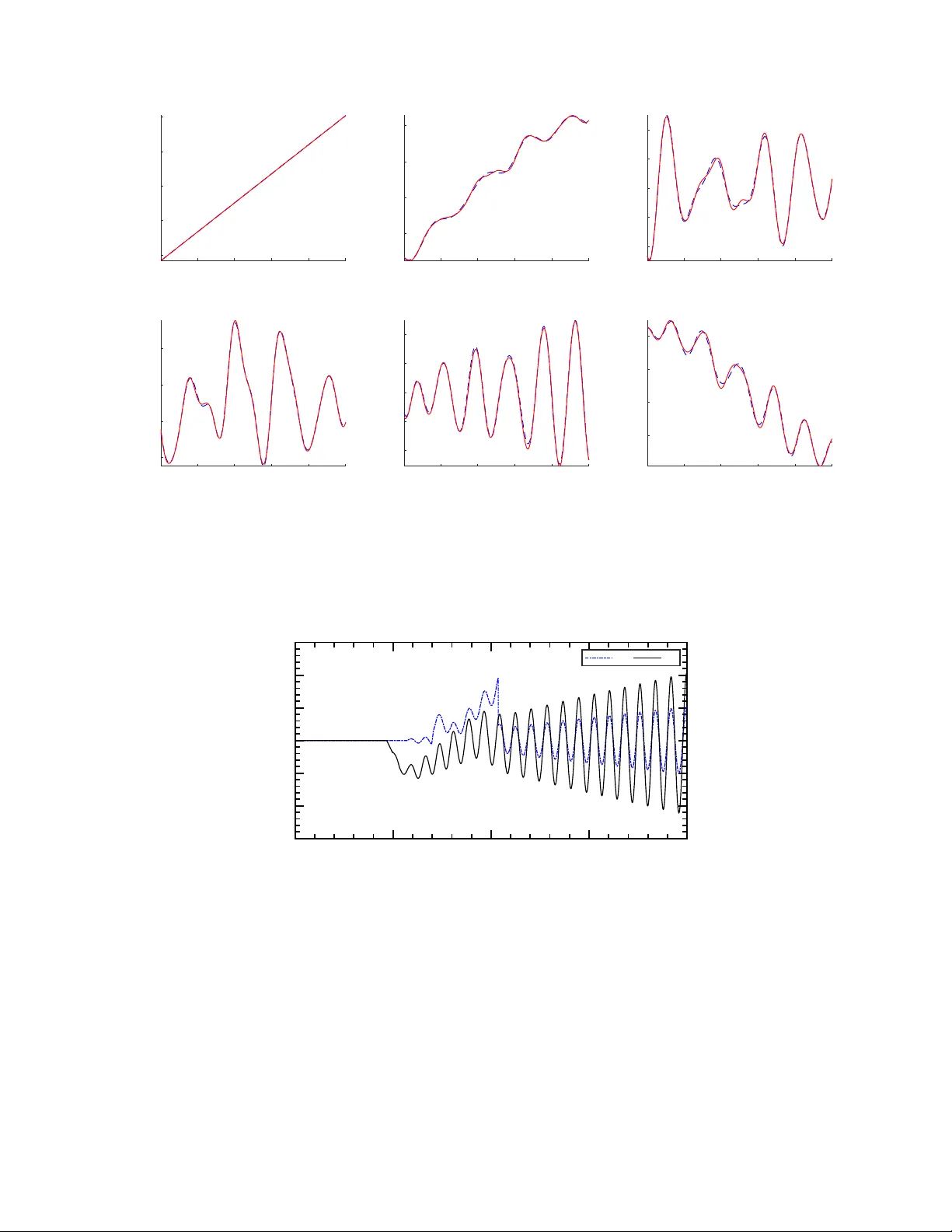
Modeling and Simulation of U A V Carrier Landings Gaura v Misra ∗ , Tian yu Gao † , and Xiaoli Bai ‡ Rutg er s, The Stat e U niv ersity of N ew Jer sey, Piscataw ay , NJ, 08854 With U A Vs’ promising capabilities to increase operation flexibility and reduce mission cost, w e ar e e xploiting the automated carrier-landing performance advancement that can be achie v ed b y fixed-wing U A Vs. T o demonstrate such potentials, in this paper , we in v estigate tw o k e y metrics, namely , flight path control performance, and reduced approach speeds f or U A Vs based on the F/A-18 High Angle of Attack (HAR V) model. The landing control arc hitecture consists of an auto-throttle, a stability augmentation system, glideslope and approach track controllers. The per f ormance of the control model is tested using Monte Carlo simulations under a rang e of en vironmental uncertainties including atmospheric turbulence consisting of wind shear , discrete and continuous wind gusts, and carrier airw ak es. Realistic deck motion is consider ed where the standard deck motion time histories under the Systematic Characterization of the Na val En vironment (SCONE) program released b y the Office of Na val Resear ch (ONR) are used. W e numerically demonstrate the limiting approach conditions which allo w for successful carrier landings and factors affecting it ’s perf ormance. I. Introduction The highl y demanding task of landing a high-performance aircraft on a carr ier has been significantly researched and dev eloped since January 1911 when Eug ene Ely landed a biplane aboard on the USS P ennsy l vania. Shipboard landing requires an aircraft to land on a pitching and rolling deck in highl y turbulent ship air wak es; the landing area is very small and the landing needs to be so precise that the landing er ror must remain within one f oot. Moreo v er , the landing often has to be performed at night and in inclement w eather . Although automatic take-off and landing technology has been tested using piloted aircraft such as F/A -18E/F [ 1 , 2 ], the full potential of emerging unmanned air v ehicles (U A Vs) has not y et been sy stematically explored and thoroughl y in v estig ated f or aircraft automated carr ier landing. For example, although a low approach speed is highly desired f or reasons such as to reduce the loads imposed on the arresting wires and on the aircraft, dependent on the exis ting flight control sys tem, the cur rent approach speed is required not be less than 110 % of the stall [ 3 ]. Although this stall mar gin criter ion has been repor ted to be inadequate and difficult to justify , we hav e not found a r igorous study on the possible minimum approac h speed. In addition, atmospher ic and car r ier induced turbulence directly impact the approach conditions. Theref ore, reduced approach speeds under turbulence needs further inv estigation. Eliminating the factor of pilots from the flight control system design av oids many inherent difficulties f or manned aircraft because of cre w s ’ operational and phy sical constraints and introduces a wide range of other wise-non-e xisting fle xibilities and potential advantag es to be e xploited for optimizing the carr ier landing processes. T ogether with the advantag e of using man y highly mature technologies gained ov er decades of manned aircraft de v elopment, U A Vs are e xpected to achiev e performance lev els significantly bey ond what piloted aircraft could possibl y accomplish. W e are currently e xploiting the landing performance advancement that can be achiev ed by fix ed-wing U A Vs. The potential benefits include: reduced approach speed closer to stall, reduced sink rate approach near the ship, reduced sink rate at touchdo wn, reduction of the landing position deviation from the arresting wire, and reduction of the flight path deviation from the ref erence. T o demonstrate such potentials, we dev elop baseline aircraft models with baseline flight controls representativ e of the F/A-18 High Angle of Attac k (HAR V) model, which will be used to compare the carr ier landing performance betw een the current technology and the advanced concepts proposed in this researc h. Although recent literature on automated carr ier landing looks at adv anced control techniques such as ` 1 adaptiv e control [ 4 ], disturbance rejection control [ 5 ], pre vie w control [ 6 ], and stoc hastic model predictiv e control [ 7 ], in this paper , the f ocus is on numer ical inv estigation of flight per f ormance and reduced approach speeds under baseline proportional-integ ral-derivativ e (PID) feedbac k control law s. This approach is taken since cur rent operational control architectures are largel y PID based. In addition, in larg ely all of the cur rent a v ailable literature, the usual assumption ∗ Ph.D. Candidate, Mec hanical and A erospace Engineer ing and AIAA Student Member . † Ph.D. Student, Mechanical and Aerospace Engineering ‡ Assistant Professor , Mechanical and Aerospace Engineer ing and AIAA Senior Member. 1 Fig. 1 System simulation models is a fixed approach condition, with an approach speed typically in the range of 220 − 250 ft/s and a fixed descent glideslope of 2 . 5 − 4 deg . The main contr ibutions of this paper are the rigorous numerical verification of the flight control architecture under a range of en vironmental conditions which include lo w intensity atmospher ic turbulence, car rier air w akes and deck motion. In addition, we numer ically demonstrate the limiting approach speed at whic h car rier landing can be conducted under the same environmental setup. The landing performance is assessed b y studying the deck landing dispersion, final altitude er ror , final glideslope, and lateral state errors. The paper outline is as f ollo ws. Section II f ocuses on the baseline simulation including the aircraft model, the control la ws consisting of a stability augmentation sys tem, auto-throttle, and a glideslope and approach trac k controller f or longitudinal and lateral landing control, respectivel y , and the environmental components including the atmospheric turbulence and car rier air wak es. The numerical implementation of the SCONE data in the simulation model giv en as a look -up table is also provided. Section III presents numer ical results f or the tw o per f or mance metrics on flight path control and reduced approach speed. Lastl y , section IV summar izes the results and future w ork. II. Simulation Models The simulation models dev eloped are schematicall y illustrated in Figure 1. The airborne components include baseline fix ed-wing U A V models including equations of motion, aerodynamic models, engine models, and a baseline flight control sys tem. The en vironment components include aircraft carr ier dynamic model, atmospheric wind and carr ier air wak e. Cur rent approach and landing procedures from [ 8 ] are f ollow ed. Also because the objectiv es of this study are f ocused on reduced approach speed and landing performance, we only consider the segment after ‘tip o ver ’ of the approach. The nominal glides slope will be set as a constant such as 3.5 degree. A. Baseline Aircraft Models A model representative of F/A-18 E/F has been de v eloped based on the F/A-18 High angle of attack (HAR V) model [9]. The phy sical parameters f or the HAR V model are shown in T able 1. 2 T able 1 Aircraft Parameters Wing Area, S 400 ft 2 Wing Span, b 37.42 ft Mean Aerodynamic Chord, c 11.52 ft Mass, m 1036 slug Maximum Thrust, T m 11,200 lb R oll Moment of Iner tia, I x x 23,000 slug-ft 2 Pitch Moment of Inertia, I y y 151,293 slug-ft 2 Y aw Moment of Inertia, I z z 169,945 slug-ft 2 The aerodynamic coefficients used in this study hav e been e xtracted from [ 10 ]. For car r ier approach and landing configuration, the sea lev el altitude is considered f or atmospheric proper ties . Assuming leading and trailing edg e flaps completely do wn to 17.6 degrees and 45 degrees, respectiv el y , and both left and right ailerons down to 42 deg, the aerodynamic coefficient dependencies are giv en as [10]. C D = ( 0 . 0013 α 2 − 0 . 00438 α + 0 . 1423 − 5 ≤ α ≤ 20 − 0 . 00000348 α 2 + 0 . 0473 α − 0 . 3580 20 ≤ α ≤ 40 (1) C L = ( 0 . 0751 α + 0 . 0144 δ e + 0 . 732 − 5 ≤ α ≤ 10 − 0 . 00148 α 2 + 0 . 106 α + 0 . 0144 δ e + 0 . 569 10 ≤ α ≤ 40 (2) C Y = − 0 . 0186 β + δ a 25 (− 0 . 00227 α + 0 . 039 ) + δ r 30 (− 0 . 00265 α + 0 . 141 ) (3) C m = − 0 . 00437 α − 0 . 0196 δ e − 0 . 123 q − 0 . 1885 (4) C l = C ∗ l − 0 . 0315 p + 0 . 0216 r + δ a 25 ( 0 . 00121 α − 0 . 0628 ) − δ r 30 ( 0 . 000351 α − 0 . 0124 ) (5) where (6) C ∗ l = ( (− 0 . 00012 α − 0 . 00092 ) β − 5 ≤ α ≤ 15 ( 0 . 00022 α − 0 . 006 ) β 15 ≤ α ≤ 40 (7) (8) C n = C ∗ n − 0 . 0142 r + δ a 25 ( 0 . 000213 α + 0 . 00128 ) + δ r 30 ( 0 . 000804 α − 0 . 0474 ) (9) where (10) C ∗ n = 0 . 00125 β − 5 ≤ α ≤ 10 (− 0 . 00022 α + 0 . 00342 ) β 10 ≤ α ≤ 40 − 0 . 00201 β 25 ≤ α ≤ 40 (11) where α and β are the angle of attack and sideslip angle, respectiv ely , C D , C L , C Y are the drag, lift and side f orce coefficients; C l , C m , and C n are the roll, pitch, and ya w-moment coefficients, respectiv ely , and δ a , δ e and δ r are the aileron, elev ator , and rudder deflections in deg. The simulation results sho wn in Section III consider aerodynamics till an angle of attack upto 40 deg. B. Baseline Flight Control Sy stem The baseline flight control system includes a glideslope controller , an approach track controller , a stability augmentation sy stem (S AS) and auto-throttle. The diagram of the controls is sho wn in Figure 2. The control system architecture proposed here is based on the flight control sy stem presented in [9]. 3 A pp r oa c h T r a c k C ontr ol l er A i r c r a ft D y na m i c M od el S ta bi l i ty A ug m en ta ti on S y st em G l i de sl ope C ontr ol l er A u to - thr ot tl e A c tua tor C a r r i er D y na m i c s M ode l Co n t r o l S u r f a c e Co m m a n d T h r o t t l e Co m m a n d A i r sp eed Mea su r ed a n g l es 𝜙 , 𝜃 , 𝜓 D esi r ed 𝜃 S i d es l i p ( 𝛽 ) , M ea su r ed l a t e r a l d i sp l a c e m e n t ( y ) M e a s u r e d H e i g h t D ec k A l t i t u d e S h i p L a t er a l P o si t i o n D esi r ed 𝜙 , D es i r ed Y a w r a t e Fig. 2 Control sy stem diagram 1. Stability Augmentation Sy stem Stability augmentation sys tem(S AS) is commonl y used to enhance the stability of an aircraft dur ing flight. Proportional-der ivativ e-integral (PID) controllers are implemented in the study to regulate the aircraft ’ s attitude to the desired state. Giv en the desired aircraft attitude in ter ms of Euler angles φ d , θ d , ψ d and tr immed elev ator deflection angle δ et r i m which is non-zero during the steady gliding, er rors from desired and measured angles are the inputs of the PID blocks. The str ucture of the S AS is shown in Figure 3. Fig. 3 Stability augmentation system 4 The S AS gains are tuned using Simulink’s control system design toolbox. The control la ws of PID Controllers are listed below , where η e a d , η a a d , η r a d are actuator demands of the elevator , aileron, and rudder , respectiv ely and θ , φ , and ψ are the errors in pitch, roll, and ya w . η e a d = δ et r i m + P θ θ + I θ ∫ θ d t + D θ d d t θ (12) η a a d = P φ φ + I φ ∫ φ d t + D φ d d t φ (13) η r a d = P ψ ψ + I ψ ∫ ψ d t + D ψ d d t ψ (14) The tuned gains for the SAS used in the simulations in Section III are pro vided in the table below T able 2 T uned SAS gains P θ -53.227 I θ -2.354 D θ -97.452 P φ -14.997 I φ -0.7946 D φ -62.889 P ψ 179551.93 I ψ 758023.01 D ψ 3565.813 The S AS also includes second order actuator models f or the elev ator , aileron, and rudder and are e xpressed as [ 11 ] δ e δ c = 30 . 74 2 s 2 + 2 ( 0 . 509 )( 30 . 74 ) s + 30 . 74 2 (15) δ a δ c = 75 2 s 2 + 2 ( 0 . 59 )( 75 ) s + 75 2 (16) δ r δ c = 72 . 1 2 s 2 + 2 ( 0 . 69 )( 72 . 1 ) s + 72 . 1 2 (17) (18) where δ c is the actuator input. 2. Glideslope Controller A glideslope based on the PID control law is implemented to stabilize the glideslope of the aircraft under disturbances. The control law is a function of the er ror in the aircraft ’ s relative altitude to the car rier deck represented as h in Eq. 19. Inspired by the approach glide path controller in [ 9 ], we design the resulting control la w based on the desired pitch angle ( θ ) which is then regulated using the SAS described abo v e. The structure of controller is sho wn in Figure 4 and the corresponding gains are giv en in T able 3. Additionall y , from the obtained simulation results which will be explained later , it is observed that the error in the aircraft rang e (x) is typically small, under a lo w perturbation of wind. Theref ore w e do not e xplicitly consider a hor izontal range controller in this paper , under the obser vation that the auto-throttle can regulate the airspeed in e xponential time. 5 Fig. 4 Glideslope controller The gains for the vertical controller hav e been tuned in presence of atmospher ic turbulence. The resulting control la w is giv en as θ d = P g s h + I g s ∫ h d t + D g s d d t h (19) T able 3 T uned approac h track controller gains P g s -0.02736 I g s -0.000959 D g s -0.17342 3. Approac h T rac k Contr oller The approach track controller design f ollow s the methodology giv en in [ 8 ]. The controller consists of tw o components: the aircraft ’ s lateral position relative to the ship’ s lateral motion in a ground fix ed reference frame is controlled via the ailerons through a desired roll command. In addition, a sideslip controller is implemented controlled via the r udder through a desired y a w rate command. The control law s are descr ibed as φ d = K p y y e + K i y ∫ y e d t + K d y d y e d t (20) r d = K p β β e + K i β ∫ β e d t + K d β d β e d t (21) where y e is the er ror in the aircraft ’ s lateral position relative to the ship, and β e is the sideslip er ror . The tuned gains are T able 4 T uned approac h track controller gains K p y -0.02736 K i y -0.000959 K d y -0.17342 K p β 9109.4 K i β 35962.11 K d β 308.67 4. Auto-thr ottle An auto-throttle control enables the regulation of the aircraft airspeed via the throttle. This is especiall y impor tant during car rier landing operations where a fixed approach speed is usually required. The control law is obtained by enf orcing the follo wing first order error dynamics. Û V + K u ( V − V T ) = 0 (22) 6 where V is the measured airspeed, K u is the gain, and V T is the trim airspeed required to be maintained dur ing landing. Substituting the equations for the der ivativ e of the airspeed, the desired throttle response can be f ound as T d = m K u ( V T − V ) + F dr a g + m g sin γ T m a x cos α cos β (23) where m is the aircraft mass, F dr a g is the drag f orce, γ is the glideslope angle, and T m a x = 11200 lb is the maximum thrust. The tuned gain K u used in the simulations is calculated as 73 . C. En vironment Model The en vironment model described in Figure 1 consists of carr ier motion, atmospheric disturbance, and the car rier airwake model. The atmospheric disturbance model based on the guidelines in the Department of Def ense handbook of flying qualities [ 12 ] includes three components: a turbulence mode, discrete wind gusts, and wind shear . The car rier airwake model consists of f ours components: per iodic ship-motion induced turbulence, steady carr ier airwake, random free air turbulence, and random ship wak e disturbance. 1. T urbulence Model Continuous wind gus ts considered here are spatiall y varying stoc hastic processes with Gaussian probability distribution. These gusts are commonl y modeled using the Dryden or V on Kármán models with their standardized f or ms pro vided in [ 12 ]. Both gust models are e xpressed in ter ms of its po wer spectral densities wherein the random processes are colored. The dr yden f or m of the spectra f or the gust components is giv en as Φ u g ( Ω ) = σ 2 u L u π 1 1 + ( L u Ω ) 2 (24) Φ w g ( Ω ) = σ 2 w L w π 1 + 3 ( L w Ω ) 2 ( 1 + ( L w Ω ) 2 ) (25) Φ q g ( Ω ) = Ω 2 1 + ( 4 b Ω π ) 2 Φ w g ( Ω ) (26) where Φ u g , Φ w g , and Φ q g are the po w er spectral densities f or translational ( u g , w g ) and rotary ( q g ) gust components; Ω is the spatial frequency , σ u , σ w are the RMS turbulence intensities, L u and L w are the turbulence scales, and b is the aircraft ’ s wing span. For lo w altitude ( ∼ 200 ft), the gust model parameters are taken as [12] L w = 100 ft (27) L u = h ( 0 . 177 + 0 . 000823 h ) 1 . 2 ft (28) σ w = 0 . 1 W 20 ft/s (29) σ u = σ w ( 0 . 177 + 0 . 000823 h ) 0 . 4 ft/s (30) where h is the altitude in ft and W 20 is the wind speed at 20 ft. Figure 5 sho ws the wind realizations at lo w turbulence. 7 0 5 10 15 20 Time(s) -6 -4 -2 0 2 4 6 Continuous gust (ft/s) Ux Uy Uz Fig. 5 Continuous gusts 2. Discr ete W ind gusts The discrete gusts used in the study are based on a "1-cosine" model shown in Figure 6. The inputs required to generate the gust are the gust lengths and gus t magnitudes. u x , w x = 0 , x < 0 (31) u x , w x = V m 2 ( 1 − cos ( π x d x , y , z )) 0 ≤ x ≤ d m (32) u x , w x = 0 x > d m (33) where u x and w x are the discrete gust components in x and z axis of the aircraft body frame, V m is the gust amplitude, d m is the gust length defined as the point where the gust reaches it maximum, and x is the distance trav eled from the beginning of the simulation (starting from zero). The chosen parameter V m is 3 . 5 ft/s for gust in x axis and 3 ft/s f or gust in z axis. The chosen gust length is 250 in both x and z axis. The aircraft body frame is the coordinate fixed to the body , f or which x-axis points to nose, y-axis points to r ight wing, and z-axis obey s to r ight-hand rule. 0 5 10 15 20 Time(s) 0 1 2 3 4 Discrete gust (ft/s) Ux Uy Uz Fig. 6 Discrete gusts 3. Wind Shear The v er tical wind shear in the vertical direction is calculated as W w s = W 20 log ( h / z 0 ) log ( 20 / z 0 ) (34) 8 where W w s is the v ertical wind shear, W 20 is the wind v elocity at 20 f eet and is 15, 30, and 45 knots f or lo w , moderate, and high turbulence, respectiv ely . z 0 is specified as 0.15 ft f or Categor y C flight phase which is the terminal phase. It should be noted that the W 20 is typicall y pro vided as a cur v e with respect to probability of occurrence with low and very lo w turbulence.The resultant mean wind shear in the iner tial frame is changed to body-fix ed axis coordinates. 0 5 10 15 20 Time(s) -15 -10 -5 0 Wind shear (ft/s) Uz Uy Ux Fig. 7 V ertical wind shear 4. P eriodic ship motion induced disturbance The periodic wind disturbance which acts in the v ertical and axial direction is a function of the v elocity of wind o ver deck, the car r ier’ s pitching frequency , pitch magnitude, and aircraft rang e. Wind o v er deck v elocity is calculated as the difference betw een the nominal wind at sea and the (equal but opposite direction) of the ship v elocity . U p = θ a c V w / d ( 2 . 22 + 0 . 0009 X c ) C (35) W p = θ a c V w / d ( 4 . 98 + 0 . 0018 X c ) C (36) C = cos ω p t ( 1 − V − V w / d 0 . 85 V w / d ) + X c 0 . 85 V w / d + P (37) where U p and W p are the axial and v ertical wind disturbance, X is relative aircraft position, θ a c is ship pitch, w p is pitching frequency , V is aircraft speed, V w / d is wind o v er deck, P is a random phase. Note that periodic air wak e f or longitudinal direction is zero f or range greater than 2236 feet and zero for vertical direction when range is greater than 2536 f eet. F igure 8 illustrates the disturbance ov er a time span of 20 s. 0 5 10 15 Time (s) -2 -1 0 1 2 Periodic disturbance (ft/s) U p W p Fig. 8 P eriodic carrier turbulence For the simulation sho wn abo ve, the range begins at 3142 f eet, airspeed is tak en as 225 ft/s, ship speed is taken as 15 9 knots, nominal sea wind is taken as 5.4 knots, the pitch is assumed as 0.018 rad, pitching frequency is assumed as 0.62 rad/s, and random phase P is taken as 0.25 π . 5. Steady carrier air wake The steady component of the airwake is pro vided as a look -up table in terms of the ratio of the steady -wind ( U s and W s ) o v er the wind o ver dec k V w / d and the range from the carr ier center of pitch (COP)[ 8 ] and is illustrated in Figure 9. -3000 -2500 -2000 -1500 -1000 -500 0 Position from carrier COP (ft) -0.5 0 0.5 1 Steady airwake(ft/s) U s W s Fig. 9 Steady carrier airwak e 6. F ree air and r andom turbulence The free air turbulence in the carr ier disturbance model is calculated by passing white noise through a filter . This component is independent of the aircraft ’ s relativ e position. The transf er functions to generate the wind are giv en as [ 12 ] u f η = s 200 V t 1 1 + 100 s V t (38) v f η = s 5900 V t 1 + 400 s V t ( 1 + 1000 s V t )( 1 + 400 s 3 V t ) (39) w f η = s 71 . 6 V t 1 1 + 100 s V t (40) (41) where V t is the approach air speed, u f , v f and w f are the turbulence in x,y and z axis, and η is the band limited white noise. Figure 10 show s the variation of free air turbulence with time, where V t is taken as 218 ft/s f or the simulation belo w . The random component of the airwak e is also given as filtered white noise and is a function of the wind-ov er -deck, and the aircraft ’ s relative position to the car r ier . The random components are computed as U x ˆ η = σ ( X c ) √ 2 τ ( X c ) τ ( X c ) s + 1 (42) U z ˆ η = 0 . 035 V w d p ( 6 . 66 ) 3 . 33 s + 1 (43) where σ ( X c ) and τ ( X c ) are pro vided as a look -up table. The white noise ˆ η is obtained as ˆ η = η j ω j w + 0 . 1 sin ( 10 π t ) (44) 10 0 5 10 15 20 Time(s) -1 -0.5 0 0.5 1 Free air carrier airwake (ft/s) Ux Uy Uz Fig. 10 Free air turbulence 0 5 10 15 20 Time(s) -0.3 -0.2 -0.1 0 0.1 0.2 0.3 0.4 Random carrier airwake (ft/s) Ux Uw Fig. 11 Random turbulence D. Carrier Motion The car rier dec k motion used in the simulations is based on the Systematic Characterization Of the N a val Environment (SCONE) data pro vided by the Office of N a v al Researc h (ONR). The data includes “lo w”, “medium”, and “high” deck motion cases f or either roll or hea ve rate as the pr imar y determinant of motion lev el. The data is provided as a look -up table f or sev eral sea-s tate lev els o v er a total time frame of 30 minutes under a sampling rate of 20 Hz. The look -up table is not directl y compatible with the Simulink based controller architecture dev eloped since the propag ation of the aircraft states uses a variable step size numerical ordinar y differential equation (ODE) solv er . N onlinear reg ression tools are used to fit the av ailable data into time-parametr ized functions giv en mostl y as either sum of sinusoids or Fourier series. Fig. 12 sho ws the fitted profiles f or the car rier’ s position and velocity for the heav e dominated, low sea state. 11 10 20 30 40 50 Time (s) -200 0 200 400 600 Ship x position (ft) 10 20 30 40 50 Time (s) -5 0 5 10 Ship y position (ft) 10 20 30 40 50 Time (s) -55 -54 -53 -52 -51 Ship z position (ft) 10 20 30 40 50 Time (s) -0.2 0 0.2 0.4 Ship roll angle (deg) 10 20 30 40 50 Time (s) -0.4 -0.2 0 0.2 0.4 Ship pitch angle (deg) 10 20 30 40 50 Time (s) -0.4 -0.2 0 0.2 Ship yaw angle (deg) Fig. 12 Nonlinear regression fit of Scone dat a with lo w sea state. Red and blue ref er to the fitted and scone data, respectiv ely . Using the numer ical fit, the deter ministic car r ier airwake profile which includes both per iodic and steady airwake is illustrated in F ig. 13. 0 5 10 15 20 Time(s) -15 -10 -5 0 5 10 15 Deterministic carrier airwake (ft/s) Ux Uz Fig. 13 Deterministic carrier airw ake obtained using SCONE data III. Simulation Results Monte-carlo analy sis is conducted to assess the controller per f or mance in terms of the tw o per f or mance metr ics described below A. Flight path control perf ormance The flight control per f or mance is analyzed by conducting 50 simulations with randomized initial conditions defined in T able 5. The wind environment consists of atmospheric turbulence including discrete, continuous gusts and wind shear , and car rier airwak es. The turbulence le vel considered is lo w . The sea-state considered is lo w and heav e dominated 12 as illustrated in Fig. 12. The noise seed taken f or g enerating the stochas tic component of gusts is sampled using unif or mly distr ibuted pseudo-random integ ers betw een 0-10 5 . The control inputs w ere saturated bef ore implementing them in the aircraft equations of motion. This is done to ensure that no control bound violations occur . As explained in the pre vious sub-section, nonlinear regression tools were used to pro vide time profiles of the ship motion from the SCONE data. T able 5 Simulation Setup Wind direction U nif or mly distr ibuted pseudo-random integ ers betw een 0 to 180 degrees Continuous gust v elocity U nif or mly distr ibuted pseudo-random integ ers -8 to 8 ft/s Wind shear v elocity U nif or mly distr ibuted pseudo-random integ ers betw een -2 to 2 ft/s Discrete gusts U nif or mly distr ibuted pseudo-random integ ers betw een -2 to 2 ft/s Time of flight 20 s Initial states T r im, V T = 225 ft/s, α = 7 . 25 deg , θ = 3 . 81 deg . Out of 50 simulations, 3 cases w ere reported to be failures, thereb y making the landing success as 96%. The deck landing dispersion is shown in Fig. 14. The landing area lay out is based on a Nimitz class car r ier and is obtained from [13]. -60 -40 -20 0 20 40 60 Lateral touchdown location (ft) -100 -50 0 50 100 Longitudinal touchdown location (ft) Wire 2 Wire 3 Wire 1 Wire 4 Runway edge Runway edge Fig. 14 Landing dispersion For most of the successful traps, the lateral dispersion is within ± 5 ft. On the contrar y , the longitudinal dispersion is much larger . 2 bolter cases are reported, wherein the aircraft touches do wn on the deck but the hook misses all the wires. There are tw o cases where the aircraft touches do wn approximatel y 3 ft from the fourth wire. These are considered as successful landings since typicall y there is an er ror margin called the safe landing edge after the f our th wire. There is one case where the aircraft f ails to clear the ramp in the given time and is not shown in the figure. The mean longitudinal landing position is -0.86 ft while the mean lateral landing position is 1.31 ft. The s tandard deviation for the longitudinal 13 position is 37.2 ft while it is 0.92 ft f or the lateral position. The final altitude is shown in Fig. 15. F or all successful landings, the final altitude error is less than 13 ft. Fig. 16 show s the av erage wind speed in x,y , and z directions. The mean wind magnitudes f or most cases are repor ted to be belo w 6 ft/s which cor responds to lo w turbulence conditions. 5 10 15 20 25 30 35 40 45 Simulation number 0 2 4 6 8 10 12 Final altitude (ft) Fig. 15 Final altitude f or successful landings 0 20 40 Simulation number 0 1 2 3 4 5 6 Mean longitudinal wind (ft/s) 0 20 40 Simulation number 0 1 2 3 4 5 6 Mean lateral wind (ft/s) 0 20 40 Simulation number 0 0.5 1 1.5 2 Mean vertical wind (ft/s) Fig. 16 Mean wind speeds in x,y , and z directions B. Reduced Approach Speed Anal ysis The car rier landing per f or mance under the same baseline control law s is s tudied but with reduced approach speeds. T o this end, eight trim conditions are numerically computed at different reduced approach speeds ranging from 150-200 ft/s. The tr im states for the reduced approach speeds are giv en in T able 6. T able 6 Reduced approach speed trim conditions V t (ft/s) 150 155 160 165 170 180 190 200 210 215 220 α (deg) 23.3 21.86 20.39 19.01 17.67 15.26 13.08 11.15 9.45 8.67 7.94 θ (deg) 19.89 18.37 16.92 15.50 14.22 11.60 9.66 7.67 5.97 5.26 4.46 δ e (deg) -14.83 -14.49 -14.16 -13.85 -13.55 -13.02 -12.53 -12.01 -11.72 -11.55 -11.38 Thrust (lb) 8540 7900 7300 6720 6220 5200 4600 4000 3600 3500 3350 14 The anal ysis is divided into three separate cases of the wind environment, namel y , high fidelity wind model with atmospheric and carr ier turbulence, atmospher ic turbulence but without air wak es, and atmospheric turbulence and airwakes but without wind shear . The motivation behind choosing these three cases is to numerically assess the impact of individual wind components on the flight per f or mance. For each wind scenar io and elev en different approach speed, 50 simulations with random wind conditions cor responding to low turbulence shown in T able 5, are conducted, resulting in a total of 1650 Monte Carlo runs. For all the cases studied, the angle of attack is limited to 40 deg due to the una vailability of aerodynamic data bey ond this value. The landing success used in all the cases studied is based on the f ollowing criteria • The altitude error must be smaller than 15 ft. • The altitude error should be positive, as a neg ativ e er ror cor responds to a strike. • The final glideslope error must be less than 5 deg. • The final landing point must be on the dec k and where the aircraft catches one of the four arresting wires. If the landing point misses the f our th wire by a margin greater than 5 ft, it is considered a bolter . • The final sink rate must be smaller than 12 ft/s. 1. Case-I: Atmospheric turbulence and air wake This case cor responds to a high fidelity model with continuous and discrete gusts, wind shear and car rier air wak es. A total of 50 simulations are conducted for each approach speed and the landing dispersion is recorded. Cases where the final landing point is outside the dec k rang e are not sho wn in the Fig. 17. In T able 7, w e summar ize the results in terms of success rate along with mean and standard deviation of final landing positions f or successful wiretraps. In all subsequent result summaries, f or the longitudinal position, the mean is denoted as µ x and standard de viation as σ x . For the lateral position, the mean is denoted as µ y and standard de viation as σ y . The final altitude er ror is shown in Fig. 18. The variance in the altitude error is obser v ed to decrease with the approach speeds. -50 0 50 -100 -50 0 50 100 Approach speed: 150 ft/s -50 0 50 -100 -50 0 50 100 Approach speed: 155 ft/s -50 0 50 -100 -50 0 50 100 Approach speed: 160 ft/s -50 0 50 -100 -50 0 50 100 Approach speed: 165 ft/s -50 0 50 -100 -50 0 50 100 Approach speed: 170 ft/s -50 0 50 -100 -50 0 50 100 Approach speed: 180 ft/s -50 0 50 -100 -50 0 50 100 Approach speed: 190 ft/s -50 0 50 -100 -50 0 50 100 Approach speed: 200 ft/s Fig. 17 Landing dispersion 15 T able 7 Result summary for reduced approach speeds V t (ft/s) 150 155 160 165 170 180 190 200 210 215 220 Success rate 88% 84% 90% 86% 92% 92% 90% 98% 92% 88% 90% µ x (ft) -3.46 -12.58 -8.37 -5 -7.77 -6.75 -13.1 -4.05 -9.55 -3.37 -9.59 µ y (ft) 1.23 1.37 1.23 1.48 1.22 1.02 1.59 1.43 1.50 1.55 1.53 σ x (ft) 32.12 35.2 36.67 40.32 35.25 35.73 34.74 31.4 39.16 42.75 40.2 σ y (ft) 2.73 2.04 2.26 2.06 1.68 1.02 1.3 0.9 0.94 0.81 0.75 From the results, it is found that the success rate is typicall y high f or all ranges of approach speed. The standard deviation in lateral dispersion is observed to decrease with increasing approach speeds. Ho we ver ,f or the longitudinal dispersion, the standard deviation is not found to ha ve a particular trend. In all the cases, the longitudinal landing dispersion is quite significant with the standard deviation σ x larg er than 30 ft. 150 ft/s 155 ft/s 160 ft/s 165 ft/s 170 ft/s 180 ft/s 190 ft/s 200 ft/s 210 ft/s 215 ft/s 220 ft/s 0 5 10 15 Altitude error (ft) Fig. 18 Altitude error 2. Case-II: Continuous gusts and air w ake In this case, the effect of wind shear and discrete gusts is not considered in simulations. Interes tingly , the landing performance impro ves remarkabl y for all approach speeds with 100 % success rate f or all cases. This is due to the fact that both shear and discrete gust profiles are near ly constant throughout the flight and impact the airspeed more than continuous gusts and airwak es which are time-v arying. F or speeds 155-220 ft/s, all cases repor ted successful wire traps betw een the second and third arresting wire as sho wn in Fig. 19. The altitude error w as also contained within 15 ft sho wn in Fig. 20. As expected, the dispersion and altitude er rors reduced as the approach speeds w ere increased. The standard de viation dispersion in both longitudinal and lateral plane are reduced with increased approach speeds as seen from T able 8. 16 T able 8 Success rate f or reduced approach speeds V t (ft/s) 150 155 160 165 170 180 190 200 210 215 220 Success rate 100% 100% 100% 100% 100% 100% 100% 100% 100% 100% 100% µ x (ft) -2.14 0.93 2.03 0.87 -1.37 -0.34 -0.42 -1.94 -0.47 -0.67 -0.09 µ y (ft) 0.81 1.07 1.1 1.16 0.32 1.27 2.28 1.46 1.42 1.42 1.42 σ x (ft) 10.25 6.36 8.98 8.58 8.1 8.23 7.85 7.99 6.67 4.10 7.35 σ y (ft) 1.4 0.54 0.57 0.45 0.32 0.26 0.25 0.21 0.14 0.09 0.19 -50 0 50 -100 -50 0 50 100 Approach speed: 150 ft/s -50 0 50 -100 -50 0 50 100 Approach speed: 155 ft/s -50 0 50 -100 -50 0 50 100 Approach speed: 160 ft/s -50 0 50 -100 -50 0 50 100 Approach speed: 165 ft/s -50 0 50 -100 -50 0 50 100 Approach speed: 170 ft/s -50 0 50 -100 -50 0 50 100 Approach speed: 180 ft/s -50 0 50 -100 -50 0 50 100 Approach speed: 190 ft/s -50 0 50 -100 -50 0 50 100 Approach speed: 200 ft/s Fig. 19 Landing dispersion 17 150 ft/s 155 ft/s 160 ft/s 165 ft/s 170 ft/s 180 ft/s 190 ft/s 200 ft/s 210 ft/s 215 ft/s 220 ft/s 11 11.5 12 12.5 13 13.5 Altitude error (ft) Fig. 20 Altitude error 3. Case-III: Wind shear , continuous, discre te gusts (No airwake) This case cor responds to the calm sea state case where the effect of carr ier airwak es is ignored. T ypically , this w ould happen if the car rier is moving at very low speeds. The landing dispersion illustrated in Fig. 21 show s worse performance compared to the both no wind shear and discrete gust case and the full-wind case. The error in the lateral direction is minimal with the mean less than 2 ft as seen from T able 9 and most of the landing error is concentrated in the longitudinal direction. F or the case of an approach speed of 150 ft/s, negativ e altitude er rors are observed, as sho wn in Fig. 22. This typicall y ref ers to the failure case of a rampstrike, wherein the aircraft strikes the ramp since the approach altitude w as too low . T able 9 Success rate f or reduced approach speeds V t (ft/s) 150 155 160 165 170 180 190 200 210 215 220 Success rate 78% 86% 88% 84% 86% 92% 92% 92% 88% 92% 88% µ x (ft) 4.79 2.13 1.88 2.73 11.09 6.43 0.86 -6.02 0.04 -1.62 -2.39 µ y (ft) 0.94 1.01 1.2 1.43 1.09 1.12 1.52 1.66 1.34 1.53 1.57 σ x (ft) 30.3 42.12 37.87 34.45 40.92 39.18 44.29 36.84 32.14 41.07 44.41 σ y (ft) 2.09 2.13 2.08 1.67 1.4 1.57 1.2 0.98 0.75 0.75 0.69 18 -50 0 50 -100 -50 0 50 100 Approach speed: 150 ft/s -50 0 50 -100 -50 0 50 100 Approach speed: 155 ft/s -50 0 50 -100 -50 0 50 100 Approach speed: 160 ft/s -50 0 50 -100 -50 0 50 100 Approach speed: 165 ft/s -50 0 50 -100 -50 0 50 100 Approach speed: 170 ft/s -50 0 50 -100 -50 0 50 100 Approach speed: 180 ft/s -50 0 50 -100 -50 0 50 100 Approach speed: 190 ft/s -50 0 50 -100 -50 0 50 100 Approach speed: 200 ft/s Fig. 21 Landing dispersion 150 ft/s 155 ft/s 160 ft/s 165 ft/s 170 ft/s 180 ft/s 190 ft/s 200 ft/s 210 ft/s 215 ft/s 220 ft/s -2 0 2 4 6 8 10 12 14 Altitude error (ft) Fig. 22 Altitude error From the three cases analyzed, the impact of wind shear and discrete gust is f ound to be the highest on the landing performance. This intuitivel y makes sense since both shear and discrete gust profiles are typically constant throughout the time of flight considered. This effect is especially sev ere on the longitudinal dispersion while the altitude er rors are still relativ ely contained. An approach speed of 150 ft/s is numer ically f ound as the limiting case belo w which the landing success is limited. An y approach speed less than this limiting speed w ould typically hav e sev ere flight path performance degradation. It should be noted that from the aerodynamic analy sis, the angle of attac k hang-up condition where limited pitch restoring moment is av ailable to reco v er from a high angle of attack condition and can cause altitude loss is about 55 deg [ 14 ]. In addition, the aerodynamic analy sis in [ 15 ] show s the stall angle of attack, where the lift coefficient begins to decrease is appro ximately 40 deg. The cor responding approach speed for a 3.5 deg descent glideslope is 107 ft/s. The minimum approach we f ound is significantly larg er than the 110% stall based margins 19 reported for minimum approach speeds and lo w er than the current recommended operational speed of approximatel y 225 ft/s. IV . Conclusion In this paper, a sy stematic control architecture is proposed and numer ically validated f or landings of fixed-wing unmanned aerial vehicles on aircraft carr iers. The model considers a wind model consis ting of atmospheric turbulence and carr ier airwakes as well as car r ier motion. Using Monte Carlo simulations, the performance of the flight path control sy stem is studied using landing dispersion and altitude er ror results under lo w turbulence. In addition, this paper makes a case for reduced approach speed landings as well. Using smaller trim approach speeds under a rang e of wind conditions, 1650 simulations are conducted to numerically determine the limiting approach speed at which carr ier landings can be per f or med. For the model considered based on the F/A-18 HAR V aircraft, this limiting approach speed is larg er than the reported stall margins and f ound to be 150 ft/s with a cor responding angle of attack of 21.8 deg and a -3.5 deg glideslope. A ckno wledgments The authors ackno w ledge the research suppor t from the Office of Na val R esearch (ONR) grant N00014-16-1-2729. The SCONE data, provided by ONR and the N av al Surface W arfare Center Carderock Division, are gratefully ackno w ledged. Ref erences [1] Durand, T . S., and T eper, G. L., “An analy sis of ter minal flight path control in car rier landing:, ” T ech. rep., Def ense T echnical Information Center, Fort Bel voir , V A, Aug. 1964. doi:10.21236/AD0606040, URL http://www.dtic.mil/docs/ citations/AD0606040 . [2] Johnson, G., P eterson, B., T ay lor, J., and McCarthy , C., “T est results of F/A -18 autoland trials for aircraft car rier operations, ” Aer ospace Conf erence, 2001, IEEE Proceedings. , V ol. 3, IEEE, 2001, pp. 3–1283. [3] Rudo wsky , T ., Cook, S., Hynes, M., Heffle y , R., Luter , M., Lawrence, T ., Niew oehner, C. R., Bollman, D., Senn, P ., Durham, W ., et al., “R e view of the Car r ier Approach Cr iteria for Car rier -Based Aircraft–Phase I; Final Report, ” N a val Air W ar fare Center Aircraft Division, Department of the Na vy , 2002. [4] Ramesh, S. H., and Subbarao, K., “ Autonomous Car rier Landing Sys tem f or the A/V -8B Har rier like U A V, ” IF A C-P apersOnLine , V ol. 49, No. 1, 2016, pp. 290–295. [5] W ang, X., Chen, X., and W en, L., “ Adaptiv e Disturbance Rejection Control f or Automatic Car rier Landing Sys tem, ” Mathematical Problems in Engineering , 2016. doi:10.1155/ 2016/7345056, URL https://www.hindawi.com/journals/ mpe/2016/7345056/abs/ . [6] Zhen, Z., Jiang, S., and Jiang, J., “Pre view Control and Particle F iltering f or Automatic Carr ier Landing, ” IEEE T ransactions on Aer ospace and Electronic Syst ems , 2018, pp. 1–1. doi:10.1109/T AES.2018.2826398. [7] Misra, G., and Bai, X., “Stochas tic Model Predictive Control f or Gust Alleviation during Aircraft Car rier Landing, ” 2018 Annual American Contr ol Confer ence (A CC) , IEEE, 2018, pp. 1479–1484. [8] Fitzg erald, P ., “Flight control sys tem design f or autonomous U A V car rier landing, ” Thesis, United Kingdom. Crainfield U niv ersity , Oct. 2004. URL https://dspace.lib.cranfield.ac.uk/handle/1826/840 . [9] Reg enie, V ., Gatlin, D., Kempel, R., and Mathen y , N., “ The F-18 High Alpha R esearch V ehicle-A high-angle-of-attack testbed aircraft, ” 28th N ational Heat T ransf er Conf erence , 1992, p. 4121. [10] F an, Y ., Lutze, F . H., and Cliff, E. M., “Time-optimal lateral maneuv ers of an aircraft, ” Journal of Guidance, Control, and Dynamics , V ol. 18, N o. 5, 1995, pp. 1106–1112. [11] Strickland, M. E., Bundick, W . T ., Messina, M. D., Hoffler, K. D., Carzoo, S. W ., Y eager , J. C., and Beissner , F . L., “Simulation model of the F/A-18 high angle-of-attac k research vehicle utilized f or the design of advanced control law s, ” T ech. rep., May 1996. URL https://ntrs.nasa.gov/search.jsp?R=19960027892 . [12] “Flying Qualities of Piloted Aircraft, ” MIL-HDBK -1797, Dept. of Defense, W ashington, DC, 1997, pp. 673–695. 20 [13] Denison, N. A., “ Automated Carr ier Landing of an U nmanned Combat Aerial V ehicle Using Dynamic Inv ersion, ” T ech. rep., Jun. 2007. [14] Wilt, J., “F/A-18 Exter nal Configuration Effects on High Angle of Attack Depar ture R esistance, ” Master ’s thesis, The U niv ersity of T ennessee, Knoxville, 2003. [15] Chakraborty , A., “Linear and nonlinear analy sis of susceptibility of F/A-18 flight control law s to the falling leaf mode. ” Master ’s thesis, Univ ersity of Minnesota, 2010. 21
Original Paper
Loading high-quality paper...
Comments & Academic Discussion
Loading comments...
Leave a Comment