Sampled-Data Observers for 1-D Parabolic PDEs with Non-Local Outputs
The present work provides a systematic approach for the design of sampled-data observers to a wide class of 1-D, parabolic PDEs with non-local outputs. The studied class of parabolic PDEs allows the presence of globally Lipschitz nonlinear and non-lo…
Authors: Iasson Karafyllis, Tarek Ahmed-Ali, Fouad Giri
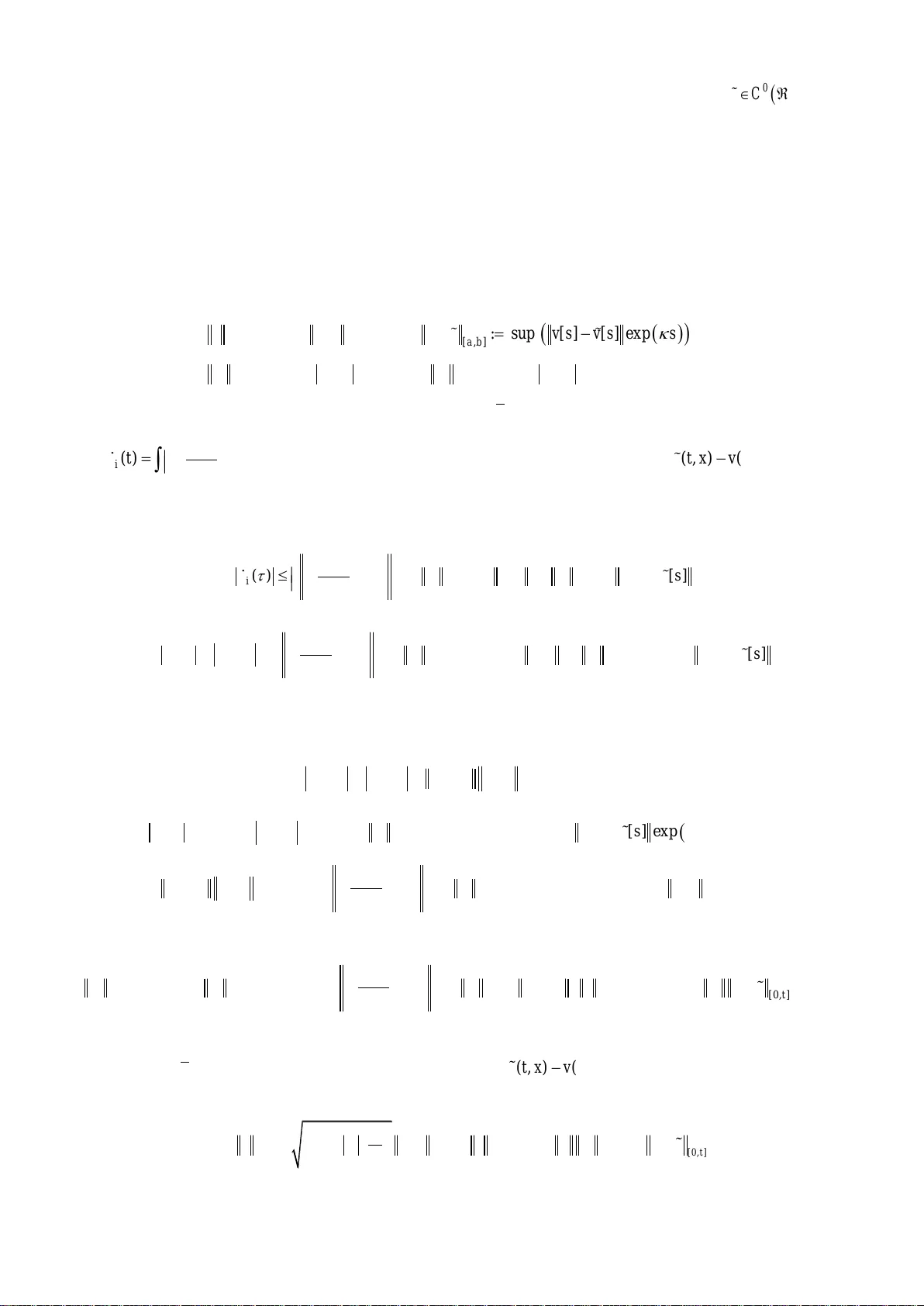
Sampled-Data Observers for 1- D Parabolic PDEs with Non-Local Outputs Iasson Karaf yllis * , Tarek Ahm ed-Ali ** and Fouad Giri ** * Dept. of Mathematics, N ational Tech nical University of Athens, Zografou Cam pus, 15780, At hens, Greece , email: iasonkar @central.ntua.gr ; iasonkaraf@gm ail.com ** Normandie UNIV, UN ICAEN, ENSICAEN , LAC, 14000 Cae n, France email: tarek.ahm ed-ali@ensicaen.f r ; fouad.giri@unicae n.fr Abstract The present work provides a systematic approach for the design of sampled-data observers to a wide class of 1 -D, parabolic PDEs with non - local outputs. The studied class of parabolic PDEs allows the presence of globally Lipschitz nonlinear and non-local t erms i n the PDE. Two differen t sampled-data observers are presented: one with an inter -sample p redictor for the unavailable continuous measure ment signal and one without an inter-sample predictor. Explicit conditions on the upper diam eter of th e (uncertain) sampling schedule for both designs ar e derived for exponential convergence of the observer error to zero in the absence of me asurement noise and modeling e rrors. Moreover, ex plicit estimates of the convergence rate c an be dedu ced bas ed on the knowledge of the upper diameter of th e sampling schedule. When measure ment noise and/or modeling errors are present, Input- to -Output Stabilit y (IOS) estimates of the observer error hold for both designs with respect to noise and modeling errors. The main results are illustrated by two examples which show how the proposed methodolog y can be extended to other cases (e.g., bounda ry point measurements). Keywords: sampled-data observer, parabolic PDEs, inter-sample predictor. 1. Introduction The problem of designing observers for PDEs has received a great deal of interest over the past decade, see e. g. [ 25,23,9,31,20,15,27,12]. Most existing works have been devoted to observer design for linear PDEs of parabolic and hyperbolic P DE t ype, using various design techniques includ ing semigroup-based L uenberger method, modal decomposition, backstepping technique, Lyapunov stability, and LMI s. Obs ervers for nonlinear P DEs have been p roposed i n e.g. [22,24,14,3] . Further interesting results have been reported on observer design for compound systems. In [22] , backstepping observer design has been developed for linear OD E-PDE cascades with parabolic PDE. The result has been extended in [2] to cope with strict-feedback Lipschitz nonlinearities in the ODE part. The case of linear ODE-PDE cascades with first-order h yperbolic PDEs have been d ealt with in [21]. Boundary observer design for linear PDE- ODE s (with hyperbolic PDE), has been considered in [32] . A common characteristic of all previousl y mentioned works is that it is suppo sed in all of them that the outputs are continuousl y accessible to measurements. However, usual ly only sampled (in time) measurements are available in practice. The observers that are based on continuous -time measurements can hardly achieve their theoretic al performances if applied in the presence of measurement sampling. Therefore, an increasing research a ctivity has recentl y been devoted to the problem of designing ob servers, both for ODEs a nd P DEs, that only require sampled (in time) out put measurements. Most results on sampled-measurement observer design have been achieved for O DEs 2 and only few for PDEs. In [11,30 ] sampled-output measurement observers of L uenberger-type have been desi gned fo r semilinear pa rabolic PDEs, using Ly apunov and LMIs tools. An ex tension of the results of [11 ] has been proposed in [4] to achieve larger s ampling intervals b y an inter-sample decreasing gain in the observer. Another extension has been proposed in [29 ] to solve the H1 filtering problem in the case of a reaction-diffusion system with sa mpled measure ments. Sampled-output measurement observer design for ODE-PDE cascades has also recently been investigated in [5,6 ] for a class of parabolic PDEs. Observers for PDEs (with sampled-measurements or not) can be divided in two classes depending on the definition of the s ystem output (i.e. the signal that provides the infor mation use d in the observer). The first class includes observers which require as output a vector form ed b y a finite number of measurements provided physical sensors, each one providin g the measurements of the PDE state at the point where it is placed on the domain. The observers in this class are obse rvers which u se point, local or sampled in space measurements; see for inst ance [ 3,7,11]. A special case is the case where the sensors are placed at the domain bound ary (providing the PDE state or its time -derivative at the boundary); the resulting observer is termed as boundar y observer. This is the case of most existing observers e.g. [9,31,15,20,14,21,4] . The second class of observers is consti tuted of those observers that deal with non-local output s. The outputs in this case are functionals of the state d efined so that the output values are weighted averages of the state values over the domain (see [8,10,13]). A crucial characteristic of sampled-data observers (those for ODEs and PDEs) is the way the innovation term depends on the (sampled) output measurements. T ypically, the existing observers a re classified in two categories. The first c ategory is one wher e the observ er involves a Zero-Order-Hold (ZOH) innovation term. Accordingly, the innovat ion term is updated at ea ch sampling time, usin g the output measurement s ample, and k ept unchanged between two successive sampling ti mes. Obs ervers for PDEs belonging to this categor y a re those proposed in [7,8,11,10,10,13]. Man y more observers of this type have been p roposed for ODEs. The second category o f sampled -data observers is characterized b y innovation terms that are contin uously updated b y using output predict ion betw een two successive sampling times. I t turns out that the observers of this type include an additional crucial component referred to as inter -sample output predictor. The approach was first proposed in [17] and several sampled-data observers involvi ng inter-sample output predictor s have been developed for different cl asses of ODEs, e.g. [1,16]. The observers with inter-sample predictors are usually more convenient in practice, since the y allow less frequent sampling compared to ZOH-innovation observers. The problem of designing sampled-d ata observers with inter-sample pr edictors for PDEs has yet to be solved. Indeed, t he extension of the approach in [17 ] to parabolic PDEs is challenging, since the time derivative of a funct ional may not b e express ed in a w ay that allows t he de rivation of bounds f or the time derivative. More specifically, the derivation of bounds for the time derivative of a functional may involve quantities which cannot be estimated (e.g., the second spatial derivative of the observer error). The present paper shows that the app roach in [ 17 ] can be applied to a wide class of 1-D, p arabolic PDEs with non -local outputs . Furthermore, the studied class of parabolic PDEs allows the presence of globally Lipschitz nonlinearities and non-local te rms in the PDE . Moreover, the s ampling schedule is not required to be ex actly known. Appl ying a sm all-gain approach and m odifying the construction of the inter-sample predictor, we are in a position to derive explicit conditions on the u pper diameter of the uncertain samplin g schedule which guarantee exponential convergence of th e observer error to zero in the absence of noise and modeling errors (Theorem 2.2). The results are compared with t he ZOH-innovation observer design (Theorem 2.3). Ex plicit estimates of the convergence rate can be deduced in both cases . On the other hand, when n oise and/or modeling errors are present, we are in a position to guara ntee Input- to -Output Stabilit y (IOS) estimates of the observer error with respect to noise and modeling errors. Two ex amples are presented in Section 3 of the present paper, which aim to show how easil y we can design sampled-data observers. Intere stingl y, the examples also illustrate additional facts: 3 the first example (Example 3.1) shows that there exist 1-D, parabolic P DEs which allow the diameter of the samplin g schedule to be arbitraril y large for the sampled-d ata observer with the inter- sample predictor, while the sampled-d ata observer without the inter -sample predictor r equires a sufficiently frequent sampling schedule, and the second example (Example 3.2) shows that our proposed methodology can be used also when the measurements are local outputs (e.g., boundary point measurements) and can guarantee stronger estimates of the observer err or (e.g., estimates in the spatial sup norm). The structure of the pa per is as follows. In Section 2, we d escribe the class of s ystems which are studied and the construction of the sampled-data observers. The main re sults (Theorem 2.2 and Theorem 2.3) a re also stated in Section 2. Sectio n 3 contains the two examples that il lustrate the use of the obtained results for the design of sample d-data observ ers. The p roofs of the main results are contained in Section 4. Finally, the concluding remarks of the present wor k are given in Section 5. Notation: Throughout the paper, we adopt the following notation. ) , 0 [ : . L et ] 1 , 0 [ : u be given. W e use the notation ] [ t u to denote the profile at certain 0 t , i.e., ( [ ]) ( ) ( , ) u t x u t x for all [0, 1 ] x . 2 (0,1 ) L denotes the equivalence clas s of measurable functions ] 1 , 0 [ : f for which 1/ 2 1 2 0 () f f x dx . For an integer 1 k , ) 1 , 0 ( k H denotes the Sobolev space of functions in ) 1 , 0 ( 2 L with all its weak derivatives up to order 1 k in ) 1 , 0 ( 2 L . Le t n S be an open set and let n A be a set that satisfies () S A c l S . By ) ; ( 0 A C , we denote the class of continuous functions on A , which take values in m . By ) ; ( A C k , where 1 k is an integer, we d enote the class of functions on n A , which takes values in m and has continuous derivatives of order k . When then we write 0 () CA or () k CA . For 0 ([0 ,1 ]) fC the sup norm is defined by 01 sup ( ) z f f z . A continuous function ] 1 , 0 [ : f is called piecewise 1 C on ] 1 , 0 [ and we write ]) 1 , 0 ([ 1 PC f , if the following properties hold: (i) for every ) 1 , 0 [ x the limi t ) ( ) ( l i m 1 0 x f h x f h h exists and is finite, (ii) for ever y ] 1 , 0 ( x the limit ) ( ) ( l i m 1 0 x f h x f h h ex ists and is finite, (iii) there exists a set ) 1 , 0 ( J of finite c ardinality, where 11 00 ( ) l im ( ) ( ) lim ( ) ( ) hh df x h f x h f x h f x h f x dx holds for J x \ ) 1 , 0 ( , and (iv) the mapping (0,1 ) \ ( ) df J x x dx is continuous. For a vector n x we denote by x it s usual Euclidean norm, by x it s transpose. For a real matrix m n A , n m A denotes it s transpose and 1 , ; s up : x x Ax A n is its induced matrix norm. For two positive integers ,0 ij , , ij denotes the Kronecker delta, i.e., , 1 ij if ij and , 0 ij if ij . 2. System D escription and Main Resu lts 2.A. System Description Consider the Sturm-Liouville (SL) operator 2 : ( 0,1 ) B D L with 2 2 ( )( ) ( ) ( ) ( ) du Bu x p x q x u x dx , for (0 ,1 ) x and uD (2.1) where 0 p is a constant, 0 [0,1 ] qC , 4 2 0 0 1 1 : (0 ,1 ): (0 ) (0) ( 1 ) ( 1 ) 0 du du D u H a u b a u b dx dx , (2.2) with 0 0 1 1 , , , a b a b being constants with 22 00 0 ab , 22 11 0 ab . Let 12 ... ... n and 2 [0,1 ] n CD ( 1 , 2 ,... n ) (with 1 n ) be the eigenvalues and the eigenfunctions of the SL operator 2 : ( 0,1 ) B D L . In this work we make the following assumption. (H 1): The SL operator 2 : ( 0,1 ) B D L defined by (2.1), (2.2), where 0 0 1 1 , , , a b a b are constants with 22 00 0 ab , 22 11 0 ab , satisfies 1 01 max ( ) nn x nM x , for certain 0 M with 0 M (2.3) It is important to notice t hat the validit y of Assumpti on (H 1) can be verified without the knowled ge of the eigenvalues and eigenfunctions of the SL operator B . In effect, it is shown in [26] that Assumption (H1) holds automatically, provided that 0 1 1 , , 0 b a b , 0 0 a . With the help of the SL operator 2 : ( 0,1 ) B D L defined b y (2.1), (2.2) under Assumption (H 1), we are in a position to des cribe the s ystem that we st udy. W e consider the observer desi gn problem for the system that is described by the parabolic PDE: 2 2 ( , ) ( , ) ( ) ( , ) ( [ ])( ) ( , [ ]) ( , ) uu t x p t x q x u t x K u t x g x Pu t v t x t x , for ( , ) (0 , ) (0 ,1 ) tx (2.4) 0 0 1 1 ( , 0) ( , 0) ( ,1 ) ( ,1 ) 0 uu a u t b t a u t b t xx , for 0 t (2.5) where the nature of all mappings appearing in (2.4) are explained by the following assumptions. (H2) The following regularity requirements hold. 1 ([0 ,1 ] ) k gC , ]) 1 , 0 ([ ]) 1 , 0 ([ : 0 0 C C K are continuous mappings with D u K ) ( for all ]) 1 , 0 ([ 0 C u , for which there exists a constant 0 L such that the inequalities ( ) ( ) K u K w L u w , 01 m ax ( , ) ( , ) x g x g x L , () B K u L u hold for all ]) 1 , 0 ([ , 0 C w u , k , , 0 : ([0, 1 ]) k PC is a compatible operat or with B , i.e., a continuous linear operator for which there exists a continuous operator k C S ]) 1 , 0 ([ : 0 such that PB u Su for al l D C u ]) 1 , 0 ([ 2 (see [19 ]) , the mapping 22 : (0 ,1 ) (0 ,1 ) f L L defined by ( )( ) ( )( ) ( , ) f u x K u x g x Pu , for [0, 1 ] x and 2 (0 ,1 ) uL (2.6) is a continuous mapping for which there exists a c onstant 0 R such that the following global Lipschitz inequality holds: ( ) ( ) f u f w R u w , for all 2 , (0,1 ) u w L (2.7) (H3) There exist mappings 0 12 , [0,1 ] v v C for which the mappin g 1 (0 , ) [0, 1 ] ( , ) ( , ) v t x t x t is continuous with 1 1 [ ] ([0,1 ]) v t PC for all 0 t , 2 [] v t D and 2 ( 0 , ] su p [ ] t Bv for all 0 t and such that the (distributed) input : [0,1 ] v satisfies 12 [ ] [ ] [ ] v t v t v t , for 0 t , [0, 1 ] x (2.8) 5 Using Corollary 4.6 in [19] , we are in a position to guarantee that when Assumptions (H1), (H2), (H3) hold then for ever y D u 0 there ex ists a unique mapping 01 ( [0 ,1 ]) ((0 , ) [0 ,1 ]) u C C satisfying ]) 1 , 0 ([ ] [ 2 C t u for all 0 t , (2.4), (2.5) and the initial condition 0 ] 0 [ u u (2.9) The measured outputs are non-local and are described by the equations 1 0 ( ) ( ) ( ) ( , ) i i j i j y t t k x u t x dx , for 1 [ , ) jj t t t , 1 ,... , im and 0 ,1 , 2 , ... j (2.10) where 2 (0, 1 ) i kL ( 1 ,... , im ) are the output kernels, 1 ( , ..., ) : m m is a bounded mapping (the measurement error) and 0 : 0, 1 , 2, ... j tj (the sampling s chedule) is an increasing seq uence of times (the sampling times) with 0 0 t and li m j j t . It is clear f rom (2.10) that the output 1 ( ) ( ( ), ..., ( )) m m y t y t y t is finite -dimensional and sampled. Moreover, we won’t assume that the sampling schedule is known (uncertain sampling schedule). Remark 2.1: (a) The parabolic PDE s ystem (2.3), (2.4) is a special case where the S L operator has a constant diffusion coe fficient and zero advection terms. However, the general case where 2 : ( 0,1 ) B D L is defined by (2.2) and 1 ( ) ( )( ) ( ) ( , ) ( , ) ( ) ( ) u q x Bu x p x t x u t x r x x x r x , for (0 ,1 ) x and uD (2.11) with 2 , ( [0 ,1 ]; (0, )) p r C , can be reduced to the case (2.1) by means of the transformation: 0 () () x ps ds rs , where 2 1 0 ) ( ) ( ds s p s r and 1 / 4 ( , ) ( ) ( ) ( , ) U t r x p x u t x . (b) The PDE system (2.3), (2.4) is allowed to contain nonlinear and non-local terms in the PDE. 2.B. The Sampled-Data Observer with Inter-Sample Predictor The first proposed samp led-data observer consists of two components: the continuous-time observer and the inter-sample predictor. We start with the continuous-time observer. Let 1 N be an integer with 1 0 N , i cD ( 1 ,... , im ) be a given set of functions and , : 1 , ..., , 1 , ..., Nm ij L L i N j m be a given matrix. Define the real matrix NN A by , , ,1 1 , , , ... i j i i j i j i m m j A L c L c for , 1 , ... , i j N (2.12) where 1 , 0 ( ) ( ) i j i j c c s s d s , for 1 ,... , im , 1 , 2, ... j (2.13) Also define , 1 ( ) ( ) N i n n i n l x x L for 1 ,... , im and [0, 1 ] x . (2.14) The continuous- ti me observer is de scribed b y the following equations: 1 2 2 1 0 ( , ) ( , ) ( ) ( , ) ( [ ])( ) ( , [ ]) ( , ) ( ) ( ) ( , ) ( ) m i i i i ww t x p t x q x w t x K w t x g x Pw t v t x l x c s w t s ds t t x for all ( , ) (0 , ) (0 ,1 ) tx (2.15) 0 0 1 1 ( , 0) ( , 0) ( ,1 ) ( ,1 ) 0 ww a w t b t a w t b t xx , for 0 t (2 .16) 6 where the distributed observer state [] wt is to be used to approximate the state [] ut and the additional observer states () i t ( 1 ,... , im ) are to be used to approximate the (unavailable) contin uous signals 1 0 ( ) ( , ) i c x u t x dx ( 1 ,... , im ). The distributed input 0 [0 ,1 ] v C is assumed to satisfy Assumption (H3) and ideally it would be equal to v . However, we do not assume that v coincides with v , in order to allow the expression of the effect of possible modeling errors. The evolution of the observer states () i t ( 1 ,... , im ) is determined by the inter-sample predictor, which is described next. I deally, we would like to have an int er-sample predictor for the output signals. However (by virtue of (2.4), (2.6)) the nominal output signals (i.e. without measurement noise) satisfy the following differential equations for 0 t , 1 ,... , im : 1 1 1 1 1 2 2 0 0 0 0 0 ( ) ( , ) ( ) ( , ) ( ) ( ) ( , ) ( )( ( [ ] )) ( ) ( ) ( , ) i i i i i du k x u t x dx p k x t x dx q x k x u t x dx k x f u t x dx k x v t x dx dt x and it becomes clear that the right-hand side of the above differential equation cannot be bounded by an estimate that involves the state no rm [] ut . Therefore, we sele ct i cD ( 1 ,... , im ) to approx imate closely the output kernels 2 (0, 1 ) i kL ( 1 ,... , im ) and instead of using an inter-sample predictor for the output signals 1 0 ( ) ( , ) i k x u t x dx ( 1 ,... , im ), we use the inter -sample predictor for the si gnals 1 0 ( ) ( , ) i c x u t x dx ( 1 ,... , im ). Notice that the (unav ailable) continuous signals 1 0 ( ) ( , ) i c x u t x dx ( 1 ,... , im ) satisfy the following differential equations for 0 t , 1 ,... , im : 1 1 1 1 2 2 0 0 0 0 ( ) ( , ) ( ) ( ) ( ) ( , ) ( )( ( [ ]) )( ) ( ) ( , ) i i i i i dc d c x u t x dx p x q x c x u t x dx c x f u t x dx c x v t x dx dt dx (2.17) Indeed, integrating by parts we get 11 2 2 22 00 ( ) ( , ) ( ) ( ) ( , ) i ii dc u c x t x dx t x u t x dx x dx , where ( ) ( 1 ) ( ,1 ) (0 ) ( , 0) ( 1 ) ( ,1 ) (0) ( , 0) ii i i i dc dc uu t c t c t u t u t x x dx dx for all 0 t , 1 ,... , im . The facts that i cD ( 1 ,... , im ) and 22 00 0 ab , 22 11 0 ab , in conjunction with (2.2) and (2.5) implies that ( ) 0 i t for all 0 t , 1 ,... , im . Equalities (2.17) follow from (2.4), (2.6) and the fact that 11 2 2 22 00 ( ) ( , ) ( ) ( , ) i i dc u c x t x dx x u t x dx x dx for 0 t , 1 ,... , im . The inter-sample predictor replaces the (unavailable) state u in (2.17) b y it s estimate w and tries to approximate the unavailable signals 1 0 ( ) ( , ) i c x u t x dx ( 1 ,... , im ). We get: 1 0 ( ) ( ) ( ) ( ) ( , ) i j j i i j t y t k x c x w t x dx , for 1 ,... , im , 0 ,1 , 2 , ... j (2.18) 1 1 1 2 2 0 0 0 ( ) ( ) ( ) ( ) ( , ) ( )( ( [ ])) ( ) ( ) ( , ) i i i i i dc t p x q x c x w t x dx c x f w t x dx c x v t x d x dx , for 1 [ , ) jj t t t , 1 ,... , im and 0 ,1 , 2 , ... j (2.19) It should be noticed that Assumpt ions (H1), (H2), (H3) guarantee that for every 00 , u w D , for every input 0 [0 ,1 ] v C that satisfies Assumption (H3) and for every increasing sequ ence of times 7 0 : 0, 1 , 2, ... j tj with 0 0 t and li m j j t , there exist unique mappings 01 ( [0 ,1 ]) ( [0 ,1 ]) w C C I and : i being right-continuous with 1 () i CI ( 1 ,... , im ), where : \ : 0,1 , 2, ... j I t j , satisfying 2 [ ] ( [ 0, 1 ]) w t C for all 0 t , 0 [0] ww , (2.18), (2.19) for all tI , (2.15) for all ( , ) (0 ,1 ) t x I and (2.16). Indee d, the solution may be constructed b y a step- by - step procedure. To see this, take any 0 ,1 , 2 , ... j and suppose that the solution w on [0, ] j tt and i ( 1 ,... , im ) on [0, ) j tt (when 0 j ) is alr eady known. First use (2.18) in order to get the values of i ( 1 ,... , im ) for j tt . Notice that by virtue of Assumptions (H1), (H2), (H3) and the f act that i lD for 1 ,... , im (recall (2.14)), all assumptions of Theorem 4.5 in [19] hold for s y s tem (2.15), (2.16) , (2.19) on the interval 1 [ , ] jj t t t . Therefore, usin g Theorem 4.5 in [19], we obtain the solut ion w on 1 [ , ] jj t t t and i ( 1 ,... , im ) on 1 [ , ) jj t t t . 2.C. The Sampled-Data Observer without the Inter-Sample Predictor The second proposed sampled -data observer is simpler than the first sam pled-data observer since the inter-sample predictor is not used. The observer is described by (2.16) and the following equation: 1 2 2 1 0 ( , ) ( , ) ( ) ( , ) ( [ ])( ) ( , [ ]) ( , ) ( ) ( ) ( , ) ( ) m i i j i j i ww t x p t x q x w t x K w t x g x Pw t v t x l x k s w t s ds y t t x for 1 ( , ) ( , ) (0,1 ) jj t x t t and 0 ,1 , 2 , ... j (2.20) where (again) the distributed observer state [] wt is to be used to approximate the state [] ut . Sim ilarly to the first observer, the distributed input 0 [0 ,1 ] v C is assumed to satisfy Assumption (H3) and ideally it would be equal to v . However, we do not assume that v coincides with v , in order to allow the expression of the effect of possible modeling errors. It should be noticed that Assumptions (H1), (H2), (H3) guarantee that for ever y 00 , u w D , for every input 0 [0 ,1 ] v C that satisfies Assumption (H3) and for every increasing sequ ence of times 0 : 0, 1 , 2, ... j tj with 0 0 t and li m j j t , there ex ists a unique mapping 01 ( [0 ,1 ]) ( [0 ,1 ] ) w C C I , where : \ : 0,1 , 2, ... j I t j , satisf y ing 2 [ ] ( [ 0, 1 ]) w t C for all 0 t , 0 [0] ww , (2.20) for all ( , ) (0 ,1 ) t x I and (2.16). I ndeed, the solution ma y be constructed by a step- by -step procedure. To see this, take any 0 ,1 , 2 , ... j and suppose that the solution w on [0, ] j tt is already kno wn. Notice that by virtue of Assumptions (H1), (H2), (H3) and the fact that i lD for 1 ,... , im (recall (2.14)), all assumptions of Theorem 4.5 in [19 ] hold for system (2.20), (2.16) on the interval 1 [ , ] jj t t t . Therefore, using Theorem 4.5 in [19], we obtain the solution w on 1 [ , ] jj t t t . 2.D. Main Results We are now in a position to give conditions on the nonlinear term f and the sampling s chedule 0 : 0, 1 , 2, ... j tj that guarantee convergence of the estimation error [ ] [ ] [ ] e t w t u t in the 2 L norm. Indeed, it is shown that the proposed s ampled-data observ ers work provided that (i) the str ength of t he nonlinear term (i.e., the constant 0 R appearing in (2.7)) is sufficiently small , (ii) the functions i cD ( 1 ,... , im ) approx imate closel y the output kernels 2 (0, 1 ) i kL ( 1 ,... , im ), and (iii) the sampling schedule is su fficiently frequent. It sh ould be noticed that since D (defined b y (2.2)) is dense in 2 (0,1 ) L , the close approximation of the output kernels 2 (0, 1 ) i kL ( 1 ,... , im ) b y functions i cD ( 1 ,... , im ) is not a problem. 8 Theorem 2 .2 (Sa mpled-Data Observer Design with Inter-Sample Predictor in presence of measurement errors ): Consider system (2.4), (2.5) under Assumptions (H1), (H2) with output given by (2.10), where 2 (0, 1 ) i kL ( 1 ,... , im ) are the output kern els, : m is the measurement error and 0 : 0, 1 , 2, ... j tj is the sampling schedule. Let 1 N be an integer with 1 0 N , let i cD ( 1 ,... , im ) be given functions and let , : 1 , ..., , 1 , ..., Nm ij L L i N j m be a matrix so that NN A defined by (2.12) is a Hurwitz matrix. Define i lD for 1 ,... , im by means of (2.14) and 1/ 2 22 1, , 11 : ... j m j j N j N K c c (2.21) Let NN P be a symmetric, positi ve definite matrix with PI for which there exists a constant 0 such that 2 P A A P P . Suppose that there exist constants 2 Q with 2 1 2 / ( ) N Q L PL K , 0 h , [0, ) , where 1 : ( ( ) 2 ) / 4 N HQ and 2 12 11 ( ) : 2 2 16 NN H Q Q L P L K , such that the following small-gain condition holds: 2 2 1 : exp( ) 1 m i i i i i i i dc R h l p qc R c h k c dx (2.22) where : 2( ) g and 1 4 : m a x , 4 ( ) 2 N P Q g HQ . T hen for every 00 , u w D , for every bounded : m , for every inpu ts 0 , [0,1 ] v v C that satisfy Assumption (H3) and for every increasing sequence of times 0 : 0, 1 , 2, ... j tj with 0 0 t , li m j j t and 1 0 su p jj j t t h , the unique solut ion of the pr oblem (2.4), (2.5), (2.10), (2.15), (2.16), (2.18), (2.19) with initial condition given by (2.9) and 0 [0] ww satisfies the following estimate for 0 t for the observe r error [ ] [ ] [ ] e t w t u t : 11 0 1 1 0 1 [ ] 1 ma x , exp [ 0] exp( ) 1 sup ( ) exp ( ) 2 1 1 exp( ) sup [ ] [ ] e xp ( ) m ii st i m ii st i Q e t P t e h l s t s h h l c v s v s t s (2.23) Theorem 2.3 (Sa mpled-Data Observer Design without Inter-Sa mple Predictor in presence of measurement errors ): Consider system (2.4), (2.5) under Assumptions (H1), (H2) wit h output given by (2.10), where 2 (0, 1 ) i kL ( 1 ,... , im ) are the output kern els, : m is the measurement error and 0 : 0, 1 , 2, ... j tj is the sampling schedule. Let 1 N be an integer with 1 0 N , let i cD ( 1 ,... , im ) be given functions and let , : 1 , ..., , 1 , ..., Nm ij L L i N j m be a matrix so that NN A defined by (2.12) is a Hurw itz matri x. Define i lD for 1 ,... , im by means of (2.14) and 0 K by (2.21). Let NN P be a symmetric, positive definite matrix with PI for which there exists a constant 0 such that 2 P A A P P . Suppose that there ex ist constants 2 Q wit h 2 1 2 / ( ) N Q L PL K , 0 h , [0, ) , where 2 12 11 ( ) : 2 2 16 NN H Q Q L PL K and 1 : ( ( ) 2 ) / 4 N HQ , such that the following small-gain condition holds: 1 2 2 11 0 : exp( ) ( ) ( ) 1 mm i i i i i r r i i ir dc R h l p qc R c c x l x dx k h k c dx (2.24) 9 where : 2( ) g and 1 4 : m a x , 4 ( ) 2 N P Q g HQ . T hen for every 00 , u w D , for every bounded : m , for every inpu ts 0 , [0,1 ] v v C that satisfy Assumption (H3) and for every increasing sequence of times 0 : 0, 1 , 2, ... j tj with 0 0 t , li m j j t and 1 0 su p jj j t t h , the unique solut ion of the problem (2.4), (2.5), (2.10), (2.20), (2.16) with initial condition given by (2.9) and 0 [0] ww satisfies the following estimate for 0 t for the observer error [ ] [ ] [ ] e t w t u t : 1 1 1 0 11 0 1 0 1 [ ] 1 max , exp [0] 2 exp( ) 1 ( ) ( ) sup ( ) exp ( ) 1 1 exp( ) sup [ ] [ ] e xp ( ) mm i r r i i st ir m ii st i Q e t P t e h l h l c x l x dx s t s h h l c v s v s t s (2.25) Remark 2.4: (a) The proofs of Theorem 2.2 and Theorem 2.3 are p rovided in Section 4; they are based on a small-gain argument as well as Ly a punov analysis. Mo re specifi cally, by usin g an appropriate Lyapunov functional for an auxil iary problem, we are in a position to utilize the I nput - to - Output Stability (IOS) property and prove the desired estimates (2.23) and (2.25). (b) It should be noticed that estimates (2.23), (2.25) are IOS estimate for the observer error w ith respect to measurement noise and modeling error s. When measurement no ise and modeling errors are absent, estimates (2.23), (2.25) imply global exponential convergence of the observer error. (c) The constan t 0 h for which the in equality 1 0 su p jj j t t h holds as well as (2.22) or (2.24) is the diameter of the sampling schedule. In general, inequalities (2.22), (2.24) im pose bounds on the diameter of the sampling schedule. Mo reover, i t should be noticed that inequalit y (2.24) is more demanding than inequ alit y (2.22) in the s ense that all 0 h and [0, ) that satisfy (2.24) necessarily also satisfy automatically (2.22). Th at is why the s ampled-data observer with the inter- sample pre dictor allows less frequent sampling than the sampled-data observer without the inter- sample predictor. (d) Inequalities (2.23), (2.25) show that th e sampled -data obs erver without the inter -sample predictor is more sensitive to measurement noise than the sampled -data obser ver with the inter-sam ple predictor. (e) For both Theorem 2.2 and Theorem 2.3, th e ex istence of a s ymmetric, positive definite matrix NN P with PI for which there exists a constant 0 such t hat 2 P A A P P is not an issue, since it is assumed that the real matrix NN A defined by (2.12) is a Hurwitz matrix. 3 . Illustrative Ex amples The examples pr esented in this section have mul tiple purposes. First of all, the examples aim to sho w how easil y we can apply Theorem 2.2 in order to design sampled-d ata observers for 1-D pa rabolic systems. Furthermore, the examples also illustrate the following additional facts : the first example shows that there exist parabolic PDEs which allow the diameter of the s ampling sc hedule to be arbitraril y large for the observer with the inter -sample predictor, while the observ er without the inter-sample predictor requires a sufficiently frequent sampling schedule, and the second example shows that Theorem 2.2 can be used also when the outputs are not non-local outputs of the fo rm (2.10) and can guarantee stron ger estimates of the observer error (e.g., estimate s in the spatial sup norm). 10 Example 3.1: Consider the PDE problem 2 2 ( , ) ( , ) ( , ) uu t x p t x v t x t x , for ( , ) (0 , ) (0, 1 ) tx (3.1) where 0 p is a constant and : [0,1 ] v is an input, under Neumann boundary conditions ( , 0) ( ,1 ) 0 uu tt xx , for 0 t (3.2) and a sampled, scalar, non-local output 1 0 ( ) ( ) ( , ) jj y t t xu t x dx , for 1 [ , ) jj t t t and 0 ,1 , 2 , ... j (3.3) where : is the mea surement error an d 0 : 0, 1 , 2, ... j tj (the sampling schedule) is an increasing sequence of times (the sampling times) with 0 0 t and li m j j t . It is clear that system (3.1), (3.2), (3.3) is a s ystem of the form (2.4), (2.5) , (2.10) with ( ) 0 qx , ( ) 0 Ku , ( , ) 0 g x Pu , 01 0 aa , 01 1 bb , 1 m and 1 () k x x . The eigenvalues and eigenfunctions of the SL operator 2 : ( 0,1 ) B D L defined by (2.1), (2.2), are 1 0 and 22 ( 1 ) n pn for 2 n (3.4) 1 ( ) 1 x and ( ) 2 cos( ) n x n x for 2 n and [0, 1 ] x (3.5) It follows that Assumpt ions (H1), (H2) hold. Mo re specificall y, inequalit y (2.7) holds with 0 R . We next apply Theorem 2.2 with 1 N , 1 ( ) 1 / 2 cx , [ 1 ] P and 2 1, 1 Lp . Definition (2.13) in conjunction with (3.5) i mplies that 1, 0 j c , for 2 j a nd 1 ,1 1 / 2 c . Definition s (2.12 ), (2.1 4) in conjunction with (3.4), (3.5), give 2 1 , 1 /2 Ap , 2 () i l x p . The proposed sampled-data observer with the inter-sample predictor takes the form 1 2 2 2 0 1 ( , ) ( , ) ( , ) ( , ) ( ) 2 ww t x p t x v t x p w t s ds t t x , for ( , ) (0 , ) (0, 1 ) tx (3.6) ( , 0) ( ,1 ) 0 ww tt xx , for 0 t (3.7) 1 0 1 ( ) ( ) ( , ) 2 j j j t y t x w t x dx , for 0 ,1 , 2 , ... j (3.8) 1 0 1 ( ) ( , ) 2 t v t x d x , for 1 [ , ) jj t t t and 0 ,1 , 2 , ... j (3.9) Using all the above, we conc lude that all assumptions of Theorem 2.2 hold with 0 R , 0 K , 2 /2 p , 2 Q , ( ) 0 HQ , 11 1 23 kc , , 2 2 : g p , 2 12 : 1 p , for all 0 h and [0 ,1 ) for which the small-gain condition 2 exp 2 :1 6( 1 ) p h (3.10) holds. Therefore , for all 0 h and [0 ,1 ) for which (3.10) holds, the following property also holds: for every 2 00 , (0 ,1 ) : (0) ( 1 ) 0 dd u w H dx dx , for ever y bounded mapping : , for ever y pair of inputs 0 , [ 0,1 ] v v C that satisfy Assumption (H3) and for every increasing sequence of 11 times 0 : 0, 1 , 2, ... j tj with 0 0 t , li m j j t and 1 0 su p jj j t t h , the unique solut ion of the initial-boundary value problem (3.1), (3.2), ( 3.3), (3.6), (3.7), (3.8), (3.9) with initial condition given by (2.9) and 0 [0] ww satisfies the estimate for all 0 t 22 22 0 22 2 0 6( 1 ) exp [ ] 6( 1 ) exp [ 0] 22 12 exp sup ( ) exp ( ) 22 1 12 exp sup [ ] [ ] e xp ( ) 2 2 2 st st pp h e t t e pp h s t s h p p h v s v s t s p (3.11) where [ ] [ ] [ ] e t w t u t . It should be noticed that for ever y given 0 h there exists (0 ,1 ) such that (3.10) holds for all 0, . Therefore, fo r every s ampling schedule the ob server e rror will converge to zero in abs ence of nois e and modeling errors. However, notice that a large value for 0 h (i.e., when measurements are sp arse) will give a small value for (0 ,1 ) , i.e., a slow convergence of the observer error. Moreover, (3.11) shows that a large value fo r 0 h im plies sensitivit y with respect to modeling errors since the gain coefficie nt of vv increases with 0 h . On the other hand, the observer without the inter-sample predictor is given by (3.7) with 1 2 2 2 0 ( , ) ( , ) ( , ) ( , ) ( ) jj ww t x p t x v t x p sw t s ds y t t x , for 1 ( , ) ( , ) (0,1 ) jj t x t t and 0 ,1 , 2 , ... j (3.12) Using all the above, we conclude tha t all assum ptions of Theorem 2.3 h old with 1 N , 1 ( ) 1 / 2 cx , [ 1 ] P , 2 1, 1 Lp , 2 1 , 1 /2 Ap , 2 () i l x p , 0 R , 0 K , 2 /2 p , 2 Q , ( ) 0 HQ , 11 1 23 kc , , 2 2 : g p , 2 12 : 1 p , for all 0 h and [0 ,1 ) for which the condition 22 1 : exp 1 2 6( 1 ) p hp (3.13) holds. It is clear that in this case the upper diameter of the sampling schedule is not allowed to be greater or equal to 2 ( 6 1 ) / ( ) p . For uniform sampling schedules ( j t jh for 0 ,1 , 2 , ... j ) we are in a position to give necessary and sufficient conditions for the successful operation of the sampled -data observer (3.7), (3.12): the sampling p eriod 0 h has to be strictl y less than 2 4 / ( ) p . Therefore, the fact that the sampled-data observer (3.7), (3.12) requires a suf ficiently small upper diameter of the sampling schedule is not an artifact of the analysis but is a fundamental li mitation of the observer (3.7), (3.12). Thus, as stated in Remark 2.4(c) the observer without the inter -sample predictor requires a sufficiently fr equent sa mpling schedule (h ere in sharp contrast with the sampled -data observer with the inter-sample predictor). Example 3.2: Consider the PDE problem 2 2 ( , ) ( , ) ( , ) ( , ) uu t x p t x qu t x v t x t x , for ( , ) (0 , ) (0, 1 ) tx (3.14) where 0 p , q are constants, : [0,1 ] v is an input, under the following boundary conditions ( , 0) ( ,1 ) 0 u u t t x , for 0 t (3.15) and a sampled, scalar, local output ( ) ( ) ( ,1 ) jj y t t u t , for 1 [ , ) jj t t t and 0 ,1 , 2 , ... j (3.16) 12 where : is the mea surement error an d 0 : 0, 1 , 2, ... j tj (the sampling schedule) is an increasing sequence o f ti mes (the s ampling times) with 0 0 t and li m j j t . The output gives the boundary point value of the state and it is not a non -local output of the form (2.10). Sy stem (3.14), (3.15), (3.16) is also studied in [30] (with x replaced by 1 x ). Despite the fact that the output is not a non-local output of the form (2.10), we show next that Theorem 2.2 can be used for the design of a sampled -data observer. To make thi ngs simpler, we assume that the reaction coefficient q satisfies the inequality 22 9 4 7 p q p (3.17) although the observer can be designed e ven when the reaction coefficient does not satisfy (3.17). In order to be able to apply Theorem 2.2 with a local measurement, we need to look at the variable ( , ) ( , ) ( 1 ) ( , 0) u u t x t x p x v t x , for 0 t , [0, 1 ] x (3.18) which contains information for the spatial derivative of the state u and n ot the state itself. Indeed, Proposition 5.11 on page 113 in [ 19] guarantees that (under sufficient regularit y for the initi al condition of the state and the input) u defined by (3.18), satisfies the PDE 2 2 ( , ) ( , ) ( , ) ( , ) u u t x p t x qu t x v t x t x , for ( , ) (0 , ) (0, 1 ) tx (3.19) and the boundary conditions ( , 0) ( , 1 ) 0 u t u t x , for 0 t (3.20) where ( , ) : ( 1 ) ( , 0) ( , ) ( 1 ) ( , 0) vv v t x p q x v t t x p x t xt , for 0 t , [0, 1 ] x (3.21) Moreover, the output map (3.16) can be expressed (using (3.18)) in the following way : 1 0 ( ) ( ) ( , ) ( , 0) 2 j j j p y t t u t x d x v t , for 1 [ , ) jj t t t and 0 ,1 , 2 , ... j (3.22) It is exactly this formula tion to which Theorem 2 .2 can b e applied: s ystem (3.1 9), (3.20 ), (3.22 ) is a system of the form (2.4 ), (2.5), (2.10) with () q x q , ( ) 0 Ku , ( , ) 0 g x Pu , 01 0 ab , 01 1 ba , 1 m and 1 ( ) 1 kx . The eigenvalues and eigenfunctions of operator B defined by (2.1), (2.2), are 2 2 ( 2 1 ) 4 n n pq for 1 n (3.23) 21 ( ) 2 cos 2 n n xx for 1 n and [0, 1 ] x (3.24) It follows that Assumpt ions (H1), (H2) hold. More specificall y, inequalit y (2.7) holds with 0 R . We next apply Theorem 2.2 with 1 N , 1 4 ( ) co s 2 x cx , [ 1 ] P and 2 1 , 1 47 16 2 qp L . Definition (2.13) in conjunction with (3.24 ) implies that 1, 0 j c , for 2 j and 1, 1 2 2 / c . Definitions (2.12), (2.14) in conjunction with (3.23), (3.24), give 2 1 , 1 9 82 q Ap , 2 1 47 ( ) cos 16 2 q p x lx . Notice that by virtue of (3.17), it holds that 1 , 1 0 A . The proposed sampled-data observer takes the form 1 22 1 2 0 4 7 4 ( , ) ( , ) ( , ) ( , ) cos c os ( , ) ( ) 16 2 2 w w q p x s t x p t x qw t x v t x w t s ds t t x for ( , ) (0 , ) (0, 1 ) tx (3.25) 13 ( , 0) ( ,1 ) 0 w t w t x , for 0 t (3.26) 1 1 0 4 ( ) ( ) ( , 0) 1 cos ( , ) 22 j j j j px t y t v t w t x dx , for 0 ,1 , 2 , ... j (3.27) 1 2 1 0 4 ( ) ( , ) ( , ) c o s 42 x t p q w t x v t x d x , for 1 [ , ) jj t t t and 0 ,1 , 2 , ... j (3.28) However, since the observer state w will not estimate the state u but the variable u (defined by (3.18)), we also need to get an estimation of the state u . This will be achieved by the state estimator 2 0 ˆ ( , ) ( , ) ( , 0) 2 x x u t x w t s ds pv t x , for 0 t , [0, 1 ] x (3.29) Using all the above, we conclude th at all assumptions of Theorem 2.2 hold with 0 K , 2 9 82 q p , 2 Q , ( ) 0 HQ , 2 11 2 8 kc , , 2 8 : 94 g pq , 2 42 : 9 4 1 pq , for all 0 h and [0 ,1 ) for which the sma ll -gain condition 22 2 2 2 7 4 4 94 ( , ) exp 8 1 8 2 2 9 4 1 4 2 p q p q pq h h h pq (3.30) holds. By vi rtue of continuit y of ( , ) h at ( , ) (0 , 0) h and the fact that (0 , 0) 1 , it follows that there ex ist 0 h and [0 ,1 ) for which (3.30) holds . Therefore, for all 0 h and [0 ,1 ) for which (3.30) holds, the following property also holds: there exists a constant 0 such that fo r every 2 00 , (0, 1 ) : (0) ( 1 ) 0 d u w H dx , for every bound ed mapping : , for every input 1 [0,1 ] vC for which v being defined by (3.21) satisfies Assumption (H3) and for every increasing sequence o f tim es 0 : 0, 1 , 2, ... j tj with 0 0 t , li m j j t and 1 0 su p jj j t t h , the unique solution of the initial-boundary value p roblem (3.1 9), (3.20), (3. 22), (3.25), (3.26), (3.27), (3.28) with initial condition 0 [ 0 ] u u , 0 [0] ww satisfies the estimate 0 [ ] exp [0] su p ( ) st e t t e s , for all 0 t (3.31) where [ ] [ ] [ ] e t w t u t . Estimate (3.31) combined with (3.15), (3.18) and (3.29) implies the estimate 01 0 ˆ max ( , ) ( , ) exp [0] sup ( ) x st u t x u t x t e s , for all 0 t (3.32) which is an estimate of the observer error in the spatial sup norm rather t han the 2 L norm. Estimates (3.31), (3.32) shoul d be compared with the estimate 2 L norm observer e rror estimate that is provided in [30] (depending also on the 1 H norm of the initial error). 4 . Proofs of Main R es ults For the proofs of the main results we need the following auxiliary result. Proposition 4.1: Consider the SL operator B under Assumpti on (H1). Let ,1 Nm be int egers with 1 0 N , i cD ( 1 ,... , im ) be given functions and let , : 1 , ..., , 1 , ..., Nm ij L L i N j m be a matrix so that the matrix NN A defined by (2.12) is a Hurwitz matrix. Define i lD for 1 ,... , im by means of (2.14) and the constant K by means of (2.21). Let NN P be a symmetric, positive 14 definite matrix with PI for which there exists a constant 0 such that 2 P A A P P . L et 0 eD , 0 T and let 0 [0, ] [0,1 ] v C T be an input. Then every solution 01 [0 , ] [0 ,1 ] (0 , ] [0 ,1 ] e C T C T with 2 [ ] ([0, 1 ]) e t C D for (0 , ] tT of the problem 1 2 2 1 0 ( , ) ( , ) ( ) ( , ) ( ) ( ) ( , ) ( , ) m ii i ee t x p t x q x e t x l x c s e t s ds v t x tx , for (0 , ] tT , (0 ,1 ) x (4.1) 0 0 1 1 ( , 0) ( , 0) ( ,1 ) ( ,1 ) 0 ee a e t b t a e t b t xx , for [0 , ] tT (4.2) 0 [0] ee (4.3) satisfies the following estimate for every 2 Q with 2 1 2 / ( ) N Q L PL K : 0 [ ] ex p( ) ma x , [0] sup [ ] exp ( ) 2 2 ( ) st Qg e t t P e v s s , for all [0 , ] tT , [0, ) (4.4) where 1 4 : m a x , 4 ( ) 2 N P Q g HQ , 1 ( ) 2 : 4 N HQ and 2 12 11 ( ) : 2 2 16 NN H Q Q L P L K . Proof: Let 2 Q with 2 1 2 / ( ) N Q L PL K and let 01 [0 , ] [0 ,1 ] (0 , ] [0 ,1 ] e C T C T with 2 [ ] ([0, 1 ]) e t C D for (0 , ] tT be a solution of the ini tial-boundary value p roblem (4.1), (4.2 ), (4.3). Define the Lyapunov functional : [ 0, ] VT by the formula: 2 1 ( ) : ( ) ( ) ( ) 2 n nN Q V t t P t r t (4.5 ) wher e 1 0 ( ) ( , ) ( ) nn r t e t x x dx , for 1 , 2 , ... n and 1 ( ) ( ( ), ..., ( )) N t r t r t (4.6) It should be noticed that by virtue of (4.6) and (4.1), (4.2) the following equations hold for (0 , ] tT : 11 , 1 1 , 00 ( ) ( ) ( ) ( , ) ... ( ) ( , ) ( ) n n n n n m m n r t r t L c x e t x dx L c x e t x dx v t , for 1 ,.. ., nN (4.7) ( ) ( ) ( ) n n n n r t r t v t , for 1 , .. . nN (4.8) where 1 0 ( ) ( , ) ( ) nn v t v t x x dx , for 1 , 2 , ... n (4.9) Using (4.6), (2.12) and the fact that 1 , 1 0 ( ) ( , ) ( ) i i j j j c x e t x dx c r t for 1 ,... , im (a direct consequence of (2.13) and (4.6)), we get that the following differential equations hold for (0 , ] tT : ( ) ( ) ( ) t A t F t (4.10) where 1, 1 1 , 1 () () () () () jj jN N m j j jN c r t vt F t L vt c r t (4 .11) Using (4.8), (4.10), definition (4.5) and the fact that 2 P A A P P , we obtain for (0 , ] tT : 2 11 ( ) 2 ( ) ( ) 2 ( ) ( ) ( ) ( ) ( ) n n n n n N n N V t t P t t PF t Q r t Q r t v t (4.12) 15 Using the f act that 0 n for 1 nN (since 1 0 N ) and the fact tha t 2 1 2 2 ( ) ( ) ( ) ( ) n n n n n n r t v t r t r t for 1 nN , we obtain from (4.12) for (0 , ] tT : 22 11 1 ( ) 2 ( ) ( ) 2 ( ) ( ) ( ) ( ) 22 n n n n N n N n Q V t t P t t PF t r t Q v t (4.13) The fact that 1 nN for 1 nN in conjunction with (4.13) and (4.11) gives for (0 , ] tT : 22 1 11 1 ( ) 2 ( ) ( ) 2 ( ) ( ) ( ) ( ) 22 N n n n N n N N QQ V t t P t t PF t r t v t (4.14) For any two vectors , N xy and an y 0 , it holds that 11 2 x y x P x y Py . Applying this fact we get from (4.14) for every (0 , ] tT and 0 : 1, 1, 11 11 1 1 ,, 11 2 1 1 ( ) ( ) ( ) ( ) ( ) 2( ) ( ) ( ) ( ) ( ) ( ) ( ) () 2 j j j j j N j N NN m j j m j j j N j N Nn nN c r t c r t v t v t V t t P t P L PL v t v t c r t c r t QQ rt 2 1 1 () 2 n nN N vt (4.15) Using the fact that 1/ 2 1/ 2 22 ,, 1 1 1 ( ) ( ) i j j i j j j N j N j N c r t c r t for 1 ,... , im in conjunction with definiti on (2.21), we get from (4.15 ) for every (0 , ] tT and 0 : 1 1 2 2 1 2 2 1 1 1 1 1 ( ) 2 ( ) ( ) ( ) 2 ( ) ( ) ( ) 2 2 2 N N n n n n N n n N N QQ V t t P t Q L PL K r t P v t v t (4.16) Setting 2 12 11 2 2 16 / 4 NN Q L PL K , we get from (4.16) and (4.5) for (0 , ] tT : 2 1 ( ) 2 ( ) ( ) n n V t V t g v t (4.17) where 1 4 : m a x , 4 ( ) 2 N P Q g HQ , 1 ( ) 2 : 4 N HQ and 2 12 11 ( ) : 2 2 16 NN H Q Q L PL K . Notice that Parseval’s id entity and (4.9) give 2 2 1 [ ] ( ) n n v t v t for 0 t . Therefore (4.17) in conjunction with continuity of the mapping () t V t for 0 t implies the following inequality for [0 , ] tT : 2 0 ( ) exp 2 ( 0) e xp 2 ( ) [ ] t V t t V g t s v s ds (4.18) Not ice that Parseval’s i dentit y in conjunction with (4.6 ) implies that 2 2 1 [ ] ( ) n n e t r t . Consequently, the facts that PI , 2 Q in conjunction with (4.5) imply the following inequalities for [0 , ] tT : 2 [ ] ( ) e t V t and 2 (0) m ax , [0] 2 Q V P e (4.19) Combining (4.18), (4.19), we get for all [0 , ] tT , [0, ) : 2 2 2 0 2 [ ] exp 2 exp 2( ) max 2 , [0] sup [ ] exp 2 / ( ) st e t t t P Q e g v s s (4.20) Estimate (4.4) is a direct consequence of estimate (4.20). The proof is complete. We are now ready to give the proofs of the main results of the present work. 16 Proof of Theor em 2.2: L et 00 , u w D , a bounded mapping : m , inputs 0 , [ 0,1 ] v v C satisfying (H3) and an increasing sequen ce 0 : 0, 1 , 2, ... j tj with 0 0 t , li m j j t and 1 0 su p jj j t t h , where 0 h satisfies (2.22). Consi der the solution [ ], [ ] u t w t , () i t ( 1 ,... , im ) of (2.4 ), (2.5), (2.10), (2.15), (2.16), (2.18), (2.19) with initial condition (2.9) and 0 [0] ww . De fine for 0 t : 1 0 ( ) : ( ) ( ) ( , ) i i i t t c x u t x dx ( 1 ,... , im ). (4.21) [ ] [ ] [ ] e t w t u t (4.22) Moreover, define for all 0 ab : [ , ] [ , ] [ , ] [ , ] : sup [ ] exp , : sup [ ] [ ] e xp : sup ( ) exp , : sup ( ) exp , 1 , ..., a b a b a s b a s b i i i i a b a b a s b a s b e e s s v v v s v s s s s s s i m (4.23) Using (2.17), (2.19) and (4.21), (4.22) we get for all : \ : 0,1 , 2, ... j t I t j , 1 ,... , im : 1 1 1 2 2 0 0 0 ( ) ( ) ( ) ( ) ( , ) ( )( ( [ ]) ( [ ]) )( ) ( )( ( , ) ( , )) i i i i i dc t p x q x c x e t x dx c x f w t f u t x dx c x v t x v t x dx dx (4.24) Let an arbitrar y inte ger 0 j and 1 ( , ) jj t t t . It follows from (4.24), (2.7) and the Cauchy-Schwarz inequality that the following estimate holds for all , j tt : 2 2 ( ) max [ ] max [ ] [ ] jj i i i i i t s t t s t dc p qc R c e s c v s v s dx (4.25) Therefore, we obtain from (4.25) the estimate: 2 2 ( ) ( ) max [ ] max [ ] [ ] jj i i i j i i j i j t s t t s t dc t t p qc R c t t e s c t t v s v s dx (4.26) Using (2.18), (2.10), (4.21) and (4.22) we get 1 0 ( ) ( ) ( ) ( ) ( , ) i j i j i i j t t k x c x e t x dx , for 1 ,... , im , which (by means of the Cauchy-Schwarz inequality) gives ( ) ( ) [ ] i j i j i i j t t k c e t , for 1 ,... , im (4.27) Combining (4.26), (4.27) we obtain the following estimate: 2 2 ( ) exp( ) ( ) exp( ) exp( ( )) sup [ ] [ ] e x p [ ] exp( ) exp( ( )) sup [ ] exp j j i i j i j j t s t i i i j i i j j t s t t t t t c t t t t v s v s s dc k c e t t p qc R c t t t t e s s dx (4.28) Using the facts that 1 [ , ) jj t t t , 1 0 su p jj j t t h and (4.28), (4.23), we get for 0 t : 2 2 [ 0, ] [ 0 , ] [ 0, ] [ 0 , ] exp ( ) exp ( ) exp ( ) i i i i i i i i t t tt dc h h p qc R c h k c e h h c v v dx (4.29) It follows from (2.4), (2.5), (2.6), (2.20), (2.16), (4.21), (4.22) that [] et is a solution of (4.1), (4.2) with 1 ( , ) ( [ ])( ) ( [ ])( ) ( ) ( ) ( , ) ( , ) m ii i v t x f w t x f u t x l x t v t x v t x , for ( , ) [0,1 ] tx (4.30) Therefore (4.4), (4.30), (2.7), (4.22) and (4.23) imply the following estimate for 0 t : [ 0 , ] [ 0, ] [ 0, ] [ 0 , ] 1 m ax , [0] 2 m ii t t t t i Q e P e R e l v v (4.31) 17 where 2 12 11 ( ) : 2 2 16 NN H Q Q L P L K , : 2( ) g , 1 4 : m a x , 4 ( ) 2 N P Q g HQ and 1 : ( ( ) 2 ) / 4 N HQ . Combining estimates (4.29) and (4.31) and using (2.22), we obtain for all 0 t : [ 0 , ] [ 0 , ] [0 , ] [ 0 , ] 11 m ax , [0] exp( ) 1 exp ( ) 2 mm i i i i t t t t ii Q e P e h l e h h l c v v (4.32) Estimate (2.23) is a direct consequence of estimate (4.32) and (4.23). Proof of Theore m 2.3 : Let (arbitrary) 00 , u w D , a bounded mappin g : m , a pair of inputs 0 , [0,1 ] v v C that satisfy Assumption (H3) and an increa sing sequence of ti mes 0 : 0, 1 , 2, ... j tj with 0 0 t , li m j j t and 1 0 su p jj j t t h , where 0 h satisfies (2.24). Consider the unique solution [ ], [ ] u t w t , () i t ( 1 ,... , im ) of problem (2.4), (2.5), (2.10), (2.20 ), (2.16) with initial condition given by (2.9) and 0 [0] ww . Define for 0 t , [] et by (4.22) and 1 0 ( ) : ( ) ( , ) ii t c x e t x dx ( 1 ,... , im ). (4.33) Moreover, define [ , ] [ , ] [ , ] ,, i a b a b ab e v v b y (4.23) for all 0 ab . L et an arbitrary integer 0 j be given. Using (2.17), (2.10), (2.20) and definitions (4.33), (4.22) we get for all 1 ( , ) jj t t t , 1 ,... , im : 1 1 1 2 2 0 0 0 1 1 1 1 1 0 0 0 0 ( ) ( ) ( ) ( ) ( , ) ( )( ( [ ])) ( ) ( )( ( [ ])) ( ) ( ) ( , ) ( , ) ( ) ( ) ( ) ( ) ( ) ( ) ( , ) i i i i i m i i r r j i r r j r dc t p x q x c x e t x dx c x f w t x dx c x f u t x dx dx c x v t x v t x dx c x l x dx t c x l x dx k s e t s ds 1 m r (4.34) It follows f rom (4.34), (2.7) and the Cauchy-Schwarz inequalit y that the follo wing estimate holds for all 1 ( , ) jj t t t , , j tt : 11 2 2 11 00 ( ) [ ] [ ] [ ] ( ) ( ) ( ) [ ] ( ) ( ) mm i i i i i r r j j i r r rr dc p qc R c e c v v c x l x dx t e t c x l x dx k dx (4.35) Using the facts that 1 [ , ) jj t t t , 1 0 su p jj j t t h and (4.35), (4.23) we obtain the estimate: 1 [ 0 , ] [ 0, ] 1 0 1 2 2 [ 0, ] 1 0 ( ) ( ) exp( ) exp( ) ( ) ( ) ( ) ( ) exp( ) m i i j i i r r t t r m i i i i r r t r t t t h h c v v c x l x dx dc p qc R c c x l x dx k h h e dx (4.36) Define for each 0 t : ( ) : max : 0,1 , 2, ... , jj t t j t t (4.37) Combining (4.36), (4.37) we obtain the following estimate for 0 t : 1 [ 0 , ] [0 , ] 0 1 0 1 2 2 [ 0, ] 1 0 sup ( ) ( ( )) exp( ) exp( ) ( ) ( ) ( ) ( ) exp( ) m i i i i r r t t st r m i i i i r r t r s s s h h c v v c x l x dx dc p qc R c c x l x dx k h h e dx (4.38) It follows from (2.4), (2.5), (2.6), (2.10), (2.16), (4.33 ), (4.22), (4.37) that [] et is a solution of (4.1), (4.2) with 18 1 1 0 ( , ) : ( [ ])( ) ( [ ])( ) ( , ) ( , ) ( ) ( ) ( ) ( ( ), ) ( ( )) ( ) ( ( )) m i i i i i i i v t x f w t x f u t x v t x v t x l x k s c s e t s ds t t t for ( , ) [0,1 ] tx (4.39) Therefore estimate (4.4) in conjunction with (4.39), (2.7) , (4.37), (4.23) and the fact that 1 0 su p jj j t t h imply the following estimate for 0 t : [ 0 , ] [ 0 , ] 1 [ 0 , ] [ 0 , ] 0 11 max , [0] exp( ) 2 sup ( ) ( ( )) exp( ) exp( ) m i i i tt i mm i i i i i t t st ii Q e P e h l k c R e l s s s h l v v (4.40) where 2 12 11 ( ) : 2 2 16 NN H Q Q L PL K , : 2( ) g , 1 4 : m a x , 4 ( ) 2 N P Q g HQ and 1 : ( ( ) 2 ) / 4 N HQ . Combining estimates (4.38) and (4.30) and using (2.24), we obtain for all 0 t : [ 0 , ] [ 0 , ] 1 1 [ 0 , ] [ 0 , ] 11 0 max , [0] 1 exp( ) 2 exp( ) ( ) ( ) m ii t t i mm i r i r i tt ir Q e P e h h l c v v h l h c x l x dx l e (4.41) Estimate (2.25) is a direct consequence of estimate (4.41) and (4.23). 5. Concluding Rem ar ks The present work showe d that the extension of the approach in [ 17] to a wide class of 1- D, pa rabolic PDEs with non -local outputs is indeed feasible. Two differe nt sampled-data observer designs are presented and analyzed: with and without an int er-sample predictor. Explicit conditions on the up per diameter of the (uncertain) sampling schedule were derived for both designs for exponential convergence of the observer error to zero in the absence of measurement noise and modeling errors. Moreover, explicit estimates of the convergence rate were dedu ced based on the knowledge of the upper diameter of the sampling schedule. On the other hand, when measurement noise and/or modeling errors are present, IOS estimates of the observer error were shown for both d esigns with respect to noise and modeling e rrors. Examples showe d how the proposed methodology c an be extended to other cases (e.g., boundar y point measurements) and how we can detect cases of parabolic PDEs that allow exponential convergence of the observer error for arbitrarily l arge diameter of the sampling schedule for the sampled-data observer with the inter-sample predictor. The use of th e prop osed sampled -data obs ervers to sampled -data feedback stabilizers (see [8,11,18,28]) is straightforwa rd. This is going to be the topic of future research. Another r esearch direction that needs further stud y is the case of s ystem of ODEs with hyperbolic P DEs as well as the case of 1-D, hyperbolic PDEs with non-local boundary conditions. References [1] Ahmed-Ali, T., I. K arafyllis and F. Lamnabhi-Lagarrigue , “Global Exponential Sampled -Data Observers for Nonlinear Sy stems with Dela yed Measurements”, Systems & Control Letters , 62 , 2013, 539-549. [2 ] Ahmed-Ali, T., F. Giri, M. Krstic and F. Lamnabhi- Lagarrigue, “ High-Gain Observer Design for a Class of Nonlinear ODE- PDE Cascade Systems”, Systems & Control Letters , 83, 2015, 19 – 27. 19 [3 ] Ahmed-Ali, T., F. Giri, M. Krstic, F. Lamnabhi -Lagarrigue and L. B urlion, “ Adaptive Observe r for a Class of Parabolic PDEs”, IEEE Transactions on Automatic Control , 61, 2016, 3083 – 3090. [4 ] Ahmed-Ali, T., E. Fridman, F. Giri, L. Burlion and F. Lamnabhi- Lagarrigue, “ A New Approach to Enlarging Sampling Intervals for Some Sampled -Data S ystems and Obs er vers”, Automatica , 67, 2016, 244-251. [5 ] Ahmed-Ali, T., I. Ka rafyllis, F. Giri, M. Krstic and F. Lamnabhi- Lagarrigue, “ Stability Result for a Class of Sampled-Data Systems and Applicati on to Observer Desi gn for Cascade ODE-PDE Systems”, 22 nd International Symposium on Mathematical Theory of N etworks and Sy stems , Minneapolis, MN, USA, 2016. [6 ] Ahmed-Ali, T., I. Karafyllis, F. Giri, M. Krstic, an d F. Lamnabhi- Lagarrigue, “ Exponenti al Stability Analysis of Sa mpled-Data ODE-PDE S ystems and Application to Obse rver Desi g n”, IEEE Transactions on Automatic Control , 62, 2017, 3091-3098. [7 ] Ahmed-Ali T., E. Fridman, F. Giri, M. Kahelras, F. Lamnabhi-Lagarrigue and L. Burlion , “Observer D esign for a Class of Parabolic S ystems with Arbitraril y D elayed Measurements” , Proceedings of the 2018 IEEE Conference on Decision and Control (CDC), FL, 2018. [8 ] Bar Am, N. and E. Fridman, “Network -Based H Filtering of P arabolic Sy stems ” , Automatica , 50, 2014, 3139 – 3146. [9 ] Demetriou, M., “ Natural Second Order Observers for Second Order Dist ributed Parameter S ystems”, Systems & Control Letters , 51, 2004, 225 – 234. [10 ] Foias, C., C. F. Mondaini and E. S. Titi , “ A Discrete Data Assimilation Scheme for th e Solutions of the Two-Dimensional Navier-Stokes Equation and Their Statistics ”, SIAM Journal on Applied Dynamical Systems , 15, 2016, 2109 – 2142. [11] Fridman, E. an d A. Blighovsky, “ Robust Sampled-Data Control of a Class of Semili near Parabolic S ystems”, Automatica , 48, 2012, 826 – 836. [12] F ridman , E., “ Obse rvers and Initial State Recovering for a Class of Hyperbolic S ystems via Ly apunov M ethod”, Aut omatica , 49, 2013, 2250 – 2260. [13 ] F ridman , E. and N . B ar Am, “Sampled -da ta Distributed H Control of Tr ansport Reaction Systems”, SIAM Journal on Control and Optimization , 51, 2013, 1500-1527. [14] Fridman , E. and M. Terushkin, “ New Stability and Exact Observability Conditions for Semilinear Wave E quations”, Automatica , 63, 2016, 1 – 10. [15] Guo, B. Z. and C. Z. Xu, “ The Stabilization of a On e-Dimensional Wave Equation b y Boundary Feedback with Noncollocated Observation”, IEEE Transactions on Auto matic Control , 52, 2007, 371-377. [16 ] Kahelras, M. , T. Ahmed-Ali, F. Giri and F. L amnabhi- Lagarrigue , “ Sampled-Data Chain- Observer Design for a Cla s s of Delayed Nonlinear S ystems”, Internation al Journal of Control , 91, 2018, 1076-1090. [1 7 ] Karafyllis, I. and C. Kravaris, “From Conti nuous -Time Design t o Sampled-Data D esign of Observers”, IEEE Transactions on Automatic Control , 54, 2009, 2169-2174. [18 ] Karafy llis, I. and M. Krstic, “S ampled -Data Boundar y Feedback C ontrol of 1- D Parab olic PDEs ” , Automatica , 87, 2018, 226 – 237. [19 ] Karafyllis, I. and M . Krstic, Input- to -State St ability for PDEs , Springer-Verlag, London (Series: Communications and Control Engineering), 2019. [20] Krstic, M., B. Z. Guo, A. Balogh and A. Sm y shl yaev, “ Output -Feedback Stabilization of an Unstable Wave E quation”, Automatica , 44, 2008, 63 – 74. [21] Krstic, M. and A. S myshlyaev, “ Backstepping Boundary Control for First-Order Hyperbolic PDEs and Application to S ystems with Actuator and Sensor D ela ys”, S ystems & Control Letters , 57, 2008, 750 – 758. [22] Krstic , M., “ Compensating Actuator and Sensor D ynamics Governed b y D iffusion PDE s”, Systems & Control Letters , 58, 2009, 372-377. 20 [23] Lasiecka, I. and R. Triggiani, Control Theory for Partial Differential Equati ons: Continuous and Approximation Theories , Cambridge University Press, Cambridge, 2000. [24] Meurer , T., “ On the Ex tended L uenberger-type Observer for Semilinear Distributed - Pa rameter Systems ” , IEEE Transactions on Automatic Control , 58, 2013, 1732 – 1743. [25] Nambu , T., “ On the Stabilization of Diffusion Equations: Boundary Observation and F eedback”, Journal of Differential Equations , 52, 1984, 204 – 233. [26 ] Orlov, Y., “On Gener al Prope rties of Eigenvalues and Eigenfunctions of a Sturm- Liouville Operator: Comments on “ I SS with Respect to Boundary Disturbances for 1 - D Parabolic PDEs” ”, IEEE Transactions on Automatic Control , 62, 2017, 5970-5973. [27] Ramdani, K., M. Tucsnak and G. Weiss, “ Recovering the Initial S tate of an Infinite-Dimension al System Using O bservers”, Automatica , 46, 2010, 1616-1625. [28 ] Selivanov, A. and E. Fridman, “ Delayed Point Control of a R eaction-Diffusion PDE Under Discrete-Time Point Measurements ” , Automatica , 96, 2018, 224 – 233. [29] Selivanov, A. and E. Fridma n, “ Sampled-Data H1 Filter ing of a 2D Heat Equation Under Pointlike M easurements”, Proceedings of the 2018 IEEE Conference on Decisi on and C ontrol (CDC), FL, 2018. [30] Selivanov, A. and E. Fridman, “ Boundar y Observers for a Reaction -Diffusion S ystem Under Time-Delayed and S ampled-Data Measurements ” , to appear in IEEE Transactions on Automatic Control . [31] Sm y shlyaev , A. and M. Krstic, “ Backstepping Observers for a Class of P arabolic PDEs”, Systems & Control Letters , 54, 2005, 613 – 725. [32] Tang S. X. and C. Xie, “ S tate and Output Feedback Boundary C ontrol for a C oupled PDE-ODE S ystem”, Systems & Control Letters , 60, 2011, 540-545. [33] Xu C. Z., P. L igaius, and J . P. Gauthier, “ An Observer for Infini te -Dimensional Dissipative Bilinear S ystems”, Computers & Mathematics with Applications , 29, 1995, 13 – 21.
Original Paper
Loading high-quality paper...
Comments & Academic Discussion
Loading comments...
Leave a Comment