Guided Self-attention: Find the Generalized Necessarily Distinct Vectors for Grain Size Grading
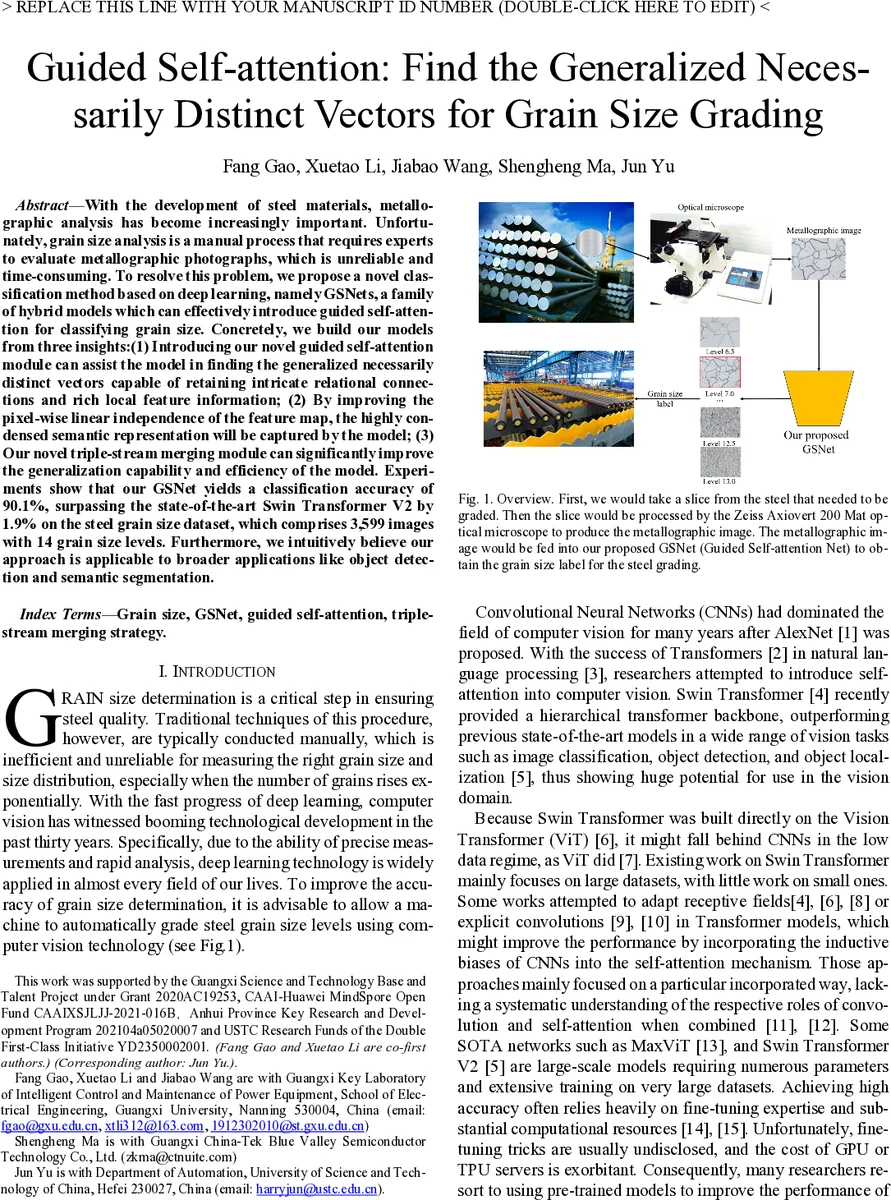
With the development of steel materials, metallographic analysis has become increasingly important. Unfortunately, grain size analysis is a manual process that requires experts to evaluate metallographic photographs, which is unreliable and time-consuming. To resolve this problem, we propose a novel classifi-cation method based on deep learning, namely GSNets, a family of hybrid models which can effectively introduce guided self-attention for classifying grain size. Concretely, we build our models from three insights:(1) Introducing our novel guided self-attention module can assist the model in finding the generalized necessarily distinct vectors capable of retaining intricate rela-tional connections and rich local feature information; (2) By improving the pixel-wise linear independence of the feature map, the highly condensed semantic representation will be captured by the model; (3) Our novel triple-stream merging module can significantly improve the generalization capability and efficiency of the model. Experiments show that our GSNet yields a classifi-cation accuracy of 90.1%, surpassing the state-of-the-art Swin Transformer V2 by 1.9% on the steel grain size dataset, which comprises 3,599 images with 14 grain size levels. Furthermore, we intuitively believe our approach is applicable to broader ap-plications like object detection and semantic segmentation.
💡 Research Summary
The paper addresses the long‑standing challenge of automating grain‑size grading in steel metallography, a task traditionally performed manually by experts and thus prone to inconsistency and high labor cost. The authors propose a novel deep‑learning framework called GSNets (Guided Self‑attention Networks) that integrates three key ideas: (1) a pixel‑wise linear independence‑enhancing encoder, (2) a guided self‑attention mechanism that explicitly searches for “generalized necessarily distinct vectors” (NDVs), and (3) a triple‑stream merging module that fuses multi‑scale features efficiently.
Encoder design – The encoder combines DenseNet blocks with Swin‑Transformer stages. DenseNet reduces inter‑channel redundancy, encouraging each pixel to carry a more independent representation. Swin‑Transformer contributes hierarchical, window‑based self‑attention that captures long‑range dependencies. This hybrid architecture yields feature maps that simultaneously encode fine‑grained local texture (critical for distinguishing individual grains) and global structural patterns (important for recognizing grain clusters).
Guided self‑attention – Conventional self‑attention treats all tokens uniformly, which can dilute the discriminative signals needed for grain‑size classification. GSNets introduce a guidance signal in the form of an Improved Adaptive Weighted Channel Attention (IA‑WCA) module. IA‑WCA computes dynamic channel‑wise weights, feeding them into both regular multi‑head self‑attention (W‑MSA) and shifted‑window self‑attention (SW‑MSA). By doing so, the network is steered toward learning NDVs—vectors that are maximally distinct across different grain groups while preserving intra‑group cohesion. These NDVs act as robust descriptors for the 14 grain‑size categories.
Triple‑stream merging – After the guided attention stage, three parallel streams process the features: (i) a CNN‑centric stream emphasizing local convolutions, (ii) a transformer‑centric stream preserving global context, and (iii) a channel‑attention stream that re‑weights features based on IA‑WCA outputs. The streams are concatenated and weighted before feeding a classification head, enabling the model to leverage complementary information from multiple receptive fields without excessive parameter growth.
Experimental validation – The authors assembled a proprietary steel‑grain dataset containing 3,599 images across 14 size levels. Without any external pre‑training, GSNets achieved 90.1 % classification accuracy, surpassing the state‑of‑the‑art Swin Transformer V2 (pre‑trained on ImageNet‑22K) by 1.9 percentage points. Ablation studies demonstrated that removing IA‑WCA, the triple‑stream merger, or the pixel‑wise linear independence enhancement each caused a drop of 2–3 % in accuracy, confirming the necessity of all three components. Moreover, GSNets required fewer parameters and comparable inference speed relative to Swin V2, highlighting its efficiency for industrial deployment.
Broader impact and future work – The paper argues that the guided self‑attention and IA‑WCA modules are generic enough to be transplanted into other vision tasks such as object detection and semantic segmentation, especially in domains where data are scarce and fine‑grained distinctions matter (e.g., semiconductor defect inspection, medical histopathology). Future directions include extending the approach to 3‑D volumetric data, exploring lightweight variants for edge devices, and testing cross‑domain generalization on non‑steel materials.
In summary, GSNets present a well‑engineered combination of dense convolutional encoding, transformer‑based global reasoning, and a novel guided attention scheme that together deliver state‑of‑the‑art grain‑size grading performance on a modestly sized, domain‑specific dataset, while maintaining computational practicality for real‑world manufacturing environments.
Comments & Academic Discussion
Loading comments...
Leave a Comment