Dynamic-RKKY induced time-reversal symmetry breaking and chiral spin liquids
We study the Ruderman-Kittel-Kasuya-Yosida (RKKY) interaction in various Kondo lattice systems. We argue that the weak Kondo-coupling expansion contains certain physics which is lost in the usual static approximation to the spin susceptibility. Most notably, while the former is sensitive to the time-reversal symmetry breaking, the latter is blind to it. Using exact diagonalization on small systems, we show that this enables inducing spin chirality by an external magnetic field. To study larger systems, we use a large-N approximation to capture the effect of dynamic-RKKY interaction on U(1) spin liquids. On a honeycomb Kondo lattice with Haldane fluxes for electrons, we show that the non-trivial topology and chiral edge states are induced on the spinons. Our results suggest that dynamic RKKY in combination with external magnetic field or in proximity to topological electronic materials, can be used as a tunable Dzyaloshinskii-Moriya even in centrosymmetric materials.
💡 Research Summary
This paper revisits the Ruderman‑Kittel‑Kasuya‑Yosida (RKKY) interaction in Kondo lattice systems, focusing on the weak‑Kondo‑coupling regime where the Kondo exchange J_K is small compared with the electronic bandwidth. By integrating out the conduction electrons to second order in J_K, the authors derive an effective spin action that contains two contributions: an instantaneous Heisenberg term J_H and a retarded (dynamic) RKKY term proportional to J_K² χ_ij(τ), where χ_ij is the full, frequency‑dependent spin susceptibility of the conduction electrons. The conventional static approximation replaces χ_ij(τ) by its zero‑frequency component χ_ij(0), thereby discarding any information contained in the finite‑frequency part of the susceptibility.
A careful symmetry analysis shows that the static susceptibility is always even under time‑reversal, even when the underlying electronic system breaks TRS (for example, by a Haldane flux or an external magnetic field). Consequently, static RKKY cannot transmit TRS breaking to the localized spins. In contrast, the full dynamical χ_ij(ω) does contain an imaginary, odd‑in‑ω component that directly reflects the electronic TRS breaking. This component survives in the retarded RKKY kernel and can generate an effective Dzyaloshinskii‑Moriya‑like (DM‑like) interaction between spins, even in centrosymmetric lattices where conventional DM interactions are symmetry‑forbidden.
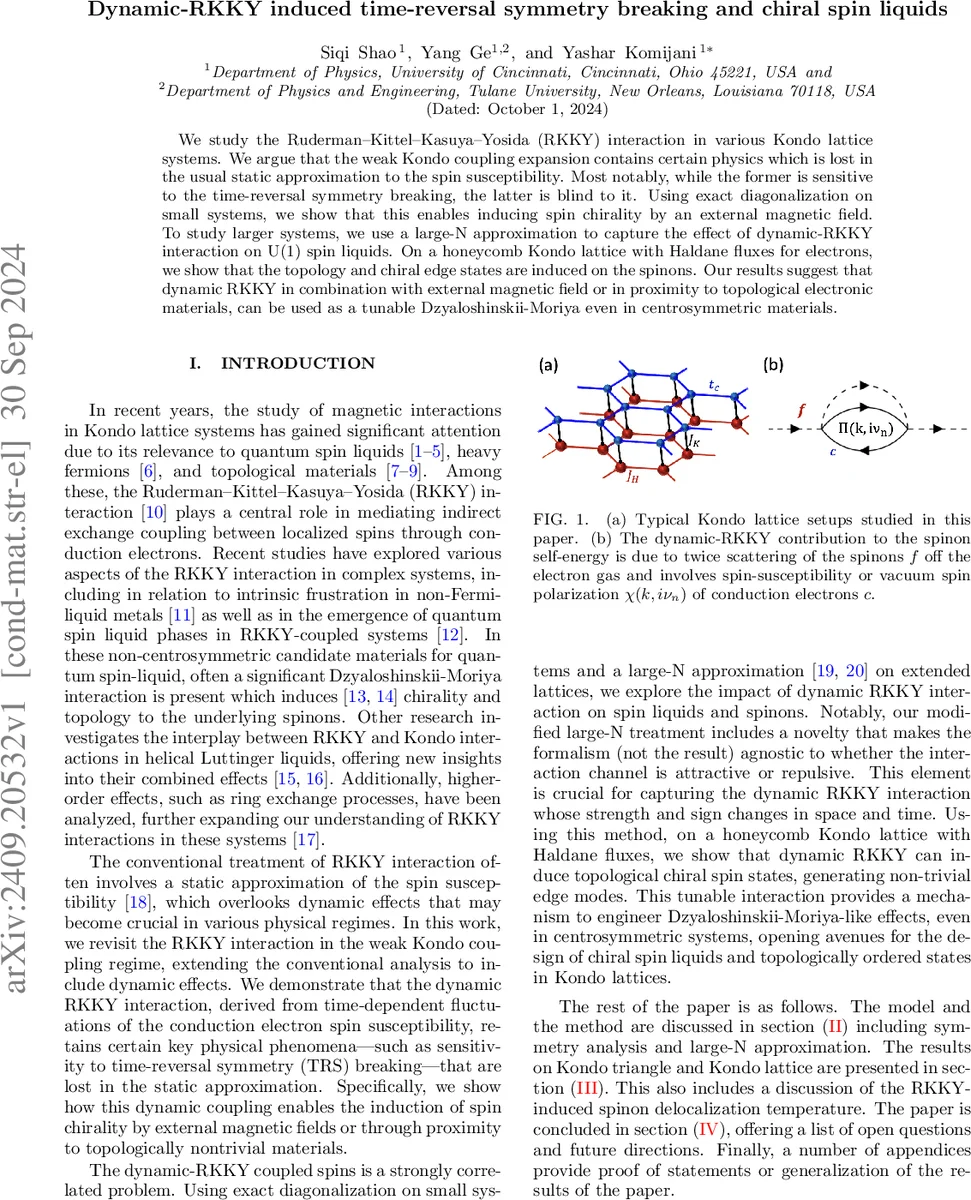
To treat the resulting strongly correlated spin problem, the authors employ a large‑N (SU(N) or SP(N)) formulation using Abrikosov fermions (f‑spinons). Rather than the usual Hubbard‑Stratonovich decoupling, they introduce a bi‑local Green’s function G_f and a Lagrange multiplier Σ_f, leading to a self‑consistency condition Σ_ij(τ)=−J_eff(τ) G_ij(τ). The self‑energy splits into a frequency‑independent mean‑field part Σ^(1) (originating from J_H) and a frequency‑dependent part Σ^(2) that encodes the dynamic RKKY contribution. Σ^(2) involves a convolution of the electronic Lindhard function Π(q,ω) with the spinon Green’s function, explicitly showing how the finite‑frequency susceptibility feeds back onto the spin sector. Numerical solution of the self‑consistent equations reveals that, for the parameter regimes studied, the quasiparticle weight Z_k remains close to unity, indicating that the dynamic RKKY does not dramatically broaden the spinon spectrum but does generate a finite imaginary self‑energy proportional to Im Π, i.e., an effective DM vector D_ij∝J_K² Im χ_ij(ω).
The theoretical framework is validated on two concrete models. First, exact diagonalization of a three‑site Kondo triangle demonstrates that an external magnetic field, which breaks TRS in the electronic sector, induces a non‑zero scalar spin chirality ⟨S_i·(S_j×S_k)⟩ via the dynamic RKKY term—an effect absent in static RKKY calculations. Second, a honeycomb Kondo lattice is considered where the conduction electrons are described by the Haldane model with a staggered flux (non‑trivial Chern number). Large‑N calculations show that the dynamic RKKY endows the spinon bands with a Chern number ±1, producing chiral edge modes analogous to those of the electronic Haldane insulator. The resulting spin liquid thus acquires topological character, and the emergent edge states are protected by the same bulk‑boundary correspondence that governs the electronic system.
Overall, the paper establishes four key insights: (i) dynamic RKKY retains sensitivity to electronic TRS breaking that static approximations miss; (ii) this sensitivity enables the induction of scalar spin chirality and effective DM‑like interactions by external fields or proximity to topological electronic phases; (iii) in U(1) spin liquids the dynamic RKKY can convert a trivial spinon band structure into a topological Chern insulator, generating chiral edge excitations; and (iv) such DM‑like interactions can be engineered even in centrosymmetric materials, providing a new route to realize chiral spin liquids without relying on intrinsic spin‑orbit coupling or lattice asymmetry. The work opens avenues for exploring dynamic RKKY effects in strongly correlated metals, heavy‑fermion compounds, and heterostructures that combine magnetic layers with topological insulators or Chern metals.
Comments & Academic Discussion
Loading comments...
Leave a Comment