Dealing with Controversy: An Emotion and Coping Strategy Corpus Based on Role Playing
There is a mismatch between psychological and computational studies on emotions. Psychological research aims at explaining and documenting internal mechanisms of these phenomena, while computational work often simplifies them into labels. Many emotion fundamentals remain under-explored in natural language processing, particularly how emotions develop and how people cope with them. To help reduce this gap, we follow theories on coping, and treat emotions as strategies to cope with salient situations (i.e., how people deal with emotion-eliciting events). This approach allows us to investigate the link between emotions and behavior, which also emerges in language. We introduce the task of coping identification, together with a corpus to do so, constructed via role-playing. We find that coping strategies realize in text even though they are challenging to recognize, both for humans and automatic systems trained and prompted on the same task. We thus open up a promising research direction to enhance the capability of models to better capture emotion mechanisms from text.
💡 Research Summary
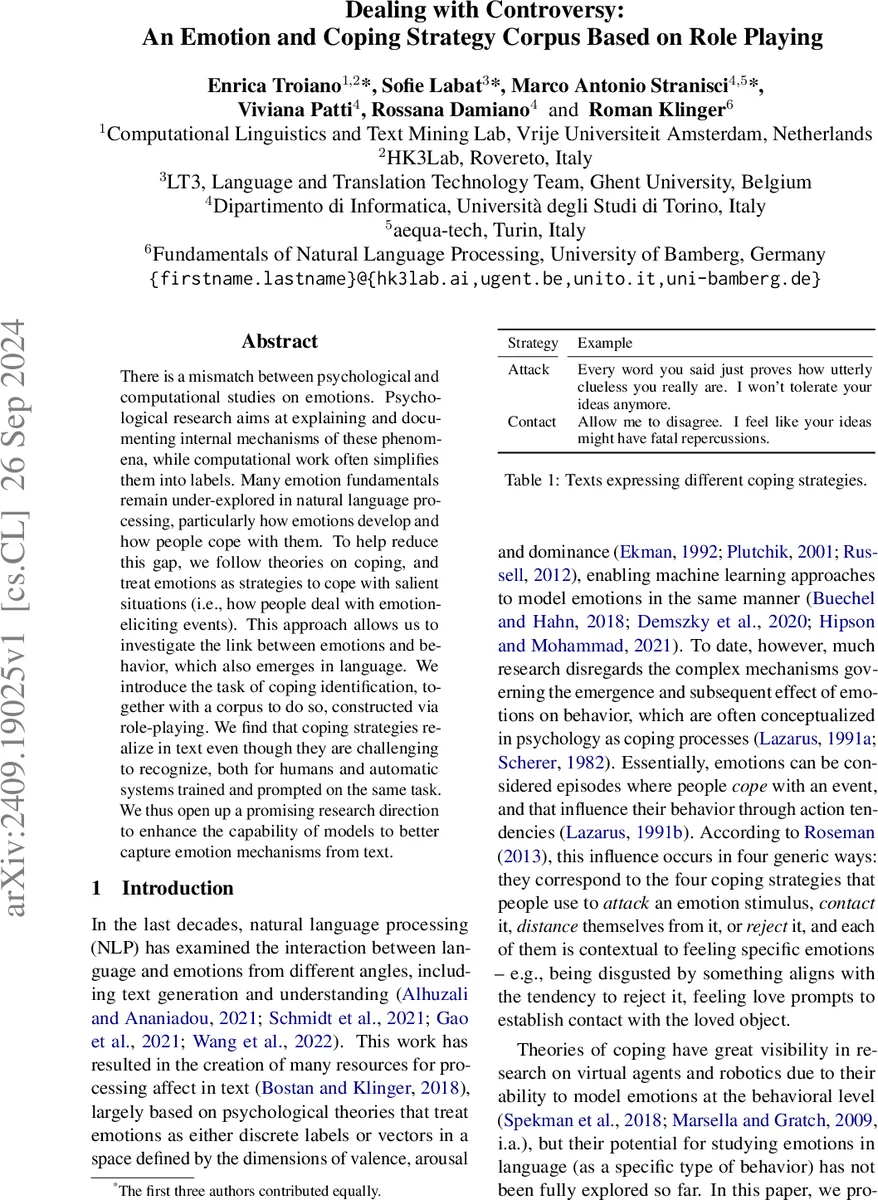
This paper addresses the gap between psychological theories of emotion and the simplified label‑based approaches common in natural language processing. Building on Roseman’s (2013) taxonomy, the authors treat emotions as manifestations of four coping strategies—Attack, Contact, Distance, and Reject—that correspond to specific emotion groups and behavioral functions. To investigate whether these strategies are expressed in text and can be automatically identified, they introduce the task of coping strategy identification and create a novel corpus, COPING, using a role‑playing methodology.
First, concise, lay‑person definitions for each strategy are crafted and validated through a pre‑test where crowd workers must correctly map a description to its coping category. Next, controversial scenarios on five socially relevant topics (abortion, immigration, racism, LGBTQ+ rights, drugs) are generated by ChatGPT‑4, each depicting a hostile interlocutor (Y). Crowd workers then assume the role of a fictional character X, whose personality embodies one of the coping strategies, and write a reply to Y. The resulting utterances are annotated with the intended coping strategy, non‑verbal behavior, emotional response, and a self‑reflection component. The final dataset comprises roughly 1,800 texts covering all strategy–topic combinations.
Annotation analysis shows high recognizability for Attack and Contact (100 % accuracy), moderate for Distance (92 %), and lower for Reject (52 %), indicating the need for clearer definitions for the latter. For the classification task, the authors fine‑tune a BERT‑based multi‑class model and evaluate four large language models (GPT‑4, Llama‑2, Claude, etc.) in zero‑shot and few‑shot settings. Human annotators achieve an average F1 of 78.3 %, while the best LLM reaches 62.5 %. Performance varies across strategies: Attack and Contact are identified more reliably than Distance and Reject, which are often confused.
The study demonstrates that coping strategies do surface in language and can be captured by both humans and machine learners, though automatic systems still lag behind humans, especially for less salient strategies. The role‑playing data collection approach proves effective for eliciting complex, behavior‑oriented emotional expressions that are scarce in natural corpora. The authors release the COPING dataset and code, inviting further research on finer‑grained strategy definitions, multi‑label coping, temporal dynamics of emotion‑coping interactions, and application to real‑world online dialogues. Overall, the work opens a promising avenue for enriching emotion analysis with psychologically grounded behavioral mechanisms.
Comments & Academic Discussion
Loading comments...
Leave a Comment