Buckling by disordered growth
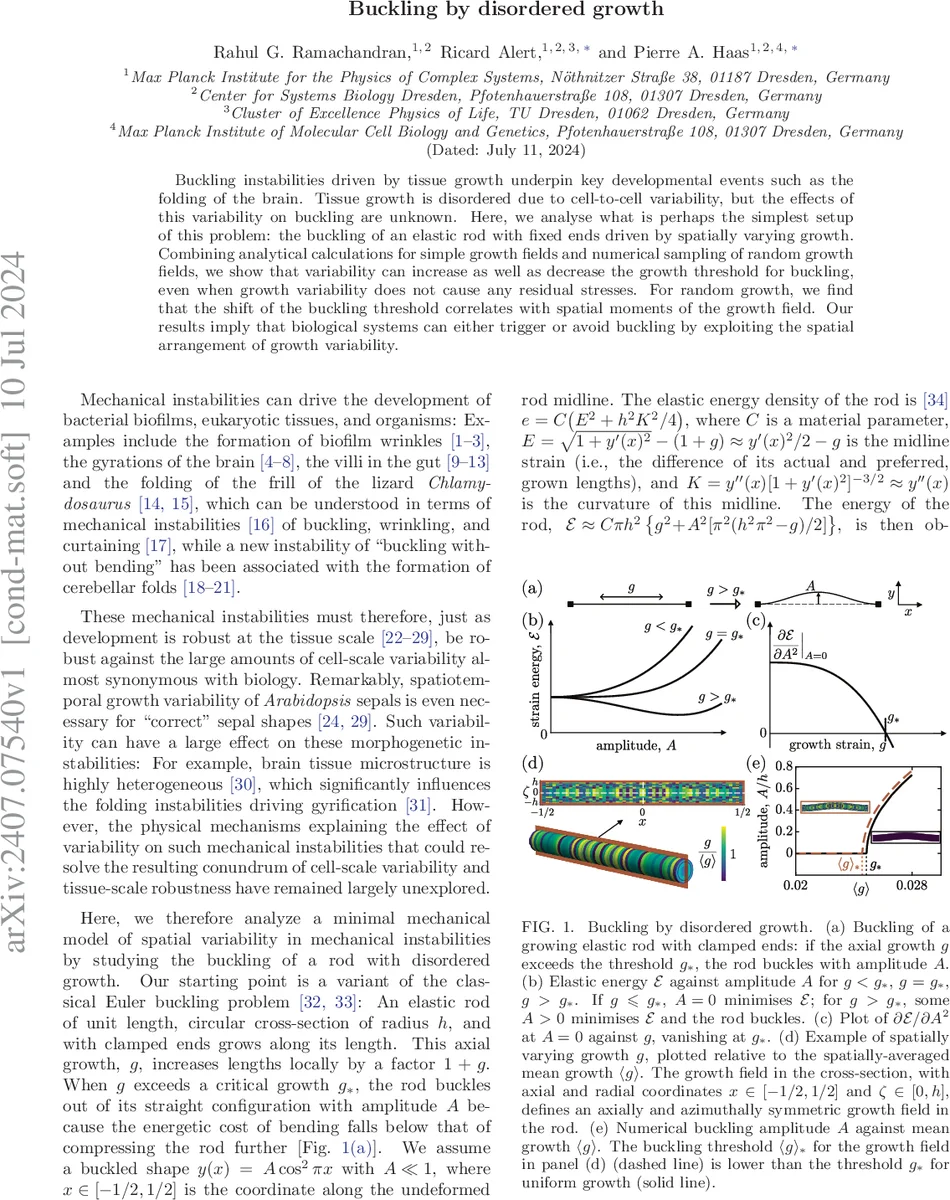
Buckling instabilities driven by tissue growth underpin key developmental events such as the folding of the brain. Tissue growth is disordered due to cell-to-cell variability, but the effects of this variability on buckling are unknown. Here, we analyse what is perhaps the simplest setup of this problem: the buckling of an elastic rod with fixed ends driven by spatially varying growth. Combining analytical calculations for simple growth fields and numerical sampling of random growth fields, we show that variability can increase as well as decrease the growth threshold for buckling, even when growth variability does not cause any residual stresses. For random growth, we find that the shift of the buckling threshold correlates with spatial moments of the growth field. Our results imply that biological systems can either trigger or avoid buckling by exploiting the spatial arrangement of growth variability.
💡 Research Summary
This paper investigates the fundamental impact of spatially disordered growth on mechanical buckling instabilities, which are central to morphogenetic processes like brain folding. The authors employ a minimal physical model: an elastic rod with fixed ends, subjected to axial growth that varies along its length and across its cross-section.
The core finding is that spatial variability in growth can either increase or decrease the critical average growth required for buckling, even when the growth pattern is “compatible” (i.e., does not generate residual stresses in a free rod). This challenges the intuitive notion that disorder solely promotes instability by creating internal stresses.
The analysis proceeds in two main stages. First, using simplified “growth island” patterns, the study combines finite-element simulations and analytical energy estimates to map how the buckling threshold depends on the island’s size and position. Key results include: 1) Axially localized but radially uniform growth islands can shift the threshold without creating residual stresses, proving the effect is not stress-mediated alone. 2) The threshold can be raised or lowered based on the island’s location; for instance, islands near the rod’s center often raise the threshold the most. 3) An analytical estimate captures qualitative trends, including a predicted “flipping” behavior where the location for maximal threshold switches from the center to the ends as the island becomes more radially localized.
Second, the authors perform “mechanical statistics” by sampling random growth fields from a uniform distribution. They find a strong correlation between the buckling threshold shift and the variance of the growth disorder. However, residual variations in the threshold among samples with the same variance are better correlated with spatial moments of the growth field (e.g., ⟨ζG⟩, ⟨ζ²G⟩) than with higher statistical moments (e.g., skewness ⟨G³⟩). This highlights that not just the magnitude, but the specific spatial arrangement of growth variability influences buckling.
The implications are significant for understanding biological robustness. The results suggest that developing tissues could exploit the spatial patterning of cell-to-cell growth variability, not just its average rate, to reliably trigger or suppress buckling instabilities. This provides a new perspective on how microscopic randomness and macroscopic order can coexist in morphogenesis. The work also suggests that buckling in systems like epithelial monolayers may be relatively robust to in-plane growth disorder, while being more sensitive to variability across the tissue thickness.
Comments & Academic Discussion
Loading comments...
Leave a Comment