High-performance Power Allocation Strategies for Active IRS-aided Wireless Network
Due to its intrinsic ability to combat the double fading effect, the active intelligent reflective surface (IRS) becomes popular. The main feature of active IRS must be supplied by power, and the problem of how to allocate the total power between bas…
Authors: Yifan Zhao, Xuehui Wang, Yan Wang
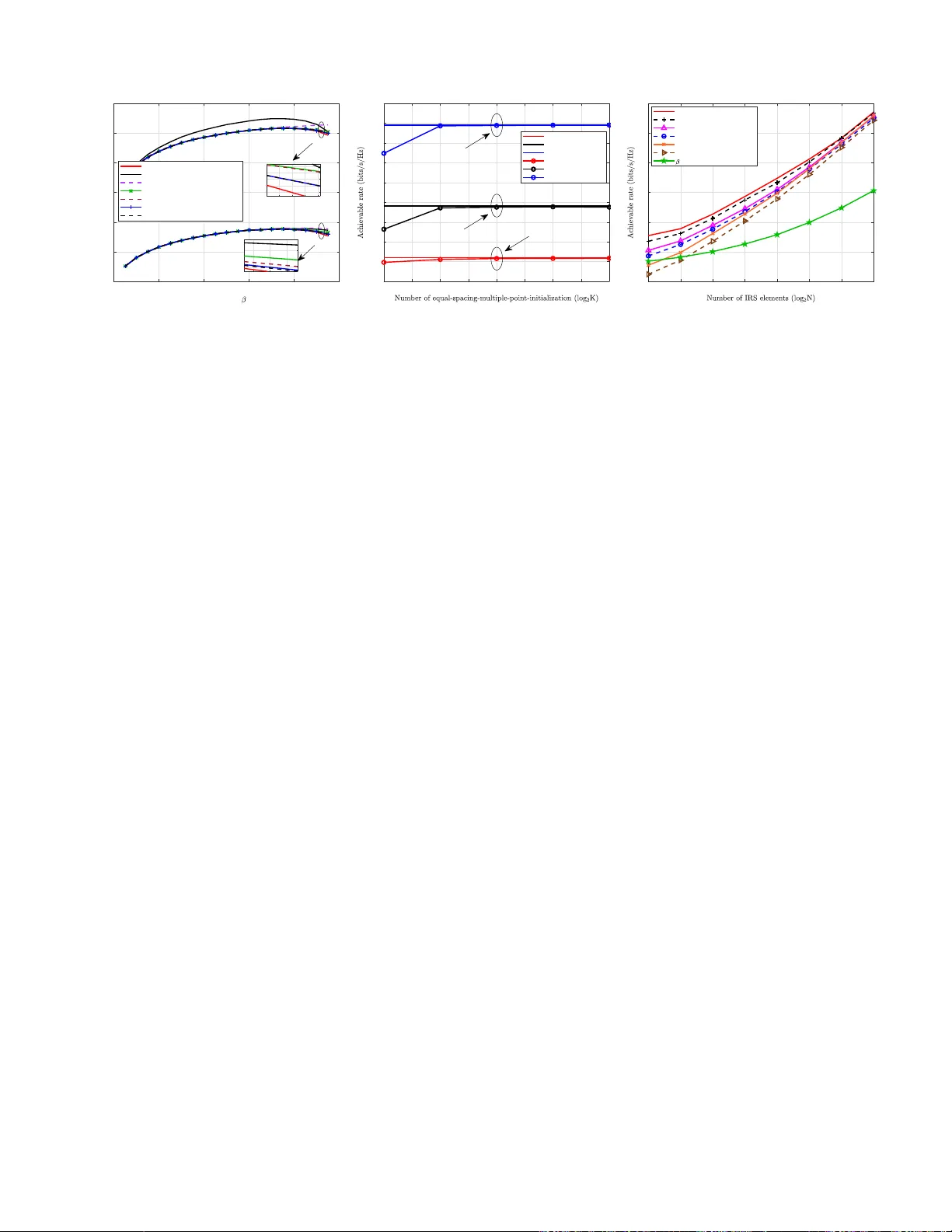
1 High-performance Po wer Alloca tion Strate gies for Acti v e IRS-aided W ireless Netw ork Y if an Zhao, Xuehui W ang, Y an W ang, Xianpeng W ang, Zhilin Chen, Feng Shu, Cun hua Pan, and J ia n gzhou W ang F e llow , IEEE Abstract —Due to its intrinsic ability to com bat the double- fading effect, the activ e in telligent reflectiv e surface (IRS) b e- comes popular . The ma in feature of activ e IRS mu st be suppl ied by power , and th e problem of how to allocate the total power between base station (BS) and IRS to fully explore the rate gain achieved b y power allocation (P A) to remo ve the rate gap between existing P A strategies and opti mal exhaustiv e search (ES) arises naturally . First, the signal-to-noise ratio (S NR) expression is derived t o be a function of P A factor β ∈ [ 0 , 1] . Then, to impro ve t h e rate perf ormance of the con ventional gradient ascent (GA), an equal-spacing-multip le-point-init i alization GA (ESMPI- GA) method is pro posed. Due to its slow linear con ver gence from iterative GA, the p roposed ESMP I-GA i s high-complexity . Eventually , to reduce this high complexity , a low-complexity closed-fo rm P A method with third-order T aylor expansion (TTE) centered at point β 0 = 0 . 5 is proposed. S imulation results show that the proposed ESMPI-GA and T T E obviously outperform existing methods like equal P A. Index T erms —Activ e in t elligent r efl ectiv e surface, power allocation, gradient ascent, equ al-sp acing-multiple-poin t - initialization, closed-fo rm, rate perf ormance I . I N T R O D U C T I O N W ith the rapid growth of big data applications such as social media, v ideo streaming, an d online gam e s, there is an increased dem a n d fo r high-spee d and stable da ta transmission. T o sup port the pr oper operation of these application s, the broade r coverage a n d lower laten cy should be provided in wireless networks [1]. I n recent years, there are still some difficult prob lems in the development of wireless commun i- cation, such as shadow fading, transmission pa th loss, energy efficiency , which have slowed down its progre ss. As a low- cost and low-power consumptio n reflecting device, in telligent This w ork was supported in part by the National Natural Science Foundatio n of China (Nos.U22A2002, and 62071234), the Hainan Provin ce Science and T echnology Special Fund (ZDKJ2021022), the Scient ific Research Fund Project of Hainan Uni versi ty under Grant KYQD(ZR)-21008, and the Col- laborat ive Innov ation Cente r of Information T echnology , Hainan Uni versi ty (XTCX2022XXC07). (Corre s ponding author: F eng Shu). Y ifan Zhao, Xuehui W ang, Y an W ang, Xianpen g W ang and Zhilin Chen are with the School of Information and Communicat ion Engineeri ng, Ha inan Uni versity , Haikou 570 228, Ch ina (e - mail: zyf1001@ha inanu.edu.cn; wangxu ehui0503 @163.com; yan- wang@h ainanu .edu.cn; zhili n.chen@hai nanu.edu.cn.; wxpeng2016 @ hainanu .edu.cn) Feng Shu is with the School of Information and Communication E nginee r- ing, and Collaborati ve Innov ation Center of Information T echnology , Hainan Uni versity , Haikou 570228, China, and also with the School of Electroni c and Optical Engineering , Nanjing Unive rsity of Science and T echnology , Nanjing 210094, China (e-mail: shufeng0101@1 63.com). Cunhua Pan is with National Mobile Communicat ions Research Laboratory , Southeast Univ ersity , Nanjing 211111, China. (e-mail: cpan@seu.edu.cn). Jiangzho u W ang is with the School of Engineeri ng, Uni versity of Kent, CT2 7NT Canterbu ry , U.K. (e-mail: j.z.wan g@ken t.ac.uk). reflective surface (IRS) h as emerged in respo nse to th e needs of wireless commun ication [ 2]–[4]. By intelligently design ing the phase shift of each reflecting unit, I RS can build a add itionally bene fit chann el for th e incident signal, so that the reflecting signal an d the d irect signal can b e reconfigur ed [5]. Meanwhile, the p e rforman ce loss caused by path loss and interf e rence in th e direct channel can b e sign ificantly improved [1]. So far, passi ve IRS h as b een extensi vely applied to various wireless commun ication scenar- ios. Aiming to impr ove th e energy efficiency (EE) of cell-free (CF) network, an IRS-assisted CF n etwork was c o nsidered in [6]. By utilizing an alternating descent algorith m , the tran smit beamfor ming at the ac cess point and the control matrix at the IRS cou ld be jointly optimized f or EE enh ancement. An IRS-aided multiple-in put single-ou tp ut (MISO) system was propo sed in [7], w h ile the hardware impairments was taken into ac c ount. It was shown that compared to the case of ide al hardware, alth ough the num bers of transm itter antennas and IRS elements went to large scale, the spectral efficiency was finite. Sim u ltaneously , a an alytical solution was derived to maximize EE. [8] co n sidered an IRS-aided millimeter wave multigrou p multicast m ultiple-inp u t mu ltiple-outp u t (MIMO) commun icaion system. T o maximize the sum rate, beamfo rm- ing vector and phase shift matrix were jointly optimiazed by combinin g blo ck diag o nalization and manif old method . Howe ver, there exists a double- fading challenge in the passiv e IRS-aid ed cascaded chan nel, wh ic h le a ds to a limited rate p erform ance enhancemen t ob tained by intro ducing passive IRS [9]. Given that, activ e IRS eq uipped with power amplifiers has appe a red to overcome this p roblem. Because of the ability to amplif y the power of reflecting signal, the perfor mance loss caused b y doub le fading can be com p ensated [ 10]. At present, researchers have begun to pay attentio n to a cti ve IRS. I n [5], the auth o rs demo nstrated th at the capacity gain of active IRS was substantial by analyzing its asymptotic perfor m ance. In addition, an active IRS-aided multi- u ser MI SO (MU-MISO) network was p roposed, wh ere transmit beam forming an d re- flecting coefficient matrix were jointly op tim ized to ma x imize sum r ate. An active IRS-assisted sing le-input single-outpu t wireless network was co nsidered in [11], where two meth ods, namely maximum ratio reflecting and selective ratio reflect- ing, were p roposed , which wer e with clo sed -form solutio ns to reflectin g coefficient matrix . T o fur ther improve the rate perfor mance, an alternately iter ati ve method was presented to solve the p roblem of m aximizing reflected-sign al-to-no ise ratio. When th e total transmit power is limited , the rate perf or- 2 mance can b e significantly imp roved via power allo c ation (P A) between transmit signals. P A is a key strategy , wh ich has been well resear ched in different networks, such a s secure spatial modulatio n ( SM ) networks [1 2], secure direction al modulatio n (DM) networks [1 3], pilot co n tamination attack (PCA) scheme [14], secur e MI M O precod ing systems [15] and passiv e IRS- assisted decode-fo rward (DF) relay networks [16]. Aiming at maximizing secrecy rate of a secure DM network [13], two P A method s, c alled gene ral P A and null-space pr o jection P A, were designed to alloc ate between co n fidential messages an d artificial noise. For IRS-assisted DF relay system s in [16], to a c h iev e a goal o f m aximizing sum rate, successi ve conve x approx imation m ethod, m aximizing determinant m ethod an d a method with rate constraint were respec tively pr oposed to optimize the power factors o f two u sers and DF relay for higher sum rate p e rforman ce. In [17], the authors fo cused on the design of P A alg orithms for active IRS assisted wireless networks. Given the fixed transmit b eamform ing vector at BS and IRS ph ase shift matrix, a T aylor polyno mial approx imation (TP A) metho d was propo sed, where analytical solutions related to P A factor co uld be obtained thro ugh T a y lor appr oximation . It is particu larly no ted th at the appr o ximate poly n omial fit the original function well under the condition of weak direct link from BS to user . Howe ver, the existing TP A method in [17] is not suitab le f or some practical scenario s. For example, in a scena r io wher e th e direct link b etween BS and user is strong co m pared with the reflecting link BS-IRS-User . Moreover , the rate perform a n ce gap b e tween the TP A an d exhaustive sear ch (ES) is still large. In other words, the ap proxim a te function canno t fit th e original function well. T o redu ce the rate perfor mance gap , two high - perfor mance efficient P A m e th ods ar e pro posed to furth er exploit the rate gain achieved by P A to r emove this rate gap. The main contributions of th is paper are as b elow: 1) Given the tr a n smit bea mformin g vector at BS an d th e reflection co efficient matrix at IRS ar e design ed well, the SNR expr ession h as been d e riv e d to be a fun ction of P A factor β . T o imp rove the rate perfor mance of con- ventional g radient ascent (GA), equal-spacin g-multiple- point-initializatio n (ESMPI) is co mbined with GA to form an e nhanced G A, called ESMPI-GA, wh ich is closer to ES than existing me th ods. Its com p utational complexity is the order O { K I } float-p ointed oper ation (FLOPs), where K is the num ber of e qual-spacin g initialization points (ESIPs) and I is th e average n umber of iterations pe r in itializatio n. Accordin g to simu la tio n results, K is larger than o r equal to 16, the proposed ESMPI-GA appr oaches ES in m edium-scale or large- scale IRS. 2) Due to the fact that GA ha s the pro perty of slow linea r conv e rgen ce, the pro posed ESMPI-GA is still hig h- complexity . T o r educe th is high comp lexity , a closed - form P A m ethod is prop o sed by using the th ird-ord er T aylor exp ansion (TTE) centered th e p o inted β 0 = 0 . 5 , called TTE, wh ich is symmetr ic in the interval β ∈ (0 , 1) and provide a better appr oximation than the TP A method in [17]. Afterwards, the Ferrari’ s method c a n be utilized to find the roots o f the first deriv ative o f the TT E f unction of SNR, which forms a c andidate set. Simulation results demonstrate that the prop osed TTE method harvests abo ut 0.5 bit rate gain over TP A in small-scale IRS with an appro ximately same ord er low complexity as TP A an d is closer to the rate per f ormance of ES. The remain der of the paper is ar r anged as follows. In Section II , an active IRS-assisted wireless network system is described and a P A prob lem is f ormulated . In Sectio n III, two m ethods are pr o posed to solve P A pro blem. Simulatio n results are presented in Section IV , and conclu sions are dr awn in Section V . N otations : Thro ughou t this paper, we den ote vectors by lowercase letters an d matrices by up percase letters, r espec- ti vely . ( · ) T and ( · ) H stand fo r transpose an d con jugate trans- pose, respectively . Euclid ean par adigm, diag o nal, expectatio n and real part operations are d enoted as k · k , diag ( · ) , E {·} and R {·} , respectively . I I . S Y S T E M M O D E L A N D P RO B L E M F O R M U L AT I O N A. System Model ;YKX N . (GYKYZGZOUT Fig. 1. System model of an acti ve IRS-assisted wireless netwo rk with P A. Fig.1 sketches an active IRS-assisted wireless communica- tion network with P A, where BS equ ipped with M antennas serves a single-anten n a user with the aid of an active IRS consisting o f N elemen ts. The received sign al at IRS is y r = p β P H si v x + n I , (1) where x with E { x H x } = 1 is th e signal transmitted by BS, β is a P A pa r ameter that allocates the power b etween BS and IRS, P is the total power b eing the power sum of BS ( β P ) a n d IRS ((1 − β ) P ) , v ∈ C M × 1 with k v k 2 2 = 1 is th e tran smit be amformin g vector at BS, H si ∈ C N × M denotes the chann el fro m BS to active IRS, n I ∈ C N × 1 is the additive white Gaussian noise (A WGN) with distribution n I ∼ C N (0 , σ 2 I I N ) . Th e transmit signal at IRS is y t = Θy r = p β P ΘH si v x + Θn I , (2) where matrix Θ = d iag ( α 1 e j θ 1 , · · · , α N e j θ N ) ∈ C N × N con- sists of the r e flection coefficient of ea c h active IRS element, α n and θ n respectively stan d for the amplification factor and phase shift of the n -th element. The received signal at user can be represen ted as y = p β P ( g H ΘH si + h H ) v x + g H Θn I + z = p β P ( θ H GH si + h H ) v x + θ H Gn I + z = p β P ( ρ e θ H GH si + h H ) v x + ρ e θ H Gn I + z , (3) 3 where h H ∈ C 1 × M and g H ∈ C 1 × N denote the chan - nels from BS to user an d I RS to user, respectively . θ = ρ e θ = [ α 1 e j θ 1 , · · · , α N e j θ ] H , ρ = k θ k 2 , k e θ k 2 = 1 and G = diag ( g H ) . z ∈ C 1 × 1 is the A WGN with distribution z ∼ C N (0 , σ 2 n ) . Th e re flec te d average power at IRS is P I = E { y H t y t } = (1 − β ) P = β P ρ 2 k e θ H diag ( H si v ) k 2 2 + σ 2 I ρ 2 , (4) which y ie ld s ρ = v u u t (1 − β ) P β P k e θ H diag ( H si v ) k 2 2 + σ 2 I . (5) The SNR at the user can be f ormulated as follows SNR = β P k ( ρ e θ H GH si + h H ) v k 2 2 σ 2 I ρ 2 k e θ H G k 2 2 + σ 2 n . (6) B. Pr oblem F ormulation Under the co nstraints of total tr a n smit power P , th e opti- mization p roblem of maximizing SNR can be cast as max β , e θ , v f ( β ) = SNR ( β ) = β P k ( ρ e θ H GH si + h H ) v k 2 2 σ 2 I ρ 2 k e θ H G k 2 2 + σ 2 n , s.t. 0 ≤ β ≤ 1 , k e θ k 2 2 = 1 , k v k 2 2 = 1 . (7) Provided that θ an d v are designed well, the optimization problem with respect to β is cast as follows max β f ( β ) = uβ 2 + 2 eβ p l 1 β 2 + l β + f + dβ bβ + a , s.t. 0 ≤ β ≤ 1 , (8) where M = d iag ( H si v ) , a = σ 2 I P k e θ H G k 2 + σ 2 I σ 2 n , (9) b = P ( σ 2 n k e θ H M k 2 − σ 2 I k e θ H G k 2 ) , d = P 2 k e θ H GH si v k 2 + P σ 2 I k h H v k 2 , e = P R { e θ H GH si vv H h } , f = P σ 2 I , u = P 2 ( k h H v k 2 k e θ H M k 2 − k e θ H GH si v k 2 ) , l = P 2 k e θ H M k 2 − σ 2 I P, l 1 = − P 2 k e θ H M k 2 . Observing the objective fu nction f ( β ) in (8) , it is clear that it is a nonlinear fun ction. Maximiz in g the function is usually addressed by iterative methods like GA. In this paper, we will also design a closed-for m solu tion to the maximization problem o f fun c tion f ( β ) over inter val [0 ,1]. I I I . P RO P O S E D T W O P A S C H E M E S T o fully explore the rate ga in of P A, two high-p e r forman ce P A schem es, namely ESMPI-GA an d TTE, are developed in this sectio n. The former will enhance the rate perfo rmance of conv e n tional GA by intro ducing ESMPI, while the latter offers an extremely low-complexity high- rate solution. A. Pr oposed ES MPI-GA method First, the original SNR function in (8) is u niform ly sampled in the in terval [0, 1 ] to for m th e following set of in itialization points S 1 = { β 1 , 0 · · · , β K, 0 } . (10) W ith β k +1 , 0 − β k, 0 = 1 / ( K − 1) . Subseq u ently , the GA is applied to each initialization point. For th e i -th iteration of the k -th initialization point, the correspon ding first deriv ative of f ( β k,i ) with regard to β k,i is defined as fo llows f ′ ( β k,i ) = ∂ f ( β k,i ) ∂ β k,i = g 1 ( β k,i ) + g 2 ( β k,i ) ( bβ k,i + a ) 2 , (11) where g 1 ( β k,i ) = ub β 2 k,i + ebβ 2 k,i (2 l 1 β k,i + l ) q l 1 β 2 k,i + l β k,i + f , (12) g 2 ( β k,i ) = ad + 2 auβ k,i + 2 ae q l 1 β 2 k,i + l β k,i + f + eaβ k,i (2 l 1 β k,i + l ) q l 1 β 2 k,i + l β k,i + f . (13) Afterwards, we can o btain β k,i +1 throug h GA algorithm as shown below β k,i +1 = β k,i + pf ′ ( β k,i ) , (14) where p repr esents the step le n gth. The above iter a tion pr ocess will con tinue until the termin ation conditio n | β k,i +1 − β k,i | ≤ η is satisfied, where η is the accuracy . It is assumed that the iteration numb er is I k . Considering the P A factor is limited to the interval [0,1], we upd ate the c a ndidate so lu tion by using the following equatio n e β k = ( β k,I k 0 ≤ β k,I k ≤ 1 , 0 β k,I k < 1 , β k,I k > 0 . (15) Finally , we find th e o p timal solution by max imizing th e original SNR functio n as follows. β opt = arg max e β k ∈ S A { f ( e β k ) } , ( 1 6) where S A = n e β 1 , · · · , e β K o . (17) The details related to E SMPI -GA me thod is summarize d in algor ithm 1 , which is displayed as follows. Meanwhile, its computatio nal co m plexity is O { P K k =1 I k } = O { K ¯ I } FLOPs, where ¯ I = K − 1 P K k =1 I k . B. Pr oposed TTE solution In the previous subsection, an enhan c ed GA is presented and its comp lexity is propo rtional to the product of K and ¯ I . Due to a linear co n vergence speed, the propo sed enh anced GA is high- complexity . Do es there exist a low-complexity closed- form for β . Now , let us r ewrite the functio n f ( β ) as fo llows 4 Algorithm 1 The Prop osed ESMPI-GA Meth od 1: Define candid ate set S 1 = { β 1 , 0 , · · · , β K, 0 } , and the step len gth p and the accuracy η . 2: Initialize β k,i , k = 1 , and i = 0 . 3: repeat 4: Calculate the grad ient f ′ ( β k,i ) by (11). 5: Update β k,i +1 by (1 4). 6: Set i = i + 1 . 7: until | β k,i +1 − β k,i | ≤ η or β k,i / ∈ (0 , 1) . 8: Obtain can d idate set S A = n 0 , 1 , e β 1 , · · · , e β K o . 9: Calculate th e optimal solu tion of β by (1 6). f ( β ) = uβ 2 + 2 eβ + dβ bβ + a , (18) which is a no nlinear functio n. Co nverting th e square r oot in numer a to r into a low order polynom ial will significantly simplify the fun c tion f ( β ) to find its maxim um value. Let u s take ou r this term and defin e q ( β ) = p l 1 β 2 + l β + f . (19) The third-ord er T aylor po lynomial in [18] is applied to ap - proxim a te q ( β ) at point β 0 = 0 . 5 as follows q ( β ) ≈ q ( β 0 ) + q 1 ( β 0 )( β − β 0 ) + 1 2 q 2 ( β 0 )( β − β 0 ) 2 + 1 6 q 3 ( β 0 )( β − β 0 ) 3 , (20) with q 1 ( β 0 ) = 2 l 1 β 0 + l 2 p l 1 β 2 0 + l β 0 + f , (21) q 2 ( β 0 ) = l 1 p l 1 β 2 0 + l β 0 + f − (2 l 1 β 0 + l ) 2 4( l 1 β 2 0 + l β 0 + f ) 3 2 , q 3 ( β 0 ) = − 3 l 1 (2 l 1 β 0 + l ) 2( l 1 β 2 0 + l β 0 + f ) 3 2 + 3(2 l 1 β 0 + l ) 3 8( l 1 β 2 0 + l β 0 + f ) 5 2 . Now , substituting the ab ove fin al approx imation (20) in to equation (18) yields an app roximation to the or iginal o bjectiv e function as follows e f ( β ) ≈ uβ 2 + 2 eβ g ( β ) + dβ bβ + a ≈ k 1 β 4 + k 2 β 3 + k 3 β 2 + k 4 β bβ + a , (22) where k 1 = 1 3 eq 3 ( β 0 ) , k 2 = eq 2 ( β 0 ) − eβ 0 q 3 ( β 0 ) , (23) k 3 = u + 2 eq 1 ( β 0 ) − 2 eβ 0 q 2 ( β 0 ) + eβ 3 0 q 3 ( β 0) , k 4 = 2 eq ( β 0 ) − 2 eq 1 ( β 0 ) + eβ 2 0 q 2 ( β 0 ) − 1 3 β 3 0 q 3 ( β 0 ) + d. T o ob ta in the optimal solution, the first deriv a ti ve of f ( β ) is set to equal z e ro e f ′ ( β ) = β 4 + Aβ 3 + B β 2 + C β + D ( bβ + a ) 2 = 0 , (24) where K 1 = 3 bk 1 , K 2 = 2 bk 2 + 4 ak 1 , (25) K 3 = bk 3 + 3 ak 2 , K 4 = 2 ak 3 , K 5 = ak 4 , A = K 2 K 1 , B = K 3 K 1 , C = K 4 K 1 , D = K 5 K 1 . In accordance with the Ferr ari’ s method in [19], we have the cand idate solution s to (24) a re as follows ˆ β 1 = − A 4 + η 2 + µ 1 2 , ˆ β 2 = − A 4 + η 2 − µ 1 2 , (26) ˆ β 3 = − A 4 − η 2 + µ 2 2 , ˆ β 4 = − A 4 − η 2 − µ 2 2 , where α 1 = 3 AC − 12 D − B 2 3 , η = r A 4 − B + γ , (27) α 2 = − 2 B 3 + 9 AB C + 72 B D − 2 7 C 2 − 27 A 2 D 27 , µ 1 = r 3 4 A 2 − η 2 − 2 B + 1 4 η (4 AB − 8 C − A 3 ) , µ 2 = r 3 4 A 2 − η 2 − 2 B − 1 4 η (4 AB − 8 C − A 3 ) , γ = B 3 + 3 s − α 2 2 + r α 2 2 4 + α 3 1 27 + 3 s − α 2 2 − r α 2 2 4 + α 3 1 27 . Considering β is confined to the in terval [0 , 1] , the above four cand idates have the following new form e β = ( ˆ β 0 ≤ ˆ β ≤ 1 , 0 ˆ β < 1 , ˆ β > 0 . (28) In the end, the optimal solution is gi ven as follows β opt = arg max β ∈ S B { f ( β ) } , (29) where S B = n 0 , 1 , ˆ β 1 , ˆ β 2 , ˆ β 3 , ˆ β 4 o . (30 ) This completes our closed-for m deriv atio n for the approxi- mate optimal value of β . Th e compu tatio nal comp lexity of TTE method is O { 6 } FLOPs. Obvio usly , th is comp lexity is far lower than th ose of ESMPI-GA an d E S: O { K ¯ I } and O{ K E S ≈ 10 4 } , wh ere K E S is the total search p o ints of E S. Thus, we have the complexity order: TTE ≪ ESMPI- G A ≪ E S. I V . S I M U L A T I O N R E S U L T S A N D D I S C I S S I O N In this section, we validate th e achievable rate per formanc e of the propo sed ESMPI- GA method an d TTE m ethod. Simula- tion param eters ar e set as follows: th e spatial locations o f BS, IRS and u ser are [0 m, 0 m, 0 m], [2 00 m , 0 m, 35 m], [ 100 m, 5 0 m, 0 m], r espectiv ely . It is assumed all ch annels follow Rayleigh fading, and the fadin g factors of th e link s from BS to IRS, from IRS to user, fro m BS to u ser are defined a s 2 .3, 2. 3 and 2 . 5, respectively . Addition ally , σ 2 I = σ 2 n = − 100 dBm. Fig. 2 plots the cur ves of origin a l rate func tio n and a p proxi- mate rate function s based on distinct o rder T aylor expansion s. From this figure, it is evident that when the polyn o mial order is larger than 2, the rate gaps be twe e n orig in al rate functio n 5 0 0.2 0.4 0.6 0.8 1 PA factor 0 2 4 6 8 10 12 Achievable rate (bits/s/Hz) Basic rate TPA method in [13] First-order Taylor approximation Second-order Taylor approximation Third-order Taylor approximation Fourth-order Taylor approximation Fifth-order Taylor approximation 0.875 0.88 0.885 3.4 3.5 0.93 0.94 9.95 10 10.05 10.1 10.15 10 dBm 30 dBm Fig. 2. Achie va ble rate versus P A fact or β . 0 1 2 3 4 5 6 7 8 9 9.5 10 10.5 11 11.5 12 12.5 13 13.5 ES ES ES Proposed ESMPI-GA Proposed ESMPI-GA Proposed ESMPI-GA N=512 N=64 N=8 Fig. 3. Achie va ble rate versus the number K of ESI. 3 4 5 6 7 8 9 10 8 9 10 11 12 13 14 ES Proposed ESMPI-GA (K=32) Proposed TTE GA in [18] TPA in [17] EPA =0.99 (Fixed PA) in [5] Fig. 4. Achie vabl e rate versus the number N of IRS element s. and a p proxim ate rate f unctions are trivial. Actually , third- order provides a g ood approx imation to the origin al func tio n curve. Mor eover , the p roposed TT E is much better than TP A in a large total power co nstraint. Fig. 3 d e monstrates the conv e rgen t cu r ves of rate versus its numbe r K of initialization points o f ESMPI-GA for N = 8, N = 6 4 and N = 5 12. From Fig. 3 , it can be seen that a s K increa ses, th e ESMPI- GA method converges to ES in terms of rate. I n particular, when N goes to large-scale, the co nvergent speed of ESI-G A method become faster . Belo w , K is taken to be 32. Fig. 4 illustrates the ach ie vable rate versu s the num ber N of IRS elements of the prop osed T TE metho d an d ESMPI- GA metho d s. The porp osed two P A methods E SMPI-GA an d TTE perfor ms much better than TGA, TP A, fixed P A ( β = 0.99) in [5 ] an d EP A. Additiona lly , wh en th e n umber of IRS elements tends to large-scale, th e ESMPI-GA and TTE achieve about 2.5-bit rate gain over fixed P A ( β = 0.9 9) in [5] . The correspo n ding rate enhancem ents ar e abo ut 22%. These rate benefits achieved by P A are significant. V . C O N C L U S I O N In this paper, we have f ocused on a n in vestigation of P A strategies in an ac ti ve I RS-aided wireless network. First, the expression of SNR has been derived to be a n onlinear f unction of P A factor β , and the co rrespon d ing maxim ization p roblem with respect to β has been formulated. Th e n , two hig h- perfor mance P A strategies, ESMPI -GA an d TT E, hav e been propo sed. In acc o rdance with simulation resula ts, the pro posed two m ethods p e r form m uch better than existing GA, TP A, EP A and fixed P A ( β = 0.9 9) in [ 5]. In paricular ly , th ey may achieve about 22% rate ga in over existing fixed P A method in [5] as the n umber of I RS ele m ents goes to large-scale. R E F E R E N C E S [1] Y . Liu, X. Liu, X. Mu, T . Hou, J. Xu, M. Di Renzo, and N. Al-Dhahir , “Recon figurable intel ligent surfaces: Principle s and opportunit ies, ” IE EE Commun. Surve ys T uts. , vol. 23, no. 3, pp. 1546–1577, Aug. 2021. [2] Q. Li, M. El-Hajja r , I. Hemadeh, A. Shojaei fard, A. A. M. Mourad, and L . Hanzo, “Recon figurable intellige nt surfac e aided amplitude - and phase-modul ated downli nk transmission, ” IEEE Tr ans. on V eh. T echnol . , vol. 72, no. 6, pp. 8146–8151, June 2023. [3] X. Pang, N . Zhao, J. T ang, C. Wu, D. Niyato, and K.-K. W ong, “Irs- assisted secure uav transmission via joint traje ctory and beamforming design, ” IEEE Tr ans. on Commun. , vol. 70, no. 2, pp. 1140–1152, Feb 2022. [4] W . W ang and W . Zhang, “Joint beam training and positioning for intel ligent reflecting surfaces assisted millime ter wav e communication s, ” IEEE T rans. on W ire less Commun. , vol. 20, no. 10, pp. 6282–6297, Oct 2021. [5] Z. Zhang, L. Dai, X. Chen, C. Liu, F . Y ang, R. Schober , and H. V . Poor , “ Activ e RIS vs. passiv e RIS: Which will pre v ail in 6G?” IEEE T rans. on Commun. , vol. 71, no. 3, pp. 1707–1725, March 2023. [6] Q. N. L e, V .-D. Nguyen, O. A. Dobre, and R. Zhao, “Energy ef ficienc y maximizat ion in RIS-aided cell-free network with limited backhau l, ” IEEE Commun. Lett. , vol. 25, no. 6, pp. 1974–1978, June 2021. [7] S. Z hou, W . Xu, K. W ang, M. Di Renzo, and M.-S. Alouini, “Spec- tral and ener gy efficien cy of IRS-assisted MISO communication with hardwa re impairments, ” IEEE W ireless Commun. Lett. , vol. 9, no. 9, pp. 1366–1369, Sep. 2020. [8] S. Z hang, Z. Y ang, M. Chen, D. Liu, K.-K. W ong, and H . V incent Poor , “Beamformin g design for the performanc e optimization of intelli gent reflecti ng surface assisted multic ast mimo netw orks, ” IEEE T rans. on W ir eless Commun. , pp. 1–1, July 2023. [9] Q. Peng, Q. W u, G. Chen, R. Liu, S. Ma, and W . Chen, “Hybrid acti ve- passi ve IRS assisted energy-ef ficient wirele s s communicat ion, ” IEEE Commun. Lett. , vol. 27, no. 8, pp. 2202–2206, Aug. 2023. [10] Y . Lin, F . Shu, R. Dong, R. Chen, S. Feng, W . Shi, J. Liu, and J. W ang, “Enhance d-rate iterati ve beamformers for activ e IRS-assisted wirele s s communicat ions, ” IE EE W ir eless Commun. Lett . , v ol. 12, no. 9, pp. 1538–1542, Sep. 2023. [11] F . Shu, J. L iu, Y . Lin, Y . Liu, Z . Chen, X. W ang, R. Dong, and J. W ang, “Three high-rat e beamforming methods for act i ve IRS-aided wireless netw ork, ” IEEE T rans. on V eh. T ech nol. , pp. 1–5, 2023. [12] F . Shu, X. Liu, G. Xia, T . Xu, J. Li, and J. W ang, “High-per formance po wer allocatio n strategie s for secure spatial modulatio n, ” IEEE T rans. on V eh. T echnol. , vol. 68, no. 5, pp. 5164–5168, May 2019. [13] S. W an, F . Shu, J. Lu, G. Gui, J. W ang, G. Xia, Y . Zhang, J. Li, and J. W ang, “Power allocatio n strate gy of maximizing secrec y rate for secure direct ional modulati on networks, ” IEEE A ccess , vol. 6, pp. 38 794–38 801, 2018. [14] K.-W . Huang and H.-M. W ang, “Intellig ent reflecting surfac e aided pilot contamin ation attac k and its counter measure, ” IEE E T rans. on W ireless Commun. , vol. 20, no. 1, pp. 345–359, Jan. 2021. [15] S.-H. Tsai and H. V . Poor , “Powe r alloc ation for artificia l-noise secure MIMO precoding systems, ” IE EE T rans. on Signal Proc ess. , vol. 62, no. 13, pp. 3479–3493, July 2014. [16] X. W ang, P . Zhang, F . Shu, W . Shi, and J. W ang, “Po wer allocation for IRS-aide d two-way decode-a nd-forwa rd relay wireless network, ” IE EE T rans. on V eh. T echno l. , vol. 72, no. 1, pp. 1337–1342, Jan. 2023. [17] Q. Cheng, R. Dong, W . Cai, R. Liu, F . Shu, and J. W ang, “T wo Enhanced-r ate Powe r Allocation Strat egi es for Acti ve IRS-assisted Wire - less Network, ” arXiv e-prints , p. arXi v:2310.09721 , Oct. 2023. [18] R. L. B. Richard L Burden, J Douglas Fair es, “Numerical analysis, ” Aug. 2010. [19] S.-Y . Jung, J. Hong, and K. Nam, “Current minimizing torque control of the IPMSM using Ferrari’ s method, ” IEEE T rans. on P ower Electr on. , vol. 28, no. 12, pp. 5603–5617, Dec. 2013.
Original Paper
Loading high-quality paper...
Comments & Academic Discussion
Loading comments...
Leave a Comment