Characteristic forms of complex Cartan geometries II
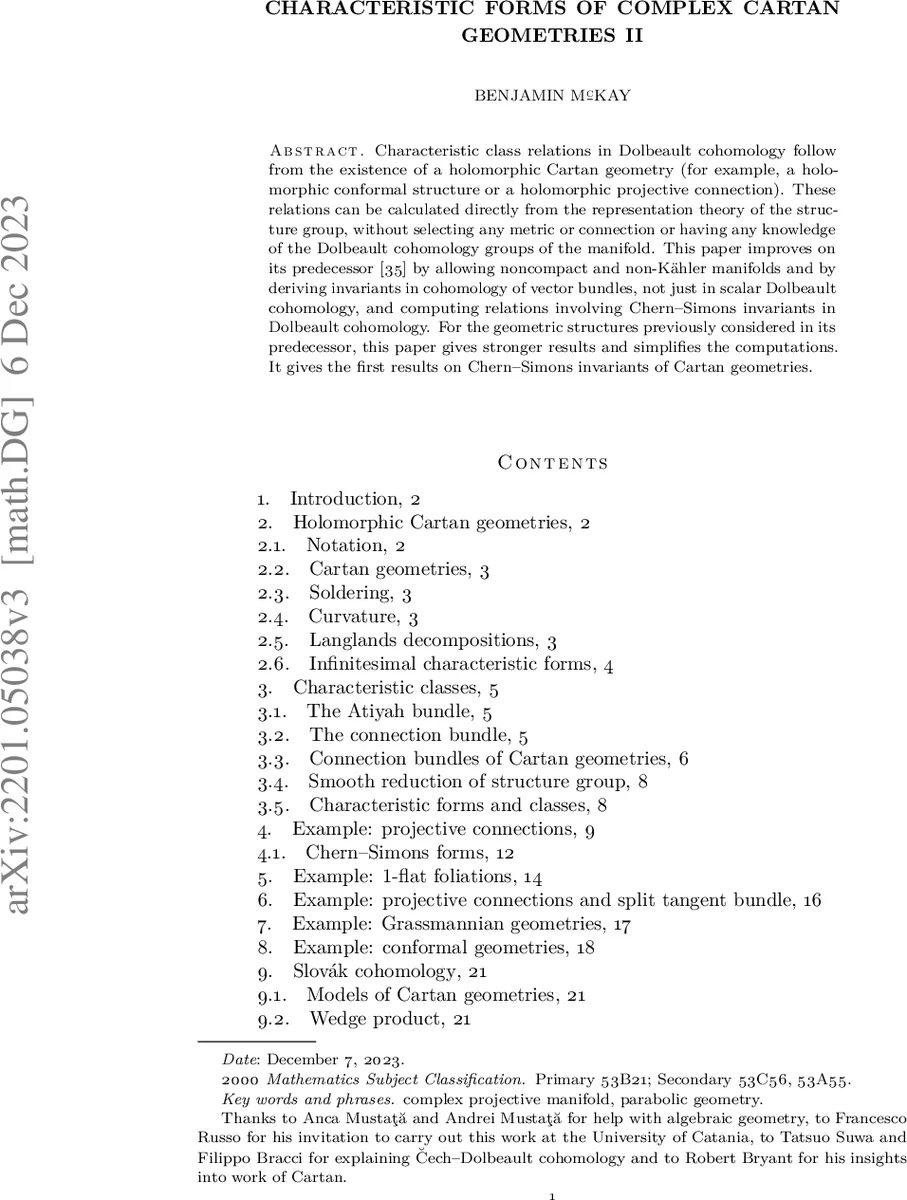
Characteristic class relations in Dolbeault cohomology follow from the existence of a holomorphic Cartan geometry (for example, a holomorphic conformal structure or a holomorphic projective connection). These relations can be calculated directly from the representation theory of the structure group, without selecting any metric or connection or having any knowledge of the Dolbeault cohomology groups of the manifold. This paper improves on its predecessor by allowing noncompact and non-Kähler manifolds and by deriving invariants in cohomology of vector bundles, not just in scalar Dolbeault cohomology, and computing relations involving Chern–Simons invariants in Dolbeault cohomology. For the geometric structures previously considered in its predecessor, this paper gives stronger results and simplifies the computations. It gives the first results on Chern–Simons invariants of Cartan geometries.
💡 Research Summary
The paper “Characteristic Forms of Complex Cartan Geometries II” extends the theory of characteristic class relations for holomorphic Cartan geometries beyond the compact Kähler setting and introduces the first systematic treatment of Chern–Simons invariants in this context. The author begins by recalling that a holomorphic Cartan geometry (for instance, a holomorphic conformal structure or a holomorphic projective connection) determines a principal H‑bundle E → M equipped with a holomorphic Cartan connection ω valued in the Lie algebra 𝔤 of a complex Lie group G. By exploiting the Langlands decomposition G = G₀·Gᵤ (with G₀ reductive and Gᵤ solvable) the connection splits as ω = ω′ + ω₀ + ω″, where ω′ is the soldering form, ω₀ is a G₀‑valued pseudo‑connection, and ω″ encodes the remaining part. This decomposition allows the curvature Ω = dω + ½
Comments & Academic Discussion
Loading comments...
Leave a Comment