An optical Ising spin glass simulator with tuneable short range couplings
Non-deterministic polynomial-time (NP) problems are ubiquitous in almost every field of study. Recently, all-optical approaches have been explored for solving classic NP problems based on the spin-glass Ising Hamiltonian. However, obtaining programmable spin-couplings in large-scale optical Ising simulators, on the other hand, remains challenging. Here, we demonstrate control of the interaction length between user-defined parts of a fully-connected Ising system. This is achieved by exploiting the knowledge of the transmission matrix of a random medium and by using diffusers of various thickness. Finally, we exploit our spin-coupling control to observe replica-to-replica fluctuations and its analogy to standard replica symmetry breaking.
💡 Research Summary
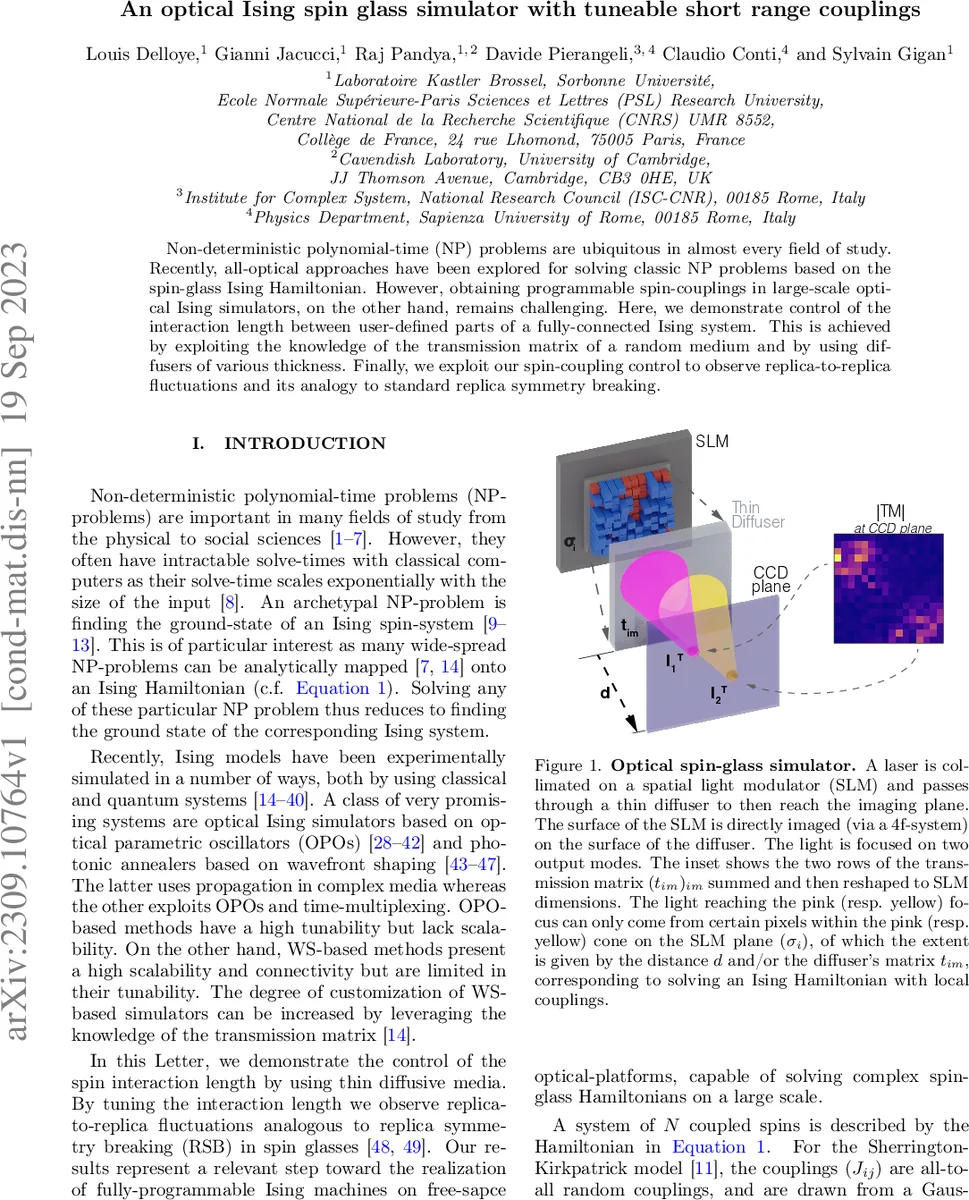
This paper presents a novel approach to programmatically control the interaction length between spins in an all‑optical Ising spin‑glass simulator, and demonstrates that this control enables the observation of replica‑to‑replica fluctuations reminiscent of replica symmetry breaking (RSB). The authors exploit the transmission matrix (TM) of a random scattering medium together with thin diffusers of varying thickness. By measuring the TM of a surface diffuser and varying the distance d between the diffuser and the CCD camera, they can continuously tune how many input modes (SLM macro‑pixels, representing Ising spins) contribute to a given output mode (camera pixel). When d is small, the speckle pattern is tightly confined; only a few SLM pixels affect a particular CCD pixel, yielding highly local couplings. As d increases, the speckle expands, and the contribution set broadens, eventually approaching an all‑to‑all coupling regime.
The optical system consists of a 532 nm laser, a phase‑only spatial light modulator (SLM) divided into N = 256 binary macro‑pixels (σ = ±1), a 4f imaging system that projects the SLM plane onto a thin diffuser, and a high‑resolution CCD that records the transmitted intensity. The TM, linking input fields E_in to output fields E_out via E_out = T E_in, is reconstructed using interferometric phase‑stepping methods. The effective Ising couplings are given by J_ij = –P ∑_m Re
Comments & Academic Discussion
Loading comments...
Leave a Comment