Combined Image Encryption and Steganography Algorithm in the Spatial Domain
In recent years, steganography has emerged as one of the main research areas in information security. Least significant bit (LSB) steganography is one of the fundamental and conventional spatial domain methods, which is capable of hiding larger secre…
Authors: :
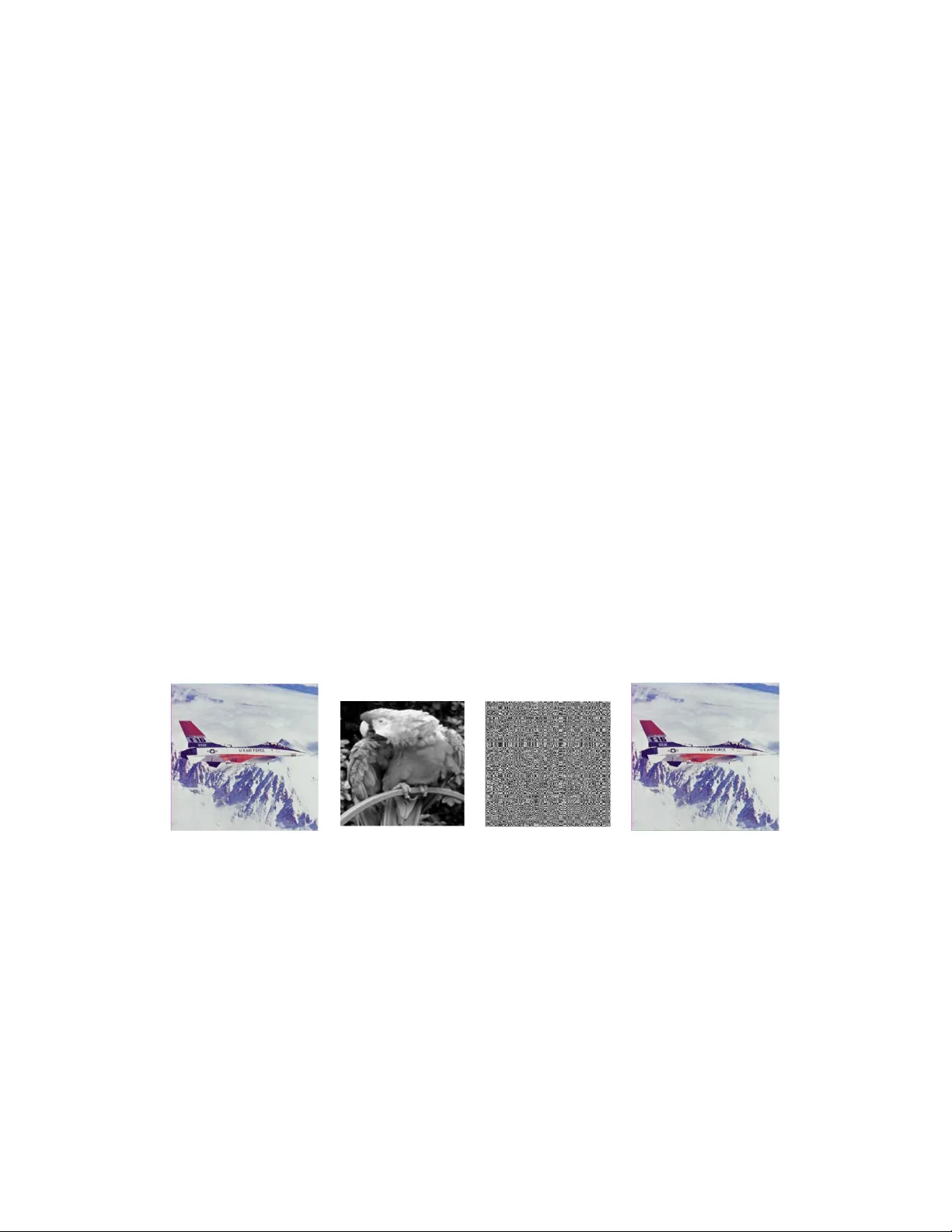
First Conference for Engineering Sciences and Technology (CEST-2018) 25 -27 September 2018 / Libya Combined Image Encry ption and Stegano graphy Algorithm in the Spatial Domain Aya H. S. Abdelgader 1 , Raneem A. Aboughalia 2 , Osam a A. S. Alkishriwo 3 1 A.Abdelgader@uo t.edu.ly, 2 Raneem.abg @gmail.com , 3 alkishriewo@yahoo.co m 1, 2 , 3 Department of Electrical and Electronic E ng. , College of Eng. , Uni versity of Tripo li , Libya *Correspo nding author email: alkis hriewo@y ahoo.com Received: 00 April 2018 / Accepted: 00 May 2018 A B S T R A C T In recent years, s teganogra phy has emerged as one of the main research areas in information security. Least significant bit (LSB) steganography is one o f the fundamental and conventional spatial domain methods, w hich is c apable of hidin g larger secret information i n a cover image without n oticeable visual distortions. In this paper, a combined algorithm based on LSB steganography a nd chaotic e ncryption is proposed. Experimental resul ts show t he feasibility of the proposed met hod. In comparison with existing steganograp hic spatial domain based algorithms, t he suggested algorithm is shown to have some advantages over existing ones, namely, larger key space and a higher level of s ecurity against some e xisting attacks. Keywords: Steganograph y, data hidin g, cover image, stego i mage. 1 Introduction The growing of digital communication technologies has caused a substantial increment in data transmi ssion. When s ensitive info rmation such as bank account numbe rs is being shared between two communicating parties over a public channel, security of such data becomes necessary. Cryptography and steganography are two important tools for providing security and protecting sensitive informatio n. Cryptography provides features such as confidentiality and integrity of data. For instance, confidentiality is achieved via an encryption algorithm which scrambles/mixes the private information so that it becomes unreadable to any party other than the in tended recipient. However, steganography provides data security by hiding the information in a cover medi um so that even the existe nce of a hidden message is not known to an intruder. Secret messages are embedded in cover objects to form stego objects. These stego objects are transmitted through the insecure channel. Cover objects may take the form of any digital image, audio, video and other computer files. Digital images are widely used as cover object of hidden information because of the high level of redundancy in them which is caused by the low sensitivity of the human visual system to details. The success of steganography lies in transmission of stego objects without suspicion [1]. First Conference for Engineering Sciences and Technology (CEST-2018) 25 -27 September 2018 / Libya A large number of image steganographic techniques have appeared in the literature, for example [2-7]. These techniques can be classified into two main classes: spatial domain and transform domain techniques. In spatial domain techniques, private message is embedded in the intensity of image pixels dir ectly [2- 4]. In transform domain techniques, the pr ivate message is embedded in the cover by modifying coefficients in a transform domain such as discrete cosine tran sform (DC T) and integer discre te wavelet transfor m [5- 6]. Although transform domain based algorithms are more r obust to steganalytic attacks, the spatial domain based algorithms such as least significant bit (L SB) algorithms are much simpler and faster. Several versions of the LSBs embedd ing algorithms have appeared in the literature. However, many steganal ysis tools that reveal the insecurity of some LSBs replacement a lgorithms have been reported. For ex ample, in [7] authors suggested a steganalytic attack that can estimate the length of information embedded in a host image for various LSBs algorithms. Nevertheless, the high embedd ing capacity and low computational complexity of these algorithms have encouraged r esea rchers to f urther participat e in this area. Chaotic maps are well known for their sensitivity to initial conditions and control parameters. T hese properties make them sui table for building blocks in the design of many cryptographic and steganographic algorith ms [3, 8]. In this pape r, we propo se a new LSB s spatial domain algorithm that is based on mixing two 2 -D chaotic maps. The proposed algorithm encrypts the secret message using mixed chaotic map and uses LSB for data hiding. The rest of the paper is organized as follow: Section 2 presents the used 2-D chaotic maps . In Section 3, we give a detaile d description of the p roposed algorithm and a flowchart. In Section 4, s imulation results are presented and disc ussed. The con clusions are gi ven in Section 5. 2 Two Dimensiona l Chaotic Maps In the proposed s teganogra phy method, we have used a combination of two 2D chaotic systems which are l ogistic and duffi ng maps defined in [8 , 9] as given in (1) and (2 ). (1) where, , , and are the control parameters and state values, respectively. When , the system is chaotic . The Duffing map depends on the two constants and . These are usually set to and to produce chaotic behav iour. It is a discrete version of the Duffing e quation. (2) First Conference for Engineering Sciences and Technology (CEST-2018) 25 -27 September 2018 / Libya 3 The Proposed Steganogr aphic Algori thm The steganog raphic scheme proposed in this article embeds a binary message ac cording to the least s ignifica nt bit technique as s hown in Figure 1. This helps imperceptibility since the more significant bits of the cover image are not altered. Data embedded is done using the following steps: Step 2: Read both of cover image and secret image, the cover image most be equal or larger than the secret image. Step 3: use chaotic maps to enc rypt secret image. Step 3: Select the block size for the encryption algorithm and generate random initial conditions for the chaotic ma ps. Step 4: Using the initial c onditions to generate c haotic maps key streams and . Step 5: Secret image is divid ed into blocks of same size ( × ), s crambled using the encryption key stream a nd recombined into a single ima ge. Step 6: Pixel wise XOR operation is done on the s cramble d image usi ng the key stream to get the enc rypted image . Step 7: Extract the pixels of the c over image and encrypt ed secret image . Step 8: Choose firs t pixel of the cove r image and pick first pixel of the encrypted secret image then place it using LSB algorithm, one pixel of the encrypted s ecret image have 8 bits, using for example 8bpp all this bi ts will be hidden inside o ne pixel of the color image. Step 10: Repeat step 9 till all the pixe ls of the encry pted secret image has been embedded. Chaotic map Generato r Secret image Divide into blocks and shuffle the m Scrambled imag e XOR operation operation Encrypted secret i mage Cover image Initial conditions Check image s sizes Choose first pixel of cover image Hide first pixel o f secret image in side first pixel of cover ima ge Repeat till all pixels of secret image are hidden Figure 1: Block diagram of propo sed stega nography algorithm. First Conference for Engineering Sciences and Technology (CEST-2018) 25 -27 September 2018 / Libya When applying L SB techniques to each byte of a 24 bit image, we can take the binary representation of the hidden data and overwrite the LSB of each byte within the cover image. If the LSB of the pi xel value of cover image is equa l to the next me ssage bit of secret massage to be embedded, remain unchanged; if not, set the LSB of to . 4 Performance Ana lysis and Ex perimental Results In this s ection, experimental results are given to demonstrate the performance of the proposed algorithm. Comparative experimental s tudies are also presented to show the superiority of the proposed algorithm over typical existing ones. F our standard colored image s, namely, Airplane, Fruits, pool, and girl are used as cover images for hiding sensitive in formation of length bit. 4.1 Visual Attack Visual attacks, regarded as the simplest type of steganal ysis, aim at revealing the presence of hidden information through visual inspection by the naked ey e. The presented algorithm is designed to be robust against visual attacks. Figure 2 presents a cover image ( Airplane), a secret-image carrying of size , an encrypted secret image, and a stego-image carrying an encrypted secret image. A visual inspection of the cover and the stego-image does no t reveal a ny difference between t he two image s. (a) (b) (c) (d) Figure 2: (a) cover image, (b) secret image, (c) encrypted secret imag e, (d) stego image. 4.2 Imperceptibility a nd Payload For data hiding in images, hiding capacity and visual quality of the scheme play important roles. So, increasing hiding capacity adversely affects the visual quality of the stego-image. The embedding r ate is the number of bits that can be embedded into one pixel, and it is measured by bits per pixel (bpp). It is known that human visual system cannot detec t the distortion of a stego-image , when the peak signal to noi se ratio (PSNR) i s higher than dB. First Conference for Engineering Sciences and Technology (CEST-2018) 25 -27 September 2018 / Libya To compare between each of 3, 6, 8 bits per pixel, we measure PSNR for all stego-images as shown in Table 1, t he highest PSNR values means the ste go-image is similar to cove r image. bpp Airplane Fruits Pool Girl 3 53.0 53.6 53.8 53.6 6 48.2 48.5 48.2 48.6 8 41.5 41.8 42.7 41.5 In Table 2, PSNR (dB) is ca lculated with different pay load capacity of 3 bpp on a stego- image using L ena as a cover image , and the results are compared with similar steganography scheme s for the same c over image. bpp Proposed [4] [10] [11] 3 53.0 37.9 37.3 37.8 4.3 Image Histogra m In Figure 3, we present the histograms of the cover image Lena and the r esulting stego - image produced by our algorithm with a message of size 3 bpp , 6 bpp, and 8 bpp. It can be observed that the two histogra ms are very similar. This test shows a comparison betw een the cover image and the stego image , using the histogram as a visual comparison tool. Table 1: PSNR comp arison in dB . Table 2: Co mparison of the propo sed algorithm to existing work in ter ms of PSNR (dB) . (a) (b) Figure 3: (a) Histogram of cover image , (b) Histogram of stego-imag e from right to left 3 bpp, 6 bpp , and 8 bpp. First Conference for Engineering Sciences and Technology (CEST-2018) 25 -27 September 2018 / Libya 4.4 Key Space Analy sis The key space of an encryption algorithm should be large enough to resist brute – force attacks. In the pr oposed algorithm, the secret key contains seven real numbers (two control parameters and fou r initial states). I f we assume the com putation precision of the computer is , then the key space is about . Such a large key s pace can ensure a high security against bru te – force attacks. 5 Conclusions In this paper, a steganographic algorithm based on two 2-D chaotic maps has been introduced. This algorithm embeds the encrypted sensitive informatio n using chaotic map s into the cover image according to the least s ignific ant bit technique. The LSB algorithm effectively allows the embedding of secret information at higher level frequencies, which are not visible t o the human eye. The presented s imulatio n results show the resistance of the suggested algorithm against some existing steganalytic attacks. Furthermore, the results show its advantages ove r some existing alg orithms. References [1] A. Kanso and H. S. Oun, “ Stegano graphic algor ithm based on a chaotic map ,” Commun Nonlinear Sci Numer Simulat, vol.17, pp. 3287- 3302, 2012. [2] C. Chan and L. Cheng, “ Hiding data in images by sim ple LSB substitution,” Pattern Recognition , vol. 37, no. 3, pp. 469 – 474, 2004 [3] D. Battikh, S. El Assad , B. Bakhache , O. Defo rges, and M. Khalil , “ Chaos -based spatial steganography sy stem for Images ,” Inter national Journal of Chaotic Com puting , vol. 3, no. 1, pp. 36 – 44, Jun. 2014 . [4] G. S. Yadav and A. Ojha , “ Chaotic system-based secure data hiding scheme with high embedding capacity ,” Computers an d Electrical Eng ineering, pp. 1-14, 2018. [5] R. El Safy, H. Zayed, and A. El Dessouki, “ An adaptive steganog raphic technique bas ed on integer wavelet transform, ” In IEEE Internati onal conference on networking and m edia convergence (I CNM 2009), pp. 111 – 11 7, 2009. [6] C. Lin and P. Shiu, “ High capacity data hidin g scheme for DCT- based i mages,” J Inf Hiding Multimedia Signal Processing, vol. 3, no. 1, pp. 220 – 2 40 , 2010. [7] J. Fridrich an d M. Gol jan, and D. Rui, “ Detecting L SB s teganography in color and grayscale images,” IEEE Multimedia, vol . 8, no. 4, pp. 22-28, 2 001. [8] N. K. Pareek, V. Patidar, and K.K. Sud , “ I mage encryption using chaotic logistic map ,” Image and Vision Computing, vol. 24, pp. 926-9 34, 2006. [9] Y. Abanda1 and A. Tiedeu , “ Image encryption by chaos mixing ,” IET Image Processi ng , vol. 10, no. 10, pp. 742 – 750 , 2016. [10] Q. Wu, C. Zhu, J. L i, C. Chang , and Z. Wang, “ A magic cube based information hiding scheme of large payl oad ,” J . Inf. Secur. Appl., vo l. 26, pp. 1 – 7, 2 016. [11] Z. Eslami and J. Ahmadabadi, “ Secret image sharing with authentication- chaining and dynamic embedding,” J. Sy st . Softw. , vol. 84, no. 5, pp. 803 – 80 9 , 2011.
Original Paper
Loading high-quality paper...
Comments & Academic Discussion
Loading comments...
Leave a Comment