Alien wavelength technique to enhance garr optical network
GARR optical network used to be composed of two separate optical network domains on its national infrastructure. With the aim to integrate these two domains and deliver high performance services all over its infrastructure, we implemented the so call…
Authors: : Giovanni Nastasi, Marco Listanti, Francesco Di Giusto
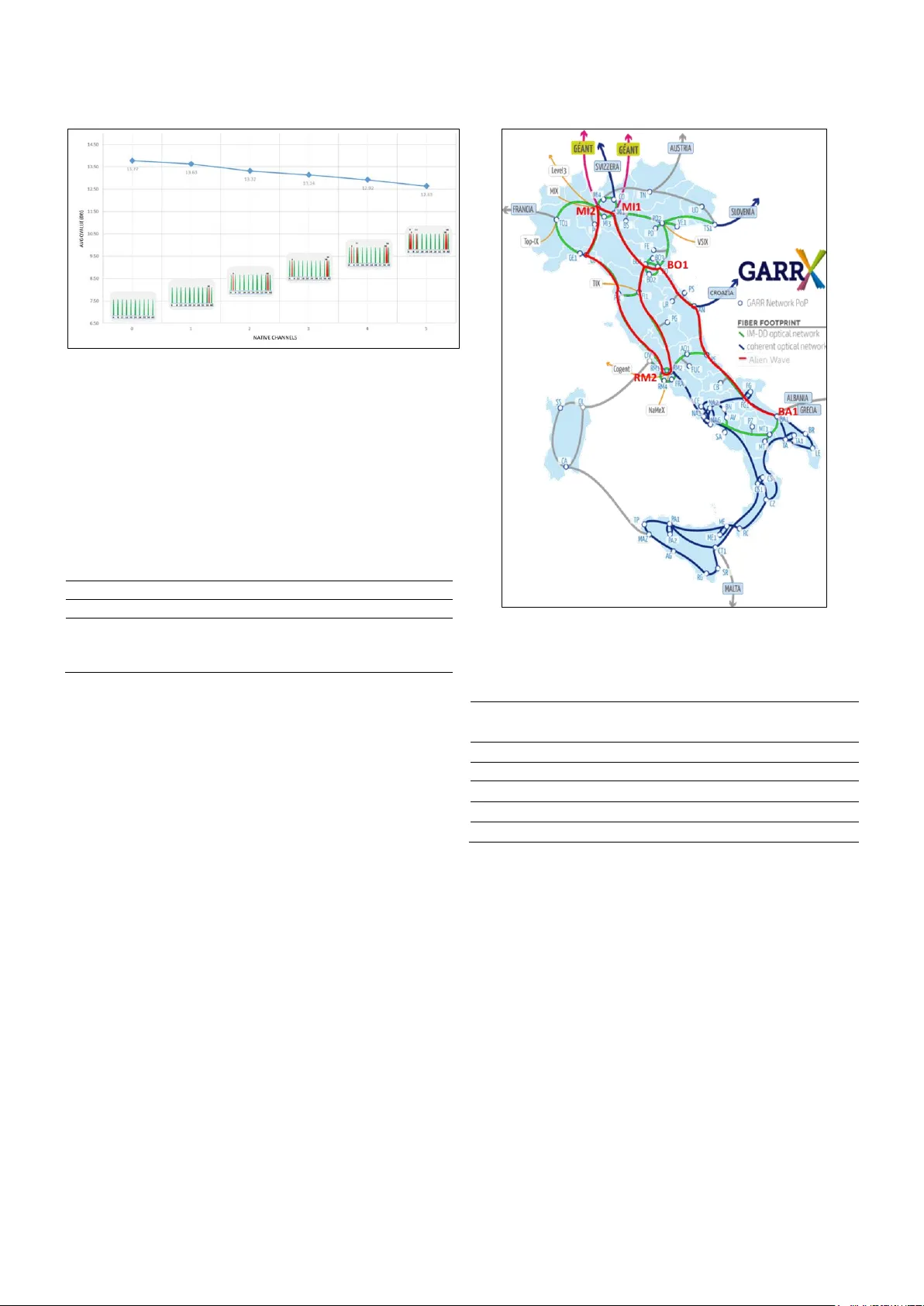
1 ALIEN WAVELENGTH TECHNIQUE TO ENHANCE GARR OPTICAL NETWORK Paolo Bolletta 1 , Massimo Carboni, 1,2 , Andrea Di Peo 1 , Americo Gervasi 1 , Lorenzo Puccio 1 , Gloria Vuagnin 1 1 GARR - The Italian Research and Edu cation Network, Rome, Ita ly 2 INFN, National Laboratory of Frascati, R ome, Italy *name.surna me@garr . it Keywords: Optical Networking, WAN, Alien Wavelengt h, Coherent, DWDM evolut ion Abstract GARR optical network used to be composed of two sep arate optical network domains on its national infrastructure. With the aim to integrate these two domains and deliver high pe rformance services all over its infrastructure, we implemented the so called alien wavele ngth technique, thus improving the overall efficiency o f the Italian research an d education network in a cost -effective way . This pa per describes the activity, results , and our experience i n t he integration of alie n wavelengths in a pro duction environme nt, with a special emphasis on de ployment and operational issues. 1. Introduction In order to match the ever evolving needs and requirements of the Italian research and educa tion community, w e recently started an evolution process to update G ARR network infrastructure and innovate the services provided. Indeed, in a global scenario characterised by an exponential growth of Internet traffic and a co ntinuous strive for inn o vative solutio ns we started a re-defi nition of both our conventional net work design and our co mm o n practice s in device engineering [ 1,2]. 2. GARR Network Overview 2.1 GARR Commun ity GARR is the Italian N REN (Natio nal Research and Educat ion Network) connecting over 1 000 sites all over Italy. Its user community is co mposed of universities, research institutes, research hospitals, cultural institutes, libraries, museums, and schools. 2.2 GARR Optical Network GARR optical network is based o n tw o geographically separated infrastructures. These infrastruct ures are based on technologies from different vendors and were deployed about four years apart. T he first infrastructure d eployed, is operating since 2011 in Northern an d Central Italy w hile the second one, implemented i n 2 015, is operational in the South. The t wo infrastructures are v er y diverse fro m the technological point of view. The co existence of such infrastructures led GARR to design an in te gration solutio n to transm it signals fro m the most recent technology over the old er one. From the technological point o f vie w, the infrastructure in Northern a nd Central Italy emplo ys a Hua wei Op tiX O SN platform. Its nodes include ROADM ( Reconfigurable Optical Add and Drop Multiplexer) m od ules, add /drop b oar ds able to support u p to 80 chan nels in the C-band with a 50 GHz grid and OTN (Optical T ransport Netw or k) switching matrices. The amplification is performed with EDFA (E rbium-Doped Fib re Amplifier) or Raman amplifiers, and DCMs (Dispersion Compensating Modules) are inserted on the f ibre lines in ord er to corr ect the chro matic dispersion. T his optical ne twork is optimised for In te nsity Modulation with Direc t Detection (IM - DD) and the cha nnels are mainl y 1 0Gb ps with few 40 Gbp s. Here, client services ar e from 1G Eth up to 10G Eth. In South er n Italy, instead, th e inf rastr ucture is DC M -f ree and the transmission of signals is performed with coherent technology. The network is equipped w ith Infin era DTN -X, a platform able to transmit 50 0Gbps super-channels. Each of them is built on 10 optical carriers spaced at 200GHz in C-ban d with a 25GHz grid. Optical channels are gro uped in pairs th at can be en ab led and m ana ged w ith QPSK ( Quadrature P hase Shift Ke ying) or BPSK (Binary Phase S hift Ke ying) modulation, thus allo wing a flexible use of the availab le spectrum, and an opti mal balance bet ween reach and capacit y. Client ser vices o n this part of the net work range from 10 GE th to 100G Eth. 2.3 Alien Wavelength Benefits for GARR Considered this tech nologically heteroge neous infrastructure, within GAR R we studied a viable solution to m atc h the high- bandwidth capacit y r equirements o f our u ser co mmunity with the existing network. As optical co mmunications are becoming m ore and more spectrum efficient thanks to coherent transmissions and digital signal processing, in GARR we thought to e xploit th e coherent transmission infrastructure of the Southern network and to extend it to the North by means of the so-called alien wavelength (AW) technique [3,4]. Thanks to A W s, it was indeed possible to harmonise and develop GARR infrastructure b y extending the 100GE th capacity alread y present in the Southern part of the network to the whole national infrastructure in an a gile and cost -effective method. The AW techniq ue i s a hybrid solution based o n th e transmission and reception of optical signals, called alien wavelengths, generated on an infrastructure, which is different 2 from the transpor t one. Therefore, the tran spo nder light is sourced f ro m a platform and is transported in the h ost optical domain regard less of t he Dense Wavelen gth Division Multiplexing (DWDM) eq uipment vendor. So, the A W concept d isaggregates the transponder ele ments fro m t he optical DWDM s ystem. In the specific case of GARR o ptical infrastructure, this method made po ssible t he integration of t he t wo separated optical networks in one single domain, able to h o mogeneousl y deliver the needed network services. Fig. 1. Alien wavelength block diagr am Fig. 1 shows the main elements involved in AW setu p as functional blocks. It illustrates ho w GARR deplo ys co herent signals over a fully compensated fibre infrastructure, b y injecting signals at the service end-points and carr ying the AW through the host network w it hout regeneratio n and span re design alo ng the fib re lines. On e of the m ai n advantages of this app roach is the p ossibilit y to light up net work ser vices based on different technologies without updating the geographical infrastr ucture and disrupting the original services, thus keeping in p lace legacy network services. Moreover this solution only r equires new installations only at the service end-po ints, ensuring an effective and agile delivery. 3. Alien Wavelength Solution S etup The integration between the two infrastructures (the one providing the transponder s and the one pro viding the photonic layer) was the key issue that required careful design and operational tuning. For this reason, we conducted a dedicated field trial to t es t a solution to be then i mplemented in the productio n network, following the sche me shown in Fig. 2. Fig. 2. Alien wavelength inte gration setup 1 Bit Error Rate befor e Forward Error Correc tion This desig ned solution can b e summarised i n these three main building blocks: ● Alien wave length domain : T he network el eme nts generating and operatin g AW sig nals are normally installed at the service e nd-points. T hey are mainly co mposed o f transponders mounted for example on white -boxes, DCI (Data Centre Interconnect) or OT N switches. ● Native (host) domain : The network elements operating and co ntrolling t he photonic la yer and t he fibr e infrastructure. These elements compose the wide area network infrastructure handling and managing t he signals acr oss the fibres (Mux/Demux, optical a mplifiers, wavelength switch, ROADMs,..). If services are already deployed on this infrastructure the respective transponders and le gacy eleme nts are part o f the native domain. ● Adaptation Layer : T he necessar y ele ment to co uple the AW signals to native ( host) op tical do main and to adjust the injected po wer at the right levels. 4. The Alien Wavelength E xperience in GARR Network 4.1. The Field Trial The first aim o f the field tria l was to test t he coexistence of native Hua wei 10Gb ps IM -DD o ptical chan nels with co herent alien wavelengths o f a higher bit rate. This test was useful to understand the i mpact of coherent alien wavelengths on the sig nals performance i n a DCM -based optical network. The parameters used duri ng t he performance evaluation were Q-value [6 ] for coherent signals and B ER-PRE-FEC 1 for the others. 4.2. The Field Trial Results Fig.2 shows the measurements of t he average Q value of a n AW super-channel versus the number of native signals shari ng the same spectrum. These results pertain to a short path (345 Km long), where we studied t he benchmark and the proof of concept of the solution. T he first point o n Fig. 2 shows the measure taken w hen only the alien carriers w ere injected in the DWDM line, with no other s ignals present in the spectrum. The measure was taken after perfor ming the line and channel equalisation, an d can be considered as the benchmark valu e for the alien performance in this s pecific set up. The next points o f Fig. 2 w ere tak e n ad ding progressively one native channel (IM - DD) , with (points 1 -2) or without (points 3 -5) guard band . 3 Fig. 3. Average Q-value Alien+Native AWs The results indicate that native ch an nels only marginally affect AW average p erfor mance, even without guard band bet ween native and alien channels. T he penalties assess ment during the tests were always withi n 0.5dB . It is important to remark that th e Q-value of a w orki ng signal should be higher th a n 6.5dB, ho wever best practices su ggest to work with a value above 8.5 dB for a p roper link design. We investigated the difference in p erformance bet ween t he QPSK and the BP SK modulation for mat. Table 1 : QPSK vs BPSK average Q val ue Average Q-value (dB QPSK BPSK AW 13.77 16.37 AW+2 native sig nals 13.32 16.31 AW+5 native sig nals 12.63 16.15 Table 1 shows t he Q -value ac hieved respecti vely using QPSK or BPSK modulation in t hree different cases: 1. only AW; 2. AW plus nati ve signals with guard band; 3. AW plus nati ve signals, without guard band. As expec ted the signal with B PSK modulation had a better performance than QP SK and it w a s more robust i n spite of t he increase in C -band occupanc y. Ho wever, the choice of using the BP SK modulation ob viously reduced the super-chan nel capacity from 500Gb ps to 250Gbps. Moreover, the field trial was us e ful to understand that the coexistence in the sa me op tical spectru m of d ifferent signals (coherent and IM-DD) did not significa ntly af fect the IM- DD signals perfor mance. 4.3. Alien waveleng ths in GARR Prod uction Network Thanks to the field trial results, GARR d esigned an d implemented the evolutio n of its network in Nort hern Italy using the cohere nt al ien wavelengths in t he old DCM -based infrastructure, thus creati ng a AW -integrated network. Fig. 4. GARR Network and AW dep loyment overview Table 2 : AW lin ks details Path BO1- MI1 RM2- BO1 BA1 - BO1 RM - MI2 Distance (km) 277 495 813 1131 Attenuation (d B) 78 105 232 325 #OLA 2 4 10 12 #ROADM 2 3 6 5 #Raman Span 1 3 2 3 Table n.2 shows more detai ls on the ne w AW -integrated network, like distance and attenuation on the path s involved in the integration pro cess . Thanks to the availability of many m ulti plexing and adaptation elements s uch as WSS, MUX/DMUX and VO A, it was possible to op timis e t he signal performance on the paths , by fine tuning the la mbdas at each tr ansit node using t he embedded signal anal yser card. 4.4. Optimisation During the design pha se of the network i t was necessar y to re- engineer the frequency or the route of some production optical channels. T he design stud y of alien wavelengths for the RM 2- MI2 link has repo rted a very low performance index . This is because of the long link distance, about 1200Km, and the presence of adj acent IM -DD carriers at the end-points. To solve this problem and im pr ove the p erformance index we chose to deploy the signal with the QPSK modulation on the 4 AW -dedicated po rtion of the spec trum, instead of deplo ying it with t he B PSK m odulatio n on the native -AW mixed portion of the spectrum. Indeed, the BP SK modulatio n o ption would ha ve i mplied a reduction in the availab le capacity to 250Gb ps (4.1.1), therefore w e opted to dedicate a portion of the C-band to AW -coherent carriers. However, because of the difference in the t wo technologies used, this dedicated C-Band por tion could o nly support 9 carriers out of the 10 available . As a result, through this design the available capac ity moved from 250Gbps to 450Gbps on this link, in addition to the na tive capacity. 5. Results During t he field trial and after the im ple mentation o f the new design on our pr oduction net work, we collected data on performance consider ing different d istances (r each). The following graph (Fig.3) summarise s these measurements, b y comparing the perfor mance of AW in their native environment in Southern Ital y (diamond shapes) v ersus their performance in the trial paths (square shap es) and in the production environment (triangle shapes). The vertical bars o n the p roduction data i ndicate the highe st and lowe st per formance measured in Q -value a mong the carriers, thus illustratin g t he to tal range of val ues co llected in the production environme nt. It is important to underline that the Q -value measured at 11.44dB was obtained in the dedicate d portion of t he optical spectrum. We ca n observe that al l pro duction signals have an acceptable performance margin, abo ve the Q-value acceptance threshol d. Fig. 5. Coherent signals perfor mance vs. distance 6. CONCLUSION Thanks to the encouraging results in the field trial and in the production environment, G ARR m a naged to m atch the requirements of its u sers co mmunity to provide 100GEth client services on the main backbone nodes of its national transport infrastructure. Al so, in this wa y GARR managed to have an integrated high -capacity net work br idging the differe nt technologies of its op tical infrastructure. From the user co mmunity p erspective, the most im po rtant effect was an increased a vailability of bandwidt h. For the future, this enriching experience w i ll be the launch pad towards the forthcoming e volution of GARR ne twork [5] . Aknowledgments We th an k Elis Bertazzon for her assistance with the technical editing process of the presen t document. References [1] Gerstel, M. Jinno, A. Lord and S. J. B. Yoo, “Elastic optical networking: a ne w dawn for the optical la yer?” in IEEE Communications Magaz ine, vol. 50, no. 2 , pp. s12 - s20, February 2012 [2] A . Lord, P. Wright, Y. Zhou, C. L ook, P. W illis, G. Jeon, S. Nathan, a nd A. Hotchkiss, "Managed Alien Wavelength Service requirements and demonstration," in 37th European Conference and Exposition on Optical Communications, OSA T echnical D igest (CD) (Optical Society of America, 20 11), paper Tu.6.K.2 . [3] Lord, A., Wright, P., & Z hou, Y. R. (20 12). Alien wavelengths: Technology, benefits and standardisatio n. 2012 International Conference on Photonics in Switching, Ps 2012 [4 ] J D. Ventorini, “ De monstration and Evaluatio n of IPover - DWDM Networking as “Alien wavelength” over Existing Carrier DWDM Infrastr ucture,” OFC, 2008 [5 ] GARR Network White pa per https://www.garr.it/it/c hi-siamo /documenti/documenti - tecnici/3474-garr -white-paper -maggio- 2017 DOI: 10.26314 /GARR-whitepaper- 01 [6 ] Infinera Q-Value: https://www.i nfinera.com/wp- content/uploads/201 6/01/WP -the-next-generation- of - coherent-optical.p df
Original Paper
Loading high-quality paper...
Comments & Academic Discussion
Loading comments...
Leave a Comment