A note on morphisms to wreath products
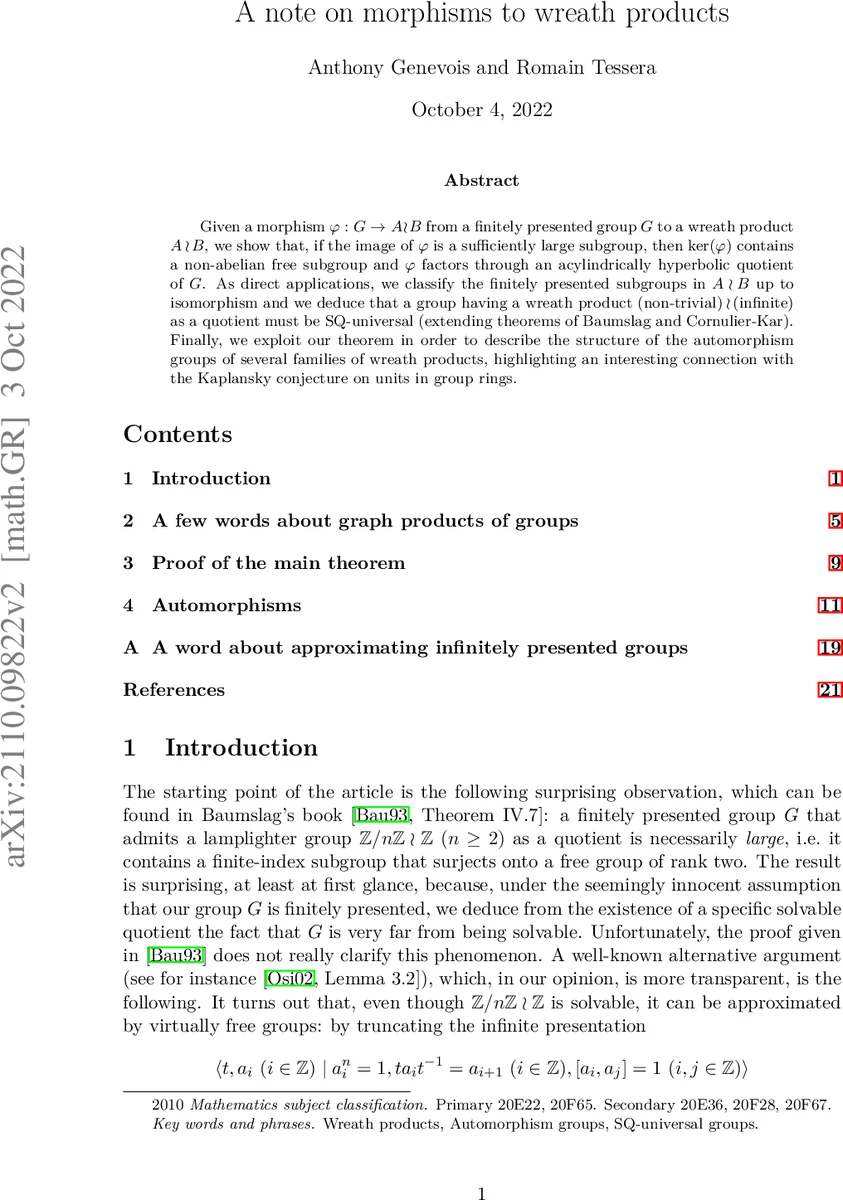
Given a morphism $φ: G \to A \wr B$ from a finitely presented group $G$ to a wreath product $A \wr B$, we show that, if the image of $φ$ is a sufficiently large subgroup, then $\mathrm{ker}(φ)$ contains a non-abelian free subgroup and $φ$ factors through an acylindrically hyperbolic quotient of $G$. As direct applications, we classify the finitely presented subgroups in $A \wr B$ up to isomorphism and we deduce that a group having a wreath product $(\text{non-trivial}) \wr (\text{infinite})$ as a quotient must be SQ-universal (extending theorems of Baumslag and Cornulier-Kar). Finally, we exploit our theorem in order to describe the structure of the automorphism groups of several families of wreath products, highlighting an interesting connection with the Kaplansky conjecture on units in group rings.
💡 Research Summary
The paper investigates morphisms from a finitely presented group G into a wreath product A ∘ B, focusing on the structural consequences when the image is “large”. The authors first reinterpret Baumslag’s classical observation—that a finitely presented group admitting a lamplighter quotient Z/nZ ∘ Z must be “large” (i.e., contain a finite‑index subgroup surjecting onto a free group of rank 2)—in terms of graph products. By truncating the infinite presentation of a wreath product they obtain finite graph‑product approximations, each of which decomposes as a semidirect product of a graph product of copies of A with B.
The central result (Theorem 1.1) splits into two mutually exclusive scenarios for a morphism ϕ : G → A ∘ B.
- If ϕ(G) projects infinitely onto B and meets the base subgroup L_B A non‑trivially, then ker(ϕ) contains a non‑abelian free subgroup and G admits a quotient that is acylindrically hyperbolic. The proof uses the truncation viewpoint: the image of G in a suitable finite graph product forces a non‑trivial free factor in the kernel, a phenomenon already known for HNN‑extensions of lamplighter groups.
- If ϕ(G) still projects infinitely onto B but is not contained in any conjugate of B, then G acts on a finite‑dimensional CAT(0) cube complex with unbounded orbits, and the stabilisers of hyperplanes embed virtually into a finite power of A. When A is finite, this forces G to be multi‑ended.
From these dichotomies the authors derive several concrete corollaries.
Nearly injective morphisms: If ker(ϕ) does not contain a free subgroup, then either ϕ(G) maps isomorphically onto B or it lies inside L_B A ∘ F for some finite subgroup F ≤ B. Consequently, every finitely presented subgroup of A ∘ B is either a finitely presented subgroup of B or a (subgroup of Aⁿ)‑by‑(finite subgroup of B) for some n ≥ 1 (Corollary 1.2). In particular, the wreath‑product construction does not create new finitely presented subgroups beyond those already present in the factors.
SQ‑universality: When A is non‑trivial and B is infinite, any finitely presented group that admits A ∘ B as a quotient must be SQ‑universal (Corollary 1.3). This follows because the quotient supplied by Theorem 1.1 is acylindrically hyperbolic, and such groups are known to be SQ‑universal (DGO17). The authors note that “large” cannot be guaranteed in full generality; they exhibit examples (e.g., free products A ∗ B) where the quotient is not large, yet SQ‑universality still holds.
Burnside groups: Using the fact that Z/kZ ∘ B(m,n) is generated by m + 1 elements all of exponent kn, they show that if the Burnside group B(m,n) is infinite then B(m+1,kn) cannot be finitely presented (Proposition 1.6). This provides a new route to non‑presentability results for certain Burnside groups.
Fixed‑point property (FW_fin): Groups satisfying a strong fixed‑point property on finite‑dimensional CAT(0) cube complexes (including Kazhdan’s property (T) groups, Thompson’s groups T and V, and certain torsion groups) cannot map “large‑ly” into wreath products (Corollary 1.7).
Automorphism groups: The final section exploits the rigidity supplied by Theorem 1.1 to describe Aut(A ∘ B) when B is one‑ended and finitely presented. If A is a finite cyclic group, then
\
Comments & Academic Discussion
Loading comments...
Leave a Comment