Coxeter polytopes with a unique pair of non-intersecting facets
We consider compact hyperbolic Coxeter polytopes whose Coxeter diagram contains a unique dotted edge. We prove that such a polytope in d-dimensional hyperbolic space has at most d+3 facets. In view of results of Lann\'er, Kaplinskaja, Esselmann, and …
Authors: Anna Felikson, Pavel Tumarkin
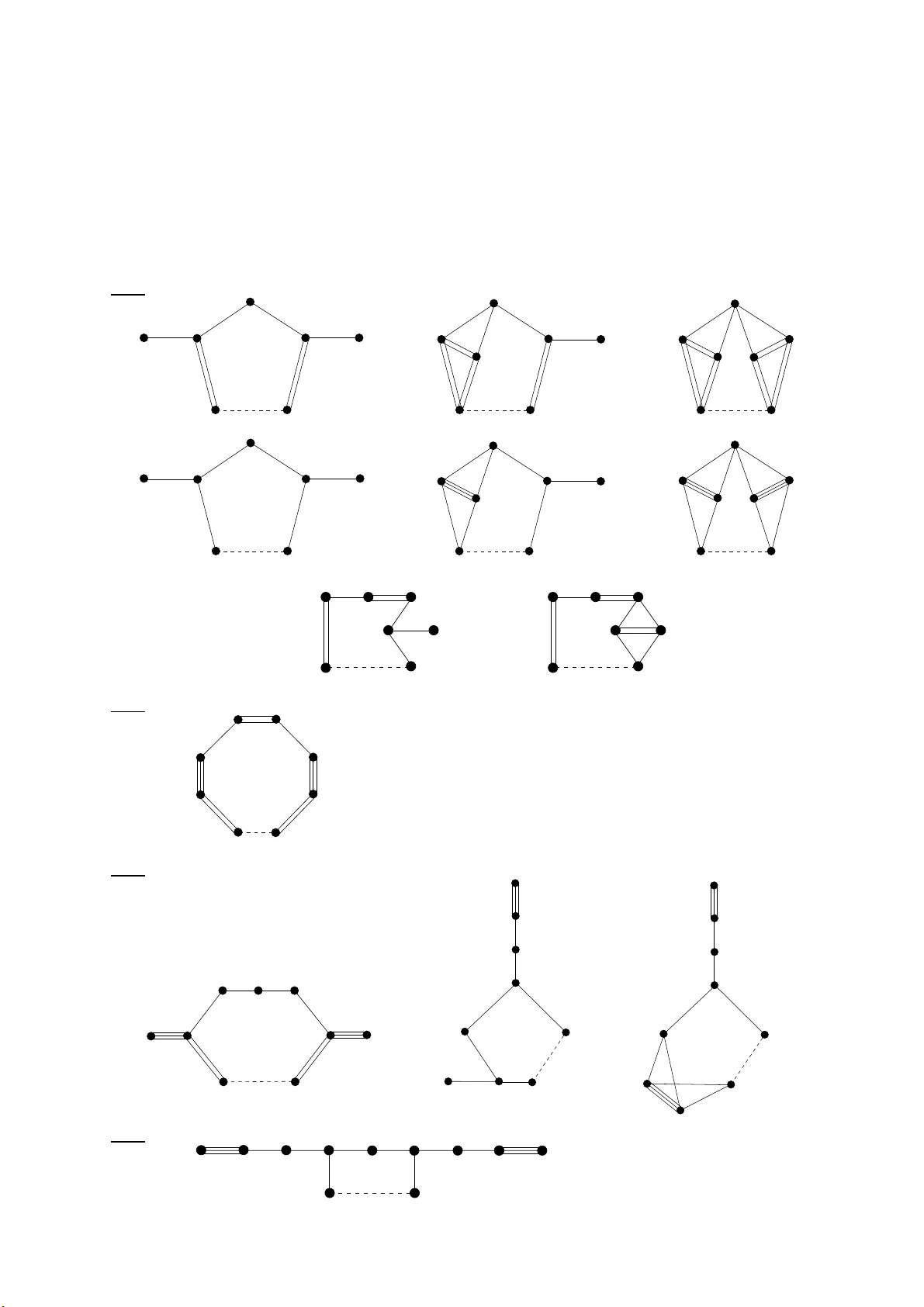
Co xeter p olytop es with a unique pair of non-in tersecting facets. Anna F elikson 1 P av el T umarkin 2 felikson@mccme.ru pasha@mccme.r u Independent Univ er sit y of Moscow, Russia Univ er sit y o f F ribourg , Switzerland Ab str act. W e consider compact hyp erbolic Coxeter p olytopes whose Co xeter diagram conta ins a unique dotted edge. W e prov e th at such a p olytope in d - dimensional hyperb olic space has at most d + 3 facets. In view of [9], [8], [4], and [11], this implies that compact hyperb olic Co xeter p olytopes with a un i qu e pair of non-intersecting facets are completely classified. They do exist up to di- mension 6 and in dimension 8 only . 1 In tro duction W e study compact Co xeter polyto pes in hyper bolic spaces. Besides the general res tr iction d < 3 0 on the dimension d of the p olytop e [1 2] a nd inv estiga tion of arithmetic subgro ups, there are several directio ns in which some attempts of general classification were under t aken. O ne of them is to fix the dimension of p olytop e . Compact hyper bolic Coxeter p olytopes of dimensions 2 and 3 were completely classified in [10] and [2], res pectively . Another direction is to fix the difference b et ween the num b er of facets of the po lytope and its dimension. Simplices w ere classified in [9], d -dimensiona l polytop es with d + 2 facets were classified in [8] and [4 ], d -dimensional polytop es with d + 3 facets were classified in [4] and [11]. This pa per is devoted to investigation of another direction in classifica t ion: the n umber of pair s of non-intersecting facets. In pa p er [5] we classified a ll compact h yp erbolic Co xeter poly t op es w ith m utually int er secting facets. It turns out that they do exist up to dimensio n 4 only , and hav e at most 6 face ts. In this pa p er we expand the tec hnique developed in [5] to inv estiga t e compact h yp erbolic Coxeter p olytope s with exactly one pair of non-intersecting fa cets. The pap er is dev oted to the pro of of the following theorem: Main Theo r em . A c omp act hyp erb olic Coxeter d - p olytop e with exactly one p air of non-interse cting fac ets has at most d + 3 fac ets. In p articular, n o su ch p olytop es do exist in dimensions d ≥ 9 and d = 7 . Clearly , neither simplices no r pro ducts of simplices (except prisms) hav e non-intersecting facets. Therefore, the Main Theorem can b e reformulated in the following w ay . Corollary . A ny c omp act hyp erb olic Coxeter d -p olytop e with exactly one p air of non-interse ct ing fac et s is either a prism or a p olytop e with d + 3 fac ets. The pro of is based on alrea dy obta in ed classifica tions of p olytop es of either s maller dimensio ns o r with smaller num b er of facets , or with smaller num b er of pairs of non-intersecting facets. In fact, the 1 Pa rtial ly supp o rted by gran ts NSh-5666.2006.1, INT AS YSF-06-10000014-591 6, and RFBR 07-01-00390-a. 2 Pa rtial ly supp orted by gran ts MK-6290.2006.1, NSh-5666.2006.1, INT AS YSF-06-10000014-5766 , and RFBR 07-01- 00390-a. techn ique w e use may lead to the inductive algorithm of classificatio n of compact hyperb olic p olytop es with r espect to three dir ections describ ed ab o ve. In this cont ext the Main Theorem may b e considered as the adjusting of the base of the ten tative algor ithm. The pap er is organize d as follows: in Section 2 we expand the technique developed in [5] to the case of compact hyp e r bolic Coxeter p olytopes with exactly o ne pair of non-intersecting facets. In Section 3 we prov e the Main Theor em mo ving from smaller dimensions to la rger ones (namely , up to dimensio n 12). T hen w e finish the proo f cons ider ing dimensions g reater than 12. In the Appendix w e repro duce the list of all the compact hyperb olic Co xeter p olytopes with exa ctly one pair of non-intersecting facets. The pape r w a s written during the authors’ stay at the Univ ersity o f F r ibourg, Switzerla nd. W e are grateful to the Univ er s it y for hospita lit y . 2 T ec hn i cal to ols W e r efer to [5, Sections 2 a nd 3.1 ] for all essential preliminar ies. Concerning Coxeter po lytopes a nd Coxeter diag r ams, we mainly follow [1 2 ] a nd [13]. W e use the tec hnique of lo cal deter mina n ts develop e d in [12]. Description o f Coxeter facets may b e found in [1]. W e use sta nd a r d no t atio n for elliptic and parab olic diag rams (see [1 3 ]). 2.1 Notation W e rec a ll some notatio n introduced in [5]. W e write d -p olytop e instea d of “ d -dimensional p olytope” and k -fac e instead of “ k -dimensional face”. W e say that an edge of Coxeter diag ram is multiple if it is of m ultiplicity a t le a st t wo, and an edge is multi-multiple if it is of m ultiplicity at leas t four. F or nodes x and y o f a Coxeter diagram Σ we write [ x, y ] = m if x is joined with y by an ( m − 2 )-tuple edge (or by an edg e lab eled by m ). W e write [ x, y ] = ∞ if x is joined with y by a dotted edge , and we write [ x, y ] = 2 if the no des x a nd y a re not joined. If Σ 1 and Σ 2 are sub diagrams of a Coxeter diagram Σ, we denote by h Σ 1 , Σ 2 i a s ub diagram o f Σ spanned by all nodes of Σ 1 and Σ 2 . By Σ 1 \ Σ 2 we denote a subdiagr am of Σ spanned by all no des o f Σ 1 that do not b elong to Σ 2 . By | Σ | we deno te an or der of the diag ram Σ. Given a Coxeter d -p olytope P we denote by Σ( P ) the Coxeter diagram of P . If S 0 is an elliptic sub dia gram of Σ( P ) , we denote by P ( S 0 ) the fac e defined by this sub diagram (it is a ( d − | S 0 | )-face obtained by the intersection of the facets c o rrespo ndin g to the no des of S 0 ). W e say that x ∈ Σ( P ) is a neighb or o f S 0 if x attaches to S 0 (i.e. x is joined with S 0 by at leas t one edge), other wise w e say that x is a n o n- nei ghb or of S 0 . W e say that the neig h bo r x of S 0 is go o d if h S 0 , x i is a n elliptic diagr a m, and b ad otherwise. W e denote b y S 0 the s ubdiagram of Σ( P ) c o nsisting of no des co r responding to facets of P ( S 0 ). The diagr am S 0 is spanned by all g o o d neig h b ors and all non-neighbors of S 0 (in other w or ds , S 0 is spa nn ed by all v er t ices of Σ( P ) \ S 0 except bad neighbo rs of S 0 ). If P ( S 0 ) is a Coxeter p olytope, denote its Coxeter diagram b y Σ S 0 . It is shown in [1, Theorem 2.2 ] that if S 0 is an elliptic diagram con taining no A n and D 5 comp onen ts, then the face P ( S 0 ) is a Coxeter p olytop e, and its diagram Σ( S 0 ) can b e easily found from the sub diagram h S 0 , Σ S 0 i . This fact is the main to ol for our induction: if S 0 has no go o d neighbors (this is a lw ays the case if S 0 is of the t yp e H 4 , F 4 or G ( k ) 2 , where k ≥ 6) then Σ S 0 = S 0 is a diagra m of a Co xeter p olytope of lo wer dimension. If the initial po lytope has at mo st one pair of non-intersecting facets, then the same is true for P ( S 0 ). So, in a ssumption that the Main Theorem ho lds in lower dimensions, this implies that P ( S 0 ) is either a simplex, o r a triangular prism, or one of 7 Esselmann p olytopes, or one of finitely man y d ′ -p olytopes with d ′ + 3 facets which hav e diagra ms containing a t most one dotted edge (more pr e cisely , in the latter case there are eigh t 4-polyto pes, a unique polytop e 5- polytop e (Fig . 3.8.1(c)), three 6-poly to pes (Fig. 3 .7.1 ), a unique 8-p olytope (Fig. 3.9.1), and no p olytope s in dimension 7 and in dimensions gr eater than 8. W e will also use the following lemmas. 2 Lemma 2.1. 1. L et P b e a c omp act Coxeter d -p olytop e with ex a ctly one p air of non-interse cting fac ets, and let S 0 ⊂ Σ( P ) b e an el liptic sub diagr am. If P ( S 0 ) is a 2-p olytop e (i.e. P ( S 0 ) is a p olygon) then 1) If S 0 = Σ S 0 and S 0 c ontains no dotte d e dge, then S 0 is a L ann´ er diagr am of or der 3. 2) If S 0 c ontains a dotte d e dge, then S 0 has at le ast one go o d neighb or. Pr o of. A triangle is the only p olygon with m utually in tersecting facets, which prov es the first statement. Suppo se that S 0 has no go o d neigh b ors, then S 0 = Σ S 0 is a Coxeter diag ram of a p olygon. Thus, S 0 either con tains no do tt ed edges (if P ( S 0 ) is a triangle), or c on tains at least tw o. The latter is imp ossible by the ass umptions on P , the for mer co n tr adicts the assumption of the seco nd statement. Lemma 2.1.2. Supp ose that P is a c omp act Coxeter d -p olytop e with exactly one p air of non-interse cting fac ets and at le ast d + 4 fac ets. L et Σ 1 ⊂ Σ( P ) b e a sub diagr am of or der not gr e ater than d + 2 . Then 1) Ther e exists a n o de x ∈ Σ( P ) \ Σ 1 such that the sub diagr am h x, Σ 1 i c ontains no dotte d e dges. 2) Supp ose in additio n that S ⊂ Σ 1 is an el liptic diagr am of or der | S | < d having less than d − | S | go o d neighb ors and non- nei ghb ors in total in Σ 1 . Then ther e exists a no de x ∈ Σ( P ) \ Σ 1 such that x is not a b ad neighb or of S and the s u b diagr am h x, Σ 1 i c ontains no dotte d e dges. 3) The statement of the pr e c e ding item is also tru e if S 1 has exactly d − | S | go o d n eighb ors and non-neighb ors in total in Σ 1 and S 1 c ontains an end of the dotte d e dge. Pr o of. T o prove the fir st statement, notice that Σ( P ) \ Σ 1 contains at le a st tw o nodes, at least one o f thes e no des is not joined with Σ 1 by a dotted edge. The same conside r ation works for the seco nd statement: S m ust hav e at least d − | S | + 1 nodes, so Σ( P ) \ Σ 1 contains at least t wo go od neigh b ors or no n-neigh b ors of S . T o prov e the third statement, notice that Σ( P ) \ Σ 1 contains a goo d neighbor or a non-neighbor o f S , which definitely cannot be a n end of the dotted edg e. 2.2 Lists L ( S 0 , d ) , L 1 ( S 0 , d ) and L ′ (Σ , C , d ) In [5, Le mma 3] we have pr o ved that if a Coxeter dia gram of a po lytope contains no dotted edges , then it contains a subdiag ram sa t isfying some sp e cial pr operties. W e have defined a finite list L ( S 0 , d ) o f diagrams sa tisfying these pr operties. In this sectio n w e slight ly change this definition to be applied to the case of diagrams containing a unique dotted edge. W e will need the following definitions. If Σ is a Coxeter dia g ram o f a simplicia l pr ism, then the node x ∈ Σ is ca lled a t a il if x is an end of the dotted edg e a nd Σ \ x is a connected diagra m. By a diagr am without tail we mean Σ with exactly one of its tails discarded. W e in tro duce a partial order “ ≺ ” o n the set of co nnected elliptic sub diagrams o f ma ximal o rder of Lann´ er diagra m s and diagrams of simplicial prisms without tail: • A 2 ≺ B 2 ≺ G ( k ) 2 , k > 2, and G ( k ) 2 ≺ G ( l ) 2 if k < l ; • A 3 ≺ B 3 ≺ H 3 ; • A 4 ≺ B 4 ≺ F 4 ≺ H 4 . Remark. W e do not need to in tro duce a partial order o n the diagrams of o rder 5, since an y diagram of a 5-prism without tail contains c o nnected elliptic diagrams of order 5 of one type only . Suppo se that Σ is a La nn´ er diagram or a diag ram of a simplicia l prism without tail. A c onnected elliptic sub diag ram S ⊂ Σ of maximal order is called maximal in Σ if Σ co ntains no connected elliptic sub dia gram S ′ such that S ≺ S ′ . A connec ted elliptic subdiag ram S ⊂ Σ of maximal order is called nex t to maximal in Σ if Σ contains a maximal connected elliptic sub diagra m S ′ such that S ≺ S ′ while Σ contains no co nnec ted elliptic subdia gram S ′′ such that S ≺ S ′′ ≺ S ′ . 3 Lemma 2.2. 1. L et P b e a c omp act Coxeter d -p olytop e with a u nique p air of non-interse cting fac ets, and assume that P has at le ast d + 4 fac ets. L et S 0 b e a c onn e cte d el liptic subdiagr am of Σ( P ) such t hat (i) | S 0 | < d and S 0 6 = A n , D 5 . (ii) S 0 has no go o d neighb ors in Σ( P ) . (ii i) If | S 0 | 6 = 2 , t hen Σ( P ) c ontains no m ulti-multiple e dges. If | S 0 | = 2 , t hen the e dge of S 0 has the max imu m mu ltiplicity amongst al l e dges in Σ( P ) . Supp ose t hat the Main The or em holds for any d 1 -p olytop e satisfying d 1 < d . Then ther e exist a sub- diagr am S 1 ⊂ Σ( P ) and t wo vertic es y 0 , y 1 ∈ Σ( P ) such that the subdiagr am h S 0 , y 1 , y 0 , S 1 i satisfies the fol lowing c onditions: (0) h S 0 , y 1 , y 0 , S 1 i c ontains no dotte d e dges and p ar ab olic su b diagr ams; (1) S 0 and S 1 ar e el liptic diagr ams, S 0 is c onne cte d, and S 0 6 = A n , D 5 ; (2) No vertex of S 1 attaches to S 0 , and | S 0 | + | S 1 | = d ; (3) h y 0 , S 1 i is either a L ann´ er dia gr am, or a diagr am of a simplicia l prism with a tail disc ar de d, or one of the diagr ams shown in T able 1 (in the latter c ase y 0 is t he m arke d vertex of the diagr am); (4) h S 0 , y 1 i is an indefinite subdiagr am, and y 1 is either a go o d neighb or of S 1 or a non-n eighb or of S 1 . (5) if | S 0 | 6 = 2 , t hen h S 0 , y 1 , y 0 , S 1 i c ontains no multi-multiple e dges; if | S 0 | = 2 , t hen the e dge of S 0 has the max imu m p ossible multiplicity in h S 0 , y 1 , y 0 , S 1 i ; (6) If h y 0 , S 1 i is either a L ann´ er diagr am or a diagr am of a simplicial prism without tail, t hen exactly one of the fol lowing holds: • either S 1 is a maximal c onne cte d el liptic sub diagr am in h y 0 , S 1 i of or der d − | S 0 | , • or S 1 is a next to maximal c onn e cte d el liptic sub diagr am in h y 0 , S 1 i of or der d − | S 0 | , S 1 c ontains a no de x which is an en d of the dotte d e dge, and the diagr am h y 0 , S 1 i \ x is a unique maximal c onne cte d el liptic su b diagr am of or der d − | S 0 | in h y 0 , S 1 i . Pr o of. The co ns truction is v er y close to one provided in [5, Lemma 3]. 1. Analyzing the data. Since S 0 has no go o d neigh b ors, S 0 = Σ S 0 . Let d 0 = d − | S 0 | b e the dimensio n of P ( S 0 ). B eing a subdiagram of Σ( P ), the diagr a m Σ S 0 contains at most one dotted edge. Clear ly , d 0 < d . By the assumption, the Main Theorem holds for p o ly top es of dimensio n less than d , so P ( S 0 ) con tains at mo st d 0 + 3 facets, and it is e ither a simplex, or a d 0 -prism, or an Esselmann po lytop e, or a d 0 -p olytop e with d 0 + 3 facets. 2. Cho osing a diagr am Σ ′ = h S 1 , y 0 i . If P ( S 0 ) is a simplex then Σ ′ = S 0 . If P ( S 0 ) is a prism then Σ ′ is a diagram of a prism without tail. If P ( S 0 ) is a d 0 -p olytop e with d 0 + 3 face ts then Σ ′ is one of the diagra ms shown in the first tw o lines of T able 1. If P ( S 0 ) is an Esselmann polyto p e, then each node of S 0 belo ngs to some sub diag r am of the t yp e shown in the third and fourth lines of T able 1. Th us, we may choose as Σ ′ a dia g ram of the t yp e shown in T able 1 not c ontaining any end of the dotted edge (clearly , at least one such no de does exist). 3. Cho osing S 1 and y 0 in Σ ′ . If P ( S 0 ) is an Esselma nn p olytop e or a d 0 -p olytop e with d 0 + 3 facets, then y 0 is the marked node of the diagram (see T able 1), a nd S 1 = Σ ′ \ y 0 . 4 T able 1: List o f diagra ms h y 0 , S 1 i , see Lemma 2.2.1. P S f r a g r e p la c e m e n t s y y y y y y y y y y y y y y y 8 8 8 8 8 8 8 10 10 10 10 If P ( S 0 ) is a prism, then Σ ′ contains at least one co nnected elliptic subdiag ram of order d 0 , a nd we take as S 1 any maxima l one. Now, let P ( S 0 ) b e a s implex. Consider a maximal elliptic connected sub diagr am S ⊂ Σ ′ of order d 0 . Let x ⊂ S b e a node not joined with S 0 by the dotted edg e (there exists one since S is either a Lann´ er diagram o r a diagram containing at lea st t wo no des b esides S 0 ). By the c hoice of x , Σ ′ \ S is the only no de of the subdia gram h S 0 , x, Σ ′ i that ca n b e joined with x by the dotted edge. If x is not jo ined with Σ ′ \ S b y the do tted edge, we c ho ose S 1 = S and y 0 = Σ ′ \ S , other wise w e tak e as S 1 a next to maximal elliptic connected sub diagr am of Σ ′ of order d 0 (and y 0 = Σ ′ \ S 1 ). 4. Cho osing y 1 . Consider a sub diagra m S 1 . W e claim that it is a lwa ys p ossible to take a no de y 1 ⊂ S 1 \ S 0 such that y 1 is not joined b y the dotted edge neither with h S 1 , y 0 i nor with S 0 . Indeed, we may c ho ose y 1 not to b e joined by the dotted edge with S 0 (the argument r ep eats one given in the preceding item). F urthermo re, such y 1 is not joined with h S 1 , y 0 i by the dotted edge b y the choice of S 1 and y 0 , (see items 2 and 3). Clearly , all co nditions (0)–(6) are satis fied by the construction. A nice pro p er ty o f the constructio n is that any edge o f the obtained diagra m h S 0 , y 1 , y 0 , S 1 i belo ng s to either h S 0 , y 1 i or h y 1 , y 0 , S 1 i . This implies that w e ma y use the follo wing equation on loca l deter minants (see [12, Prop ositio n 1 2] or [5, Prop os itio n 3 .1.1]): det( h S 0 , y 1 , y 0 , S 1 i , y 1 ) = det( h S 0 , y 1 i , y 1 ) + det( h y 1 , y 0 , S 1 i , y 1 ) − 1 . Combining this with the fact that |h S 0 , y 1 , y 0 , S 1 i| = d + 2 (and, hence, det h S 0 , y 1 , y 0 , S 1 i = 0), w e o btain det( h S 0 , y 1 i , y 1 ) + det( h y 1 , y 0 , S 1 i , y 1 ) = 1 . ( ∗ ) 5 This allows us to prove the finiteness of the num b er of diagra ms h S 0 , y 1 , y 0 , S 1 i in considera tio n. Lemma 2.2. 2. The numb er of diag r ams h S 0 , y 1 , y 0 , S 1 i of s ignatu r e ( d, 1) , 4 ≤ d ≤ 8 , satisfying c ondi- tions (0) − (6) of L emma 2.2.1, is fi nite. Pr o of. It is easy to see that the num b er of the diagra ms h S 0 , y 1 , y 0 , S 1 i with S 0 6 = G ( k ) 2 for k ≥ 6 is finite. Indeed, by conditions (0) and (5) the diagra m h S 0 , y 1 , y 0 , S 1 i contains neither dotted nor m ulti-multiple edges. Since | S 0 | + | S 1 | = d ≤ 8, we obtain that |h S 0 , y 1 , y 0 , S 1 i| ≤ 1 0, a nd we have finitely many po ssibilities for the diag ram. Now, consider the cas e S 0 = G ( k ) 2 , k ≥ 6. As it was mentioned a b ov e, by co nstruction of the diagra m h S 0 , y 1 , y 0 , S 1 i we may use the equation ( ∗ ) on lo c al determinants. Since |h y 1 , y 0 , S 1 i| = d , we ha ve | det h y 1 , y 0 , S 1 i| ≤ d ! ( ∗∗ ) (since the absolute v alue of each of the summands in the standard expansion of the determinan t do es not e x ceed 1). F urther, if h y 0 , S 1 i is a Lann´ er diagra m of order 3 then det h y 0 , S 1 i is bo unded fr om abov e by 3 4 − cos 2 ( π 7 ) ≈ − 0 . 329 (which is the determinant of the Lann´ er diag ram of order 3 with one simple edge, one empty e dg e and one edge labeled b y 7). If h y 0 , S 1 i is a diagram of a 3-prism without tail, then the deter minant of h y 0 , S 1 i is a decr e asing function on m ultiplicities of all edges o f h y 0 , S 1 i . So, it is easy to chec k that det h y 0 , S 1 i is b ounded from ab ove b y 1 − √ 5 16 ≈ − 0 . 0 8. In all other c a ses, i.e. if h y 0 , S 1 i is neither a Lann ´ er diagram of o rder 3 nor a 3 -prism without tail, according to condition (3) w e hav e finitely many p os s ibilities for h y 0 , S 1 i . Therefor e , there exists a positive constant M s uch that M < | det h y 0 , S 1 i| . ( ∗ ∗ ∗ ) Combining ( ∗∗ ) and ( ∗ ∗ ∗ ), we o btain that the deter minant det( h y 1 , y 0 , S 1 i , y 1 ) (which is p o sitive) is bo unded from a bove, so det( h S 0 , y 1 i , y 1 ) (whic h is neg ative) is uniformly b ounded from below. How ever, since S 0 = G ( k ) 2 , k ≥ 6, the determinant det( h S 0 , y 1 i , y 1 ) tends to infinit y while k incr eases (see [12]). Thu s, k is b ounded, and ther e are finitely many p os sibilities for the whole diagra m h S 0 , y 1 , y 0 , S 1 i . Now we de fine several lists of diag r ams similar to ones defined in [5, Section 3]. F or each S 0 = G ( k ) 2 , B 3 , B 4 , H 3 , H 4 , F 4 we can write down the complete list L 1 ( S 0 , d ) of diagra ms h S 0 , y 1 , y 0 , S 1 i of signature ( d, 1), 4 ≤ d ≤ 8, satisfying conditions (0) − (6) of Le mma 2.2.1. Define also a list L 1 ( d ) = ∞ S k =6 L 1 ( G ( k ) 2 , d ) . By Lemma 2.2.2, the list L 1 ( d ) is also finite. Clearly , the list L 1 ( S 0 , d ) contains the list L ( S 0 , d ) defined in [5, Section 3.2]. These lists were obtained b y a computer. The pro cedure is provided by the pr o of of Lemma 2.2.2. Namely , to get the list L ( S 0 , d ) we do the following. W e list all po ssible diagr ams h y 0 , S 1 i o f sig na ture ( d − | S 0 | , 1) a ccording to condition (3 ) taking in to account that m uliplicity of an edge in h y 0 , S 1 i does not ex ceed e ither 3 (if | S 0 | 6 = 2 ) or k − 2 (if S 0 = G ( k ) 2 ). F or each o f these diagrams we comp ose all p os s ible dia g rams h S 0 , y 1 , y 0 , S 1 i b y jo ining a new no de y 1 with S 0 and h y 0 , S 1 i in all pos sible w ays by edges of multiplicit y not e x ceeding either 3 or k − 2 dep ending on S 0 . The list L ( S 0 , d ) consists of those diagrams h S 0 , y 1 , y 0 , S 1 i whic h hav e zero determinant and contain no parab olic sub diagr ams. T o get the list L 1 ( d ) w e take the union of the lists L 1 ( G ( k ) 2 , d ) for 6 ≤ k ≤ k 0 , where k 0 can be found according to the pro of of Le mma 2.2.2. Mor e precisely , the expression for det( h G ( k ) 2 , y 1 i , y 1 ) (see e.g. [5, 6 Section 3.1]) shows that for k ≥ 7 the local determinant det( h G ( k ) 2 , y 1 i , y 1 ) do es not exceed 1 − 1 / (4 sin 2 π k ). Combining inequalities ( ∗∗ ) a nd ( ∗ ∗ ∗ ), w e see that the lo cal determina nt det( h y 1 , y 0 , S 1 i , y 1 ) is b ounded from above b y some constant d ! / M dep ending on d o nly . Now, combining this with equation ( ∗ ), we g et an explicit expressio n for k 0 . Usually the lists L 1 ( S 0 , d ) and L 1 ( d ) are not very short. In what follows w e repro duce some parts of the lists as far as w e need. In fact, the b ounds obtained in the pro of o f Lemma 2 .2.2 ar e no t optimal. T o reduce computations w e usually analyze concrete data. F o r example, instead of taking d ! as the bound of | det h S 0 , y 1 , y 0 , S 1 i| , we may b o und it by the num b er o f negative summands in its expa nsion. This leads to r e a sonable b ounds o n the mu ltiplicity of mu lti-multiple edges in h S 0 , y 1 , y 0 , S 1 i , the worst of which w as 87 in one of the cases. Now, given a diagram Σ, a constant C and dimension d , define a list L ′ (Σ , C, d ) of diagr a ms h Σ , x i of signature ( d, 1 ) containing no s ub dia grams of the type G ( k ) 2 for k > C , no dotted edges incident to x , and no parab olic sub diagr ams. Clearly , for given Σ, C and d , this list is finite. One can no tice tha t if Σ co nt ains no dotted edg es, this list coincides with the list L ′ (Σ , C, d ) defined in [5, Section 3.2]. The list L ′ (Σ , C, d ) is easy to obtain by computer. W e join a new no de with all no des of Σ by edg es of m ultiplicity at most C − 2 and choo s e those diagrams ha ving signa ture ( d, 1 ) and con taining no para b olic sub dia grams. T o reduce the computations, we first co mpute the determinant, and chec k the signature only if the determinant v anishes. As in [5], for giv en Σ, C , d and a n elliptic sub diag ram S ⊂ Σ we define the s ublist L ′ (Σ , C, d, S ) whic h consists of diagra ms h Σ , x i , wher e either x is either a g o o d neighbor or a non-neighbor of S (in [5] this list is denoted by L ′ (Σ , C, d, S ( g,n ) ). 3 Pro of of the Main theorem First, w e pro ve some g eneral facts concerning sub diagr ams of the type B k which will b e used later for the pr o of in all dimensions; then we prov e the theorem starting from low dimensions a nd g oing to hig her ones. 3.1 Sub diagrams of the t yp e B k Lemma 3.1.1. L et P ⊂ H d , d ≥ 6 , b e a c omp act Coxeter p olytop e such that Σ( P ) c ontains a unique dotte d e dge. If Σ( P ) c ontains neither sub diagr am of the typ e F 4 nor sub diagr am of the typ e G ( k ) 2 , k ≥ 5 , then Σ( P ) c ontains no sub diagr am of the typ e B d . Pr o of. At first, notice that the assumptions of the lemma imply that for any tw o no des t i , t j ∈ Σ we hav e [ t i , t j ] ∈ { 2 , 3 , 4 , ∞} (recall that [ t i , t j ] = k means that the no des t i and t j are joined b y a ( k − 2)-fo ld edge, and [ t i , t j ] = ∞ means that the no des are joined by a do tted edge). This will b e used fre quently throughout the pro of. Suppo se that S 0 ⊂ Σ( P ) is a diagram of the t yp e B d , denote by t 1 , . . . , t d the no des of S 0 ([ t 1 , t 2 ] = 4 , [ t i , t i +1 ] = 3 for a ll 1 < i < d ). Consider the diagram S 1 = h t 1 , t 2 , . . . , t d − 1 i of the t yp e B d − 1 . The po lytop e P ( S 1 ) is one- dimensional, so the diagram Σ S 1 consists of t wo no des connected by a dotted edge. By [1, Theor e m 2.2], this implies that the diagr am h S 1 , S 1 i is of one of the tw o t yp es shown in Fig. 3.1.1 (since t d ∈ S 1 ). W e c o nsider these t wo diagrams separately . Case (1): h S 1 , S 1 i is a diagra m o f the type shown in Fig. 3 .1.1(a). Consider the diagr am S 2 = h t 2 , t 3 , . . . , t d − 1 , t d i of the type A d − 1 . It has a unique go o d neigh b or in h S 1 , S 1 i , so in Σ there exists a no de y which is e ither a go o d neighbor or a non-neig hbor of S 2 (since the diagram of the t yp e A d − 1 defines a 1 - face of P , which should hav e tw o ends). W e consider t wo cases : either y is joined with t 1 by a do tted edge, o r it is not. 7 P S f r a g r e p la c e m e n t s (a) (b) x x t 1 t 1 t 2 t 2 t 3 t 3 t 4 t 4 t d − 2 t d − 1 t d − 1 t d t d 2 , 3 . . . Figure 3.1.1: Two types of the diagram h S 1 , S 1 i , see Lemma 3.1.1 Case (1a): Supp os e that [ y , t 1 ] = ∞ . Consider the dia gram S 3 = h t 1 , t 2 , . . . , t d − 3 i of the t yp e B d − 3 . P ( S 3 ) is a Coxeter 3-p olytop e who s e Cox- eter diagr am Σ S 3 contains a Lann ´ er sub diag ram of o rder 3 (coming from the subdiag ram h t d − 1 , t d , x i ⊂ Σ). This implies that P ( S 3 ) is not a simplex, so , it has a pair of no n-intersecting facets. Since Σ con tains only one do tted edge y t 1 , whic h is not contained in S 3 , w e conclude that S 3 has a go o d neigh b or z . So, z is not joined with h t 1 , t 2 , . . . , t d − 4 i , [ z , t d − 3 ] = 3 (here we use that d ≥ 6 and that Σ cont ains no sub diagram of the type F 4 ). F ur thermore, z may be joined with t d − 1 , t d and x b y either simple or double edge. Notice, that [ z , t d − 2 ] = 4 , otherwise either h t d − 3 , t d − 2 , z i or h S 3 , t d − 2 , z i is a parab o lic sub diagr a m (of the types e A 2 and e B d − 2 resp ectively). So, we ha ve 27 p ossibilities for the diagr am h S 0 , x, z i = h t 1 , t 2 , . . . , t d − 1 , t d , x, z i (see Fig. 3.1.2(a)). The diagr a m h S 0 , x, z i contains d + 2 nodes , so det h S 0 , x, z i = 0, w hich holds only in the case shown in Fig. 3.1.2(b) (to se e this for a ny d ≥ 5, w e use lo cal determinants, namely , we check the equality det( S 3 , t d − 3 ) + det( h x, z , t d − 3 , t d − 2 , t d − 1 , t d i , t d − 3 ) = 1). Recall that y is either a go o d neighbor o r a no n-neighbor of S 2 . So, y is joined with S 2 by at most one edge (simple or double, since [ y , t 1 ] = ∞ ). On the other hand, y should b e joined with each of the Lann´ er diagrams h z , t d − 3 , t d − 2 i , h z , t d − 2 , t d − 1 i and h x, t d − 1 , t d i . Since any non-dotted edge in Σ( P ) has m ultiplicity at most tw o, a short explicit chec k shows that we always obtain a parab o lic sub diag ram of one of the types e A 2 , e C 2 , e A 3 and e C 3 , which is imp oss ible. P S f r a g r e p la c e m e n t s (a) (b) ( c ) x x y z z t 1 t 1 t 2 t 2 t 3 t 3 t 4 t 4 t d − 4 t d − 3 t d − 3 t d − 2 t d − 2 t d − 1 t d − 1 t d t d 2 , 3 , 4 2 , 3 , 4 2 , 3 , 4 3 , 4 . . . . . . Figure 3.1.2: T o the pr o of of Lemma 3.1.1, case (1a). Case (1b): Suppose that [ y , t 1 ] 6 = ∞ . Since y is either a goo d neig hbor or a non-neighbo r of S 2 = h t 2 , . . . , t d − 1 , t d i , y cannot be joined with S 0 by a do tted edge. How ever, it is p ossible that [ y , x ] = ∞ . In the latter case we consider the diag ram S ′ 2 = h t 2 , . . . , t d − 1 , x i instea d of the diagram S 2 and find its go o d neig hbor (or non-neighbor) y ′ , which is definitely not an end of a dotted edge in this c a se. Therefore, we may assume that [ y , x ] 6 = ∞ , in other words, that the diag ram h S 0 , x, y i co ntains no dotted edges. T o find out, how y can be joined with h S 0 , x i , notice that: 1. y is joined with S 0 and with h S 1 , x i (otherwise we obtain an e lliptic diagram of order d + 1). 2. [ y , t 1 ] 6 = 2 (otherwise either the subdiagr am h S 0 , y i contains a parab olic subdiag ram, or h S 0 , y i is a diagram of the t yp e B d +1 , whic h is also imp ossible). 3. y is joined with o ne of t 2 and t 3 (otherwise h y , t 1 , t 2 , t 3 i either is a diag ram o f the type F 4 or contains a parab olic sub dia g ram of the type e C 2 ). In particula r, this implies tha t y is not joined with h t 4 , t 5 , . . . , t d i . 4. [ y , x ] 6 = 2 (since d ≥ 6, the edge y x is the only wa y to join an indefinite sub diagr a m h y , t 1 , t 2 , t 3 i with Lann´ er diagram h t d − 1 , t d , x i ). 8 5. [ y , x ] = 3 (if [ y , x ] = 4 then h y , x, t d i is a parab olic diagra m o f the type e C 2 ). 6. [ y , t 1 ] = 3 (if [ y , t 1 ] = 4 then h t 1 , y , x, t d i is a parab olic diagra m o f the t yp e e C 3 ). 7. [ y , t 2 ] = 3 (if [ y , t 2 ] = 2 then h t 2 , t 1 , y , x, t d i is a par ab olic diagr am of the type e C 4 , if [ y , t 2 ] = 4 then h t 2 , y , x, t d i is a parab olic diagra m o f the t yp e e C 3 . W e a r rive with a para b olic sub diagra m h x, y , t 2 , t 3 , t 4 , . . . , t d − 2 , t d − 1 i of the type e A d − 1 , which is im- po ssible. Case (2): h S 1 , S 1 i is a diagra m o f the type shown in Fig. 3 .1.1(b). Similarly to the cas e (1), w e consider the diagrams S 2 = h t 2 , t 3 , . . . , t d − 1 , t d i a nd S 3 = h t 1 , t 2 , . . . , t d − 2 i . As b efore, S 2 has either a go o d neighbor or a non- neig hbor y , a nd S 3 has a go o d neigh b or z (to see the latter statement, notice, that P ( S 3 ) is a 2-p o lytop e whose diagra m Σ S 3 contains a dotted edg e coming from h t d , x i , so Σ S 3 contains at least one more dotted edge , which ca n app ear only if S 3 has one mor e go o d neig hbor). So, [ z , t d − 2 ] = 3 , which implies [ z , t d − 1 ] = 4 (o therwise, either h S 3 , t d − 1 , z i is a parab olic diagram of the t yp e e B d − 1 or e C d − 1 , or h t d − 2 , t d − 1 , z i is of the t yp e e A 2 ). So, h S 0 , z i is one o f the t wo diagrams shown in Fig . 3.1.3(a). P S f r a g r e p la c e m e n t s (a) (b) ( c ) x y z z t 1 t 1 t 2 t 2 t 3 t 3 t 4 t 4 t 5 t 6 t d − 4 t d − 3 t d − 2 t d − 1 t d 2 , 3 , 4 2 , 3 2 , 3 Figure 3.1.3: T o the pro of of Lemma 3.1.1, case (2). Similarly to case (1b), consider the multiplicities of edge s joining y with h S 1 , z i . All the a ssertions 1–7 (a s well as the arguments) still hold if we replace x b y z , t d by t d − 1 , and t d − 1 by t d − 2 . How ever, to state assertion 4 w e need to assume now that d ≥ 7. T o state the same for d = 6 notice, that the only case when [ y , z ] = 2 and all Lann´ er sub diag rams of h y , t 1 , t 2 , t 3 i are joined with La nn´ er diagram h t d − 2 , t d − 1 , z i is one shown in Fig . 3 .1.3(b) (in all other cases the sub diagram h t 1 , . . . , t 5 , y , z i co nt ains a para bo lic s ub dia gram). How ever, this diagram is sup erhyperb olic , so all the asse r tions 1–7 hold for any d ≥ 6. This leads to a par ab olic sub diagr am h z , y , t 2 , t 3 , t 4 , . . . , t d − 3 , t d − 2 i of the type e A d − 2 , which is impo ssible. Lemma 3.1.2. L et P ⊂ H d , d ≥ 4 , b e a c omp act Coxeter p olytop e such that Σ( P ) c ontains a unique dotte d e dge. Supp ose that Σ( P ) c ont ains no sub diagr am of the typ e F 4 , G ( m ) 2 , m ≥ 5 , and B d . Then Σ( P ) c ontains no sub diagr am of the t yp e B k for any k < d , k ≥ 3 . Pr o of. Supp ose that the lemma is true fo r all k ′ > k , but there ex ists a sub diagr am S 0 ⊂ Σ( P ) of the t yp e B k . Then S 0 has no go o d neighbors (here we use the assumption that Σ contains no subdiag ram of the t yp e F 4 ). Thus, S 0 = Σ S 0 is a Co xeter diagra m of a ( d − k )-p oly to p e P ( S 0 ). Clearly , S 0 contains at most one dotted edge and does no t contain e dg es of multip licity gre a ter than 2. As ab ove, denote by t 1 , t 2 , . . . , t d the no des of S 0 ([ t 1 , t 2 ] = 4, [ t i , t i +1 ] = 3 for all 1 < i < d ). Consider a subdiagra m S 1 ⊂ S 0 of the t yp e B k − 1 . Since S 1 ⊂ S 0 , at least one bad neigh b or (denote it by x ) o f S 0 is not a bad neighbo r of S 1 ( P ( S 1 ) is a face of bigger dimension than P ( S 0 ) is). Supp ose that x is not an end of the dotted edge. Clearly , x is a go o d neighbo r of S 1 , otherwise it is a non-neig hbor and the diagr am h S 0 , x i is either a par ab olic diagra m e C k or a dia gram of the t yp e B k +1 which is imp ossible by a ssumption. So, h S 1 , x i is a diagram of the type B k (w e us e the a s sumption that k > 3 and that Σ( P ) contains no sub diagra m of the type F 4 ). Let x ′ be any node of S 0 joined with x (it do es exist since an indefinite diag ram h S 0 , x i sho uld b e joined with each La nn´ er sub diagr am of S 0 ). Then the 9 diagram h S 1 , x, x ′ i is either a par ab olic diag ram e C k or a diagra m of the t yp e B k +1 , which is impo ssible by assumption. Therefore, x is an end o f the dotted e dg e. Moreover, the para graph ab ove shows that another end of the dotted edge c oincides with either t d or some x ′ ⊂ S 0 (otherwise we rep eat the a rguments and obtain a con tradictio n). This implies that x is the only bad neigh b or of S 0 that is not a bad neigh b or of S 1 , and e ither [ x, t k ] = ∞ or [ x, x ′ ] = ∞ , whe r e x ′ ∈ S 0 . In particula r, this implies that S 0 contains no dotted e dg e, which is p os sible only if Σ S 0 is one of the diag rams shown in Fig. 3.1 .4 (here we use the classifica tion of Coxeter p olytop es with m utually in tersecting facets, w e a lso use that an y non-do tted edge of Σ is either a simple edge or a double edge). Figure 3.1.4: Possible dia grams Σ S 0 = S 0 , see Lemma 3.1.2. Suppo se that [ x, x ′ ] = ∞ , where x ′ ∈ S 0 . It is e a sy to see that [ x, t k − 1 ] = 3 and [ x, t k ] = 4 (otherwise Σ co nt ains either a parab olic sub dia g ram o r a sub dia gram of the type B k +1 ). Since x is the only bad neighbor of S 0 that is not a bad neigh b or of S 1 , w e hav e S 1 = h t k , x, S 0 i . T hus, the diagram Σ S 1 contains exactly three Lann´ er subdia grams: tw o dotted edges coming fr o m t k x and xx ′ , and a Lann´ er diag ram of order 2 or 3 (whic h coincides with S 0 ). Hence, the Lann ´ er diagra m coming fro m xx ′ has a common po int with a ny other Lann´ er diag ram of Σ S 1 , which is imp oss ible by [6, Lemma 1 .2]. Therefore, [ x, t k ] = ∞ . Let S 2 = h t 2 , t 3 , . . . , t k i b e a s ubdia gram of the type A k − 1 , and let S 3 ⊂ S 0 be any sub diagr am of the t yp e B 3 (if any) or of the type B 2 (otherwise). Then the sub diag r am h S 2 , S 3 i has exactly one go o d neighbor (or non-neighbo r) y b esides the no de t 1 . Clearly , y is a bad neighbor of S 0 distinct from x . So, y is not a n end of the dotted edge. Let y ′ = S 0 \ S 3 . T o find out, how y ca n be joined w ith h S 0 , x i , notice that: 1. [ y , t 1 ] 6 = 2 (other w is e the subdia gram h S 0 , y i co ntains a par ab olic subdiag ram). 2. y is joined with one of t 2 and t 3 (otherwise h y , t 1 , t 2 , t 3 i either is a dia gram of the type F 4 , or contains a parab olic sub dia g ram of the type e C 2 ). In particula r, this implies tha t y is not joined with h t 4 , t 5 , . . . , t k i . 3. y is not jo ined with S 3 (otherwise a n elliptic diagram h S 2 , S 3 , y i is co nnected, s o it is of the type B k +2 or B k +3 ). 4. [ y , y ′ ] = 3 (if [ y , y ′ ] = 4 then h t 1 , y , S 0 i co nt ains e ither a parab olic diagram of the type e C 2 or e C 3 , o r a subdia gram of the type F 4 ). Either h t 1 , t 2 , t 3 , y i or h t 1 , t 2 , y i is a Lann´ er diagr am (one o f the diagrams shown in Fig. 3.1.4), denote it by L . By co nstruction, L is jo ined with a La nn´ er dia gram S 0 by the edge y y ′ only . Thus, we obtain a sub diagr am h L, S 0 i ⊂ h S 0 , y , S 0 i of the following type: it co nsists of t wo Lann´ er dia grams L and S 0 from Fig . 3.1.4 joined by a unique simple edge y y ′ , where y ∈ L , y ′ ∈ S 0 , and b o th diagrams L \ y and S 0 \ y ′ are of the type B 2 or B 3 . It is easy to see that a ny such diagram h L, S 0 i is super hyperb olic, whic h prov es the lemma. Lemma 3.1 .3. Su pp ose t hat the Main The or em holds for any dimension d ′ < d , d > 4 . Supp ose also that for any c omp act Coxeter p olytop e P ⊂ H d , such that Σ( P ) c ontains a un ique dotte d e dge, it is alr e ady shown that Σ( P ) c ontains neither sub diagr am of the typ e F 4 , nor sub diagr am of the typ e G ( k ) 2 , k ≥ 5 , nor sub diagr am of the t yp e B d . Then the Main The or em holds in dimension d . 10 Pr o of. Supp ose that the Main Theorem is broken in dimension d . Let P ⊂ H d be a compac t Coxeter po lytop e with at least d + 4 face ts , such that Σ( P ) co ntains a unique dotted edge, and Σ( P ) con tains neither sub dia g ram of the type F 4 nor subdiag ram of the type G ( k ) 2 , k ≥ 5, nor sub diagr am of the type B d . By Lemma 3.1 .2, Σ( P ) a lso co ntains no sub diagram of the type B k , k > 2. It follows that any Lann´ er diagra m of Σ( P ) is either a dotted edge or o ne of the three diagr ams of o rder three shown in Fig. 3.1.4. Let L 0 ⊂ Σ( P ) be a Lann´ e r diagra m of order 2 , i.e. a do tted edge . By [6, Lemma 1.2], Σ( P ) \ L 0 contains at least one Lann´ er diagra m L . So, L is one of three diagra ms of order three shown in Fig. 3.1.4. Let S 0 ⊂ L b e a sub dia gram of the type B 2 . By assumptions, S 0 has no go o d neig hbors, so S 0 = Σ S 0 is a diag ram co ntaining at most o ne dotted e dge. S 0 is a diag ram of a ( d − 2)-p olytop e with at mo s t ( d − 2) + 3 nodes, containing no edges of multiplicit y g r eater than 2, and no diagrams o f t yp e B 3 . I t follows from the cla ssification o f d ′ -p olytop es with at most d ′ + 3 facets, that P ( S 0 ) is a p olytop e o f dimension at most 3 . If P ( S 0 ) is either a 2-po lytop e o r an 1 -p olytop e, then d < 5 in contradiction to the assumptions. So, P ( S 0 ) is a 3-p o lytop e. Then P ( S 0 ) is a 3-pr ism (it canno t b e a simplex since diagr ams of 3- simplices always contain sub diag rams of one of the forbidden types). It is ea sy to see that S 0 = Σ S 0 is the diagram shown in Fig. 3.1.5. Since the 5-p olytop e P has at least d + 4 = 9 facets, ther e exists a no de x ∈ Σ( P ) such that x / ∈ h S 0 , S 0 i . Notice tha t x is joined with h S 0 , S 0 i by simple and double edges only . Since P is a 5 - p olytop e, det h x, S 0 , S 0 i = 0. How ever, each of the diagr ams satisfying all the conditions above either co ntains a parab olic s ub dia gram, or is super hyperb olic (in o ther words, the lis t L ′ ( h S 0 , S 0 i , 4 , 5) is empty). This prov es the lemma. P S f r a g r e p la c e m e n t s 2 , 3 Figure 3.1.5: The diagr am Σ S 0 = S 0 , see Lemma 3.1.3. 3.2 Dimensions 2 and 3 In dimensions 2 and 3 the statement o f the Main Theor em is com binato rial: it is easy to see tha t any po lygon exc ept triangle ha s at least t wo pairs of disjoint sides, a nd any po lyhedron (3-p olyto p e ) having a unique pair of disjoint facets is a tria ngular prism. 3.3 Dimension 4 Let P b e a 4- dimensional compact hyper b olic Coxeter polytop e suc h that Σ( P ) con tains a unique dotted edge and P has at least 8 facets. Lemma 3 .3.1. Σ( P ) c ontains no multi-mult iple e dges. Pr o of. Supp ose tha t S 0 ⊂ Σ( P ) is a m ulti-multiple edge of the max imum mult iplicity in Σ( P ). Then S 0 has no go o d neighbor s and, by Lemma 2.2.1, Σ( P ) co ntains a s ubdia gram h S 0 , y 1 , y 0 , S 1 i from the list L 1 (4). The list contains 28 diagrams, 3 o f these diagr ams are Esselmann diagra ms, which cannot be sub diagr ams of Σ( P ) by [5, Lemma 1]. F or ea ch of the remaining 25 diagrams we chec k the list L ′ (Σ 1 , k (Σ 1 ) , 4), wher e Σ 1 ranges ov er the 25 diagrams, and k (Σ 1 ) is the maximum multip licity of an edge in Σ 1 (in fact, k (Σ 1 ) ≤ 14; Σ( P ) contains some diagram from one of these lists by Lemma 2.1.2). All these lists are empty , s o the lemma is prov ed. 11 In the pro of o f the following lemma we use Gale diagra m of simple p olytop e (see [5, Section 2 .2] for essential fac ts ab o ut Gale diagrams, and [7] for general theory). Lemma 3.3.2. Σ( P ) c ontains two non- int erse ct ing L ann´ er diagr ams of or der 3, al l no des of which ar e not ends of the dotte d e dge. Pr o of. The pro of follows the pro of of [5, Lemma 8]. Let n be the num b er of facets of P and let f n − 1 and f n be the facets of P having no common po int. Let G b e a Gale dia gram of P . It consists of n p oints a 1 , . . . , a n in ( n − 6)-dimensio nal sphere S ( n − 6) . Let a i be the p o int corres po nding to facet f i . Consider a unique hype r plane H ⊂ S ( n − 6) containing all po ints a i , i ≥ 7. Let H + and H − be op en hemispheres of S ( n − 6) bo unded by H . Since a ny tw o of f j , 1 ≤ j ≤ 6, have non-empt y in tersection, each of H + and H − contains at least three p oints a j , 1 ≤ j ≤ 6. Since n ≥ 8, H + and H − do not contain neither a n − 1 nor a n , which proves the lemma. Lemma 3 .3.3. The Main The or em holds in the dimension d = 4 . Pr o of. Supp ose that the Main Theor e m does not hold for d = 4, so let P b e a compact Coxeter 4-p olyto p e with at least 8 facets such tha t Σ( P ) contains a unique dotted edg e. By Lemma 3 .3.2, Σ( P ) contains t wo disjoint Lann´ er sub diag rams T 1 and T 2 of order thre e each such that the diagram h T 1 , T 2 i contains no dotted edges. It is shown in [5, Lemma 9] that there a re only 39 diagrams h T 1 , T 2 i of signature (4 , 1) such that T 1 and T 2 are La nn´ er diagr ams of order three a nd h T 1 , T 2 i contains no edges of multiplicit y gr eater than three. 3 of these diag r ams a re E sselmann diagrams (by [5, Lemma 1], they are not parts of a ny diagram of a 4-p oly top e with more than 6 facets), 5 o f them c o ntain parab olic sub diagra ms . F or each of the r emaining 31 diagrams the list L ′ ( h T 1 , T 2 i , 5 , 4) is empty . 3.4 Dimension 5 Let P b e a 5- dimensional compact hyper b olic Coxeter polytop e suc h that Σ( P ) con tains a unique dotted edge and P has at least 9 facets. Lemma 3 .4.1. Σ( P ) c ontains no multi-mult iple e dges. Pr o of. Supp ose that S 0 ⊂ Σ( P ) is a multi-m ultiple edge of the ma ximum multiplicit y in Σ( P ). Then S 0 has no go o d neighbo rs a nd, by Lemma 2.2.1, Σ( P ) co ntains a subdiag r am h S 0 , y 1 , y 0 , S 1 i from the list L 1 (5). The list co nsists of 1 1 diagrams shown in T able 2. Notice that S 0 in this ca se is a diagra m o f a 3-p olytop e with a t most one pair of non-intersecting facets, i.e. either a simplex or a prism. In the cases when S 1 is either a diagram of a pr ism without tail or a nex t to maximal subdiag ram o f a diagram of a simplex, we mark the end o f the dotted edge by a circle. Denote by S 2 an elliptic sub diag r am of h S 0 , y 1 , y 0 , S 1 i of or der 4 marked by a gray blo ck (if any , see T able 2). No tice that S 2 has at mos t 1 go o d neighbor or non-neighbor in h S 0 , y 1 , y 0 , S 1 i , and if it has exactly one then S 2 contains an end of the dotted edge. Ther efore, there exists a no de x ∈ Σ( P ) \ h S 0 , y 1 , y 0 , S 1 i such that x is not a bad neighbor of S 2 , and the diagra m h x, S 0 , y 1 , y 0 , S 1 i contains no dotted edges . In other words, Σ( P ) c o ntains a diagra m from the list L ′ (Σ 1 , k (Σ 1 ) , 5 , S 2 ), where Σ 1 ranges ov er the 11 diagrams h S 0 , y 1 , y 0 , S 1 i and k (Σ 1 ) is a maximum m ultiplicity of the edge in Σ 1 (in a unique case when the diagram S 2 is not defined, w e take a list L ′ (Σ 1 , 10 , 5 ) instead). All these lists but one a re empt y . The r emaining one contains a unique entry Σ 2 shown in Fig. 3.4.1 (again, we mar k an end o f the dotted edge by a circle). Consider a sub diagra m S 3 ⊂ Σ 2 of the type G (8) 2 marked in Fig. 3.4 .1 by a gray blo ck. Clear ly , the s ubdia gram S 3 contains no dotted edges. At the s ame time, starting from S 3 instead o f S 0 , w e sho uld obtain some diagr am of the list L 1 ( S 3 , 5) ⊂ L 1 (5), but lo oking at T a ble 2 one can note that each entry of L 1 (5) containing the sub dia gram G (8) 2 contains a n end of the dotted edge. The contradiction prov es the lemma. Lemma 3 .4.2. Σ( P ) c ontains no sub diagr ams of the typ es H 4 . 12 T able 2: The list L 1 (5). Ends of dotted edg e s are encircled. P S f r a g r e p la c e m e n t s ( a ) ( b ) 6 6 6 8 8 8 8 8 8 8 8 8 10 10 10 12 P S f r a g r e p la c e m e n t s ( a ) ( b ) 6 8 8 8 1 0 1 2 Figure 3.4.1: T reating the list L 1 (5), see Lemma 3.4.1. Pr o of. Supp ose tha t S 0 ⊂ Σ( P ) is a sub diagra m o f the t yp e H 4 . Then S 0 has no go o d neighbor s, so S 0 = Σ S 0 is a dotted edge. Let S 1 ⊂ S 0 be a sub dia g ram of the type H 3 . By Lemma 2 .1 .1, S 1 has a go o d neighbo r or a non- neighbor x / ∈ h S 0 , S o i . If x is a go o d neighbor of S 1 , consider the dia g ram S 2 = h S 1 , x i of the t yp e H 4 . As it is shown ab ove for the diagram S 0 , the dotted edge b elongs to S 2 . Hence, the dotted edge is not joined with an indefinite diag r am h S 0 , x i , whic h is imp ossible. Therefore, x is a no n-neighbor o f S 1 . Let y be a n end of the dotted edge joined with x (there exists one, since Σ( P ) is not sup erhyperb olic). Let t 1 = S 0 \ S 1 and notice that [ x, t 1 ] 6 = 5 (other wise h S 0 , x i contains a sub dia gram S 3 of the type H 4 such that S 3 contains no do tted edge, which is imp o s sible as it was prov ed ab ov e). Thus, we hav e only 6 p os sibilities for the diagra m h S 0 , x, y i (see Fig.3.4 .2(a)). In fact, only in 3 of these cases the dia g ram h S 0 , x, y i contains no parab olic subdiagr ams. If x is joined with S 0 by a simple edg e, w e consider the list L ′ ( h S 0 , x, y i , 5 , 5), whic h is empt y . If x is joined with S 0 by a do uble edge, we denote by S 4 ⊂ h S 0 , x i a subdiagr am of the type B 4 and consider the lis t L ′ ( h S 0 , x, y i , 5 , 5 , S 4 ). The latter list consists of a unique diagra m Σ ′ , shown in Fig .3.4.2(b). Let S 4 ⊂ Σ ′ be the sub diagr am of t yp e B 4 marked b y a gray b ox. S 4 contains an end of the dotted edge a nd has a unique g o o d neighbor (and no non-neighbo rs) in Σ ′ . Hence, it has at least one g o o d neighbor (or non-neigh b or ) in Σ( P ) \ Σ ′ , so Σ( P ) con tains a diagram from the list L ′ (Σ ′ , 5 , 5 , S 4 ), which is empt y . P S f r a g r e p la c e m e n t s (a) (b) 6 8 x x y y h S 0 , x , y i Σ ′ 3 , 4 3 , 4 , 5 Figure 3.4.2: Notatio n to the pro of of Lemma 3.4.2. (a) six p ossibilities fo r h S 0 , x, y i ; (b) diagram Σ ′ . Lemma 3 .4.3. Σ( P ) c ontains no sub diagr ams of the typ e H 3 . Pr o of. Supp ose that S 0 ⊂ Σ( P ) is a sub dia gram of the type H 3 . In view of Lemma 3.4.2, the diagr am S 0 13 has no g o o d neighbors , and S 0 = Σ S 0 is a La nn´ er diagram of o rder 3 (see Lemma 2 .1 .1). By Le mma s 2.1.2 and 3.4.1, Σ( P ) con tains a sub diag ram from the list L ′ ( h S 0 , S 0 i , 5 , 5). This list cons ists of 12 diagr ams, 5 of which contain a subdia g ram o f the t yp e H 4 . Again, by Lemma 2.1.2, Σ( P ) contains a sub dia gram fr o m the lis t L ′ (Σ 1 , 5 , 5), where Σ 1 ranges ov er the 7 diagrams of L ′ ( h S 0 , S 0 i , 5 , 5) containing no sub diagra m of the type H 4 . All these lists L ′ (Σ 1 , 5 , 5) are empty , which completes the pro of. Lemma 3 .4.4. Σ( P ) c ontains no sub diagr ams of the typ e G (5) 2 . Pr o of. Supp ose that S 0 ⊂ Σ( P ) is a s ubdia gram o f the type G (5) 2 . Then S 0 has no g o o d neighbor s, and S 0 = Σ S 0 . P ( S 0 ) is a 3-p olyto p e with at most o ne pa ir of no n- intersecting facets, so S 0 is either is a Lann´ e r dia gram of order 4 , or a diagram o f a triangular prism. If S 0 is a diagra m of a triangular prism, let Σ 1 be a diagr am spanned by S 0 and S 0 without tail. In case of a La nn´ er diag r am of order 4, let Σ 1 = h S 0 , S 0 i . By Lemmas 2.1.2 and 3.4.3, Σ( P ) co ntains a sub diag ram from one of the lists L ′ (Σ 1 , 5 , 5) with Σ 1 as above. Notice that we ma y consider only Lann ´ er dia grams and diagrams of prisms not c o ntaining sub diagr ams of the type H 3 . The union of these lists contains 5 ent rie s, only one of them contains no subdia gram o f the t yp e H 3 . W e pr esent this diagr am in Fig. 3.4.3 a nd denote it by Σ 2 . B y Lemma 2.1.2, Σ( P ) contains a subdiag ram from the list L ′ (Σ 2 , 5 , 5), which is empt y . P S f r a g r e p la c e m e n t s 6 8 1 0 1 2 Figure 3.4.3: T o the pro of of Lemma 3.4.4. Lemma 3 .4.5. Σ( P ) c ontains no sub diagr ams of the typ es F 4 . Pr o of. Supp ose that S 0 ⊂ Σ( P ) is a s ubdia gram of the type F 4 . Then S 0 has no g o o d neighbor s, s o S 0 = Σ S 0 is a dotted edge. Let S 1 ⊂ S 0 be a subdiag r am of the type B 3 . P ( S 1 ) is a 2-p oly top e with a pair o f non-intersecting facets, so Σ( P ) contains a no de x such tha t x is not a ba d neighbor of S 1 , and the edge xt 1 turns in to a do tted edge in Σ S 1 . It follo ws from [1, Theo rem 2.2] that h S 0 , x i is o ne of the tw o diagrams Σ 1 and Σ 2 shown in Fig. 3.4.4(a). Notice , that x is a bad neigh b or of S 0 , so it is joined with at lea st one end (denote it by y ) o f the dotted edge (otherwise the diagr am h S 0 , x, S 0 i is sup e rhyperb olic). By Lemma s 3 .4 .1 and 3.4.4, [ y , x ] = 3 or 4. In case of the diagra m Σ 1 this leads to a parab olic sub diagr am o f the t yp e e F 4 or e C 3 . In case of Σ 2 this implies that [ y , x ] = 3 (o therwise w e obta in a par ab olic s ubdia gram of the type e C 4 ). So , w e are left with the o nly p ossibility for the diag ram h Σ 2 , x i , see Fig. 3.4 .4(b). By Le mma 2.1.2, Σ( P ) co ntains a sub diag r am from the list L ′ ( h Σ 2 , x i , 4 , 5). Howev er, this list is empt y . P S f r a g r e p la c e m e n t s (a) (b) x x x y Σ 1 Σ 2 Figure 3.4.4: T o the pro of of Lemma 3.4.5. Lemma 3 .4.6. Σ( P ) c ontains no sub diagr ams of the typ e B 5 . 14 Pr o of. Supp ose that S 0 ⊂ Σ( P ) is a subdiagr am of the t yp e B 5 . Let S 1 ⊂ S 0 be a subdiag r am of the t yp e B 4 . P ( S 0 ) is a 1-p oly top e, so Σ S 0 is a dotted edge. By [1, Theorem 2 .2], this may happen only if h S 1 , S 1 i is one of t wo diagrams Σ 1 and Σ 2 shown in the left r ow of T able 3. T able 3: Notatio n to the pro of of Lemma 3.4.6. P S f r a g r e p la c e m e n t s t 1 t 1 t 2 t 2 t 3 t 3 t 4 t 4 t 5 t 5 L ′ (Σ 1 , 4 , 5) L ′ (Σ 1 a 1 , 4 , 5) L ′ (Σ 1 2 , 4 , 5) Σ 1 Σ 2 Σ 1 a 1 Σ 1 b 1 Σ 1 2 Σ 2 2 Σ 2 1 x 2 , 3 2 , 3 2 , 3 Consider the diag r am Σ 1 . By Lemma 2.1 .2, Σ( P ) contains a diagram from the list L ′ (Σ 1 , 4 , 5) The list cons is ts of tw o diag r ams Σ 1 a 1 and Σ 1 b 1 (see T able 3). The diagra m Σ 1 b 1 contains a sub dia gram o f the t yp e F 4 , which is impos sible by Lemma 3.4.5. F or the diag r am Σ 1 a 1 we co nsider the list L ′ (Σ 1 a 1 , 4 , 5), which consists of a unique diagram Σ 2 1 . The latter diagram co ntains a s ub dia gram of the type F 4 , whic h is imposs ible. Consider the dia g ram Σ 2 . Let S 2 ⊂ Σ 2 be a sub diag ram of the t yp e B 3 . P ( S 2 ) is a poly gon with at least 4 edges. So , there exists at leas t one g o o d neighbo r or a non-neighbor x of S 2 such that xt 4 turns int o a do tted edge in Σ S 2 (see T able 3 for the no tation). This is poss ible only if [ x, t 3 ] = 3 and [ x, t 4 ] = 4 . Notice, that [ x, t 5 ] 6 = 4, otherwise h S 0 , x i contains a para b o lic subdiagr am of the type e C 4 . Denote by Σ 1 2 the sub diag ram h S 0 , x i (see T able 3 ). By Lemma 2.1.2, Σ( P ) contains a diag ram from the list L ′ (Σ 1 2 , 4 , 5), which cons is ts of a unique diagram Σ 2 2 (see T able 3 a gain). Cons ider the sub diagra m S 3 ⊂ Σ 2 2 marked by a g ray b ox. S 3 is a diagra m of the t yp e B 4 containing a n end t 5 of the dotted edge. So, h S 3 , S 3 i is a diagram of the sa me type as Σ 1 . As it is s hown ab ove, the diagram Σ 1 cannot b e a sub diagr am of Σ( P ). So, the diagram S 3 also cannot b e a sub diagra m o f Σ( P ), which completes the proo f. Lemma 3 .4.7. The Main The or em holds in dimension 5. Pr o of. Let P b e a compact hyperb o lic Coxeter 5- p olytop e with at le a st 5 facets and exactly o ne pair of no n- int er secting facets. B y Le mmas 3 .4.1-3.4.6, Σ( P ) do es not contain neither edges o f multiplicit y greater than 2, nor diagra ms of the type B 5 . Applying Lemmas 3.1 .2 and 3.1.3, w e finish the pro of. Remark. Ins tead o f Lemmas 3.4.2-3.4.6 one could use the reas o ning similar to the pro of of L e mma 3 .3.3; how ever, in dimension 5 this leads to very long computation (in particular, one should find the list L ′ ( h T 1 , T 2 i , 5 , 5), where T 1 and T 2 are Lann ´ er diagr a ms o f order 3 containing no m ulti-multiple edges, and then for each diagr am Σ ∈ L ′ ( h T 1 , T 2 i , 5 , 5) we s ho uld find the list L ′ (Σ , 5 , 5)). 3.5 Dimension 6 Let P b e a 6- dimensional compact hyper b olic Coxeter polytop e suc h that Σ( P ) con tains a unique dotted edge and P has at least 10 facets. 15 Lemma 3 .5.1. Σ( P ) c ontains no multi-mult iple e dges. Pr o of. Supp ose that S 0 ⊂ Σ( P ) is a multi-m ultiple edge of the ma ximum multiplicit y in Σ( P ). Then S 0 has no go o d neighbors, and, b y Lemma 2 .2.1, Σ( P ) con tains a sub diag ram h S 0 , y 1 , y 0 , S 1 i from the list L 1 (6). The list consists o f 8 diagra ms shown in T able 4 . W e denote these diagr a ms Σ 1 , . . . , Σ 8 . Notice, that for each of the diag rams it is easy to find out wher e the s ubdia gram S 0 is (the multi-m ultiple edg e with a unique ba d neighbor ), where the no de y 1 is (whic h is the bad ne ig hbor of S 0 ), and where h y 0 , S 1 i is. The no de y 1 is a bad neighbor o f the subdia gram S ⊂ h y 0 , S 1 i of the type H 4 or F 4 , so the no de h y 0 , S 1 i \ S is an end of the dotted edge (w e mark the end of the dotted e dg e b y a cir cle). F or each of Σ 1 , . . . , Σ 8 (except Σ 7 ) denote by S 2 the elliptic s ub dia gram of o r der 5 marked by a g ray b ox. Notice , that S 2 has a unique go o d neig hbor (or a unique non-neighbo r ) in Σ i . So, it has one more in Σ( P ). Thus, in cas e of diagrams Σ 1 , . . . , Σ 6 we consider the lists L ′ (Σ i , k (Σ i ) , 6 , S 2 ), where k (Σ i ) = 6 for i = 1 , 2 , 3 and k (Σ i ) = 10 for i = 4 , 5 , 6. The lists ar e empt y . T able 4: The list L 1 (6). P S f r a g r e p la c e m e n t s ( a ) ( b ) 6 6 6 8 8 10 10 10 10 10 Σ 1 Σ 2 Σ 3 Σ 4 Σ 5 Σ 6 Σ 7 Σ 8 W e are left to conside r the diagra ms Σ 7 and Σ 8 . In case of the diagram Σ 7 denote b y Σ 1 7 ⊂ Σ 7 the sub dia gram with the end of the do tted edge discarded. Let S 2 ⊂ Σ 1 7 be the sub dia g ram of the type H 4 . Since S 2 has only tw o non-neig hbors in Σ 1 7 , it has at leas t one more in Σ( P ). So, Σ( P ) co ntains a diagram from the list L ′ (Σ 1 7 , 10 , 6 , S 2 ), whic h co nsists of t wo diagr ams shown in Fig. 3.5.1. T he diagra m shown in Fig. 3.5.1( a) is a diagram of a 6-polyto p e with 9 facets, so by [5, Lemma 1] it cannot be a sub diag ram o f Σ( P ). Denote b y Σ 2 7 the diag ram shown in Fig. 3.5.1(b) and consider the elliptic subdiagr am S 3 ⊂ Σ 2 7 of order 5 marked by a gray box. It has no go o d neighbors (non-neighbors) in Σ 2 7 , so at least one of its go o d neighbors (non-neig hbors) is not joined with Σ 2 7 by a dotted e dg e. How ever, the list L ′ (Σ 2 7 , 10 , 6 , S 3 ) is empt y , and the diagra m Σ 7 cannot be a sub diagra m o f Σ( P ). P S f r a g r e p la c e m e n t s (a) (b) 6 8 10 10 10 Figure 3.5.1: T reating the diagra m Σ 7 , see Lemma 3.5.1. Consider the remaining diagr am, Σ 8 . The sub diagr am S 2 of o rder 5 (mar ked by a gray b ox) has a unique go o d neighbor in Σ 8 . S 2 contains an end of the dotted edge, so, the second go o d neighbor o f S 2 (or non-neig hbor) is not joined with Σ 8 by the dotted edge. Therefore, Σ( P ) contains a dia gram from the list L ′ (Σ 8 , 8 , 6 , S 2 ), which consists of a unique diagr a m Σ 1 8 shown in T able 5. Let S 3 ⊂ Σ 1 8 be a sub dia gram of or der 4 marked by a gray box (see T a ble 5). S 3 has only one non- neighbor (and no go o d neighbors) in Σ 1 8 , so it should hav e at least tw o more in Σ( P ). Therefore, Σ( P ) contains a diagram from the list L ′ (Σ 1 8 , 8 , 6 , S 3 ), whic h consists of tw o diag rams Σ 2 a 8 and Σ 2 b 8 shown in T able 5. Denote by Σ 2 a ′ 8 and Σ 2 b ′ 8 these diagra ms with the end of the dotted edge discar ded. Denote b y S 4 the sub diagra m of order 4 in Σ 2 a ′ 8 and Σ 2 b ′ 8 marked by a gray box. S 4 has o nly to non- neighbors (a nd no go o d neig hbors) 16 in Σ 2 a ′ 8 (and in Σ 2 b ′ 8 ), so, it has at least one more in Σ( P ). Since the diagra ms Σ 2 a ′ 8 and Σ 2 b ′ 8 contain no end of dotted edge, Σ( P ) co ntains a diagram from one of the lists L ′ (Σ 2 a ′ 8 , 8 , 6 , S 4 ) and L ′ (Σ 2 b ′ 8 , 8 , 6 , S 4 ). The fir st of these lists is empt y , the second one consists of t wo diagr a ms Σ 3 a ′ 8 and Σ 3 b ′ 8 shown in T able 5. Returning the end of the dotted edge and computing the w eight of the edge joining that with Σ 3 a ′ 8 \ Σ 2 a ′ 8 (resp., with Σ 3 b ′ 8 \ Σ 2 b ′ 8 ), we obtain sub diagr ams Σ 3 a 8 and Σ 3 b 8 of Σ( P ), see T a ble 5. Consider the diagram Σ 3 a 8 . L e t S 5 ⊂ Σ 3 a 8 be a subdia g ram of the type D 4 marked b y a gray box. It has o nly t wo non-neig hbors (a nd no go o d neighbo rs) in Σ 3 a 8 . Hence, Σ 3 a 8 is not a diagram of a Coxeter po lytop e. Now, consider the diag ram Σ 3 a ′ 8 . Since there exists a go o d neigh b or (or a non-neighbor ) of S 5 which do es not b elong to Σ 3 a 8 , w e conclude that Σ( P ) contains a diag ram fro m the list L ′ (Σ 3 a ′ 8 , 8 , 6 , S 5 ), which is empty . W e are left to consider the diagr am Σ 3 b 8 . Consider the diagram S 6 of the type G (8) 2 marked b y a gray box. It has no goo d neighbo rs in Σ( P ), so S 6 = Σ S 6 is either a La nn´ er diagram of o rder 5 or an Esselmann diagram (since one of the ends of the dotted edge is a bad neighbo r of S 6 ). How ever, disca rding fro m Σ 3 b 8 the sub dia g ram S 6 with all its bad neighbors, w e obta in a sub diag ram Σ ′ shown in T able 5, which is neither a Lann´ er diagram nor a pa rt of an Esselmann diagram. Therefore, the diagra m Σ 8 also cannot be a subdiag ram of Σ( P ), and the lemma is proved. T able 5 : T r eating the diagra m Σ 8 , see Lemma 3.5.1. P S f r a g r e p la c e m e n t s Σ 1 8 Σ 2 a 8 Σ 2 b 8 Σ 3 a 8 Σ 3 b 8 Σ ′ Σ 3 a ′ 8 Σ 3 b ′ 8 6 8 8 8 8 8 8 8 8 8 8 8 8 8 8 8 8 8 8 8 8 8 8 8 8 8 8 8 1 0 17 Lemma 3 .5.2. Σ( P ) c ontains no sub diagr ams of the typ es H 4 and F 4 . Pr o of. Supp ose that S 0 ⊂ Σ( P ) is a sub diagr am o f the t yp e H 4 or F 4 . Then Σ( P ) co ntains a diagram from the list L 1 ( H 4 , 6) or L 1 ( F 4 , 6). The union of these lists consists of 9 diagrams shown in T able 6, w e denote these dia g rams Σ 1 , . . . , Σ 9 (the list L 1 ( H 4 , 6) is sho wn in the le ft column, L 1 ( F 4 , 6) is sho wn in the right one). F or the diagrams Σ 1 , . . . , Σ 6 we consider the lists L ′ (Σ i , 5 , 6), which turn out to be empty . In particular, this implies that Σ( P ) contains no subdiag ram of the t yp e H 4 . T able 6 : Lists L 1 ( H 4 , 6) and L 1 ( F 4 , 6). P S f r a g r e p la c e m e n t s ( a ) ( b ) 6 8 1 0 Σ 1 Σ 2 Σ 3 Σ 4 Σ 5 Σ 6 Σ 7 Σ 8 Σ 9 F or the diag rams Σ 7 , Σ 8 and Σ 9 we deno te by S 2 a sub diagr am of order 5 marked by a gray box. It has neither go o d ne ig hbors nor non-neig hbors in cases of Σ 7 and Σ 9 , and it has a unique g o o d neighbo r in case of Σ 8 , how ever in the latter case S 2 contains a n end o f the dotted edg e (w e know where the end of the do tted edge is, since y 1 is a go o d neighbor of a sub dia g ram of the t yp e B 2 ⊂ S 0 but not of the sub dia gram of the t yp e G (5) 2 , which is maximal). Therefore, Σ( P ) con tains a s ubdia gram from one of the lists L ′ (Σ i , 5 , 6 , S 2 ), i = 7 , 8 , 9. E ach of the lis ts L ′ (Σ 7 , 5 , 6 , S 2 ) and L ′ (Σ 8 , 5 , 6 , S 2 ) consist of the diagr am Σ 78 shown in Fig. 3.5 .2(a), the list L ′ (Σ 9 , 5 , 6 , S 2 ) c onsists of the diag r am Σ 9 shown in Fig. 3.5 .2(b). F or each o f Σ 78 and Σ 9 consider a sub diagr a m S 3 of the t yp e H 3 marked by a gray b ox. As it w as shown ab ove, S 3 has no go o d neighbor s in Σ( P ). So, P ( S 3 ) is a 3-p olytop e with at most one pair of non-intersecting facets, a nd S 3 = Σ S 3 is either a Lann´ er dia gram of order 4, or a diag ram of a 3 -prism. The former case is imp ossible since S 3 contains a Lann´ er subdia gram o f order 3, so P ( S 3 ) is a pris m. In case of the dia gram Σ 9 this implies that S 3 has at least 2 additional non-neighbors, and hence, Σ( P ) contains a diag ram from the list L ′ (Σ 9 , 5 , 6 , S 3 ), which is empty . W e are left with the diag ram Σ 78 . L e t T be the Lann´ er sub diagra m of Σ 78 contained in S 3 , and let x be the leaf of Σ 78 (no de of v alency 1). Since P ( S 3 ) is a pris m, there exists a non-neighbor of S 3 , a no de y ∈ Σ( P ) \ Σ 78 , suc h that y is joined with T b y some edge and y is joined with x by a dotted edge. How ever, the list L ′ (Σ 78 \ x, 5 , 6 , S 3 ) contains no ent ry in which the new no de is joined with T . This completes the pro of. Lemma 3 .5.3. Σ( P ) c ontains no sub diagr am of the t yp e H 3 . Pr o of. Supp ose that S 0 ⊂ Σ( P ) is a subdiagr a m of the type H 3 . Then Σ( P ) contains a diagram from the list L 1 ( H 3 , 6), which consists of 4 diagr ams. Two of these dia g rams con tain the subdiagr ams of the t yp e 18 P S f r a g r e p la c e m e n t s ( a ) ( b ) 6 8 1 0 Σ 78 Σ 9 Figure 3.5.2: T r eating the diagra ms Σ 7 , Σ 8 and Σ 9 , see Lemma 3.5.2. F 4 or H 4 . The remaining t wo diagrams are the diagrams Σ 1 and Σ 2 shown in Fig . 3.5.3. F or the diagr am Σ 1 we c heck the lis t L ′ (Σ 1 , 5 , 6), which is empty . F or the diagra m Σ 2 the list L ′ (Σ 2 , 5 , 6) consists of a unique entry Σ ′ 2 (see Fig. 3.5.3). Let S 2 ⊂ Σ ′ 2 be a sub diag ram of the t yp e B 2 marked by a gr ay b ox. Discarding from Σ ′ 2 the sub diagr am S 2 with all its bad neigh b or , we obtain a sub diagr a m Θ of order 5 which consists of a Lann´ er diag ram of or der 3 and o f tw o separ ate no des. It is ea s y to s e e that Θ is not a sub diag r am of a Lann ´ er diagra m of order 5, of an Esse lma nn diagram or of dia gram of a 4 -prism. Therefore, Σ S 2 contains at least 7 node s , and Σ( P ) contains a dia g ram fro m the lis t L ′ (Σ ′ 2 , 5 , 6 , S 2 ), whic h is empt y . P S f r a g r e p la c e m e n t s ( a ) ( b ) 6 8 1 0 Σ 1 Σ 2 Σ ′ 2 Figure 3.5.3: T o the pro of of Lemma 3.5.3, see Lemma 3.5.3. Lemma 3 .5.4. Σ( P ) c ontains no sub diagr am of the t yp e G (5) 2 . Pr o of. Supp ose that S 0 ⊂ Σ( P ) is a s ubdia gram o f the type G (5) 2 . Then S 0 has no g o o d neighbor s, so P ( S 0 ) is a 4-po ly top e with at mo st one pa ir of non-intersecting facets, so (b y the Main Theorem in dimension d = 4), a 4-p olyto p e with at most 7 facets. There a r e only four 4-po lytop es with a t most 7 facets such that their Coxeter diagrams con tain no sub diag ram of the type H 4 or F 4 . The diagrams are shown in Fig. 3.5.4(a) (the dia g ram Σ 1 corres p o nds to tw o 4-pris ms). Notice, that all these diagrams contain dotted edge s . A t the same time, the diagram Σ 3 contains a sub diagr am S 1 of the t yp e G (5) 2 such that S 1 definitely contains no dotted edges (one end o f the dotted edge is a ba d neighbor o f S 1 ). This is imp oss ible, so w e are le ft with the diagr ams Σ 1 and Σ 2 . Denote by Σ ′ 1 and Σ ′ 2 the diagrams with resp ectively one and tw o nodes discar ded (se e Fig. 3.5.4(b)). Let S 2 be a s ub dia gram of Σ ′ 1 or Σ ′ 2 of the t yp e B 4 (marked b y a g ray b ox). The diag r am S 2 has only tw o go o d neighbor s in h S 0 , Σ ′ 1 i as well as in h S 0 , Σ ′ 2 i , at the same time, S 2 contains an end of the dotted e dge. The r efore, S 2 has a go o d neigh b or (or a non-neighbor ) in Σ( P ) \ h S 0 , Σ ′ 1 i (or in Σ( P ) \ h S 0 , Σ ′ 2 i r e sp ectively), and Σ( P ) co ntains a dia gram from the list L ′ ( h S 0 , Σ ′ 1 i , 5 , 6 , S 2 ) or L ′ ( h S 0 , Σ ′ 2 i , 5 , 6 , S 2 ). Both these lists are empty , and the lemma is prov ed. Lemma 3 .5.5. The Main The or em holds in dimension 6. Pr o of. Let P b e a compact h yp erb o lic Coxeter 6-p olytop e with a t least 10 facets and exa ctly one pair o f non-intersecting facets. By Lemmas 3.5.1-3.5.4, Σ( P ) do e s not contain edges o f multiplicit y g reater than 2. Now w e apply Lemmas 3.1.1, and 3.1.3 to complete the pro of. 19 P S f r a g r e p la c e m e n t s (a) (b) 6 8 2 , 3 Σ 1 Σ 2 Σ 3 Σ ′ 1 Σ ′ 2 Figure 3.5 .4: T o the pro o f of Lemma 3.5.4. (a) 4-p olytop es with at most 7 facets co ntaining no sub dia- grams H 4 , F 4 and G ( k ) 2 , k ≥ 6; (b) some sub diag r ams o f the dia grams sho wn in (a) (Σ ′ 1 ⊂ Σ 1 , Σ ′ 2 ⊂ Σ 2 ). 3.6 Dimension 7 Let P b e a 7-dimensio nal hyp erb olic Coxeter p olytop e such that Σ( P ) contains a unique dotted edge and P has a t least 11 facets. Lemma 3 .6.1. Σ( P ) c ontains no multi-mult iple e dges. Pr o of. Supp ose that S 0 ⊂ Σ( P ) is a multi-m ultiple edge of the ma ximum multiplicit y in Σ( P ). Then S 0 has no go o d neighbor s and P ( S 0 ) is either a 5-prism or a 5-p oly to p e with 8 facets with a unique pair of non-intersecting face ts (there is a unique suc h p olytop e). By Lemma 2.2 .1, Σ( P ) con tains a subdia gram h S 0 , y 1 , y 0 , S 1 i from the list L 1 (7). The list co nsists of 5 diagrams Σ 1 , . . . , Σ 5 (see T able 7). Notice, that for each of these dia grams the subdia gram h y 0 , S 1 i is a part o f a dia gram of a 5-pr is m, and we know where the end o f the dotted edge is. Denote b y S 2 ⊂ Σ i , i = 1 , . . . , 5 the elliptic subdia g ram o f or der 6 marked by a gr ay b ox. The dia gram S 2 contains an end of the dotted edge and has at most 1 go o d neighbor in Σ i . Therefor e, there exists a go o d neigh b or or a non-neighbor of S 2 which is no t joined with Σ i by a dotted edge. So, Σ( P ) con tains a subdiagr a m from the list L ′ (Σ i , k (Σ i ) , 7), where Σ i ranges ov er 5 diagrams Σ 1 , . . . , Σ 5 and k (Σ i ) is a maximum m ultiplicit y of the edge in Σ i . All these lists are empt y , and the lemma is prov ed. T able 7: The list L 1 (7). P S f r a g r e p la c e m e n t s ( a ) ( b ) 6 6 8 10 10 10 Lemma 3 .6.2. Σ( P ) c ontains no sub diagr ams of the typ es H 4 and F 4 . Pr o of. Supp ose that S 0 ⊂ Σ( P ) is a sub diagr am o f the t yp e H 4 or F 4 . Then Σ( P ) co ntains a diagram from the list L 1 ( H 4 , 7) or L 1 ( F 4 , 7). E ach of these lists c o nsists of 3 diagrams, we denote these 6 diagrams by Σ 1 , . . . , Σ 6 (see T able 8). Notice that in cases o f the dia grams Σ 2 , Σ 3 , Σ 5 and Σ 6 we know wher e the end of the dotted edge is, s ince y 1 (the bad neighbor of S 0 ) is a go o d neig hbor of a diagram S 1 ⊂ S 0 of the t yp e B 3 , but not H 3 . First, consider the diagram Σ 1 . Let t 1 and t 2 be the no des of Σ 1 marked in T able 8. Without los s of generality we may assume that neither t 1 nor t 2 is an end of the do tted edge (here we use the symmetry of the diagr am Σ 1 ). Let S 2 ⊂ Σ 1 be a diagram of the type A 6 that do es not contain the nodes t 1 and t 2 . Then Σ( P ) contains a diagram from the list L ′ ( h S 2 , t 1 , t 2 i , 5 , 7), which is empt y . 20 F or the diag rams Σ 2 , . . . , Σ 6 denote by S 2 a sub diagra m marked by a gr ay b ox. In case s of Σ 4 and Σ 5 the diagram S 2 is o f order 4, and it has only 2 g o o d neigh b ors (or non-neig hbors) in Σ i , so it has a t leas t 2 more go o d neighbors (or non-neighbors) in Σ( P ), one of which is jo ined with Σ i without dotted edges. In cases of Σ 2 , Σ 3 , and Σ 6 , the diagr am S 2 is of or der 6 , a nd it has only 1 go o d neigh b or (or non- neighbor) in Σ i , s o , it has another one in Σ( P ) \ Σ i (and this go o d neighbor or non-neighbo r cannot b e joined with Σ i by a dotted edge s ince S 2 contains an end of the dotted e dg e). Therefore, Σ( P ) contains a diagr am from the list L (Σ i , 5 , 7 , S 2 ), where i = 2 , . . . , 6. F o r i = 2 , 3 , 4 the lists a re empty . F or i = 5 a nd i = 6 the lists consis t of a unique entry Σ 56 shown in Fig. 3 .6.1. Denote b y S 3 ⊂ Σ 56 a sub diagr am o f order 6 mar ked b y a gray box. It has only one g o o d neighbor (and no non- neighbors) in Σ 56 and co nt ains an end of the dotted edge. Hence, Σ( P ) cont ains a diagram from the list L (Σ 56 , 5 , 7 , S 3 ), which is empty . P S f r a g r e p la c e m e n t s Σ 56 Figure 3.6.1: T reating the diagr ams Σ 5 and Σ 6 , see Lemma 3.6.2. Lemma 3 .6.3. Σ( P ) c ontains no sub diagr am of the t yp e H 3 . Pr o of. Supp ose that S 0 ⊂ Σ( P ) is a sub diag ram of the t yp e H 3 . Then P ( S 0 ) is a 4-p o lytop e whose Coxeter diagr am con tains at most 1 dotted edge, so it is either a simplex, or an Esselmann p olytop e, or a 4-prism, or a 4- p o lytop e with 7 facets. Since S 0 = Σ S 0 contains neither m ulti-multiple edges nor sub dia grams of the t yp es H 4 and F 4 , w e are left with o nly thre e po ssibilities for S 0 shown in Fig. 3.5.4(a). F or each of these diagrams consider a sub diagra m Σ ′ of or der 5 shown in Fig. 3.6.2, and let S 1 ⊂ Σ ′ be a sub diagra m of or der 4 marked by a gray blo ck. Notice that S 1 has at le a st one goo d neighbor or non-neighbor in Σ( P ) \ h S 0 , S 0 i , so Σ( P ) co ntains a diagram from the list L ′ (Σ ′ , 5 , 7 , S 1 ), where Σ ′ ranges ov er the three diagrams shown in Fig. 3.6.2. T he s e lists are empt y , and the lemma is proved. P S f r a g r e p la c e m e n t s 2 , 3 Figure 3.6.2: T o the pro of of Lemma 3.6.3. T able 8 : The lists L 1 ( H 4 , 7) and L 1 ( F 4 , 7). P S f r a g r e p la c e m e n t s Σ 1 Σ 2 Σ 3 Σ 4 Σ 5 Σ 6 Σ 1 Σ 2 Σ 3 Σ 4 Σ 5 Σ 6 t 1 t 2 21 Lemma 3 .6.4. Σ( P ) c ontains no sub diagr am of the t yp e G (5) 2 . Pr o of. Supp ose that S 0 ⊂ Σ( P ) is a sub diag ram of the type G (5) 2 . Then P ( S 0 ) is a 5-p o lytop e with at most o ne pair of non-int er secting facets. By the Main Theo rem in dimension 5, this implies that P ( S 0 ) has at most 8 facets. How ever, a ny diagram of a 5-p olyto pe with at most 8 facets co ntains either 2 dotted edges or a sub diagra m of the types H 4 or F 4 . T ogether with Lemma 3.6.2 this proves the lemma. Applying Lemmas 3.1.1, and 3.1.3, we obtain the following result. Lemma 3 .6.5. The Main The or em holds in dimension 7. 3.7 Dimension 8 Let P b e a n 8-dimensiona l compact hyperb o lic Coxeter p olytop e such that Σ( P ) contains a unique dotted edge and P has at least 12 facets. Lemma 3 .7.1. Σ( P ) c ontains no multi-mult iple e dges. Pr o of. Supp ose that S 0 ⊂ Σ( P ) is a multi-m ultiple edge of the ma ximum multiplicit y in Σ( P ). Then S 0 has no go o d neigh b ors and P ( S 0 ) is a Co xeter 6-p olytop e with at most 1 pa ir of non-int er secting facets. Since the Main Theorem is alrea dy prov ed in dimens ion 6, this implies that P ( S 0 ) has at mos t 9 facets and S 0 is one of the 3 diagrams Σ 1 , Σ 2 , Σ 3 shown in Fig. 3.7 .1. P S f r a g r e p la c e m e n t s ( a ) ( b ) Σ 1 Σ 2 Σ 3 8 10 Figure 3.7.1: T o the pro of of Lemma 3.7.1. Consider the dia gram Σ 1 . It contains a sub diagr a m S 1 of the t yp e G (10) 2 such that S 1 = Σ S 1 contains no dotted edge. Since P ( S 1 ) is a 6-po lytop e, this is imp ossible. Consider the diagram Σ 2 . It contains a sub diag ram S 1 of the t yp e H 4 (marked b y a gray box) such that S 1 = Σ S 1 contains no dotted edge. P ( S 1 ) is a 4-poly to p e , so S 1 is either a L a nn´ er diag ram of order 5 or an Esselmann diagram. At the s ame time, S 1 contains a multi-m ultiple edge S 0 and a Lann ´ er diagra m of o rder 3 with one triple edge and tw o s imple edges. This is imp ossible for an Esselmann dia gram as well as for a La nn´ er diagram of order 5. Consider the diagr am Σ 3 . It contains a sub dia gram S 1 of the type H 4 such that S 1 = Σ S 1 contains no dotted edge. At the same time, S 1 contains a m ulti-multiple edge S 0 and a Lann´ er diagram of order 3 with one triple edge, one double edge, a nd one empty edge. This is p oss ible o nly if S 1 is an Esselma nn diagram a nd S 0 = G (10) 2 . In par ticular, this implies that any m ulti-multiple edge in Σ( P ) is o f the t yp e G (10) 2 . Denote by Σ ′ 3 the diagram Σ 3 with o ne end o f the dotted edge discarded. Let S 2 ⊂ Σ ′ 3 be a sub dia gram of the type B 6 . It has only t wo non- neighbors (and no g o o d neighbors) in h S 0 , Σ 3 i , so there exists either a go o d neighbor or a non-neig hbor x of S 2 , suc h that x / ∈ h S 0 , Σ 3 i and the diagram h x, S 0 , Σ ′ 3 i contains no dotted edges. Since a ny m ulti-multiple edge in Σ( P ) is of the t yp e G (10) 2 , the n umber o f such diagrams is finite. None of these diagr ams has zero determinant, so the lemma is proved. Lemma 3 .7.2. Σ( P ) c ontains no sub diagr ams of the typ es H 4 and F 4 . 22 Pr o of. Supp ose that S 0 ⊂ Σ( P ) is a subdia g ram o f the type H 4 or F 4 . S 0 has no go o d neigh b or s, s o Σ( P ) contains a diagra m from the list L 1 ( H 4 , 8) or L 1 ( F 4 , 8). The union of these lists consists of 9 diag rams Σ 1 , . . . , Σ 9 , see T able 9. One can note that fo r any of diagrams Σ 1 , . . . , Σ 9 the diagram S 0 is a linea r Lann´ er s ubdia gram con taining a sub diag r am of the type H 4 , and S 0 ⊂ Σ i (b y a linear diagra m we mean a c o nnected diagram without nodes of v ale ncy g reater than 2 ). This implies tha t we ca n a lwa ys star t from the diag ram S 0 of the t yp e H 4 , so Σ( P ) m ust contain one of the diagr ams Σ 1 , . . . , Σ 6 , and we do not need to consider the diagrams Σ 7 , Σ 8 , and Σ 9 . Moreov er , notice that y 1 (whic h is a unique bad neig hbor of S 0 in Σ i ) is alwa ys a bad neighbor of a unique subdia gram S 2 ⊂ S 0 of the t yp e H 4 . B y constructio n (see Lemma 2.2 .1), this implies that there exists a non-neighbor y 2 / ∈ Σ i of S 2 joined with S 0 \ S 2 by a dotted edg e . Starting from S 2 instead o f S 0 , w e o btain (by symmetry ) that S 2 is a lso a linear Lann´ er diagram of order 5 . Since h S 0 , y 2 i ⊂ S 2 , w e see that b o th h S 0 , y 2 i and S 0 are linea r Lann´ er diagrams, and y 2 is joined with S 0 \ S 2 by a dotted edge. Thus, w e o btain three p o ssibilities for the subdia gram h S 0 , y 2 , S 0 i , s ee Fig. 3.7.2. F or each of these 3 diagr ams we solve the equatio n det( h S 0 , y 2 , S 0 i ) = 0 and find the weigh t of the do tted edge. Cons ide r a diag ram S 3 ⊂ h S 0 , y 2 , S 0 i of the t yp e H 3 + H 3 (it is marked on Fig. 3.7.2). S 3 has four go o d neigh b or s and non-neighbor s in total in h S 0 , y 2 , S 0 i , while S 3 has at least three dotted edg e s (one coming from a dotted edg e of Σ( P ) a nd t wo coming from simple or double edges). This implies that S 3 has at lea s t one go o d neighbor or a non-neig hbo r in Σ( P ) \ h S 0 , y 2 , S 0 i . So, Σ( P ) con tains a dia gram from the list L ′ ( h S 0 , y 2 , S 0 i , 5 , 8). This list consists of a unique diagram, which is a diagr am of a Co xeter 8-p olytop e with 11 facets (see Fig. 3.9.1). By [5, Lemma 1], this diagr am cannot be a subdiag ram of Σ( P ). T able 9: The lists L 1 ( H 4 , 8) and L 1 ( F 4 , 8). P S f r a g r e p la c e m e n t s ( a ) ( b ) 6 8 1 0 Σ 1 Σ 2 Σ 3 Σ 4 Σ 5 Σ 6 Σ 7 Σ 8 Σ 9 P S f r a g r e p la c e m e n t s ( a ) ( b ) 6 8 3 , 4 3 , 4 Figure 3.7.2: The diagr am h S 0 , y 2 , S 0 i , see Lemma 3.7.2. 23 Lemma 3 .7.3. Σ( P ) c ontains no sub diagr am of the t yp e H 3 . Pr o of. Supp ose that S 0 ⊂ Σ( P ) is a sub diagr am of the type H 3 . Then P ( S 0 ) is a 5- p o lytop e with at mos t one pair of non-intersecting facets. By the Main Theorem in dimension 5, this implies that P ( S 0 ) has at most 8 facets. How ever, an y diagram of a 5-p oly to p e with at most 8 facets either co ntains 2 dotted edges or contains a s ub dia gram of the t yp es H 4 or F 4 . T ogether with Lemma 3.7.2, this prov es the lemma. Lemma 3 .7.4. Σ( P ) c ontains no sub diagr am of the t yp e G (5) 2 . Pr o of. Supp ose that S 0 ⊂ Σ( P ) is a sub diag ram of the type G (5) 2 . Then P ( S 0 ) is a 6-p o lytop e with at most o ne pair of non-int er secting facets. By the Main Theo rem in dimension 6, this implies that P ( S 0 ) has at most 9 facets, so P ( S 0 ) has exactly 9 facets. How ever, any diagra ms of a 6-p o lytop e with 9 facets contains a sub diag ram of the t yp e H 4 . T ogether with Lemma 3.7.2, this prov es the lemma. As in dimensions 6 and 7, we apply Lemmas 3.1 .1 and 3.1.3 to obtain Lemma 3 .7.5. The Main The or em holds in dimension 8. 3.8 Dimension 9 Lemma 3 .8.1. The Main The or em holds in dimension 9. Pr o of. Supp ose that the lemma is bro ken. Let P be a 9-dimensio nal co mpact hyperb olic Coxeter p olyto p e such that Σ( P ) co nt ains a unique dotted edg e and P has at least 13 facets. • Σ( P ) c ontains no multi-mult iple e dges. Indeed, if S 0 ⊂ Σ( P ) is a m ulti-multiple edge, then P ( S 0 ) is a 7- po lytop e with at most o ne pair of non-intersecting face ts, so P ( S 0 ) is a 7-po lytop e with at most 10 facets, which does not exists. • Σ( P ) c ontains no sub diagr ams of the typ es H 4 and F 4 . Suppo se that S 0 ⊂ Σ( P ) is a sub dia gram of the type H 4 or F 4 . Then P ( S 0 ) is a 5-p olytop e with a t most one pair of non-in ters e c ting facets, s o P ( S 0 ) is a 5-po lytop e with at most 8 facets. Since S 0 = Σ S 0 contains no mult i-multiple edges and at most one dotted edge, ther e are only three pos sibilities for the diagram S 0 , see Fig. 3.8 .1(a)– (c). F or e a ch of these cases w e choo se a sub diagr am Σ 1 of order 6 shown in Fig. 3.8 .1(d)–(f ) resp ectively , and de no te b y S 1 ⊂ Σ 1 a subdiagr am of the t yp e H 4 or F 4 marked b y a gray b ox. L e t S 2 ⊂ S 0 be a subdiagr a m of the t yp e H 3 or B 3 (if S 0 is of the type H 4 or F 4 , resp ectively). Let S 3 = h S 1 , S 2 i . Notice that S 3 has 3 go o d neigh b or s and non-neighbors in total in h S 0 , S 0 i , t wo of which are the ends o f the dotted edg e. Hence, by Lemma 2.1.1, S 3 has at lea st one g o o d neighbor o r non-neighbor in Σ( P ) \ h S 0 , S 0 i . Ther efore, Σ( P ) contains a diagram from the list L ′ ( h S 0 , Σ 1 i , 5 , 9 , S 3 ), where Σ 1 ranges o ver the diagrams shown in Fig. 3.8 .1(d)–(f ). The lists are empty , and the statement is prov ed. • Σ( P ) c ontains no sub diagr ams of the typ es H 3 . Indeed, if S 0 ⊂ Σ( P ) is a sub diagra m o f the type H 3 , then P ( S 0 ) is a 6-p olyto pe with at most o ne pair of non-intersecting facets . Howev er, a dia gram of an y suc h a polytop e contains a sub diag ram of the t yp e H 4 . • Σ( P ) c ontains no sub diagr ams of the typ es G (5) 2 . If S 0 ⊂ Σ( P ) is a sub diagr a m of the type G (5) 2 , then P ( S 0 ) is a 7-p o ly top e with at most one pair of non-intersecting face ts, whic h do es not exists. Now, we a pply Lemmas 3.1.1 and 3.1.3, whic h finishes the pro of. 24 P S f r a g r e p la c e m e n t s (a) (b) (c) (d) (e) (f ) 6 8 1 0 3 , 4 3 , 4 2 , 3 , 4 2 , 3 Figure 3.8.1: T o the pro of of Lemma 3.8.1. 3.9 Dimension 10 Lemma 3 .9.1. The Main The or em holds in dimension 10. Pr o of. Supp ose that the lemma is bro ken. Let P be a 10 -dimensional compact hyper b olic Coxeter po lytop e such that Σ( P ) con tains a unique dotted edge. • Σ( P ) c ontains no multi-mult iple e dges. Indeed, if S 0 ⊂ Σ( P ) is a m ulti-multiple edge, then P ( S 0 ) is a 8- po lytop e with at most o ne pair of non-intersecting facets, so P ( S 0 ) is a 8-p olyto p e with a t most 11 facets. Ther e exists a unique suc h a po lytop e, its diag ram is shown in Fig. 3.9 .1. Let S 1 ⊂ S 0 be a sub diagr am of the type H 4 . T he n S 1 contains no dotted edges , and P ( S 1 ) is a Coxeter 6-po lytop e with mutually intersecting facets, which is impo ssible. P S f r a g r e p la c e m e n t s ( a ) ( b ) 6 8 1 0 Figure 3.9.1: A unique 8-p oly top e with 11 facets. • Σ( P ) c ontains no sub diagr ams of the typ es H 4 and F 4 . Suppo se that S 0 ⊂ Σ( P ) is a sub dia gram of the type H 4 or F 4 . Then P ( S 0 ) is a 6-p olytop e with a t most one pair of non-in ters ecting facets, so P ( S 0 ) is a 6-p olyto p e with exactly 9 facets. There are 3 s uch po lytop es (see Fig . 3.7.1), each contains a sub diag ram S 1 of the type H 4 such that S 1 contains no do tted edges. So, P ( S 1 ) is a 6-po lytop e with mu tually in terse c ting facets, whic h is imp ossible. • Σ( P ) c ontains no sub diagr ams of the typ es H 3 . Indeed, if S 0 ⊂ Σ( P ) is a subdia g ram of the type H 3 , then P ( S 0 ) is a 7-p o lytop e with at most o ne pair of non-intersecting facets. This implies that P ( S 0 ) is a 7- p olytop e with at most 10 facets, which is impo ssible. • Σ( P ) c ontains no sub diagr ams of the typ es G (5) 2 . As it was already s hown, the diagr a m o f the type G (5) 2 cannot ha ve go o d ne ig hbors, so the proof coincides with the reasoning used for m ulti-multiple edges. Applying Lemmas 3.1.1 and 3.1.3, we complete the pro o f. 3.10 Dimension 11 Lemma 3 .10.1. The Main The or em holds in dimension 11. 25 Pr o of. Supp ose that the lemma is bro ken. Let P be a 11 -dimensional compact hyper b olic Coxeter po lytop e such that Σ( P ) con tains a unique dotted edge. • Σ( P ) c ontains no multi-mult iple e dges. If S 0 ⊂ Σ( P ) is a m ulti-multiple edg e, then P ( S 0 ) is a 9-p olytop e with at most o ne pair of non-intersecting facets. • Σ( P ) c ontains no sub diagr ams of the typ es H 4 and F 4 . Indeed, if S 0 ⊂ Σ( P ) is a subdia gram of the t yp e H 4 or F 4 , then P ( S 0 ) is a 7-po ly top e with at most one pair of non-intersecting facets, which is impos sible. • Σ( P ) c ontains no sub diagr ams of the typ es H 3 . If S 0 ⊂ Σ( P ) is a sub diag r am o f the t yp e H 3 , then P ( S 0 ) is a 8-p olytop e with at mo st one pair of non-intersecting face ts. Howev er, the dia gram of a unique s uch a p olytop e contains a sub diag r am of the t yp e H 4 . • Σ( P ) c ontains no sub diagr ams of the typ es G (5) 2 . Again, we follow the proo f for m ulti-multiple edges. Application of Lemmas 3.1.1 and 3.1.3 finishes the pro of. 3.11 Dimension 12 Lemma 3 .11.1. The Main The or em holds in dimension 12. Pr o of. Supp ose tha t the lemma is broken. Let P be a 1 2-dimensiona l hyp e rb olic Coxeter polytop e suc h that Σ( P ) contains a unique dotted edg e. • Σ( P ) c ontains no sub diagr ams of the typ es H 4 and F 4 . Indeed, if S 0 ⊂ Σ( P ) is a subdia gram of the t yp e H 4 or F 4 , then P ( S 0 ) is a 8-po ly top e with at most one pair of non-intersecting facets. So, S 0 is the diagr am s hown in Fig. 3.9 .1. How ever, the la tter diagram contains a sub diag ram S 1 of the type H 4 such tha t S 1 contains no dotted edg es, which is imp ossible. • Σ( P ) c ontains no sub diagr ams of the typ es H 3 and G ( k ) 2 , k ≥ 5 . If S 0 ⊂ Σ( P ) is a subdia gram of the t yp e H 3 or G ( k ) 2 , k ≥ 5, then P ( S 0 ) is a d -polytop e with at most one pair of non-intersecting fa cets, where d = 9 or 10 , whic h is imp ossible. Again, we complete the pro of a pplying Lemmas 3.1.1 and 3.1.3. 3.12 Large dimensions T o complete the pr o of of the Main Theorem, we prove the following lemma. Lemma 3 .12.1. The Main The or em holds in dimensions d > 12 . Pr o of. Supp ose that the lemma is br oken, and let P b e a d -dimensio nal compact hyperb olic Coxeter po lytop e s uch that Σ( P ) co nt ains a unique dotted edge ( d > 12). W e may assume that the Ma in Theorem holds in a ll dimensio ns les s than d . Supp os e that Σ( P ) contains a sub diagram S 0 of the type H 4 or F 4 . Then P ( S 0 ) is a d -poly top e with at most one pa ir of non-int er secting facets, where d ≥ 9, which is imp oss ible . Similarly , Σ( P ) cont a ins no sub diagr ams of the t yp es H 3 and G ( k ) 2 , k ≥ 5. As usual, Lemmas 3.1.1 and 3.1.3 imply that such a p olyto p e P does not ex ist. App endix In this section we list all co mpact hyperb o lic Coxeter polyto p e s with exactly one pair of non-intersecting facets. T able 10 contains Co xeter diagrams of d -p olyto pe s with d + 3 facets, the list is r e pro duced from [11]. 26 T able 10 : Compact h yp er bo lic Coxeter d -p olytop es with d + 3 fac ets and exactly one pair of non- int er s ecting facets d=4 P S f r a g r e p la c e m e n t s 8 8 P S f r a g r e p la c e m e n t s 8 P S f r a g r e p la c e m e n t s 10 10 P S f r a g r e p la c e m e n t s 10 P S f r a g r e p la c e m e n t s 8 8 P S f r a g r e p la c e m e n t s 8 d=5 d=6 P S f r a g r e p la c e m e n t s 10 P S f r a g r e p la c e m e n t s 1 0 d=8 27 References [1] D. Allco ck, Infinitely many hyperb olic Coxeter gr oups through dimensio n 19. Geom. T op ol. 10 (200 6 ), 737–7 58. [2] E. M. Andre e v, On conv ex p olyhedra in Lobachevskii spa ces. Math. USSR Sbor nik 10 (197 0), 413– 440. [3] F. E sselmann, ¨ Uber kompakte hyper b olische Coxeter-P oly to p e mit wenigen F a cetten. Universit¨ at Bielefeld, SFB 343 , P reprint 9 4-08 7. [4] F. Esselmann, The classific a tion of compact h yp erb olic Coxeter d -p olytop es with d + 2 facets. Com- men t. Math. Helvetici 71 (1996), 229–24 2. [5] A. F eliks on, P . T umarkin, O n hyperb olic Coxeter p o ly top es with mutually intersecting facets. J. Combin. T heo ry Ser. A (2007), doi:10.10 16/j.jcta.20 07.04 .006. ar Xiv:math/060 4 248 . [6] A. F elikson, P . T umar k in, On c ompact h yp erb olic Coxeter d -p o lytop es with d + 4 facets. arXiv:math/05 1023 8 . T o a ppe a r in T rans. Moscow Math. Soc. 69 (200 8). [7] B. Gr ¨ un baum, C o nv ex polytop es. Jo hn Wiley & Sons, 1967 . [8] I. M. Kaplinsk aya, Discrete groups generated by reflections in the faces of simplicial prisms in Lobachevskian spaces. Ma th. No tes 15 (1974), 88–91. [9] F. Lann´ er , O n complexe s with transitive gr oups of automorphisms. Comm. Sem. Ma th. Univ. Lund 11 (1950), 1–71. [10] H. Poincar´ e, Th´ eor ie des g roups fuc hsiennes. Acta Math. 1 (18 8 2), 1–62. [11] P . T umarkin, Compact h yp er b o lic Coxeter n -p oly to p e s with n + 3 facets. ar Xiv:math/040 6 226 [12] E. B. Vinberg, The abs ence of cr ystallogr aphic groups of r e fle c tions in Lobachevsky spa ces of larg e dimension. T r ans. Moscow Math. So c. 4 7 (1985), 75–112 . [13] E. B. Vin b erg, Hyp erb olic r eflection groups. Russian Math. Surveys 40 (19 85), 31–7 5. 28
Original Paper
Loading high-quality paper...
Comments & Academic Discussion
Loading comments...
Leave a Comment