When Smoothness is Not Enough: Toward Exact Quantification and Optimization of the Price of Anarchy
The price of anarchy (PoA) is a popular metric for analyzing the inefficiency of self-interested decision making. Although its study is widespread, characterizing the PoA can be challenging. A commonly employed approach is based on the smoothness fra…
Authors: Rahul Ch, an, Dario Paccagnan
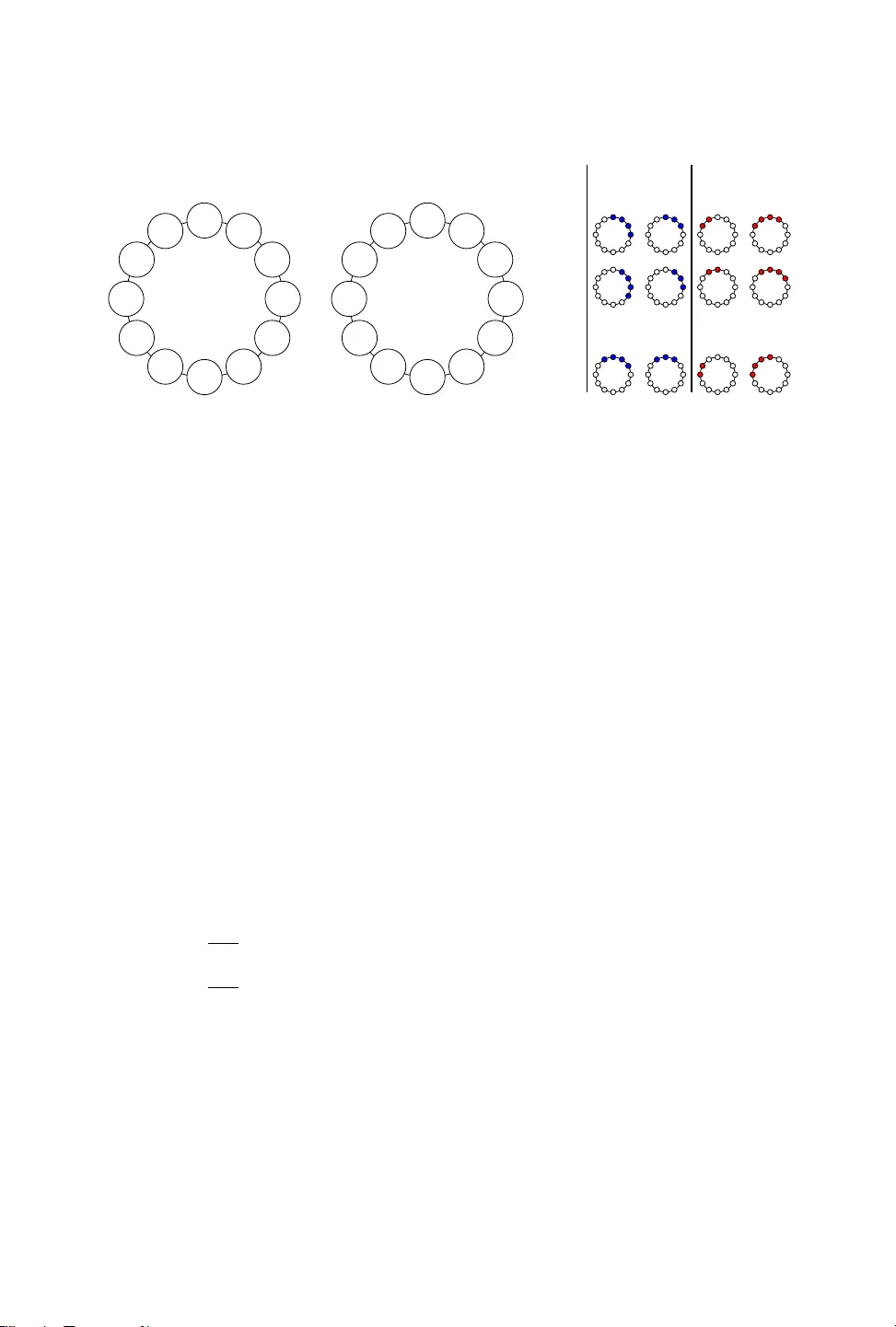
When Smoothness is Not Enough: T oward Exact antification and Optimization of the Price of Anarchy RAH UL CHAND AN, University of California, Santa Barbara D ARIO P ACCA GNAN, Imp erial College London JASON R. MARDEN, University of California, Santa Barbara The price of anar chy (Po A ) is a popular metric for analyzing the ineciency of self-interested decision making. Although its study is widespr ead, characterizing the Po A can be challenging. A commonly employed approach is based on the smoothness framew ork , which provides tight Po A values under the assumption that the system objective consists in the sum of the agents’ individual w elfares. Unfortunately , several important classes of problems do not satisfy this requirement (e.g., taxation in congestion games), and our rst result demonstrates that the smoothness framework does not tightly characterize the PoA for such settings. Motivated by this observation, this work develops a framework that achiev es two chief objectives: i) to tightly characterize the Po A for such scenarios, and ii) to do so through a tractable approach. A s a direct consequence, the proposed framework recov ers and generalizes many existing Po A results, and enables ecient computation of incentives that optimize the Po A. W e conclude by highlighting the applicability of our contributions to incentive design in congestion games and utility design in distributed welfare games. Additional K ey W ords and Phrases: game theor y , multiagent systems, price of anar chy , optimal incentives 1 INTRODUCTION The widespread proliferation of smartphones and other smart devices has led to a momentous shift in the operation of shared te chnological infrastructure like road-trac networks, cloud computing and the p ower grid, where the lo cal behaviours and interactions of individual decision makers are increasingly inuencing the system wide performance. Although such performance could be improved if a central coordinator was able to dictate the choices of individual decision makers, this approach is often infeasible owing to the distributed and self-inter ested nature of the v ery same decision making process. Within these settings, wide ranging ineciencies can sever ely degrade system performance, a phenomenon that is typically referr ed to as the tragedy of the commons [ 25 ] in economics and the social sciences. In light of these growing challenges, this paper focuses on (i) characterizing the impact of self-interested decision making on system performance and (ii) deriving locally implementable mechanisms to help mitigate these ineciencies. Before delving into our specic contributions, we b egin with two motivating examples: incentive design in congestion games and distributed coordination of multiagent systems. Both these problem settings hav e been widely studied in the operations research and game theor y literature as they capture the adverse ee cts of local de cision making on system wide performance. Applications include r outing in trac and communication networks [ 18 , 41 ], distributed resource allocation [ 24 , 26 ], credit assignment in teams [ 28 ], among many others. The tw o problems detailed below apply to vastly dierent elds of research and yet are intimately related as they pr ompt the same set of questions: how can we characterize and optimize the system performance as measured by the price of anarchy ? 1.1 Motivating Example #1 : Incentive design in congestion games A widely studied model for self-interested resource allo cation problems is that of (atomic) congestion games [ 39 ]. A congestion game consists of a set of users 𝑁 = { 1 , . . . , 𝑛 } sharing the use of a For the interested reader , the authors provide a software package, available in both MA TLAB ® and Python, that implements the techniques described in this manuscript at https://github.com/rahul-chandan/resalloc-poa . 2 R. Chandan, D. Paccagnan and J. R. Mar den common set of resources R , where each resour ce 𝑟 ∈ R is associated with a congestion function 𝑐 𝑟 : { 1 , . . . , 𝑛 } → R . The term 𝑐 𝑟 ( 𝑘 ) identies the cost a user experiences for selecting resource 𝑟 given that there are 1 ≤ 𝑘 ≤ 𝑛 users concurrently selecting resource 𝑟 . Further , each user 𝑖 ∈ 𝑁 is associated with a giv en action set A 𝑖 ⊆ 2 R that meets the individual ne eds. Within the conte xt of trac routing, for e xample, an action 𝑎 𝑖 ∈ A 𝑖 describes a path in the network connecting the user’s source to destination. Given an admissible allocation of users to resour ces 𝑎 = ( 𝑎 1 , 𝑎 2 , . . . , 𝑎 𝑛 ) ∈ A = A 1 × · · · × A 𝑛 , the system cost describes the sum of the costs incurred by all users, i.e., 𝐶 ( 𝑎 ) = 𝑖 ∈ 𝑁 𝑟 ∈ 𝑎 𝑖 𝑐 𝑟 ( | 𝑎 | 𝑟 ) , (1) where | 𝑎 | 𝑟 = | { 𝑖 ∈ 𝑁 : 𝑟 ∈ 𝑎 𝑖 } | denotes the number of users selecting resource 𝑟 in allocation 𝑎 . In this setting, an optimal allocation of users to resources consists in 𝑎 opt ∈ arg min 𝑎 ∈ A 𝐶 ( 𝑎 ) . One of the fundamental challenges associated with the allocation of resour ces in this problem setting is that users are often modeled as selsh de cision makers. Sp ecically , each user 𝑖 ∈ 𝑁 independently chooses an action 𝑎 𝑖 ∈ A 𝑖 with the aim of minimizing the individual cost 𝐽 𝑖 : A → R incurred over the selected resources, i.e ., 𝐽 𝑖 ( 𝑎 ) = 𝑟 ∈ R 𝑐 𝑟 ( | 𝑎 | 𝑟 ) . (2) The resulting allocation is then suitably described as a pure Nash equilibrium 𝑎 ne ∈ A of the game, or a generalization thereof (e.g., mixed Nash, correlated/coarse correlated equilibria). Accordingly , there has been signicant research seeking to quantify the quality of Nash equilibria relativ e to the optimal allocation. This is typically measured using the notion of price of anarchy [ 29 ], i.e., the worst case ratio 𝐶 ( 𝑎 ne ) / 𝐶 ( 𝑎 opt ) across a family of games. The analysis of the price of anarchy in congestion games has a rich history and clearly demon- strates the ineciencies associated with self interested de cision making [ 1 , 3 , 16 , 43 ]. Given these ineciencies, there is also signicant research interest in the design of incentives that alter the users’ experienced costs, thereby inuencing the set of Nash equilibria and, thus, impr oving the price of anarchy [ 7 , 9 , 17 , 24 , 27 , 35 ]. Within this context, each resource 𝑟 ∈ R is commonly associ- ated with an incentive function 𝜏 𝑟 : { 1 , . . . , 𝑛 } → R , where 𝜏 𝑟 ( 𝑘 ) denotes the incentive imposed on resource 𝑟 when ther e ar e 𝑘 users selecting it. 1 As a result, user 𝑖 ∈ 𝑁 experiences a cost accounting for both the congestion on the resources and the imposed incentives, i.e., 𝐽 𝑖 ( 𝑎 ) = 𝑟 ∈ 𝑎 𝑖 𝑐 𝑟 ( | 𝑎 | 𝑟 ) + 𝜏 𝑟 ( | 𝑎 | 𝑟 ) . (3) It should be stressed that, while the incentives modify the users’ cost functions, the y do not alter the assessment of the system cost, which still takes the form in ( 1 ) . Thus, unless all incentive are identically zero, the sum of the users’ costs in ( 3 ) does not equal the system cost in ( 1 ). The objective of a system op erator is to design admissible incentives, i.e., functions { 𝜏 𝑟 } 𝑟 ∈ R that satisfy a viable constraint on monetary budget, to improv e the quality of the resulting collective behaviour . While this objective may seem deceptively straightforward, it requires the follo wing theoretical advances which are currently unresolv ed: – Characterization: What is the price of anarchy for a given set of incentives { 𝜏 𝑟 } 𝑟 ∈ R ? – Optimization: What are admissible incentives { 𝜏 𝑟 } 𝑟 ∈ R that optimize the price of anarchy? 1 W e will use the terminology of “tax” and “rebate” when referring to incentiv es satisfying 𝜏 𝑟 ( 𝑘 ) ≥ 0 and 𝜏 𝑟 ( 𝑘 ) ≤ 0 for all 𝑟 and 𝑘 , respectively . When Smoothness is Not Enough 3 1.2 Motivating example #2 : Distributed coordination of multiagent systems Alternatively , in systems where the set of users is a group of autonomous, computer controlled entities, the users’ de cision making processes can be explicitly selected by the system designer . Resource allocation problems represent a particular class of such multiagent systems. In a resource allocation problem a set of 𝑛 users, 𝑁 = { 1 , . . . , 𝑛 } , must b e allocated to a set of resources R . Each user 𝑖 ∈ 𝑁 has a corresponding set of p ermissible actions, A 𝑖 . For a given allocation 𝑎 = ( 𝑎 1 , . . . , 𝑎 𝑛 ) ∈ A 1 × · · · × A 𝑛 = A , we consider a system welfare with the following separable form: 𝑊 ( 𝑎 ) = 𝑟 ∈ R 𝑊 𝑟 ( | 𝑎 | 𝑟 ) , where we refer to 𝑊 𝑟 : { 1 , . . . , 𝑛 } → R as the resource welfar e function on resource 𝑟 , and denote with 𝑎 opt ∈ arg max 𝑎 ∈ A 𝑊 ( 𝑎 ) an optimal allocation. Applications of this model are not limited to distributed sensing [ 23 , 47 ], resource allocation [ 20 , 24 ] and task assignment [ 2 , 15 ]. Requirements for scalability and se curity of multiagent systems compounded with constraints on the users’ communication and computation capabilities make centralized coordination undesirable or even impossible. Thus, there has recently been increased interest in the distributed co ordination of such systems [ 13 , 23 , 24 , 26 ], where the users determine their actions according to a prescribed local decision making process. A natural paradigm for the design of distributed co ordination algorithms consists in i) the assignment of a local utility function to each user , and ii) the choice of a learning rule that species each user’s decision making process in light of the perceiv ed utility [ 31 , 42 ]. The class of distributed welfar e games [ 31 ] provides a frame work for studying r esource allocation problems under this lens. In this context, each user 𝑖 ∈ 𝑁 is asso ciated with a utility function 𝑈 𝑖 : A → R of the following form: 𝑈 𝑖 ( 𝑎 ) = 𝑟 ∈ 𝑎 𝑖 𝐹 𝑟 ( | 𝑎 | 𝑟 ) , where the utility generating functions 𝐹 𝑟 : { 1 , . . . , 𝑛 } → R , 𝑟 ∈ R , are subje ct to our design . As such, the sum of the users’ utilities need not be equal to the system welfare. Remarkably , the performance (formally , the approximation ratio) of many learning rules including best response and no-regret dynamics matches the price of anarchy of a corresponding game whereby each user in 𝑁 is asso ciated to the action set A 𝑖 and utility 𝑈 𝑖 , se e [ 40 ]. Thus, in order to derive ecient coordination algorithms, we must address the following questions: – Characterization: What is the price of anarchy of a given set of utility generating functions? – Optimization: What are utility generating functions that optimize the price of anarchy? 1.3 Our contributions The focus of this manuscript is on developing an exact, computationally ecient technique to address both the characterization and optimization questions highlighted above for a broad class of games that includes congestion games and distributed welfare games. The specic contributions associated with this paper are as follows: (1) In Section 2 , we propose a generalization of the smoothness framework introduced by Rough- garden [ 40 ]. W e show that for any cost minimization game ( or analagous welfare maximization game), this new framework gives an impro ved bound on the price of anarchy when compared to the original smoothness framework (Proposition 2.2 ). (2) Our se cond result focuses on a generalization of congestion games wher e the system-level obje c- tive is not necessarily equal to the sum of the users’ individual welfares. Here, we demonstrate 4 R. Chandan, D. Paccagnan and J. R. Marden that our framework tightly characterizes the price of anarchy for any such game (The orem 3.5 ). This is in contrast to the original smo othness framework which provides only an upper bound on the price of anarchy in these settings. (3) Our third result shifts attention to the ecient characterization of the price of anar chy . In particular , the problem of characterizing the price of anarchy is transforme d to the problem of computing an optimal set of parameters ( 𝜆 , 𝜇 ) over a giv en admissible space. In Theorem 3.5 , we provide a tractable linear program that can characterize the exact price of anar chy for any set of generalized congestion games using our framework. (4) Our fourth result focuses on optimizing the price of anarchy . Specically , we show that the linear program for computing the price of anarchy can be modied to derive incentiv es that minimize the price of anarchy in generalized congestion games (Theorem 3.7 ). (5) Lastly , in Section 5 , we demonstrate the applicability of our methodology to the pr oblems of incentive design in congestion games and utility design in distributed welfare games introduce d in Sections 1.1 and 1.2 . Additionally , we show how our approach recov ers and unies a variety of existing results on the price of anarchy . All above results extend unchanged to mixed Nash, correlated and coarse correlated equilibria. 1.4 Related literature The notion of price of anarchy was introduced by Koutsoupias and Papadimitriou in 1999 as a metric to quantify equilibrium performance [ 29 ]. While a number of works have initially derived bounds on such metric, the breakthrough in the analysis of the price of anarchy came with the introduction of smoothness style arguments in two studies on atomic congestion games with ane latency functions [ 3 , 16 ]. The smo othness framework was later formalized and generalized by Roughgarden [ 40 ]. This approach has not only pro ven to be useful for characterizing the eciency of many classes of equilibria [ 1 , 10 , 34 ], it has also been applied more broadly in problems including learning [ 22 ] and mechanism design [ 44 ]. The smoothness framework provides several advantages when deriving bounds on the price of anarchy: it is tight for well studied families of games; and, it consists of a standard set of linear inequalities that govern the price of anarchy bound. How ever , as we show in this manuscript, the original smo othness argument does not provide exact bounds on the price of anarchy in settings when the social welfare is not aligned with the system-level objective, i.e., Í 𝑖 𝐽 𝑖 ( 𝑎 ) ≠ 𝐶 ( 𝑎 ) , and thus provides an inaccurate approach to the problems of incentive design and utility design. The generalization of smoothness proposed in this manuscript r esolves these deciencies, while retaining the strengths of the original smoothness approach. The notion of generalize d smoothness pr esented in this w ork is most similar to the style of argument used by Gairing [ 23 ] to quantify the price of anarchy of covering problems. This work also builds upon the results of Paccagnan et al. [ 36 ], who provide a linear programming framework for characterizing and optimizing the eciency of pure Nash equilibria in restricted classes of r esource allocation games. Generalized smoothness p ermits a non-trivial extension of their framework: we are now able to construct linear programs for computing and optimizing the coarse-correlated equilibrium eciency , relative to a broader class of pr oblems that includes the class of atomic congestion games. For an in-depth study on optimal local incentive design within the class of atomic congestion games, we refer the interested reader to Paccagnan et al. [ 35 ]. Our derivation of a linear programming technique to compute upper and lower bounds on the price of anarchy is inspired by the primal-dual approach [ 6 , 33 ]. The primal-dual approach was used in Nadav and Roughgar den [ 33 ] to understand when the smoothness bound from [ 40 ] is exact. It was then sp ecialized to the class of weighted congestion games in [ 6 ], applied to bound the eciency of approximate Nash equilibria in [ 5 ] and used to identify the best achievable price of When Smoothness is Not Enough 5 anarchy for weighted polynomial congestion games with incentives based on the optimal allo cation in [ 7 ]. It is important to note that these prior works also propose linear programming techniques for computing upper and lower bounds on the price of anarchy . Howev er , as w e discuss in Section 3.4 , our te chnique provides an exact and computationally tractable characterization of the price of anarchy , while the techniques introduced in the above works are either ine xact (i.e., the bounds do not always match) or ar e not computationally ecient (i.e., the complexity of computing the bounds gr ows exponentially in the number of users 𝑛 ) for the class of generalized congestion games considered in this paper . The improvements we obtain stem fr om the formalization of the generalized smoothness framework in addition to the use of a succinct parameterization that guarantees tightness of the price of anarchy bound. As the price of anarchy bound we obtain is exact, there is no further analysis required: our linear program automatically generates a worst case game instance (lower bound) and a matching generalized smoothness argument (upp er bound). Furthermore, our framework can be modied to eciently compute incentives and utilities that optimize the price of anarchy . 1.5 Outline This article is organized as follows. Se ction 2 denes the class of games and the performance metrics that we consider throughout this paper , reviews the original notion of smoothness [ 40 ] and denes the novel generalized smoothness argument. Section 3 renes our study to the class of generalized congestion games, presents our results relating to the characterization of tight and tractable bounds on the price of anarchy using the primal-dual approach in conjunction with a novel game parameterization and the derivation of optimal incentives under this sp ecialized game model. Section 4 presents analogous results for the welfare maximization problem setting without proof. Section 5 applies our theoretical r esults to the problems of incentive design in congestion games and utility design in distributed welfare games. Section 6 includes our conclusions and a brief discussion on future work. 2 GENERALIZED SMOOTHNESS IN COST MINIMIZA TION GAMES This section introduces the class of games and performance metrics used throughout this paper . W e proceed to review the smoothness framework from Roughgaren [ 40 ] and highlight its limitations. W e then introduce a revised framew ork, termed generalize d smoothness, that alleviates these limitations and improv es upon the eciency guarantees pro vided by the original smoothness framework. 2.1 Cost minimization games W e consider the class of cost minimization problems in which ther e is a set of users 𝑁 = { 1 , . . . , 𝑛 } , and where each user 𝑖 ∈ 𝑁 is associated with a given action set A 𝑖 and a cost function 𝐽 𝑖 : A → R . The system cost induced by an allo cation 𝑎 = ( 𝑎 1 , . . . , 𝑎 𝑛 ) ∈ A = A 1 × · · · × A 𝑛 is measured by the function 𝐶 : A → R > 0 , and an optimal allocation satises 𝑎 opt ∈ arg min 𝑎 ∈ A 𝐶 ( 𝑎 ) . (4) W e represent a cost minimization game as dened above as a tuple 𝐺 = ( 𝑁 , A , 𝐶 , J ) , where J = { 𝐽 1 , . . . , 𝐽 𝑛 } . Note that the example highlighted in Section 1.1 represents a special class of cost minimization games, where the users’ cost functions and the system cost are separable over a given set of shared resources. The main focus of this work is on characterizing the degradation in system wide performance resulting from local decision making. T o that end, we focus on the solution concept of (pure) Nash 6 R. Chandan, D. Paccagnan and J. R. Mar den equilibrium as a model of the emergent behaviour in such systems. A Nash equilibrium is dened as any allocation 𝑎 ne ∈ A such that 𝐽 𝑖 ( 𝑎 ne ) ≤ 𝐽 𝑖 ( 𝑎 𝑖 , 𝑎 ne − 𝑖 ) ∀ 𝑎 𝑖 ∈ A 𝑖 , ∀ 𝑖 ∈ 𝑁 . (5) For a given game 𝐺 , let NE ( 𝐺 ) denote the set of all allocations 𝑎 ∈ A that satisfy Equation ( 5 ) . Assuming the set NE ( 𝐺 ) is non-empty , w e dene the price of anarchy of the game 𝐺 as P oA ( 𝐺 ) : = max 𝑎 ∈ NE ( 𝐺 ) 𝐶 ( 𝑎 ) min 𝑎 ∈ A 𝐶 ( 𝑎 ) ≥ 1 . (6) The price of anarchy represents the ratio between the costs of the worst-performing pure Nash equilibrium in the game 𝐺 , and the optimal allocation. For a giv en class of cost minimization games G , which may contain innitely many game instances, we further dene the price of anarchy as, P oA ( G ) : = sup 𝐺 ∈ G P oA ( 𝐺 ) ≥ 1 . (7) Note that a lo wer price of anarchy corresponds to an improvement in worst case equilibrium performance and PoA ( G ) = 1 implies that all Nash equilibria of all games 𝐺 ∈ G are optimal. 2.2 Smoothness in cost minimization games The framework of ( 𝜆 , 𝜇 ) -smoothness, introduced in [ 40 ], is widely used in the existing literature aimed at characterizing the price of anar chy over various classes of games. A cost minimization game 𝐺 is termed ( 𝜆, 𝜇 )-smooth if the following two conditions are met: (i) For all 𝑎 ∈ A , we have Í 𝑛 𝑖 = 1 𝐽 𝑖 ( 𝑎 ) ≥ 𝐶 ( 𝑎 ) ; (ii) For all 𝑎, 𝑎 ′ ∈ A , there exist 𝜆 > 0 and 𝜇 < 1 such that 𝑖 ∈ 𝑁 𝐽 𝑖 ( 𝑎 ′ 𝑖 , 𝑎 − 𝑖 ) ≤ 𝜆𝐶 ( 𝑎 ′ ) + 𝜇𝐶 ( 𝑎 ) . (8) If a game 𝐺 is ( 𝜆, 𝜇 )-smooth, then the price of anarchy of game 𝐺 is upper bounded by P oA ( 𝐺 ) ≤ 𝜆 1 − 𝜇 . Observe that if all the games in a class G are shown to be ( 𝜆, 𝜇 )-smooth, then the price of anarchy of the class P oA ( G ) is also upper bounded by 𝜆 / ( 1 − 𝜇 ) . W e refer to the best upper bound obtainable using a smoothness argument on a given class of games G as the r obust price of anarchy , i.e., RP oA ( G ) : = inf 𝜆 > 0 ,𝜇 < 1 𝜆 1 − 𝜇 s.t. Equation ( 8 ) holds ∀ 𝐺 ∈ G . (9) It is important to note that the r obust price of anarchy r epresents only an upper bound on the price of anarchy , i.e., for any class of ( 𝜆, 𝜇 )-smooth games G , it holds that P oA ( G ) ≤ RPoA ( G ) , where it could be that PoA ( G ) < RPoA ( G ) . 2.3 Generalized smoothness in cost minimization games In this section, we pr ovide a generalization of the smoothness frame work, termed generalized smoothness . W e will then proceed to show how this new framework provides tighter eciency bounds and covers a broader spectrum of problem settings than the original smoothness frame work, dened in the previous section. When Smoothness is Not Enough 7 Denition 2.1 (Generalized smoothness). The cost minimization game 𝐺 is ( 𝜆, 𝜇 )-generalized smooth if, for any two allocations 𝑎, 𝑎 ′ ∈ A , there exist 𝜆 > 0 and 𝜇 < 1 satisfying, 𝑛 𝑖 = 1 𝐽 𝑖 ( 𝑎 ′ 𝑖 , 𝑎 − 𝑖 ) − 𝑛 𝑖 = 1 𝐽 𝑖 ( 𝑎 ) + 𝐶 ( 𝑎 ) ≤ 𝜆 𝐶 ( 𝑎 ′ ) + 𝜇𝐶 ( 𝑎 ) . (10) Note that we maintain the notation of ( 𝜆, 𝜇 ) as in the original notion of smoothness for ease of comparison. In the specic case when Í 𝑛 𝑖 = 1 𝐽 𝑖 ( 𝑎 ) = 𝐶 ( 𝑎 ) for all 𝑎 ∈ A , observe that the smo othness conditions in Equation ( 10 ) are equivalent to the original smoothness conditions in Equation ( 8 ) . As with Equation ( 9 ) , we dene the generalized price of anarchy of a class of cost minimization games G as the best upper bound obtainable using a generalized smoothness argument, i.e., GP oA ( G ) : = inf 𝜆 > 0 ,𝜇 < 1 𝜆 1 − 𝜇 s.t. Equation ( 10 ) holds ∀ 𝐺 ∈ G . (11) In our rst result w e show that (i) price of anar chy bounds under the generalized smoothness framework follow in the same way as the original smoothness framework without the restriction that Í 𝑛 𝑖 = 1 𝐽 𝑖 ( 𝑎 ) ≥ 𝐶 ( 𝑎 ) for all 𝑎 ∈ A and (ii) the generalized smoothness framework provides stronger bounds on the price of anarchy than the original smoothness framework whenever both are dened. Proposition 2.2. For any ( 𝜆 , 𝜇 )-generalized smooth game 𝐺 , the following statements hold: (i) The price of anarchy of 𝐺 is upper b ounded as PoA ( 𝐺 ) ≤ 𝜆 / ( 1 − 𝜇 ) . (ii) If the game 𝐺 is ( 𝜆 , 𝜇 )-smooth, then RP oA ( 𝐺 ) ≥ GP oA ( 𝐺 ) ≥ P oA ( 𝐺 ) . Furthermore, if Í 𝑛 𝑖 = 1 𝐽 𝑖 ( 𝑎 ) > 𝐶 ( 𝑎 ) holds for all 𝑎 ∈ A , then RPoA ( 𝐺 ) > GP oA ( 𝐺 ) ≥ P oA ( 𝐺 ) . Proof. Proof. For the proof of statement (i), observe that, for all 𝑎 ne ∈ NE ( 𝐺 ) and 𝑎 opt ∈ A , 𝐶 ( 𝑎 ne ) ≤ 𝑛 𝑖 = 1 𝐽 𝑖 ( 𝑎 opt 𝑖 , 𝑎 ne − 𝑖 ) − 𝑛 𝑖 = 1 𝐽 𝑖 ( 𝑎 ne ) + 𝐶 ( 𝑎 ne ) ≤ 𝜆 𝐶 ( 𝑎 opt ) + 𝜇 𝐶 ( 𝑎 ne ) . (12) The inequalities hold by Equations ( 5 ) and ( 10 ), respectively . Rearranging giv es the result. The remainder of the proof focuses on statement (ii). Since the condition Í 𝑛 𝑖 = 1 𝐽 𝑖 ( 𝑎 ) ≥ 𝐶 ( 𝑎 ) for all 𝑎 ∈ A implies that any pair of ( 𝜆, 𝜇 ) satisfying Equation ( 8 ) necessarily satises Equation ( 10 ) , we note that the generalized price of anar chy is less than or equal to the robust price of anar chy , i.e., RP oA ( 𝐺 ) ≥ GP oA ( 𝐺 ) ≥ P oA ( 𝐺 ) . Note that for any game 𝐺 = ( 𝑁 , A , C , J ) with Í 𝑛 𝑖 = 1 𝐽 𝑖 ( 𝑎 ) > 𝐶 ( 𝑎 ) for all 𝑎 ∈ A there must exist a uniform scaling factor 0 < 𝛾 < 1 such that Í 𝑛 𝑖 = 1 𝛾 𝐽 𝑖 ( 𝑎 ) ≥ 𝐶 ( 𝑎 ) , but for which the price of anarchy remains the same, i.e., for 𝐺 ′ = ( 𝑁 , A , C , J ′ ) where J ′ = { 𝛾 𝐽 1 , . . . , 𝛾 𝐽 𝑛 } , it holds that P oA ( 𝐺 ′ ) = PoA ( 𝐺 ) . The price of anarchy remains the same despite the rescaling, b ecause the inequalities in Equation ( 5 ) are unaected by a positive scaling factor (i.e., NE ( 𝐺 ) = NE ( 𝐺 ′ ) ), and because the optimal cost remains unchanged since the scaling does not impact the system cost. Further , one can verify from Equation ( 8 ) that RP oA ( 𝐺 ) > RP oA ( 𝐺 ′ ) , and thus RP oA ( 𝐺 ) > RP oA ( 𝐺 ′ ) ≥ P oA ( 𝐺 ′ ) = P oA ( 𝐺 ) . Finally , we know that GP oA ( 𝐺 ′ ) is less than or equal to RP oA ( 𝐺 ′ ) and can verify from Equation ( 10 ) that GP oA ( 𝐺 ) = GPoA ( 𝐺 ′ ) . Thus, RP oA ( 𝐺 ) > RP oA ( 𝐺 ′ ) ≥ GP oA ( 𝐺 ′ ) = GPoA ( 𝐺 ) ≥ P oA ( 𝐺 ) . □ Further comparisons between the original notion of smoothness and generalized smoothness can be made, as summarize d by the following obser vations. These obser vations are stated without proof for brevity , but can easily be veried by the reader . 8 R. Chandan, D. Paccagnan and J. R. Mar den – Obser vation #1 : The price of anarchy and generalized price of anarchy are shift-, and scale-invariant, i.e., for any given 𝛾 > 0 and ( 𝛿 1 , . . . , 𝛿 𝑛 ) ∈ R 𝑛 , P oA ( ( 𝑁 , A , 𝐶 , { 𝐽 𝑖 } 𝑛 𝑖 = 1 ) ) = P oA ( ( 𝑁 , A , 𝐶 , { 𝛾 𝐽 𝑖 + 𝛿 𝑖 } 𝑛 𝑖 = 1 ) ) , GP oA ( ( 𝑁 , A , 𝐶 , { 𝐽 𝑖 } 𝑛 𝑖 = 1 ) ) = GP oA ( ( 𝑁 , A , 𝐶 , { 𝛾 𝐽 𝑖 + 𝛿 𝑖 } 𝑛 𝑖 = 1 ) ) . Neither of these properties hold for the robust price of anarchy . – Observation #2 : The robust price of anarchy is optimized by budget-balance d user cost functions, i.e., Í 𝑖 ∈ 𝑁 𝐽 𝑖 ( 𝑎 ) = 𝐶 ( 𝑎 ) for all 𝑎 ∈ A . In general, this does not hold for the price of anarchy and generalized price of anarchy . – Obser vation #3 : For a given cost minimization game 𝐺 , we dene an av erage coarse-correlated equilibrium as a probability distribution 𝜎 ∈ Δ ( A ) satisfying, for all 𝑎 ′ ∈ A , E 𝑎 ∼ 𝜎 " 𝑁 𝑖 = 1 𝐽 𝑖 ( 𝑎 ) # : = 𝑎 ∈ A " 𝜎 𝑎 𝑁 𝑖 = 1 𝐽 𝑖 ( 𝑎 ) # ≤ 𝑎 ∈ A " 𝜎 𝑎 𝑁 𝑖 = 1 𝐽 𝑖 ( 𝑎 𝑖 , 𝑎 ′ − 𝑖 ) # , (13) where 𝜎 𝑎 ∈ [ 0 , 1 ] is the probability associated with action 𝑎 ∈ A in the distribution 𝜎 . Note that the set of average coarse correlated equilibria contains all of the game ’s pur e Nash e quilibria, mixed Nash equilibria, correlated equilibria and coarse-correlated e quilibria [ 40 ]. The generalized price of anarchy tightly characterizes the average coarse correlated equilibrium performance of any cost minimization game 𝐺 , and, thus, of any class of cost minimization games G . The proof follows identically to the result by Nadav and Roughgarden [ 33 ] that proves this claim for the robust price of anarchy under an alternative denition of average coarse correlated equilibrium. The two equilibrium denitions match for games with Í 𝑛 𝑖 = 1 𝐽 𝑖 ( 𝑎 ) = 𝐶 ( 𝑎 ) . 3 GENERALIZED SMOOTHNESS IN GENERALIZED CONGESTION GAMES The previous section introduced the framew ork of generalized smoothness and showed that the resulting generalized price of anarchy pr ovides improv ed bounds on the price of anarchy when compared with the robust price of anarchy . How ever , deriving the generalize d price of anarchy still requires solving for the optimal 𝜆 and 𝜇 given in Equation ( 11 ) . In this se ction, we sho w that the optimal parameters 𝜆 and 𝜇 for a generalization of the well-studied class of congestion games can be computed as solutions of a tractable linear program. Furthermore , we demonstrate that the generalized price of anarchy tightly characterizes the price of anarchy for this important class of games, extending the canonical results on the robustness of the price of anarchy from Roughgarden [ 40 ] to the broader class of generalized congestion games that we present below . 3.1 Generalized congestion games In this section, we consider a generalization of the congestion game framew ork that consists of a user set 𝑁 = { 1 , . . . , 𝑛 } and a resource set R . Given an allocation 𝑎 ∈ A , the system cost and user cost functions have the following separable structure: 𝐶 ( 𝑎 ) = 𝑟 ∈ R 𝐶 𝑟 ( | 𝑎 | 𝑟 ) , (14) 𝐽 𝑖 ( 𝑎 𝑖 , 𝑎 − 𝑖 ) = 𝑟 ∈ 𝑎 𝑖 𝐹 𝑟 ( | 𝑎 | 𝑟 ) , (15) where 𝐶 𝑟 : { 0 , 1 , . . . , 𝑛 } → R ≥ 0 and 𝐹 𝑟 : { 1 , . . . , 𝑛 } → R dene the resource cost functions and cost generating functions, respectively . W e will denote a congestion game by the tuple 𝐺 = When Smoothness is Not Enough 9 ( 𝑁 , R , A , { 𝐶 𝑟 , 𝐹 𝑟 } 𝑟 ∈ R ) . This game model covers many of the e xisting models studied in the game theoretic literature, including congestion games [ 39 ]. Example 3.1 (Congestion Games). In congestion games, each resource 𝑟 ∈ R is associated with a congestion function 𝑐 𝑟 : { 1 , . . . , 𝑛 } → R ≥ 0 . Here, the r esource cost and cost generating functions are 𝐶 𝑟 ( 𝑘 ) = 𝑘 · 𝑐 𝑟 ( 𝑘 ) and 𝐹 𝑟 ( 𝑘 ) = 𝑐 𝑟 ( 𝑘 ) for any 𝑘 ≥ 1 . Note that 𝐶 𝑟 ( 𝑘 ) = 𝑘 · 𝐹 𝑟 ( 𝑘 ) for this case, hence the denitions of smoothness and generalized smoothness coincide. Example 3.2 (Congestion Games with Incentives). When incentives ar e intr oduced into the conges- tion game setup, each resource 𝑟 ∈ R is also associate d with an incentive function 𝜏 𝑟 : { 1 , . . . , 𝑛 } → R . For this class of games, the resource cost and cost generating functions take on the form where 𝐶 𝑟 ( 𝑘 ) = 𝑘 · 𝑐 𝑟 ( 𝑘 ) and 𝐹 𝑟 ( 𝑘 ) = 𝑐 𝑟 ( 𝑘 ) + 𝜏 𝑟 ( 𝑘 ) for any 𝑘 ≥ 1 . Note that for the case when 𝜏 𝑟 ( 𝑘 ) > 0 for all 𝑟 (i.e., taxes), then 𝐶 𝑟 ( 𝑘 ) < 𝑘 · 𝐹 𝑟 ( 𝑘 ) and the generalized price of anar chy provides a strictly closer bound on the price of anarchy than the r obust price of anarchy , by Proposition 2.2 . Furthermore , when 𝜏 𝑟 ( 𝑘 ) < 0 for all 𝑟 (i.e., rebates), then 𝐶 𝑟 ( 𝑘 ) > 𝑘 · 𝐹 𝑟 ( 𝑘 ) and the original smoothness framework is inadmissible, by denition. 3.2 Tight price of anarchy for generalized congestion games Our goal in this section is to characterize the price of anarchy for a given set of generalized congestion games G . W e begin by dening our set of games. Denition 3.3. A generalized congestion game 𝐺 = ( 𝑁 , R , A , { 𝐶 𝑟 , 𝐹 𝑟 } 𝑟 ∈ R ) is generated from basis function pairs { 𝐶 𝑗 , 𝐹 𝑗 } , 𝑗 = 1 , . . . , 𝑚 , if there exists a set of coecients 𝛼 1 𝑟 , . . . 𝛼 𝑚 𝑟 ≥ 0 such that 𝐶 𝑟 ( 𝑘 ) = Í 𝑚 𝑗 = 1 𝛼 𝑗 𝑟 · 𝐶 𝑗 ( 𝑘 ) and 𝐹 𝑟 ( 𝑘 ) = Í 𝑚 𝑗 = 1 𝛼 𝑗 𝑟 · 𝐹 𝑗 ( 𝑘 ) for any 𝑘 ∈ { 1 , . . . , 𝑛 } and any 𝑟 ∈ R . W e let G denote the set of all generalize d congestion games with a maximum of 𝑛 users that can b e generated from given basis function pairs { 𝐶 𝑗 , 𝐹 𝑗 } , 𝑗 = 1 , . . . , 𝑚 . The following example demonstrates how a limited set of basis function pairs can actually model a diverse set of games. Example 3.4 (Ane and Polynomial Congestion Games). One commonly studied class of congestion games is ane congestion games, where each resour ce 𝑟 ∈ R is associated with a cost generating function 𝐹 𝑟 ( 𝑘 ) = 𝑎 𝑟 · 𝑘 + 𝑏 𝑟 and resource cost function 𝐶 𝑟 ( 𝑘 ) = 𝑘 · ( 𝑎 𝑟 · 𝑘 + 𝑏 𝑟 ) = 𝑘 · 𝐹 𝑟 ( 𝑘 ) for any 𝑘 ≥ 1 , where 𝑎 𝑟 , 𝑏 𝑟 ≥ 0 . Observe that all admissible function pairs { 𝐶 𝑟 , 𝐹 𝑟 } can be represented as linear combinations of the basis function pairs { 𝐶 1 , 𝐹 1 } , { 𝐶 2 , 𝐹 2 } where { 𝐶 1 ( 𝑘 ) , 𝐹 1 ( 𝑘 ) } = { 𝑘 , 1 } (case where 𝑎 𝑟 = 0 and 𝑏 𝑟 = 1 ) and { 𝐶 2 ( 𝑘 ) , 𝐹 2 ( 𝑘 ) } = { 𝑘 2 , 𝑘 } (case where 𝑎 𝑟 = 1 and 𝑏 𝑟 = 0 ). Similarly , the function pairs { 𝐶 𝑟 , 𝐹 𝑟 } of any polynomial congestion game of degree 𝑑 ≥ 1 , i.e., wher e each resource is associated with a cost generating function of the form 𝐹 𝑟 ( 𝑘 ) = Í 𝑑 + 1 𝑗 = 1 𝛼 𝑗 𝑟 · 𝑘 𝑗 − 1 such that 𝛼 1 𝑟 , . . . , 𝛼 𝑑 + 1 𝑟 ≥ 0 and 𝐶 𝑟 ( 𝑘 ) = 𝑘 · 𝐹 𝑟 ( 𝑘 ) , can b e r epresented as linear combinations of 𝑑 + 1 basis function pairs in the same fashion as in the ane case. The following theorem provides our main contribution p ertaining to the price of anarchy in generalized congestion games. Throughout, we dene 𝐶 𝑗 ( 0 ) = 𝐹 𝑗 ( 0 ) = 𝐹 𝑗 ( 𝑛 + 1 ) = 0 , 𝑗 = 1 , . . . , 𝑚 , for ease of notation and without loss of generality . Additionally , I R ( 𝑛 ) is dened as the set of all triplets ( 𝑥 , 𝑦, 𝑧 ) ∈ { 0 , 1 , . . . , 𝑛 } 3 that satisfy: (i) 1 ≤ 𝑥 + 𝑦 − 𝑧 ≤ 𝑛 and 𝑧 ≤ min { 𝑥 , 𝑦 } ; and, (ii) 𝑥 + 𝑦 − 𝑧 = 𝑛 or ( 𝑥 − 𝑧 ) ( 𝑦 − 𝑧 ) 𝑧 = 0 . The structure of the set I R ( 𝑛 ) comes from our game parameterization and will be fully addressed in the proof of Theorem 3.5 . Theorem 3.5. Let G denote the set of all generalized congestion games with a maximum of 𝑛 users generated from basis function pairs { 𝐶 𝑗 , 𝐹 𝑗 } , 𝑗 = 1 , . . . , 𝑚 , and let 𝜌 opt be the optimal value of the 10 R. Chandan, D. Paccagnan and J. R. Mar den following (tractable) linear program: 𝜌 opt = maximize 𝜈 ∈ R ≥ 0 ,𝜌 ∈ R 𝜌 subject to: 𝐶 𝑗 ( 𝑦 ) − 𝜌𝐶 𝑗 ( 𝑥 ) + 𝜈 [ ( 𝑥 − 𝑧 ) 𝐹 𝑗 ( 𝑥 ) − ( 𝑦 − 𝑧 ) 𝐹 𝑗 ( 𝑥 + 1 ) ] ≥ 0 , ∀ 𝑗 = 1 , . . . , 𝑚 , ∀ ( 𝑥 , 𝑦, 𝑧 ) ∈ I R ( 𝑛 ) . (16) Then, it holds that PoA ( G ) = GPoA ( G ) = 1 / 𝜌 opt . There are two signicant ndings associated with Theorem 3.5 . First, obser ve that the generalized price of anarchy achieves a tight bound on the price of anarchy for any set of generalized congestion games. Therefore, there is no loss in characterizing the price of anar chy using the generalized smoothness bound. Second, the price of anarchy associated with a set of generalized congestion games G can b e characterized by means of a tractable linear program that scales linearly in its complexity with the number of basis function pairs, 𝑚 , and quadratically with the numb er of users 𝑛 . Thus, there are computationally ecient mechanisms for characterizing the price of anarchy in a given set of congestion games. 3.3 Proof of Theorem 3.5 The following informal outline of the proof for Theorem 3.5 is directly followed by the formal proof, which follows a similar structure: – Step 1 : W e dene our game parameterization, which represents any generalized congestion game 𝐺 ∈ G with O ( 𝑚𝑛 3 ) parameters 𝜃 ( 𝑥 , 𝑦, 𝑧 , 𝑗 ) ≥ 0 corresponding with basis pairs { ( 𝐶 𝑗 , 𝐹 𝑗 ) } , 𝑗 = 1 , . . . , 𝑚 , and triplets 𝑥 , 𝑦 , 𝑧 ∈ { 0 , . . . , 𝑛 } such that 1 ≤ 𝑥 + 𝑦 − 𝑧 ≤ 𝑛 and 𝑧 ≤ min { 𝑥 , 𝑦 } . – Step 2 : For any class of generalized congestion games G , we observe that an upp er bound on the generalized price of anar chy can be computed as a fractional program with 𝑚 × | I R ( 𝑛 ) | constraints under the game parameterization presented in Step 1. – Step 3 : Following a change of variables, w e observe that the linear program in Equation ( 16 ) is equivalent to the fractional program from Step 2. W e then provide a game 𝐺 ∈ G with price of anarchy equal to the upper bound on the generalized price of anarchy , implying that P oA ( 𝐺 ) ≥ GP oA ( G ) . Since P oA ( 𝐺 ) ≤ PoA ( G ) ≤ GP oA ( G ) , it must then be that P oA ( 𝐺 ) = PoA ( G ) = GP oA ( G ) for any class of generalized congestion games G , concluding the proof. Proof of Theorem 3.5 . The proof is shown in three steps, corresponding with the informal outline: – Step 1 : For a given game 𝐺 ∈ G , our game parameterization is dened as follows for allocations 𝑎, 𝑎 ′ ∈ A : For every resource 𝑟 ∈ R , we dene integers 𝑥 𝑟 , 𝑦 𝑟 , 𝑧 𝑟 ≥ 0 where 𝑥 𝑟 = | 𝑎 | 𝑟 is the number of users that select 𝑟 in 𝑎 , 𝑦 𝑟 = | 𝑎 ′ | 𝑟 is the numb er of users that select 𝑟 in 𝑎 ′ and 𝑧 𝑟 = | { 𝑖 ∈ 𝑁 s.t. 𝑟 ∈ 𝑎 𝑖 } ∩ { 𝑖 ∈ 𝑁 s.t. 𝑟 ∈ 𝑎 ′ 𝑖 } | is the number of users that select 𝑟 in both 𝑎 and 𝑎 ′ . Note that 1 ≤ 𝑥 𝑟 + 𝑦 𝑟 − 𝑧 𝑟 ≤ 𝑛 and 𝑧 𝑟 ≤ min { 𝑥 𝑟 , 𝑦 𝑟 } must hold for all 𝑟 ∈ R . For all 𝑥 , 𝑦 , 𝑧 ≥ 0 such that 1 ≤ 𝑥 + 𝑦 − 𝑧 ≤ 𝑛 and 𝑧 ≤ min { 𝑥 , 𝑦 } , and all 𝑗 = 1 , . . . , 𝑚 , we dene the parameters 𝜃 ( 𝑥 , 𝑦, 𝑧 , 𝑗 ) = 𝑟 ∈ R ( 𝑥 ,𝑦 ,𝑧 ) 𝛼 𝑗 𝑟 , (17) where R ( 𝑥 , 𝑦 , 𝑧 ) = { 𝑟 ∈ R s.t. ( 𝑥 𝑟 , 𝑦 𝑟 , 𝑧 𝑟 ) = ( 𝑥 , 𝑦 , 𝑧 ) } . and 𝛼 𝑗 𝑟 ≥ 0 , 𝑗 = 1 , . . . , 𝑚 , are the coecients in the basis representation of the resour ce cost function 𝐶 𝑟 and cost generating function 𝐹 𝑟 . Although the parameterization into values 𝜃 ( 𝑥 , 𝑦, 𝑧 , 𝑗 ) ≥ 0 is of size O ( 𝑚𝑛 3 ) , we show in Step 2 that only O ( 𝑚𝑛 2 ) parameters are needed in the computation of the price of anarchy . When Smoothness is Not Enough 11 – Step 2 : For any generalized congestion game 𝐺 ∈ G , we denote an optimal allocation as 𝑎 opt , and a Nash equilibrium as 𝑎 ne , i.e. 𝑎 ne ∈ NE ( 𝐺 ) such that P oA ( 𝐺 ) ≥ 𝐶 ( 𝑎 ne ) / 𝐶 ( 𝑎 opt ) . W e observe that using the above denitions of ( 𝑥 𝑟 , 𝑦 𝑟 , 𝑧 𝑟 ) for 𝑎 = 𝑎 ne and 𝑎 ′ = 𝑎 opt , it follows that 𝑛 𝑖 = 1 𝐽 𝑖 ( 𝑎 opt 𝑖 , 𝑎 ne − 𝑖 ) = 𝑟 ∈ R ( 𝑦 𝑟 − 𝑧 𝑟 ) 𝐹 𝑟 ( 𝑥 𝑟 + 1 ) + 𝑧 𝑟 𝐹 𝑟 ( 𝑥 𝑟 ) . Informally , if a user 𝑖 ∈ 𝑁 selects a given resour ce 𝑟 ∈ R in both 𝑎 ne 𝑖 and 𝑎 opt 𝑖 , then by deviating from 𝑎 ne 𝑖 to 𝑎 opt 𝑖 , the user does not add to the load on 𝑟 , i.e., | 𝑎 opt 𝑖 , 𝑎 ne − 𝑖 | 𝑟 = | 𝑎 ne | 𝑟 = 𝑥 𝑟 . Howev er , if 𝑟 ∈ 𝑎 opt 𝑖 and 𝑟 ∉ 𝑎 ne 𝑖 , then | 𝑎 opt 𝑖 , 𝑎 ne − 𝑖 | 𝑟 = | 𝑎 ne | 𝑟 + 1 = 𝑥 𝑟 + 1 . Recall that for all 𝑟 ∈ R , it must hold that 𝑧 𝑟 ≤ min { 𝑥 𝑟 , 𝑦 𝑟 } , and 1 ≤ 𝑥 𝑟 + 𝑦 𝑟 − 𝑧 𝑟 ≤ 𝑛 . W e dene the set of triplets I ( 𝑛 ) ⊆ { 0 , 1 , . . . , 𝑛 } 3 as I ( 𝑛 ) : = { ( 𝑥 , 𝑦, 𝑧 ) ∈ N 3 s.t. 1 ≤ 𝑥 + 𝑦 − 𝑧 ≤ 𝑛 and 𝑧 ≤ min { 𝑥 , 𝑦 } } , and 𝛾 ( G ) as the value of the following fractional program: 𝛾 ( G ) : = inf 𝜆 > 0 ,𝜇 < 1 𝜆 1 − 𝜇 s.t. ( 𝑧 − 𝑥 ) 𝐹 𝑗 ( 𝑥 ) + ( 𝑦 − 𝑧 ) 𝐹 𝑗 ( 𝑥 + 1 ) + 𝐶 𝑗 ( 𝑥 ) ≤ 𝜆 𝐶 𝑗 ( 𝑦 ) + 𝜇𝐶 𝑗 ( 𝑥 ) , ∀ 𝑗 = 1 , . . . , 𝑚 , ∀ ( 𝑥 , 𝑦, 𝑧 ) ∈ I ( 𝑛 ) . (18) Observe that, by Equation ( 17 ) , the generalized smoothness condition in Equation ( 10 ) can be rewritten within the context of generalized congestion games as ( 𝑥 ,𝑦 ,𝑧 ) ∈ I ( 𝑛 ) 𝑚 𝑗 = 1 ( 𝑥 − 𝑧 ) 𝐹 𝑗 ( 𝑥 ) − ( 𝑦 − 𝑧 ) 𝐹 𝑗 ( 𝑥 + 1 ) + 𝐶 𝑗 ( 𝑥 ) 𝜃 ( 𝑥 , 𝑦, 𝑧 , 𝑗 ) ≤ ( 𝑥 ,𝑦 ,𝑧 ) ∈ I ( 𝑛 ) 𝑚 𝑗 = 1 𝜆𝐶 𝑗 ( 𝑦 ) + 𝜇𝐶 𝑗 ( 𝑥 ) 𝜃 ( 𝑥 , 𝑦, 𝑧 , 𝑗 ) It must then hold that for any pair ( 𝜆 , 𝜇 ) in the feasible set of the fractional program in Equation ( 18 ) , all games 𝐺 ∈ G are ( 𝜆 , 𝜇 ) -generalized smooth, i.e., 𝛾 ( G ) ≥ GPoA ( G ) . This is because the generalized smoothness condition for generalize d congestion games can be expressed as a weighted sum with positive coecients over a subset of the constraints in Equation ( 18 ). T o conclude Step 2 of the proof, w e show that it is sucient to dene 𝛾 ( G ) in Equation ( 18 ) over the reduced set of constraints corresponding to 𝑗 ∈ { 1 , . . . , 𝑚 } and triplets in I R ( 𝑛 ) ⊆ I ( 𝑛 ) , where I R ( 𝑛 ) : = { ( 𝑥 , 𝑦, 𝑧 ) ∈ I ( 𝑛 ) s.t. 𝑥 + 𝑦 − 𝑧 = 𝑛 or ( 𝑥 − 𝑧 ) ( 𝑦 − 𝑧 ) 𝑧 = 0 } . For each 𝑗 ∈ { 1 , . . . , 𝑚 } and any ( 𝑥 , 𝑦, 𝑧 ) ∈ I ( 𝑛 ) , obser ve that the constraint in Equation ( 18 ) is equivalent to 𝑦 𝐹 𝑗 ( 𝑥 + 1 ) − 𝑥 𝐹 𝑗 ( 𝑥 ) + 𝑧 [ 𝐹 𝑗 ( 𝑥 ) − 𝐹 𝑗 ( 𝑥 + 1 ) ] ≤ 𝜆 𝐶 𝑗 ( 𝑦 ) + ( 𝜇 − 1 ) 𝐶 𝑗 ( 𝑥 ) . If 𝐹 𝑗 ( 𝑥 + 1 ) ≥ 𝐹 𝑗 ( 𝑥 ) , the strictest condition on 𝜆 and 𝜇 corresponds to the lowest value of 𝑧 . Thus, 𝑧 = max { 0 , 𝑥 + 𝑦 − 𝑛 } , and either ( 𝑥 − 𝑧 ) ( 𝑦 − 𝑧 ) 𝑧 = 0 or 𝑥 + 𝑦 − 𝑧 = 𝑛 . Otherwise, if 𝐹 𝑗 ( 𝑥 + 1 ) < 𝐹 𝑗 ( 𝑥 ) , then the largest value of 𝑧 is strictest, i.e., 𝑧 = min { 𝑥 , 𝑦 } which satises ( 𝑥 − 𝑧 ) ( 𝑦 − 𝑧 ) 𝑧 = 0 . – Step 3 : In order to derive the game instances with price of anarchy matching 𝛾 ( G ) , it is convenient to perform the following change of variables: 𝜈 ( 𝜆 , 𝜇 ) : = 1 / 𝜆 and 𝜌 ( 𝜆, 𝜇 ) : = ( 1 − 𝜇 ) / 𝜆 . For ease of notation, we will refer to the new variables simply as 𝜈 and 𝜌 , respe ctively , i.e., 𝜈 = 𝜈 ( 𝜆, 𝜇 ) and 𝜌 = 𝜌 ( 𝜆, 𝜇 ) . For each 𝑗 ∈ { 1 , . . . , 𝑚 } and each ( 𝑥 , 𝑦, 𝑧 ) ∈ I R ( 𝑛 ) , it is straightforward to verify that the constraints in Equation ( 18 ) can be rewritten in terms of 𝜈 and 𝜌 as 𝐶 𝑗 ( 𝑦 ) − 𝜌𝐶 𝑗 ( 𝑥 ) + 𝜈 [ ( 𝑥 − 𝑧 ) 𝐹 𝑗 ( 𝑥 ) − ( 𝑦 − 𝑧 ) 𝐹 𝑗 ( 𝑥 + 1 ) ] ≥ 0 . 12 R. Chandan, D. Paccagnan and J. R. Mar den Thus, the value 𝛾 ( G ) must b e equal to 1 / 𝜌 opt , where 𝜌 opt is the value of the follo wing linear program: 𝜌 opt = maximize 𝜈 ∈ R ≥ 0 ,𝜌 ∈ R 𝜌 subject to: 𝐶 𝑗 ( 𝑦 ) − 𝜌𝐶 𝑗 ( 𝑥 ) + 𝜈 [ ( 𝑥 − 𝑧 ) 𝐹 𝑗 ( 𝑥 ) − ( 𝑦 − 𝑧 ) 𝐹 𝑗 ( 𝑥 + 1 ) ] ≥ 0 , ∀ 𝑗 = 1 , . . . , 𝑚 , ∀ ( 𝑥 , 𝑦, 𝑧 ) ∈ I R ( 𝑛 ) . (19) It is important to note here that while 𝛾 ( G ) is the inmum of a fractional program (see, e.g., Equation ( 18 ) ), the value 𝜌 opt can be computed as a maximum b ecause the feasible set is b ounded and closed. Firstly , since 𝛾 ( G ) is an upper bound on the price of anarchy , its inverse (i.e., 𝜌 ) must be in the bounded and closed interval [ 0 , 1 ] . A dditionally , one can verify that 𝜈 is not only bounded from below by 0, but also from above by the quantity ¯ 𝜈 : = min 𝑗 ∈ { 1 ,. . ., 𝑚 } minimize ( 𝑥 ,𝑦 ,𝑧 ) ∈ I R ( 𝑛 ) 𝐶 𝑗 ( 𝑦 ) ( 𝑦 − 𝑧 ) 𝐹 𝑗 ( 𝑥 + 1 ) − ( 𝑥 − 𝑧 ) 𝐹 𝑗 ( 𝑥 ) subject to: ( 𝑥 − 𝑧 ) 𝐹 𝑗 ( 𝑥 ) − ( 𝑦 − 𝑧 ) 𝐹 𝑗 ( 𝑥 + 1 ) < 0 and 𝐶 𝑗 ( 𝑥 ) = 0 , (20) which comes from the constraints in Equation ( 19 ) corresponding to triplets ( 𝑥 , 𝑦, 𝑧 ) ∈ I R ( 𝑛 ) such that 𝐶 𝑗 ( 𝑥 ) = 0 and ( 𝑥 − 𝑧 ) 𝐹 𝑗 ( 𝑥 ) − ( 𝑦 − 𝑧 ) 𝐹 𝑗 ( 𝑥 + 1 ) < 0 . Such a value must exist, as we assume 𝐶 𝑗 ( 0 ) = 0 . One can verify that any 𝑗 ∈ { 1 , . . . , 𝑚 } and ( 𝑥 , 𝑦, 𝑧 ) ∈ I R ( 𝑛 ) such that 𝐶 𝑗 ( 𝑥 ) = 0 and ( 𝑥 − 𝑧 ) 𝐹 𝑗 ( 𝑥 ) − ( 𝑦 − 𝑧 ) 𝐹 𝑗 ( 𝑥 + 1 ) ≥ 0 correspond to constraints that are satised trivially in Equation ( 19 ) since 𝜈 ≥ 0 , by denition, and 𝐶 𝑗 ( 𝑦 ) ≥ 0 for all 𝑦 = 0 , 1 , . . . , 𝑛 , by assumption. W e denote with H 𝑗 ( 𝑥 , 𝑦, 𝑧 ) the halfplane of ( 𝜈 , 𝜌 ) values that satisfy the constraint corresponding to 𝑗 ∈ { 1 , . . . , 𝑚 } and ( 𝑥 , 𝑦, 𝑧 ) ∈ I R ( 𝑛 ) , i.e., H 𝑗 ( 𝑥 , 𝑦, 𝑧 ) : = ( 𝜈 , 𝜌 ) ∈ R ≥ 0 × R s.t. 𝜌 ≤ 𝐶 𝑗 ( 𝑦 ) 𝐶 𝑗 ( 𝑥 ) + 1 𝐶 𝑗 ( 𝑥 ) 𝜈 ( 𝑥 − 𝑧 ) 𝐹 𝑗 ( 𝑥 ) − ( 𝑦 − 𝑧 ) 𝐹 𝑗 ( 𝑥 + 1 ) . The set of feasible ( 𝜈 , 𝜌 ) is the intersection of these 𝑚 × | I R ( 𝑛 ) | halfplanes. Since the objective is to maximize 𝜌 , any solution ( 𝜈 opt , 𝜌 opt ) to the linear program in Equation ( 19 ) must be on the (upper) boundar y of the feasible set. W e argue b elow that a solution ( 𝜈 opt , 𝜌 opt ) can only exist in one of the three follo wing scenarios: (1) at the intersection of two halfplanes’ b oundaries, wher e one halfplane has boundar y line with positive slope, and the other has b oundary line with nonp ositive slope; (2) on a halfplane boundary line with p ositive slope at 𝜈 opt = ¯ 𝜈 ; or (3) at ( 𝜈 opt , 𝜌 opt ) = ( 0 , 0 ) . W e denote with 𝜕 H 𝑗 ( 𝑥 , 𝑦, 𝑧 ) the b oundary line of the halfplane H 𝑗 ( 𝑥 , 𝑦, 𝑧 ) , i.e., 𝜕 H 𝑗 ( 𝑥 , 𝑦, 𝑧 ) : = ( 𝜈 , 𝜌 ) ∈ R ≥ 0 × R s.t. 𝜌 = 𝐶 𝑗 ( 𝑦 ) 𝐶 𝑗 ( 𝑥 ) + 1 𝐶 𝑗 ( 𝑥 ) 𝜈 ( 𝑥 − 𝑧 ) 𝐹 𝑗 ( 𝑥 ) − ( 𝑦 − 𝑧 ) 𝐹 𝑗 ( 𝑥 + 1 ) . Observe that the boundary lines of halfplanes corresponding to the choice 𝑦 = 𝑧 = 0 have 𝜌 -intercept equal to zero and slope 𝑥 𝐹 𝑗 ( 𝑥 ) / 𝐶 𝑗 ( 𝑥 ) . If 𝐹 𝑗 ( 𝑥 ) ≤ 0 for any 𝑗 ∈ { 1 , . . . , 𝑚 } and 𝑥 ∈ { 1 , . . . , 𝑛 } , then an optimal pair ( 𝜈 , 𝜌 ) is trivially at the origin, i.e., ( 𝜈 opt , 𝜌 opt ) = ( 0 , 0 ) (i.e., scenario (3) ab ove). Note that the 𝜌 -intercept of any halfplane boundary cannot be below 0, as we only consider cost functions such that 𝐶 𝑗 ( 𝑘 ) ≥ 0 for all 𝑘 and all 𝑗 . Otherwise, the maximum value of 𝜌 occurs at the intersection of a boundar y line with p ositive slope and a boundar y line with nonp ositive slope (i.e., scenario (1) above) or on a boundar y line with positive slope at 𝜈 = ¯ 𝜈 (i.e., scenario (2) above). W e illustrate this reasoning in Fig. 1 . Observe that for Scenarios (1) and (2), the pair ( 𝜈 opt , 𝜌 opt ) is at the intersection of two boundary lines, which we denote as 𝜕 H 𝑗 ( 𝑥 , 𝑦, 𝑧 ) and 𝜕 H 𝑗 ′ ( 𝑥 ′ , 𝑦 ′ , 𝑧 ′ ) . The parameters 𝑗 , 𝑗 ′ ∈ { 1 , . . . , 𝑚 } and When Smoothness is Not Enough 13 ( 𝜈 opt , 𝜌 opt ) 𝜌 𝜈 ¯ 𝜈 Scenario (1) ( 𝜈 opt , 𝜌 opt ) 𝜌 𝜈 ¯ 𝜈 Scenario (2) 𝜌 𝜈 ¯ 𝜈 ( 𝜈 opt , 𝜌 opt ) Scenario (3) Fig. 1. The three dierent scenarios in which optimal solutions ( 𝜈 opt , 𝜌 opt ) to Equation ( 19 ) can exist. W e illustrate the reasoning b ehind each of the three scenarios for optimal solutions ( 𝜈 opt , 𝜌 opt ) to the linear program in Equation ( 19 ) . Since the objective of Equation ( 19 ) is to maximize 𝜌 , the optimal values will b e at the (upper) boundary of the feasible set, illustrated with a solid, bolded line in each of the examples above. Additionally , the optimal solution ( 𝜈 opt , 𝜌 opt ) is marked by a solid, red dot in the illustrations above. In Scenario (1), on the le, ( 𝜈 opt , 𝜌 opt ) lie on the intersection of a boundary line with p ositive slope and a boundary line with nonpositive slop e. In Scenario (2), centre, ( 𝜈 opt , 𝜌 opt ) lie on the intersection of a boundary line with positive slope at 𝜈 = ¯ 𝜈 , which is defined in Equation ( 20 ) . In Scenario (3), on the right, there exists a halfplane boundary line with nonpositive slope and 𝜌 -intercept equal to zero, and so ( 𝜈 opt , 𝜌 opt ) = ( 0 , 0 ) . Using the parameters corresponding to the halfplanes on which the pair ( 𝜈 opt , 𝜌 opt ) lays, we can construct games 𝐺 ∈ G with PoA ( 𝐺 ) = 1 / 𝜌 opt in each of these scenarios. ( 𝑥 , 𝑦, 𝑧 ) , ( 𝑥 ′ , 𝑦 ′ , 𝑧 ′ ) ∈ I R ( 𝑛 ) satisfy the following: 𝜈 opt [ ( 𝑥 − 𝑧 ) 𝐹 𝑗 ( 𝑥 ) − ( 𝑦 − 𝑧 ) 𝐹 𝑗 ( 𝑥 + 1 ) ] = 𝜌 opt 𝐶 𝑗 ( 𝑥 ) − 𝐶 𝑗 ( 𝑦 ) , 𝜈 opt [ ( 𝑥 ′ − 𝑧 ′ ) 𝐹 𝑗 ′ ( 𝑥 ′ ) − ( 𝑦 ′ − 𝑧 ′ ) 𝐹 𝑗 ′ ( 𝑥 ′ + 1 ) ] = 𝜌 opt 𝐶 𝑗 ′ ( 𝑥 ′ ) − 𝐶 𝑗 ′ ( 𝑦 ′ ) , (21) because ( 𝜈 opt , 𝜌 opt ) is on both b oundary lines. Further , there exists 𝜂 ∈ [ 0 , 1 ] such that 𝜂 ( 𝑥 − 𝑧 ) 𝐹 𝑗 ( 𝑥 ) − ( 𝑦 − 𝑧 ) 𝐹 𝑗 ( 𝑥 + 1 ) + ( 1 − 𝜂 ) h ( 𝑥 ′ − 𝑧 ′ ) 𝐹 𝑗 ′ ( 𝑥 ′ ) − ( 𝑦 ′ − 𝑧 ′ ) 𝐹 𝑗 ′ ( 𝑥 ′ + 1 ) i = 0 . (22) Equation ( 22 ) holds in Scenario (1) b ecause one of the boundar y lines has p ositive slope, i.e., ( 𝑥 − 𝑧 ) 𝐹 𝑗 ( 𝑥 ) − ( 𝑦 − 𝑧 ) 𝐹 𝑗 ( 𝑥 + 1 ) > 0 , while the other has nonpositive slope, and in Scenario (3) b ecause one b oundary line has positive slope while the other is the vertical line 𝜈 = ¯ 𝜈 which corresponds to a particular choice of 𝑗 ∈ { 1 , . . . , 𝑚 } and ( 𝑥 , 𝑦, 𝑧 ) ∈ I R ( 𝑛 ) such that ( 𝑥 − 𝑧 ) 𝐹 𝑗 ( 𝑥 ) − ( 𝑦 − 𝑧 ) 𝐹 𝑗 ( 𝑥 + 1 ) < 0 by Equation ( 20 ). Next, for the parameters 𝑗 , 𝑗 ′ ∈ { 1 , . . . , 𝑚 } , ( 𝑥 , 𝑦, 𝑧 ) , ( 𝑥 ′ , 𝑦 ′ , 𝑧 ′ ) ∈ I R ( 𝑛 ) , and 𝜂 ∈ [ 0 , 1 ] obtained above, we construct a game instance 𝐺 ∈ G such that P oA ( 𝐺 ) = 1 / 𝜌 opt . Let R 1 = { 𝑟 1 , . . . , 𝑟 𝑛 } and R 2 = { 𝑟 𝑛 + 1 , . . . , 𝑟 2 𝑛 } denote two disjoint cycles of r esources. Every resource 𝑟 ∈ R 1 has cost function 𝐶 𝑟 ( 𝑘 ) = 𝜂𝐶 𝑗 ( 𝑘 ) , and cost generating function 𝐹 𝑟 ( 𝑘 ) = 𝜂 𝐹 𝑗 ( 𝑘 ) for all 𝑘 . Meanwhile, every 𝑟 ∈ R 2 has cost function 𝐶 𝑟 ( 𝑘 ) = ( 1 − 𝜂 ) 𝐶 𝑗 ′ ( 𝑘 ) , and cost generating function 𝐹 𝑟 ( 𝑘 ) = ( 1 − 𝜂 ) 𝐹 𝑗 ′ ( 𝑘 ) for all 𝑘 . W e dene the user set 𝑁 = { 1 , . . . , 𝑛 } , where each user 𝑖 ∈ 𝑁 has action set A 𝑖 = { 𝑎 ne 𝑖 , 𝑎 opt 𝑖 } . In action 𝑎 ne 𝑖 , the user 𝑖 selects 𝑥 consecutive resources in R 1 starting with 𝑟 𝑖 , i.e. { 𝑟 𝑖 , 𝑟 ( 𝑖 mo d 𝑛 ) + 1 , . . . , 𝑟 ( ( 𝑖 + 𝑥 − 2 ) mod 𝑛 ) + 1 } , and 𝑥 ′ consecutive resources in R 2 starting with resource 𝑟 𝑛 + 𝑖 . In 𝑎 opt 𝑖 , user 𝑖 selects 𝑦 consecutive resources in R 1 ending with resour ce 𝑟 ( ( 𝑖 + 𝑧 − 2 ) mod 𝑛 ) + 1 , i.e. { 𝑟 ( ( 𝑖 + 𝑧 − 𝑦 − 1 ) mod 𝑛 ) + 1 , . . . , 𝑟 ( ( 𝑖 + 𝑧 − 2 ) mod 𝑛 ) + 1 } , and 𝑦 ′ consecutive r esources in R 2 ending with 14 R. Chandan, D. Paccagnan and J. R. Mar den R 1 𝐶 𝑟 ( 𝑘 ) = 𝜂𝐶 ( 𝑘 ) , 𝐹 𝑟 ( 𝑘 ) = 𝜂 𝐹 ( 𝑘 ) , for all 𝑟 ∈ R 1 𝑟 1 𝑟 2 𝑟 3 𝑟 4 𝑟 5 𝑟 𝑛 − 3 𝑟 𝑛 − 2 𝑟 𝑛 − 1 𝑟 𝑛 R 2 𝐶 𝑟 ( 𝑘 ) = ( 1 − 𝜂 ) 𝐶 ′ ( 𝑘 ) , 𝐹 𝑟 ( 𝑥 ) = ( 1 − 𝜂 ) 𝐹 ′ ( 𝑘 ) , for all 𝑟 ∈ R 2 𝑟 𝑛 + 1 𝑟 𝑛 + 2 𝑟 𝑛 + 3 𝑟 𝑛 + 4 𝑟 𝑛 + 5 𝑟 2 𝑛 − 3 𝑟 2 𝑛 − 2 𝑟 2 𝑛 − 1 𝑟 2 𝑛 𝑖 1 2 . . . 𝑛 𝑎 ne 𝑖 R 1 R 2 . . . 𝑎 opt 𝑖 R 1 R 2 . . . Fig. 2. The game instance construction 𝐺 consisting of 𝑛 users, and tw o disjoint cycles R 1 and R 2 , as described in the proof of Theorem 3.5 , Step 2 for Scenarios (1) and (2). Consider the set of games G , where 𝑛 is the maximum number of users and Z is a set of basis functions pairs, and suppose that ( 𝜈 opt , 𝜌 opt ) satisfy the conditions of Scenarios (1) or (2). Further , suppose that the parameters for which Equation ( 21 ) and Equation ( 22 ) hold are 𝐶 , 𝐹 , 𝐶 ′ , 𝐹 ′ ∈ Z , ( 𝑥 , 𝑦 , 𝑧 ) = ( 4 , 2 , 0 ) , ( 𝑥 ′ , 𝑦 ′ , 𝑧 ′ ) = ( 3 , 4 , 2 ) ∈ I R ( 𝑛 ) and 𝜂 ∈ [ 0 , 1 ] . In the above figure, we illustrate the game 𝐺 ∈ G such that P oA ( 𝐺 ) = PoA ( 𝐺 ′ ) = 1 / 𝜌 opt according to the reasoning for constructing game instances in Scenarios (1) and (2). Observe that each resource 𝑟 ∈ R 1 has 𝐶 𝑟 ( 𝑘 ) = 𝜂𝐶 ( 𝑘 ) , and 𝐹 𝑟 ( 𝑘 ) = 𝜂 𝐹 ( 𝑘 ) , whereas each resource 𝑟 ∈ R 2 has 𝐶 𝑟 ( 𝑘 ) = ( 1 − 𝜂 ) 𝐶 ′ ( 𝑘 ) , and 𝐹 𝑟 ( 𝑥 ) = ( 1 − 𝜂 ) 𝐹 ′ ( 𝑘 ) , for all 𝑘 ∈ { 1 , . . . , 𝑛 } . Each user 𝑖 ∈ 𝑁 has two actions 𝑎 ne 𝑖 and 𝑎 opt 𝑖 , as defined in the table on the right. Observe that every resource in R 1 is selected by 4 users in the allocation 𝑎 ne = ( 𝑎 ne 1 , . . . , 𝑎 ne 𝑛 ) , and 3 users in 𝑎 opt = ( 𝑎 opt 1 , . . . , 𝑎 opt 𝑛 ) , where no user 𝑖 ∈ 𝑁 has a common resour ce between its actions 𝑎 ne 𝑖 and 𝑎 opt 𝑖 , i.e., 𝑥 𝑟 = 4 = 𝑥 , 𝑦 𝑟 = 3 = 𝑦 , and 𝑧 𝑟 = 0 = 𝑧 for all 𝑟 ∈ R 1 . Similarly , 𝑥 𝑟 = 3 = 𝑥 ′ , 𝑦 𝑟 = 4 = 𝑦 ′ , and 𝑧 𝑟 = 2 = 𝑧 ′ , for each resource 𝑟 ∈ R 2 . resource 𝑟 𝑛 + ( ( 𝑖 + 𝑧 ′ − 2 ) mo d 𝑛 ) + 1 . W e provide an illustration of this game construction in Fig. 2 . Observe that 𝑎 ne = ( 𝑎 ne 1 , . . . , 𝑎 ne 𝑛 ) satises the conditions for a Nash equilibrium, 𝐽 𝑖 ( 𝑎 ne ) = 𝜂 𝑥 𝐹 𝑗 ( 𝑥 ) + ( 1 − 𝜂 ) 𝑥 ′ 𝐹 𝑗 ′ ( 𝑥 ′ ) = 𝜂 [ 𝑧 𝐹 𝑗 ( 𝑥 ) + ( 𝑦 − 𝑧 ) 𝐹 𝑗 ( 𝑥 + 1 ) ] + ( 1 − 𝜂 ) [ 𝑧 ′ 𝐹 𝑗 ′ ( 𝑥 ′ ) + ( 𝑦 ′ − 𝑧 ′ ) 𝐹 𝑗 ′ ( 𝑥 ′ + 1 ) ] = 𝐽 𝑖 ( 𝑎 opt 𝑖 , 𝑎 ne − 𝑖 ) , which holds by Equation ( 22 ). Then, by the above equality and Equation ( 21 ), 0 = 𝑛 𝑖 = 1 𝐽 𝑖 ( 𝑎 opt 𝑖 , 𝑎 ne − 𝑖 ) − 𝑛 𝑖 = 1 𝐽 𝑖 ( 𝑎 ne ) = 1 𝜈 opt h 𝑛 · 𝜂 𝜌 opt 𝐶 𝑗 ( 𝑥 ) − 𝐶 𝑗 ( 𝑦 ) + 𝑛 · ( 1 − 𝜂 ) h 𝜌 opt 𝐶 𝑗 ′ ( 𝑥 ′ ) + 𝐶 𝑗 ′ ( 𝑦 ′ ) i i = 1 𝜈 opt 𝜌 opt 𝐶 ( 𝑎 ne ) − 𝐶 ( 𝑎 opt ) , where 𝑎 opt = ( 𝑎 opt 1 , . . . , 𝑎 opt 𝑛 ) . Thus, PoA ( 𝐺 ) = 1 / 𝜌 opt . For Scenario (3), obser ve that 𝜌 opt = 0 , and so 1 / 𝜌 opt is unbounded. Re call that, in this scenario, there e xist 𝑗 ∈ { 1 , . . . , 𝑚 } and 𝑥 ∈ { 1 , . . . , 𝑛 } such that 𝐹 𝑗 ( 𝑥 ) ≤ 0 . W e use the basis function pair { 𝐶 𝑗 , 𝐹 𝑗 } to construct a game 𝐺 with unbounded price of anarchy . Consider a game instance with 𝑥 users and resource set R = { 𝑟 1 , 𝑟 2 } , where 𝑥 ∈ { 1 , . . . , 𝑛 } is the value that minimizes the function 𝐹 ( 𝑥 ) , i.e., 𝐹 𝑗 ( 𝑥 ) = min 𝑘 ∈ { 1 ,. . .,𝑛 } 𝐹 𝑗 ( 𝑘 ) ≤ 0 . Every user 𝑖 ∈ { 1 , . . . , 𝑥 } has action set A 𝑖 = { { 𝑟 1 } , { 𝑟 2 } } . The resource 𝑟 1 has cost function 𝐶 𝑟 ( 𝑘 ) = 𝜂𝐶 𝑗 ( 𝑘 ) and cost generating function 𝐹 𝑟 ( 𝑘 ) = 𝜂 𝐹 𝑗 ( 𝑘 ) for all 𝑘 . Similarly , the resource 𝑟 2 has cost function 𝐶 𝑟 ( 𝑘 ) = ( 1 − 𝜂 ) 𝐶 𝑗 ( 𝑘 ) and cost generating function 𝐹 𝑟 ( 𝑘 ) = ( 1 − 𝜂 ) 𝐹 ( 𝑘 ) . It is straightforward to verify that, for 𝜂 approaching 0 When Smoothness is Not Enough 15 from above, the allocation in which all users select 𝑟 1 is an equilibrium and the price of anarchy is unbounded. □ 3.4 Comparison to Existing Literature There has been a signicant amount of research focused on characterizing the price of anarchy in congestion games. Accordingly , in this section, we position the results of Theorem 3.5 in the broader context of smoothness [ 40 ] and the primal-dual approach [ 6 , 33 ]. First, it is important to recognize that b oth the smoothness and generalized smoothness frameworks can b e written as linear programs for any family of games G . For example , observe that the generalized price of anarchy satises GP oA ( G ) = 1 / 𝜌 opt , where 𝜌 opt = maximize 𝜈 ∈ R ≥ 0 ,𝜌 ∈ R 𝜌 subject to: 𝐶 ( 𝑎 ′ ) − 𝜌𝐶 ( 𝑎 ) + 𝜈 " 𝑛 𝑖 = 1 𝐽 𝑖 ( 𝑎 ) − 𝑛 𝑖 = 1 𝐽 𝑖 ( 𝑎 ′ 𝑖 , 𝑎 − 𝑖 ) # ≥ 0 , ∀ 𝑎, 𝑎 ′ ∈ A , ∀ 𝐺 ∈ G , (23) which follows from Equations ( 10 ) and ( 11 ) for the change of variables 𝜈 = 1 / 𝜆 and 𝜌 = ( 1 − 𝜇 ) / 𝜆 . Although the price of anarchy bound obtained using the above linear pr ogram is the best achievable following a generalized smoothness argument, computing such a bound for a family of games is intractable as there may be e xponentially many constraints, even for modest values of the maximum number of users 𝑛 . The novelty of the result in Theorem 3.5 is in identifying a game parameterization for any set of generalized congestion games such that the number of linear pr ogram constraints only grows linearly in 𝑚 and quadratically in 𝑛 while verifying and preserving the tightness of the generalized price of anarchy bound. Our result is inspired by se veral previous works, most notably Bilò [ 6 ] and Roughgarden [ 40 ], that introduce game parameterizations to reduce the complexity of smoothness bounds. W e note that many of the bounds proposed in these previous w orks remain intractable, as the number of linear program constraints gro ws exponentially in 𝑛 . Nonetheless, [ 6 ] provides a tractable linear program for deriving upper bounds on the price of anarchy that has two decision variables and O ( 𝑛 2 ) constraints. Here, w e demonstrate that upper bounds computed using the tractable linear program in [ 6 ] are not tight, ev en for ane congestion games with 𝑛 = 2 users. Example 3.6. For the set of ane congestion games G with a maximum of 𝑛 users, Bilò [ 6 ] proposes the following linear program for computing an upper bound 𝛾 opt on the price of anarchy: 𝛾 opt = maximize 𝜅 ∈ R ≥ 0 , 𝛾 ∈ R 𝛾 subject to: 𝛾 𝑦 2 − 𝑥 2 + 𝜅 [ 𝑥 2 − ( 𝑥 + 1 ) 𝑦 ] ≥ 0 , ∀ 𝑥 , 𝑦 ∈ { 0 , 1 , . . . , 𝑛 } . (24) W e obser ve that solving the linear programs in Equations ( 16 ) and ( 24 ) for the set of ane congestion games G with 𝑛 ≤ 2 users yields P oA ( G ) = 2 and P oA ( G ) ≤ 2 . 5 , respectively . 2 It then holds that upper bounds on the price of anarchy derived from the tractable linear program in Refer ence [ 6 ] are not tight, as P oA ( G ) = 2 < 2 . 5 in this example. Observe that the linear program in Equation ( 16 ) closely resembles the linear program in Equa- tion ( 24 ) . In fact, these two linear programs are identical in structure as they are both tractable reductions of the linear pr ogram in Equation ( 23 ) . They only dier in the parameterization of 2 One can verify that the solution to the linear program in Equation ( 16 ) is ( 𝜈 opt , 𝜌 opt ) = ( 0 . 5 , 0 . 5 ) , while the solution to the linear program in Equation ( 24 ) is ( 𝜅 opt , 𝛾 opt ) = ( 1 . 5 , 2 . 5 ) . 16 R. Chandan, D. Paccagnan and J. R. Mar den the constraint set. In this respect, the game parameterization we identify in this work is critical in retaining tightness of the generalized price of anarchy using an extremely modest number of constraints. In contrast, though the parameterization used in [ 6 ] has a comparable number of constraints, we observed in Example 3.6 that it loses tightness. 3.5 Optimizing the price of anarchy The previous section focused on how to characterize the price of anarchy in any set of generalized congestion games. In this section, we shift our focus to the derivation of cost generating functions that optimize the price of anarchy . That is, given a set of resour ce cost functions 𝐶 1 , . . . , 𝐶 𝑚 , what is the corresponding set of cost generating functions 𝐹 1 , . . . , 𝐹 𝑚 that minimizes the resulting price of anarchy P oA ( G ) ? Recall from the intr oduction that this line of questioning is r elevant to the problem of incentive design given in Section 1.1 , when the price of anarchy is the performance bound of interest. The following theorem pro vides a tractable and scalable methodology for computing the set of cost generating functions that minimize the price of anarchy . Theorem 3.7. Let 𝐶 1 , . . . , 𝐶 𝑚 denote a set of resource cost functions dene d for 𝑛 users, and let ( 𝐹 opt , 𝑗 , 𝜌 opt , 𝑗 ) , 𝑗 = 1 , . . . , 𝑚 , be solutions to the following 𝑚 linear programs: maximize 𝐹 ∈ R 𝑛 ,𝜌 ∈ R 𝜌 subject to: 𝐶 𝑗 ( 𝑦 ) − 𝜌𝐶 𝑗 ( 𝑥 ) + ( 𝑥 − 𝑧 ) 𝐹 ( 𝑥 ) − ( 𝑦 − 𝑧 ) 𝐹 ( 𝑥 + 1 ) ≥ 0 , ∀( 𝑥 , 𝑦 , 𝑧 ) ∈ I R ( 𝑛 ) . (25) Then the cost generating functions 𝐹 opt , 1 , . . . , 𝐹 opt , 𝑚 minimize the price of anarchy and the price of anarchy corresponding to basis function pairs { 𝐶 𝑗 , 𝐹 opt , 𝑗 } , 𝑗 = 1 , . . . , 𝑚 , satises P oA ( G ) = max 𝑗 ∈ { 1 ,. . ., 𝑚 } 1 𝜌 opt , 𝑗 . Theorem 3.7 states that we can derive cost generating functions 𝐹 opt , 1 , . . . , 𝐹 opt , 𝑚 that minimize the price of anarchy by solving 𝑚 independent linear progams, where each 𝐹 opt , 𝑗 can be derived using only information about the corresponding resource cost function 𝐶 𝑗 . Accordingly , the price of anarchy of this optimized system corresponds to the worst price of anarchy associated with any single pair { 𝐶 𝑗 , 𝐹 opt , 𝑗 } , i.e., P oA ( G ) = max 𝑗 ∈ { 1 ,. . ., 𝑚 } P oA ( G 𝑗 ) , where G 𝑗 ⊆ G represents the set of generalized congestion games induced by 𝑛 and the basis function pair { 𝐶 𝑗 , 𝐹 opt , 𝑗 } . Observe that this statement is not true in general for an arbitrar y set of basis function pairs, i.e., there exist sets of basis function pairs { 𝐶 𝑗 , 𝐹 𝑗 } , 𝑗 = 1 , . . . , 𝑚 , such that 3 P oA ( G ) > max 𝑗 ∈ { 1 ,. . ., 𝑚 } P oA ( G 𝑗 ) . Howev er , when we restrict our attention to optimal cost generating functions for each 𝐶 𝑗 , the above strict inequality holds with e quality . This is the key observation in the proof of Theorem 3.7 . Proof of Theorem 3.7 . For each 𝑗 ∈ { 1 , . . . , 𝑚 } , the function 𝐹 opt , 𝑗 maximizes 𝜌 opt , 𝑗 by the following reasoning: For each resource cost function 𝐶 𝑗 , we wish to nd the function 𝐹 opt , 𝑗 that 3 For example, consider the set of generalize d congestion games G induced by 𝑛 = 3 , and { { 𝐶 1 , 𝐹 1 } , { 𝐶 2 , 𝐹 2 } } , where { 𝐶 1 ( 𝑘 ) , 𝐹 1 ( 𝑘 ) } = { 𝑘 2 , 𝑘 } and { 𝐶 2 , 𝐹 2 } = { 𝑘 , 𝑘 } for all 𝑘 = 1 , . . . , 𝑛 . Using the linear program in Equation ( 16 ) , we get PoA ( G 1 ) ) = 2 . 5 , PoA ( G 2 ) ) = 2 . 0 , and PoA ( G ) = 2 . 6 . For this particular choice of G , obser ve that PoA ( G ) > max 𝑗 ∈ { 1 ,. . .,𝑚 } PoA ( G 𝑗 ) . When Smoothness is Not Enough 17 maximizes 𝜌 in Equation ( 16 ). Finding such a function is equivalent to nding the solution to ( 𝐹 opt , 𝑗 , 𝜈 opt , 𝑗 , 𝜌 opt , 𝑗 ) ∈ arg max 𝐹 ∈ R 𝑛 ,𝜈 ∈ R ≥ 0 ,𝜌 ∈ R 𝜌 s.t. 𝐶 𝑗 ( 𝑦 ) − 𝜌𝐶 𝑗 ( 𝑥 ) + 𝜈 [ ( 𝑥 − 𝑧 ) 𝐹 ( 𝑥 ) − ( 𝑦 − 𝑧 ) 𝐹 ( 𝑥 + 1 ) ] ≥ 0 , ∀ ( 𝑥 , 𝑦, 𝑧 ) ∈ I R ( 𝑛 ) . It is imp ortant to note that an optimal function 𝐹 opt , 𝑗 must e xist since the above pr ogram is feasible for 𝐹 𝑗 ( 𝑘 ) = 0 , 𝑘 = 1 , . . . , 𝑛 , 𝜈 = 1 and 𝜌 ≤ min 𝑥 , 𝑦 𝐶 𝑗 ( 𝑦 ) / 𝐶 𝑗 ( 𝑥 ) , and is bounded since any pair { 𝐶 𝑗 , 𝐹 opt , 𝑗 } generates a set of games G 𝑗 so 𝜌 opt , 𝑗 = 1 / P oA ( G 𝑗 ) ∈ [ 0 , 1 ] must hold by Theorem 3.5 . T o obtain a linear program, we combine the decision variables 𝜈 and 𝐹 in ˜ 𝐹 ( 𝑘 ) : = 𝜈 𝐹 ( 𝑘 ) to get ( ˜ 𝐹 𝑗 opt , ˜ 𝜌 𝑗 opt ) ∈ arg max 𝐹 ∈ R 𝑛 ,𝜌 ∈ R 𝜌 s.t. 𝐶 𝑗 ( 𝑦 ) − 𝜌𝐶 𝑗 ( 𝑥 ) + ( 𝑥 − 𝑧 ) 𝐹 ( 𝑥 ) − ( 𝑦 − 𝑧 ) 𝐹 ( 𝑥 + 1 ) ≥ 0 , ∀ ( 𝑥 , 𝑦, 𝑧 ) ∈ I R ( 𝑛 ) . Note that ˜ 𝐹 𝑗 opt ∈ R 𝑛 must be feasible as ˜ 𝐹 opt , 𝑗 ( 𝑘 ) = 𝜈 opt , 𝑗 𝐹 opt , 𝑗 ( 𝑘 ) , and we know that 𝐹 opt , 𝑗 ∈ R 𝑛 exists. Further , ˜ 𝜌 opt , 𝑗 = 𝜌 opt , 𝑗 , as equilibrium conditions are invariant to scaling of 𝐹 . For the set of generalized congestion games G induced by 𝑛 and basis function pairs { 𝐶 𝑗 , ˜ 𝐹 opt , 𝑗 } , 𝑗 = 1 , . . . , 𝑚 , and the set of games G 𝑗 induced by 𝑛 and the basis function pair { 𝐶 𝑗 , ˜ 𝐹 opt , 𝑗 } , it holds that P oA ( G ) ≥ max 𝑗 ∈ { 1 ,. . ., 𝑚 } P oA ( G 𝑗 ) . W e conclude by proving that the converse also holds, i.e., P oA ( G ) ≤ max 𝑗 ∈ { 1 ,. . ., 𝑚 } P oA ( G 𝑗 ) . Simply note that the values ( 𝜈 , 𝜌 ) = ( 1 , 𝜌 opt ) are feasible in the linear program in Equation ( 16 ) for the function pairs { 𝐶 𝑗 , ˜ 𝐹 opt , 𝑗 } , 𝑗 = 1 , . . . , 𝑚 , where 𝜌 opt : = min 𝑗 𝜌 opt , 𝑗 . This implies that P oA ( G ) ≤ 1 / 𝜌 opt . Observing that 1 / 𝜌 opt = max 𝑗 ∈ { 1 ,. . ., 𝑚 } P oA ( G 𝑗 ) concludes the proof. □ 4 GENERALIZED SMOOTHNESS IN WELF ARE MAXIMIZA TION GAMES Although the primar y focus of this paper is on cost minimization settings, many of the results that we obtain can be analogously derived for welfare maximization problems. A welfar e maximization problem consists of a set 𝑁 = { 1 , . . . , 𝑛 } of users, where each user 𝑖 ∈ 𝑁 is asso ciated with a nite action set A 𝑖 . The global objective is to maximize the system’s welfare, which is measured by the welfar e function 𝑊 : A → R > 0 , i.e. we wish to nd the allocation 𝑎 opt ∈ A , such that 𝑎 opt ∈ arg max 𝑎 ∈ A 𝑊 ( 𝑎 ) . A s with cost minimization problems, we consider a game-theoretic model where each user 𝑖 ∈ 𝑁 is associated with a utility function 𝑈 𝑖 : A → R , which it uses to evaluate its own actions against the collective actions of the other users. A welfar e maximization game is a tuple 𝐺 = ( 𝑁 , A , 𝑊 , { 𝑈 𝑖 }) . Given a welfare maximization game 𝐺 , a pure Nash equilibrium is dened as an allocation 𝑎 ne ∈ A such that 𝑈 𝑖 ( 𝑎 ne ) ≥ 𝑈 𝑖 ( 𝑎 𝑖 , 𝑎 ne − 𝑖 ) for all 𝑎 ∈ A 𝑖 , and all 𝑖 ∈ 𝑁 . The price of anarchy in welfare maximization games is dened similarly to Equation ( 6 ) and Equation ( 7 ), 4 P oA ( 𝐺 ) : = max 𝑎 ∈ A 𝑊 ( 𝑎 ) min 𝑎 ∈ NE ( 𝐺 ) 𝑊 ( 𝑎 ) ≥ 1 , PoA ( G ) : = sup 𝐺 ∈ G P oA ( 𝐺 ) ≥ 1 , where a lower value of the price of anar chy corresponds to an improvement in performance . 4 For consistency with the previous sections, w e opt to dene the price of anarchy in w elfare maximization games as the ratio between the welfare at the optimal allocation and the system w elfare at the worst performing Nash equilibrium, in contrast with previous works [ 23 , 40 ]. This is achieved by inverting the ratio, i.e., dening the price of anarchy as the worst case ratio between the welfare at optimum, and the welfare at the equilibria in NE ( 𝐺 ) . By adopting this formalism, we retain the overall objectiv e of minimizing the system’s price of anarchy . 18 R. Chandan, D. Paccagnan and J. R. Mar den 4.1 Generalized smoothness in welfare maximization games W e begin with the denition of generalized smoothness in welfare maximization games and then provide the analogue of Proposition 2.2 . Denition 4.1. The welfar e maximization game 𝐺 is ( 𝜆, 𝜇 )-generalized smo oth if, for any two allocations 𝑎, 𝑎 ′ ∈ A , there exist 𝜆 > 0 and 𝜇 > − 1 satisfying, 𝑛 𝑖 = 1 𝑈 𝑖 ( 𝑎 ′ 𝑖 , 𝑎 − 𝑖 ) − 𝑛 𝑖 = 1 𝑈 𝑖 ( 𝑎 ) + 𝑊 ( 𝑎 ) ≥ 𝜆 𝑊 ( 𝑎 ′ ) − 𝜇 𝑊 ( 𝑎 ) . (26) Proposition 4.2. The price of anarchy of a ( 𝜆, 𝜇 )-generalized smooth welfare maximization game 𝐺 is upp er bounded as, P oA ( 𝐺 ) ≤ 1 + 𝜇 𝜆 . W e dene the generalized price of anarchy of a set of welfare maximization games G as GP oA ( G ) : = inf 𝜆 > 0 ,𝜇 > − 1 1 + 𝜇 𝜆 s.t. Equation ( 26 ) holds ∀ 𝐺 ∈ G . (27) As with cost minimization games, all eciency guarantees also e xtend to av erage coarse-correlated equilibria (as in Obser vation #3) and there are also provable advantages of generalized smoothness over the original smoothness framework in terms of characterizing price of anarchy bounds (as in Proposition 2.2 ). W e do not explicitly state or prov e these parallel results to avoid redundancy . 4.2 Generalized smoothness in distributed welfare games In this section, we consider distributed welfare games [ 31 ] as described in Section 1.1 , which are the welfare maximization analogue to generalized congestion games. Games in this class featur e a set of users 𝑁 = { 1 , . . . , 𝑛 } and a nite set of resources R . The system welfare and user utility functions are dened as 𝑊 ( 𝑎 ) = 𝑟 ∈ R 𝑊 𝑟 ( | 𝑎 | 𝑟 ) , 𝑈 𝑖 ( 𝑎 ) = 𝑟 ∈ 𝑎 𝑖 𝐹 𝑟 ( | 𝑎 | 𝑟 ) , where, for each 𝑟 ∈ R , 𝑊 𝑟 : { 0 , 1 , . . . , 𝑛 } → R ≥ 0 and 𝐹 𝑟 : { 1 , . . . , 𝑛 } → R ≥ 0 are the resour ce welfare function and utility generating function, respectively . For the remainder of this se ction, given basis function pairs { 𝑊 𝑗 , 𝐹 𝑗 } , 𝑗 = 1 , . . . , 𝑚 , we dene the set of local welfare maximization games G in the same fashion as for generalized congestion games given in Section 3 . Distributed welfare games have been used to model several problems of interest as in [ 4 , 13 , 23 , 28 , 31 ]. The following theorem provides the analagous results derived for generalized congestion games to the domain of distributed welfare games. As before , we dene 𝑊 𝑗 ( 0 ) = 𝐹 𝑗 ( 0 ) = 𝐹 𝑗 ( 𝑛 + 1 ) = 0 , for 𝑗 = 1 , . . . , 𝑚 , for ease of notation. Theorem 4.3 is stated without proof as the reasoning follows almost identically to the proofs of Theorems 3.5 and 3.7 . Theorem 4.3. Let G denote the set of all distributed welfare games with a maximum of 𝑛 users generated from basis function pairs { 𝑊 𝑗 , 𝐹 𝑗 } , 𝑗 = 1 , . . . , 𝑚 . The following statements hold true: (i) The price of anarchy and the generalized price of anarchy satisfy PoA ( G ) = GPoA ( G ) . (ii) Let 𝜌 opt be the value of the following linear program: 𝜌 opt = min 𝜈 ∈ R ≥ 0 ,𝜌 ∈ R 𝜌 s.t. 𝑊 𝑗 ( 𝑦 ) − 𝜌𝑊 𝑗 ( 𝑥 ) + 𝜈 ( 𝑥 − 𝑧 ) 𝐹 𝑗 ( 𝑥 ) − ( 𝑦 − 𝑧 ) 𝐹 𝑗 ( 𝑥 + 1 ) ≤ 0 ∀ 𝑗 = 1 , . . . , 𝑚 , ∀ ( 𝑥 , 𝑦, 𝑧 ) ∈ I R ( 𝑛 ) , (28) When Smoothness is Not Enough 19 Then, it holds that PoA ( G ) = 𝜌 opt . (iii) Let the parameters ( 𝐹 opt , 𝑗 , 𝜌 opt , 𝑗 ) , 𝑗 = 1 , . . . , 𝑚 , be solutions to the following 𝑚 linear programs: ( 𝐹 opt , 𝑗 , 𝜌 opt , 𝑗 ) ∈ arg min 𝐹 ∈ R 𝑛 ,𝜌 ∈ R 𝜌 subject to: 𝑊 𝑗 ( 𝑦 ) − 𝜌𝑊 𝑗 ( 𝑥 ) + ( 𝑥 − 𝑧 ) 𝐹 ( 𝑥 ) − ( 𝑦 − 𝑧 ) 𝐹 ( 𝑥 + 1 ) ≤ 0 , ∀ ( 𝑥 , 𝑦, 𝑧 ) ∈ I R ( 𝑛 ) . (29) Then, the utility generating functions 𝐹 opt , 1 , . . . , 𝐹 opt , 𝑚 minimize the price of anarchy , and the price of anarchy corresponding to basis function pairs { 𝑊 𝑗 , 𝐹 opt , 𝑗 }, 𝑗 = 1 , . . . , 𝑚 , satises P oA ( G ) = max 𝑗 ∈ { 1 ,. . ., 𝑚 } 𝜌 opt , 𝑗 . 5 ILLUSTRA TI VE EXAMPLES In the intr oduction, we motivated our study by considering tw o seemingly distinct pr oblems: incentive design in congestion games and utility design in distributed welfar e games. In this section, we utilize these same classes of problems (among others) to demonstrate the breadth of our approach. For an in-depth study discussing the application of the machinery derived here to the design of incentives in congestion games, we refer to Paccagnan et al. [ 35 ]. 5.1 Price of anarchy in congestion games and their variants Theorem 3.5 allows to determine the exact price of anarchy for any game that can be cast as generalized congestion game. In this section we illustrate the applicability of this result by i) recovering/extending classical ndings on the price of anarchy of congestion games, ii) comput- ing the eciency of marginal cost incentiv es, iii) providing nov el price of anarchy results for perception-parametrized congestion games. i) Congestion games. Congestion games constitute a sub class of problems to which Theorem 3.5 applies. This follows readily up on letting 𝐶 𝑟 ( 𝑘 ) = 𝑘 · 𝑐 𝑟 ( 𝑘 ) , 𝐹 𝑟 ( 𝑘 ) = 𝑐 𝑟 ( 𝑘 ) for 𝑘 = 1 , . . . , 𝑛 and 𝑟 ∈ R in Equations ( 14 ) and ( 15 ) , where 𝑐 𝑟 ( · ) describes the original resource congestion. Hence , we are able to compute their price of anarchy by simply solving the linear program in Theorem 3.5 . As a special case, we recover w ell-known price of anarchy r esults [ 1 , 3 , 16 ] for polynomial congestion games of maximum degree 𝑑 , i.e., congestion games where the resource congestion is obtained by non-negative linear combinations of monomials 1 , 𝑥 , . . . , 𝑥 𝑑 . Although the bounds provided in these works are exact (for large 𝑛 ), the authors had to combine traditional smoothness arguments with nontrivial worst-case game constructions. 5 In contrast, the linear program in Theorem 3.5 provides exact price of anar chy values for all 𝑛 , can be solved eciently (featuring only two decision variables and ( 𝑑 + 1 ) O ( 𝑛 2 ) constraints), and does not require ad-hoc worst-case constructions. W e solve such pr ogram as a function of the number of users 𝑛 and the maximum degree 𝑑 , reporting the results in Fig. 3 . T o the best of our knowledge, this is the rst characterization of the dependence of the price of anarchy in polynomial congestion games on the number of users 𝑛 . Remarkably , we note (table in Fig. 3 ), that the price of anar chy values for 𝑛 = 5 users exactly match their corresponding asymptotic values ( 𝑛 → ∞ ) from [ 1 , 3 , 16 ], suggesting that very small instances are sucient to produce highly inecient equilibria. Finally , we remark that the machinery developed here can be used to characterize the price of anarchy for a variety of congestion functions often employed in the literature. This includes the well- studied Bur eau of Public Roads (BPR) function [ 45 ] where 𝑐 𝑟 ( 𝑥 ) = 𝑇 𝑟 · h 1 + 0 . 15 · 𝑥 𝐾 𝑟 4 i , and 𝑇 𝑟 ≥ 0 , 5 Limited to this settings, the smoothness and generalized smoothness inequalities coincide since the system cost e quals the sum of the users’ costs when no incentives are employed. 20 R. Chandan, D . Paccagnan and J. R. Marden 𝑛 = 1 𝑛 = 5 𝑛 = 10 1 10 1 10 2 10 3 𝑑 = 1 𝑑 = 2 𝑑 = 3 𝑑 = 4 𝑑 = 5 P oA 𝑑 P oA , 𝑛 = 5 (Theorem 3.5 ) P oA , 𝑛 → ∞ ([ 1 , 3 , 16 ]) 1 2.50 2 9.58 3 41.54 4 267.64 5 1513.57 Fig. 3. Evolution of the price of anarchy in polynomial congestion games of order 𝑑 = 1 , . . . , 5 as a function of the number of users (le). These values were obtaine d by solving the corresponding linear program in Theorem 3.5 . Observe that the price of anarchy plateaus at 𝑛 = 5 , matching the asymptotic bounds ( 𝑛 → ∞ ) previously obtained in the literatur e [ 1 , 3 , 16 ]. This suggests that small instances ar e suicient to produce highly ineicient equilibria. 𝐾 𝑟 ∈ N ≥ 1 are the free ow congestion and capacity of road 𝑟 . Solving the corresponding linear program in Theorem 3.5 , one obtains a price of anarchy of approximately 36 . 09 for 𝑛 = 50 users and 𝐾 𝑟 ∈ { 1 , . . . , 50 } . This highlights that, although BPR functions are polynomials of order 𝑑 = 4 , their special structure allows signicant reductions in the price of anarchy (from 267 . 64 to 36 . 09 ). ii) Marginal cost incentives in congestion games. Marginal cost incentives have been repeatedly proposed to improve the performance of Nash equilibria in congestion games, e.g., [ 30 , 37 ]. In the nonatomic variant of this model (whereby users ar e treated as divisible entities), these incentives guarantee optimal equilibrium eciency , i.e., their price of anarchy is exactly 1 . In the classical atomic setting, marginal cost incentives take the form 𝜏 𝑟 ( 𝑘 ) = ( 𝑘 − 1 ) [ 𝑐 𝑟 ( 𝑘 ) − 𝑐 𝑟 ( 𝑘 − 1 ) ] , allowing for the deployment of our framework to compute their eciency . This follows readily upon letting 𝐶 𝑟 ( 𝑘 ) = 𝑘 · 𝑐 𝑟 ( 𝑘 ) and 𝐹 𝑟 ( 𝑘 ) = 𝑘 · 𝑐 𝑟 ( 𝑘 ) − ( 𝑘 − 1 ) · 𝑐 𝑟 ( 𝑘 − 1 ) for all 𝑘 and 𝑟 in Equations ( 14 ) and ( 15 ) . Thus, using the linear program in Theorem 3.5 , we compute the corresponding price of anarchy for polynomial congestion games of order 𝑑 = 1 , . . . , 5 with 𝑛 = 100 (Column 3 in Section 5.2 ). Perhaps surprisingly , while marginal cost incentives promote optimal performance in the nonatomic settings, their use in the atomic model signicantly deteriorates the system’s eciency , with a price of anarchy greater than that experienced when no incentives are used (Columns 2, 3 in Section 5.2 ). iii) Perception-parametrized congestion games. The perception-parameterized congestion game model was proposed by Kleer and Schäfer [ 27 ] to unify the notions of risk sensitivity [ 8 , 38 ], and altruism [ 11 , 14 ] in ane congestion games. In this model, the system and user costs are 𝐶 ( 𝑎 ) = 𝑟 ∈ R | 𝑎 | 𝑟 · 𝑐 𝑟 ( 1 + 𝜎 ( | 𝑎 | 𝑟 − 1 ) ) , 𝐽 𝑖 ( 𝑎 ) = 𝑟 ∈ 𝑎 𝑖 𝑐 𝑟 ( 1 + 𝛾 ( | 𝑎 | 𝑟 − 1 ) ) , where 𝜎 , 𝛾 ≥ 0 are xe d parameters and 𝑐 𝑟 ( 𝑥 ) is an ane function. Among other parameterizations, 𝜎 = 𝛾 = 1 models “classical” congestion games as in Example 3.1 and 𝜎 = 1 , 𝛾 ≥ 1 models congestion games with altruistic users, whereas 𝜎 = 𝛾 ≥ 0 describes congestion games in which each user 𝑖 ∈ 𝑁 participates in the game with pr obability 𝑝 𝑖 = 𝜎 = 𝛾 [ 19 ]. Note that, for giv en 𝜎 , 𝛾 ≥ 0 , the corresponding class of perception-parameterized congestion games is cover ed by our framework. T o se e this, it suces to set 𝐶 𝑟 ( 𝑘 ) = 𝑘 · 𝑐 𝑟 ( 1 + 𝜎 ( 𝑘 − 1 ) ) , 𝐹 𝑟 ( 𝑘 ) = 𝑐 𝑟 ( 1 + 𝛾 ( 𝑘 − 1 ) ) for all 𝑘 and 𝑟 in Equations ( 14 ) and ( 15 ) to cover the case of ane resource costs as well as mor e general cases. Thus, evaluating the price of anar chy of perception-parameterized congestion games – which r emains an When Smoothness is Not Enough 21 open problem even in the ane case – is equivalent to solving the linear program in Theorem 3.5 . In Fig. 4 , we plot the solution for the ane case, 𝑛 = 20 users and 𝜎 , 𝛾 ∈ [ 0 , 2 ] . Not only do we recover the exact asymptotic bounds of [ 27 ] where applicable (region enclosed by white line), but we also provide a complete characterization of the price of anar chy for all 𝜎 , 𝛾 ∈ [ 0 , 2 ] . 0 0 . 25 0 . 5 0 . 75 1 1 . 25 1 . 5 1 . 75 2 2 4 6 8 1 0 𝛾 P oA 𝜎 = 0 . 5 𝜎 = 1 . 0 𝜎 = 1 . 5 𝜎 = 2 . 0 𝛾 𝜎 Fig. 4. Exact price of anarchy for perception-parameterized aine congestion games with 𝑛 = 20 users and 𝜎 , 𝛾 ∈ [ 0 , 2 ] , computed via The orem 3.5 (le). Corresponding values for fixed 𝜎 ∈ { 0 . 5 , 1 , 1 . 5 , 2 } (right). Kleer and Schäfer [ 27 ] give asymptotic values limited to the region enclosed in the white p erimeter , which we recover exactly and generalize . 5.2 Optimal local incentives in congestion games In this section we consider local incentives, i.e, incentiv es that map each r esource 𝑟 of the game to an incentive function 𝜏 𝑟 by le veraging solely information on the corr esponding congestion function 𝑐 𝑟 . Whilst pre vious works also consider incentives that utilize global information, e.g., [ 7 , 9 ], incentives based solely on local information have a numb er of advantages including limited informational requirements, scalability , ability to accommo date resour ces that are dynamically added or removed, and r obustness against a number of variations. T o ease presentation, we will refer to local incentives simply as incentives. As illustrated in the previous section, Theorem 3.5 allows us to evaluate the price of anarchy of commonly studied classes of games, e.g., congestion games and generalization thereof. In contrast, we obser ve that Theorem 3.7 does not directly pro vide a machinery for the design of optimal incentives. T o se e this observe that, while Theorem 3.7 allows to determine the best linear incentive, optimal incentives might very well not satisfy this structural property . 6 Surprisingly , Paccagnan et al. [ 35 ] recently showed that the best linear incentiv e is optimal (i.e., its performance can not be improved, even by a nonlinear incentive). Building upon this result, w e are then guaranteed that the incentives derived in Theorem 3.7 are the best possible. Thus, we solve the linear program derived in Theorem 3.7 and report the optimal values of the price of anarchy for polynomial congestion games of degree 𝑑 = 1 , . . . , 5 and 𝑛 = 100 in Column 5 of Section 5.2 . W e observe that the achieved price of anarchy is signicantly lower (better) than the setting without incentiv es (Column 2). W e conclude the section by highlighting that our framework can also accommodate commonly- studied constraints on the set of admissible incentiv es. For example , xed incentives (i.e., incentives 6 Given a set of congestion games where each resource cost is obtained by the linear combination 𝑐 𝑟 ( 𝑘 ) = Í 𝑚 𝑗 = 1 𝛼 𝑗 𝑟 · 𝑐 𝑗 ( 𝑘 ) , we say that an incentive 𝑇 is linear if it satises 𝑇 ( 𝑐 𝑟 ) = Í 𝑚 𝑗 = 1 𝛼 𝑗 𝑟 · 𝑇 ( 𝑐 𝑗 ) (i.e., if it is obtained by a linear combination of the incentives { 𝑇 ( 𝑐 𝑗 ) } 𝑚 𝑗 = 1 using the same coecients that dene 𝑐 𝑟 ). 22 R. Chandan, D . Paccagnan and J. R. Marden that are constant in the congestion) can be studied by imposing 𝜏 𝑟 ( 𝑘 ) = 𝜏 𝑟 , which corresponds to substituting 𝐹 𝑗 ( 𝑘 ) = 𝑐 𝑗 ( 𝑘 ) + 𝜏 𝑗 , into the linear program in Theorem 3.5 . Including 𝜎 𝑗 = 𝜈 · 𝜏 𝑗 as decision variables, we obtain a linear program with 𝑚 + 2 decision variables and O ( 𝑚𝑛 2 ) constraints for computing the optimal xed incentives. W e report the corresponding optimal price of anarchy for polynomial congestion games of degr ee 𝑑 = 1 , . . . , 5 in Column 6 of Section 5.2 , and observe that such simple incentives already pro vide a good improvement upon the setting without incentives. T able 1. Price of anarchy in polynomial congestion games. Price of anarchy for polynomial congestion games with degree 𝑑 = 1 , . . . , 5 and 𝑛 = 100 . The second column contains the asymptotic values ( 𝑛 → ∞ ) without incentives [ 1 , 3 , 16 ]. In the third column, we report the values corresponding to the use of marginal cost incentives (computed through Theorem 3.5 ). The fourth and fih columns feature optimal price of anarchy values for general and fixed local incentives, respectively (computed through Theorems 3.5 and 3.7 ). 𝑑 No Incentive Marginal Cost Optimal Local Incentives Optimal Fixed Incentives 1 2.50 3.00 2.012 2.15 2 9.58 13.00 5.101 5.33 3 41.54 57.36 15.551 18.36 4 267.64 391.00 55.452 89.41 5 1513.57 2124.21 220.401 469.74 5.3 Optimal utility design in distributed welfare games The preceding discussion show cases how the machinery we developed can be used to compute and optimize the price of anarchy in well-studied classes of cost minimization games. While a similar approach can be followed also for welfare maximization problems (and in fact, r ecent results build on top of this w ork to derive state-of-the-art appr oximation algorithms with explicit guarantees [ 4 , 13 , 35 , 46 ]), we purposely decide to take a dierent perspective in this section. Sp ecically , we aim at demonstrating the robustness of the proposed approach and the quality of the corresponding results. T oward this goal, rather than xing a specic set of welfare functions, we consider a general setting, whereby 𝑊 𝑟 : { 1 , . . . , 𝑛 } → R merely satises two properties: non-de creasingness, i.e., 𝑊 𝑟 ( 𝑘 + 1 ) ≥ 𝑊 𝑟 ( 𝑘 ) , and concavity (or diminishing returns property), i.e., 𝑊 𝑟 ( 𝑘 + 1 ) − 𝑊 𝑟 ( 𝑘 ) ≤ 𝑊 𝑟 ( 𝑘 ) − 𝑊 𝑟 ( 𝑘 − 1 ) , for all 𝑘 and 𝑟 . Obser ve that these properties are commonly encountered in application areas including vehicle-target assignment problems [ 15 , 32 ], multiwinner elections [ 21 ] and sensor cov erage [ 23 , 47 ]. For any giv en welfare function satisfying non-decreasingness and concavity , we compare the performance (price of anarchy) obtained by optimal utilities against that of the commonly-advocated-for identical interest design, wher eby each user’s utility coincides with the system welfare, i.e ., 𝑈 𝑖 ( 𝑎 ) = 𝑊 ( 𝑎 ) . W e do so for 10 5 unique resource welfar e functions 𝑊 𝑟 , randomly generated by sorting 10 independently values from a uniform distribution over [ 0 , 1 ] from largest to smallest and setting 𝑊 𝑟 ( 𝑘 ) to be the sum over the rst 𝑘 sorted values. Nondecreasingness and concavity of 𝑊 𝑟 follow readily . For each generated resource welfar e, we determine the corresponding optimal price of anarchy and the price of anarchy of the identical interest design through the solution of the linear programs in ( 29 ) and ( 28 ) , respectively . 7 The left 7 Instead of determining the price of anarchy of the identical interest utilities directly , we can compute the price of anarchy of the marginal contribution utilities (taking the form 𝑈 𝑖 ( 𝑎 ) = 𝑊 ( 𝑎 ) − 𝑊 ( ∅ 𝑖 , 𝑎 − 𝑖 ) ), as these two values coincide. T o see this note that the underlying set of Nash equilibria remains the same under either utility as, for any 𝑎, 𝑎 ′ ∈ A , since 𝑊 ( 𝑎 ) − 𝑊 ( 𝑎 ′ 𝑖 , 𝑎 − 𝑖 ) ≥ 0 ⇐ ⇒ 𝑊 ( 𝑎 ) − 𝑊 ( ∅ 𝑖 , 𝑎 − 𝑖 ) − [ 𝑊 ( 𝑎 ′ 𝑖 , 𝑎 − 𝑖 ) − 𝑊 ( ∅ 𝑖 , 𝑎 − 𝑖 ) ] ≥ 0 . Here, 𝑊 ( ∅ 𝑖 , 𝑎 − 𝑖 ) denotes the system welfare when user 𝑖 selects no action and the remaining users select their action in 𝑎 . When Smoothness is Not Enough 23 panel in Fig. 5 depicts the resulting empirical distribution of the price of anarchy values, while the right reports the ratio between the price of anarchy in the identical inter est and optimal settings (this ratio is never lower than one, as expe cted). W e conclude by obser ving that, whilst the identical interest design may initially appear to be an intuitiv e and appealing option, Fig. 5 clearly highlights that strictly better performance can b e readily achieved using the machinery developed here. 1.259 1.100 1 1 . 2 1 . 4 1 . 6 1 . 8 0% 10% 20% 30% Price of Anarchy Percentile Identical interest Optimal utilities 1.144 1 1 . 1 1 . 2 1 . 3 1 . 4 1 . 5 0% 4% 8% 12% Improvement Factor Percentile Fig. 5. Price of anarchy for identical interest and optimal utilities in distributed welfare games. Le: Empirical distribution of the price of anar chy with optimal utilities vs. identical inter est design. Right: Impro vement factor when using the optimal design in place of the identical inter est design. The mean of each distribution is indicated by a bisecting solid black line. Observe that the optimal utilities oer significant improvement over the identical interest utilities, r educing the price of anarchy by a factor of approximately 1.144 on av erage. The values in the above charts were obtained using the linear pr ograms in Theorem 4.3 for nondecreasing, concave resource w elfare functions. 6 CONCLUSIONS AND F U T URE WORK Though well-studied, the price of anar chy can still be dicult to compute as ad-hoc approaches ar e often nee ded. As a result, the design of incentives that optimize this metric is even more challenging, with only few results available. Motivated by this observation, our work provides a framew ork achieving tw o fundamental goals: to tightly characterize and optimize the price of anarchy through a computationally tracable approach. T oward this end, we rst introduced the notion of generalized smoothness , which we showed always produces tighter or equal price of anar chy bounds compared to the original smoothness approach. W e pro ved that such bounds are exact for generalized congestion and local w elfare maximization games, unlike those obtained through a simple smoothness argument. Additionally , we showed that the problems of computing and optimizing the price of anarchy can be p osed (and solved) as tractable linear programs, when considering these broad problem classes. Finally , we demonstrated the ease of applicability , strength and breadth of our approach by r ecovering and generalizing existing results on the computation of the price of anarchy , as well as by tackling the problems of incentive design in congestion games and utility design in distributed welfare games. In this regard, the list of illustrative e xample provided in Section 5 is certainly non-exhaustive . Overall, we feel that the proposed approach has signicant potential, especially since it can be used as a “black box” to compute and optimize the exact price of anarchy in many problems of interest. The linear programs derived here can be used, for example, as “computational companions” to support the analytical study of the price of anarchy , e.g, by pro viding evidence, or disproving certain conjectures. For this reason, we compliment our work with a software package that imple- ments the techniques and linear programs derived here in the hope that they can be of help for new research to come . 8 8 https://github.com/rahul-chandan/resalloc-poa 24 R. Chandan, D . Paccagnan and J. R. Marden W e conclude observing that the price of anarchy represents but one of many metrics for measuring an algorithm’s performance. Nevertheless, we believ e that the techniques introduced here can b e suitably extended to analyze dierent metrics ( e.g., the price of stability) and to understand whether optimizing for the price of anarchy has any unintended consequences on them. A CKNO WLEDGMENTS A preliminary version of this work appeared in [ 12 ]. This work is supported by ONR grants #N00014- 17-1-2060 and #N00014-20-1-2359, NSF grant #ECCS-1638214, and SNSF grant #P2EZP2_181618. REFERENCES [1] Aland, S., Dumra uf, D., Gairing, M., Monien, B., and Schoppmann, F. Exact price of anarchy for p olynomial congestion games. SIAM Journal on Computing 40 , 5 (2011), 1211–1233. [2] A ugustine, J., Chen, N., Elkind, E., Fanelli, A., Gra vin, N., and Shiry aev, D. Dynamics of prot-sharing games. Internet Mathematics 11 , 1 (2015), 1–22. [3] A werbuch, B., Azar, Y ., and Epstein, A. The price of routing unsplittable ow . SIAM Journal on Computing 42 , 1 (2013), 160–177. [4] Barman, S., Fa wzi, O., and Fermé, P. Tight approximation guarantees for concave coverage problems. arXiv preprint arXiv:2010.00970 (2020). [5] Bilò, V . On the robustness of the approximate price of anarchy in generalize d congestion games. In International Symposium on Algorithmic Game Theor y (2016), Springer , pp. 93–104. [6] Bilò, V . A unifying tool for bounding the quality of non-co operative solutions in weighted congestion games. The ory of Computing Systems 62 , 5 (2018), 1288–1317. [7] Bilò, V ., and Vinci, C. Dynamic taxes for polynomial congestion games. ACM Transactions on Economics and Computation (TEAC) 7 , 3 (2019), 1–36. [8] Caragiannis, I., Fanelli, A., Gra vin, N., and Skopalik, A. Computing appr oximate pure nash equilibria in congestion games. A CM SIGecom Exchanges 11 , 1 (2012), 26–29. [9] Caragiannis, I., Kaklamanis, C., and Kanellopoulos, P. T axes for linear atomic congestion games. A CM Transactions on Algorithms (TALG) 7 , 1 (2010), 1–31. [10] Caragiannis, I., Kaklamanis, C., Kanellopoulos, P., Kyropoulou, M., Lucier, B., Leme, R. P., and T ardos, É. Bounding the ineciency of outcomes in generalized second price auctions. J. Econ. Theory 156 (2015). [11] Caragiannis, I., Kaklamanis, C., Kanellopoulos, P., Kyropoulou, M., and P apaioannou, E. The impact of altruism on the eciency of atomic congestion games. In International Symp osium on Trustworthy Global Computing (2010), Springer , pp. 172–188. [12] Chandan, R., P accagnan, D ., and Marden, J. R. When smoothness is not enough: T owar d exact quantication and optimization of the price-of-anarchy . In 2019 IEEE 58th Conference on Decision and Control (CDC) (2019), IEEE, pp. 4041–4046. [13] Chandan, R., P a ccagnan, D., and Marden, J. R. Tractable mechanisms for computing near-optimal utility functions. In Proceedings of the 20th International Conference on A utonomous Agents and Multiagent Systems (AAMAS) (2021), IF AAMAS, p. to appear . [14] Chen, P.-A., Keijzer, B. D., Kempe, D., and Schäfer, G. Altruism and its impact on the price of anarchy . A CM Transactions on Economics and Computation (TEA C) 2 , 4 (2014), 1–45. [15] Chopra, S., Not arstef ano, G., Rice, M., and Egerstedt, M. A distributed version of the hungarian metho d for multirobot assignment. IEEE Transactions on Robotics 33 , 4 (2017), 932–947. [16] Christodoulou, G., and Koutsoupias, E. The price of anarchy of nite congestion games. In Proceedings of the thirty-seventh annual ACM symp osium on The ory of computing (2005), ACM, pp . 67–73. [17] Christodoulou, G., K outsoupias, E., and Nana v a ti, A. Coordination mechanisms. In International Collo quium on A utomata, Languages, and Programming (2004), Springer , pp. 345–357. [18] Colini-Baldeschi, R., Cominetti, R., Mertikopoulos, P., and Scarsini, M. When is selsh routing bad? the price of anarchy in light and heavy trac. Operations Research 68 , 2 (2020), 411–434. [19] Cominetti, R., Scarsini, M., Schröder, M., and Stier-Moses, N. Price of anarchy in bernoulli congestion games with ane costs. arXiv e-prints (2019), arXiv–1903. [20] Dai, H., Huang, Y., and Y ang, L. Game theoretic max-logit learning approaches for joint base station selection and resource allocation in heter ogeneous networks. IEEE Journal on Sele cted Ar eas in Communications 33 , 6 (2015), 1068–1081. When Smoothness is Not Enough 25 [21] Dudy cz, S., Manurangsi, P., Marcinko wski, J., and Sorna t, K. Tight approximation for proportional approval voting. Proceedings of IJCAI’20 (2020), 276–282. [22] Foster, D. J., Li, Z., Lykouris, T ., Sridharan, K., and T ardos, E. Learning in games: Robustness of fast convergence. In Advances in Neural Information Processing Systems (2016). [23] Gairing, M. Covering games: Appro ximation through non-cooperation. In International W orkshop on Internet and Network Economics (2009), Springer , pp. 184–195. [24] Gka tzelis, V ., K ollias, K., and Roughgarden, T . Optimal cost-sharing in general resource selection games. Operations Research 64 , 6 (2016), 1230–1238. [25] Hardin, G. The tragedy of the commons. Science 162 , 3859 (1968), 1243–1248. [26] Harks, T ., and Miller, K. The worst-case eciency of cost sharing methods in resource allocation games. Operations research 59 , 6 (2011), 1491–1503. [27] Kleer, P., and Schäfer, G. Tight ineciency bounds for perception-parameterized ane congestion games. Theoretical Computer Science 754 (2019), 65–87. [28] Kleinberg, J., and Oren, S. Mechanisms for (mis) allocating scientic credit. In Proceedings of the forty-third annual A CM symposium on Theor y of computing (2011), ACM, pp. 529–538. [29] K outsoupias, E., and P ap adimitriou, C. W orst-case equilibria. In Annual Symposium on Theoretical Aspects of Computer Science (1999), Springer , pp. 404–413. [30] Maillé, P., and Stier-Moses, N. E. Eliciting coordination with rebates. Transportation Science 43 , 4 (2009), 473–492. [31] Marden, J. R., and Wierman, A. Distribute d welfare games. Operations Research 61 , 1 (2013), 155–168. [32] Murphey, R. A. T arget-based weapon target assignment problems. In Nonlinear assignment problems . Springer , 2000, pp. 39–53. [33] Nada v, U., and Roughgarden, T . The limits of smo othness: A primal-dual framework for price of anarchy bounds. In International W orkshop on Internet and Network Economics (2010), Springer , pp . 319–326. [34] Nisan, N., Roughgarden, T ., T ardos, E., and V azirani, V . V . Algorithmic game theor y . Cambridge university press, 2007. [35] P accagnan, D., Chandan, R., Ferguson, B. L., and Marden, J. R. Optimal taxes in atomic congestion games. ACM Transactions on Economics and Computation (to appear), arXiv preprint arXiv:1911.09806v4 (2021). [36] P accagnan, D ., Chandan, R., and Marden, J. R. Utility design for distributed resource allocation—part i: Characterizing and optimizing the exact price of anarchy . IEEE Transactions on A utomatic Control 65 , 11 (2019), 4616–4631. [37] Pigou, A. The economics of welfare . Macmillan, 1920. [38] Piliouras, G., Nikolov a, E., and Shamma, J. S. Risk sensitivity of price of anarchy under uncertainty . ACM Transactions on Economics and Computation (TEAC) 5 , 1 (2016), 1–27. [39] Rosenthal, R. W . A class of games possessing pure-strategy nash equilibria. International Journal of Game The ory 2 , 1 (1973), 65–67. [40] Roughgarden, T . Intrinsic robustness of the price of anarchy . Journal of the ACM ( JACM) 62 , 5 (2015), 32. [41] Scarsini, M., Schröder, M., and T omala, T . Dynamic atomic congestion games with seasonal ows. Operations Research 66 , 2 (2018), 327–339. [42] Shamma, J. S. Cooperative control of distributed multi-agent systems . Wiley Online Library , 2007. [43] Suri, S., Tóth, C. D ., and Zhou, Y . Selsh load balancing and atomic congestion games. Algorithmica 47 , 1 (2007), 79–96. [44] Syrgkanis, V ., and T ardos, E. Composable and ecient mechanisms. In Proceedings of the forty-fth annual ACM symposium on Theory of computing (2013), ACM. [45] United St a tes Bureau of Public Roads . Trac assignment manual for application with a large, high speed computer , vol. 2. US Department of Commerce, Bur eau of Public Roads, 1964. [46] Vija y alakshmi, V . R., and Sk opalik, A. Improving approximate pure nash equilibria in congestion games. In International Conference on W eb and Internet Economics (2020), Springer , pp. 280–294. [47] Zhu, M., and Martinez, S. Distributed coverage games for energy-aware mobile sensor networks. SIAM Journal on Control and Optimization 51 , 1 (2013), 1–27.
Original Paper
Loading high-quality paper...
Comments & Academic Discussion
Loading comments...
Leave a Comment