Threat determination for radiation detection from the Remote Sensing Laboratory
The ability to search for radiation sources is of interest to the Homeland Security community. The hope is to find any radiation sources which may pose a reasonable chance for harm in a terrorist act. The best chance of success for search operations …
Authors: William P. Ford, Emma Hague, Tom McCullough
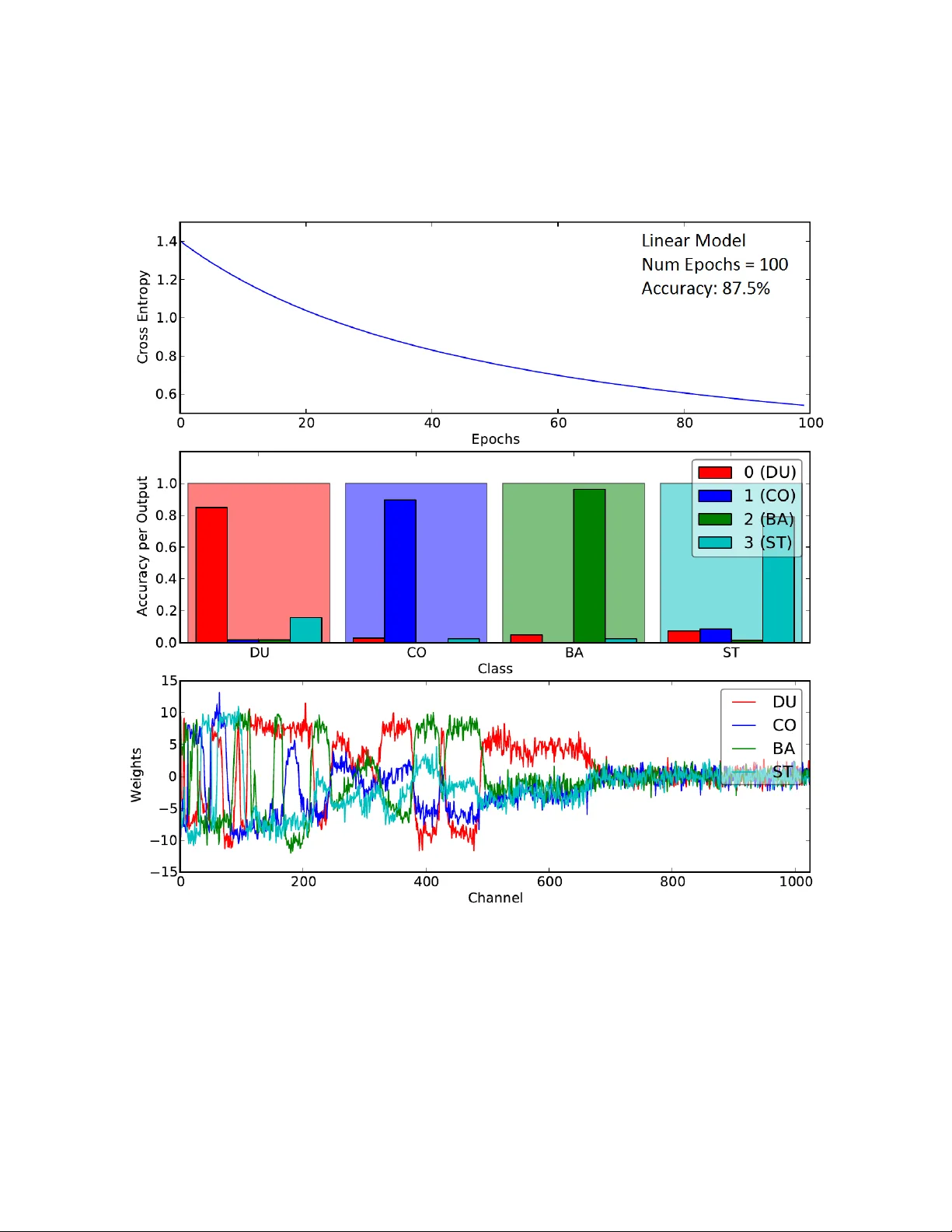
Threat determination for radiation detection from the Remote Sensing Lab oratory William P . F ord a , Emma Hague a , T om McCullough a , Eric Mo ore a , and Johanna T urk a a Remote Sensing Lab oratory , 1783 Arnold Av e., Join t Base Andrews 20762, US ABSTRA CT The abilit y to searc h for radiation sources is of in terest to the Homeland Securit y communit y . The hop e is to find an y radiation sources which may p ose a reasonable chance for harm in a terrorist act. The b est chance of success for searc h op erations generally comes with fielding as many detection systems as p ossible. In doing this, the hop ed for encoun ter with the threat source will inevitably be buried in an even larger n umber of encoun ters with non-threatening radiation sources commonly used for many medical and industrial use. The problem then b ecomes effectively filtering the non-threatening sources, and presenting the human-in-the-loop with a mo dest list of potential threats. Our approach is to field a collection of detection systems whic h utilize soft-sensing algorithms for the purp ose of discriminating p oten tial threat and non-threat ob jec ts, based on a v ariet y of mac hine learning techniques. Keyw ords: machine learning, sp ectra, spectrum, gamma, ray , neural netw ork 1. INTRODUCTION Radiological w eap ons pose a serious concern. In order to mitigate this concern Prev entativ e Radiological Nuclear Detection (PRND) is p erformed b efore and during ma jor public even ts. The traditional method of p erforming PRND consists of deploying p ersonnel equipp ed with radiological detectors around the even t. This approac h is limited by the amount of p ersonel a v ailable, their exp ertise in using the detectors, and interpreting the data. F alse alarms are common, as confuser sources e.g. medical isotop es and industrial gauges, are numerous. In addition the radiological background v aries significantly based on immediate surroundings further complicating threat determination. In order to deal with false alarms, spectroscopists are utilized to review data and determine whether an anomaly is a threat. Therefore PRND is fundamen tally limited b y the n umber of trained personnel, b oth in fielding detectors, and in interpreting the results. Our approac h is to employ a v ast net work of static sensors, monitored by neural netw orks allowing a single sp ectroscopist to monitor orders of magnitude more sensors than is traditionally possible. With suc h a net w ork augmen ting classical PRND, w e can hav e an increased confidence in detecting threats. This pap er discusses our implementation of machine learning techniques for isotop e iden tification of gamma ra y sp ectra. 2. FRAMEWORK F or this w ork we employ ed tw o simple net works depicted in Fig. 1 . The single la yer net work (left in Fig. 1 ) can b e expressed as ˆ y = ( W · x + b ) , (1) where x is the input v ector, W is a matrix of the weigh ts, b are the bias’, and ˆ y is a softmax normalized output v ector representing the v arious classes. F or this w ork the input vector is a gamma spectrum of 1024 c hannels (or rebinned to 256), and the elements of the output v ector are the isotop es we are considering. The slightly more complex netw ork shown on the right in Fig. 1 can likewise be expressed as ˆ y = W 2 · y 1 + b 2 , (2) y 1 = tanh ( W 1 · x + b 1 ) , (3) F urther author information: E-mail: fordwp@nv.doe.gov, T elephone: 1 (301) 817-3358 where the tanh function implies element wise op eration. The netw orks were implemented and trained using T ensorflo w. 1 The cost function was c hosen to b e cross en tropy . T raining w as p erformed using AdamOptimizer. F or this work we generate data from mo deled, or simulated, and measured sp ectra. The first source is sim ulated sp ectra using GADRAS. 2 , 3 Gadras provides deterministic gamma and neutron transport, and has a v ariet y of detectors characterized. F or the purp oses of this work we fo cus on 2” x 4” x 16” so dium io dide (NaI) detectors. This was chosen to be consisten t with our detector that we used for our data collects. The spectra are initially produce d at 24 hour long dwells, and then are P oisson sampled to appropriate dw ell times, typically 1 second sp ectra again corresp onding to the sampling frequency of our detectors. The second source of data are measured sp ectra, which we p erformed in controlled collects at our lab. The data w ere collected using a 2” x 4” x 16” so dium iodide (NaI) detector. Both collected and simulated sources are at a v ariet y of distances and shielding configurations in order to ensure that the mac hines trained are robust against these v ariations. These v ariations are presented in T able 1 . W e show an example of a long dwell sp ectrum and a 1 second sp ectrum that we t ypically train our machines to identify in Fig. 2 T able 1. V ariations of sources, distances, and shieldings for data. Isotop es Distances (m) Shiedings Sim ulated Cesium, Cobalt, Barium, Selenium, Iridium 10,11,12,...,20 Bare, Concrete, Steel, Depleted Uranium Measured Cesium, Cobalt, Barium 0-10 Bare, Steel 3. RESUL TS In Fig. 3 results are sho wn for training to simulated data and testing against a Poisson sampled ensemble. W e exp erimen ted with training to b oth the time asymptotic sp ectra as well as a subset of the ensemble. Preliminary results suggest that it is actually b etter to train to a subset of the ensemble, ho wev er, further studies are needed. The results shown are from training to time asymptotic sp ectra. The top figures represent the cost function, Cross Entrop y , after training to ten ep ochs (left) vs. training to 100 ep ochs (right). Also shown is the ov erall accuracy with regards to the testing data. the middle plots represent the accuracy p er output, i.e. ho w often the mac hine classifies the appropriate isotop e. The bottom plots are of the weigh ts, each row of the weigh t matrix is a different colored line on the plot. These results illustrate con vergence of the training. Notice in the plots on the left the muc h low er accuracy , b oth ov erall and p er output. Particularly in teresting are the plots of the w eights. As the training conv erges one starts to see sp ectral features apparen t in the weigh ts. Note also that at higher energies (Channels > 600) there are no features as these sp ectra ha ve no counts that high and only noise is reflected in the weigh ts. Besides just trying to classify according to isotop e w e also w anted to test whether we could iden tify what t yp e of shieding a source was b ehind. While this has no direct application it sheds light onto the robustness of the mac hines. W e to ok the same training set, and trained to identify shielding; these results are shown in Fig. 4 . Note the while some of the features extracted are similar many others are significan tly different. In particular the double humps b et w een Channels 500-600 are in teresting as they corresp ond to depleted uranium, and one can see a strong correlation and anti-correlation in the weigh ts. Next we turn our attention to testing our machine against real data. F or this w e utilize the single la yer net work trained to time asymptotic simulated data, and tested againts data collects taken at our lab. The testing data are 1 second sp ectra as sho wn in Fig. 2 . The results are surprisingly go od considering that this mac hine w as not trained to data ha ving an y bac kground radiation. The results are shown in Fig. 5 Eac h of the abov e results were also implemen ted with the hidden lay er net work with similar results. While w e t ypically had slightly b etter accuracy the small improv ement did not seem to justify the more complicated arc hitecture for these examples. A t ypical confuser when p erforming PRND are industrial gauges. T o determine the feasablit y of a machine iden tify suc h a gauge we defined a surragate industrial gauge as Cesium shielded by steel, and allow ed all other sources and configurations to b e confusers, including Cesium in the other shielding and distance configurations. W e then train the machin e to iden tify Cesium Steel (Industrial Gauge) or Not Cesium Steel (an ything else!). The results of this are shown in Fig. 6 . Here we sho w the results of b oth the simple linear mo del and the hidden la yer net work. In particular we note that while we hav e go od conv ergence of the linear mo del it almost completely fails to identify the gauge, i.e. the accuracy for that output is less than 20%. The hidden la yer netw ork on the other hand is almost completely accurate correctly identifying the gauge. This suggests that there are certain sp ectral id problems that demand deep learning or at least the nonlinearit y that is in the hidden la yer netw ork. 4. SUMMAR Y AND OUTLOOK W e ha ve implemented tw o different machine learning models, a simple linear mo del and a hidden lay er neural net work. These machines w ere trained with simulated spectra and were tested against a Poisson sampled ensem ble and measured data. An imp ortan t result is that one can train to simulated data and obtain a mac hine that p erforms well against measured data. W e hav e iden tified that for man y cases a simple linear machine may suffice, but there are cases where non-linear machines v astly outp erform the linear mo del. F uture work includes expanding b oth our sim ulated and mo deled datasets, and with more complex data we exp ect to need more complex architectures. A CKNOWLEDGMENTS This manuscript has b een authored by Mission Supp ort and T echnical Services, LLC, under Contract No. DE- NA0003624 with the U.S. Departmen t of Energy , National Nuclear Securit y Administration, Office of Defense Nuclear Nonproliferation Researc h and Developmen t. The United States Gov ernment retains and the publisher, b y accepting the article for publication, ac knowledges that the United States Gov ernment retains a non-exclusiv e, paid-up, irrevocable, worldwide license to publish or repro duce the published form of this man uscript, or allow others to do so, for United States Gov ernmen t purp oses. The U.S. Departmen t of Energy will provide pub- lic access to these results of federally sp onsored research in accordance with the DOE Public Access Plan ( h ttp://energy .go v/downloads/doe-public-access-plan ). The views expressed in the article do not necessarily represen t the views of the U.S. Department of Energy or the United States Gov ernment. DOE/NV/03624–0088 The authors w ould like to thank Sarah Bender, Andre Butler, Emily Jac kson, Lance Mclean, Jessica McNutt, Scott Such yta, and Julia Y ou for their help with this pro ject. REFERENCES [1 ] Abadi, M., Agarw al, A., Barham, P ., Brevdo, E., Chen, Z., Citro, C., Corrado, G. S., Da vis, A., Dean, J., Devin, M., Ghemaw at, S., Go odfellow, I., Harp, A., Irving, G., Isard, M., Jia, Y., Jozefowicz, R., Kaiser, L., Kudlur, M., Leven b erg, J., Man ´ e, D., Monga, R., Mo ore, S., Murray , D., Olah, C., Sch uster, M., Shlens, J., Steiner, B., Sutsk ever, I., T alwar, K., T uc ker, P ., V anhouck e, V., V asudev an, V., Vi ´ egas, F., Viny als, O., W arden, P ., W atten b erg, M., Wick e, M., Y u, Y., and Zheng, X., “T ensorFlow: Large-scale machine learning on heterogeneous systems,” (2015). Softw are a v ailable from tensorflo w.org. [2 ] Horne, S. M., Thoreson, G. G., Theisen, L. A., Mitc hell, D. J., Harding, L., and Amai, W. A., “Gadras-drf 18.5 user’s manual.,” [3 ] Mattingly , J. and Mitchell, D. J., “A framew ork for the solution of in verse radiation transp ort problems,” IEEE T r ansactions on Nucle ar Scienc e 57 , 3734–3743 (Dec 2010). Figure 1. Representations of the netw ork architectures emplo yed. The net work on the left represen ts a linear mo del and the netw ork on the righ t is a single hidden lay er neural netw ork (NN). The activ ation function on the NN hidden lay er w as tanh . The num b er of weigh ts and neurons depicted are representativ e, not literal, and were v aried throughout the study . Figure 2. Examples of a Cobalt Gamma-ray sp ectra taken with a 2” x 4” x 16” NaI detector. The one on the left is a long dw ell of ab out 3 hours. The spectrum on the right is a 1 second sp ectrum, which is a standard sampling frequency , and what we train the machines to identify in this work. Figure 3. Conv ergence example for training to the simple linear mo del. The graphs from top to b ottom corresp ond to the cost function, cross en tropy , then we show the accuracy for each class, and the bottom graph shows the v alues of the w eights. The plots on the left are after training to ten epo chs while the graphs on the right corresp ond to 100 epo c hs. Note the appearance of sp ectral features in the weigh ts in the right after the training has conv erged. Figure 4. Results of a single lay er mac hine trained to identify shielding t yp e regardless of what source is b ehind it. Plots from top to b ottom corresp ond to the cost function, accuracy p er output, and v alues for the w eight matrix. These results illustrate robustness of the iden tifying machine. Figure 5. Results of training to simulated data and testing against measured data. Figure 6. Results sho wing surragate industrial gauge classifier. Plots are the same as in Fig. 3 . Note the failure of the linear mo del to correctly identify the gauge (accuracy p er output < 20%) while the hidden lay er determines it with almost 100% accuracy .
Original Paper
Loading high-quality paper...
Comments & Academic Discussion
Loading comments...
Leave a Comment