Inverse Halftoning Through Structure-Aware Deep Convolutional Neural Networks
The primary issue in inverse halftoning is removing noisy dots on flat areas and restoring image structures (e.g., lines, patterns) on textured areas. Hence, a new structure-aware deep convolutional neural network that incorporates two subnetworks is…
Authors: Chang-Hwan Son
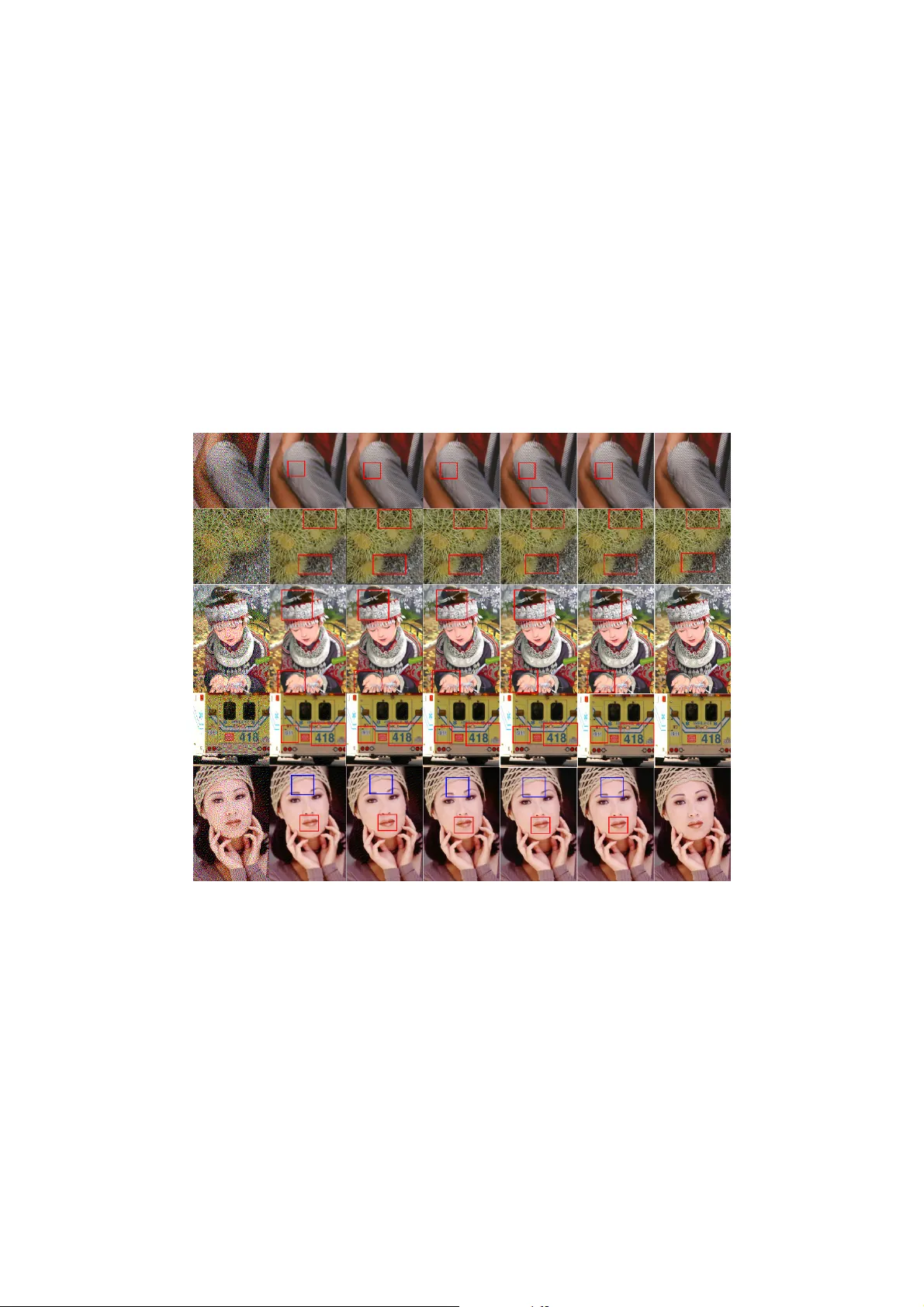
Inverse Halftoning Through Structure-Aware Deep Convolutional Neural Networks Chang-Hwan Son [0000-0001-7077-3074] Kunsan National University, South Korea cson@kunsan.ac.kr Abstract. The prim ary issue in inverse halfton i ng is removing noisy dots on flat areas and restoring image structures (e.g., lines , patterns) on textured areas. Hence, a new structure-aware de ep convol utional neural network that incorpo- rates two subnetworks is proposed in th is paper. One subnetwork is for image structure prediction while the other is for con tinuous-tone image reconstruction. First, to predict image structures , patc h p airs comprising continuous-tone p atches and the corresponding halftoned patches ge nerated through digital halfton ing are trained. Subsequently, gradient patches are generated by convolv ing gradient fil- ters with the continuous-tone patches. The subnetwork for the image structure prediction is trained using the mini-batch gr adient descent algorithm given the halftoned patches and gradient patches, which are fed in to the input and loss lay- ers of the subnetwork, respectively. Next , the predicted map inclu ding the image structures is stacked on the top of th e input halftoned image th rough a fusion layer and fed into the image reconstructi on subnetwork such that the entire n et- work is trained a daptively to the im age structures. The experi mental results con- firm that the proposed structure-aware network can remove noisy dot-patterns well on flat are as and restor e details clear ly on textured areas. Fu rthermore, it is demonstrated that the proposed method su rpasses the conventional state-of-the- art methods based on the deep convolutiona l neural network , U-Net, and locally learned dictionaries. Keywords: Inverse Halftoning, Dictionary Lear ning, Deep Convolutional Neu- ral Network, U-Net, Image Filtering. 1 Introduction Digital halfto ning is a proces s of generatin g a halftone im age with hom ogenously distributed black a nd white dots from a cont in uous-tone image with discrete gray levels (e.g., 255 gray level s) [1]. It has been use d primaril y in bilevel out put devices such as printers and copiers to render an im age on a paper. In laser printers, black and white dots are used t o control a la ser beam to form a latent im age on a photoco nductor dr um, and determines whether toner particles will touch the surface of the drum. Similarly, in inkjet printers, a halftoned image d etermines the spatial positio n of the ink that drops on a pape r. Digi tal halft oning is used in othe r appl ications, for exam ple, anim ated GIF 2 generation from videos [2], rem oval of c ontour arti facts in dis plays [3], vi deo pro- cessing in electro nic papers [4], and dat a hidin g [5]. The t ypically used digita l half- toning are di thering, e rror dif fusion, and di rect bina ry search [6] . Inverse halft oning is t he revers e of digita l halftoni ng; in ot her words , a continu ous- tone image with 255 gray levels or more is reconstructed from its halftoned version [7]. Inverse halftoning is required in several practical applications: bilevel data compression [8], waterm arking [9] , digita l reconstruct ion of col or com ics [10], and high dynam ic range imaging [1 1]. Digita l halftoni ng is a many -to-one m apping; henc e, inverse half- toning is an ill-posed problem with many possible solu tions. Many approach es have been introduce d over the last several deca des based on look-up ta bles [12], a daptive low-pass filtering [13], maximum-a-posterior estimation [14], local polynomial ap- proxim ation and i ntersection of confide nce interval s (LPA-ICI) [15], a nd deconvol u- tion [16]. Recently, machine-l earning approa ches have been actively studie d based on dictionary learning [1 7-19] a nd neural net works [ 20]. In p articular, deep convol utional neural network s (DCNNs) [21 -24], which is a variant of neural networks, have demon- strated powerf ul perform ance for im age restoration, seg mentation, a nd classificatio n problem s. Hence, the DCNN can be used dir ectly for invers e halftoning. 1.1 Primary Problem for Inverse Halftoning Through di gital halft oning, which inclu des binary quantizat ion, image st ructures such as lines and regular patterns are lo st inevitably on textured areas, whereas noisy dots are de nsely or sp arsely generat ed on fl at areas. Particularly, white dots that are distributed spa rsely on da rk areas, an d black dot s on brig ht areas resem ble impul se-like noises. Therefore , the critical i ssue in inverse halft oning is rem oving noisy dots on flat areas and resto ring image st ructures p recisely from quantiz ed binary data. Even though the DCNN is used for inverse halftoning, many problems are still un resolved. More specifically, the DCNN can automatically le arn a large number of m odel paramete rs hierarchically from t he given t raining patc hes. This implies that low-level features can be reused to represent high-level features through a layer-by-layer feature transfor- mation; t hus, the nonlinear m apping relationshi p between halftoned patches a nd con- tinuous-tone patches can be pre dicted more accurately. The application of the DC NN to inverse halfton ing can result in improvements in detail representation and dot elimi- nation. Howev er, further im provement s are possible. 1.2 Proposed App roach For image restoration [22], the layers typically us ed are the convolution layers with filters and the rectified linea r unit (ReLU) layers, which are arrang ed in a sequence to build the architecture of the DCNN. The last layer is the lo ss layer that minimizes the mean square erro r (MSE) bet ween the predi c ted continuou s-tone patches and the orig- inal continuous-tone p atches. Given the tr aining data that comprise continuou s-tone patches and halft oned patches, the m ini-batch stoc hastic gradient desce nt algorit hm in [25] is used to update the filters iteratively to finally complete the nonlinear transfor- mation from the input layer to the last loss layer. 3 From the pers pective of re gression a nalysis, t his training a pproach i s simil ar to global regression, in whic h the param eters of a hypot hesis functi on is learne d without pa rti- tioning the training data into subsets. Meanwh ile, local regression partitions training data into subsets with similar attributes, an d subseque ntly learns the parameters of t he hypothesis fun ctions to be fit ted into each s ubset. If this t ype of local re gression ap- proach is use d for inverse hal ftoning [1 8,19], the deta il represent ation can be improved . Inspired by the me thod used in [18] that pa rt itions training data into subsets, a new image structure map predictor (ISMP), which is the subnetwork to predict image struc- tures, is introduced in this study. In add ition, the method to comb ine the ISMP with the reconstructio n subnetwo rk (RS) to recover c ontinuous-t one im ages from the in put half- toned images is prese nted. The primary id ea is to pre dict the image structure m ap through the ISMP and connect the pred icted map to the RS such that the en tire network is trained in an en d-to-end manner. Thi s training strategy can provide useful infor - mation rega rding whic h areas are sm ooth or te xtured. He nce, the entire net work can be trained adaptively to local im age structures. The predicted image structure map serves as a guide for a m ore accurate image reconstruction. 1.3 Contributions In this study, a new structu re-aware DCNN is proposed for inverse halftoning. Spe- cifically, the method to design three subnetwo rks and subsequen tly combining them to be trained in an end-to-end manner is describ ed. The first subnetwork is the initial reconstruction subnetwork (IRS), which aims to generate initial continuou s-tone im- age from an input halftoned i mage. The second sub network is the ISM P by which the initial continuo us-tone image is transformed in to an image structure map. The third subnetwor k is the RS to reconstruct the final con tinuous-tone image from thre e types of images: halftoned image, image structure map, an d initial continuou s-tone image. The proposed a rchitecture requires three types of images for continuous-tone image reconstruction, wherea s the typica lly used DCNN architecture requires only one image (i.e. , halftoned im age). The th re e subnetworks are com bined through a fusion layer t o create the entir e network and trained in an e nd-to-end m anner. In the entire network, the image structure map output by the ISMP is fed into the RS to provide useful inf ormation about whi ch areas are flat or text ured. Hence, the enti re network can be trained a daptively t o image st ructures. Briefly, this study presen ts a method of predicting an image structur e map from input halftoned images and demonstrates t he method t o train t he entire network adaptiv ely to local im age struc- tures. This is the primary contribution of this paper. If the ISMP is excluded, th e proposed architectur e become s iden tical to the conven- tional DCNN. Through this study, it is verified whether the ISMP can increase the restoration quality through the performance comparison b etween the proposed stru c- ture-aware DC NN and the conve ntional DCNN . Furthermore, it is confirmed that the proposed method surpa sses the co nventional state-of-the-art m ethods: DCNN [22], U-Net [ 24], and LL D [18]. 4 Fig. 1. Architecture of the deep convolutional n eural network for inverse halftonin g. 2 Conventional Approach based on DCNN The typically used DCNN architecture for i m age restoration [22] can be applied to inverse halfto ning, as sh own in Fi g. 1. The DCNN archit ecture consist s of two ty pes of layers: the convolution layers and ReLU la yers, which are arranged in a sequence. The convolution layer conv olves filters with input feature maps to extract local features, and the ReLU layer forces negative input values to b e zero to consider the non linearity. The last layer is the loss layer to minimize the MSE between the predicted and original data. To train the DCNN in a supervise d manne r, halftone d patches a nd co ntinuous-ton e patches are requi red, and are fed into the in put layer and loss layer, respectively, as shown in Fig. 1. The filters are initialized ran domly, and subsequently updated itera- tively using the mini-b atch stochastic gradient d escent algorithm to minimize loss. If a stop criterion is satisfied, the nonlinear tran sformation from the input layer to the last loss layer is completed. To test the DCNN, the last loss layer is removed and the half- toned image fed into th e input layer is passed throu gh the trained nonlinear tran sfor- mation, t hus finall y producing a continuo us-tone im age. This DCNN-base d approach has contributed significantly to th e restoration quality. Nevertheless, further improve- ments are possible. In Fig. 1, the layer-b y-layer nonlinear transformation can be regarded as a black box that transform s the halft oned patches into cont inuous-tone patches. F rom the pers pec- tive of regression analysis, this training ap proach corresponds to global regr ession that learns the parameters of a hypothesis functi on with out partitioning train ing data into subsets. It was reported in [18] that the local regr ession approach ef fectively impro ves the detail representation by fitting the hypothesis fun ctions into subsets with similar image structures. In Fig. 1, the DCNN is trai ned without dividing the training data into subsets. Hence, the DCNN can lack de tail representation and dot elimination. 3 Proposed Structure-Aware DCNN for Inverse Halftoning Inspired by th e method in [1 8], a new stru cture-aware D CNN architecture i s pro- posed. The key idea is to provide the DCNN with useful information about lo cal image structures. Fig. 2 shows the proposed stru cture-aware DCNN arc hitecture for inverse halftoning. Three subnetworks ex ist in the proposed architectu re. The first one is the 5 IRS that aims to generate the initial co ntinuous-tone image from an input h alftoned image. The IRS comprises two types of layers: convolution and ReLU layers. It is note- worthy that no loss layer exists in the IRS. This implies that the IRS is pretrained. After training the IRS with the loss layer to minimi ze the MSE, the last loss layer is rem oved. The second subnetwork is the ISMP that is co nnected to th e back of the IRS to predict the image structure map. Digital halftoning includes binary quan tization, and thus in- formation loss inevitably occurs. Because ha lftone d images contain much less infor- mation than co ntinuous-tone images, it is pr eferable to predict the image structures from the initially reconstructed continuous-tone image than from the halfto ned image. Hence, the feature map at the last layer of the IRS is fed into the input layer of the ISMP. The loss layer of the ISMP require s two inputs. One is the predicted gradient patch that corr esponds to t he feature m ap at the laye r before the l oss layer. T he other is the original grad ient patch. In this study, the Sobel gradien t operator is applied to the original c ontinuous -tone patc h to gene rate the gra dient pat ch. A fe w exam ples of gra- dient patches and th e corresponding con tinuous-tone patches are provid ed at the right side of Fig. 2. It is confirmed t hat the gradient patches contain l ocal image structu res such as lines, curves, or te xtures. The third subnetwork is the RS. In Fig. 2, the f eature map at the layer before the lo ss layer of the ISMP is the predicted i mage st ructure map. The concatenation layer stacks three types of images to form a three-dimensional tensor that is fed into the input layer of the RS. The three types of inpu ts are the halftoned image, initial co ntinuous-tone image, and image structure map. However, the proposed entire network in Fig. 2 is trained in an end-to-end manner, and thu s the initial continuous-ton e image cannot be preserved. In other word s, even though th e pretrained IRS starts by generating the initial continuous-tone image at the last layer, it adju sts the initial continuous-tone image through backpropagation such that the ISMP is more accurate. Therefore, the key idea of the proposed architecture is that the pr edicted image structure m ap is connected to the input layer of the RS. The inform ation about the im age structure map can teach the RS regarding which areas are flat, lined , or textured. This enab les the entire network to be trained by adapting to l ocal image struct ures. If the IRS a nd ISMP are e xcluded f rom Fig. 2, the prop osed architect ure become s identical to t he conventional DCNN in Fi g. 1. The refore, the extent of rest oration qual - ity im provement with the ISMP can be veri fied by com paring the pro posed struct ure- aware D CNN and th e conventio nal D CNN. Even th ough seve ral wa ys exist for co m- bining the IRS and ISMP wit h the RS in Fig. 2, t he prim ary focus herein is to demon- strate the effectiveness of the ISMP in improving the restoration quality. Hence, the ISMP is connected to the RS. In this stud y, the predicted image structure map is stacked on the top of the input halftoned image th rough the concatenation layer, an d subse- quently fed into the input layer of the RS . This architecture can clarify the prim ary difference between the propose d structur e- aware DCNN and the conventional DCNN in Fig. 1. 6 Fig. 2. Proposed structure-aware DCNN for inverse halftonin g. 4 Experiments The propose d structu re-aware DC NN for i nverse hal ftoning is im plemente d using MatConvNet [26] and trained with two 1080Ti G PUs on a Windows operatin g system. To compare th e proposed m ethod, state-of -the-art m ethods base d on the LLD [18], DCNN [22], U -Net [24], an d LPA-ICI [15] were tested. For performa nce evaluation, the peak signal-to-noise ratio (PSNR) and stru cture similarity (SSIM) [27] are used to measure the inve rse of the MSE in a log spa ce and the structure similarity between t wo images, respectively. In both of the PSNR and SSIM, a higher value indicates a higher quality. The training and testing c odes of the propose d structure-awa re DCNN me thod can be downloaded at https://sites.google.com/view/ch son/home. 4.1 Training Data Collection For training, p ublic datasets [28] includi ng General 100, Urban 100 , BSDS100, an d BSDS200 are used to prepare continuo us-tone color images. The to tal number of con- tinuous-tone color images is 500. Fo r digital halftoning, the con tinuous-tone color im- ages are converted i nto grayscale images, a nd s ubsequentl y error di ffusion [ 29] is use d to transform the grayscale images in to ha lftoned images. The Floyd–Steinburg filter [1] is used for error diff usion. Th e Sobel gradie nt operator is applied to the grayscale im- ages to obtain gradient images contain ing gradient magnitudes. To obtain the training patches, three types of patches are extract ed randomly from the grayscale i mages, gra- dient images, and halftone d images. T he patc h size extracted is 32×32. In this st udy, grayscale patches are used for training beca us e error diffusion can be easily applied to them. 7 Table 1. Number of filters and channels used in the convolutional layers. Layers Subnetworks Input layer Last convolutional layer Other layers IRS c =1, m =64 c =64, m =1 c =64, m =64 ISMP c =1, m =64 c =64, m =1 c =64, m =64 RS c =3, m =64 c =64, m =1 c =64, m =64 4.2 Network Training In the subnetworks, m filters of size 5×5× c are used in the convolu tion layers. Here, c represents the number of input ch annels . Tab le 1 shows the n umber of filters and channels used in the convolution layers. In the input layer of the RS, c is set to 3 because three input channe ls are fed into the input layer. The filters are initialized u sing a ran- dom num ber generat or. The p , q , and r numbers i n Fig. 2 a re set to 16, 6, a nd 16, re- spectively. To update the filters, the mini-bat ch gradient de scent algorithm is used. The epoch number is 200 and the batch size is 64. Each epoch involv es 1,000 iterations of backpropagatio n. The learning rate is 10 -5 . All the loss functions are modeled by the l - 2 norm. Fig. 3. Test images. 4.3 Performance Comparison Fig. 3 shows the 10 test images for visual qu ality evaluation that are numbered ac- cordingly. T he test im ages contain various t ypes of im age structures i ncluding l ines, curves, and reg ular patterns to verify whet her the proposed struct ure-aware DCNN can improve detail representation and do t elimination. Fig. 4 shows the experimental re - sults. As shown in the red boxes, the prop osed method describes th e image structures more accurately. In a ddition, the overall sha r pness is better. Particularly, on the first row, more lines are restored with the proposed method. On the second row, the outlines 8 of the grains of sand are restored m ore clear ly and the textures on t he palm and t he hair accessory are described in more detail on the th ird row. On the fourth and l ast rows, the texts and the outline of the rip are more clearly restored, respectively. Moreover, the proposed m ethod rem oves noisy dots on the flat areas com pletely , as shown in t he blue box of the last row, which is not the case with the conventional DCNN [22] and U-Net [24] me thods. By comparing the propose d me thod and th e DCNN-base d method [22], it is verified that the additional us e of th e ISMP can increase the performance for detail representation and dot elimination . From these results, it is concluded that the ISMP subnetwork enables the entire network to be trained adaptively to local image struc- tures. Fig. 4. Experimental results: halftoned im ages (first colum n), reconstructed im ages with LPA- ICI [15] (second column), recons truct ed images with LLD [18] (third column), reconstructed images with DCNN [22] (fourth column), r econstr ucted images w ith U-Net [24] (f ifth column), reconstructed images with propos ed method (sixth column), and original imag es (last column). Table 2 shows the result s of the P SNR a nd SSIM e valuations. As expected, the pro- posed me thod demonst rates the best per formance am ong all the m ethods and particu- larly surpasses the conventi onal DC NN and U- Net methods . This im plies that the ISMP provides the R S with info rmation regardin g the areas that a re smooth or textu red, thus enabling the entire net work to be trai ned adap tively to local image structures. In ot her 9 words, the ISM P serves as a guide f or a more accurate image r econst ruction. The per- formance of the LLD m ethod does not s urpass that of the DCNN-based method. Before the emergence of the DCNN, the LLD method dem onstrat ed one of the best perf or- mances. Howe ver, this m ethod repre sents input patches using t he linear co mbination of signal-atom s and sparse coef ficients. Hence , modeli ng the nonlinea rity is restrict ed, i.e., binary quantization occu rs inevitably during digital halftoning. Mean while, the DCNN learns a la rge number of parameters hi erarchically. Lo w-level features ca n be reused to repre sent high-le vel features through a layer-b y-l ayer feature transform ation. Even a nonlinear system can be modeled m ore accurately. The L PA-ICI belongs to nonlinear filtering, which fuses directional es timates. However, the model capacity is insufficient to preserve the overall sharpness. As shown in Table 2, the averaged PSNR value of the LPA- ICI metho d is the lowest am ong all the methods. In Table 2, it is shown that t he perform ance of t he U-Net-b ased method [24] is better th an that of t he DCNN-based m ethod [22] . The U-Net downsam ples the input i mage thro ugh the en- coder and t hen upsam ples the feature maps w ith skip co nnections t hrough the decoder, which means that this network includes th e multiscale fusion like as wavelets, which can lead to more improvement in the restoration quality. Table 2. Performance evaluation. Methods Proposed Method U-Net [24] DCNN [22] LLD [18] LPA-ICI [15] Test Images PSNR SSIM PSNR SSIM PSNR SSIM PSNR SSIM PSNR SSIM 1 25.659 0.824 25.563 0.815 25.181 0.808 25.016 0.799 23.975 0.749 2 25.633 0.907 25.590 0.904 25.395 0.900 25.541 0.818 24.031 0.857 3 25.473 0.866 25.247 0.857 24.81 0.846 24.654 0.798 23.485 0.794 4 29.410 0.882 29.262 0.873 28.608 0.854 28.500 0.846 27.034 0.795 5 32.291 0.982 31.901 0.979 31.818 0.979 31.023 0.87 31.163 0.979 6 25.916 0.905 25.820 0.899 25.370 0.890 25.15 0.869 24.233 0.858 7 31.578 0.981 31.248 0.979 31.084 0.979 30.514 0.844 30.457 0.976 8 28.273 0.968 27.992 0.966 27.275 0.959 27.563 0.919 25.889 0.950 9 30.886 0.962 30.539 0.948 30.237 0.949 30.013 0.874 28.924 0.920 10 29.901 0.937 29.601 0.930 29.214 0.928 28.645 0.865 27.615 0.900 AVG. 28.502 0.921 28.276 0.915 27.899 0.909 27. 662 0.850 26.681 0.878 10 5 Conclusion A new structure-aware DCNN for inve rse ha l ftoning wa s propose d. The central i dea was to build the subnetwork for image structure prediction and combine it with another subnetwork t o be trained in a n end-to-en d manner fo r continuous-t one image recon- struction. The experim ental results confi r med that the propos ed architecture ena bled the entire network to b e trained adaptively to local image structures , and thus noisy dot- patterns on the flat areas were rem oved com pletely and local image structures such as lines and patterns were desc ribed precisely. I t was also demonst rated that the proposed method yiel ded a bette r perform ance than the stat e-of-the a rt methods: DCNN, U-Net , and LLD. Acknowledgment This work was su pported by the Nation al Research Foundation of Korea (2017 R1D1A3B0303 0853). References 1. Kang, Henry: Digital color halftoning. SPIE Press (1999). 2. Wang, Y., Huang, H., Wa ng, C., He, T., Wang , J. , and Nguy en, M. H.: GIF2Video: Color dequantization and temporal interpolation of (2019). 3. Do, H. C., Cho, B. G., Chien, S . I., and Ta e, H. S.: Improvement of low gray-level linearity using perceived luminance of hu man visual s ystem in PDP-TV . IEEE Transactions on Con- sumer Electronics, 51(1), pp. 204–209 (2005). 4. Kao, W.-C., Liu , C.-H., Liou, S .-C., Tsai, J .-C ., and Hou, G.-H.: Towards video display on electronic papers. Journal of Display Technolog y, 12(2) (2016). 5. Son C.-H., and Choo, H.: Wate rmark detection of clustered halftoned images vi a learned dictionary. Signal Processing, 102, pp. 77-84 (2014). 6. Lieberman, D. J. and Al lebach, J. P.: A dua l in terpretation for dir ect binary search and its implications for tone reproduction and textur e qu ality. IEEE Tran sactions on Image Pro- cessing, 9(11), pp. 1950-1963 (2 000). 7. Son, C. H.: Inverse halftoning based on spar se representation. Optics Letters, 37(12), pp. 2352-2354 (2012). 8. Liu, Y.-F., Guo, J.-M., and Le e, J.-D.: Inverse halftoning based on the ba yesian theorem. IEEE Transactions on Image Pro cessing, 20(4), pp. 1077-1084 (2 011). 9. Guo, J.-M.: Watermarking in dithered halft one images with embeddabl e cells se lection and inverse halftoning. Signal Processing, 88(6), pp . 1496-1510 (2008). 10. Kopf, J. and Lischinski, D.: Digital reconstr uction of halfton ed color comics. ACM Trans- actions on Graphics, 31(6), article no . 140 (2012). 11. Remez, T., Lit any, O., and Bronstein, A.: A picture is worth a b illion bits: real-t ime image reconstruction from dense binary threshold pi xels. In IEEE International Conference on Computational Photography, Evan ston, U.S.A., pp. 1-9 (2016). 11 12. Mese, M. and Vaidyanathan, P . P.: Look-up table (LUT) method for inv erse halftoning. IEEE Transactions on Image Pro cessing, 10(10), pp. 1566-1578 ( 2001). 13. Kite, T. D., Damera-Venkata, N., Evans, B. L., and Bovik, A. C.: A fast, high-quality inverse halftoning algorithm for error dif fused halft ones. IEEE Transactions on Image Pro cessing, 9(9), pp. 1583-1592 (2000). 14. Stevenson, R.: Inverse halftoning via MAP estimation. I EEE Transactions on I mage Pro- cessing, 6(4), pp. 574–583 (1997 ). 15. Foi, A., Katkovnik, V., Egiazaria n, K., and Astol a, J.: Inverse halftoning b ased on the ani- sotropic LPA-ICI deconvolution. In Proc. In t. TICSP Workshop Spectral M eth. Multirate Signal Processing, Vienna, Austria, pp. 49-56 (2004). 16. Son C.-H., and Choo, H.: Iterative inverse halftoning based on texture-enh ancing deconvo- lution and error-compensating feedback. Si gnal P rocessing, 93(5), pp. 1126-1140 (2013). 17. Freitasa, P. G., Fariasb, Mylè ne C. Q., and Araújo, Aletéia P. F.: Enhancing inverse half- toning via coupled dictionary training. Signal Processing: Image Communication, 49, pp. 1- 8, (2016). 18. Son, C.-H. and Choo, H.: Local le arned d ictionaries optimized to ed ge orientation for inverse halftoning. IEEE Transactions on Image Processing, 23(6), pp. 2542-2556 (2014). 19. Zhang, Y., Zhang, E., Chen , W., Chen, Y. , and Duan, J .: Sparsity-based inverse halftoning via semi-coupled multi-dict ionary learning and structural clustering. Engineering Applica- tions of Artificial Intelligence, 72, pp. 43-53 (2018). 20. Jimenez, F. P., Miyatake, M. N ., Medina, K. T. , Perez, G. S ., and Meana, H. P.: An inverse halftoning algorithms based on neural networ ks and atomic functions . IEEE Latin America Transactions, 15(3), pp. 488-495 (2017). 21. Simonyan, K. and Z isserman, A.: Ver y deep c onvolutional networks for large-scale image recognition. arXiv: 1409.1556 [cs. CV] (2014). 22. Zhang, K., Zuo, W., Chen, Y ., Meng, D., and Zhang, L.: Beyond a gaussian denois er: resid- ual learning of deep CNN for image deno isi ng. IEEE Transactions on Image Processing, 26(7), pp. 3142-3155 (2017). 23. Hou, X. and Qiu, G.: Image companding and inverse halftoning using deep convolutional 24. Ronneberger, O., Fischer, P., and Brox, T.: U- Net: Convolutional networks for biom edical image segmentation. arXi v:1505.04597 [cs.CV] (2015). 25. Ruder, S.: An overview of gradient d e scent optimization al gor [cs.LG] (2016). 26. http://www.vlfeat.org/matconvne t/, last accessed 2019/07/30. 27. Wang, Z., Bovik, A. C., Sheikh, H. R ., and Simoncelli, E. P.: Image qual ity assess ment: from error visibility to structure s imilarity. IE EE Transactions on Image Processing, 13(4) , pp. 600–612 (2004). 28. Dong, C., Loy, C. C., and Tang , X.: Accelera ting the super-resolution convolu tional neural 29. Kwon, J.-H., Son, C.-H., Cho, Y.-H., and Ha , Y.-H.: Text-enhanced error diffusion using multiplicative pa rameters and err or scaling factor. Journal of Imaging Science and Technol- ogy, 50(5), pp. 437–447 (2006.) .
Original Paper
Loading high-quality paper...
Comments & Academic Discussion
Loading comments...
Leave a Comment