Ordinal Compactness
We introduce a new covering property, defined in terms of order types of sequences of open sets, rather than in terms of cardinalities of families. The most general form of this compactness notion depends on two ordinal parameters. In the particular …
Authors: Paolo Lipparini
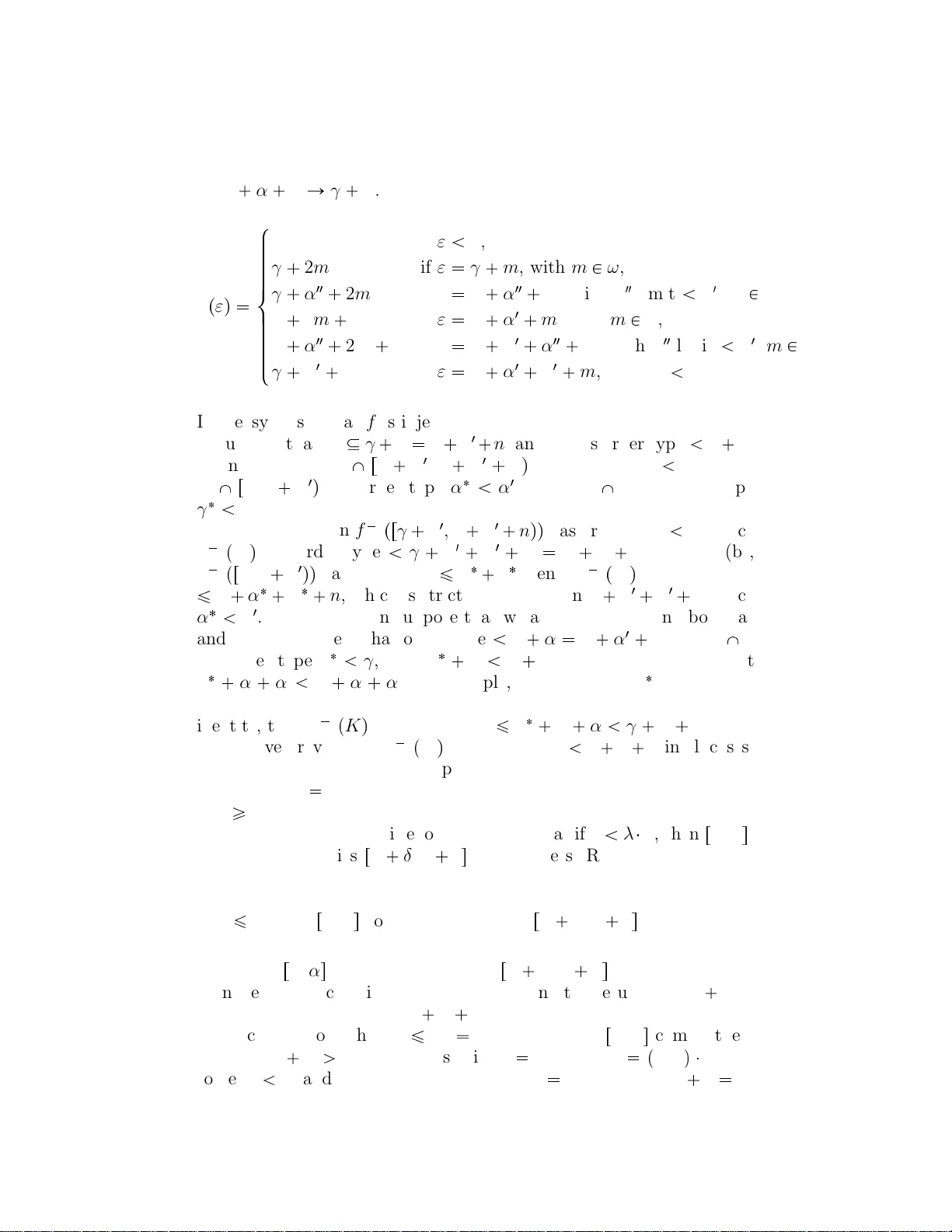
ORDINAL COMP A CTNESS P A OLO LIPP ARINI Abstract. W e int ro duce a new covering property , defined in terms of order t ypes of sequences of op e n sets, rather than in terms of cardinalities o f families. The most gener al form of this compa c t- ness notion depe nds on tw o or dinal parameters . In the particular case when the para meters are c a rdinal num ber s, we get bac k a classical notio n. Generalized to ordinal num bers, this notion turns out to b ehav e in a m uch more v ar ied wa y . W e prov e many nontrivial results o f the form “e very r α, β s -compact space is r α 1 , β 1 s -compact”, for ordinals α , β , α 1 and β 1 , while only trivia l results o f the ab o ve form hold, if we re s trict to cardinals. Counterexamples are pr o vided showing that our results a r e optimal. W e present many e xamples of spa ces s atisfying the very same cardinal compac tnes s proper ties, but with a bro ad ra nge o f distinct behaviors, with r espect to ordinal compactness. A muc h more r e - fined theor y is obtained for T 1 spaces, in compariso n with arbitrar y top ological spa c e s. The notio n of o rdinal compactness becomes partly trivial for spaces of small car dinalit y . 1. Introduction The no w ada ys standard notio n of c omp actness for top ological spaces is usually expressed in terms of cardinalities of op en cov ers, and as- serts t ha t every op en cov er has a finite sub co v er. Since compact spaces constitute a relativ ely special class, v a rious w eak enings hav e been ex- tensiv ely considere d, the most notable b eing Lin del¨ ofness (“an y op en co v er has a coun table sub co v er”), and c ountable c omp actness (“an y coun table op en co v er ha s a finite sub cov er”). Still more g enerally , fina l κ -c om p actness asserts that any op en cov er has a sub co v er of cardinality κ , and initial κ -c omp actness asserts that ev ery op en cov er of cardi- nalit y ¤ κ has a finite sub co v er. A v ast literature exists on the sub ject: see the surv eys [Go, Ste, V3, V4], and, as a v ery sub jectiv e and partial 2000 Mathematics Subje ct Classific ation. P r imary 5 4D20, 03E 1 0; Secondary 54A05, 54D10. Key wor ds and phr ases. Ordina l, co mpa ctness, o pen cover, top ological space, T 1 , disjoint union, shifted sum. 1 2 P AOLO LI PP AR INI c hoice, [BN, ScT a, S hTs, T] for more r ecen t line s of r esearch . See also the references there. In this note w e extend the notio n of cardinal compactness to ordinals, that is, w e take into accoun t order types of fa milies o f cov erings, rather than just their cardinalities. Assuming the Axiom of Choice, eac h cardinal can b e seen as an ordinal, th us o ur notion is more general: when a sequence is cardinal-lik e ordered, we get bac k the more usual notions. On the con trary , and quite surprisingly , it turns out that our ordinal g eneralization pro vides a muc h finer tuning of compactness prop erties of top ological spaces. 1.1. A first example: Lindel¨ of nu m b ers. Before discussing the most general ve rsion of our notion, let us exemplify it in the particular case of Lindel¨ of n um b ers. Let us define the Lindel¨ of c ar dinal of a top ological space X as t he smallest c ar dinal λ suc h tha t ev ery op en co v er of X has a sub co v er of cardinality λ (the superscript is a reminder t hat the more common definition asks just for a sub co v er of cardinalit y ¤ λ . T he presen t v arian t is more conv enien t here, since it distinguishes b et w een compactness and Lindel¨ ofness). In other words , the Lindel¨ of cardinal of a top ological space is the smallest cardina l λ suc h that the space is finally λ -compact. As an ordinal generalization o f the ab o v e notion, let us define the Lindel¨ of or dinal of a t o po lo gical space X as the smallest or dinal α suc h that, for ev ery o pen co v er of X whose elemen ts are indexed b y some ordinal β , there exists some subset H of β suc h that H has order t yp e α , and the set of elemen ts with index in H still constitutes a cov er of X . Thus w e are dealing with cov ers ta k en in a certain (w ell) order and, when dealing with sub co v ers , w e w an t the order of the original co v er to b e resp ected. While the Lindel¨ of o r dina l o f a space clearly determines its Lindel¨ of cardinal, on the con trary , there are spaces with the same Lindel¨ of car- dinal, but with v ery differen t Lindel¨ of ordinals. As a simple example, if κ is a regular uncoun table cardinal, then κ , b oth with the discrete top ology , and with the order top olog y , has Lindel¨ of cardinal κ . On the other hand, though κ is also the Lindel¨ of or dina l o f the former space, the latter space has a muc h smaller Lindel¨ o f ordinal, that is, κ ω (here and b elo w, denotes or dinal sum ). In termediate cases can o ccur: for example, the disjoin t union of tw o copies of κ with the order top ology has Lindel¨ of o rdinal κ κ ω . W e can also hav e κ 1, κ 2, . . . as Lindel¨ of o rdinals, but o nly in some pathological cases, and only for spaces satisfying v ery few separation prop erties. More in v olv ed ex- amples shall b e presen ted in the b o dy of the pap er. Th us our ordinal ORDINA L COMP ACT NESS 3 generalization can b e used to distinguish among spaces whic h app ear to b e quite similar, as f ar as the cardinal notio n is considered. Imp osing further conditions on a space pro vides some constrain ts on its Lindel¨ of ordinal. F or example, the Lindel¨ of o rdinal of a coun table space is either ω 1 , or is ¤ ω ω . F or spaces of cardinality κ , there are similar limitations, sligh tly more in v olv ed. Stronger restrictions are obtained by imp osing mild separation axioms. F or example, the Lindel¨ of ordinal of a T 1 space (of any car dinality) is either ¤ ω , or ¥ ω 1 . Ac tually , only ordinals o f a v ery sp ecial form can b oth ha v e cofinalit y ω and b e the Lindel¨ of ordinal of some T 1 space (Corollary 6.11). W e also sho w that, for arbitrary spaces, the Lindel¨ of ordinal of a disjoint union is exactly determined b y the Lindel¨ of ordinals of the summands. Summing up, the Lindel¨ of ordina l of a top olog ical space app ears to b e a quite fine measure of the compactness prop erties the space satisfies. Moreov er, there are interesting and deep connections b etw een the p ossible v alues the Lindel¨ of ordinal can take , and cardinalities and separation prop erties of spaces. 1.2. r µ, λ s -compactness (for cardinals). No w w e pro ceed b y con- sidering more general forms of compactness . All the (cardinal) com- pactness prop erties defined in the first paragra ph of this introduction can b e unified in a single framew ork b y in tro ducing the f ollo wing tw o- cardinals prop ert y . F or cardinals µ ¤ λ , a to p olo gical space is said to b e r µ, λ s -c om p act if and only if ev ery op en co v er by at most λ sets has a sub co v er with µ sets. Th us, for example, compactnes s is the same as r ω , λ s -compactness, for ev ery cardinal λ , and Lindel¨ ofness is r ω 1 , λ s -compactness, for ev ery cardinal λ . On the other hand, count- able compactness is r ω , ω s -compactness, and, more generally , initial λ -compactness is r ω , λ s -compactness. With a restriction on regular cardinals, and also in v arious equiv alent forms, the ab ov e t w o-cardinals ve rsion has b een in tro duced in 1929 b y P . Alexandroff and P . Urysohn [A U]. F or arbitrary cardinals, the v ery exact form of the ab o v e definition seems to hav e first app eared in [Sm]. It has b een studied b y man y p eople, sometimes under different names and notations, a nd in sev eral equiv alent formulations. See a surv ey o f further related notions and results in [V2]. See also, e. g., [Ga, Li4, V1] and references there for f ur t her information. Apart from intrinsic in terest, r µ, λ s -compactness has pro v ed useful in man y cases. Beside s prov iding a common generalization of coun t- able compactness, Lindel¨ ofness, a nd so on, it exhibits a v ery in teresting 4 P AOLO LI PP AR INI feature: r µ, λ s -compactness is equiv alent to r ν, ν s -compactness, fo r ev- ery ν with µ ¤ ν ¤ λ . In par t icular, (full) compactness is equiv alent to r ν, ν s -compactness for ev ery infinite cardinal ν , and Lindel¨ ofness is equiv alen t to r ν, ν s -compactness for ev ery ν ¡ ω . In other words, we can “slice” compactness in to smaller pieces. This fact has found many applications, mainly in view of the fact that, for ν regular, r ν, ν s -com- pactness has man y equiv alent formulations, most notably in terms of the existence of accumu lation p oin ts of sets of cardinality ν . See [V1]. See a lso [Li2], where the ab ov e mentioned “slicing” pro cedure has found another substan tial application. By the wa y , let us also men tion that the notion of r µ, λ s -compact- ness has ostensibly inspired some f urther notions out side mainstream general top ology . Most notably , some of the earliest definitions of b oth w eakly and strongly compact cardinals w ere introduced as forms of r κ, κ s -compactness for certain infinitary languages [J, Chapters 17 a nd 20]. The exact top ological conte n t of these definitions later clearly emerged: see [Cai2, Ma] for history , references, and for ot her notions in Mo del Theory and Lo g ic whic h hav e apparently b een inspired by r µ, λ s -compactness. Also the notion of a p µ, λ q -regular ultrafilter, whic h pla y ed some ro le in the ev olution of Set Theory [CN ], [KM, Section 13], [J, p. 373], appar en tly originat ed in this stream of ideas. 1.3. The ordinal generalization. Motiv ated b y the in terest of (car- dinal) r µ, λ s -compactness, we started considering the p ossibilit y of an ordinal generalization. Though initially misled by the observ atio n that “initial α -compactness” actually reduc es to a cardinal notion (Corol- lary 2.8), w e so on r ealized that the more general notion of “tw o or dina ls compactness” is really new, as exemplified ab o v e in the particular case of Lindel¨ of-like prop erties or, put in other w ords, final α -compactness. In detail, if β and α are ordinals, let us sa y that a space X is r β , α s - compact if a nd only if ev ery α -indexed op en cov er has a sub co v er in- dexed b y a set o f order ty p e β (in the induced order). Ordinal compactness, in the ab ov e sense, turns o ut to ha v e some v ery particular feat ures. As in the case of cardinals, w e can sho w that, also for ordinals, r β , α s -compactness is equiv alen t to r γ , γ s -compactness, for ev ery or dinal γ with β ¤ γ ¤ α . How ev er, the similarities ess en tially stop here. Indeed, for µ λ infinite regular cardinals, r µ, µ s -compact- ness and r λ, λ s -compactness are indep enden t prop erties. On the other hand, for ordinals, w e ha v e man y results whic h tie to g ether r β , α s -com- pactness and r β 1 , α 1 s -compactness, fo r v arious β , α , β 1 and α 1 . Just to state some of the simplest relatio ns, we hav e that , for α and β infinite ordinals, ORDINA L COMP ACT NESS 5 (1) If β ¤ α , then r β , α s -compactness implies r β , α 1 s -compact- ness. (2) r β α, β α s -compactness implies r β α α, β α α s - compactness. (3) r α, α s -compactness implies b oth r β α, β α s -compactness and r β α, β α s -compactness. Ho w ev er, no t “eve rything” is pro v able, ev en for ordinals hav ing the same cardinalit y . Indeed, still presen ting only some simple examples: (4) r α 1 , α 1 s -compactness do es not imply r α, α s -compactness, in general. (5) r κ ω , κ ω s -compactness do es not imply r κ, κ s -compactness, in general. (6) r κ κ, κ κ s -compactness do es not imply r κ κ, κ κ s -compact- ness, in general. Th us, ordinal compactness is a highly nontrivial notion, in compar- ison with cardina l compactness. Moreov er, the ordinal compactness prop erties of a top ological space are deeply affected b oth by its car- dinalit y and its separation prop erties. F or example , for κ an infinite regular cardinal, any counte rexample to Clause (6) a bov e m ust b e of cardinalit y ¡ κ . On the other hand, no T 1 space can b e a coun terexam- ple to Clause (4). Conside ring the compactness prop erties of disjoin t unions inv o lv es some problems on ordinal arithmetic whic h ar e not completely trivial. T 1 spaces turn out to b e a somewhat neat dividing line: man y r ather o dd coun terexamples, p ossible in spaces lac king separation prop erties, cannot b e constructed using T 1 spaces. Thus w e prov ide a quite neat theory for T 1 spaces. In particular, in this resp ect, countable ordinals b eha v e v ery differen tly from uncoun table ones. The compactness the- ory for T 1 spaces is trivial on coun table ordinals; more generally , apart from a few exce ptions, the o r dinal prop erties of a T 1 space are “in- v ariant” mo dulo in terv a ls o f coun table length. Apparen tly , assuming stronger separation axioms do es not seem to mo dify the theory a lot ; at larg e, w e get essen tially the same results and coun terexamples for T 1 and f o r normal spaces. Ho w ev er, there is still r o o m for the p ossibilit y of some finer results holding only fo r normal spaces; this is left as an op en pro blem. 1.4. Synopsis of the pap er. In summary , the pap er is divided as fo l- lo ws. In Section 2 w e in tro duce the main definition, together with some relativ ely simple pro perties and a couple of equiv alent reformulations. Then w e prov e many r esults of the form “ev ery r α, β s -compact space is 6 P AOLO LI PP AR INI r α 1 , β 1 s -compact”; most of these results shall b e used in the rest of the pap er. In Section 3 w e then pro vide a lot of examples, show ing that r β , α s -compactness, for α and β ordinals, provides a v ery fine tuning of prop erties of op en co v erings: there are man y spaces whic h sho w a v ery differen tiated b eha vior with resp ect to ordinals, but b ehav e ex- actly the same wa y , when α and β are take n to v ary only on cardinals. W e also sho w tha t man y o f the results of Section 2 a re the b est p ossible ones. The most basic example s are presen ted in Subsection 3.1; t hen in Subsection 3.2 w e discuss the b eha vior of ordinal compactness with resp ect to disjoin t unions, a nd show that many more countere xamples can b e obtained in suc h a w a y . W e also in tro duce a generalized form of infinite disjoin t union with a partial compactification. Compactness prop erties of disjoin t unions are shown to b e connected to some no- tions in or dina l arithmetics related to natural sums of ordinals. Suc h matters are clarified in detail in Subsection 3.3. In Section 4 w e sho w that man y more implications b et w een compact- ness pr o perties hold, f or spaces of small cardinalit y; put in another w a y , certain coun terexample s can b e constructed only b y means of space s of sufficien tly lar g e cardinalit y . Suc h coun terexamples are indeed pro- vided in Section 5, where w e giv e an exact c haracterization of those pairs of ordinals α and β suc h that r α, α s -compactness implies r β , β s - compactness. In Section 6 w e then get a more refined theory , which holds f or T 1 spaces. F or suc h spaces, r β , α s -compactness b ecomes tr iv- ial fo r countably infinite ordinals (Corollary 6.8 ) . More generally , with a few exceptions, ordina l compactness for T 1 spaces is inv aria nt mo dulo in terv als of coun table length. F ina lly , Section 7 con tains v arious quite disparate remarks and problems. In particular, it introduces further generalizations of o rdinal compactness, and also discusses the p ossibil- it y of a v ar ia n t in a mo del theoretical sense. The presen t note by no means exhausts all that can b e said abo ut r β , α s -compactness. F urthermore, as w e mentioned, the notion of r β , α s - compactness can b e also g eneralized to differen t con texts. 2. Main definition and basic pr oper ties In this section w e in tro duce o ur main notion, and state some simple prop erties. W e compare it with the more usual notion whic h deals only with cardinals; then we start pro ving results of the form “ev ery r β , α s -compact space is r β 1 , α 1 s -compact”, for appropria te or dinals. F o r cardinal compactness, only trivial results of the ab o v e kind hold. In the subsequen t sections w e shall presen t coun terexamples sho wing that our results cannot b e impro v ed. ORDINA L COMP ACT NESS 7 Throughout, let α , β and γ b e nonzero ordinals, and λ , µ b e nonzero cardinals. As custom, w e shall assume the Axiom of Choice, hence we can iden tify cardinals with initial ordinals. Definition 2.1. If X is a nonempty set (usually , but not necessarily , a to po lo gical space), and τ is a nonempt y family of subsets of X , we sa y that p X , τ q is r β , α s -c om p act if and only if the fo llo wing condition holds. Whenev er p O δ q δ P α is a sequence of mem b ers of τ suc h that δ P α O δ X , then there is H α with order t ype β and suc h that δ P H O δ X . If there is no danger of confusion, we shall simply sa y X in place of p X , τ q . As usual, a sequence p O δ q δ P α of mem bers of τ suc h that δ P α O δ X shall b e called a c ov er of X . A sub c over of p O δ q δ P α is a subseque nce whic h itself is a cov er. By r β , α q -c om p actness we mean r β , α 1 s -compactness for all α 1 α . The nota t ion is justified b y Prop osition 2.3(4) b elo w. Another notatio n for r β , α q -compactness is r β , α s -compactness. Finally , r β , 8q -c om p actness is r β , α s -compactness for all ordinals α ¥ β . When α and β are b oth cardinals, a nd X is a top ological space ( τ b eing alw a ys understo o d to b e the top ology on X ), w e g et bac k the classical cardinal compactness notion o f Alexandroff, Urysohn a nd Smirno v [A U, Sm ]. This is b ecause, for λ a cardinal, ha ving order type λ is the same as ha ving cardinality λ . Notice that we allow rep etitions in p O δ q δ P α , that is, w e allo w t he p os- sibilit y that O δ O δ 1 , fo r δ δ 1 . An equiv alen t and sometimes useful definition in which (among other things) rep etitions are not a llo w ed is giv en by Lemma 2.9. W e hav e given the definition in the presen t fo r m since it app ears somewhat simpler. R emark 2.2 . In the definition o f r β , α s -compactness, the assumption that the sequence is indexed b y elemen ts in the ordinal α is only for con v enie nce. W e get an equiv alen t definition b y a sking that, for ev ery w ell ordered set J of order type α , if p O j q j P J is a cov er of X , then there is H J suc h that the order type o f H (under the order induced by the order on J ) is β , and suc h that p O j q j P H is a co v er of X . Of course, r β , α s -compactness is equiv alen t to the following condition (just take complemen ts!). Whenev er p C δ q δ P α is a sequence of comple- men ts of mem b ers of τ , and δ P H C δ H , for ev ery H α with order t yp e β , then δ P α C δ H . 8 P AOLO LI PP AR INI As we shall see b elo w in Remarks 3.4 and 3 .11, ordinal compactness is actually a new no tion, tha t is, it cannot b e defined in terms of cardinal compactness. W e first list some simple but useful prop erties of r β , α s -compactness. Prop osition 2.3. L et α and β b e non z er o or din als. (1) If β ¤ β 1 and α 1 ¤ α then r β , α s -c om p actness implies r β 1 , α 1 s - c om p actness. (2) r β , α s -c om p actness is e quivalent to r γ , γ s -c om p actness for every γ with β ¤ γ ¤ α . (3) If β ¤ β 1 ¤ α , then X is r β , α s -c om p act if and only if X is b oth r β , β 1 q -c om p act and r β 1 , α s -c om p act. (4) r β , α q -c om p actness is e quivalent to r γ , γ s -c om p actness fo r every γ with β ¤ γ α . Pr o of. (1) is trivial. If α 1 α , add dumm y elemen ts at the top of the sequence, for example, by adding new o ccurrences of one elemen t already in the sequence. One implication in (2) is immediate from (1). The con v erse is obtained by transfinite induction. Supp ose that X is r γ , γ s -compact, for eve ry γ with β ¤ γ ¤ α . W e shall pro v e r β , γ s - compactness, fo r ev ery γ with β ¤ γ ¤ α , b y induction on γ . The induction ba sis γ β is true by assumption. As for the induction step, let β γ ¤ α , and assume that X is r β , γ 1 s -compact, fo r ev ery γ 1 with β ¤ γ 1 γ . Let p O δ q δ P γ b e a co v er of X . By r γ , γ s -compactness, p O δ q δ P γ has a sub co v er S whose index set has order ty p e γ 1 γ . If γ 1 β , w e are done. Otherwise, b y r β , γ 1 s -compactness, and R emark 2.2, w e get a sub co v er of S whose index set has order type β , a nd the item is prov ed. (3) The only if condition is immediate from (1). F or the con v erse, notice t hat, again b y (1), r β , β 1 q -compactness implies r γ , γ s -compact- ness for ev ery γ with β ¤ γ β 1 , and that r β 1 , α s -compactness implies r γ , γ s -compactness for ev ery γ with β 1 ¤ γ ¤ α . Th us w e get r γ , γ s -compactness, for ev ery γ with β ¤ γ ¤ α , hence r β , α s -compactness, by (2). (4) is immediate f r om (2). R emark 2.4 . When α , β , α 1 . . . are restricted to v a r y only on cardinals, rather tha n ordinals, Prop osition 2.3 still holds, with the same pro of. In fact, f o r infinite cardina ls, (1) and (2) are classical r esults ab out r µ, λ s - compactness. Again for infinite cardina ls, it is w ell kno wn (and easy to prov e) that, for top o logical spaces, r cf µ, cf µ s -compactness implies ORDINA L COMP ACT NESS 9 r µ, µ s -compactness. An o rdinal generalization of the ab ov e f a ct will b e giv en in Corollary 2.6 (8). F or infinite regular cardinals, there is no other non trivial implication b et w een r µ, λ s -compactness and r µ 1 , λ 1 s -compactness, except for those whic h follo w immediately from the ab ov e men tio ned facts. Indeed, if λ is a regular infinite cardinal, then λ , with the order top ology , is not r λ, λ s -compact, but it is r µ, µ s -compact for ev ery infinite cardinal µ λ . Hence, if µ ¤ µ 1 are infinite cardinals, then λ with the order top ology is r µ, µ 1 s -compact if and only if λ R r µ, µ 1 s . (Here and in what follows r µ, µ 1 s shall denote t he in terv al consisting of those ordinals δ suc h that µ ¤ δ ¤ µ 1 .) More generally , the exact ordinal compactness prop erties of λ (with v a rious top ologies) shall b e determined in Example 3.2. Con trary to the case of cardinal compactness, and quite surprisingly , there are man y non trivial “transfer prop erties” for ordinal compact- ness, relating r β , α s -compactness and r β 1 , α 1 s -compactness, for v arious β , α , β 1 and α 1 . The next prop osition and its coro llary list some simple relations. More significan t results along this line, and some c haracter- izations shall b e prov ed in Section 5 . Prop osition 2.5. Supp ose that β , α , β 1 and α 1 ar e nonze r o or dinals, and that ther e e x ists an i n je ctive function f : α 1 Ñ α such that, fo r every K α with or der typ e β , it happ ens that f 1 p K q has or d er typ e β 1 . Then r β , α s -c om p actness implies r β 1 , α 1 s -c om p actness. The assumption that f is inje c tive c an b e dr opp e d in the c ase of top olo gic al sp a c es (or just assumin g that τ is close d under unions). Pr o of. Supp ose that p X , τ q is r β , α s -compact, and let f b e giv en satis- fying the assumption. L et p O δ q δ P α 1 b e a co v er of X , and let p U ε q ε P α b e defined by U ε O δ , if f p δ q ε , a nd arbitra rily , if ε is not in the image of f . The definition is w ell p osed, since f is injectiv e. Let α 2 b e the order t yp e of f p α 1 q p U ε q ε P f p α 1 q is still a co v er of X , hence, by r β , α 2 s -compactness (whic h follo ws fr o m r β , α s -compactness, b y Prop osition 2.3(1)), and b y Re- mark 2.2 , there is K α of order t ype β and suc h that p U ε q ε P K still co v ers X . If w e put H f 1 p K q , then, by assu mption, H has order t yp e β 1 ; moreo v er, p O δ q δ P H is a cov er of X , hence r β 1 , α 1 s - compactness is prov ed. In case τ is closed under unions, and f is not injectiv e, define U ε f p δ q ε O δ , and the same arg umen t carries ov er. In what fo llo ws , if not otherwise sp ecified, the op eration will de- note o r dinal s um . That is, α β is the order type of the order obtained 10 P AOLO LI PP AR INI b y at t a c hing a copy of β “at the top” of α . Similarly , denotes or d inal pr o duct . The next corollary provid es a sample of results that can b e prov ed ab out t he relationship b et w een r β , α s -compactness, and r β 1 , α 1 s -com- pactness, for v arious ordinals. Most of them shall b e used in the rest of the pap er. Corollary 2.6. Sup ose that α , β and γ ar e nonzer o o r dinals, a nd λ , and ν ar e c ar dinals. (1) If β ¤ α , and α is i n finite, then r β , α s -c om p actness implies r β , α 1 s -c om p actness, he n c e also r β , α n s -c om p actness, for e ach n ω . (2) If either γ o r α is infinite, then r γ α, γ α s -c om p actness implies r γ α α, γ α α s -c om p actness, henc e also r γ α n, γ α n s -c om p actness, for e ach n ω . (3) If β ¤ α , α is infinite, an d λ cf α , then r β , α s -c om p actness implies r β , α λ ω q -c om p actness. (4) If β ¤ λ , then r β , λ s -c om p actness implies r β , λ q -c om p actness. (5) If β ¤ α λ , and either cf α ¡ λ , or α c an b e written as a limit of or dinals o f c ofinality ¡ λ , then r β , α λ s -c om p actness implies r β , α λ q -c om p actness. Supp ose further that τ is close d under unions. T hen: (6) r α, α s -c om p actness implies r β α, β α s -c om p actness. (7) r α, α s -c om p actness implies r β α, β α s -c om p actness. (8) If cf α ν is i n finite, then r ν, ν s -c om p actness implies r α, α s - c om p actness. Pr o of. (1) In view of Prop osition 2.3( 1), and since β ¤ α , r β , α s -com- pactness implies r α, α s -compactness. In view of Prop osition 2.3(3), it is then enough to show that r α, α s -compactness implies r α 1 , α 1 s - compactness. The latter is pro v ed b y applying Prop osition 2.5 to the f unction f : α 1 Ñ α defined as follo ws. f p ε q $ ' & ' % 0 if ε α, ε 1 if ε ω , ε if ω ¤ ε α. (2) If α is finite, then γ is infinite, and the result f ollo ws from (1). Otherwise, suppo se that α α 1 n , with α 1 limit and n ω . Th us γ α α γ α 1 α 1 n . Consider the follo wing function ORDINA L COMP ACT NESS 11 f : γ α α Ñ γ α . f p ε q $ ' ' ' ' ' ' ' ' & ' ' ' ' ' ' ' ' % ε if ε γ , γ 2 m if ε γ m , with m P ω , γ α 2 2 m if ε γ α 2 m , with α 2 limit α 1 , m P ω , γ 2 m 1 if ε γ α 1 m , with m P ω , γ α 2 2 m 1 if ε γ α 1 α 2 m , with α 2 limit α 1 , m P ω , γ α 1 m if ε γ α 1 α 1 m , with m n. It is easy to see that f is injective . Supp ose that K γ α γ α 1 n , and K has o rder t yp e γ α . Then either (a) K X r γ α 1 , γ α 1 n q has order t yp e n , or (b) K X r γ , γ α 1 q has order t ype α α 1 , or (c) K X γ has o rder t yp e γ γ . If (a) holds, then f 1 pr γ α 1 , γ α 1 n qq has order t yp e n , hence f 1 p K q has order ty p e γ α 1 α 1 n γ α α . In case (b), f 1 pr γ , γ α 1 qq has or der t yp e ¤ α α , hence f 1 p K q has order t yp e ¤ γ α α n , whic h is strictly smaller than γ α 1 α 1 n , since α α 1 . Finally , w e can supp ose that w e are in case (c), and b oth (a) and (b) fail. Since K has order t yp e γ α γ α 1 n and K X γ has order ty p e γ γ , then γ α γ α . This easily implies that γ α α γ α α (for example, b y expres sing γ , γ and α in Can tor normal form). Since f is injectiv e a nd, restricted to γ , is the iden tit y , then f 1 p K q has order t yp e ¤ γ α α γ α α . W e hav e pr ov ed that f 1 p K q has order type γ α α in all cases, hence Prop osition 2.5 can b e applied. (3) If cf α 1, this follows from (1), hence let us supp o se that cf α ¥ ω . By Prop osition 2.3, it is enough to pr ov e that if δ λ ω , then r α, α s - compactness implies r α δ , α δ s -compactness. Refining further, it is enough to prov e that (*) if δ ¤ λ , then r α, α s -compactness implies r α δ , α δ s -compactness, since then r α, α s -compactness implies r α λ, α λ s -compactness, and then we can pro ceed inductiv ely , by applying the result with α λ in place of α , and then with α λ λ in place of α , and so on. Hence, supp ose that δ ¤ λ cf α , and that r α, α s -compactness holds. If δ α ¡ α , then necessarily δ cf α and α p cf α q m , for some m ω , and (*) follows from (2) with γ 0. Otherwise, δ α α , 12 P AOLO LI PP AR INI hence w e can define the follow ing injectiv e function f : α δ Ñ α . f p ε q # δ ε if ε α, η if ε α η , for η δ . No w, if K α has order type ζ α , then f 1 p K q has order t yp e ¤ ζ δ , whic h is necessarily α δ , since δ ¤ cf α . Hence Prop osition 2.5 can b e applied in order to get (*). (4) Again by Prop osition 2.3, it is enough to prov e that r λ, λ s -com- pactness implies r α, α s -compactness, for ev ery α with | α | λ . This is accomplished b y Pro p osition 2.5, letting f b e an y injection from α to λ . (5) As ab o v e, it is sufficien t to pro v e that r α λ, α λ s -compactness implies r α γ , α γ s -compactness, for ev ery γ with | γ | λ . Let g b e an y injection from γ to λ , and apply Prop osition 2.5 to the fo llo wing function f : α γ Ñ α λ . f p ε q # ε if ε α, α g p η q if ε α η , with η γ . If K α λ has order type α λ , then either K X α has o r der t yp e α , or K X r α, α λ q has order type λ . In the la t ter case, and since λ is a cardinal, w e ha v e that f 1 p K q has order t ype ¤ α γ 1 , for some γ 1 with | γ 1 | λ , hence f 1 p K q has order type α γ , since | γ | λ . On the o t her hand, if K X α has o r der t yp e α , then f 1 p K q X α has order t yp e α , since f is the iden tit y on α . The assumptions on α , and | γ | λ then imply that f 1 p K q has order type α γ . (6) Apply the la st stateme n t in Prop osition 2.5 to the function f : β α Ñ α defined by f p ε q # 0 if ε β , η if ε β η , with η α. (7) Apply the la st stateme n t in Prop osition 2.5 to the function f : β α Ñ α defined by f p ε q ζ if ε β ζ η , for some η β . (8) Let p γ η q η P ν b e a sequence cofinal in α o f order t yp e ν . Define f : α Ñ ν b y f p ε q inf t η P ν | ε γ η u , and apply Prop osition 2.5. Example 2.7 . As suggested by Corolla ry 2.6 (6)- (8), the relationships b et w een v ar io us ordinal compactness prop erties c hange according to whether τ is required or no t to b e closed under unio ns. F or example, if λ ¡ µ are infinite cardinals, then ev ery r µ, µ s -compact top ological space is r λ µ, λ µ s -compact, b y Corollary 2.6(6). On the other hand, ORDINA L COMP ACT NESS 13 if X p λ µ, τ q , where τ tr 0 , β q | β P λ u Y tr λ, λ γ q | γ P µ u , then X is trivially r µ, µ s -compact (since it has no cov er of cardinality µ ), but it is not r λ µ, λ µ s -compact. This is a n example of a more general fact: see Corollary 5.6. See a lso Example 4.4. W e shall see in Sections 3 and 5 t ha t r β , α s -compactness is v ery far f rom b eing a trivial notion. Ho w ev er, Corollary 2.6(4) implies that r β , α s -compactness b ecomes partly trivial for in terv als containing a car- dinal. Corollary 2.8. If α is infinite, a nd β ¤ | α | , then the fol lowi ng pr op- erties a r e e quivalent. (1) r β , | α |s -c om p actness. (2) r β , | α | q -c om p actness. (3) r β , α s -c om p actness. In p articular, if µ ¤ λ ar e infi n ite c ar d i n als, then r µ, λ s -c om p actness is e quivalen t to r µ, λ q -c om p actness. Pr o of. (1) ñ (2) is from Corollary 2.6(4). (2) ñ (3) and (3) ñ (1) are immediate from Pro p osition 2.3(1). In particular, “initial α - compactness ”, that is, r ω , α s -compactness, do es become tr ivial, in the sense that it actually reduces to cardinal compactness, in fact, to r ω , | α |s -compactness. The next Lemma gives a somewhat useful equiv alen t fo rm ulation of r β , α s -compactness. It states that it is enough to take into account only co v ers whic h are made o f “irredundan t” elemen ts. Lemma 2.9. L e t X b e a nonem pty set, τ b e a n o nempty family of subsets o f X , and β , α b e nonzer o or dinals. Then p X , τ q is r β , α s -c om p act i f and only if the fo l lowing c ondition holds. Whenever α ¤ α , and p O δ q δ P α is a se quenc e of memb ers of τ such that (1) δ P α O δ X , and (2) for every δ α , O δ is not c o n taine d in ε δ O ε , then ther e is H α with or der typ e β and such that δ P H O δ X . Pr o of. The “only if ” part follo ws trivially from Prop osition 2.3(1). Con v ers ely , suppose that p O δ q δ P α is a co v er of X . Let K t δ P α | O δ is not con tained in ε δ O ε u . Clearly , p O δ q δ P K is still a cov er of X . Let α b e the order t yp e of K , and let f : α Ñ K b e the order preserv- ing bijection. Applying the assumption to the sequence p O f p γ q q γ P α , w e get H α with order t yp e β , suc h that γ P H O f p γ q X . This 14 P AOLO LI PP AR INI means that p O δ q δ P f p H q is a co v er of X indexed by a set of o r der t ype β . In particular, it is a sub co v er of p O δ q δ P α th us r β , α s -compactness is pro v ed. 3. First e xamples In this section w e provide many examples sho wing tha t ordinal com- pactness is not a “trivial” notion. In particular, it cannot b e reduced to cardinal compactness. W e also sho w that man y o f the results prov ed in Corolla ry 2.6 are the b est p ossible ones, in the g eneral case. On the con trary , w e shall sho w in Section 6 that certain results can b e impro v ed if w e just assume tha t w e are dealing with a T 1 top ological space. In subsection 3.1 we endow cardinals with sev eral top olog ies, and c haracterize exactly the ordinal compactness prop erties they share. Then in Subsection 3.2 w e giv e detailed results ab out compactness prop erties of disjoin t unions, and show that taking disjoint unions is a v ery flexible w a y to get more counterex amples. Examples of a differen t kind shall b e presen ted in Section 5. Finally , in Subsection 3.3 w e discuss the tec hnical notio n o f a shifted sum of t w o ordinals, introduced in connection with compactness prop- erties of disjoin t unions. 3.1. Basic examples. Definition 3.1. W e shall endow cardinals with sev eral top olo g ies. As usual, the discr ete top ology d (on an y set) is the trivial to p olo g y in whic h ev ery subset is op en. The initial interval top olo gy iit on some cardinal λ is the top olo g y whose op en sets are the interv als of the f o rm r 0 , β q , with β ¤ λ . The or der top olo gy ord on some cardinal λ is the more usual top ology; a base for this top ology is g iv en b y the inte rv als p α, β q ( α β ¤ λ ), and r 0 , β q ( β ¤ λ ). Examples 3 .2 . Let λ b e an y cardinal, and κ b e an infinite regular car- dinal. (1) p λ, d q is r λ , 8q -compact, and no t r α, α s -compact, for ev ery nonzero α λ . (2) p κ, iit q is not r κ, κ s -compact, but it is r κ 1 , 8q -compact, and r 2 , κ q -compact. (3) If κ ¡ ω , then p κ, ord q is a normal top ological space whic h is r κ ω , 8q -compact, r ω , κ q -compact, and not r κ n, κ n s - compact, for eac h n P ω . ORDINA L COMP ACT NESS 15 Pr o of. (1) is trivial. (2) The sequence r 0 , β q β κ itself prov es r κ, κ s -incompactness, since κ is an infinite regula r cardina l. On the ot her hand, let p O δ q δ P α b e a co v er of p κ, iit q . If O δ κ , for some δ P α , then clearly t O δ u itself is a one-elemen t sub co v er. Supp ose otherwise. Since κ is regular, then necessarily α ¥ κ , and our aim is to extract a sub co v er of order ty p e ¤ κ . In fact, the sub co v er will turn out to b e o f order t yp e exactly κ . By Lemma 2.9, the result follows from t he particular case in whic h the co v er p O δ q δ P α has the additional prop ert y that, f o r ev ery δ α , O δ is no t con tained in ε δ O ε . Supp ose that the ab o v e condition is satisfied. Since each O δ has the form r 0 , β δ q , for some β δ κ , then, b y the ab o v e condition, β δ β δ 1 , for all pairs δ δ 1 α . Since p O δ q δ P α is a co v er of κ , then sup δ α β δ κ . Thus , the sequence p β δ q δ α is strictly increasing, and cofinal in κ , hence has order ty p e κ , since κ is a r egula r car dina l. (3) Let p O δ q δ P α b e a co v er of p κ, ord q . First, consider the case when some O ¯ δ con tains an interv a l of the form p ε, κ q , for some ε κ . Since r 0 , ε s is compact, it is co v ered b y a finite n um ber of the O δ ’s. If we add O ¯ δ to these, w e get a finite sub co v er of κ , since κ r 0 , ε s Y p ε, κ q , hence the conclusion holds in this case. So w e can supp ose that no O δ con tains an interv a l of the form p ε, κ q , th us necessarily α ¥ κ , since κ is regular. Since p O δ q δ P α is a cov er, and each O δ is a union of interv a ls, w e ha v e that, for ev ery β P κ , with β 0, there is an in terv al I β p ε β , φ β q , with ε β φ β κ , suc h that β P I β , and I β O δ p β q , for some δ p β q P α . F or ev ery nonzero β P κ , c hoo se some I β and some δ p β q P α as ab ov e. The function f : κ zt 0 u Ñ κ defined b y f p β q ε β is regressiv e , hence constant on a set S stationa ry in κ , say , f p β q ¯ ε , for β P S . Let D t δ P α | δ δ p β q , for some β P S u . F or δ P D , let η δ sup t η κ | O δ p ¯ ε, η qu , and let J δ p ¯ ε, η δ q . Th us, O δ J δ , for δ P D . Moreo v er, I β J δ p β q , for β P S , since, if β P S , then p ¯ ε, φ β q I β O δ p β q . W e no w sho w that p J δ q δ P D is a co ver of p ¯ ε, κ q . Indeed, sinc e S is stationary , in particular, cofinal, then, for eve ry β 1 with ¯ ε β 1 κ , there is β ¡ β 1 , suc h that β P S , thu s β 1 P I β , since ¯ ε β 1 β P I β p ε β , φ β q , hence β 1 P J δ p β q I β . Since p ¯ ε, κ q is order-isomorphic to κ , and, thro ug h this isomorphism, the J δ ’s cor r espond to op en sets in the iit top ology , w e can apply (2) in order to get a subset E D α suc h that E has order ty p e ¤ κ , and p J δ q δ P E co v ers p ¯ ε, κ q . Hence also p O δ q δ P E co v ers p ¯ ε, κ q . 16 P AOLO LI PP AR INI Since κ r 0 , ¯ ε s Y p ¯ ε, κ q , and r 0 , ¯ ε s is compact, it is enough to add to E a finite n um b er of eleme n ts from the original seq uence p O δ q δ P α , in order to get a co v er of the whole κ . Since w e ha v e a dded a finite n um ber of elemen ts to a sequenc e o f order t ype ¤ κ , we get a cov er of κ whic h has o r der t yp e κ ω , and whic h is a subsequence of the original sequence. Thus , we ha v e pro v ed r κ ω , α s -compactness. In order to finish the pro of, w e hav e to show that, for eac h n P ω , p κ, ord q is not r κ n, κ n s -compact. An easy counterex ample is giv en b y the sequence p O δ q δ P κ n defined b y O δ # r n, n δ q if δ κ, t m u if δ κ m , with m n The situation app ears in a clearer ligh t if w e intro duce an ordinal v ariant of the L indel¨ of num b er of a space. Definition 3.3. The Lindel¨ of or d i n al of p X , τ q is the smallest ordinal α suc h that p X , τ q is r α, 8q -compact. Compare the ab ov e definition with the classical notion of the Linde l ¨ of numb er of a top olo g ical space X , whic h is the smallest c ar dinal µ suc h that X is r µ , 8q -compact (the Lindel¨ of numb er is a distinct notion from the Lindel¨ of c ar dinal defined in the intro duction.) Th us, the Lindel¨ of n um b er µ of X is determined by its Lindel¨ of ordinal α . Indeed, µ is t he predecessor of α , if α is a successor cardinal, and µ | α | otherwise. On the other hand, in general, the Lindel¨ of ordinal cannot b e determined b y the Lindel¨ of num b ers, as show n by Example 3.2. Indeed, taking λ κ regular and uncoun table, all the spaces in Examples 3.2 hav e Lindel¨ of nu m b er equal to κ , ho w ev er, their Lindel¨ of ordinals are, r espectiv ely , κ , κ 1, and κ ω . Other p ossibilities for the Lindel¨ of ordinal are presen ted in Examples 3 .10, 3.11 and 3.12. On the other hand, restrictions on t he p ossible v alues Lindel¨ of or dina ls can assume ar e giv en in Corolla ry 4 .8 fo r spaces o f small cardinalit y , and in Corollary 6.11 for T 1 spaces. R emark 3.4 . Examples 3.2 also show that o rdinal compactness cannot b e determined exclusiv ely b y the cardina l compactness prop erties en- jo y ed by some space. F or example, X 1 p ω , iit q is r ω 1 , 8q -compact, hence, by Prop osition 2.3(1), it is r α, α s -compact, for ev ery or dina l α ¡ ω . On the other hand, X 2 p ω , d q is r ω 1 , 8q -compact, but not r α, α s -compact, for ev ery coun table ordinal α . Th us, X 1 and X 2 are r λ, µ s -compact exactly fo r the same pairs of infinite cardinals λ and µ , but there are man y ordinals α for which X 1 is r α, α s -compact, but X 2 is not. ORDINA L COMP ACT NESS 17 Example 3.11 b elow furnishes tw o normal top ological spaces which are r λ, µ s -compact exactly f o r the same pairs of cardinals λ and µ , no matter whether finite or infinite, but not r α, α s -compact for the same ordinals. 3.2. Disjoin t unions. In order to refine Examples 3 .2, w e need some definitions. Definition 3.5. If X 1 and X 2 are sets, with τ 1 , τ 2 resp ectiv e fa milies of subsets, the disjoint union p X 1 Y X 2 , τ q of p X 1 , τ 1 q and p X 2 , τ 2 q is a set X 1 Y X 2 obtained by t a king the union of disjoin ted copies of X 1 and X 2 , with τ b eing the fa mily of a ll subsets of X 1 Y X 2 whic h either b elong to (the copy o f ) τ 1 , o r b elong to τ 2 , or are the union of a set in τ 1 and a set in τ 2 . Of course, in the case when X 1 and X 2 are top ological spaces, w e get back the usual notion of disjoint union in the t o po lo gical sense. Definition 3.6. If α and β are or dinals, w e say that some o r dinal γ is a shif te d sum of α and β if and only if γ I Y J , fo r some (not necessarily disjoin t) subsets I , J γ such that I has or der type α and I has order type β . T rivially , b oth α β and β α are shifted sums of α and β . The (Hessen b erg) na tural sum α ` β is the largest p ossible shifted sum of α and β . This is immediate from [Car, Theorem 1, I, I I], where the Hessen b erg natural sum is denoted b y σ p α, β q , and follo ws also from Prop osition 3.16 b elo w. Ho w ev er, there a re other p ossibilities for shifted sums. F o r example, ω 1 ω is a shifted sum of ω 1 and ω ω . A quite inv olve d fo rm ula f or determining all the p ossible shifted sums of α and β shall b e obtained in Prop osition 3.16, by expressing ordinals in additiv e normal fo rm. The complication arises from t he fact that, say , though b oth ω 3 ω 1 and ω 3 ω 2 1 are shifted sums o f α ω 3 ω and β ω 2 1, on the con trary ω 3 1 is not a shifted sum of α and β . If α and β are ordinals, w e denote b y α β the smallest ordinal δ larger than all the shifted sums of α 1 and β 1 , for α 1 α and β 1 β . Alternativ ely , α β can b e defined as sup α 1 α,β 1 β α 1 ` β 1 1. W e shall also need the f o llo wing lemma. Lemma 3.7. S upp ose that γ is a shifte d s um of α and β , that is, γ I Y J , w ith I having or der typ e α and J having or der typ e β . Then the fol lowing additional pr op erty is satisfie d. Whe n ever I I has stil l or der typ e α , and J J has stil l or der typ e β , then I Y J has stil l or de r typ e γ . 18 P AOLO LI PP AR INI Pr o of. Express γ in a dditiv e normal form as γ ω η h ω η h 1 ω η 1 ω η 0 , for some in teger h ¥ 0, and ordinals η h ¥ η h 1 ¥ ¥ η 1 ¥ η 0 . Put γ h 1 0 and, for i 0 , . . . , h , put γ i ω η h ω η h 1 ω η i 1 ω η i . Consider the interv als K i r γ i 1 , γ i q , for i 0 , . . . , h . Clearly , each K i has order type ω η i . Moreo v er, γ is t he disjoin t union of the K i ’s. Fix some ¯ ı . Since γ I Y J , then K ¯ ı p I X K ¯ ı q Y p J X K ¯ ı q . Since K ¯ ı has order t ype ω η ¯ ı , then, b y an easy prop ert y of suc h expo nen ts, either I X K ¯ ı or J X K ¯ ı has order t ype ω η ¯ ı (this is similar to, e. g., Hilfssatz 1 in [L¨ a]). Supp ose that, sa y , I ¯ ı I X K ¯ ı has order type ω η ¯ ı . Let I I X p K h Y Y K ¯ ı 1 q , and I I X p K ¯ ı 1 Y Y K 0 q , and let α , α b e their resp ectiv e order t yp es. Since γ is the union of the K i ’s, then I I Y I ¯ ı Y I . Because of the relative wa y the elemen ts of the K i ’s a re ordered in γ , w e ha v e tha t α α ω η ¯ ı α . Notice t ha t α ω η ¯ ı 1 , since the o r der ty p e o f K i 1 Y Y K 0 is ω η i 1 ω η 0 ω η ¯ ı ω ω η ¯ ı 1 . Since I I , then the order types of, resp ectiv ely , I X I , I X I ¯ ı , and I X I are ¤ than, resp ectiv ely , α , ω η ¯ ı , and α . How ever, since b oth I and I ha v e order ty p e α , then necessarily I X I ¯ ı I X K ¯ ı has order t yp e ω η ¯ ı , since otherwise the order t ype of I w ould b e strictly smaller tha n α α ω η ¯ ı α , since, as w e men tioned, α ω η ¯ ı 1 . In a similar w a y , if J X K ¯ ı has order ty p e ω η ¯ ı , then also J X K ¯ ı has order type ω η ¯ ı . Since the ab ov e arg umen t works for each i , w e get that, for each i 0 , . . . , h , either I X K i or J X K i con tribute to K i with order ty p e ω η i , that is, p I Y J q X K i has order type ω η i . This, together with the definition of the K i ’s, implies that I Y J has order t yp e γ . In the next lemma we characterize the compactness prop erties of disjoin t unions. T he lemma has not the most g eneral form p ossible, but it is quite go o d for o ur purp oses. Lemma 3.8. Assume the notation in Defin i tion s 3.5 an d 3.6. (1) Supp ose that X 1 is not r α, α s -c om p act, and X 2 is not r β , β s - c om p act. If γ is a shifte d sum of α an d β , then X 1 Y X 2 is not r γ , γ s - c om p act. In p a rticular, X 1 Y X 2 is neither r α β , α β s -c om p act, nor r β α, β α s -c om p act, nor r α ` β , α ` β s -c om p act. ORDINA L COMP ACT NESS 19 (2) If X 1 is r β 1 , α s -c om p act, a nd X 2 is r β 2 , α s -c om p act, then X 1 Y X 2 is r β 1 β 2 , α s -c om p act. Pr o of. (1) Represen t γ as I Y J as in the definition of a shifted sum, with I of order t yp e α and J of order type β , and let f 1 : I Ñ α and f 2 : J Ñ β b e the order preserving bijections. Let p O δ q δ P α b e a co v er of X 1 witnessing r α, α s -incompactness, and let p P ε q ε P β b e a cov er of X 2 witnessing r β , β s -incompactness. F or φ P γ , let Q φ X 1 Y X 2 b e defined b y Q φ $ ' & ' % O δ if φ P I z J a nd δ f 1 p φ q , P ε if φ P J z I and ε f 2 p φ q , O δ Y P ε if φ P I Y J , δ f 1 p φ q , and ε f 2 p φ q . By the definition of disjoint union, p Q φ q φ P γ is a co v er of X 1 Y X 2 with elemen ts in τ . Supp ose that H γ , and that p Q φ q φ P H is still a cov er of X 1 Y X 2 . Then it is easy t o see t ha t p O δ q δ P f 1 p H X I q is a cov er of X 1 . Since p O δ q δ P α witnesses the r α, α s -incompactness of X 1 , then f 1 p H X I q has order t yp e α , hence also I H X I ha s order t yp e α , since f 1 is an order preserving bijection. Similarly , J H X J has o rder t yp e β . By Lemma 3.7, H H X γ H X p I Y J q p H X I q Y p H X J q I Y J has o rder type γ . Th us, p Q φ q φ P γ is a counterex ample to the r γ , γ s - compactness of X 1 Y X 2 . The last statemen t in (1) f o llo ws fro m the remarks in Definition 3.5. (2) Let p O δ q δ P α b e a co v er of X 1 Y X 2 . Let I b e the set o f all δ P α suc h that either O δ P δ , for some P δ P τ 1 , or O δ P δ Y Q δ , for some (unique pair) P δ P τ 1 and Q δ P τ 2 . Similarly , let J b e the set of all δ P α suc h tha t either O δ Q δ , for some Q δ P τ 2 , or O δ P δ Y Q δ , for some P δ P τ 1 and Q δ P τ 2 . Notice that I Y J α , b ecause o f the definition of disjoin t union. Since p O δ q δ P α is a co v er of X 1 Y X 2 , then p P δ q δ P I is a cov er of X 1 , and, since I has or der t ype ¤ α , then, b y Remark 2.2, Prop osition 2.3(1), and the r β 1 , α s -compactness of X 1 , there is I I suc h that I has order ty p e β 1 1 β 1 , and p P δ q δ P I is still a co v er of X 1 . Similarly , there is J J suc h tha t J has order ty p e β 1 2 β 2 , and p Q δ q δ P J is a co v er of X 2 . Let γ b e the order t ype of I Y J . Then γ is a shifted sum of β 1 1 and β 1 2 , th us γ β 1 β 2 . Since p O δ q δ P I Y J turns out to b e a co v er of X 1 Y X 2 , the conclusion follo ws. Corollary 3.9. Supp ose that the Linde l ¨ of o r dinal of X 1 is β 1 , and that the Linde l ¨ of or dinal of X 2 is β 2 . Then the Lindel ¨ of or dinal of X 1 Y X 2 is β 1 β 2 . 20 P AOLO LI PP AR INI Pr o of. The Lindel¨ of ordinal of X 1 Y X 2 is ¤ β 1 β 2 , a s an immediate consequenc e of Lemma 3.8( 2 ). Hence, to pro v e equality , and in view of Prop osition 2.3(2), w e ha v e to sho w that, for ev ery γ β 1 β 2 , there is γ 2 with γ ¤ γ 2 β 1 β 2 and suc h that X 1 Y X 2 is not r γ 2 , γ 2 s -compact. Let γ β 1 β 2 . By the definition of β 1 β 2 , t here are β 1 1 β 1 , β 1 2 β 2 , and γ 1 β 1 β 2 suc h that γ ¤ γ 1 and γ 1 is a shifted sum of β 1 1 and β 1 2 . By assumption, X 1 is not r β 1 1 , 8q -compact, hence, b y Prop osition 2.3(2 ), there is β 2 1 ¥ β 1 1 suc h that X 1 is not r β 2 1 , β 2 1 s -compact, and necessarily β 2 1 β 1 . Similarly , there is β 2 2 suc h that X 2 is not r β 2 2 , β 2 2 s -compact, and β 1 2 ¤ β 2 2 β 2 . It follo ws trivially form the definition of a shifted sum, a nd from β 1 1 ¤ β 2 1 and β 1 2 ¤ β 2 2 , that there is some shifted sum γ 2 of β 2 1 and β 2 2 suc h that γ 1 ¤ γ 2 . By Lemma 3 .8 (1), X 1 Y X 2 is not r γ 2 , γ 2 s -compact. Since β 2 1 β 1 and β 2 2 β 2 , then γ 2 β 1 β 2 . Th us γ 2 is an ordinal as w an ted. W e are now ready to presen t many improv ements of Examples 3.2. Examples 3.10 . Let κ b e a n infinite regular cardinal, and n P ω , n ¥ 2. (1) If X is the disjoint union of tw o copies of κ with the initial in terv al top ology iit of D efinition 3.1, then X is not r κ, κ s -com- pact, not r κ 1 , κ 1 s -compact, a nd not r κ κ, κ κ s -compact, but it is r κ κ 1 , 8q -compact, r κ 2 , κ κ q -compact, and r 3 , κ q -compact. Thus X has Lindel¨ of ordinal (Definition 3.3) κ κ 1. (2) More generally , if X is the disjoin t union of n copies of κ with the initial in terv al top ology , t hen X is not r κ, κ s -compact, not r κ κ, κ κ s -compact, . . . , not r κ n, κ n s -compact, but it is r κ n 1 , 8q -compact, r κ n, κ κ q -compact, r κ κ n 1 , κ κ κ q -compact, . . . , r κ p n 1 q 2 , κ n q -compact, and r n 1 , κ q -compact. Its Lindel¨ of ordinal is κ n 1. Example 3.1 1 . Supp ose that κ is regular and ¡ ω , let X 1 p κ, ord q , and let X 2 b e the disjoin t union o f tw o copies of X 1 . Then b oth X 1 and X 2 are r µ, λ s -compact, for eve ry pair of infinite cardinals µ and λ suc h that either κ µ ¤ λ , or ω ¤ µ ¤ λ κ ; furthermore, b oth X 1 and X 2 are not r κ, κ s -compact, and not r n, n s - compact, for ev ery p ositiv e integer n . Th us, X 1 and X 2 are r µ, λ s - compact exactly fo r the same pa ir s of car dina ls µ a nd λ , whether finite or not. Ho w ev er, X 1 is r κ ω , 8q -compact, while X 2 is no t ev en r κ κ, κ κ s - compact. Actually , X 2 is not r κ κ n, κ κ n s -compact, fo r ev ery ORDINA L COMP ACT NESS 21 n ω , but it is r κ ω , κ κ q -compact, and r κ κ ω , 8q -compact. Its Lindel¨ of ordinal is κ κ ω . Example 3.12 . Supp ose that X 1 is a nonempt y set, a nd τ is a nonempt y family o f subsets o f X 1 . Supp ose that X 2 is a discrete top ological space of cardinalit y µ , and tha t X is the disjoin t union o f X 1 and X 2 . Then the follow ing statemen ts hold. (1) If X 1 is not r α, α s -compact, | β | ¤ µ , and γ is a shifted sum of α and β , then X is not r γ , γ s -compact. (2) If X 1 is r β , α s -compact, then X is r β µ , α s -compact. In particular, b y adding a discrete finite set to Example 3 .2(2), w e can get a r κ m 1 , 8q -compact space whic h is not r κ m, κ m s - compact. Th us we can hav e κ m 1, a s a Lindel¨ of ordinal of some space. In a similar w a y , b y starting with Example 3.10, we can hav e κ n m 1 as a Lindel¨ of ordinal. Pr o ofs. Almost ev erything in Examples 3.10, 3.1 1 and 3.12 f ollo ws from Prop osition 2.3, Examples 3.2 a nd Lemma 3.8. An exception is r κ 2 , κ κ q -compactness in Example 3.1 0(1), whic h is prov ed as follows. Let X b e the disjoint union of t w o copies of p κ, iit q , and consider an ordinal- indexed cov er C of X . By Example 3.2(2), there is a subsequence of C whic h is a cov er of the first copy o f p κ, iit q and either has order t yp e κ , or consists of a single elemen t, that is, has order t yp e 1. Similarly , there is a subsequenc e of C which is a co v er of the second copy and has the same p ossible or der t yp es. By joining the ab o v e t w o partial sub cov ers, we get a cov er of the whole of X , whose order type is a shifted sum of β 1 and β 2 , where the p ossible v alues β 1 and β 2 are either κ or 1. An y suc h shifted sum, if κ κ , m ust necessarily b e ¤ κ 1, from whic h r κ 2 , α s -compactness follows , for ev ery α with κ 2 ¤ α κ κ . The pro ofs o f r κ n, κ κ q -compactness, r κ κ n 1 , κ κ κ q - compactness, . . . in 3.1 0(2), and of r κ ω , κ κ q -compactness in 3.11 are similar. Man y other similar examples can b e obt a ined by combining in v ari- ous w a ys the examples in 3.2 with Lemma 3.8. F urther countere xam- ples can b e obtained b y a pplying disjoin t unions to the examples w e shall in tro duce in Definition 5.1. Example 3.13 . It is trivial to sho w that, f or µ ¤ λ infinite car dina ls, the disjoin t union of tw o to po logical spaces is r µ, λ s -compact if and only if the t w o spaces are b oth r µ, λ s -compact (this also fo llo ws from Lemma 3.8). 22 P AOLO LI PP AR INI The space constructed in Example 3.11 sho ws that, for ordinals, the disjoin t union of tw o r β , α s -compact spaces is not necessarily r β , α s - compact. Just tak e α β κ κ , for some regular κ ¡ ω , and consider the union of t w o disjoin t copies of p κ, ord q . One can also deal with the o b vious ly define d notio n of the disjoin t union of an infinite family . It app ears to b e promising also the p os- sibilit y of considering a part ial compactification of an infinite disjoint union. This can b e a ccomplis hed as follo ws. Definition 3.14. Supp ose t ha t p X i q i P I is a family of nonempt y sets and, for eac h i P I , τ i is a nonempt y family of subsets of X i . Supp ose, for sak e of simplicit y , that eac h τ i con tains the empty set. The F r e chet d isjoint union p X , τ q of p X i , τ i q i P I is defined as f o llo ws. Set theoretically , X t x u Y i P I X i is the union of (disjoint copies) of the X i ’s, plus a new elemen t x whic h b elongs to no X i . The members of τ are those subsets O of X whic h ha v e one o f the follo wing t w o forms. O ¤ i P I O i , where O i P τ i , for ev ery i P I , or O t x u Y ¤ i P I O i , where the O i ’s are suc h that, for some finite set F I , it happ ens that O i P τ i , for i P F , and O i X i , for i P I z F . The ab ov e definition app ears to be in teresting, in the presen t con- text, since, as in Example 3.13, r β , α s -compactness of a F rechet dis- join t union is not necessarily preserv ed. How ev er, (infinite) cardinal compactness a nd man y other top olog ical prop erties are preserv ed, as asserted b y the next prop osition. Prop osition 3.15. If p X i q i P I is a family of top olo gic al sp ac es, then their F r e chet disjoint union X t x u Y i P I X i is a top olo gic al sp ac e, and is T 0 , T 1 , Hausdorff, r e gular, norma l , r λ, µ s -c om p act (for given infinite c ar dinals λ and µ ) , has a b ase of c l o p en sets if a nd on ly if so is (has) e ac h X i . Pr o of. Straightforw a r d. W e shall commen t only on r egula r ity and nor - malit y . F or these, just o bserv e that if C is closed in X and C has nonempt y in tersection with infinitely many X i ’s, then x P C . Notice that the spaces in Examples 3.2(2) and 3.1 0 satisfy very few separation axioms. Indeed, just ass uming that X is a T 1 top ological ORDINA L COMP ACT NESS 23 space, it is imp ossible to construct similar coun terexamples. See Sec- tion 6. Curiously enough, Counterex ample 3.10 cannot b e generalized in a simple wa y in order to get a space X whic h is not r κ κ, κ κ s -compact, but whic h is, sa y , r κ κ κ, κ κ κ s -compact. Suc h a countere xample exists (Remark 5.5), but w e need a m uc h more inv olve d construction. Indeed, if X is suc h a coun terexample, then | X | ¡ κ , as w e shall sho w in the next section. 3.3. A note on shifted sums and mixed sums. W e now giv e the promised c haracterization of t hose ordina ls γ whic h can b e realized as a shifted sum of tw o ordinals α and β . Ev ery ordinal γ can b e expressed in a unique w a y in additive no rmal form as γ ω η h ω η h 1 ω η 1 ω η 0 , for some in teger h ¥ 0, and ordinals η h ¥ η h 1 ¥ ¥ η 1 ¥ η 0 . Hence to an y ordina l γ w e can uniquely asso ciate the finite string σ p γ q of ordinals in (not necessarily strictly) decreasing order η h η h 1 . . . η 1 η 0 . W e are allowing the empty string, which is asso ciated to the ordinal 0. T o ev ery string of ordinals σ η h η h 1 . . . η 1 η 0 w e can asso ciate the ordinal δ p σ q ω η h ω η h 1 ω η 1 ω η 0 . W e ar e not necessarily assuming tha t the ordinals in σ are in decreasing order. Ho w ev er, an arbitrary string σ can b e r e duc e d to a string σ r whose elemen ts are in (no t necessarily strictly) decreasing o r der, by taking out from σ all those elemen ts whic h are follow ed fr om some strictly larger elemen t. Notice that, any w a y , δ p σ r q δ p σ q , since, fo r example, ω ξ ω ξ 1 ω ξ 1 , if ξ ξ 1 . In particular, if γ δ p σ q , then σ p γ q σ r , since the corresp ondence b et w een ordinals and strings consisting of decreasing ordinals is bijectiv e. W e let denote string juxtap osition. Prop osition 3.16. Supp ose that α , β , γ ar e or di n als, and σ p γ q η h η h 1 . . . η 1 η 0 . Then the fol lowing c onditions ar e e quivalent. (1) γ is a shifte d sum of α and β . (2) Ther e ar e (p ossibly empty) string s σ h , . . . , σ 0 and σ 1 h , . . . , σ 1 0 such that (a) α δ p σ h σ h 1 σ 0 q , (b) β δ p σ 1 h σ 1 h 1 σ 1 0 q , (c) fo r e ach i 0 , . . . , h , either σ i η i , or σ i is empty, or every element of σ i is η i , (d) f o r e ac h i 0 , . . . , h , either σ 1 i η i , or σ 1 i is empty, or every element of σ 1 i is η i , 24 P AOLO LI PP AR INI (e) fo r e a ch i 0 , . . . , h , either σ i η i , or σ 1 i η i . (3) Sam e as (2) with c onditions (a ) an d (b) r e plac e d by (a 1 ) σ p α q σ h σ h 1 σ 0 , (b 1 ) σ p β q σ 1 h σ 1 h 1 σ 1 0 . Pr o of. F or i 0 , . . . , h , define the interv als K i as in the pro of of L emma 3.7. Recall tha t each K i has order ty p e ω η i , that γ is the disjoin t union of the K i ’s, and that, for ev ery i ¡ i 1 , eac h elemen t of K i precedes ev ery elemen t of K i 1 , in the ordering induced b y the ordering on γ . (1) ñ (2) By (1), γ I Y J , for some I and J of order types, resp ectiv ely , α and β . F or i 0 , . . . , h , let α i b e the o rder type o f I X K i , th us α α h α 0 , by the ab ov e prop erties of the K i ’s. Put σ i σ p α i q . Then (a) is satisfied, since δ p σ h σ 0 q δ p σ h q δ p σ 0 q , and since δ p σ p ε qq ε , for ev ery ordinal ε . Moreo v er, (c), to o, holds, since the order t yp e of α i is ¤ the order ty p e of K i , tha y is, ω η i . Similarly , letting β i b e the order t yp e of J X K i , and σ 1 i σ p β i q , w e hav e that ( b) and (d) hold. F ina lly , as remark ed in the pro of of Lemma 3.7, since K i p I X K i q Y p J X K i q has order t yp e ω η i , then either α i or β i has order t yp e ω η i , th us (e) holds. (2) ñ (3) Observ e t ha t p σ h σ 0 q r σ h σ 0 , for appropriate strings σ i , suc h that eac h σ i is a substring of σ i (ho w ev er, it is not necessarily the case that σ i σ s i ). Then, by the last remark b efore the statemen t of the prop osition, σ p α q p σ h σ 0 q r σ h σ 0 . Moreo v er, if the σ i ’s satisfy (c), then also the σ i ’s satisfy (c), since w e are just taking out elemen ts. F urthermore, if σ i η i and (c) holds, then this o ccurrence of η i is not deleted in σ i , since η i ¥ η i 1 , for i ¡ i 1 . By taking further strings σ 1 i suc h t ha t p σ 1 h σ 1 0 q r σ 1 h σ 1 0 , and arguing as b efore, we get that the σ i ’s and the σ 1 i ’s witness (3). (3) ñ (2) is tr ivial, since δ p σ p ε qq ε , for eve ry o r dina l ε . (2) ñ (1) F or i 0 , . . . , h , put α i δ p σ i q and β i δ p σ 1 i q . By Clauses (c)-(d), α i and β i are b oth ¤ ω η i . Let I i b e the initial segmen t of K i of order t yp e α i , and J i b e the initial segmen t o f K i of order type β i . The definition is w ell p osed, since the order t yp e of K i is ω η i . By Clause (e), I i Y J i K i . If w e put I I 0 Y Y I h and J J 0 Y Y J h , then I Y J K 0 Y Y K h γ . Not ice that, by the pro p erties of the K i ’s, I has order type α h α 0 δ p σ h q δ p σ 0 q δ p σ h σ 0 q α , b y Clause (a ). Similarly , by Clause (b), J has order type β , th us we are done. Notice that, giv en α and β , there is o nly a finite n um b er of ordinals γ whic h are shifted sums of α and β . Indeed, by Prop osition 3.16, the elemen ts of σ p γ q are a (p ossibly prop er) subset of the union of the sets ORDINA L COMP ACT NESS 25 of the elemen ts of σ p α q and of σ p β q (coun ting multiplicitie s), and this can b e accomplished only in a finite n um b er of w a ys. On the ot her hand, given γ , it migh t b e the case that γ can b e realized in infinitely man y w a ys as a shifted sum. F or example, for ev ery n ω , ω ω 1 can b e realized as the shifted sum of ω ω and ω n 1. Notice that γ is the natural sum α ` β of α and β if and only if a represen t ation as in Prop osition 3.16 exists in suc h a w a y tha t , for eac h i 0 , . . . , h , either σ i η i and σ 1 i is empt y , or σ 1 i η i and σ i is empty . The notion of a shifted sum is related to a known similar notion, usually called mixed sum ( Mischsumme , [N, L ¨ a]). In our notation, γ is a mixe d sum of α and β if and only if and only γ can b e realized as a shifted sum of α and β as in Definition 3.6, with the additio nal assumption that I X J H . Prop osition 3.17. Under the assumptions in Pr op osition 3.16, we have that γ is a mixe d sum of α and β if a n d only if Condition (2) (e quiva l e n tly, Condition (3)) in 3.16 holds with the fol lowing a dditional clause (f ) F or e ach i 0 , . . . , h , if η i 0 , then either σ i or σ 1 i is the empty string. Pr o of. If γ is a mixed sum of α and β , t hen, in particular, it is a shifted sum, hence the conditions in Prop osition 3.16(2)(3) hold. In order to pro v e (f ) , notice that, if γ is a mixed sum of α and β , and η i 0, then | K i | 1, hence either I i or J i is empt y , since, in the presen t situation, they are disjoint and con tained in K i , th us (f ) follows. It remains to sho w how to get disjoin t I i and J i , for eac h i , in the pro of o f (2 ) ñ (1) (hence w e get disjoin t I and J , since the K i ’s are pairwise disjoin t). If η i 0, this follo ws from Clause (f ). Otherwise , observ e that any set of order t yp e ω η i can alw a ys b e expresse d as the union o f tw o disjoin t subsets ha ving prescrib ed order ty p es α i and β i , pro vided that α i and β i are b oth ¤ ω η i , and their maxim um is ω η i . A somewhat similar c haracterization of those ordinals γ whic h can b e expresse d as a mixed sum of α and β ha s b een given in [L¨ a]. Actually , [L¨ a] deals with mixed sums with p ossibly more than t w o summands. Also the results presen ted here can b e easily generalized to the case of more than tw o summands. W e lea v e this to the reader. W e no w discuss in more details the r elatio nship b et w een the notions of a shifted sum and of a mixed sum. It turns out that the only difference is made b y the “ finite tail” of γ , that is, if γ γ m , with 26 P AOLO LI PP AR INI γ limit, then the wa y s γ can b e realized as a shifted sum determine the w a ys γ can b e realized as a mixed sum. Corollary 3.18. L e t α , β , and γ b e or dinals. (1) Supp ose that γ is a limit or dinal. T hen γ is a mixe d sum o f α and β if and only if γ is a shi f te d sum of α and β (and, if this is the c ase, then either α or β is li m it, but no t ne c essarily b oth). (2) Mor e g e n er al ly, supp ose that γ γ m , with γ limit, and ω ¡ m ¥ 0 . Then γ is a m ixe d sum o f α and β if and only if ther e ar e inte g e rs n, p ¥ 0 such that n p m , α has the form α n , β has the form β p , a nd γ is a shifte d s um of α and β (one of α and β must thus b e limit, but not n e c essari l y b oth). Pr o of. (1) If γ is limit, and σ p γ q η h η h 1 . . . η 1 η 0 , then a ll the η i ’s a re ¡ 0, thus Clause (f ) in Prop osition 3.17 is auto matically satisfied. (2) If γ γ m , then η i 0 exactly for i 0 , . . . , m 1, th us σ p γ q η h η h 1 . . . η m . The conclusion no w follows easily from (1) and Prop ositions 3.16 and 3 .1 7. Notice that t he notions of a shifted sum and o f a mixed sum are dis- tinct. Indeed, it follows easily from Prop osition 3.16 that the smallest shifted sum of α and β is sup t α, β u . How ever, the smallest mixed sum of, sa y , ω 1 and ω 2 is ω 3 ¡ sup t ω 1 , ω 2 u . In general, as a corollary o f Prop osition 3.1 7, w e obtain a result b y Neumer [N]: for α α n and β β p , where α and β are limit ordinals, the smallest mixed sum of α and β is α n p , if α β , and sup t α, β u , if α β . 4. Some indispensability arguments and sp a ces of s mall cardinality As w e men tioned, a discrete space of cardina lity λ is not r α, α s - compact, for ev ery or dina l α of cardinality ¤ λ . In a more general w a y , w e can exhibit plent y of spaces whic h b eha v e as discrete spaces, that is, f o r whic h o r dina l (in- )compactnes s reduces to cardinal (in- )compactness. This is the theme of the first prop ositions in the presen t section. Then we pro ceed to prov e a more sophisticated r esult, Theo- rem 4.5, which implies that, if we restrict ourselv es to spaces of cardi- nalit y κ , then r α, α s -compactness is equiv alent to r β , β s -compactness, for a large set of limit ordinals α and β of cardinalit y κ . In particu- lar, for coun table spaces, Corollary 4.7 shows that r α, α s -compactness b ecomes trivial abov e ω ω . The ab ov e men tioned results imply that the relativ ely simple examples in tro duced in the previous section are ORDINA L COMP ACT NESS 27 really far from exhausting all p ossible kinds of coun terexamples. In- deed, further and more inv olved coun terexamples shall b e constructed in the next se ction. In fact, in the next section w e shall prov e some equiv alences whic h sho w that Prop osition 2.5 cannot b e improv ed. In order t o carry on the pro of of the next prop osition, w e need a definition. Definition 4.1. If p O δ q δ P α is a cov er of X , let us sa y that some O ¯ δ is i ndisp ensabl e if and only if ev ery sub co v er of p O δ q δ P α m ust contain O ¯ δ . Equiv a len t ly , O ¯ δ is indisp ensable if and o nly if there is x P O ¯ δ suc h that x R δ P α,δ ¯ δ O δ . F or example, if X is a top ological space with the discrete t opo logy , and p O δ q δ P α is a co v er o f X consisting of (all) singletons, then eac h elemen t of this cov er is indisp ensable. Prop osition 4.2. Supp ose that α is a non zer o or dinal, λ is an in- finite c ar dinal, and p X , τ q has some c over p O δ q δ P α having at le ast λ indisp ensable e lements. (1) If | α | λ , then X is not r β , β s -c om p act, for every or dinal β with | β | λ . (2) If τ is close d under unions, then X is not r β , β s -c om p act, for every nonzer o or dinal β with | β | ¤ λ . Pr o of. (1) Let | β | λ . Rearrange the seque nce p O δ q δ P α as p O 1 ε q ε P β in suc h a w a y that, in this latter sequence, the subsequence of the indisp ensable elemen ts has or der type β . This is alwa ys p ossible, since λ is an infinite cardinal, | β | λ , and there are λ - man y indisp ensable elemen ts in the original sequence. F or example, if µ is the cardinality of the set of no n indispensable elemen ts (it may happ en that µ 0), c ho ose a subset Z λ with | Z | µ a nd suc h that | λ z Z | λ , assign to non indispensable elemen ts only p ositions in Z , and assign all the other p ositions in β z Z to all indisp ensable elemen ts. Ev ery sub co v er of p O 1 ε q ε P β m ust contain all o f its indisp ensable el- emen ts, th us has order t ype β . This implies that X is not r β , β s - compact. (2) Let | β | ¤ λ , say | β | ν . Consider a new cov er of X obtained b y c ho osing ν -many indisp ensable O δ ’s and joining all the remaining O δ ’s in to one of them (it is still in τ , since τ is closed under unions). If ν is finite, then the result is trivial. Otherwise, it is obta ined b y applying (1), with ν in place of λ , to this new cov er. In Section 6 w e shall use argumen ts similar to those used in the pro of o f Prop osition 4.2 in order to pro v e results ab out compactness prop erties of T 1 spaces. 28 P AOLO LI PP AR INI Theorem 4.5 b elo w is a far more sophisticated result than Prop osi- tions 4.2. Recall tha t and denote, resp ective ly , ordinal sum and pro duct. Moreov er, also exp onen tiation, if not otherwise sp ecified, will denote or d inal exp onentiation . Lemma 4.3. Supp ose that κ is a n infinite r e gular c ar dinal and α is an or din a l of the form α 1 κ ε , for some or dinals α 1 ¥ 0 an d ε ¡ 1 such that ε is either a suc c essor or dinal, or cf ε κ . Supp ose further that | X | κ , and that p X , τ q is not r α, α s -c om p act. Then p X , τ q is not r α 1 , α 1 s -c om p act, for every lim i t or din al α 1 of the form α 1 κ α 1 1 , for some α 1 1 ¡ 0 with | α 1 1 | ¤ κ . If, in addition, τ is close d under unions (in p articular, if τ is a top olo gy on X ), then p X , τ q is not r α 1 , α 1 s -c om p act, for every or dinal α 1 with | α 1 | ¤ κ . Pr o of. Supp ose tha t p O δ q δ P α is a counterex ample to r α, α s -compactness. In particular, for ev ery β α , w e hav e δ β O δ X prop erly . W e shall show a little more. Claim. F or every β α , ther e a r e x P X z δ β O δ and γ x α such that x R δ ¥ γ x O δ (henc e, x P β ¤ δ γ x O δ , sinc e p O δ q δ P α is a c over of X ). Pr o of of the Claim. Supp ose by contradiction that the statemen t in t he claim fails. Then, fo r some giv e n β α , w e ha v e that, for every x P X z δ β O δ , there ar e arbitrarily large indexes δ α suc h tha t x P O δ . Fix some β as ab ov e, and en umerate the elemen t s in X z δ β O δ as p x γ q γ P κ 1 , with κ 1 ¤ κ (here w e are using the assumption that | X | ¤ κ ). W e shall define by tr a nsfinite induction a strictly increasing sequence p δ γ q γ P κ 1 suc h that x γ P O δ γ , for ev ery γ P κ 1 . First, c ho ose some δ 0 α suc h that x 0 P O δ 0 . Supp ose that γ κ 1 , and that p δ γ 1 q γ 1 γ ha v e already been define d. Notice that, by the a ssu mption o n ε , the cofinality o f α α 1 κ ε is κ . Since γ κ 1 ¤ κ , and κ is regular, then sup γ 1 γ δ γ 1 α . Hence, b y the first paragraph in the pr o o f, there is some δ γ ¡ sup γ 1 γ δ γ 1 suc h that x γ P O δ γ . Notice that t δ γ | γ P κ 1 u has order t ype κ 1 ¤ κ . Hence, if w e put D r 0 , β q Y t δ γ | γ P κ 1 u , then D has order t ype ¤ β κ 1 . Notice that β κ 1 α , since α is of the form α 1 κ ε with ε ¡ 1, hence eac h final subset of α has order ty p e κ ε ¡ κ . Ho w ev er, by construction, δ P D O δ X , hence w e hav e found a sub- co v er of p O δ q δ P α of order t ype α , and this con tradicts the assumption that p O δ q δ P α witnesses the f ailure of r α, α s -compactness of X . W e hav e reac hed a contradiction, th us the claim is prov ed. C l aim ORDINA L COMP ACT NESS 29 Pr o of of L emm a 4.3 ( c ontinue d) Now w e are g oing to construct by transfinite induction t w o sequenc es p x ξ q ξ P α 2 and p γ ξ q ξ P α 2 , for some or- dinal α 2 ¤ α , suc h that (1) x ξ b elongs to X , for every ξ α 2 , (2) γ ξ 1 γ ξ α , f o r ev ery ξ 1 ξ α 2 , (3) γ 0 0, p γ ξ q ξ P α 2 is contin uous, and sup ξ P α 2 γ ξ α , (4) x ξ P t O δ | γ ξ ¤ δ γ ξ 1 u , for ev ery ξ α 2 , (5) x ξ R t O δ | δ P r 0 , γ ξ q Y r γ ξ 1 α qu , for ev ery ξ α 2 . Put γ 0 0. By applying the claim to β γ 0 0, w e get x 0 P X and γ 1 α suc h that x 0 P δ γ 1 O δ and x 0 R δ ¥ γ 1 O δ . Supp ose that x ξ and γ ξ 1 ha v e b een already defined, for some ξ . Apply the claim to β γ ξ 1 , in order to o bt a in x ξ 1 and γ ξ 2 α . No w suppo se that ξ is a limit ordinal, and that x ξ 1 and γ ξ 1 ha v e already b een defined, for a ll ξ 1 ξ . If sup ξ 1 ξ γ ξ 1 α , tak e α 2 ξ , and terminate the induction. Otherwise, let γ ξ sup ξ 1 ξ γ ξ 1 . Then apply the claim with β γ ξ , in order to o bt a in x ξ and γ ξ 1 . It is immediate to show that the sequenc es constructed in suc h a w a y satisfy (1)-(5) ab ov e. Notice that, since | X | κ , and X is not r α, α s -compact, then neces- sarily | α | ¤ κ . On the other hand, α ¥ κ , since α α 1 κ ε , for ε ¡ 1. Hence | α | κ . Moreov er, b y (2 ) a nd (3), and since cf α κ , w e also get cf α 2 κ , th us | α 2 | κ , since α 2 ¤ α . If w e assu me that τ is closed under unions, then the pro of can b e concluded in a rather simple w a y . Indeed, by letting U ξ t O δ | γ ξ ¤ δ γ ξ 1 u , fo r ξ α 2 , we ha v e that x ξ P U η if and o nly if ξ η . Th us p U ξ q ξ α 2 is a co v er, b y (3), and since p O δ q δ P α is a co v er. Moreo v er, p U ξ q ξ α 2 consists of | α 2 | κ indisp ensable elemen ts, hence w e are done b y Prop osition 4.2(2). It remains to pro v e the theorem without the assumption that τ is closed under unions, and this in v olv es some t ec hnical computations. Hence, supp ose that α 1 κ α 1 1 , for some α 1 1 ¡ 0 with | α 1 1 | ¤ κ . P artition α 2 in to α 1 1 -man y classes p Z η q η α 1 1 , in such a wa y that | Z η | κ , for ev ery η α 1 1 . This is p ossible, since | α 2 | κ , and | α 1 1 | ¤ κ . F or η α 1 1 , put I η r κ η , κ p η 1 qq , and W η ξ P Z η r γ ξ , γ ξ 1 q . Notice that | W η | κ , for ev ery η α 1 1 . F or each η , let f η b e a bijection fr om I η on to W η . Notice tha t α 1 η α 1 1 I η , and that eac h I η has order t yp e κ . Rearra nge the orig ina l cov er p O δ q δ P α as p O 1 ζ q ζ P α 1 according to the follow ing rule. If ζ P α 1 , then ζ P I η , for some unique η α 1 1 ; then put O 1 ζ O f η p ζ q . W e shall show that p O 1 ζ q ζ P α 1 witnesses r α 1 , α 1 s -incompactness of X . Indeed, since p Z η q η α 1 1 is a partition of α 2 , then, by Condition (3) 30 P AOLO LI PP AR INI ab o v e, and by the definition of the W η ’s, we get that η α 1 1 W η α . Since eac h f η is a bijection, and α 1 η α 1 1 I η , w e get that p O 1 ζ q ζ P α 1 is actually a rearrangemen t of p O δ q δ P α , th us it is still a co v er of X . Let Y α 1 , and supp ose t ha t p O 1 ζ q ζ P Y is a cov er of X . W e ha v e to sho w that Y has order t ype α 1 . It is enough to sho w that, for ev ery η α 1 1 , | Y X I η | κ , thus Y X I η and I η ha v e the same order type ( κ ). Hence Y and α 1 ha v e t he same order ty p e, since α 1 η α 1 1 I η . So, fix η α 1 1 . F or ev ery ξ P Z η , by Condition (5 ) ab ov e, w e ha v e that x ξ R O δ , fo r ev ery δ P r 0 , γ ξ q Y r γ ξ 1 , α q . Since p O 1 ζ q ζ P Y is a cov er, there is ζ P Y suc h that x ξ P O 1 ζ . Ne cessarily , O 1 ζ O δ , for some δ P r γ ξ , γ ξ 1 q , thus δ P W η , hence δ f η p ζ q , and ζ P Y X I η . By construction, | Z η | κ . Since, for ξ ξ 1 , the in terv als r γ ξ , γ ξ 1 q and r γ ξ 1 , γ ξ 1 1 q are disjoin t, then, for eac h ξ P Z η , w e get a distinct δ P α , hence a distinct ζ P Y X I η , th us | Y X I η | κ . Since the ab o v e argumen t w orks for eac h η α 1 1 , w e get that p O 1 ζ q ζ P α 1 is indeed a countere xample to r α 1 , α 1 s -compactness. Example 4.4 . If τ is not supp osed to b e closed under unions, the con- clusion in the second statemen t in Lemma 4 .3 might fail. Indeed, let κ b e an infinite regular cardinals, let X κ κ , and let τ consist of the sets o f the form r κ γ , κ γ δ s , for γ , δ λ . Then p X , τ q is trivially not r κ κ, κ κ s -compact, but it is r κ 1 , κ 1 s -compact, since an y cov er of X alw a ys remains a co v er if w e take off an y single mem ber of the cov er. Actually , if | α | κ , then X is r α, α s -compact if and only if α has not the form κ α 1 , for some ordinal α 1 . The example also sho ws that the a ssu mption that τ is closed under unions is necessary in Condition (5) in Theorem 4.5 b elo w, as well a s in Condition (4) in Corollary 4.7. As a consequence of Lemma 4 .3, f o r spaces of cardinality κ , the theory of r α, α s -compactness b ecomes trivial on a large class o f limit ordinals, as explicitly stat ed in the next Theorem. More strikingly , for coun table spaces, the theory of r α, α s -compactness is non trivial only for ordinals ¤ ω ω (Coro lla ry 4.7 b elo w). Theorem 4.5. If κ is a n infin ite r e gular c ar dinal and | X | κ , then the fo l low i n g c onditions ar e e quivalent. (1) X is r κ κ, κ κ s -c om p act. (2) X is r α, α s -c om p act, for some limit or dinal α of the fo rm α κ α 1 , for some α 1 ¡ 0 with | α 1 | ¤ κ . ORDINA L COMP ACT NESS 31 (3) X i s r α, α s -c om p act, for every or d i n al α of the form α 1 κ ε , for some or dinals α 1 ¥ 0 and ε ¡ 1 such that ε is either a suc c essor or din a l, or cf ε κ . (4) X is r α, α κ ω q -c om p act, for every or dinal α o f the form α 1 κ ε , for some or dinals α 1 ¥ 0 and ε ¡ 1 such that ε is either a suc c essor or dinal, or cf ε κ . If τ is close d unde r unions, then the pr e c e ding c onditions ar e also e quiv- alent to: (5) X is r α, α s -c om p act, for some nonzer o or dinal α such that | α | ¤ κ . Pr o of. (1) ñ (2) and (1) ñ (5) are trivial. (2) ñ (3) and, for τ closed under unions, (5) ñ (3) f o llo w fro m Lemma 4.3. (3) ñ (4) is fr om Corollary 2.6(3). (4) ñ (1) is immediate from Prop osition 2.3( 1 ), with α 1 0 and ε 2. Corollary 4.6. Supp ose that κ is an infinite r e gular c a r dinal, | X | κ , and let A b e the set of al l or dinals α κ of the form κ p α n q , with cf α κ and 0 ¤ n ω . Then X is r α, α s -c om p act, for some α P A , if and only if X is r α, α s - c om p act, for al l α P A . Pr o of. Supp ose that X is r α 1 , α 1 s -compact, fo r some α 1 P A . Since α 1 is of t he f o rm given in Clause 4.5(2 ) , then all t he equiv alent conditions in Theorem 4.5 hold. No w let α κ p α n q P A b e arbitrary . Since cf α κ , then α κ α , where α is either successor or has cofinality κ itself. In b oth cases, α κ p α n q is of the fo r m α 1 κ ε κ n , with ε ¡ 1 either successor, or of cofinalit y κ . Th us, X is r α, α s -compact, in force of Clause 4.5(4) and of Prop osition 2.3(1). Corollary 4.7. If | X | ω , then the fol lowing c onditions ar e e quiva- lent. (1) X is r ω ω , ω ω s -c om p act. (2) X is r α, α s -c om p act, for some c ountable limit or din a l α . (3) X is r ω ω , 8q -c om p act. If τ is close d unde r unions, then the pr e c e ding c onditions ar e also e quiv- alent to: (4) X is r α, α s -c om p act, for some non zer o or d i n al α ω 1 . Pr o of. The equiv alence of (1 ) , (2 ), and (4) is a particular case of The- orem 4.5 (Conditions (1 ) , (2) and (5) there). 32 P AOLO LI PP AR INI (3) ñ (1) is immediate from Prop osition 2.3. In order to finish the pro of, supp ose that (2) holds. Then, b y Theo- rem 4.5 (2) ñ (4), X is r δ , δ s -compact, for ev ery ordinal δ of the form α 1 ω ε m , for ε ¡ 1, that is, for ev ery countable ordinal δ ¥ ω ω . Since X , b eing coun table, is trivially r δ , δ s -compact for ev ery uncoun t- able δ , w e g et r ω ω , 8q -compactness from Prop osition 2.3 (2). Hence (3) holds. A result similar to Coro llary 4.7 holds for T 1 spaces (of a r bitrary cardinalit y): see Corolla ry 6 .8. Corollary 4.8. If | X | ω , then the Lindel¨ of or dinal of X is either ω 1 , or is ¤ ω ω . Mor e gener al ly, if κ is r e gular, and | X | κ , then the Lindel¨ of or d i n al of X c an not ha ve the form α 1 κ ε γ , with 0 γ κ ω , and ε ¡ 1 such that ε is either a suc c essor or dinal, or cf ε κ . Pr o of. The first statemen t is immediate from Corollary 4.7 (2) ñ (3). As f or the second statemen t, if the Lindel¨ of ordinal of X is κ , then X is r α, α s -compact, fo r some α as in Item (2) in Theorem 4.5. The conclusion now follows fr om Prop osition 2.3 and Item (4) in Theorem 4.5. 5. An exa ct characteriza tion of transfer proper ties In this section we introduce some further examples, more in v olv e d than those presen ted in Examples 3 .2. This is necessary in order to a v oid the limitat io ns giv en b y Theorem 4.5 and Coro lla ries 4.6 and 4.7. The examples in tro duced in this section are optimal, in the sense that they prov ide an exact c haracterization of those ordinals α and β suc h that r α, α s -compactness implies r β , β s -compactness. Definitions 5.1. As usual, w e denote b y α 2 the set of all the functions from α to 2 t 0 , 1 u . If f P α 2, the supp ort of f is t δ P α | f p δ q 1 u . F or nonzero ordinals β ¤ α , w e no w define S β p α q t f P α 2 | the supp ort of f has order ty p e β u . S β p α q is in a one-to o ne corresp ondence, via c haracteristic functions, with the set of a ll subsets of α which ha v e order type β . The S in our notation is a reminder for Subset . How eve r, in the presen t note, w e shall mainly deal with elemen ts of α 2, rather than with subsets of α , since it will b e more con v enien t for our purp oses. W e shall mainly deal with the case β α , and w e shall consider v arious families of subsets of S β p α q . ORDINA L COMP ACT NESS 33 W e put X p β , α q p S β p α q , τ 0 q , where the elemen ts of τ 0 are all the subsets of S β p α q ha ving the f orm Z p ε q t f P S β p α q | f p ε q 0 u , ε v arying in α . W e also let X U p β , α q p S β p α q , τ U q , where τ U is the smallest fa mily of subsets of S β p α q whic h con tains τ 0 ab o v e, and is closed under unions. In other w ords, a generic elemen t o f τ U has the form ε P H Z p ε q t f P S β p α q | f p ε q 0, for some ε P H u , for some H α . F or α ¤ 2 a nd β ¡ 1, neither τ 0 nor τ U are top ologies, since they are not closed under finite inte rsections. How eve r, if w e take the closure of τ U under finite intersec tions, w e do g et a top ology τ on S β p α q . F or ε ε ε t ε 0 , ε 1 , . . . , ε n 1 u P S n 1 p α q , let Z p ε ε ε q Z p ε 0 , ε 1 , . . . , ε n 1 q Z p ε 0 q X Z p ε 1 q X X Z p ε n 1 q t f P S β p α q | f p ε 0 q f p ε 1 q f p ε n 1 q 0 u . Members o f τ ha v e t hen t he form ε ε ε P H Z p ε ε ε q , H v arying a mong the subsets of S ω p α q . W e let X τ p β , α q p S β p α q , τ q . The a bov e top ology τ is T 0 , but not ev en T 1 . A top olog y satisfying stronger separation a xioms can b e in tro duced as follow s. X T p β , α q p S β p α q , τ T q , where τ T is the ( T ychonoff ) top ology in- herited b y the pro duct top ology on α 2, where 2 is giv en the discrete top ology . Notice that X T p β , α q inherits from α 2 also the structure of a top ological group, W e shall write X p β q in place of X p β , β q , and similarly for X U p β q , X τ p β q , and X T p β q . The subscript τ is a reminder for top olo gy , the subscript U is a reminder for (closed under) Unions , and the subscript T is a reminder f or T ychonoff . R emark 5.2 . Similar constructions, when restricted to cardinal num- b ers, ha v e sometimes b een considered in the literature. See, e. g., [AB, Example 4.1], [Li1] and [Ste, Example 4.2]. Lemma 5.3. Supp ose 0 β ¤ α , and assume the notations in Defi- nition 5.1. If H α , then the s e quenc e p Z p ε qq ε P H is a c over of X p β , α q if and only if H has or der typ e ¥ β . In p articular, X p β , α q is not r β , β s -c om - p act, henc e neither X U p β , α q , n or X τ p β , α q , n or X T p β , α q ar e r β , β s - c om p act. Pr o of. If H has order type β , define f : α Ñ 2 by f p δ q 1 if and only if δ P H . Then f P X p β , α q , but f b elongs to no Z p ε q ( ε P H ). On the con trary , supp ose b y contradiction that H has order ty p e ¥ β , but t here is f P X p β , α q suc h that f b elongs to no Z p ε q ( ε P H ). If f R Z p ε q , then f p ε q 1, th us the supp ort of f con tains H , whic h has order t yp e ¥ β , and this contradicts f P X p β , α q . In order to sho w that X p β , α q is not r β , β s -compact, it is enough to c ho ose some H α of order type β . Then, b y ab o v e, p Z p ε qq ε P H is a 34 P AOLO LI PP AR INI co v er of X p β , α q , but if K H has order t ype β , then p Z p ε qq ε P K is not a co v er of X p β , α q . The same argument w orks for X U p β , α q , X τ p β , α q , and X T p β , α q . Theorem 5.4. L e t α and β b e non zer o or dinals, and assume the no- tations in Definition 5.1. Th e n the fo l low i n g c onditions ar e e quivalent. (a) X p β q is not r α, α s -c om p act. (b) Ther e exists an inje ctive function f : β Ñ α such that, for every K α with o r der typ e α , it happ ens that f 1 p K q has or der typ e β . (c) F or arbitr ary p X , τ q , r α, α s -c om p actness implies r β , β s -c om p act- ness. Pr o of. (a) ñ (b). Supp ose that (a) holds. Then X p β q has a co v er p O δ q δ P α suc h that, whenev er H α has order type α , then p O δ q δ P H is no t a co v er o f X p β q . By Lemma 2.9, w e can suppo se that O δ O δ 1 , for δ δ 1 P α . Because of the definition o f τ 0 , for each δ P α , there is ε P β suc h tha t O δ Z p ε q . Let W t ε P β | Z p ε q O δ , for some δ P α u β . Since p O δ q δ P α is a co v er o f X p β q , t hen also p Z p ε qq ε P W is a co v er of X p β q . By Lemma 5.3, W has order ty p e β . Let g : W Ñ α b e defined b y g p ε q δ if and only if Z p ε q O δ . Such a δ exists b ecause o f the definition of W , a nd is unique b ecause of the prop ert y p O δ q δ P α is assumed to satisfy . If K α ha s o r der type α , then, by r α, α s -incompactness, p O δ q δ P K is not a co v er of X p β q . Hence , p Z p ε qq ε P g 1 p K q is not a co v er of X p β q . By Lemma 5.3, g 1 p K q has order type β . Th us, the coun terimage by g of a subset of α of o r der type α has order t yp e β . Since W has order t yp e β , then, b y comp osing g with an isomorphism b et w een W and β , we get a function f satisfying the required prop ert y . Not ice that g (hence also f ) is inj ective , since Z p ε q Z p ε 1 q , for ε ε 1 . (b) ñ (c) is a particular case of Prop osition 2.5. (c) ñ (a). If (c) holds, then X p β q is not r α, α s -compact, since, b y Lemma 5.3, it is not r β , β s -compact. R emark 5.5 . Th us, f o r example, for ev ery pair ν ¤ κ of infinite regu- lar cardinals, r κ κ, κ κ s -compactness does not imply r κ ν, κ ν s - compactness, since there is no function f : κ ν Ñ κ κ satisfying Condition (b) in Theorem 5.4. Similarly , r κ 2 κ, κ 2 κ s -compactness do es no t imply r κ ν, κ ν s - compactness. ORDINA L COMP ACT NESS 35 Th us, Coro lla ry 2.6(2)(3) cannot b e improv ed. Notice that, b ecause of Theorem 4.5(2) ñ (1), if X is r κ κ, κ κ s -compact and not r κ 2 , κ 2 s - compact, then | X | ¡ κ . Corollary 5.6. Supp o s e that α and β ar e nonzer o or dinals, and | α | | β | . T hen the fo l low ing statements hold. (1) X p β q is r α, α s -c om p act. (2) Ther e is so m e p X , τ q which is r β , β s -c om p act and not r α, α s - c om p act. Pr o of. If f : β Ñ α is an injectiv e function, t hen | α | ¡ | β | , since | α | | β | . Hence K f p β q α has o r der t yp e α , but f 1 p K q β has order type β . Hence Condition (b) in Theorem 5.4 fa ils, hence also the equiv alen t Conditions (a) and (c) fail. Of course, Corollary 5.6 do es not hold in the case when τ is requested to b e closed under unions. See, e. g., Corollary 2.6(6)-(8 ) . The next Theorem is the analogue of Theorem 5.4 in the case when τ is ask ed to b e closed under unions. Theorem 5.7. L et α , β b e nonzer o o r dinals, and assume the notations in Definition 5.1. Then the fol lowing c on d i tions ar e e quivalent. (a) X U p β q is not r α, α s -c om p act. (b) Ther e e x i s ts a function f : β Ñ α such that, for every K α with or der typ e α , it h app ens that f 1 p K q has or der typ e β . (c) F or every X and τ , if τ is close d under unions, then r α, α s - c om p actness of p X , τ q implies r β , β s -c om p actness of p X , τ q . Pr o of. (a) ñ (b). Supp ose that (a) holds, and that p O δ q δ P α is a coun- terexample to the r α, α s -compactness of X p β q . By the definition o f τ U , eac h O δ has the form ε P W δ Z p ε q , for some W δ β . F or δ P α , let W δ W δ z γ δ W γ , and let O δ ε P W δ Z p ε q . Notice that p O δ q δ P α is still a co v er of X p β q , hence it is still a coun terexample to the r α, α s -compactness of X p β q , since O δ O δ , for ev ery δ P α . Since p O δ q δ P α co v ers X p β q , we ha v e t Z p ε q | ε P W δ , for some δ P α u t Z p ε q | ε P δ P α W δ u X p β q , hence, by Lemma 5.3, the order t yp e o f W δ P α W δ δ P α W δ equals β . Let g : W Ñ α b e defined b y g p ε q the unique δ P α suc h that ε P W δ . If K α has order type α , then, by r α, α s -incompactness, p O δ q δ P K is not a cov er of X p β q . Hence p Z p ε qq ε P g 1 p K q is not a cov er of X p β q . By Lemma 5.3, g 1 p K q has order type β . W e ha v e prov ed that the coun terimage by g of a subset of α of order t yp e α has order t ype β , th us, arguing as in corresp onding part 36 P AOLO LI PP AR INI of the pro of of Theorem 5.4, and since W has order t yp e β , we get a function f as desired. (b) ñ (c) follows from the la st statement in Prop osition 2.5. (c) ñ (a). If (c) holds, then X U p β q is not r α, α s -compact, since, b y Lemma 5.3, it is not r β , β s -compact, and since τ U is closed under unions. 6. r α, β s -comp a ctness of T 1 sp aces The counterexample s presen ted in Examples 3.2 (2) and 3.10 satisfy v ery few separation axioms. In fact, w e can show that more results ab out r β , α s -compactness can b e pro v ed just on the assu mption that w e are dealing with T 1 top ological spaces. Indeed, since in this note w e ha v e k ept the greatest p ossible generalit y , w e men tion that w e do not actually need a T 1 top ological space, in order to prov e the results in the presen t section. The follow ing we ak er notion is enough. Definition 6.1. If X is a nonempt y set, and τ is a nonempt y family of subsets of X , we say that p X , τ q is T 1 if and only if, for ev ery O P τ , and ev ery x P O , O zt x u P τ . Clearly , the ab o v e condition is equiv alen t to asking that, for ev ery O P τ , and every finite F X , O z F P τ . T rivially , if τ is a top ology on X , then p X , τ q is T 1 in the ab ov e sense if a nd only if it is T 1 in the ordinary top ological theoretical sense. It is con v enient to in tro duce some notation, in order to state the next Prop osition more concisely . Definition 6.2. If β is an infinite or dina l, w e let β ℓ b e the la rgest limit ordinal ¤ β . Th us, β ℓ β n , for an appropriate n P ω . Prop osition 6.3. Supp ose that X is T 1 , a n d let α b e an infinite or d i - nal. (1) X is r α, α s -c om p act if and only if X is r α 1 , α 1 s -c om p act. (2) F or every n P ω and infinite β ¤ α , X is r β , α s -c om p act if and only if it is r β ℓ , α n s -c om p act. (3) F or every infinite β ¤ α , X is r β , α s -c om p act i f and only if it is r β ℓ , α ω q -c om p act. (4) If β ¤ α an d β is infinite, then X is r β , α s -c om p act if and only if it is r γ , γ s -c om p act, for every limit or dinal γ with β ℓ ¤ γ ¤ α . Pr o of. (1) One implication follows from Corolla ry 2.6(1) and Prop osi- tion 2.3(1). On the ot her hand, supp ose that X is r α 1 , α 1 s -compact a nd let p O δ q δ P α b e a cov er o f X . Without loss of generalit y , e. g., b y Lemma ORDINA L COMP ACT NESS 37 2.9, we can suppose tha t O 0 H . Let x P O 0 , a nd, for δ P α with δ ¡ 0, let O 1 δ O δ zt x u . Since p X , τ q is a ssu med to b e T 1 , eac h O 1 δ still b elongs to τ . Moreov er, p O 1 δ q δ P α is still a cov er of X . Notice that every sub co v er o f p O 1 δ q δ P α m ust con tain O 0 , which is the only elemen t of the co v er con taining x . Rearrange p O 1 δ q δ P α as p U δ q δ P α 1 b y letting U δ O 1 f p δ q , where f : α 1 Ñ α is the bijection defined by f p δ q $ ' & ' % δ 1 if δ ω , δ if ω ¤ δ α, 0 if δ α. By a pplying r α 1 , α 1 s -compactness to p U δ q δ P α 1 , w e get H α 1 suc h that H ha s order t ype α 1, and p U δ q δ P H is a cov er. Since U α O 1 0 , and O 1 0 is the only elemen t of the cov er con taining x , we hav e that U α b elongs to the subcov er, that is, α P H . Since H has order t yp e α 1, then necessarily H X α has order t ype α . Since f | α is order-preserving, t hen a lso f 1 p H X α q has order ty p e α . Hence K f 1 p H q , to o, has order type α , since α is infinite, a nd w e are adding to f 1 p H X α q just one elemen t “a t the b eginning”. Then p O 1 δ q δ P K is a co ver o f X indexed by a set of order type α , and also p O δ q δ P K is a co v er, since O 1 δ O δ , f o r ev ery δ P α . Hence, p O δ q δ P K is a sub co v er o f o rder t yp e α of our original cov er p O δ q δ P α , and w e ha v e prov ed r α, α s -compactness. (2) - (4) are immediate from (1) and Prop osition 2.3. Of course, Item 1 in Prop osition 6.3 is false without the a ssu mption that α is infinite. Indeed, the discrete space with exactly n elemen ts is r n 1 , n 1 s -compact, but not r n, n s -compact. The next Lemma captures a v ery useful consequen ce of b eing T 1 . Lemma 6 .4. Supp os e that α is an or dinal, cf α ω , an d p α n q n P ω is a strictly incr e asing se quenc e such that sup n P ω α n α . If X is T 1 and not r α, α s -c om p act, then ther e is a c ounter e x ample p O δ q δ P α to the r α, α s -c om p actness of X with the p r op erty that, for every n P ω , O α n is indisp ensable (De fi nition 4.1). Pr o of. Let α and the α n ’s b e giv en. Suppo se that p O δ q δ P α is a coun- terexample to r α, α s -compactness. By Lemma 2.9, w e can also supp ose that, for ev ery δ α , O δ is not con tained in ε δ O ε . In particular, for ev ery n P ω , w e can choose x n P O α n suc h that x n R ε α n O ε . Define 38 P AOLO LI PP AR INI p O 1 δ q δ P α as follows . O 1 δ # O δ if δ ¤ α 0 , O δ zt x 0 , . . . , x n u if α n δ ¤ α n 1 . Since X is T 1 , eac h O 1 δ still b elongs to τ . Moreo v er, p O 1 δ q δ P α is still a co v er of X . Indeed, f or ev ery n P ω , x n P O 1 α n . If x is not one of the x n ’s, then x P O δ , for some δ P α , a nd also x P O 1 δ . Since O 1 δ O δ , fo r ev ery δ P α , w e hav e that p O 1 δ q δ P α , to o, is a coun terexample to r α, α s - compactness, and it is easy to see that p O 1 α n q n P ω is a set o f indisp ensable elemen ts. Th us, p O 1 δ q δ P α is a co v er as wan ted. Man y results on T 1 spaces will b e obtained b e rearranging the indis- p ensable elemen ts giv en by Lemma 6.4. The follo wing notatio n shall b e useful in the pro o f of the forthcoming Theorem 6.6. Definition 6.5. If β is an y ordinal, let β b e the smallest o rdinal ¤ β suc h that |r β , β s| ¤ ω . Th us, β is the largest ordinal ¤ β whic h is either 0 , or has uncountable cofinality , or has cofinalit y ω but can b e written as a limit o f ordina ls of uncoun table cofinality . Theorem 6.6. Supp ose that X is T 1 , and β is an or dinal of c ofinality ω . Then the fol lowing c ondi tion s ar e e quivalent. (1) X is r β , β s -c om p act. (2) X is r β α, β α s -c om p act, for every or dina l α with | α | ¤ ω . (3) X is r β α, β α s -c om p act, for some or dinal α with | α | ¤ ω . (4) X is r β , β ω 1 q -c om p act. Pr o of. (2) (4) follo ws from Prop osition 2.3 (4), hence it is enough to pro v e the equiv alence of (1) - (3). W e shall first pro v e the theorem in some particular cases. Claim 1. Conditions ( 1 ) - (3) ar e e quivalent in c ase β β ω . Pr o of of Claim 1. In case β 0, (1) ñ (2) follo ws f rom Prop osition 2.3(1) and Corollary 2.6(4) with β γ ω . In case β ¡ 0, (1) ñ (2) follo ws from Prop osition 2.3(4) and Corol- lary 2.6(5), b y ta king t here α β , λ ω and β β ω . (2) ñ (3) is tr ivial. W e shall prov e (3) ñ (1) by proving the con trap ositiv e form. So supp ose that X is not r β , β s -compact, and α ω 1 . W e w an t to show that X is not r β α, β α s -compact. F or n ω , let α n β n . Since β β ω , then, b y Lemma 6.4, there is some co v er p O δ q δ P β witnessing r β , β s -incompactness, and such that eac h O α n is ORDINA L COMP ACT NESS 39 indisp ensable . If β 0, then r β α, β α s -incompactness fo llo ws from Prop osition 4.2(1), hence in what follows let us supp ose β ¡ 0. F or ev ery H β β ω , if p O δ q δ P H is a co v er of X , then the order t yp e of H is β β ω , hence the o rder type of H X β is β , since β is a limit ordinal. Moreov er, H X r β , β q r β , β q , since O δ is indisp ensable , for ev ery δ P r β , β q . Let f : β ω α Ñ β ω b e a bijection whic h is the iden tit y on β , and let p U ε q ε P β ω α b e defined by U ε O f p ε q . W e claim tha t p U ε q ε P β ω α witnesses that X is not r β ω α, β ω α s -compact, and this is what w e w an t, since β ω α β α . Indeed, if K β ω α , and p U ε q ε P K is a cov er of X , then p O δ q δ P H , with H f p K q , is a co v er of X . Since f is the iden tit y on β , then, b y the ab o v e men tioned prop erties of H , w e get that the order t ype of K X β equals the order type o f H X β , that is, β ; moreov er, K X r β , β ω α q r β , β ω α q , thus K has o r der ty p e β ω α , hence r β ω α, β ω α s -incompactness is prov ed. C l aim 1 Claim 2. Conditions ( 1 ) - (3) ar e e quivalent in the c ase when β has c ofin ality ω , and β β . Pr o of of Claim 2. In view of Claim 1, and of Prop osition 6 .3(1), it is enough to sho w that if cf β ω , then r β , β s -compactness is equiv- alen t to r β ω , β ω s -compactness. The fo r mer implies the latter b ecause of Corollary 2.6(3) (ta king β α β there), by Prop osition 2.3(4), a nd since w e ha v e a ssum ed that cf β ω . W e shall pro v e t he rev erse implication by contrapo sition. Supp ose that X is not r β , β s - compact. W e w an t to sho w that X is not r β ω , β ω s -compact, Cho ose some strictly increasing sequence p α n q n P ω cofinal in β . This is p ossible, since cf β ω . By Lemma 6.4, there is a coun terexample p O δ q δ P β to r β β s -compactness suc h that eac h O α n is indisp ensable. Th us, if H β and p O δ q δ P β is a cov er of X , then H has order t yp e β , and moreov er α n P H , for ev ery n P ω . Let A p β ω qzt α n | n P ω u . A has order t yp e β ω , since β is expressible a s a limit of ordinals of uncountable cofinality , hence taking off a sequence of order t yp e ω do es not alter the order t yp e of β . Let p O 1 δ q δ P A b e defined by O 1 δ O δ , if δ P β zt α n | n P ω u , and b y O 1 β n O α n , for n P ω . Since these latt er elemen ts of the co v er are indisp ensable, it is easy t o see that p O 1 δ q δ P A is a coun terexample to r β ω , β ω s -compactness. C l aim 2 Pr o of of T he or em 6.6 (c ontinue d). Summing up, we ha v e prov ed the theorem in the case when either (1) β β ω , or 40 P AOLO LI PP AR INI (2) β β and cf β ω . No w let β b e arbitra ry . By definition, β ¥ β , and, since w e ha v e assumed cf β ω , w e ha v e further that, if cf β ¡ ω , then β ¥ β ω . Notice also that, by definition, there is γ with | γ | ¤ ω suc h that β β γ and, if cf β ¡ ω , then, by ab ov e, there is γ 1 with | γ 1 | ¤ ω suc h that β β ω γ 1 . No w observ e that, if the statemen t of the theorem holds for some giv en ordinal β 1 in place of β , and β 2 is another ordinal such that β 2 β 1 γ , for some γ with | γ | ¤ ω , then the statemen t o f the theorem holds for β 2 in place of β , to o . The ab o v e observ ations sho w that the t w o already pro v ed pa r t icu- lar cases (1) a nd (2) imply t he statemen t of the theorem in its full generalit y . R emark 6.7 . (a) The assumption that β has cofinalit y ω in Theorem 6.6 is necessary . By Example 3.2(3), if κ is regular and uncoun table, then p κ, ord q is r κ ω , κ ω s -compact, but not r κ, κ s -compact, hence the implication (3) ñ (1) in the statemen t of Theorem 6.6 fails, f or β κ and α ω . (b) On the other hand, for β ¥ ω , and T 1 spaces, the implication (1) ñ (2) in Theorem 6.6 a lw ays holds, eve n without the assumption that β has cofinality ω . Indeed, b y Prop osition 6 .3(4), r β , β s -compactness implies r β ℓ , β ℓ s -compactness, th us, without loss of generalit y , w e can supp ose that β is limit. Then, for ev ery α ω 1 , we get r β α, β α s - compactness: this f o llo ws from Theorem 6.6 itself, in case cf β ω , and from Corollary 2.6( 3 ) and Prop osition 2.3(1), if cf β ¡ ω . (c) On the con trary , the implication (1) ñ (2) in the statemen t of Theorem 6.6 fails, in general, for non T 1 spaces. See, for example, the first example in Remark 5.5, with κ ω . (d) Also the implication (3 ) ñ (1) in the statemen t of Theorem 6.6 fails, in general, for non T 1 spaces. Just consider Example 3.2(2), and tak e β κ ω and arbitrary α ¡ 1. Corollary 6.8. Supp ose that X is T 1 . Then X is r ω , ω s -c om p act if and only if X is r α, α s -c om p act, for some (e quivalently, every) c ountably infinite or din al α , if and only if X is r ω , ω 1 q -c om p act. Pr o of. The corollary fo llows by taking β ω in Theorem 6.6. Theorem 6.6 can b e used to strengthen Prop osition 6.3. ORDINA L COMP ACT NESS 41 Definition 6.9. Recall from Definition 6.5 the definition of β . F or an ordinal β , define β as follows : β # β if either cf β ω , or β β n , for some n ω , β ω otherwise . Notice that β ¤ β , for ev ery o r dinal β . Corollary 6.10. S upp ose that X is T 1 , and β ¤ α ar e in finite or dinals. Then the fol lowing c o n ditions ar e e quivalent. (1) X is r β , α s -c om p act. (2) X is r β , α ω 1 q -c om p act. (3) X is b oth r β , β s -c om p act, a n d r γ , γ s -c om p act, f o r every γ such that β ¤ γ ¤ α and γ γ . Pr o of. (1) ñ (3) F rom Prop osition 2 .3(1) w e get r β , β s -compactness. If cf β ω , then r β , β s -compactness f o llo ws from Theorem 6.6(3) ñ (1), with β in place of β , and since, b y the definitions of β and of β , w e hav e that β β α 1 , f or some α 1 with | α 1 | ¤ ω . If cf β ω , then β β n , fo r some n ω , and r β , β s -compactness fo llo ws from Prop osition 6.3(1), since β is assumed to b e infinite. Finally , r γ , γ s -compactness, for ev ery γ suc h that β ¤ γ ¤ α , is trivial, b y Prop osition 2.3(1). In order to prov e (3) ñ (2), in view o f Prop osition 2.3(4), it is enough to prov e r ε, ε s -compactness, for ev ery ε suc h that β ¤ ε α ω 1 . Let us fix some ε as ab ov e, and let γ ε . Notice that γ γ , and that γ ¤ α , since |r α, ε s| ¤ ω . If γ ¥ β , then, by assumption, we hav e r γ , γ s -compactness, whic h implies r ε, ε s -compactness, by Theorem 6.6 and Corollary 2.6(3), as remark ed in R emark 6.7(b). O n the other hand, if γ β , then ε β , since β ¤ β ¤ ε , and ε γ β . Then r β , β s -compactness implies r ε, ε s -compactness, aga in by Remark 6.7(b). (2) ñ (1) follows fro m Prop osition 2 .3 (1), since β ¤ β . In particular, the compactness prop erties of T 1 spaces are completely determined b y che c king r β , β s -compactness for (1) β finite, (2) β ω , (3) β of uncoun table cofinalit y (4) β γ ω , for γ of uncoun table cofinality , a nd (5) β of cofinality ω , but expressible as a limit of ordinals of un- coun table cofinality . 42 P AOLO LI PP AR INI The ab o v e statemen t, and the next corollar y as w ell, follo w from Corollary 6.10 (1) ñ (3) and the fact that, for infinite β , b oth β and β ha v e necessarily one a mong the forms (2)-(4 ). Corollary 6.11. If X is T 1 , and β is the Lindel¨ of or din al o f X , then β has on e of the a b ove forms (1)-(5). In p articular, if β ω 1 , then β ¤ ω . R emark 6.12 . It f ollo ws from Example 3.2 (3) that the b ehavior o f coun table ordinals in Theorem 6.6 and Corollary 6.8 constitutes an exceptional case. The situation is radically differen t for lar g er cardi- nals and ordinals, ev en fo r normal to p olo g ical spaces. Indeed, if κ is a regular a nd uncoun table cardinal, then p κ, ord q is r κ κ, κ κ s -com- pact but not r κ, κ s -compact. Th us, 6.6 and 6.8 do not hold when ω is replaced b y an uncoun table car dina l. As another example, the disjoint union of t w o copies of p κ, ord q is r κ κ κ, κ κ κ s -compact, but not r κ κ, κ κ s -compact (see Example 3.11). Ho w ev er, Theorem 6.6 do es admit a generalization to larger cardi- nals, but only under a somewhat stronger assumption. Definition 6.13. If λ is a n infinite cardinal, we sa y that p X , τ q is λ - T 1 if and only if, for ev ery O P τ , a nd ev ery Z X with | Z | λ , O z Z P τ . Th us, T 1 is the same as ω - T 1 . If p X , τ q is a T 1 top ological space, and the in tersection of λ o pen sets of X is still an op en set of X , then p X , τ q is λ - T 1 in the ab ov e sense. Prop osition 6.14. Supp ose that X is λ - T 1 , and β is a limit or dinal of c ofina lity ¤ λ . Then the fol lowing c ond itions ar e e quivalent. (1) X is r β , β s -c om p act. (2) X is r β α, β α s -c om p act, for every or dina l α with | α | ¤ λ . (3) X is r β α, β α s -c om p act, for some or dinal α with | α | ¤ λ . (4) X is r β , β λ q -c om p act. The next lemma is prov ed as Lemma 6.4. Lemma 6.15. Supp ose that λ is an infinite c ar dinal, α and γ ar e limit or dinals, γ ¤ λ , cf γ cf α , and p α ζ q ζ P γ is a strictly i n cr e asing se quenc e such that sup ζ P γ α ζ α . If X is λ - T 1 and not r α, α s -c om p act, then ther e is a c ounter example p O δ q δ P α to the r α, α s -c om p actness of X with the p r op erty that, for every ζ P γ , O ζ is indisp ensable. ORDINA L COMP ACT NESS 43 Pr o of of Pr op osition 6.1 4. If β is an y ordinal, let β λ b e the smallest ordinal ¤ β suc h tha t |r β λ , β s| ¤ λ . Th us, β λ is t he largest ordinal ¤ β whic h is either 0, or has cofinalit y ¡ λ , or can b e written as a limit of ordinals of cofinality ¡ λ . The pro of now follo ws t he lines of the pro o f of Theorem 6.6: prov e first the result in the case when β β λ λ , a nd then when β β λ and ω ¤ cf β λ ¤ λ . 7. Rela ted notions and problems The spaces in tro duced in Examples 3.2(3) and 3.11 are normal top o- logical spaces (with a base of clop en sets), and they th us pro vide cer- tain limits to prov able results for r β , α s -compactness of normal spaces. Ho w ev er, the theory dev elop ed so far app ears to b e not sharp enough to deal with suc h spaces. As a ve ry roug h hy p othesis, w e conjecture that there is not v ery m uc h difference in the theory of r β , α s -compactness for, sa y , T 1 spaces and Tyc honoff spaces. W e also conjecture that w e can get some more theorems under the additiona l a ssumption o f normality . All t he ab o v e rough h yp otheses need to be v erified; the presen t note a pp ears to b e already long enough, thus w e p ostp one the discussion of suc h matters to a subsequen t w ork. Problem 7.1. Give c haracterizations, similar to the ones g iv en in The- orems 5.4 and 5.7, for those pa ir s o f ordinals α and β suc h that r α, α s - compactness implies r β , β s -compactness, for general top ological spaces and, resp ectiv ely , for top ological space s satisfying some giv en separa- tion axiom. O f course, the spaces introduced in Examples 3.2, 3.10, 3.11, 3.12, as we ll as the spaces X τ p β , α q and X T p β , α q of Definitions 5.1 will b e relev ant to the solution of this problem. R emark 7.2 . Indeed, f o r normal spaces, some problems might b e op en ev en restricted to cardinal compactness. F or example, it is easy to see that X is a linearly Lindel¨ of not Lindel¨ of space (see [AB]) if a nd only if X is r κ, κ s -compact, for ev ery regular uncountable cardinal κ , but there is some uncountable cardinal λ (necessarily o f cofinalit y ω ) suc h that X is not r λ, λ s -compact. Problem 7.3. Study the b eha vior of r β , α s -compactness of top olog ical spaces with resp ect to pro ducts. This problem migh t ha v e some interes t, since nontrivial results a bo ut cardinal compactness of pro ducts of top olo g ical spaces are already kno wn. See, e. g ., [Sto, GS, SS, Cai1, Cai2]. See [L i1, Li2] for fur - ther results and references. 44 P AOLO LI PP AR INI Problem 7.4. Study the m utual relationships among r β , α s -compact- ness and other compactness prop erties, either defined in terms of cov- ering prop erties or not. Definition 7.5. W e can also generalize the presen t notion of ordinal compactness to the relativized notion introduced in [Li3]. If X is a top ological space, a nd F is a family of subsets of X , let us sa y that X is F - r β , α s - c omp act if and only if the follo wing condition holds. F or ev ery sequence p C δ q δ P α of closed sets o f X , if, for ev ery H α with order type β , there exists F P F suc h that δ P H C α F , then δ P α C α H . With this notation, r β , α s -compactness turns out to b e the particular case of F - r β , α s -compactness when F is the set of all singletons of X . The particular case when F is the set of all nonempty op en sets of X migh t hav e particular intere st. The corresp onding not io n when b oth α and β are cardinals has b een studied in [Li4]. Still another g eneralization is suggested by [Li3]. If F is a family o f subsets of X , let us say tha t X is r β , α s - c omp act r elative to F if and only if the following condition holds. F or ev ery sequence p F δ q δ P α of elemen ts of F , if, for ev ery H α of order t yp e β , δ P H F δ H , then δ P α F α H . F or a top ological space X , r β , α s -compactness is the same as r β , α s -compactness relativ e to the family of a ll closed subsets of X . Problem 7.6. A similar definition of ordinal compactness can b e give n for abstract logics. See [E] for definitions and background ab out logics. Let us sa y that a logic L is p α, β q - c omp act if and only if, for ev ery α -indexed set p σ δ q δ P α of L - sen tences, if, f o r ev ery H α with order t yp e β , t σ δ | δ P H u has a mo del, then t σ δ | δ P α u has a mo del. Notice the rev ersed order of α and β , to b e consisten t with the stan- dard notation used in the literature ab out compactness of logics. W e do not know whether ordina l compactness fo r log ics is really a new notion, that is, whether or not it can b e expressed in terms of cardinal compactness only . See, e. g., [Ma] for notions of cardinal compactness for logics. The idea o f defining r β , α s -compactness came to us after reading the definition of an p α, κ q -regular ultrafilter in [BK, p. 237]. Definition 7.7. W e can define an ev en more general not io n of com- pactness. If Z is any set, and W is a subset of the p o w er set of Z , sa y that a to po lo gical space is r W , Z s -c om p act if and only if, whenev er ORDINA L COMP ACT NESS 45 p O z q z P Z is an op en cov er of X , then there is w P W suc h that p O z q z P w is still a cov er of X . The usual notion o f r µ, λ s -compactness is the particular case when Z has cardinalit y λ , and W is the set of all subsets o f Z of cardinality µ . More g enerally , our notion of r β , α s -compactness is the particular case when Z α , and W is the set of a ll subsets of α of or der t yp e β . W e do not kno w whether there ar e other significant pa rticular cases. Reference s [A U] P . Alexandro ff, P . Urysohn, M´ emorie sur les ´ esp ac es top olo giques c omp acts , V er . Ak ad. W e tens ch. Amsterdam 14 (192 9), 1–96 . [AB] A. V. Arhangel’skii, R. Z. Buzyako v a, On line arly Lindel¨ of and str ongly dis- cr etely Lindel¨ of sp ac es , P roc . Amer. Math. So c. 127 (1999), 2449 –2458. [BN] A. Bella, P . Nyikos, Se quential c omp actness vs. c ountable c omp actness , Col- lo q. Math. 120 (2010), 16 5–189. [BK] M. Benda and J. K etonen, R e gularity of ultr afilters , I s rael J. Ma th. 17 (19 7 4), 231–2 40. [Cai1] X. Caicedo, On pr o ductive r κ, λ s -c omp actness, or the Abstr act Comp actness The or em r evisite d , manuscript (199 5). [Cai2] X. Caicedo, The Abstr act Comp actness The or em R evisite d , in L o gic and F oundations of Mathematics (A. Cantini et al. e ditors), Kluw er Academic Publishers (199 9), 131– 141. [Car] P . W. Carruth, Arithmetic of or dinals with applic ations to the the ory of or- der e d Ab elian gr oups , Bull. Amer. Math. So c. 48 (19 4 2), 262- 271. [CN] W. Co mfort, S. Negre p ontis, The The ory of Ultr afilters , Ber lin (197 4 ). [E] H.-D. Ebbinghaus, Ex tende d lo gics: the gener al fr amework , in: Mo del-the or et ic lo gics , edited by J. Bar wise and S. F eferman, P ersp ectiv es in Mathema tical Logic (Springer- V erlag , New Y or k , 198 5), Chap. I I, p. 25–7 6. [Ga] L. S. Gaa l, On the the ory of p m, n q -c omp act sp a c es , Pacific J. Math. 8 (1958), 721–7 34. [GS] J . Ginsburg and V. Saks, Some applic atio ns of ult r afilters in top olo gy , Pacific J. Math. 57 (1 9 75), 403 –418. [Go] C. Go o d, The Lindel¨ of Pr op erty , in Encyclop e dia of gener al top olo gy , e dited by K . P . Hart, J. Naga ta and J. E. V a ug han, Els evier Science P ublishers, Amsterdam, 20 0 4, Chap. d-8, 182 –184. [J] T. Jec h, Set the ory. The thir d mil lennium e dition, r evise d and exp ande d , Springer Monog raphs in Mathematics. Springe r -V erla g, Berlin, 200 3. [KM] A. Kana mori, M. Magidor , The evolution of lar ge c ar di nal axioms in set the- ory , in: Higher Set The ory (Pr o c. Conf., Ma th. F or sc hungsinst., Ob erwolfac h, 1977), edited by G. H. M ¨ uller and D. S. Scott, Lecture Notes in Math. V o l. 669 (Springer, Berlin, 1978), 99–2 75. [L¨ a] H. L¨ a uc hli, Mischsummen von Or dnungszahlen , Arch. Math. 10 (1959), 356 – 359. 46 P AOLO LI PP AR INI [Li1] P . L ipparini, Pr o du ct ive r λ, µ s -c omp actness and r e gu lar ultr afilters , T op ology Pro ceedings 21 (1996), 16 1 –171. [Li2] P . Lipparini, Comp act factors in final ly c omp act pr o ducts of top o lo gi c al sp ac es , T o polog y and its Applica tio ns 153 (20 06), 136 5–1382. [Li3] P . Lipparini, Some c omp actness pr op erties r elate d to pseudo c omp actness and ult ra filter c onver genc e , accepted by T op ol. P roc ., preprint a v ailable at arXiv:090 7.0602 v3 (2009 ). [Li4] P . Lipparini, Mor e gener alizatio ns of pseudo c omp actness , submitted, prepr int av ailable at arXiv:1 003.6058 (2010) [Ma] J. A. Makowsky , Comp actness, emb e dd ings and definability , in: Mo del- the or etic lo gi cs , edited by J . Bar wise a nd S. F eferman, Persp ectives in Mathe- matical Logic (Springer -V erla g , New Y or k, 19 85), chap. XVI I, 645 –716. [N] W. Neumer, ¨ Ub er Mischsummen von Or dnungszahlen , Arch. Math. 5 (195 4), 244–2 48. [SS] C. T. Sca rbor ough, A. H. Sto ne, Pr o ducts of ne arly c omp act sp ac es , T rans. Amer. Math. So c. 124 (1966 ), 131–1 47. [ScT a ] M. Scheepe r s, F. D. T all, Lindelof indestructibility, top olo gic al games and sele ct ion principles , F und. Math. 210 (2010 ), 1–4 6. [ShTs] S. Shelah, B. Tsaban, On a pr oblem of Juh´ asz and van Mil l , T op olog y Pro c. 36 (2010), 38 5–392, [Sm] Y. M. Smirnov, On top olo gic al sp ac es c omp act in a given interval of p owers (russian), Ak a d. Nauk. SSSR Izvest. Ser . Ma t. 14 (1950), 155– 178. [Ste] R. M. Stephenson, Initial ly κ -c omp act and r elate d sp ac es , in: Handb o ok of set-the or etic top ol o gy , edited by K. Kunen and J. E . V a ug han, No r th-Holland, Amsterdam (198 4), Chap. 13, 603 –632. [Sto] A. H. Stone, Par ac omp actness and pr o duct sp ac es , Bull. Amer. Ma th. So c. 54 (1948), 97 7 –982. [T] F. D. T all, Pr o ductively Lindel¨ of Sp ac es , a nnouncemen t, av ailable at ht tp://www.math.toro n to.edu/cms/toro n to-set-theory/ 2010-03-05 [V1] J. E. V aughan, Some r e c ent r esults in the t he ory of r a, b s -c omp actness , in TOPO 72–gener al top olo gy and its applic ations (Pro c. Second P ittsburgh In- ternat. Conf., Pittsburgh, Pa., 1972; dedicated to the memo ry of J ohannes H. de Gro ot), Lecture Notes in Math., V ol. 3 78, Springer, Berlin (1 974), 5 34–550. [V2] J. E. V aughan, Some pr op erties r elate d to [a,b]-c omp actness , F und. Math. 87 (1975), 25 1 –260. [V3] J. E. V a ughan, Count ably c omp act and se quential ly c omp act sp ac es , in Hand- b o ok of set-the or etic top olo gy , edited by K. K unen and J. E. V aug han, North- Holland, Amsterdam, 19 84, Chap. 12, 56 9–602. [V4] J. E. V aughan, Countable Comp actness , in Encyclop e dia of gener al top olo gy , edited by K. P . Hart, J. Nagata and J. E. V aug ha n, Elsevier Science Publishers, Amsterdam, 20 0 4, Chap. d-6, 174 –176. Dip ar timentum Topologiæ (Stic...), Vial e della Ricerca Scientifica, I I Universit ` a di Roma (Tor V er ga t a), I-00133 ROME IT AL Y URL : http: //www.ma t.uniroma2.it/~lipparin
Original Paper
Loading high-quality paper...
Comments & Academic Discussion
Loading comments...
Leave a Comment