Width of l^p balls
We say a map f:X \to Y is an \epsilon-embedding if it is continuous and the diameter of the fibres is less than \epsilon. This type of maps is used in the notion of Urysohn width (sometimes referred to as Alexandrov width), a_n(X). It is the smallest…
Authors: Antoine Gournay (LM-Orsay)
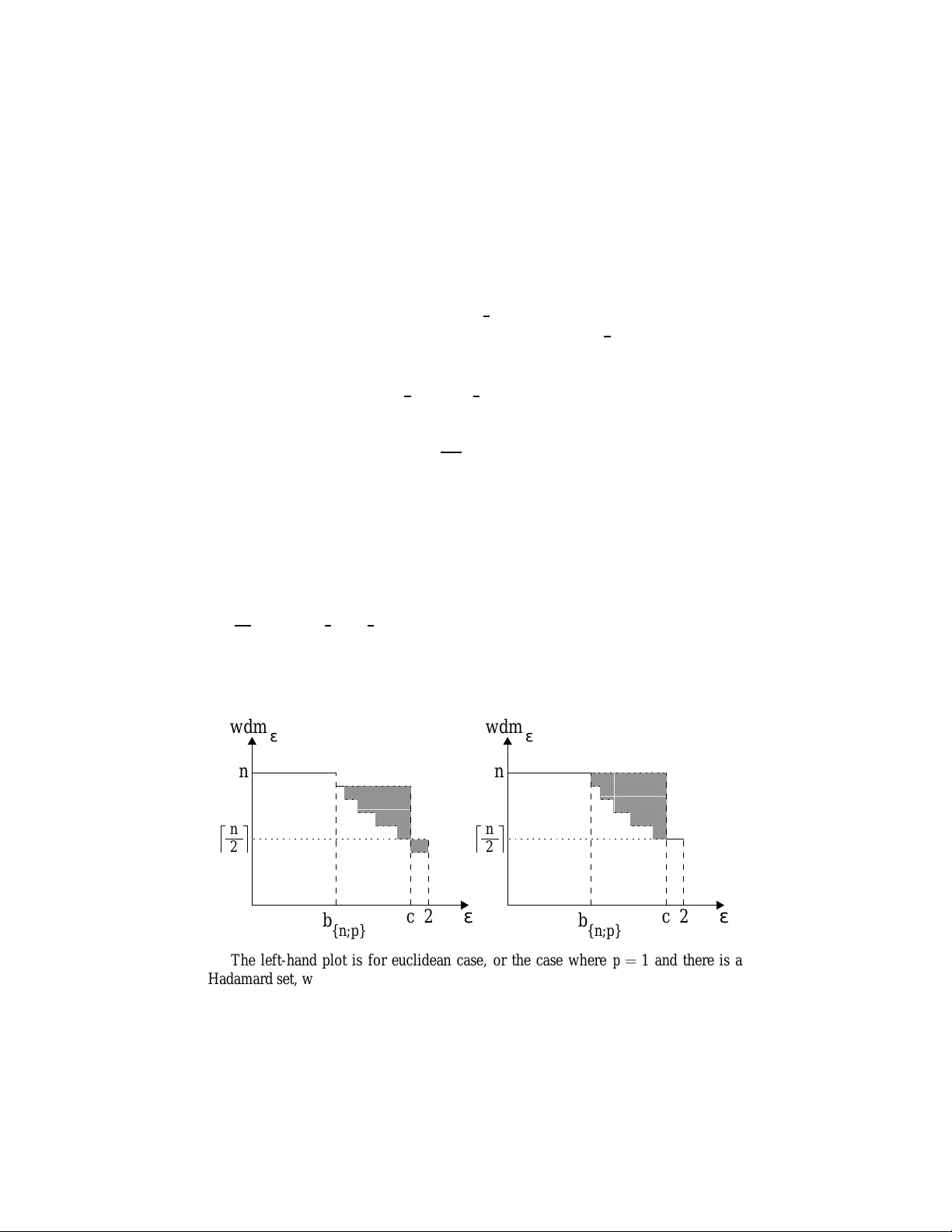
W idths of l p balls Antoine Gournay November 2, 2007 1 Introd uction Let ( X , d ) be a metric space and ε ∈ R > 0 , then we say a map f : X → Y is an ε - embedd ing if it is con tinuous a nd the diam eter o f th e fibres is less than ε , i.e. ∀ y ∈ Y , Diam f − 1 ( y ) ≤ ε . W e will use the notatio n f : X ε ֒ → Y . This type of maps, which can be traced at least to the work of Pon tryagin (see [13] o r [8]), is related to the no tion of Urysohn width (sometim es r eferred to as Alexandrov width), a n ( X ) , see [3]. It is the smallest real num ber such that there exists an ε -embedd ing from X to a n -d imensional polyhed ron. Surprisingly few estimation s of these numbers can be found, and one o f the aims of this paper is to present some. Howe ver , following [7], we shall introdu ce: Definition 1.1: wdim ε X is the smallest integer k such that there e xists an ε -embedding f : X → K where K is a k-dimen sional polyh edron. wdim ε ( X , d ) = inf X ε ֒ → K dim K . Thus, it is equivalent to be given a ll the Urysohn’ s widths or the who le data of wdim ε X as a function of ε . Definition 1.2: The wdim spectrum o f a metric sp ace ( X , d ) , denoted wspec X ⊂ Z ≥ 0 ∪ { + ∞ } , is the set of values taken by the map ε 7→ wdim ε X . The a n ( X ) obvio usly f orm an non-inc reasing sequence , an d the points o f wspec X are precisely th e integer s f or which it decr eases. W e shall be in terested in the widths of the f ollowing metric spaces: let B l p ( n ) 1 be the set g iv en by the unit b all in R n for the l p metric ( k ( x i ) k l p = ∑ | x i | p 1 / p ), but look at B l p ( n ) 1 with the l ∞ metric ( i.e. th e sup metric of the produ ct). T hen Proposition 1.3: wspec ( B l p ( n ) 1 , l ∞ ) = { 0 , 1 , . . . , n } , and, ∀ ε ∈ R > 0 , wdim ε ( B l p ( n ) 1 , l ∞ ) = 0 if 2 ≤ ε k if 2 ( k + 1 ) − 1 / p ≤ ε < 2 k − 1 / p n if ε < 2 n − 1 / p . The imp ortant outco me of th is theo rem is that for fixed ε , the wdim ε ( B l p ( n ) 1 , l ∞ ) is bo unded from below by min ( n , m ( p , ε )) and f rom above b y min ( n , M ( p , ε )) , wh ere m , M are ind epende nt of n . As an up shot high v alues can only b e reached f or small ε indepen dantly of n . It can be u sed to show that the mean d imension of the unit b all of 1 l p ( Γ ) , for Γ a countab le grou p, with the natural action of Γ and the weak- ∗ to polog y is zero when p < ∞ (see [14 ]). It is one of the possible w ays of proving the non-existence of action preserving homeomo rphisms between l ∞ ( Γ ) and l p ( Γ ) ; a simpler argument would be to notice that with the weak- ∗ topology , Γ sends all points of l p ( Γ ) to 0 while l ∞ ( Γ ) has many periodic orbits. The behaviour is quite different when balls are looked upon with their natural met- ric. Theorem 1.4: Let p ∈ [ 1 , ∞ ) , n > 1 , then ∃ h n ∈ Z satisfying h n = n / 2 for n ev en, h 3 = 2 and h n = n + 1 2 or n − 1 2 otherwise, such that { 0 , h ( n ) , n } ∪ ⊂ wspec ( B l p ( n ) 1 , l p ) ⊂ { 0 } ∪ ( n 2 − 1 , n ] ∩ Z . When p = 2 or when p = 1 and th ere is a Ha damard m atrix o f ran k n + 1 , then n − 1 also belongs to wspec ( B l p ( n ) 1 , l p ) . More pr ecisely , let k , n ∈ N with n 2 − 1 < k < n . Then there exists b n ; p ∈ [ 1 , 2 ] and c k , n ; p ∈ [ 1 , 2 ) such that if ε ≥ 2 then wdim ε ( B l p ( n ) 1 , l p ) = 0 if ε < 2 then wdim ε ( B l p ( n ) 1 , l p ) > n 2 − 1 if ε ≥ c k , n ; p then wdim ε ( B l p ( n ) 1 , l p ) ≤ k if ε < b k ; p then wdim ε ( B l p ( n ) 1 , l p ) ≥ k and, fo r fixed n and p , the sequence c k , n ; p is non -increasing . Fur thermor e, b k ; p ≥ 2 1 / p ′ 1 + 1 k 1 / p when 1 ≤ p ≤ 2 , whereas b k ; p ≥ 2 1 / p 1 + 1 k 1 / p ′ if 2 ≤ p < ∞ . Additionally , in the Euclidean case ( p = 2 ), we have that b n ;2 = c n − 1 , n ;2 = q 2 ( 1 + 1 n ) , while in the 2 -dimension al case b 2; p ≥ max ( 2 1 / p , 2 1 / p ′ ) for any p ∈ [ 1 , ∞ ] . Also, if p = 1 , and th ere is a Hadam ard matr ix in dimension n + 1 , then b n ;1 = c n − 1 , n ;1 = 1 + 1 n . Finally , when n = 3 , ∀ ε > 0 , wdim ε B l p ( n ) 1 6 = 1 and c 2 , 3; p ≤ 2 ( 2 3 ) 1 / p , which means in particular that c 2 , 3; p = b 3; p when p ∈ [ 1 , 2 ] . V ariou s techniqu es are in volved to ach iev e this result; they will be expo sed in sec- tion 3. While upper bou nds on wdim ε X are obtain ed by writing down explicit maps to a space of the pr oper dimension (th ese constructio ns u se Hada mard matrices), lower bound s are fo und as con sequences of the Borsuk- Ulam th eorem, the filling radius of spheres, and lower bou nds for th e diam eter of sets o f n + 1 p oints n ot con tained in an open hemisphere (obtain ed by methods very close to those of [9]). W e ar e also able to giv e a complete description in dimension 3 for 1 ≤ p ≤ 2. 2 Pr operties of wdim ε Here are a few well established results; they can be found in [1], [2], [11], and [12]. Proposition 2.1 : Let ( X , d ) and ( X ′ , d ′ ) be two metric spa ces. wdim ε has the f ollowing proper ties: a. If X admits a triangulation, wdim ε ( X , d ) ≤ d im X . 2 b . The function ε 7→ wdim ε X is non-in creasing. c. Let X i be the c onnected compo nents of X , then wdim ε ( X , d ) = 0 ⇔ ε ≥ max i Diam X i . d. If f : ( X , d ) → ( X ′ , d ′ ) is a co ntinuou s function such th at d ( x 1 , x 2 ) ≤ Cd ′ ( f ( x 1 ) , f ( x 2 )) where C ∈ ] 0 , ∞ [ , then wdim ε ( X , d ) ≤ wdim ε / C ( X ′ , d ′ ) . e. Dilations beh av e as expected , i.e. let f : ( X , d ) → ( X ′ , d ′ ) be an homeo morph ism such that d ( x 1 , x 2 ) = Cd ′ ( f ( x 1 ) , f ( x 2 )) ; this equality passes th rough to the wdim : wdim ε ( X , d ) = wdim ε / C ( X ′ , d ′ ) . f. If X is compact, then ∀ ε > 0 , wdim ε ( X , d ) < ∞ . Pr oof. They are bro ught forth by the follo wing remarks: a. If dim X = ∞ , the statement is trivial. For X a finite-dimensional space, it s uffices to look at the identity map from X to its triangulation T ( X ) , which is continu ous and injective, thus an ε -embeddin g ∀ ε . b . I f ε ≤ ε ′ , an ε -embedding is also an ε ′ -embedd ing. c. If wdim ε X = 0 the n ∃ φ : X ε ֒ → K where K is a totally discontin uous space. ∀ k ∈ K , φ − 1 ( k ) is both open and closed , which implies that it con tains at least one connected com ponent, consequen tly Diam X i ≤ ε . On the oth er hand, if ε ≥ Diam X i the map that sends every X i to a point is an ε -embedd ing. d. If wdim ε / C X ′ = n , there exists an ε C -embedd ing φ : X ′ → K with d im K = n . Noticing that the m ap φ ◦ f is an ε -em beddin g from X to K allows us to sustain the claimed inequality . e. This stateme nt is a simple application of the preceding for f and f − 1 . f. T o sh ow th at wdim ε is finite, we will use the ne rve of a c overing; see [8, § V .9] for example. Given a covering of X by balls of radius less than ε / 2, there e xists, by com pactness, a finite subcovering . Thu s, sending X to th e nerve of this finite covering is an ε -immersion in a finite dimen sional polyhedron . Another prope rty worth noticin g is that lim ε → 0 wdim ε ( X , d ) = d im X for com pact X ; we refer the reader to [1, prop 4.5 .1]. Reading [6, app.1] lea ds to b eliev e that th ere is a strong relatio n between wdim and the quantities d efined th erein (Rad k and Diam k ); the existence of a relation between wdim and the filling radiu s becomes a natural idea, implicit in [7, 1 .1B]. W e sh all make a small par enthesis to r emind the reader of the definition of this concept, it is advised to look in [6, §1] for a detailed discussion. Let ( X , d ) be a compact m etric space of d imension n , and let L ∞ ( X ) be the (Banach) space o f r eal-valued boun ded functio ns on X , with the n orm k f k L ∞ = sup x ∈ X | f ( x ) | . Th e metric on X y ields an isometric e mbeddin g o f X in L ∞ ( X ) , known as the Kuratows ki embedd ing: I X : X → L ∞ ( X ) x 7→ f x ( x ′ ) = d ( x , x ′ ) . 3 The triangle inequality ensures that this is an isometry: k f x − f x ′ k L ∞ = sup x ′′ ∈ X d ( x , x ′′ ) − d ( x ′ , x ′′ ) = d ( x , x ′ ) . Denote b y U ε ( X ) the neighborh ood of X ⊂ L ∞ ( X ) given b y all points at distance less than ε from X , i.e. U ε ( X ) = f ∈ L ∞ ( X ) inf x ∈ X k f − f x k L ∞ < ε . Definition 2.2: T he filling radiu s of a n - dimension al compac t metric space X , wr itten FilRad X , is defined as the smallest ε such that X bounds in U ε ( X ) , i.e. I X ( X ) ⊂ U ε ( X ) induces a trivial hom omorp hism in simplicial homolo gy H n ( X ) → H n ( U ε ( X )) . Thoug h FilRad can be defined fo r a n arbitrary emb edding , we will only be con- cerned with the Kurato w ski embedding. Lemma 2.3: Let ( X , d ) be a n -dimension al com pact metric space, k < n an integer, and Y ⊂ X a k -dimension al closed set representing a trivial (simplicial) hom ology class in H k ( X ) . Then ε < 2 FilRad Y ⇒ wd im ε ( X , d ) > k . If we remove the assumptio n that [ Y ] ∈ H k ( X ) be trivial, the inequ ality is n o longer strict: wdim ε ( X , d ) ≥ k . Pr oof. Let us show that wdim ε ( X , d ) ≤ k ⇒ ε ≥ 2FilRad Y . Giv en an ε -embedd ing φ : X ε ֒ → K , then φ ( Y ) ⊂ K bo unds, since φ ∗ [ Y ] = 0 as [ Y ] = 0 in H k ( X ) . Since dim K ≤ k = dim Y , th e chain repr esenting φ ( Y ) is trivial. Compactness of X allows us to suppose that φ is on to a compac t K . Other wise, we restrict the target to φ ( X ) . W e will now produ ce a map Y → L ∞ ( Y ) who se image is con tained in U ε / 2 ( Y ) , so tha t Y will bound in its ε 2 -neighb orhoo d. This will mean that ε ≥ 2FilRad Y . Let Q : K → L ∞ ( X ) k 7→ g k ( x ′′ ) = ε / 2 + inf x ′ ∈ φ − 1 ( k ) d ( x ′′ , x ′ ) , and ρ Y : L ∞ ( X ) → L ∞ ( Y ) f 7→ f | Y . First, notice that ρ Y ◦ Q ◦ φ ( Y ) ⊂ U δ + ε / 2 ( Y ) , ∀ δ > 0 : k ρ Y ◦ Q ◦ φ ( y ) − I Y ( y ) k L ∞ = sup y ′′ ∈ Y ε 2 + inf y ′ ∈ φ − 1 ( φ ( y )) d ( y ′′ , y ′ ) − d ( y ′′ , y ) = ε / 2 , since φ is an ε -embedd ing. Second, ( ρ Y ◦ Q ◦ φ ) ∗ [ Y ] = 0 and ( ρ Y ◦ Q ◦ φ ) ∼ I Y in U δ + ε / 2 ( Y ) , as L ∞ ( Y ) is a vector space . Co nsequently , [ I Y ( Y )] = 0 and ε ≥ 2FilRad Y , by letting δ → 0. If [ Y ] 6 = 0 ⊂ H k ( X ) , the proof still follo ws by tak ing K of dime nsion k − 1: the homolo gy class φ ∗ [ Y ] is then inevitably tri vial, since K has no rank k h omolo gy . Thus, calculating FilRad is a goo d starting point. The following lemma consists of a lo we r bound for FilRad: Lemma 2.4 : Let X be a closed conv ex set in a n -dimension al normed vector space. Suppose it contains a point x 0 such that the conve x h ull of n + 1 points on ∂ X whose diameter is < a excludes x 0 . Then FilRad ∂ X ≥ a / 2 , and, using lemma 2 .3, ε < a ⇒ wdim ε X = n . 4 Pr oof. Supp ose th at Y = ∂ X has a filling r adius less than a / 2 . Then, ∃ ε > 0 and ∃ P a polyhed ron such that Y boun ds in P , P ⊂ U a 2 − ε ( Y ) and that the simplices o f P have a diameter less than ε . T o any v er tex p ∈ P it is possible to associate f ( p ) ∈ I Y ( Y ) so that k p , f ( p ) k L ∞ ( Y ) < a 2 − ε . Let p 0 , . . . , p n be a n -simplex of P , Diam { f ( p 0 ) , . . . , f ( p n ) } < 2 ( a 2 − ε ) + ε < a − ε < a . Since I Y is an isometry , f ( p i ) can be s ee n as points of Y without changing the diameter of the set they form. The convex h ull of these f ( p i ) in B will not contain x 0 : the ir distance to f ( p 0 ) is < a which excludes x 0 . Let π b e the projectio n a way fro m x 0 , that is associate to x ∈ X , the poin t π ( x ) ∈ ∂ X on the half-line joining x 0 to x . Usin g π , the n -simp lex gen erated by the f ( p i ) yield s a simplex in Y . Th us we extended f to a retraction r from P to Y . Let c b e a n -chain of P which bounds Y , i.e. [ Y ] = δ c . A contradictio n beco mes appa rent: [ Y ] = r ∗ [ Y ] = r ∗ δ c = δ r ∗ c . Indeed, if that was to be true, Y , wh ich is n − 1 dim ensional would be bou nding an n - dimensiona l chain in Y . Hence FilRad Y > a / 2. This yields, for example: Lemma 2.5: ( cf. [7, 1.1B]) Let B be the unit ball of a n -dimension al Banac h space, then ∀ ε < 1 , wdim ε B = n . Pr oof. Any set o f n + 1 points on Y = ∂ B whose diameter is less than 1 does not contain the o rigin in its co n vex hu ll. So accord ing to lemm a 2. 4, FilRad Y > 1 / 2 , and since Y is a closed set o f dimen sion n − 1 whose homology class is trivial in B , we conclu de by applying lemma 2.3. Let us emphasise this impor tant fact on l ∞ balls in finite dimensio nal space. Lemma 2.6: Let B l ∞ ( n ) 1 = [ − 1 , 1 ] n be the unit cu be of R n with the pro duct (supremu m) metric, then wdim ε B l ∞ ( n ) 1 = 0 if ε ≥ 2 n if ε < 2 . This lemma will be used in the proo f of pro position 1.3. Its pr oof, wh ich uses th e Brouwer fixed po int theore m and the Leb esgue lemm a, can b e fo und in [ 12, lem 3.2 ], [2, prop 2.7] or [1, prop 4.5.4]. Pr oof of pr oposition 1.3: W e fir st show the lower b ound on wdim ε . I n a k -dimension al space, the l ∞ ball of rad ius k − 1 / p is included in the l p ball: B l ∞ ( k ) k − 1 / p ⊂ B l p ( k ) 1 , as k x k l p ( k ) ≤ k 1 / p k x k l ∞ ( k ) . Since B l p ( k ) 1 ⊂ B l p ( n ) 1 , by 2.1.d, we a re assured that, if B l p ( n ) 1 is considered with the l ∞ metric, ε < 2 k − 1 / p implies that wdim ε ( B l p ( n ) 1 , l ∞ ) ≥ k . T o get the up per bou nd, we g iv e explicit ε -embed dings to fin ite dim ensional poly- hedra. Th is will be done by pro jecting onto the union of ( n − j ) -dim ensional coo rdi- nates hyperplanes (who se points have at least j coor dinates equal to 0). Project a point x ∈ B l p ( n ) 1 by the map π j as follows: let m b e its j t h smallest coo rdinate (in absolu te value), set it and all the smaller coordinates to 0, other coord inates are substracted m if they are positi ve or added m if they are negative. 5 Denote by ~ ε an elemen t of {− 1 , 1 } n and ~ ε \ A the same vector in which ∀ i ∈ A , ε i is replaced by 0. The largest fibre of the map π j is π − 1 j ( 0 ) = ∪ ~ ε , i 1 ,..., i j − 1 { λ 0 ~ ε + ∑ 1 ≤ l ≤ j − 1 λ l ~ ε \{ i 1 ,..., i l } | λ i ∈ R ≥ 0 } ∩ B l p ( n ) 1 . Its d iameter is achieved by s 0 = ( n − j + 1 ) − 1 / p , . . . , ( n − j + 1 ) − 1 / p , 0 , . . . , 0 and − s 0 ; thus Diam π − 1 j ( 0 ) = 2 ( n − j + 1 ) − 1 / p . π j allows u s to assert that ε > 2 ( n − j + 1 ) − 1 / p ⇒ wdim ε ( B l p ( n ) 1 , l ∞ ) ≤ n − j , by realising a continuou s ma p in a ( n − j ) -dimen sional poly- hedron whose fibres are of diameter less than 2 ( n − j + 1 ) − 1 / p . The above pr oof f or an uppe r bou nd also g iv e s th at wdim ε ( B l p ( n ) , l q ) ≤ k if ε ≥ 2 ( k + 1 ) 1 / q − 1 / p , b u t the inclusion of a l q ball of pr oper r adius in the l p ball giv es a lower boun d that doe s no t meet these num bers. Also note that lemma 2.3 is efficient to e valuate width of tori, as the filling radius of a product is the minimum of the filling radius of each factor . 3 Evaluation of wdim ε B l p ( n ) 1 W e now f ocus on the com putation of wdim ε X f or unit ball in finite d imensional l p . Except for a f ew cases, the comp lete descriptio n is hard to gi ve. W e start with a simple example. Example 3.1 : Let B l 1 ( 2 ) be the unit ball of R 2 for the l 1 metric, then wdim ε B l 1 ( 2 ) = 0 if ε ≥ 2 , 2 if ε < 2 . If B l 1 ( 2 ) is endowed with the l p metric, then ε < 2 1 / p ⇒ wdim ε B l 1 ( 2 ) = 2. Pr oof. Given any three p oints whose conve x hull contains the orig in, two of them ha ve to be on opp osite sides, which means their d istance is 2 1 / p in the l p metric. Hen ce a radial p rojection is po ssible f or simplices whose vertices fo rm sets of diameter less than 2 1 / p . I n voking lemma 2. 4, FilRad ∂ B l 1 ( 2 ) ≥ 2 − 1 + 1 / p . Lemma 2.3 conclud es. Th is is specific to dimension 2 an d is co herent with lem ma 2.6, since, in dimen sion 2, l ∞ and l 1 are isometric. An interesting lower bound ca n be obtained thanks to the Borsuk-Ulam theorem ; as a remind er , this th eorem states that a map f rom the n - dimension al sphere to R n has a fibre containing two opposite points. Proposition 3.2: Let S = ∂ B l p ( n + 1 ) 1 be the unit s p here of a ( n + 1 ) -dimension al Banach space, then ε < 2 ⇒ w dim ε S > ( n − 1 ) / 2 . In particular, the sam e statement holds for B l p ( n + 1 ) 1 : ε < 2 ⇒ wd im ε B l p ( n + 1 ) 1 > ( n − 1 ) / 2 . 6 Pr oof. W e will show th at a map from S to a k -dim ensional p olyhed ron, for k ≤ n − 1 2 , sends two a ntipodal points to the same v a lue. Since radial projection is a hom eomor- phism between S a nd the Euc lidean sph ere S n = ∂ B l 2 ( n + 1 ) 1 that sen ds antipodal points to antipo dal points, it will be sufficient to show this for S n . Let f : S n → K be a n ε - embedd ing, where K is a polyhed ron, dim K = k ≤ ( n − 1 ) / 2 and ε < 2 . Since any polyhed ron of dimension k can b e em bedded in R 2 k + 1 , f extends to a map fro m S n to R n that does not a ssociate the same value to oppo site points, be cause ε < 2 . Th is contradicts Borsuk-Ulam the orem. The statem ent on the ball is a conseq uence o f th e inclusion of the sphere. Hence, wdim ε B l p ( n ) 1 always jumps f rom 0 to at least ⌊ n 2 ⌋ if they are eq uipped with their proper metric. A first upper bound. Tho ugh this fi rst step is very en courag ing, a precise evaluation of wdim can be c onv oluted , even for simple spaces. It seems t hat describing an explicit continuo us map with small fibers remains the best way t o get upper bou nds. Denote by n = { 0 , . . . , n } . Lemma 3.3: Let B be a unit ball in a normed n -dimension al real vector spac e. Let { p i } 0 ≤ i ≤ n be po ints on the sphere S = ∂ B that are not co ntained i n a closed hemisphere . Suppose that ∀ A ⊂ n with | A | ≤ n − 2 , and ∀ λ j ∈ R > 0 , where j ∈ n , if k ∑ i ∈ A λ i p i k ≤ 1 , k / ∈ A and k ∑ i ∈ A λ i p i − λ k p k k ≤ 1 , then k λ k p k k ≤ 1 . A set p i satisfying this assumption giv e s ε ≥ Diam { p i } : = max i 6 = j p i − p j ⇒ wdim ε B ≤ n − 1 . Pr oof. This will be d one by p rojecting the ball on the co ne with vertex at the origin over the n − 2 skeleton of the simplex spanne d by the poin ts p i . No te that n + 1 po ints satisfying the assumption of th is lemma cannot all lie in the same open hemisphere, howe ver we need th e stronger hyptothesis that they do not belong to a closed hemi- sphere. Now let ∆ n be the n -simplex given b y the con vex h ull of p 0 , . . . , p n . W e will project th e ball o n the various con vex hulls of 0 and n − 1 of the p i . Call E the radial projection o f elem ents o f the ball (sa ve th e o rigin) to the sphere, and let, fo r A ⊂ n , P A = { p 0 , . . . , p n } \ { p i | i ∈ A } . In particular, P ∅ is the set of all the p i . Fu rthermo re, denote by C X the con vex hu ll of X . Given the se notations, E C P { i } is the radial pro- jection of the ( n − 1 ) -simp lex C P { i } ( C P { i } does no t con tain 0 else the po ints would lie in a closed h emisphere ), and E C P { i , j } are p arts of the b ounda ry of this p rojection . Finally , consider , again for A ⊂ n , ∆ ′ A = C [ E C P A ∪ 0 ] . Let s i : ∆ ′ { i } → ∪ j 6 = i ∆ ′ { i , j } be the p rojection along p i . More precisely , w e claim that s i ( p ) is the uniqu e point of ∆ ′ { i , j } that also belongs to Λ p i ( p ) = { p + λ p i | λ ∈ R ≥ 0 } . Existence is a consequ ence of the fact that the po ints ar e no t con tained in an closed hemispher e, i.e. ∃ µ i ∈ R > 0 such that ∑ k ∈ n µ k p k = 0. Indeed , p ∈ ∆ ′ { i } , if p ∈ ∆ ′ { i , j } for some j , then there is nothing to show . Supp ose th at ∀ j 6 = i , p / ∈ ∆ ′ { i , j } . Th en p = ∑ k 6 = i λ k p k , where λ k > 0. Write p i = − 1 µ i ∑ k 6 = i µ k p k . It f ollows that for some λ , p + λ p i can be written as ∑ k ∈ n \{ i , j } λ ′ k p k with 0 ≤ λ ′ k ≤ λ k . Uniqueness co mes from a transversality observation. ∆ ′ { i , j } is co ntained in th e plane generated by the set P { i , j } 7 and 0 which is of codimension 1. If the line Λ p i ( p ) was to lie in that plane then the set P { j } would lie in th e same plane, and P ∅ would be contained in a clo sed hemisp here. Thus Λ p i ( p ) is transversal to ∆ ′ { i , j } . Th e figure below illustrates this projectio n in ∆ ′ { 0 } for n = 3. 1 p 2 p 3 p ∆ {0,1} ∆ {0,3} 0 p Our (candidate to be an) ε -embedding s is defined by s | ∆ ′ { i } = s i . Since on E C P { i } ∩ E C P { j } ⊂ E C P { i , j } , we see that s | ∆ ′ { i , j } = I d and that ∪ i ∈ n ∆ ′ { i } = B , this map is well- defined. It remain s to chec k that the d iameter of th e fibre s is bou nded by ε . W e claim that th e bigg est fibr e is s − 1 ( 0 ) = ∪ i C {− p i , 0 } , wh ose diame ter is that of the set of vertices of the simplex, Diam { p i } . T o see th is, note tha t for x ∈ ∆ ′ { i , j } , the diameter of s − 1 ( x ) attained on its extremal poin ts (b y con vexity o f the norm ), that is x an d points of the form x − λ k p k (for k ∈ A , where A ⊃ { i , j } an d x ∈ ∆ ′ A ⊂ ∆ ′ { i , j } ) whose nor m is one. Howe ver, sin ce x = ∑ λ i p i for i / ∈ A and λ i > 0, k x − λ k p k k = 1 implies k λ k p k k ≤ 1 , so a simple translation of s − 1 ( x ) is actually includ ed in s − 1 ( 0 ) . This allows us to ha ve a first look at the Euclidean case. Theorem 3.4: Let B l 2 ( n ) 1 be the unit ball of R n , endowed with the Euclidean metric, and let b n ;2 : = q 2 ( 1 + 1 n ) . Then , for 0 < k < n , wdim ε B l 2 ( n ) 1 = 0 if 2 ≤ ε , k ≤ wdim ε B l 2 ( n ) 1 < n if b k + 1;2 ≤ ε < b k ;2 , wdim ε B l 2 ( n ) 1 = n if ε < b n ;2 . Pr oof. First, wh en ε ≥ Diam B l 2 ( n ) 1 = 2 th is r esult is a sim ple co nsequen ce of prop osi- tion 2.1.c; wh en n = 1 it is sufficient, so suppose from no w on that n ≥ 2. Ap plying lemma 2. 3 to ∂ B l 2 ( n ) 1 ⊂ B l 2 ( n ) 1 yields that wdim ε B l 2 ( n ) 1 = n if ε < 2FilRad ∂ B l 2 ( n ) 1 , but FilRad B l 2 ( n ) 1 ≥ b n ;2 by Jung’ s theorem (see [4, §2.10 .41]) , as any set whose diameter is less tha n < b n ;2 is contained in a n open he misphere ([10] shows that FilRad B l 2 ( n ) 1 = b n ;2 ). On the othe r hand, balls o f dimension k < n are all in cluded in B l 2 ( n ) 1 , which means that wdim ε B l 2 ( k ) 1 ≤ wdim ε B l 2 ( n ) 1 , th anks to 2.1.d. Hence we h av e th at wd im ε B l 2 ( n ) 1 ≥ k when ever b k + 1;2 ≤ ε < b k ;2 . This proves the lower bounds. 8 The vertices o f the standard simplex satisfy the assumption of lemma 3.3: thanks to the inv ar iance of the n orm un der ro tation we can assume p 0 = ( 1 , 0 , . . . , 0 ) . The o ther p i will all have a negativ e first coordinate, and so will any positive linear combin ation. Substracting λ p 0 will be nor m increasing. As th e diameter of this set is b n ;2 , lemm a 3.3 gi ves the desired upper bound. Let us now gi ve an additional upper bound for the 3-dimensional case: Proposition 3.5: If 1 ≤ p < ∞ , then ε ≥ 2 ( 2 3 ) 1 / p ⇒ wdim ε B l p ( 3 ) 1 ≤ 2 . Pr oof. In R 3 there is a p articularly go od set of p oints to defin e our projectio ns. T hese are p 0 = 3 - 1 p ( 1 , 1 , 1 ) , p 1 = 3 - 1 p ( 1 , -1 , -1 ) , p 2 = 3 - 1 p ( -1 , 1 , -1 ) and p 3 = 3 - 1 p ( -1 , -1 , 1 ) . Let x = λ 1 p 1 , where λ ∈ [ 0 , 1 ] , and suppo se k λ 1 p 1 − λ 2 p 2 k l p ≤ 1 for λ 2 ∈ R ≥ 0 . W e have to check that λ 2 ≤ 1. Su ppose λ 2 > 1, then 1 ≥ k λ 1 p 1 − λ 2 p 2 k l p = 2 3 ( λ 1 + λ 2 ) p + 1 3 ( λ 2 − λ 1 ) p = λ p 2 [ 2 3 ( 1 + t ) p + 1 3 ( 1 − t ) p ] , where t = λ 1 / λ 2 . Th e fun ction of t has minimal value 1, which gi ves λ 2 ≤ 1 as desired. Suppose now that x = λ 1 p 1 + λ 2 p 2 is of nor m less than 1, wher e without loss of generality we assume λ 2 ≥ λ 1 , and k λ 1 p 1 + λ 2 p 2 − λ 3 p 3 k l p ≤ 1. k x k l p ≤ 1 implies that 1 ≥ 1 3 ( λ 1 + λ 2 ) p + 2 3 ( λ 2 − λ 1 ) p so ( λ 2 − λ 1 ) p ≤ 1 − 1 3 ( λ 2 + λ 1 ) p + 1 3 ( λ 2 − λ 1 ) p ≤ 1. If λ 3 > 1, then 1 ≥ k λ 1 p 1 + λ 2 p 2 − λ 3 p 3 k l p = 1 3 ( λ 3 + λ 2 + λ 1 ) p + 1 3 ( λ 3 − ( λ 2 − λ 1 )) p + 1 3 ( λ 3 + ( λ 2 − λ 1 )) p . Howe ver, λ p 3 ≤ 1 3 ( λ 3 + λ 2 + λ 1 ) p + 2 3 λ p 3 ≤ 1 3 ( λ 3 + λ 2 + λ 1 ) p + 1 3 ( λ 3 − ( λ 2 − λ 1 )) p + 1 3 ( λ 3 + ( λ 2 − λ 1 )) p ≤ 1 . Using that f ( t ) = ( 1 + t ) p + ( 1 − t ) p has minimu m 2 for t ∈ [ 0 , 1 ] . These a rguments can be repea ted for any indices to show th at the points p i , where i = 0 , 1 , 2 or 3, s a tisfy the assumption of lemma 3.3. The conclu sion follows by showing that Diam ( p i ) = 2 ( 2 3 ) 1 / p For certain dim ensions, a set of points th at allows to build projections with small fibers can be fou nd. Their descr iptions require the con cept of Hadamard matrices of rank N ; these are N × N matrices, that will be den oted H N , whose entries are ± 1 and such that H N · H t N = N Id. I t has b een shown th at they can o nly exist when N = 2 or 4 | N , and it is co njectured that this is pr ecisely when they exist. Up to a perm utation and a sign, it is po ssible to write a m atrix H N so that its first column and its first row consist only of 1s. It is quite easy to see that two rows or colu mns of such a matrix have exactly N / 2 identical elements. Definition 3 .6: Let H N be a Hadamard matrix of ran k N , and let, for 0 ≤ i ≤ N , h i be the i th row of the matrix withou t its first entry (wh ich is a 1). Then the h i form a Hadamard set in dimension N − 1. 9 These N elements, n ormalised so that k h i k l p ( N − 1 ) = 1 . When so n ormalised, the ir diameter ( for th e l p metric) is 2 1 − 1 / p ( 1 + 1 N − 1 ) p . Since ∑ h i = 0, by o rthogo nality of the columns with the column of 1 that was rem oved, we see that the y are not contained in an o pen h emisphere. Th e set of po ints in the p receding pro position was given by a Hadamard matrix o f rank 4, and when p = 2 the convex hu ll of these p oints is ju st the standard simplex. Proposition 3.7: Suppose there exists a Hadamard matrix of rank n + 1 , then ε ≥ 1 + 1 n ⇒ wdim ε B l 1 ( n ) 1 ≤ n − 1 . Pr oof. Let the h i be as a bove, and N = n + 1 . Note th at fo r i 6 = j , h i and h j have N 2 opposed coor dinates, and N 2 − 1 iden tical ones. Thus λ i h i − λ j h j has always a big- ger l 1 norm th an any of its two sum mands. In deed, the coefficients c j of the vector ∑ i ∈ A λ i h i where the contribution o f h k reduces c j are in lesser number than those that get increased. Since the l 1 norm is linear , the magnitude of the c j getting smaller is not relev ant, only their number . W e conclu de by app lying lemma 3.3, as Diam l 1 ( h i ) = 1 + 1 N − 1 . Note that in dimension higher th an 3 and for p > 2, Hadamard sets no lo nger satisfy the assumption of lemma 3.3. Further upper bounds for wdim ε B l p ( n ) 1 . The projectio n argument still w o rks for non-E uclidean spheres. It can also be repeated , thoug h unef ficien tly , to construct maps to lower dimen sional polyhedra. Proposition 3.8: For 1 < p < ∞ , consider th e sphe re B l p ( n ) 1 with its natural metr ic. Then, for n − 1 2 < k < n , ∃ c k , n ; p ∈ [ 1 , 2 ) such that c k , n ; p ≥ c k + 1 , n ; p , and wdim ε B l p ( n ) 1 ≤ k if ε ≥ c k , n ; p . Furthermo re c n − 1 , n ;2 = b n ;2 Pr oof. This p ropo sition is also o btained by constru cting explicitly maps that red uce dimension (up to n − j for j < n + 1 2 ) and whose fibres are small. Un fortun ately , n othing indicates this is optimal, and the size of the preimages is hard to determine. W e will abbreviate B : = B l p ( n ) 1 . W e procee d by induction, and keep the notations introduced in the proof of lemma 3.3. The p i that are used here are the vertices of the simplex; th ey need to be renor- malised to be of l p -norm 1, but n ote that multiplyin g th em by a c onstant h as actua lly no effect in this argument. Also no te that the sets ∆ ′ A are not the same for different p , since they are constructed by radial projection to different spheres. Th e keys to this constru ction are the maps s j ; { i 1 ,..., i j } : ∆ ′ { i 1 ,..., i j } → ∪ m / ∈{ i 1 ,..., i j } ∆ ′ { i 1 ,..., i j , m } giv en by projection along the vectors j ∑ l = 1 p i l . Call σ 1 the fun ction s from lemma 3.3, then, f or 10 j > 1, σ j : B → ∪ { i 1 ,..., i j + 1 }⊂ n ∆ ′ { i 1 ,..., i j + 1 } is obtained by compo sing, on appr opriate do- mains, s j ; { i 1 ,..., i j } with σ j − 1 . Since s j ; i 1 ,..., i j are equal to the identity when their dom ain intersect, and their u nion covers the image of σ j − 1 , the map is again well-defined . It remains only to calculate the diameter of the fibres. At 0 the fibre is σ − 1 j ( 0 ) = ∪ { i 1 ,..., i j }⊂ n {− ( λ 1 + . . . + λ j ) p i 1 − ( λ 1 + . . . + λ j − 1 ) p i 2 − . . . − λ 1 p i j | λ i ∈ R ≥ 0 } . Whereas f or a g iv en x ∈ ∆ ′ A in the ima ge ( that is A co ntains at least j elements), x can also be written down as a comb ination ∑ λ i p i , for i / ∈ A an d λ i ∈ R > 0 . W e have σ − 1 j ( x ) = ∪ { i 1 ,..., i j }⊂ A { x − ( λ 1 + . . . + λ j ) p i 1 − ( λ 1 + . . . + λ j − 1 ) p i 2 − . . . − λ 1 p i j | λ i ∈ R ≥ 0 } . If we set c k , n = sup x ∈ σ j ( B ) Diam σ − 1 n − k ( x ) , then w hen ε ≥ c k , n , wdim ε B l 2 ( n ) 1 ≤ k . It is possible to determine two simple facts abo ut these numbe rs. First, they are non -increasing c k , n ≥ c k + 1 , n , which is obvious as the construction is done by induc tion, the s ize of th e fiber of maps to lower dimension is bigger than for map s to higher dimension. Second, they ar e meaningf ul: c k , n < 2. Ind eed, wh en p 6 = 1 , ∞ , c k , n = 2 only if σ − 1 n − k ( x ) con tains oppo site points, which is a line ar condition . Whe n x 6 = 0, by conve x ity of the distance, the points on which the diameter can be attained are at the bound ary of σ − 1 j ( x ) . Say Y is the set of tho se p oint except x . The distance from Y to x is at most one, while the diameter of Y is bou nded. In deed, there is a cap of d iameter less than 2 that c ontains all th e p i but on e. The biggest dia meter of such caps is also less than 2 and bounds Diam Y . Any poin t o f the fibre at 0 is a linear combin ation of the vertices p i , a nd the re is on ly one linear relation between these, namely ∑ p i = 0. As long as j < n + 1 2 ( i.e. k > n − 1 2 ) there are not enoug h p i in any two sets that fo rm σ − 1 j ( 0 ) to combine into the req uired relations, but as soon as j exceeds this bou nd, opposite points are easily found. For B l p ( n ) 1 , where 1 < p < ∞ , we used the regular simplex to describ e our projec- tions, though noth ing indicates th at th is cho ice is th e m ost appr opriate. In fact, many sets of n + 1 points allow to build pro jections to a p olyhed ron, but it is hard to tell wh ich are m ore effecti ve: o n o ne hand we need th is set to hav e a small diam eter (so th at the fibre at 0 is small), while on th e other, we need it to be somehow well spread (so as to avoid fibres at x to be too large, as in the assump tion o f lemma 3.3). Fu rthermo re, there is in g eneral no reaso n for c n − 1 , n ; p to coincid e with a lower bound , or even to be different from other c k ; p , thus we cannot alw a ys insure that n − 1 ∈ wspec ( B l p ( n ) 1 , l p ) . The lowest non zero element of wspec . Before we return to the gener al l p case, no- tice that tog ether p roposition 3 .2 and th eorem 3.4 g i ve a go od p icture of the functio n wdim ε B l 2 ( n ) 1 . It equals n for ε < b n ;2 = c n − 1 , n ;2 , then n − 1 for b n ;2 ≤ ε < b n − 1;2 . After- wards, I cou ld n ot show a strict in equality for th e c k , n ;2 , but even if they are all equ al, wdim ε B l 2 ( n ) 1 takes at least one value in ( n 2 − 1 , n 2 + 1 ) ∩ Z . Then ,wh en ε ≥ 2, it d rops to 0. 11 For odd dimensional balls, th ere is a gap b etween the value g iv en b y propo sition 3.2 and the lowest dimen sion obtained by the p rojections introd uced above. Say B is of dimension 2 l + 1 an d ε less than but suf ficiently clo se to 2, then on one hand we k now that wd im ε B ≥ l , while on th e oth er wd im ε B ≤ l + 1. It is thu s worthy to a sk whether one of these two methods can be imp roved, p erhaps by using extra homolog ical in- formation o n th e simp lices in the proof o f p roposition 3. 2 ( e.g. if its h ighest degree cohomo logy i s trivial then a k -d imensiona l polyhedron is embeddable in R 2 k , see [5]). Remark 3. 9 : Such an imp rovement is actually av ailable wh en n = 3: if th e 2 -dimensio nal sphere maps to a 1-dimensional polyh edron ( i. e. a graph ), the map lifts to the universal cover , a tree K . Hence K is embedd able in R 2 , and, for 1 < p < ∞ . ε < 2 ⇒ w dim ε B l p ( 3 ) 1 ≥ 2 for otherwise it would contradict Borsuk-Ulam theorem. Note that estimates obtained in [6, app 1 .E5] for Diam 1 , c an also yield lower b ounds for th e diameter of fibres for map s to graphs ( i.e. 1-dimension al polyh edra). Applied to spheres, it becomes a special case of proposition 3.2 and of the above remark . Lower bounds for wd im ε B l p ( n ) 1 . The remaind er of this sectio n is dev oted to the im- provement of lower bound s, using an ev aluation of the filling rad ius as a prod uct of lemma 2.4, and a short discussion of their sharpness. W e shall tr y to find a lower boun d on the diam eter of n + 1 po ints on the l p unit sphere that are not in an open hemisphere; recall that points f i are not in an open hemispher e if ∃ λ i such th at ∑ λ i f i = 0 . A dir ect use of Jung’ s constant (defined as th e supremum over all con vex M of the radius of the smallest b all that contains M divided by M ’ s dia meter) that is clev e rly es timated for l p spaces in [9] does not yield the result like it did in the Euclidean case. This is du e to the f act that t h ere are s ets of n + 1 points on the spher e that are n ot con tained in an open h emisphere, but are contained in a ball (not centered at the origin) of radius less than 1. The set of points giv e n by (3.10) ( 1 , . . . , 1 ) , − 2 n − 1 , . . . , − 2 n − 1 , 1 , . . . , and 1 , − 2 n − 1 , . . . , − 2 n − 1 is such an exam ple for l ∞ , an d deformin g it a little can make it work for th e l p case, p finite but close to ∞ . Ho w ev er, a very minor adaptatio n of the metho ds given in [9] is sufficient. First, we intro duce nor ms fo r th e spaces of sequen ces (and matrices) tak ing v al- ues in a Banach space E . Let α i ∈ R ≥ 0 be such th at n ∑ i = 0 α i = 1 and deno te by α th is sequence of n + 1 real numbers. Let E p , α be the space of sequenc es made of n + 1 ele- ments of E and consider the l p norm weighted by α : k x k E p , α = ∑ i α i k x i k p E 1 / p where x = ( x 0 , . . . , x n ) . On the other ha nd, E p , α 2 shall repre sent the space of matrices whose entries are in E , with th e n orm ( x i , j ) E p , α 2 = ∑ i , j α i α j x i , j p E 1 / p . Now define, for E , E ′ Banach spaces based on th e same vector space and f or 1 ≤ s , t ≤ ∞ , the linear operator T : E s , α → E ′ t , α 2 by ( x i ) 7→ ( x i − x j ) . 12 Theorem 3.11 : Consider a vecto r space on which two no rms ar e d efined, and denote by E 1 , E 2 the Banach sp ace they form. Let f i ∈ E ∗ 1 , 0 ≤ i ≤ n , be such that k f i k E ∗ 1 = 1 but th at they are not included in an op en hemisphere, i.e. there exists λ i ∈ R ≥ 0 such that ∑ λ i f i = 0 and ∑ λ i = 1 . Let Diam E ∗ 2 ( f ) = sup 0 ≤ i , j ≤ n f i − f j E ∗ 2 be the diameter o f this set with respect to the other norm. Then, for α i = λ i , Diam E ∗ 2 ( f ) ≥ 2 sup 1 ≤ s , t ≤ ∞ 1 + 1 n 1 / t ′ sup E 1 k T k − 1 ( E 1 ) s , α → ( E 2 ) t , α 2 . Pr oof. As the f i are not in an open hemisph ere, re al n umbers λ i ∈ R ≥ 0 such that ∑ λ i = 1 and ∑ λ i f i = 0 e x ist. Fur thermor e, since k f i k E ∗ 1 = 1, there also e xist x i ∈ E 1 such that f i ( x i ) = 1 an d k x i k E 1 = 1. The remar k on which the estimation relies i s, as in [9], 2 = n ∑ i , j = 0 λ i λ j ( f i − f j )( x i − x j ) . Choosing α i = λ i , th is equality can be re w ritten in the form 2 = ( T f )( T x ) , where T x ∈ ( E 2 ) t , α 2 and T f ∈ (( E 2 ) t , α 2 ) ∗ = ( E ∗ 2 ) t ′ , α 2 , and thus 2 ≤ k T f k ( E ∗ 2 ) t ′ , α 2 k T x k ( E 2 ) t , α 2 . Notice that ∑ i 6 = j α i α j = n ∑ i = 0 α i ( 1 − α i ) ≤ 1 − 1 n + 1 = n n + 1 , because k α i k l 1 ( n + 1 ) = 1 ⇒ k α i k l 2 ( n + 1 ) ≥ ( n + 1 ) − 1 / 2 . W e can isolate the required di- ameter: k T f k ( E ∗ 2 ) t ′ , α 2 = n ∑ i = 0 α i α j f i − f j t ′ E ∗ 2 1 / t ′ ≤ Diam E ∗ 2 ( f ) ∑ i 6 = j α i α j 1 / t ′ ≤ Diam E ∗ 2 ( f ) n n + 1 1 / t ′ . On the other hand, k x i k E 1 = 1, conseq uently k x k ( E 1 ) s , α = 1, so we bou nd k T x k ( E 2 ) t , α 2 ≤ k T k ( E 1 ) s , α → ( E 2 ) t , α 2 . The con clusion is found by substitution of the estimates for the norms o f T f and T x . W e on ly quo te the next result, as there is no altera tion need ed in that p art of the argument of Pichug ov and Ivanov . Theorem 3.12: ( cf. [9, thm 2]) if 1 ≤ p ≤ 2 , k T k ( l p ( n )) ∞ , α → ( l p ( n )) p , α 2 ≤ 2 1 / p n n + 1 1 / p − 1 / p ′ , if 2 ≤ p ≤ ∞ , k T k ( l p ( n )) ∞ , α → ( l p ( n )) p , α 2 ≤ 2 1 / p ′ . A simp le substitution in theorem 3.1 1, with E 1 = E 2 = l p ( n ) , s = ∞ a nd t = p , yields the desired inequalities. 13 Corollary 3.13: Let f i , 0 ≤ i ≤ n , be points on the unit sphere of l p ( n ) that are n ot included in an open hemisphere, then if 1 ≤ p ≤ 2 , Diam l p ( n ) ( f ) ≥ 2 1 / p ′ 1 + 1 n 1 / p , ( ∗ ) if 2 ≤ p ≤ ∞ , Diam l p ( n ) ( f ) ≥ 2 1 / p 1 + 1 n 1 / p ′ . ( ∗∗ ) Remark 3.14 : Before we tu rn to the co nsequen ces o f this r esult on wdim ε , note that there are examp les f or which the first inequality is attained . These ar e th e Had amard sets defined in 3.6. When normalised to 1, they are not inc luded in an open hemisphere and of the prop er diame ter . Hence, when a Hadamard m atrix of rank n + 1 e x ists, then ( ∗ ) is o ptimal. No thing so con clusiv e can be said f or other dimen sions, see the argument in example 3.1. I ig nore if there are cases for which ( ∗∗ ) is optimal, tho ugh it is very easy to construct a family F n ∈ ( B l p ( n ) 1 ) n + 1 such that Diam F n → 2 1 / p as n → ∞ . In particular for p = ∞ , the points gi ven in (3.10) b ut by substituting − 1 n − 1 instead of the entries with value − 2 n − 1 , is a set that is not co ntained in an o pen h emisphere and whose diameter is n n − 1 , which is close to the bou nd given. Someh ow , th is case, is also the one where the u se of lemma 2.4 re sults in a b ound that is quite far from th e righ t value of wdim, cf. lemma 2.6. This might not be so surprising as s e ts with small diameter on l p balls seem, when p > 2 , to differ from sets satisfying the assumption of lemma 3.3. Still, by lemma 2.4 we obtain the following lo wer bou nds on wdim: Corollary 3.1 5: Let b k ; p be defined by b k ; p = 2 1 / p ′ 1 + 1 k 1 / p when 1 ≤ p ≤ 2 , wher eas b k ; p = 2 1 / p 1 + 1 k 1 / p ′ if 2 ≤ p < ∞ . Then , for 0 < k ≤ n , ε < b k ; p ⇒ wdim ε B l p ( n ) 1 ≥ k . Pr oof. Let Y = ∂ B l p ( n ) 1 . Sin ce the conve x hu ll of a set of n + 1 points on the spher e Y will not con tain the origin if the diam eter of th e set is larger than b n ; p , lemma 2.4 ensures that FilRad Y ≥ b n ; p / 2. W e then use lemma 2.3 for Y to conclude. These inequatio ns might not be optimal, propo sition 3.2 for example is al ways stronger when k < ⌊ n 2 ⌋ . In dimension n , B l ∞ ( n ) n − 1 / p ⊂ B l p ( n ) 1 yields that ε < 2 n − 1 / p ⇒ wdim ε B l p ( n ) 1 = n which improves corollary 3.15 as long as p ≥ ln ( 2 n 2 n + 1 ) ln ( 2 n n + 1 ) . Howe ver, when p = 1, and H n + 1 is a Hadamard matrix, these estimates are as sharp as we can hope since the lower bound meets the upp er bounds. Corollary 3.16 : Suppose there is a Hadamard matrix of rank n + 1 . Then , for 0 ≤ k < n , wdim ε B l 1 ( n ) 1 = 0 if 2 ≤ ε , max ( n − 1 2 , k ) ≤ wdim ε B l 1 ( n ) 1 < n if ( 1 + 1 k + 1 ) ≤ ε < ( 1 + 1 k ) , wdim ε B l 1 ( n ) 1 = n if ε < ( 1 + 1 n ) . 14 Furthermo re, in d imension 3, lower bou nds of cor ollary 3.15 me et upper b ounds of proposition 3. 5 wh en 1 ≤ p ≤ 2. In particu lar , thank s to remark 3.9, this gives a complete description of the 3-dimen sional case for such p . Corollary 3.17: Let p ∈ [ 1 , 2 ] , then wdim ε B l p ( 3 ) 1 = 0 if 2 ≤ ε , 2 if 2 ( 2 3 ) 1 / p ≤ ε < 2 , 3 if ε < 2 ( 2 3 ) 1 / p . When p > 2, all th at can be said is tha t the value of ε for which wdim ε B l p ( 3 ) 1 drops from 3 to 2 is in the interval [ 2 ( 2 3 ) 1 − 1 / p , 2 ( 2 3 ) 1 / p ] . This last cor ollary is special to th e 3-d imensional case, which happen s to be a dimension where th ere exist a Hadamard set, and where th e Borsuk-Ulam argument can be improved to r ule ou t maps to n − 1 2 -dimension al polyh edra. For example, in the 2-dimen sional case, a prec ise description is not so easy . Indeed, thanks to example 3.1 and using the inclusion of B l 1 ( 2 ) 1 ⊂ B l p ( 2 ) 1 , we kno w th at wdim ε B l p ( 2 ) 1 = 2 when ε ≥ 2 1 / p . On the other hand, the inclusion of B l ∞ ( 2 ) 2 − 1 / p ⊂ B l p ( 2 ) 1 giv es ε ≥ 2 1 / p ′ ⇒ wdim ε B l p ( 2 ) 1 = 2. Putting these together yields: ε ≥ max ( 2 1 / p , 2 1 / p ′ ) ⇒ wdim ε B l p ( 2 ) 1 = 2 . These simple estimates in dim ension 2 are be tter tha n coro llary 3.15 as lon g as p ≤ 3 − ln 3 ln 2 or p ≥ ln ( 8 3 ) / ln ( 4 3 ) . I do ubt that any of these estimations actually g iv es the value of ε where wdim ε B l p ( 2 ) 1 drops from 2 to 1. All the resu lts of this section can be summa rised to give theo rem 1.4. Here ar e two d epictions of the situation . Gray areas co rrespon d to possible values, full lines to known values and dotted line to bounds. 0000 0000 0000 0000 0000 0000 1111 1111 1111 1111 1111 1111 00000 00000 00000 00000 00000 00000 11111 11111 11111 11111 11111 11111 b {n;p} n 2 wdm ε 2 ε c n b {n;p} n 2 wdm ε 2 ε c n The left- hand plot is for eu clidean case, o r the c ase wh ere p = 1 and there is a Hadamard set, wh en the dimensio n is o dd and d ifferent from 3: th is is when a map to a n − 1-d imensional po lyhedr on with small fiber s can be constructed , but the bou nds from th e Borsuk- Ulam argumen t and pro jections to lower d imensional polyh edron do not meet. The right-hand on e re presents the situation in cases wh ere the dimension is 15 ev en and there is no known pro jection with small fib ers. c ⌈ n / 2 ⌉ , n ; p is ab breviated by c . The case of dimension 3 is described in corollary 3.17. It is no t expected that n − 1 2 be in wspec whe n n is od d, no r is it expec ted that the lower boun ds b k ; p be sharp for B l p ( n ) 1 when k < n . Refer ences [1] M ichel Coornaert. Dimension topologiqu e et s y st ` emes dynamiques , volume 14 of Cours Sp ´ ecialis ´ es . Soci ´ et ´ e Math ´ ema tique de France, P ar is, 2005. [2] M ichel Coorn aert an d Fabrice Krieger . Mean to polog ical dimen sion f or actions of discrete amenable groups. Discr ete Contin. Dyn. Syst. , 13(3) :779–7 93, 20 05. [3] Alexan der N. Dranishnikov . Hom ological dimension th eory . Uspekh i Mat. Nauk , 43(4( 262)) :11–55, 255, 1988 . [4] He rbert Federer . Geometric measur e theory . Die Grundleh ren der mathema- tischen W issenschaften, Band 15 3. Springer-V erlag New Y ork I nc., Ne w Y ork, 1969. [5] Rog er Fenn. Embe dding polyhedra. Bull. London Math. Soc. , 2:316–3 18, 197 0. [6] M ikhael L . Gr omov . Filling Riemannian manifolds. J. Differ en tial Geom. , 18(1) :1–147 , 19 83. [7] M ikhael L. Gromov . T opolo gical inv arian ts of d ynamica l systems and spaces of holomo rphic maps. I. Math. Phys. Anal. Geom. , 2(4):323– 415, 1999. [8] Witold Hure wicz and Henry W allman. Dimension Theo ry . Princeton Mathemat- ical Series, v . 4. Princeton University Press, Princeton , N. J . , 1941 . [9] V alerii I. Ivanov an d Sergei A. Pichugov . Jung co nstants in l n p -spaces. Mat. Zametki , 48(4) :37–47 , 15 8, 1990. [10] Mikh ail Katz. The fill ing radius o f two-point hom ogeneo us spaces. J. Differ entia l Geom. , 18(3):50 5–51 1, 198 3. [11] Elo n Lindenstrau ss. Mean dimension, small entro py factors a nd an embedding theorem. Inst. Hautes ´ Etudes Sci. Publ. Math. , (89) :227–2 62 ( 2000) , 1999. [12] Elo n Linden strauss and Ben jamin W eiss. Mean topolo gical dimension. Israel J. Math. , 115:1–2 4, 2000 . [13] Lev S. Pontryagin . Application of comb inatorial topology to compact metric spaces. Uspekh i Mat. Nauk , 39(5(23 9)):13 1–164, 1984 . [14] Masak i Tsukamo to. Mean dimension o f the unit b all l p . h ttp://www .math.kyoto- u.ac.jp/p r eprint/2 007/10 tsukamoto.pdf . 16
Original Paper
Loading high-quality paper...
Comments & Academic Discussion
Loading comments...
Leave a Comment