Sharing Energy Storage Between Transmission and Distribution
This paper addresses the problem of how best to coordinate, or `stack,' energy storage services in systems that lack centralized markets. Specifically, its focus is on how to coordinate transmission-level congestion relief with local, distribution-le…
Authors: Ryan Elliott, Ricardo Fern, ez-Blanco
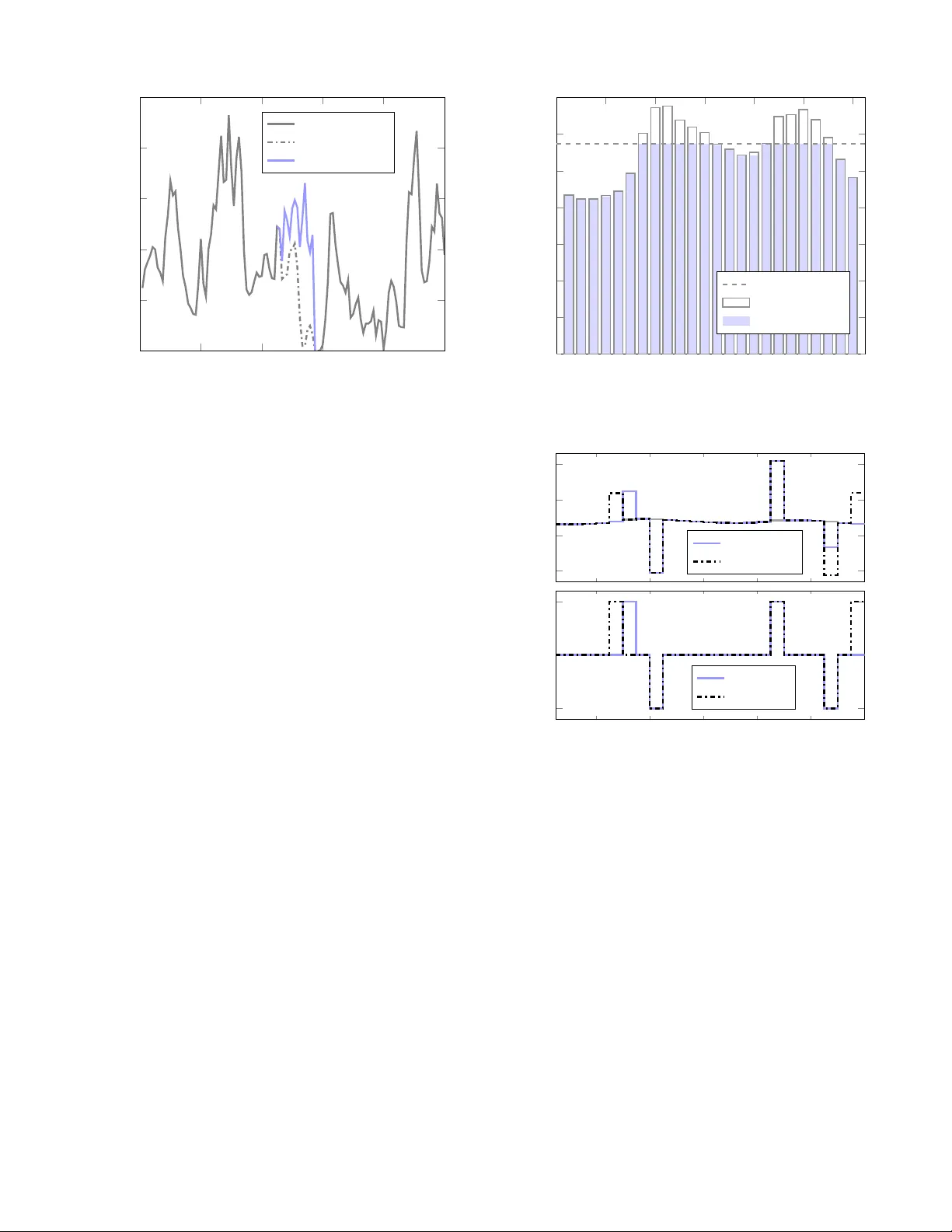
1 Sharing Ener gy Storage Between T ransmission and Distrib ution Ryan T . Elliott, Ricardo Fern ´ andez-Blanco, K elly Kozdras, Josh Kaplan, Brian Lock year , Jason Zysko wski, and Daniel S. Kirschen Abstract —This paper addresses the pr oblem of how best to co- ordinate, or “stack, ” energy storage services in systems that lack centralized markets. Specifically , its focus is on how to coordinate transmission-level congestion r elief with local, distribution-le vel objectives. W e describe and demonstrate a unified communication and optimization framework f or performing this coordination. The congestion relief problem formulation employs a weighted ` 1 -norm objective. This approach determines a set of corrective actions, i . e ., energy storage injections and con ventional generation adjustments, that minimize the requir ed deviations from a planned schedule. T o exercise this coordination framework, we present two case studies. The first is based on a 3-bus test system, and the second on a realistic repr esentation of the Pacific Northwest region of the United States. The results indicate that the scheduling methodology provides congestion relief, cost savings, and impro ved renewable energy integration. The large- scale case study informed the design of a live demonstration carried out in partnership with the Uni versity of W ashington, Doosan GridT ech, Snohomish County PUD, and the Bonneville Po wer Administration. The goal of the demonstration was to test the feasibility of the scheduling framework in a production en vironment with real-world energy storage assets. The demon- stration results wer e consistent with computational simulations. Index T erms —Distrib ution system operator , energy storage sys- tem, mixed-integer linear programming, state of charge, transmis- sion congestion, transmission system operator , unit commitment. I . I N T RO D U C T I O N U TILITY -SCALE energy storage has the potential to provide non-wire solutions to longstanding power grid problems. For example, distribution system operators (DSOs) could use energy storage to help reduce energy imbalance expenses or to serve their load more economically through energy arbitrage. Likewise, transmission system operators (TSOs) could use energy storage to mitigate congestion or provide frequency regulation. While the prospect of employing energy storage to tackle these challenges has drawn immense interest, the question of how best to coordinate, or “stack, ” services remains open. A systematic approach to service coordination would not only help maximize resource utilization, but also bolster the financial viability of energy storage projects. In this work, we describe and demonstrate a unified commu- nication and optimization frame work for scheduling multiple R. T . Elliott, K. K ozdras, and D. S. Kirschen are with the University of W ashington Department of Electrical Engineering in Seattle, W A 98195 USA (e-mail: ryanelliott@ieee.org). R. Fern ´ andez-Blanco is with the Department of Applied Mathemat- ics at the University of Malaga, Malaga 29076 Spain (e-mail: ri- cardo.fcarramolino@uma.es). J. Kaplan and B. Lockyear are with Doosan GridT ech in Seattle, W A. J. Zysko wski is with Snohomish County PUD in Everett, W A. simultaneous storage services between a TSO and one or more DSOs. T o address this problem, we propose a multistage approach based on mixed-integer linear programming. T o demonstrate the viability of the framew ork, it was implemented and used to control a utility-scale battery energy storage system (ESS) in Ev erett, W A. This battery is owned and operated by Snohomish County PUD (SnoPUD), and offers services to the Bonneville Power Administration (BP A). The scheduling frame work presented here reflects the op- erating en vironment of the Pacific Northwest region of the United States; howe ver , it is also suitable for systems that lack centralized markets or that rely heavily upon bilateral contracts. This is the case, for example, in lar ge parts of Europe [1]. Furthermore, the ideas developed in this paper may inspire new approaches to ener gy storage scheduling in systems that do have centralized mark ets. A. Literatur e re view The concept of pro viding multiple simultaneous services with storage resources has generated acti ve discussion throughout academia, industry , and government. The business case for multiple service provision in wholesale and retail mark ets is assessed by T eng and Strbac in [2]. Related economic analyses can be found in [3]–[5]. In contrast to [2], which focuses on the aggregation of distrib uted storage systems, we concentrate on independently scheduled utility-scale systems. The problem of scheduling multiple services is addressed in [6]–[9]. For previous work on sharing storage resources among multiple parties, see [10]–[13]. In [6], M ´ egel et al . employ a model predictive control approach for co-optimizing simultaneous provision of local and system-wide services. The algorithm proposed therein determines the optimal power and energy capacity to allocate for each service as a function of time. Alternatively , we take a decentralized approach that permits the resource to determine the capacity required for local service provision. In regard to economics, [6] sho ws that stacking services can improv e the financial prospects of storage resources. Providing transmission-level congestion relief with energy storage is e xplored in [14]–[17]. The related problem of employing ener gy storage in congestion-constrained distrib ution networks is considered in [18]. The multi-objectiv e formulation dev eloped by Khani et al . in [17] seeks to maximize ESS rev enue generated via arbitrage and the ESS contribution to congestion relief. Balancing the two objecti ves is achie ved using an adaptiv e penalty mechanism. This mechanism has a similar mathematical structure to the weighted ` 1 -norm employed in the formulation we present in Section III. 2 Regulatory agencies and independent system operators hav e taken steps to facilitate the integration of storage resources into markets for electricity and ancillary services. In a notice of proposed rulemaking [19], FERC states that permitting storage resources to manage their o wn state of charge would “allow these resources to optimize their operations to provide all of the services that the y are technically capable of providing. ” W e hav e adopted this perspectiv e in the service coordination framework de veloped in this paper . In line with FERC’ s guidance, CAISO has held workshops on the governance of storage resources for multiple-use applications [20]. B. P aper or ganization The remainder of this paper is organized as follows. Sec- tion II describes the method behind the link ed communication and optimization procedures. It also outlines the reports that facilitate communication between parties. The formulation of the congestion relief optimization problem is presented in Section III. In Sections IV and V, we discuss results from the case studies and li ve demonstration. Section VII summarizes and concludes. I I . P RO P O S E D M E T H O D The framew ork developed in this paper is an interlinked series of optimization problems and data transfers. W e refer to the transmission grid energy positioning optimizer as TEPO and its counterpart in the distribution grid as DEPO. TEPO utilizes av ailable energy storage capacity to satisfy transmission-side objectiv es, and DEPO seeks to satisfy local, distribution-side objectiv es. The communication between TEPO and a given DEPO instance is based on fiv e r eports that are exchanged when their contents are required by a particular stage of the optimization. T able I outlines the contents of these reports, and T able II the sequence in which they are e xchanged. This scheme complies with the OpenADR specification, an open and interoperable information exchange model for smart grid applications [21], [22]. In its simplest form, the procedure in T able II represents an exchange between two parties; howe ver , there is no restriction on the number of DEPO instances with which TEPO may communicate. Each DEPO instance corresponds to a distribution-side entity or a subset of a given entity’ s storage resources. In this w ay , the framework accommodates service coordination between a transmission system operator and an arbitrary number of additional parties. Here we explain the chain of data transfers for the basic case with one DEPO instance corresponding to a single ESS. T ABLE I D E SC R I P TI O N O F T H E R E P ORT S Name Contents Capacity ESS power and energy capacity Congestion forecast Load forecast and TEPO charging indicator Initial schedule Initial DEPO injection schedule Mitigation needs Minimum and maximum net load Final schedule Final ESS combined injection schedule T ABLE II C O MM U N I CATI O N P RO C E D UR E Direction Capacity exchange TEPO → DEPO TEPO requests the capacity report. TEPO ← DEPO DEPO returns the capacity report. Direction Congestion forecast exchange TEPO → DEPO TEPO requests the initial schedule report. TEPO ← DEPO DEPO requests the congestion forecast report. TEPO → DEPO TEPO returns the congestion forecast report. TEPO ← DEPO DEPO returns the initial schedule report. Direction Mitigation needs exchange TEPO → DEPO TEPO requests the final schedule report. TEPO ← DEPO DEPO requests the mitigation needs report. TEPO → DEPO TEPO returns the mitigation needs report. TEPO ← DEPO DEPO returns the final schedule report. Fig. 1 shows the interconnection of a typical ESS with the transmission grid. Fig. 2 sho ws the relationship between the communication procedure and the TEPO formulation. Initiating the procedure, TEPO requests the Capacity report from DEPO. This prompts DEPO to share information about the po wer rating and energy capacity of the ESS. Based on this information and the anticipated system operating conditions, TEPO pro vides DEPO with the Congestion for ecast r eport . This report contains a forecast of the demand at the bus where the ESS is located and a charging indicator that flags whether TEPO would like to charge or discharge the ESS in each period of the optimization horizon. DEPO uses this information to generate a preliminary ESS schedule that it shares in the Initial schedule r eport . TEPO then processes DEPO’ s initial schedule and generates its preferred supplemental injections. These are transmitted to DEPO in the form of bounds on the net load at the energy storage bus in the Mitigation needs r eport . After receiving the net load bounds, DEPO finalizes the ESS schedule and notifies TEPO through the Final schedule r eport . This concludes the procedure. A. Hour-ahead framework The scheduling method presented here comprises both day- ahead and hour-ahead components. The purpose of the hour- ahead framew ork is to reassess the day-ahead schedule and account for changes in the system operating conditions, e . g ., the load and renewable ener gy forecasts. This reassessment reflects the fact that there is less uncertainty in the hour-ahead framew ork than in the day-ahead. The flo w of information is effecti vely the same as in Fig. 2, e xcept the routine is solv ed iterativ ely over a shorter time horizon. I I I . F O R M U L A T I O N The e xchange of information delineated in T able II is de- signed to support a multistage optimization frame work. Here we en vision a TEPO formulation that pro vides transmission-le vel congestion relief; howe ver , other services, such as frequency regulation could also be handled under this framew ork. DEPO 3 ES DEPO TEPO p n ( t ) p d s ( t ) p c s ( t ) d n ( t ) Fig. 1. Representative interconnection diagram for an ESS. T ABLE III S E T N OM E N C LAT UR E Set Index Description B b Generator cost curve segments I i Con ventional generators J j Fix ed generators K k Solar power plants L l T ransmission lines N n Buses S s Storage devices T t T ime intervals W w W ind farms has the flexibility to run a separate optimization or control scheme that oversees local service provision. T able III outlines a set nomenclature for the TEPO formulation, and T able IV the optimization stages. The relationship between the TEPO formulation and the communication procedure is shown in Fig. 2. At a high le vel, each stage of the formulation can be stated as minimize ξ f ( ξ ) , sub ject to g r ( ξ ) ≤ 0 , r ∈ { 1 , . . . , p } , h r ( ξ ) = 0 , r ∈ { 1 , . . . , q } , (1) where ξ denotes an ordered list, or tuple , of decision variables. The inequality constraints are denoted by { g r } p r =1 , and the equality constraints by { h r } q r =1 . A. Stage 1 , Pre-mitigation unit commitment Stage 1 is called the Pr e-mitigation unit commitment problem. In it, TEPO solves a standard unit commitment and economic dispatch without taking energy storage or system security constraints into account. The output corresponds to the optimal commitment and dispatch irrespective of energy storage and transmission capacity . 1) Decision variables: The tuple of decision variables in Stage 1 is ξ : ( v i , y i , z i , p ib , p i , x k , x w , θ n ) , for all b ∈ B , i ∈ I , k ∈ K , n ∈ N , w ∈ W , and t ∈ T , where the rele vant sets are defined in T able III. For the i th con v entional generation unit, v i , y i , and z i are the commitment, startup, DEPO µ UC 1 CR 1 CR 2 UC 2 ξ ? Capacity report Congestion forecast Initial schedule Mitigation needs Final schedule TEPO Fig. 2. Day-ahead communication and optimization flow . T ABLE IV O P TI M I Z A T IO N S TAG E S No. Stage Description 1 UC 1 Pre-mitigation stage 2 CR 1 Independent congestion relief 3 CR 2 Coordinated congestion relief 4 UC 2 Post-mitigation stage and shutdown status variables, respectiv ely . Correspondingly , p i is the total po wer output, and p ib is the power of the b th segment, or block, of its cost curve. For renew able generation, x k is the po wer curtailment of the k th solar plant, and x w the curtailment of the w th wind farm. Lastly , θ n denotes the voltage angle at bus n . 2) Objective function: For Stage 1 , we employ a standard minimum operating cost objective that can be separated into three components: f ( ξ ) = X t ∈T X i ∈I C i ( t ) + X t ∈T X w ∈W C w ( t ) + X t ∈T X k ∈K C k ( t ) , (2) where C i is the total cost incurred by the i th con ventional generating unit, while C w and C k account for the cost of curtailing wind and solar generation, respectively . The con ventional generation costs are gi ven by C i ( t ) = c nl i v i ( t ) + c su i y i ( t ) + X b ∈B m ib p ib ( t ) , (3) where m ib is the incremental cost of the b th block of unit i ’ s cost curve, c nl i is the no-load cost, and c su i the startup cost. 4 The costs arising from curtailing renewable generation are C w ( t ) = m w x w ( t ) (4) C k ( t ) = m k x k ( t ) , (5) where m w and m k denote the incremental costs of curtailing the w th wind farm and k th solar plant, respecti vely . 3) Binary variable generation constraints: The startup and shutdown of unit i is captured by the constraints y i ( t ) − z i ( t ) = v i ( t ) − v i ( t − 1) (6) y i ( t ) + z i ( t ) ≤ 1 , (7) which are enforced for all i ∈ I and t ∈ T . In the initial time period, v i ( t − 1) takes a special value, v 0 i , that reflects the initial commitment status of unit i . 4) Minimum up and down time constraints: Let L i denote the number of time periods that unit i must remain up at the beginning of the operating horizon, and let L i be the corresponding number of periods that it must remain down. These parameters are defined in [23]. At least one of L i and L i is zero by definition. T o ensure that the commitment status of unit i remains unchanged for the initial number of periods dictated by L i or L i , the constraint v i ( t ) = v 0 i , for all t ≤ L i + L i , (8) is enforced for all i ∈ I . The minimum up and down time requirements over the remainder of the operating horizon are giv en by t X τ = t − Γ i +1 y i ( τ ) ≤ v i ( t ) , for all t ≥ L i (9) t X τ = t − Γ i +1 z i ( τ ) ≤ 1 − v i ( t ) , for all t ≥ L i , (10) for all i ∈ I , where Γ i is the minimum up time, and Γ i the minimum down time. 5) Generator output constraints: The total power output of the i th unit is given by sum of the outputs corresponding to the segments, or blocks, of its cost curve, i . e ., p i ( t ) = X b ∈B p ib ( t ) , (11) for all i ∈ I and t ∈ T . The con ventional generator cost curves employed in (3) are piecewise-linear with se gments b ∈ B . T ypically , the associated marginal cost curves are monotonically nondecreasing. The power output of each block and the total output of each unit is bounded such that p i v i ( t ) ≤ p i ( t ) ≤ p i v i ( t ) (12) 0 ≤ p ib ( t ) ≤ p ib v i ( t ) , (13) for all b ∈ B , i ∈ I , and t ∈ T . F or the i th unit, p i is the minimum power output, and p i the maximum po wer output. Similarly , p ib is the maximum output of the b th block of unit i ’ s cost curve. The maximum unit output, p i , is permitted to vary between operating horizons to account for scheduled maintenance and forced outages. 6) Ramping constraints: The ramping constraints on con- ventional generation are expressed as follo ws: − R i ≤ p i ( t ) − p i ( t − 1) ≤ R i , (14) for all i ∈ I and t ∈ T , where R i is the upward ramp limit, and R i the do wnward ramp limit. In the initial time period, p i ( t − 1) takes a special v alue, p 0 i , that reflects the initial po wer output of the i th unit. 7) Renewable generation curtailment constraints: Recall that the objective function stated in (2) includes terms that account for the cost of curtailing variable renew able generation. In accordance with (4) and (5), the constraints on curtailment are giv en by 0 ≤ x w ( t ) ≤ p w ( t ) (15) 0 ≤ x k ( t ) ≤ p k ( t ) , (16) where p w is the power available at the w th wind farm, and p k the po wer available at the k th solar plant. These constraints are enforced for all w ∈ W , k ∈ K , and t ∈ T . 8) Nodal power balance constraints: Power transfer through- out the transmission netw ork is modeled using a standard dc power flow approximation, i . e ., F l ( t ) = θ o ( l ) ( t ) − θ d ( l ) ( t ) /x l , (17) for all l ∈ L and t ∈ T . This network model encompasses high- voltage transmission lines for which the resistance to reactance ratio, r l /x l , may be reasonably assumed to be small [24]–[26]. For line l , x l is the reactance, and F l the real po wer flow . The function o ( l ) returns the origin or “from” b us index of line l , and d ( l ) returns the destination or “to” bus index. The voltage angles are bounded between − π and π for all n ∈ N and t ∈ T . Per con vention, the reference bus is constrained to hav e a v oltage angle of zero for all t ∈ T . Using (17), the nodal power balance constraints can be stated as follows: d n ( t ) = X i ∈I n p i ( t ) + X j ∈J n p j ( t ) + X k ∈K n ˆ p k ( t ) + X w ∈W n ˆ p w ( t ) − X l ∈O n F l ( t ) + X l ∈D n F l ( t ) , (18) for all n ∈ N and t ∈ T , where d n is the total demand at bus n . Let a subscript n af fixed to a set indicate the subset of components connected to bus n . The set of lines originating at bus n is denoted by O n , and the set with destinations at bus n by D n . The net power from the k th solar plant is ˆ p k ( t ) = p k ( t ) − x k ( t ) , and the net power from the w th wind farm ˆ p w ( t ) = p w ( t ) − x w ( t ) . B. Stage 2 , Independent congestion relief Stage 2 is called the Independent congestion relief problem because TEPO solves it without knowledge of the ESS schedule (or hour-ahead adjustments) that DEPO would lik e to carry out. Using the capacity report, TEPO solves an optimization to determine a minimal set of corrective actions, i . e ., commitment and dispatch adjustments and ESS injections, required to alleviate congestion. This allows TEPO to form a cursory 5 schedule indicating whether each ESS should be charged or discharged as a function of time to mitig ate congestion. At a high lev el, the objectiv e of the congestion relief problem takes the form f ( ξ ) = X r ∈R | α r ξ r | = k Aξ k 1 , (19) where α r ≥ 0 for all r ∈ R . Let A ∈ R |R|×|R| be a real, positiv e-semidefinite diagonal matrix. Mathematically , (19) is a weighted ` 1 -norm where α r is the weight for the r th entry of ξ . Recall that the cardinality of ξ is the number of nonzero entries it contains. Although cardinality minimization is NP- hard in general, for bounded systems of linear equalities and inequalities it is equiv alent to ` p -norm minimization [27]. As shown in [28], the ` 1 -norm is the con vex en velope, i . e ., the best con vex lower bound, of the cardinality function. For this reason, the ` 1 -norm is used as a con vex approximation to the cardinality function in statistical regression, compressed sensing, and else where [29], [30]. Hence, the objectiv e stated in (19) has the ef fect of minimizing the number of corrective actions required to alle viate congestion. It is possible to formulate optimization problems with ` 1 -norm objectiv es as linear programs, as described in [31]. Absolute value terms, such as | α r ξ r | , can be implemented with auxiliary variables and constraints of the form ξ r = ξ + r − ξ − r (20) 0 ≤ ξ + r , 0 ≤ ξ − r . (21) The absolute value is then gi ven by | α r ξ r | = | α r | ( ξ + r + ξ − r ) , (22) or simply α r ( ξ + r + ξ − r ) where α r ≥ 0 . Where necessary , binary variable constraints can be introduced to ensure that at most one of ξ + r and ξ − r is nonzero. 1) Decision variables: The tuple of decision variables in Stage 2 is ξ : v i , y i , z i , ν s , ψ s , ζ s , E s , δp ib , δp i , δp c s , δp d s , δx w , δx k , for all b ∈ B , i ∈ I , k ∈ K , n ∈ N , s ∈ S , w ∈ W , and t ∈ T . The conv entional generation binary variables are defined as in Stage 1 . The ener gy storage binary v ariables ν s , ψ s , and ζ s prev ent simultaneous charging and discharging (and simultaneous opposing adjustments). The state of charge (SOC) of the s th ESS is denoted by E s . Let variables beginning with δ denote adjustments or deviations in some underlying quantity . For example, δ p c s is the charging adjustment of the s th ESS, and δ p d s the corresponding discharging adjustment. Each of these deviations is implemented with a pair of nonnegati ve decision variables as in (20)–(22). 2) Objective function: In this case, the objective function does not correspond precisely to an economic cost. Rather, it represents a penalty for deviating from the schedule determined in Stage 1 . For Stage 2 , the objectiv e function can be separated into four components: f ( ξ ) = X t ∈T X i ∈I Φ i ( t ) + X t ∈T X w ∈W Φ w ( t ) + X t ∈T X k ∈K Φ k ( t ) + X t ∈T X s ∈S Φ s ( t ) , (23) where Φ i , Φ w , Φ k , and Φ s are penalty functions. The con ventional generation adjustment penalty function is Φ i ( t ) = c nl i v i ( t ) + c su i y i ( t ) + X b ∈B ρ ib [ δ p + ib ( t ) + δ p − ib ( t )] , (24) where ρ ib is an incremental penalty on adjusting generation dispatch. The no-load and startup costs are included to ensure changes in commitment are reflected in the objective. The penalties arising from rene wable generation curtailment adjustments are given by Φ w ( t ) = ρ w [ δ x + w ( t ) + δ x − w ( t )] (25) Φ k ( t ) = ρ k [ δ x + k ( t ) + δ x − k ( t )] , (26) where ρ w and ρ k are incremental penalties on adjusting wind and solar curtailment, respecti vely . Lastly , the penalty associated with energy storage char ging and discharging is given by Φ s ( t ) = ρ s δ p c s ( t ) + δ p d s ( t ) , (27) where ρ s is an incremental penalty on adjusting ESS injections. This function is equiv alent to penalizing the total charging and discharging amounts because it differs only by a constant. F or the complete energy storage model, refer to Section III-B7. 3) Generator output adjustment constraints: The binary variable generation constraints and minimum up and do wn time constraints in Stage 2 are identical to those in Stage 1 ; howe ver , the generator output constraints require modification. Let p ib and p i be the block and unit outputs determined in Stage 1. Conv entional generation output is then bounded by p i v i ( t ) ≤ p i ( t ) + δ p + i ( t ) − δ p − i ( t ) ≤ p i v i ( t ) (28) 0 ≤ p ib ( t ) + δ p + ib ( t ) − δ p − ib ( t ) ≤ p ib v i ( t ) , (29) for all b ∈ B , i ∈ I , and t ∈ T . As in (11), unit and block output are related by p i ( t ) + δ p + i ( t ) − δ p − i ( t ) = X b ∈B [ p ib ( t ) + δ p + ib ( t ) − δ p − ib ( t )] , (30) for all i ∈ I and t ∈ T . 4) Ramping constraints: In Stage 2 , conv entional generation ramp rates are limited such that − R i ≤ p i ( t ) + δ p + i ( t ) − δ p − i ( t ) − p i ( t − 1) − δ p + i ( t − 1) + δ p − i ( t − 1) ≤ R i , (31) for all i ∈ I and t ∈ T . This constraint follows from (14). 6 5) Nodal power balance and transmission constraints: The nodal power balance constraints ha ve the same structure as (18), with the exception that the power terms are augmented to account for curtailments and dispatch adjustments. Since the objectiv e of Stage 2 is to determine a minimal set of correcti ve actions required to alleviate congestion, we introduce transmission constraints of the form F l ≤ F l ( t ) ≤ F l for all l ∈ L m and t ∈ T , (32) where L m denotes the set of monitored lines such that L m ⊆ L . For symmetric bidirectional flow limits, we have F l = − F l . 6) Renewable gener ation curtailment adjustment constraints: As in (15) and (16), curtailment le vels are bounded such that 0 ≤ x w ( t ) + δ x + w ( t ) − δ x − w ( t ) ≤ p w ( t ) (33) 0 ≤ x k ( t ) + δ x + k ( t ) − δ x − k ( t ) ≤ p k ( t ) , (34) for all w ∈ W , k ∈ K , and t ∈ T . 7) Ener gy storage constraints: The total ener gy storage charging and dischar ging amounts are giv en by p c s ( t ) = p c 0 s ( t ) + δ p c + s ( t ) − δ p c − s ( t ) (35) p d s ( t ) = p d 0 s ( t ) + δ p d + s ( t ) − δ p d − s ( t ) , (36) where p c 0 s is the initial charging schedule, and p d 0 s the initial discharging schedule. In Stage 2 of the day-ahead formulation p c 0 s ( t ) = p d 0 s ( t ) = 0 for all t ∈ T because neither party has proposed a nonzero ESS injection schedule. For a complete breakdo wn of these initial conditions by stage, refer to T able V and Section III-B8. The charging and discharging decision variables are nonneg- ativ e and bounded above such that 0 ≤ p c s ( t ) ≤ p c s ν s ( t ) (37) 0 ≤ p d s ( t ) ≤ p d s [1 − ν s ( t )] , (38) where p c s is the maximum charging power of the s th ESS, and p d s the maximum discharging power . If the s th ESS is charging at time t , ν s ( t ) = 1 ; otherwise, ν s ( t ) = 0 . Constraints (37) and (38) prohibit simultaneous charging and discharging. Similarly , the charging adjustments are nonne gativ e and bounded abov e such that 0 ≤ δ p c + s ( t ) ≤ [ p c s − p c 0 s ( t )] ψ s ( t ) (39) 0 ≤ δ p c − s ( t ) ≤ p c 0 s ( t )[1 − ψ s ( t )] , (40) where ψ s ( t ) = 1 when the charging adjustment of the s th ESS is positi ve, and ψ s ( t ) = 0 otherwise. For the dischar ging adjustments, we have 0 ≤ δ p d + s ( t ) ≤ [ p d s − p d 0 s ( t )] ζ s ( t ) (41) 0 ≤ δ p d − s ( t ) ≤ p d 0 s ( t )[1 − ζ s ( t )] , (42) where ζ s ( t ) = 1 when the dischar ging adjustment of the s th ESS is positive, and ζ s ( t ) = 0 otherwise. Constraints (35)–(42) are enforced for all s ∈ S and t ∈ T . The formulation also includes a set of constraints that enable TEPO to respect ESS state of charge limitations. The difference equation that describes the SOC trajectory is given by E s ( t ) = E s ( t − 1) + (∆ η c s ) p c s ( t ) − (∆ /η d s ) p d s ( t ) , (43) T ABLE V I N IT I A L C H AR G I N G A N D D IS C H A RG I N G C O ND I T I ON S B Y S T A GE T ime frame Stage p c 0 s ( t ) p d 0 s ( t ) Day-ahead CR 1 0, for all t ∈ T 0, for all t ∈ T Day-ahead CR 2 δ ˜ p c s ( t ) δ ˜ p d s ( t ) Hour-ahead CR 1 ˜ p c s ( t ) ˜ p d s ( t ) Hour-ahead CR 2 ˜ p c s ( t ) + δ ˜ p c s ( t ) ˜ p d s ( t ) + δ ˜ p d s ( t ) for all s ∈ S and t ∈ T , where ∆ is the step size parameter . The charging efficienc y of the s th ESS is denoted by η c s , and the discharging efficienc y by η d s . The SOC is then bounded as follows: E s ( t ) ≤ E s ( t ) ≤ E s ( t ) , (44) for all s ∈ S and t ∈ T , where E s is the minimum SOC, and E s the maximum SOC. Additionally , we impose an equality constraint at the end of each day such that E s ( t f ) = E 0 s , (45) for all s ∈ S . The final time index of the day is t f , and the target SOC at t = t f is E 0 s . This approach brings each ESS to a predictable SOC at the end of each day . 8) Energy storage scheduling initial conditions by stage: The initial ESS charging and discharging schedules, denoted respectiv ely by p c 0 s and p d 0 s , vary with the optimization stage. In Stage 2 of the day-ahead formulation, the initial schedules are zero-v alued because neither party has proposed a set of injections. The schedules agreed upon at the conclusion of the day-ahead frame work, denoted by ˜ p c s and ˜ p d s , serve as the initial schedules for Stage 2 of the hour-ahead framework. The schedule adjustments proposed by DEPO prior to Stage 3 are denoted by δ ˜ p c s and δ ˜ p d s . T able V pro vides a complete breakdown of the ESS scheduling initial conditions by stage. C. Stage 3 , Coordinated congestion r elief Stage 3 is called the Coor dinated congestion r elief problem because it considers DEPO’ s proposed ESS schedule (or hour- ahead adjustments). The formulation is nearly the same as in Stage 2, except the storage penalty function is gi ven by Φ s ( t ) = χ c 0 s ( t ) ρ c + s δ p c + s ( t ) + ρ c − s δ p c − s ( t ) + ρ d ∗ s δ p d + s ( t ) + χ d 0 s ( t ) ρ d + s δ p d + s ( t ) + ρ d − s δ p d − s ( t ) + ρ c ∗ s δ p c + s ( t ) , (46) where χ c 0 s and χ d 0 s are indicator functions. For charging, we hav e χ c 0 s ( t ) = 1 , if p c 0 s ( t ) > 0 , 0 , otherwise, (47) and χ d 0 s is defined analogously for dischar ging. Let ρ c + s , ρ c − s , ρ d + s , and ρ d − s be incremental penalties set by DEPO. These penalties reflect the v alue that DEPO places on maintaining a particular ESS injection schedule. The parameters ρ c ∗ s and ρ d ∗ s are similar, but they allow DEPO to ascribe different incremental penalties when TEPO re verses the ESS charging action. Here these incremental penalties are in units of 1 / MWh , 7 Bus 1 Bus 2 Bus 3 Fig. 3. 3-bus test system. although in theory they could be viewed as prices. The output of Stage 3 fixes the ESS injections and, by extension, the net load at the storage buses. After completing this stage, TEPO sends DEPO the mitigation needs report. Based on this information, DEPO computes and returns the final combined ESS schedule. D. Stage 4 , P ost-mitigation unit commitment Stage 4 is called the P ost-mitigation unit commitment prob- lem. In it, TEPO solves a network-constrained unit commitment and economic dispatch. The constraints are the same as in Stage 1 , except the line flow limits in (32) are also enforced. The objectiv e function is identical to (2). This problem treats the ESS injection schedules determined in Stage 3 as inputs and solves for the least-cost generation schedule. The output of Stage 4 is the optimal commitment and dispatch considering ESS injections and transmission capacity constraints. I V . 3 - B U S C A S E S T U DY T o illustrate the formulation presented in Section III, a case study based on a small test system was developed. Fig. 3 shows the system of interest. The transmission line parameters are giv en in T able VI, and the generator data in T able VII. The system load is concentrated at Bus 3 and reaches a peak of 110 MW . Here we explore the effect of siting a 5 MW / 10 MWh battery at one of the buses in the system. The full ESS capacity was made av ailable to TEPO, reflecting no local service provision. For simplicity , the constraints on generator ramp rates and minimum up and down times were relaxed, and all of the con v entional generators were initially scheduled off. The large-scale case study in Section V considers all of the constraints. Over the operating day of interest, the transmission line connecting the wind generation to the load center becomes congested. Because Unit 3 is located next to the load and has the lowest incremental cost, its output is maximized during the period of congestion. Unit 2 is not committed. Hence, in the absence of energy storage, wind curtailment is the primary mechanism used to reduce congestion on Line 2–3 . The amount of wind ener gy curtailed can be reduced by installing energy storage, depending on where the ESS is sited. Fig. 4 shows the real power flow on Line 2–3 in the pre- and T ABLE VI 3 - BU S S Y S T EM L I NE DAT A Line Reactance (pu) Max. flow (MW) 1–2 0.13 50 1–3 0.13 50 2–3 0.13 25 T ABLE VII 3 - BU S S Y S T EM G E NE R A T O R DAT A Unit Bus Min. gen. Max. gen. Start-up cost Inc. cost (MW) (MW) ($) ($/MWh) 1 1 10 100 100 30 2 2 10 100 100 40 3 3 10 50 100 20 T ABLE VIII 3 - BU S R E S U L T S S U M MA RY Location T otal cost Gen. cost Spill. cost Wind spill. ($) ($) ($) (MWh) No ESS 25,090 24,470 620 31 Bus 1 25,047 24,427 620 31 Bus 2 24,692 24,272 420 21 Bus 3 24,642 24,184 458 22.9 4 8 12 16 20 24 0 5 10 15 20 25 30 Hour of Day 2 Po wer flow ( MW ) Capacity Pre-mitigation Post-mitigation Fig. 4. 3-bus case study: Congestion mitigation on Line 2–3. post-mitigation stages when the ESS is sited at Bus 3. As shown in T able VIII, placing the ESS here yields the lowest ov erall operation cost and reduces the wind curtailment by roughly 26 % ov er the case with no storage. Intuitiv ely , the ESS location that yields the lowest curtailment is Bus 2, ne xt to the wind farm. In this particular case, the operation cost is slightly higher than when the ESS is sited near the load due to differences in generation dispatch. This example demonstrates that the scheduling methodology promotes congestion relief, cost savings, and improved renew able energy integration. 8 24 48 72 96 120 0 50 100 150 200 250 Hour W ild Horse output ( MW ) Baseline output D A forecast HA forecast Fig. 5. Wild Horse wind ramp. V . L A R G E - S C A L E C A S E S T U DY A N D D E M O N S T R A T I O N T o demonstrate the scalability of the framework, we de vel- oped a large-scale case study based on a realistic representation of the Pacific Northwest re gion of the United States. The system model, summarized in T able IX, w as built from a subset of the WECC 2024 Common Case [32]. This production cost modeling data set projects how the generation mix of the W estern Interconnection will change over time. The focal point of the case study w as an actual 2 MW/1 MWh battery energy storage system located at SnoPUD’ s Hardeson substation in Everett, W A. By itself, this amount of capacity is insuf ficient to significantly reduce transmission congestion; therefore, it was represented in the model as a 200 MW / 100 MWh ESS. This served to better illustrate the capabilities of the coordination framew ork given adequate resources. This case study examines a scenario in which there are substantial changes in the wind forecast between the day- ahead and hour -ahead frame works. Specifically , we consider a multi-hour wind ramp at the W ild Horse wind farm ( 273 MW capacity) near Ellensbur g, W A. The day-ahead and hour-ahead wind power forecasts at W ild Horse are shown in Fig. 5. During this operating day , the 1.5 mile Blue Lake–T routdale 230 kV transmission line near Portland, OR is congested for roughly 11 hours. That is, the solution to a standard unit commitment and economic dispatch causes violations of the short term line rating. Fig. 6 sho ws the real power flow on this line in both the pre- and post-mitigation stages. The optimal net injections for the ESS are shown in Fig. 7. An action indicator value of 1 implies the ESS is charging, and a value of −1 implies the ESS is discharging. The injections shown in Fig. 7 correspond to the two distinct blocks of time when the Blue Lake–T routdale line is congested. Immediately prior to each congested period the battery is char ged so that it may discharge at the correct moment to mitigate congestion. In conjunction with modestly redispatching some con ventional generation units, this strategy is ef fective in satisfying the static system security constraints. A notable finding of this study is 4 8 12 16 20 24 0 100 200 300 400 500 600 700 Hour of Day 3 Po wer flow ( MW ) Capacity Pre-mitigation Post-mitigation Fig. 6. Congestion mitigation on Line 1716, Blue Lake–Troutdale 230 kV . − 50 0 50 100 Net load ( MW ) D A net load HA net load 4 8 12 16 20 24 − 1 0 1 Hour of Day 3 Action indicator D A action HA action Fig. 7. Net load at the SnoPUD energy storage bus. that the storage system w as able to help mitigate congestion on a transmission line despite being roughly 170 miles away . In Fig. 7, the ESS injections determined in the day-ahead and hour-ahead frameworks do not fully ov erlap. In this case, the mismatch between the two is expected because of the substantial change in the system operating condition. Ef fectively , the solution provided by the day-ahead frame work is no longer optimal because of the changes in the wind forecast. The hour-ahead framework allows TEPO to proactiv ely plan for the wind ramp. The charging activity at the end of the day brings the ESS back to its tar get SOC, E 0 s . A. Demonstration The framework presented in Sections II and III was imple- mented within SnoPUD’ s production power scheduling environ- ment. TEPO was implemented in GAMS using the IBM CPLEX solver [33], [34]. DEPO implements an OpenADR V irtual 9 T ABLE IX L A RG E - S CA L E T E S T S Y ST E M I N F OR M A T I O N Component Quantity Buses 2,764 Branches 3,318 Fixed generators 440 Controllable generators 38 W ind farms 73 Solar plants 5 Energy storage systems 1 End Node that communicates with TEPO via a cloud-hosted XMPP server [22], [35]. Upon completion of the optimization procedure, DEPO supplies ESS scheduling recommendations to a human operator . The large-scale case study outlined above served as the basis for the liv e demonstration. T o highlight the transmission-side impact, the ESS was not called upon for local service provision during the demonstration. Over the operating day with the wind ramp, the maximum absolute difference between the simulated and actual schedules was 70 kW for the 2 MW battery system. The scheduling dif ferences largely reflect approximation errors in the SOC tracking constraints (43)–(45). V I . B E N C H M A R K W I T H O N E - S H OT O P T I M I Z A T I O N Here we explore the possibility that, giv en sufficient cen- tralized coordination, TEPO could solve a master problem encompassing all constraints and distribution system require- ments. This hypothetical formulation would take the form of a one-shot optimization rather than a sequence of link ed stages. The design of this master problem would need to carefully specify what information needs to be exchanged and when between TEPO and the DEPO instances. This one-shot formulation could potentially be decomposed preserving some degree of independence and information pri vac y by allowing each DEPO instance to solve its own subproblem. The complete de velopment of a master problem that meets the abo ve criteria is outside the scope of this paper; ho we ver , when the DEPOs make their storage capacity fully available to TEPO, as in the case study from Section V, the master problem effecti vely becomes a network-constrained unit commitment (NCUC) with energy storage constraints. Thus, we present a benchmark comparison of the operating costs incurred in Stage 4 of the multistage framew ork versus the augmented NCUC, henceforth denoted as NCUC+. The purpose of this comparison is to provide a rough estimate of the cost of not solving the problem in a fully centralized manner . A. Augmented network-constrained unit commitment The tuple of decision variables in NCUC+ is ξ : v i , y i , z i , ν s , p ib , p i , p c s , p d s , x k , x w , θ n , where p c s and p d s are the charging and discharging schedules of the s th ESS, respectiv ely . As in (37), ν s is a binary variable that pre vents simultaneous charging and discharging. The remaining decision variables are defined as in Stage 1. T ABLE X B E NC H M A RK R E SU LT S S U MM A RY Problem Storage cap. Gen. cost Cost reduction Reduct. gap (MWh) (k$) ($) (%) NCUC+ 0 1,740.93 – – NCUC+ 100 1,735.96 4,964.27 0.0 Stage 4 100 1,735.97 4,955.09 0.2 The objectiv e function of NCUC+ is: f ( ξ ) = X t ∈T X i ∈I C i ( t ) + X t ∈T X w ∈W C w ( t ) + X t ∈T X k ∈K C k ( t ) + X t ∈T X s ∈S C s ( t ) , (48) where C i , C w , and C k are defined as in (2). The energy storage utilization costs are C s ( t ) = m s p c s ( t ) + p d s ( t ) , (49) where charging and discharging are priced symmetrically for simplicity . In order to make a fair comparison, the incremental cost of storage utilization was set to match the incremental penalty on ESS injections from (27), i . e ., m s = ρ s . The minimum operating cost objecti ve in (48) results in the av ailable storage capacity being used for a variety of transmission services, such as temporal arbitrage, rather than purely for congestion relief. The constraints of NCUC+ include those from Stage 4 and a simplified energy storage model based on (35)–(45). B. Quantitative comparison The large-scale test system described in Section V was used for the benchmark comparison. As in the case study , the focal point of this analysis was operating day 3 . Each data point in the comparison corresponds to a scheduling method paired with a given amount of storage capacity . T o determine a baseline, we ran NCUC+ with no energy storage. When there is no storage in the system, NCUC+ is mathematically equi valent to Stage 4 , i . e ., they return exactly the same solution. Then the 200 MW / 100 MWh battery was reinserted and the multistage and one-shot frameworks were compared. For all optimization runs, a relati ve MILP g ap of 0.1 % was used as the stopping criterion, i . e ., optcr=0.001 in GAMS. The results are summarized in T able X. For the case with no energy storage, the generation costs are $1,740,926 ov er the day of interest. With the battery in the system, the generation costs incurred by NCUC+ are reduced by $4,964.27 . This difference is attributable to the ESS, which NCUC+ uses to perform a v ariety of transmission-side services. In contrast, the generation costs incurred in Stage 4 of the multistage framework decrease by $4,955.09 in relation to the case with no storage. Although the reduction in operating cost is slightly smaller than with NCUC+, the dif ference is only about 0.2 % . This dif ference, indicated in T able X as the cost r eduction gap , can be partially attributed to the fact that the one- shot formulation uses the ESS to perform multiple transmission- side services while the multistage framework does not. The cost 10 reduction gap is sensitive to the incremental penalties employed in the congestion relief stages. F or instance, if the incremental penalty on wind curtailment is set much lo wer than the actual incremental cost, i . e ., ρ w m w , the congestion relief stages may produce storage injection schedules that presume too much wind curtailment and therefore have a larger gap. In this analysis, the incremental penalties were set to reflect the actual costs, e . g ., ρ w = m w . From an economic perspectiv e, the cost reduction gap is indicativ e of how the social welfare declines when TEPO and DEPO act in their own self-interest. This benchmark comparison indicates that there is indeed a price to be paid for allowing TEPO and DEPO to act independently , but that price appears to be small when the incremental penalties in Stages 2 and 3 are set appropriately . Eliminating this ef fect entirely would require full centralized coordination and/or a carefully crafted decomposition of a suitable master problem. V I I . C O N C L U S I O N This paper addresses the problem of how to share energy storage capacity among transmission and distribution entities. It describes and demonstrates a method for coordinating transmission-le vel congestion relief with local, distrib ution-lev el services in systems that lack centralized markets. A weighted ` 1 -norm objectiv e determines a minimal set of correcti ve actions required to alleviate transmission congestion. This work could be readily extended to accommodate other system- wide objectiv es, such as frequency regulation. Future w ork will explore the effect of line losses when sharing energy storage capacity among transmission and distribution entities. Finally , another interesting avenue of research will be the use of mathematical decomposition techniques ( e . g ., Dantzig- W olfe decomposition) to analyze the coordination of energy storage services between transmission and distribution within a centralized environment. R E F E R E N C E S [1] B. F . Hobbs and F . A. M. Rijkers, “Strategic generation with conjectured transmission price responses in a mixed transmission pricing system – Part I: Formulation, ” IEEE T rans. P ower Syst. , vol. 19, no. 2, pp. 707–717, May 2004. [2] F . T eng and G. Strbac, “Business cases for energy storage with multiple service provision, ” J. Modern P ower Syst. and Clean Energy , vol. 4, no. 4, pp. 615–625, Oct. 2016. [3] X. He, R. Lecomte, A. Nekrassov , E. Delarue, and E. Mercier, “Com- pressed air energy storage multi-stream value assessment on the French energy market, ” in 2011 IEEE Tr ondheim P owerT ech , Jun., pp. 1–6. [4] W . Hu, P . W ang, and H. B. Gooi, “ Assessing the economics of customer-sited multi-use energy storage, ” in 2016 IEEE Re gion 10 Conf. (TENCON) , Nov ., pp. 651–654. [5] G. F ong, R. Moreira, and G. Strbac, “Economic analysis of energy storage business models, ” in 2017 IEEE Manchester P owerT ech , Jun., pp. 1–6. [6] O. M ´ egel, J. L. Mathieu, and G. Andersson, “Scheduling distributed energy storage units to provide multiple services under forecast error, ” Int. J. Electr . P ower and Energy Syst. , vol. 72, pp. 48–57, 2015. [7] S. Y ou, C. Træholt, and B. Poulsen, “Economic dispatch of electric energy storage with multi-service provision, ” in 2010 Conf. Pr oc. Int. P ower Eng. (IPEC) , Oct., pp. 525–531. [8] J. M. Gantz, S. M. Amin, and A. M. Giacomoni, “Optimal capacity partitioning of multi-use customer-premise energy storage systems, ” IEEE T rans. Smart Grid , vol. 5, no. 3, pp. 1292–1299, May 2014. [9] W . W . Kim, J. S. Shin, and J. O. Kim, “Operation strategy of multi- energy storage system for ancillary service, ” IEEE T rans. P ower Syst. , vol. PP , no. 99, pp. 1–1, 2017. [10] K. Paridari, A. Parisio, H. Sandberg, and K. H. Johansson, “Demand response for aggregated residential consumers with energy storage sharing, ” in 2015 IEEE Conf. Decision and Contr ol (CDC) , Dec., pp. 2024–2030. [11] W . T ushar, B. Chai, C. Y uen, S. Huang, D. B. Smith, H. V . Poor, and Z. Y ang, “Energy storage sharing in smart grid: A modified auction-based approach, ” IEEE Tr ans. Smart Grid , vol. 7, no. 3, pp. 1462–1475, May 2016. [12] J. Y ao and P . V enkitasubramaniam, “Stochastic games of end-user energy storage sharing, ” in 2016 IEEE Conf. Decision and Contr ol (CDC) , Dec., pp. 4965–4972. [13] D. Kalathil, C. W u, K. Poolla, and P . V araiya, “The sharing economy for the electricity storage, ” IEEE T rans. Smart Grid , pp. 1–1, 2018. [14] Z. Hu and W . T . Jewell, “Optimal power flow analysis of energy storage for congestion relief, emissions reduction, and cost savings, ” in IEEE PES P ower Syst. Conf. and Expo. , Mar . 2011, pp. 1–8. [15] A. D. D. Rosso and S. W . Eckroad, “Energy storage for relief of transmission congestion, ” IEEE T rans. Smart Grid , vol. 5, no. 2, pp. 1138–1146, Mar . 2014. [16] L. S. V argas, G. Bustos-Turu, and F . Larra ´ ın, “W ind power curtailment and energy storage in transmission congestion management considering power plants ramp rates, ” IEEE T rans. P ower Syst. , vol. 30, no. 5, pp. 2498–2506, Sep. 2015. [17] H. Khani, M. R. D. Zadeh, and A. H. Hajimiragha, “Transmission congestion relief using pri vately o wned large-scale energy storage systems in a competitive electricity market, ” IEEE T rans. P ower Syst. , vol. 31, no. 2, pp. 1449–1458, Mar . 2016. [18] G. K oeppel, M. Geidl, and G. Andersson, “V alue of storage devices in congestion constrained distribution networks, ” in 2004 Int. Conf. P ower Syst. T ech. (P owerCon) , vol. 1, Nov ., pp. 624–629. [19] FERC, “Electric storage participation in markets operated by regional transmission organizations and independent system operators, ” Notice of Proposed Rulemaking, Docket Nos. RM16-23-000; AD16-20-000, Nov . 2016. [20] CAISO, “Joint workshop report and framework: Multiple-use appli- cations for energy storage, ” CPUC Rulemaking 15-03-011, A vail- able at http://docs.cpuc.ca.gov/PublishedDocs/Efile/G000/M187/K237/ 187237488.PDF, May 2017. [21] T . Samad, E. Koch, and P . Stluka, “ Automated demand response for smart buildings and microgrids: The state of the practice and research challenges, ” Proc. of the IEEE , vol. 104, no. 4, pp. 726–744, Apr . 2016. [22] C. McParland, “OpenADR open source toolkit: Dev eloping open source software for the smart grid, ” in 2011 IEEE P ower and Ener gy Soc. General Meeting , Jul., pp. 1–7. [23] H. Pand ˇ zi ´ c, Y . W ang, T . Qiu, Y . Dvorkin, and D. S. Kirschen, “Near- optimal method for siting and sizing of distributed storage in a transmission network, ” IEEE T rans. P ower Syst. , vol. 30, no. 5, pp. 2288–2300, Sep. 2015. [24] B. Stott, J. Jardim, and O. Alsa c ¸ , “DC power flow revisited, ” IEEE T rans. P ower Syst. , vol. 24, no. 3, pp. 1290–1300, Aug. 2009. [25] A. J. Conejo, J. M. Arroyo, N. Alguacil, and A. L. Guijarro, “Trans- mission loss allocation: A comparison of different practical algorithms, ” IEEE T rans. P ower Syst. , vol. 17, no. 3, pp. 571–576, Aug. 2002. [26] A. L. Motto, F . D. Galiana, A. J. Conejo, and J. M. Arroyo, “Network- constrained multiperiod auction for a pool-based electricity market, ” IEEE T rans. P ower Syst. , vol. 17, no. 3, pp. 646–653, Aug. 2002. [27] G. M. Fung and O. L. Mangasarian, “Equiv alence of minimal ` 0 - and ` p -norm solutions of linear equalities, inequalities and linear programs, ” J. Optimization Theory and Appl. , vol. 151, no. 1, pp. 1–10, Oct. 2011. [28] D. L. Donoho, “Compressed sensing, ” IEEE T rans. Inf. Theory , vol. 52, no. 4, pp. 1289–1306, Apr . 2006. [29] D. L. Donoho and Y . Tsaig, “Fast solution of ` 1 -norm minimization problems when the solution may be sparse, ” IEEE T rans. Inf. Theory , vol. 54, no. 11, pp. 4789–4812, Nov . 2008. [30] M. A. T . Figueiredo, R. D. Nowak, and S. J. Wright, “Gradient projection for sparse reconstruction, ” IEEE J. Sel. T opics Signal Pr ocess. , vol. 1, no. 4, pp. 586–597, Dec. 2007. [31] O. L. Mangasarian, “ Absolute value equation solution via linear program- ming, ” J. Optimization Theory and Appl. , vol. 161, no. 3, pp. 870–876, Jun. 2014. [32] WECC, “Release notes for WECC 2024 common case, v1.1, ” W estern Electric Coordinating Council report. A vailable at https://www .wecc.biz/ Reliability/140815- 2024CC- V1.1.zip, 2014. 11 [33] R. Rosenthal, “GAMS – A user’ s guide, ” GAMS Development Corporation, A vailable at https://www .gams.com/24.8/docs/userguides/ GAMSUsersGuide.pdf, W ashington, DC, USA, May 2017. [34] G. Sander and A. V asiliu, “V isualization and ILOG CPLEX, ” in Proc. 12th Int. Conf. Graph Drawing . Berlin, Heidelberg: Springer-V erlag, 2004, pp. 510–511. [35] A. Hornsby and R. W alsh, “From instant messaging to cloud computing, an XMPP revie w , ” in 2010 IEEE Int. Symp. Consumer Electron. (ISCE) , Jun., pp. 1–6. Ryan Elliott is a Ph.D. candidate in the Department of Electrical Engineering at the University of W ashington. His research focuses on renewable energy integration, wide-area measurement systems, and power system operation and control. Prior to pursuing a Ph.D., he was with the Electric Power Systems Research Department at Sandia National Laboratories from 2012–2015. While at Sandia, he served on the WECC Renewable Energy Modeling T ask Force, leading the development of the WECC model validation guideline for central- station PV plants. In 2017, he earned an R&D 100 A ward for his contributions to the design of a real-time damping control system using PMU feedback. Ryan received the M.S.E.E. degree from the University of W ashington in 2012. Ricardo Fern ´ andez-Blanco is a Postdoctoral Researcher at the University of Malaga, Spain. His research interests include the fields of operations and economics of power systems, smart grids, bilev el programming, hydrothermal coordination, electricity markets, and the water-energy nexus. Previously , he was a Postdoctoral Researcher at the University of W ashington, Seattle, W A, USA, and later a Scientific/T echnical Project Officer in the Knowledge for the Energy Union Unit at the Joint Research Centre (DG JRC) of the European Commission, Petten, The Netherlands. Ricardo received the Ingeniero Industrial degree and the Ph.D. degree in electrical engineering from the Universidad de Castilla-La Mancha, Ciudad Real, Spain, in 2009 and 2014, respectively . Kelly Kozdras is the Distributed Energy Resource Planner at Puget Sound Energy (PSE). Previously while at PSE she provided engineering services for PSE-owned generating facilities and pilot projects in utility and customer- scale battery storage. She earned her M.S.E.E. degree from University of W ashington in 2016, completing her thesis on modeling and analysis of a microgrid containing hydro and battery storage. Prior to that, Kelly worked in various capacities as an electrical engineer and task manager on infrastructure projects around the USA as well as at South Pole Station, Antarctica. She earned a B.S.E.E. from Rose-Hulman Institute of T echnology in 1999, and is a licensed professional engineer in the state of W ashington. Josh Kaplan is an aspiring carpenter and avid outdoorsman based in Seattle, W A. Formerly , he was a founding employee of 1Energy Systems, an energy storage software company . At 1Energy , which became Doosan GridT ech following acquisition, he was responsible for software design and project management on sev eral energy storage deployments and research projects. Prior to his work in the energy storage field, he worked as a software engineer at Microsoft, primarily on developer tools products. Josh holds a B.A. degree in Political Science from the Univ ersity of W ashington. Brian Lockyear is a Principal Software Development Engineer with Doosan GridT ech. His interests include green energy in both design and implementation and in applications of artificial intelligence in energy control systems. He holds a Ph.D. in computer science from the University of W ashington, a M.Arch. from the University of Oregon, and a B.S.E.E. from Oregon State University . Prior to Doosan, he worked for Synopsys, T era Computer , and NASA. Jason Zyskowski is the Senior Manager of Planning, Engineering and T echnical Services at the Snohomish County PUD. He was the project manager for the District’ s first energy storage system deployment and has contributed to numerous renew able generation and automation upgrade projects. Jason has been with the PUD since receiving the B.S.E.E. degree from the University of W ashington in 2004. His professional experience includes time in the T ransmission, System Protection and Substation Engineering departments. He is a registered professional engineer in the state of W ashington. Daniel Kirschen is the Donald W . and Ruth Mary Close Professor of Electrical Engineering at the University of W ashington. His research focuses on the integration of renewable energy sources in the grid, po wer system economics and power system resilience. Prior to joining the University of W ashington, he taught for 16 years at The University of Manchester (UK). Before becoming an academic, he worked for Control Data and Siemens on the dev elopment of application software for utility control centers. He holds a Ph.D. from the Univ ersity of Wisconsin-Madison and an Electro-Mechanical Engineering degree from the Free University of Brussels (Belgium). He is the author of two books.
Original Paper
Loading high-quality paper...
Comments & Academic Discussion
Loading comments...
Leave a Comment