Multitaper Analysis of Evolutionary Spectra from Multivariate Spiking Observations
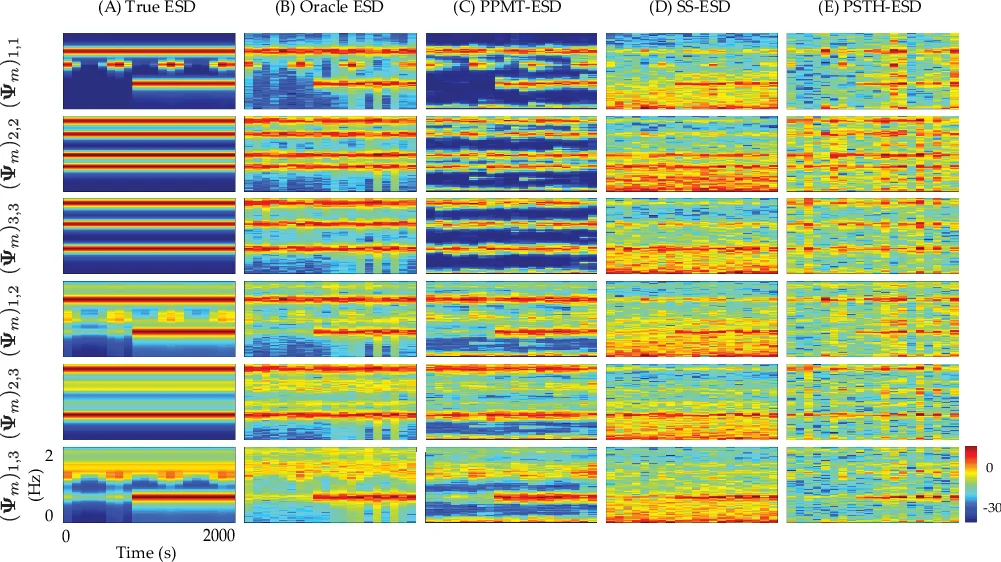
Extracting the spectral representations of the neural processes that underlie spiking activity is key to understanding how the brain rhythms mediate cognitive functions. While spectral estimation of continuous time-series is well studied, inferring the spectral representation of latent non-stationary processes based on spiking observations is a challenging problem. In this paper, we address this issue by developing a multitaper spectral estimation methodology that can be directly applied to multivariate spiking observations in order to extract the evolutionary spectral density of the latent non-stationary processes that drive spiking activity, based on point process theory. We establish theoretical bounds on the bias-variance trade-off of the proposed estimator. Finally, we compare the performance of our proposed technique with existing methods using simulation studies and application to real data, which reveal significant gains in terms of the bias-variance trade-off.
💡 Research Summary
The paper tackles the challenging problem of estimating the time‑varying (evolutionary) spectral density of latent non‑stationary neural processes from multivariate spiking recordings. Traditional spectral methods are designed for continuous signals and, when applied to point‑process data, suffer from bias introduced by smoothing procedures. The authors propose a novel multitaper framework that works directly on binary spike observations, leveraging point‑process theory, a logistic link to latent continuous processes, and a state‑space model to capture temporal dynamics.
First, each neuron’s conditional intensity function (CIF) is modeled as a logistic transformation of an underlying latent variable xₖ,ⱼ. The latent process is allowed to be non‑stationary and is represented in the Priestley evolutionary spectral formalism, where the evolutionary spectrum ψₖ,ⱼ(ω) describes the instantaneous distribution of power across frequencies. For the multivariate case, a complex vector of coefficients (cₖ,ⱼ, dₖ,ⱼ) is introduced, and the evolutionary spectral density (ESD) matrix Ψₖ(ω) = (π/N) E
Comments & Academic Discussion
Loading comments...
Leave a Comment