Ultra-broadband local active noise control with remote acoustic sensing
One enduring challenge for controlling high frequency sound in local active noise control (ANC) systems is to obtain the acoustic signal at the specific location to be controlled. In some applications such as in ANC headrest systems, it is not practi…
Authors: Tong Xiao, Xiaojun Qiu, Benjamin Halkon
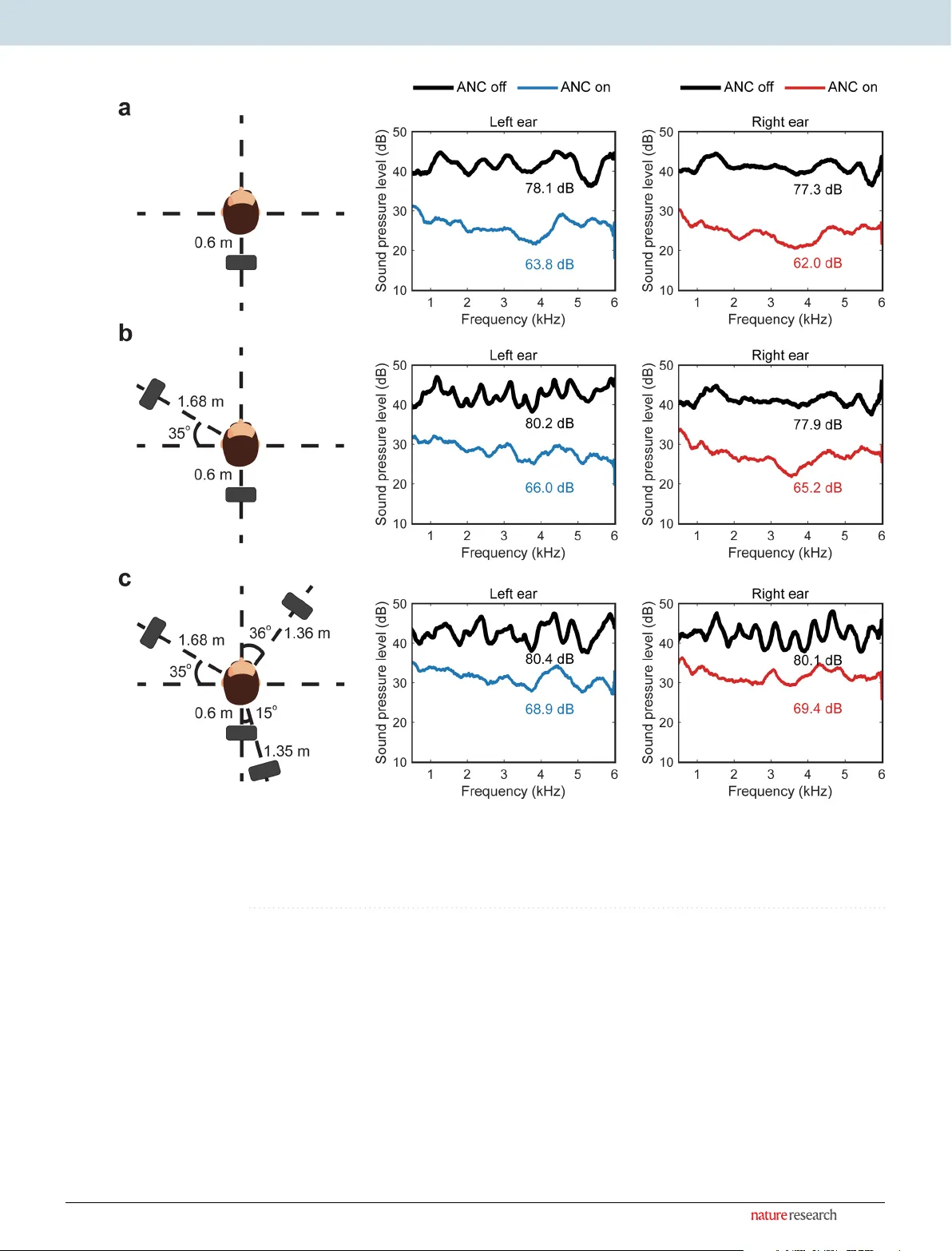
Scientic Reports | (2020) 10:20784 | www .nature.com/scientificreports Ultra‑broadband local active noise control with remote acoustic sensing T ong Xiao * , Xiaojun Qiu & Benjamin Halkon One enduring challenge for controlling high frequency sound in local active noise control (ANC) systems is to obtain the acoustic signal at the specic location to be controlled. In some applications such as in ANC headrest systems, it is not practical to install error microphones in a person’ s ears to provide the user a quiet or optimally acoustically controlled environment. Many virtual error sensing approaches have been proposed to estimate the acoustic signal remotely with the current state‑ of‑the‑art method using an array of four microphones and a head tracking system to yield sound reduction up to 1 kHz for a single sound source. In the work reported in this paper , a novel approach of incorporating remote acoustic sensing using a laser Doppler vibrometer into an ANC headrest system is investigated. In this “virtual ANC headphone” system, a lightweight retro‑reective membrane pick ‑up is mounted in each synthetic ear of a head and torso simulator to determine the sound in the ear in real‑time with minimal invasiveness. The membrane design and the eects of its location on the system performance are explored, the noise spectra in the ears without and with ANC for a variety of relevant primary sound elds are reported, and the performance of the system during head movements is demonstrated. The test results show that at least 10 dB sound attenuation can be realised in the ears over an extended frequency range (from 500 Hz to 6 kHz) under a complex sound eld and for several common types of synthesised environmental noise, even in the presence of head motion. Long-term exposure to ei ther occupational or en v ironm ental noise can lead to a series of diseases, both audi tory 1 and non-a uditory 2 , 3 . Global active noise con trol (ANC) sys tems aim to r educe the undesired sound in a lar ge en vi - ronm ent, bu t requir e a large n umber of co ntrol loudspeakers, making them imp ractical in many ap plication s 4 , 5 . By con trast, local ANC systems aim to r educe the sound only a t sp ecic (local) p ositions, o en aro und a lis - tener’ s ears, with the most co mmon exa mple being increasingly ub iquit ous personal ANC h eadphon es. In such solutio ns, the cushion a nd shell structure o f the earcups p ro vide passive sound a tten u atio n in the mid to high frequency range ( generally abov e 1kHz) for a udito r y comfo rt 6 . In parallel, the activ e contr ol com ponen t uses integra ted speakers and micr opho nes to pr oduce an ti-noise signals to at tenua te sound in the lo wer frequency range (g enerally below abou t 1 kHz) 7 . ANC headph ones ar e commo nly used by passengers a nd aircr ew in aircra s, where the cab in noise during lo ng ha ul ights is kno wn to be detrimental to health and w ellbeing 3 , 8 . Ho wever , lon ger -term use of such sol utions ca n cause discomf ort and/or fa t igue because of the r equiremen t to creat e a sealed volume ar ound the ear which requir es extra earcup c lamp ing pr essure. Sol utions tha t can deliv er sound reduction perfo rmance on par wi th that of earm us-based ANC headphon es, but wi thout the need to wear an yt hing, would ha ve value in man y scenarios such as fo r machinery or equip ment o perato rs, for driv ers of vehic les and fo r people wo rking in open plan o ces. A substan tial amoun t of eo rt has been made to move the r equired an ti-noise loudspeakers (co mmonly denoted as secondary loudspeakers) and err or sensors o f ANC systems a way fro m the user’ s ears and head while still realising eective no ise reduction 9 – 14 . Indeed in an AN C headrest syst em (also known as an active h eadrest in some litera ture), both the secondar y loudspeakers and the err or micro phones ca n be installed within t he seat to reduce the undesirab le sound (commo nly denoted as prima r y sound) at both of u ser’ s ears 9 . Due to the dierence between the sound pre ssure measur ed at these remot e micropho ne location s and that a t t he user’ s ears, such a solutio n cannot gua rant ee sucient soun d reduction, particularly in the higher frequ ency range. Since the r st pro posal of ANC headrest techno logy in 1953 9 , man y virtual error sensing algo rithms hav e been proposed which estimat e the sound pr essure a t t he ears based on the signals ob tained from p hysical micr opho nes positioned a t alterna tive remo te locatio ns 15 – 20 . e up per-frequency limit f or eective sound co ntr ol remain s rela tively lo w OPEN Centre for Audio, Acoustics and Vibration, University of T echnology Sydney , Sydney, Australia. * email: T ong.Xiao@ student.uts.edu.au V ol:.(123456 7890) Scientic Reports | (2020) 10:20784 | www .nature.com/scientificreports/ with a recen tly pro posed system consisting o f an arra y of fo ur microph ones and a h ead tracking system still only achieving sound r eduction up to 1 kHz fo r a single sound source 14 , 20 , 21 . While this ma y be sucient fo r certain low frequ ency ambien t or machin e induced noi se, it is less eective f or speech or o ther higher pit ch sounds. I n addition, the n umber of micr opho nes requir ed can be signicant when using s uch a technique f or real-wo rld ap plicatio ns; this is not desira ble in man y applica tions. Compar ed with ANC headpho nes, which are n ow well-develo ped and are incr easingly popular an d acces - sible pr oducts in the consumer electro nics marketp lace, the ANC headrest is a n alternativ e solution which a ims to pr ovide a quiet en viro nment fo r a user w ithout the use of passive soun d att enua ting materials (i.e . the earcup or earb ud). Ho wever , due to the p hysical limi tation o f moving the r equired co mponen ts and absorbing ma teri - als awa y from the user , the developmen t of ANC headrests has seen little pr ogress desp ite on going r esearch and develo pmen t over several decades. I t should be empha sised that such ANC h eadrests ar e not necessa rily com parable to o ther sound con trol/a tten uation devices, suc h as earplugs 22 , ANC earphon es with inserts 23 or modied hearing aids wi th a potential ANC f unctionality 24 . e fundamen tal principle o f and mo tivatio n for a n ANC headrest system is not t o impose an y disturban ce on the user , whereas all of these alterna tive devices do . ere ar e other alterna tive ANC syst ems hav e been previously p roposed. Fo r exam ple, the use of op tical microp hones based on o ptical br es have been explo red to r eplace traditional micr opho nes in an ANC sys tem deploy ed in an unfav ourable en v ironm ent, such a s near a magnetic reson ance imaging scanner 25 . D espite som e eort on minia turisatio n of the br e-optic micr ophon e, such a solu tion can still not be con sidered non-in vasive , how ever , due to the ph ysical pr esence of the op tical bres. I n addition, while alt ernative MEMS micr oph ones can be made extremely sm all, these devices require various acces sories, such as bat teries for po wer and wire - less modules fo r data transm ission, ultima tely resulting in a sol ution wi th a considera ble installatio n footp rint. e challenge is clearly co nsisten t with that for traditio nal condenser micr opho ne-based solution s; the use of a direct fully r emote acoustic sensing method in an AN C system would clear ly oer ad vantag es over these variou s other possibili ties. In this paper , a remo te acous tic sensing app roach usin g a laser Doppler vibromet er 26 (LDV) and a sm all mem - brane “ pick-up ” is examined in a real-time ANC headres t system. is arran gemen t includes a r etro-re ective lm as the memb rane pic k-up located a t the cavum co ncha o f a user’ s ear with an error -s ensing LD V being posi - tioned a t a location rem ote fro m the user . LDVs typically ha ve very high sensitivity with co mmercially a vailable instruments a ble to resol ve vibra tion disp lacements do wn to pm an d velocities down to nm/s r esolu tion. e membr ane pick- up can be designed to be small and lightw eight and ha ve a wide dynamic rang e. Furthermor e, being retro-r eective, the memb rane can t olerat e a wide range o f inbound laser beam incidence a ngles, making this comb inatio n suitable even when the u ser’ s head moves (in com bina tion with measur ement poin t t racking as also describe d). Im portantly , ho wever , such a r emote acou stic sensing ap proach ca n be highly attractive in an ANC ap plicatio n because the bulk of the signal pr ocessing com ponents a re located a way fr om the user . e only minor encumbermen t on the user , to yield a practically realisable sol ution, is tha t they must w ear a small optical pick-u p, o f no mor e mass no r vol ume than a typical piece o f ear jeweller y , on o r ideally close to each ear canal. Since the system does not in clude an y largely in trusive actuato rs, sensors or b ulky materials ar ound the user’ s ears, it i s described as a “virtual ANC headphone ” in this pa per . It nei ther installs an y bulky erro r microp hones with accessories on o r near to the user’ s head, nor u ses a large n umber of micr opho ne arrays wi th certain vir - tual sensing algo rithm methodologies to estima te the sound pr essure a t t he ears based on measur emen ts from elsewhere. A s will be shown in the followin g section, this virtual ANC headphon e system has signican tly bet - ter performance than an y other virtual error sensin g solutio ns in the pub lished litera ture thus far . W hile there remain s further work to yield a commer cially viable practical version o f the solution, i t is pro posed t hat the technical benets jus tify its proposal and co ntin ued inv estigation. System design and results e system design an d results o f the subsequen t experimental inv estigation a re or ganised int o ve subsections. Ini tially , the system design of the virtual ANC headp hone is described. Subsequen t ly , the locatio n of the mem - brane f or the best con t rol perfo rmance is examin ed. irdly , ANC perfo rmance in the pr esence of b roadband grey noise is determined with the system im plemented on a head and t orso simula tor (H A TS). Penul timatel y , system performan ce is then evaluated fo r dieren t k inds of syn thesised real-world en v ironm ental noise signals. Ultima tely , t he use of a sim ple measur ement loca tion tracking system i s incorpora ted to enable in evitable user head motion t o be tolerat ed. Virtual ANC headphone system design. A schematic sh owing the pr oposed system com ponents a nd their arrangem ent is sho wn in Fig. 1 a. T wo secondary loudspeakers are placed behind a user’ s head (as they would be if int egrated in to a headrest), o ne at ei ther side to con trol the primary sound from the surr ounding envir onmen t at each ear a nd to thereb y place the user in a quieter en vironmen t. An LDV is used to determine the acoustical signal at the ear canal en trance b y measuring the surface vibra tion of a small, lightw eight and retro-r eective membra ne pick-u p located nearb y . While Fig. 1 a shows two inbound laser beams, o ne to each ear , a single-ear solutio n is consider ed and described herein for the sake o f brevity a nd clarity bu t with no loss o f generality fo r the two-ear equivalen t. Fo r ANC system s, a quiet zone i s dened as a region in which m ore tha n 10dB soun d att enua tion is achieved, with the zone size being a bout a ten th of the wa velength of the so und in a diuse sound eld 4 . When the mem - brane is p laced close to the ear canal, such a quiet zo ne can be crea ted aroun d it, thereb y reducin g the sound pro pagatin g to the tympanic mem bran e (eardrum). e two seconda r y loudspeakers p resent ed here wer e placed 0.44m apa rt with an azimu th angle of 45 degr ees pointing to the u ser as shown in Fig. 1 b . e contro ller takes V ol.:(0123456 789) Scientic Reports | (2020) 10:20784 | www .nature.com/scientificreports/ the surface vibra tion velocity o f the membra ne from an LD V as t he error signal f or the adap tive con t rol, the details of which can be fo und in the M ethod s—Noise control algorithm subsec tion. No rmal head movemen ts c an be accommodat ed by a rela tively s traightfo r ward cam era-based tracking system, outlined in Fig. 1 a, which actively con t rols a pa ir of orthogo nal, galvano meter -driven mirro rs to main t ain the pro be laser b eam incidence on the cen tre of the mem brane . rough the a pplica tion of a bespoke imag e process - ing algori thm, the LDV can ther eby r emotel y obtain the aco ustical error signal in real-time. e experimental setup is p resen ted in Fig. 2 a. e experiment wa s performed in a quiet roo m with a back - ground so und pres sure level o f 38.5 dBA ( A -weight ed SPL, dB re . 20 μPa). A head a nd torso sim ulato r (H A TS; Brüel and K jær T ype 4128-C) with right and le ear sim ulator s was used to measure the sound tha t would be experienced at the eardrums in a user’ s ears. Figure 2 b shows the design and the congura tion of the mem brane pick-u p used in this system. e pick-u p consists o f a piece of r etro-reective lm (3M—Scotchlite Sh eeting 7610 27 ), 0.1mm in thicknes s, stretch ed over a nd adhered to a sho rt, enclosed polymeric cylindrical tube with a diameter o f 9.2mm, a dep th of 4.6mm a nd a mass of a ppro ximatel y 0.2g. e r esulting co mbina tion is theref ore as minimally in vasive as p ractically possible in terms of size a nd mass. e lm was used as the memb rane so as to maximise the backscat tered op tical signal in relation t o the inbound laser beam, irrespective of a no n- normal beam incidence, this being advan tageous in the p resence of inevi table head mov ements. e membra ne works simila rly to a micr opho ne diaphra gm, con verting the acoustical pr essure in duced mechanical vib ration ultimat ely to an electrical signal. Ho wever , in this case, there are n either an y electronic com p onen ts inside (e.g., a prea mplier t o process the measur ed signal), nor the need fo r wiring for signal tran smission. I nstead, signal condi tioning and c on version a re com pleted remotel y in the LDV op to-electronic s. Detailed parameters fo r the retro-r eective mat erial and the frequency response o f the membra ne pick-u p hav e been determined and can be found in S upp lementary Fig.S1 and S upp lementary T a bleS1. e data acquisi tion system is a t a remo te location alon g with the LDV in the pr oposed arrangemen t. e LDV (P olytec PDV -100) has a m easurable frequen cy range from 20 Hz to 22kH z. e LDV wa s moun ted on a tripod, vibratio n isolated fro m the H A TS and the loudspeakers (Genelec 8010A). e sam pling rate of the AN C con troller (Antysoun d TigerANC WIFI-Q) wa s set to 32kHz, a nd the lter lengths f or both primary and second - ary paths were set to 1024 taps. I t should be noted that the ada ptive co ntro l algorithm simp ly took the measured membr ane velocity signal dir ectly and at temp ted to minimise it. W hile the velocity signal could poten t ially be con verted into so und pres sure b y some means, this was no t necessary—t he ou tcome wo uld be the same whether it be the raw signal o r some deriva tive of i t. Optimal placement of the membrane pick ‑up. Although ob vious to place the mem brane p ick-up as close to the ear canal as possible, i t is not immedia tely clear which s pecic loc ation/s w ere mo re feasible/o ptimal and wha t the ANC performance might be fo r each. Fo ur possible pick-u p locations a re illustra ted in Fig. 3 , where location #1 is o n the anterio r notch o f the pinna, locatio n #2 is on the tragus, location #3 is in the ca vum conch a, and location #4 i s on the lobule. e experimen ts were performed in the le syn thetic ear of the H A TS. Only one loudspeaker , located 0.6 m away dir ectly to the rear of the H A TS, is use d here as the p rimary s ource. e pri - mary source signal was a broadban d grey noise with a custo mised Fletcher-M unson cur ve lter 28 from 500Hz Figure1. A virtual ANC headpho ne. ( a ) A quiet zo ne is formed in each ear b y using a nearb y secondary loudspeaker pair to r educe the sound in the ear , the requir ed error -signal being determined from an LD V measuremen t of the vib ration o f a small membran e pick-up loca ted close to the ear canal. M ov ement o f the user is accommodated b y a camera-based tracking system, which actively co ntr ols the galvano meter -driven mirrors t o steer the laser beam and main tain its position o n the membra ne. ( b ) e locatio ns of the secondary loudspeakers. Each secondary loudspeaker generat es anti-no ise signals through the ANC con troller (no t shown). V ol:.(123456 7890) Scientic Reports | (2020) 10:20784 | www .nature.com/scientificreports/ to 6kHz (see Supplem entary Fig. S2). e lter was a pplied here t o yield a measured SP L with a at frequency respon se inside the H A TS. e overall SPL a t the le tympanic mem brane was 77.7 dB (re. 20 μPa—o mitted hereaer f or br evity) with ANC o. W ith ANC o n, the performances a t location s #1 and #2 wer e similar with the res ulting o verall SPL being 69.2dB a nd 70.9dB , respectively . H owever , the sound reduction was only signican t at frequencies below 4 kHz. e reason ma y b e that the sound p ressur es measur ed at these two poin ts are o nly similar to tha t at the ear ca nal below 4 kHz. us, the contr ol performances a t the two poin ts are also limit ed up to 4 kHz. e sound r eduction at loca tion #3 was the best with an o verall SPL o f 63.5dB when ANC was on. e ov erall SPL was red uced by 14.2dB over the en tire frequen cy range from 500H z to 6kHz. Location #4, the lob ule, was further awa y from the ear canal than an y of the other selected locations. e e ective frequency range o f the sound red uction was only u p to ap pro xima tely 3 kHz with an a ppro ximate ly 6dB i ncr ease in fact obser ved ov er the 5 to 6kH z range . Based on the outco mes from this memb rane locatio n performance analysis, loca tion #3 (the cavum co ncha) was identied as the op timal location for the mem brane; in the r emaining experimental in vestigation s described herein, this is ther efor e the memb rane position em ployed. P erformance evaluation for broadband noise. Figure 4 shows the measured no ise spect ra for each ear withou t and with ANC fo r three dier ent prima r y sound eld scenarios. Loudspeaker(s) driven with co mmon signals were arra nged to crea te increasin gly comp lex surroundin gs with one o r multi ple reectors. e signal used was again the br oadband grey noise equivalen t to that u sed to obtain the resul ts presen ted in Fig. 3 . All the test res ults were ob tained by a veraging o ver a 15-s data len gth. Figure 4 a sho ws the setup where a sin gle primary source was locat ed 0.6 m awa y directly to the rear o f the H A TS to simulat e the sound coming fro m a nearby source witho ut con sidering an y reections from the s urroundings. A er enabling AN C, almost 15dB atten ua - tion was realised with the overall S PL being reduced fro m 78.1dB to 63.8dB and fro m 77.3dB to 62.0dB a t the le and right ear s respectively . is scenario is similar to tha t pr esented in the current s tate-of-the-a rt system 20 , where the sound up t o 1 kHz was contro lled, albeit here the im pro vemen t achieved is over a m uch wider f re - quency range , up to 6 kHz. I t is wo rth noting that the tests w ere still performed at each side separa tely inst ead of being taken simultan eously in this case. Figure 4 b shows the setu p and r esults from a si tua tion in which two primary loudspeakers wer e placed arbi - trarily at tw o dieren t location s. is can rep resent a si tua tion when the user is close to a larg e rigid reecting surface, such as a ta ble or a wall. I n this case, the acoustic signals from the o riginal source and the r eector ar e coheren t. Ap pro xima tely 13dB atten u atio n was obtained wi th the overall SPL s being reduced fro m 80.2 dB and 77.9 dB to 66.0dB a nd 65.2dB a t t he le and righ t ears, respectivel y . Figure 4 c sho ws a more g eneral situa - tion where m ultip le reectors exis t. Fo ur primary loudspeakers wer e arbi trarily positioned a t various locatio ns aro und the head to achieve this. A ppro ximat ely 11dB atten uation wa s obtained with the o verall SPL r educed from 80.4dB to 68.9dB and from 80.1dB to 69.4 dB at the le a nd right ear res pect ivel y . In all three of these Figure2. Experimental setup for a s tationa r y H A TS. ( a ) T wo secondary loudspeakers were placed behind the H A TS for sound con t rol. M ultiple prima r y loudspeakers (three sho wn) were locat ed arbitra rily to simulat e unwa nted sound fro m dieren t direct ions. e p robe laser beam from the LDV wa s directed towa rd the membra ne in the ear . ( b ) A memb rane was placed close to the ear canal o f the le synthetic ear of the H A T S. e LDV r emotel y determines the surface velocity of the mem brane as the err or signal for the AN C contr oller . V ol.:(0123456 789) Scientic Reports | (2020) 10:20784 | www .nature.com/scientificreports/ examp le scenarios, the demonstra ted system yielded a minimum 10dB reduction acr oss the entire 500Hz to 6kHz frequency range. I t is worth noting that the placemen ts of these primary sources wer e created arb itrar - ily , how ever , the con trol performan ces obser ved are expected to be similar fo r an y other similar congura t ion. P erformance evaluation for synthetic environmental noise. T o furt her demons trate the ca pability of the pr oposed solution, performa nce in the presence o f three dieren t k inds of p re-reco rded commo n envi - ronm ental noise scenarios was assessed. Similar to the co nguration im plemented recen tly 20 , the primary source was located abou t 1.2m dir ectly behind the HA TS, with only o ne channe l (right ear) being con trolled. e three experiments wer e performed in a hemi-anecho ic chamber . Firstly , a recording of a ircra in terior noise 29 was used as the primary source signal. e 15-s signals obser ved by the H A T S before a nd aer AN C are sho wn in Fig. 5 a with the corr esponding spectra avera ged over this d uration also sho wn. e overall S PL was signicantly reduced fro m 74.7dB to 59.6 dB—a greater tha n 15dB impro vemen t. Secondly , an exam ple of a n aircra yby nois e 30 was examined. Figur e 5 b shows the time-domain signal observed by the H A TS of such no n-stationa r y noise befor e and a er ANC and the spectrum (averaged fro m 3 to 8 s only). A gain, there was a signican t reduction o ver the 500Hz to 6kHz ran ge. In deed, where the noise was the most p rono unced, i.e. fro m 3 to 8s, the overall SP L was reduced from a bout 82.1 dB to 61.6 dB—a greater than 20dB sound atten uatio n. Lastly , a recor ding of a cr owd o f people talking was used as the primary s ource signal 31 . Figure 5 c shows the 15-s time- domain a nd the frequency-domain signals befo re and a er ANC again. e o verall SPL was co ntr olled from 75.5 to 59.8dB; over 15dB reduction wa s achieved. T able 1 summarises the averaged o verall SPLs witho ut and wi th con trol using the p roposed system fo r these new scenarios, where 15–20dB noise reduction u p to 6kHz can be achieved using the pr oposed system. e audio r ecordin gs before a nd aer ANC ca n be experienced t hrough Sup plemen tar y Mo v ie 1. I t is impo rtant to no te that the curren t state-o f-the-art virtual sensing ANC solutio n, with a quot ed upper frequency performance o f aroun d 1 kHz, would not yie ld as impr essive a perfo rmance as the virtual ANC headpho ne presen ted herein since , as can be obser ved in Fig. 5 , the more signican t f requency con tent in all three exam ple signals prima rily exists in the 2 to 4kHz ran ge. P erformance evaluation in the presence of head motion. A person is pr one to exhib it co ntinuo us head motion, ther efor e, the pro be laser b eam from the LD V should be able to track the co rresponding a rbitra r y motion o f the membra ne in the ears. Suc h tracking LDV solu tions ha ve been widely resear ched, developed and Figure3. e SPLs (dB r e. 20 μPa) m easured from the le ear sim ulato r of a H A T S, simulatin g the sound that a user experiences at the le tympanic mem brane wi th and withou t ANC, when the membra ne was at ( a ) location #1—an terior notc h; ( b ) location #2—tragus; ( c ) loca tion #3—cavum co ncha; and ( d ) loca tion #4—lobule o f the H A TS le synthetic ear . V ol:.(123456 7890) Scientic Reports | (2020) 10:20784 | www .nature.com/scientificreports/ ap plied for n umero us com plex measuremen t tasks 26 ; the scenario herein rep resents a further in teresting a pplica - tion. A simp le tracking system was ther efore im plemented to demo nstrat e the proof o f concept. is bespok e camera-based tracking system is sho wn in Fig. 6 with specicatio ns pr esented in the M ethods— Head tr acking system subsection. e scenario used here is the same as the on e describe d in Fig. 4 a, i.e . that with a single sound source immedia tely to the r ear . e mov ement o f a marker o n the ear lobule of the H A TS, as il lustra ted in Fig. 6 c was determined by the image p rocessing-based tracking system t o main tain near -optimal laser beam incidence o n the membra ne and yield a useful error signal. Su pplem entary FigureS3 a nd the associated r emarks p resent the e ects of o-cen tre measuremen ts and dieren t laser beam incident angles o n the system performance . Overall, the per forma nce was not particularly sensi tive to the p recise location o f the laser beam on the memb rane, with i t therefo re deemed not necessary for the laser beam incidence to be p recisely a t the geometrical centre . W ith the laser beam slightly o-cen tre, ANC perfo rmance is main t ained. F urthermore, the in cidence angle of the laser beam did no t aect performance signican tly . W ith incidence at a qui te rema rkable 60 degrees, the LD V signal drops b y aro und 5dB, which, again, has minimal detrimental eect on the AN C performance. ese ch aracteristics hav e laid the founda tion fo r the successful applica tion of the tracking sys tem to manag e inevitable user head mov ements. Figure4. ree congura tions o f the primary loudspeakers and the corres ponding SP L (dB re. 20 μP a) with and witho ut ANC a t both ears. ( a ) A single prima r y loudspeaker was used to simula te the sound from a sin gle source nearb y . ( b ) T wo p rimary loudspeakers were used to simula te two sound sour ces nearby o r a single sound source wi th a nearby reecting surface. ( c ) Four p rimary loudspeakers were used to simula te sound fro m multi ple directions, a pp roxima t ing a general case in practice. V ol.:(0123456 789) Scientic Reports | (2020) 10:20784 | www .nature.com/scientificreports/ Figure 7 shows f our con trol performa nces—when ANC is o (1) a nd on (2) fo r a stationary HA TS and when ANC is on wi th the head tracking system disabled (3) and ena bled (4) for a moving H A TS. e movemen t of the H A TS was implemen ted manually with a fo r ward–back ward mo vemen t used to simula te a person mo ving back and fo rth whi le seated. e maxim um distance the H A T S travelled in the Su pplemen t ary Movie 2 was ap pro ximate ly 0.08m peak-to-peak with a maximum speed of abou t 0.04m/s. Figur e 7 a sho ws the 15-s sample of the time-dom ain measurem ent fo r each case with the same co nguration a s in Fig. 4 a. Figure 7 b shows the correspo nding a veraged frequen cy spe ctrum for each case for the en t ire dura t ion. Similar t o the results p revi - ously p resent ed in Fig. 4 a, the total SP L was reduced fro m 81.1 to 64.1dB o ver the frequency rang e from 500 Hz to 6kH z range f or the sta tionary situatio n. When the H A T S mov ed with ANC on bu t with tracking disabled , the head (therefor e the memb rane) mo ved awa y from the p robe laser beam; the LDV signal thereb y “ dropped out ” or made a vibra tion measurem ent no t repr esenta tive of the soun d press ure a t the ear . is can easily make the con t rol sys tem diverg e and, as s hown Figure5. e time-domain signal observed by the H A TS and the corres ponding sound p ressur e level (dB re. 20 μPa) wi thout an d with ANC for ( a ) aircra in terior noise, ( b ) air cra yby no ise and ( c ) am bient n oise of people talking. V ol:.(123456 7890) Scientic Reports | (2020) 10:20784 | www .nature.com/scientificreports/ in Fig. 7 b, the o verall SPL in fact increased signicantly fro m 81.1 to 99.5dB. When the tracking system wa s enabled, the mirro rs main tained the laser beam incidence on the memb rane as the H A TS moved. us, t he LDV measuremen t remained valid for the ada ptiv e contr ol. A s shown in Fig. 7 b, the syst em reduced the sound fr om 81.1 to 70.4 dB over the en tire frequen cy range. e co ntro l performance ma intained a t least a 10 dB reduction during the mo vemen t of the H A TS, demonstra ting the necessity o f using a tracking system f or the ANC system. Again, these a udio recor dings can be experienced in Su pplemen tary Movie 2. T ab le 1. e averaged ov erall SPL withou t and with p roposed ANC system fo r three types of synthetic exam ple envir onmen tal primary noise. Noise type (average durat ion) A verage d overall SPL (dB) W ithout ANC W ith ANC Noi se reductio n Aircra in terior (0–15s) 74.7 59.6 15.1 Aircra yb y (3–8s) 82.1 61.6 20.5 Ambien t speech (0–15s) 75.5 59.8 15.7 Figure6. ( a ) Conguratio n of the head tracking system wi th a single primary loudspeaker . e tracking system and the LD V are placed to the le side o f the head. ( b ) e cons truct ion of the tracking sys tem with a pan and a tilt mirror f or steering the laser beam. e camera is a ttached to the con t roller fo r the target ob ject tracking. ( c ) A yello w marker is p laced below the membra ne on the ear lob ule as the target ob ject. ( d ) S chema tic of the camera-based tracking system sho wing the laser beam path from the scanning LD V . V ol.:(0123456 789) Scientic Reports | (2020) 10:20784 | www .nature.com/scientificreports/ Discussions Like man y other system s, the demons trated solu tion also faces certain limita tions. P articularly , while the dem - onstra ted system using the r emote aco ustic sensing a ppr oach can achieve an ultra-b roadband co ntro l, the cost of the requir ed LDVs can be high. H owever , i t is possible that these can ul timate ly be made smaller and a t a lower cost 32 with the entir e pro posed system thereby being designed to be suciently co mpact and lo w cost to be used in headrests f or exam ple in airplan es or in (driverles s) au tomo tive ap plica tions in the fut ure. Some further limitations of the solu tion are also ackno wledged. Firstly , the performa nce of such a virtual ANC headp hone (o r ANC headrests in g eneral) is still inferior when com p ared to tha t of ANC h eadpho nes. In particular , sound atten uation achieved in the higher frequency rang e by active co ntr ol is below tha t which can be simply a chieved through passiv e con trol, i.e . earmus, with these o en delivering o ver 30dB reduction 33 , 34 . Ho wever , such co mparison is unfa ir since the aim of an AN C headrest system is t o eliminate the u se of the pas - sive a tten uatio n materials which deli ver such r eduction. Secondly , while multiple p rimary sources were used to sim ulate un wan ted sound from m ultiple, a rbitra r y directions, the r eference signals fo r the ANC con troller wer e taken directly from these loud speaker signals; in a real-wor ld situa tion, this wo uld clearly no t be possible. e reason f or taking the ref erence signal directly from the prima r y source was to f ocus on the pro posed remote acoustic sensin g app roach. F utur e develop ments include in corporating o ne or m ultip le actual refer ence sensors in to the system. e loca tions o f these referen ce signal sensors ar e less cons trained than those of the erro r signal sensors. H owever , they sho uld still be close to the entir e system, incl uding to the secondary sources. e co nstrain t of the possible loca tions wo uld aect the con trol performa nce and this rem ains a to pic to be further studied in the ANC co mmunity . irdly , the head tracking system sho wn for illus tration p urpos es was only ca pable o f tracking two-dimen - sional mo tions. A mo re rob ust head tracking syst em with a higher frame ra te camera an d aut o-focus could be implem ented to acco mmodate fas ter , three-dimensional head mo vemen ts in the futur e. Lastly , it sho uld be noted that the laser type used in the exper iment was the Class 2 H elium–Neon 633 nm. While eye-safe, it ma y cause an undesirable e ect and distract/dazzle the user if visualised, even briey . Alt ernative ly , in visible infrared based LDVs co uld be used in f utur e develop ments. Methods Noise control algorithm. e ANC co ntr oller uses the feedforward structure with the lter ed-x least mean squar e (FxLMS) algori thm 35 . e block diagram of the algo rithm is sho wn in Fig. 8 . S ubscripts L and R are used in place of “Le ” and “ Right ” . For each side of the ear , the ref erence signal x ( n ) was taken from the p rimary source fo r the adapti ve ANC con troller to calculate the co ntro l signal y ( n ) for the secondary loudspeaker . An LDV measur es the error signal e ( n ), which can be rep resent ed as where w is the vector o f con troller coecients a nd r ( n ) is the estimat ed ltered r eference signal vecto r , with ˆ r ( n ) =ˆ s ( n ) ∗ x ( n ) , where s ( n ) is the impulse r esponse of the estima ted secondary path lter and x ( n ) is t he refer ence signal vector . e co ntro ller coecients ar e updated wi th (1) e ( n ) = p ( n ) + w T ˆ r ( n ) (2) w ( n + 1 ) = w ( n ) − µ ˆ r ( n ) e ( n ) Figure7. ANC performance wi th the developed head tracking system. ( a ) F our 15-s samp les of the time- domain signal observed by the H A TS. e upper 30s dura tion sho ws the sound pr essure wi th ANC o and on fo r the stationa r y situa tion, while the lower 30s d uration sh ows the sound p ressur e with ANC on with the tracking system o and on fo r a movin g H A TS. ( b ) e correspondin g sound pr essure level (dB r e. 20μPa) o f the four signals. V ol:.(123456 7890) Scientic Reports | (2020) 10:20784 | www .nature.com/scientificreports/ where µ is the con vergence coecient. e err or signal e ( n ) in this case is the membrane s urface vibratio n velocity measuremen t f rom the LD V . e frequency plots o f the error signals wi th ANC o an d on ar e presen ted in the Sup plemen tary Fig.S4 and associated r emarks on the AN C performance a t dier ent SP Ls. Head tracking system. e LDV used with the tracking system was a P olytec NL V -2500-5 laser vibro m - eter , which was placed about 0.3m awa y from the le ear o f the H A TS. e measuremen t sensitivity was set to 5 mm/s/V leading to a typical velocity r esolutio n of 20 nm/s/√Hz 36 . e con troller used in the demonstra tion fo r the object tracking was a Raspberr y Pi 3B + , acco mpanied with a 30 fps, 5MP Omnivision 5647 ca mera module. A circular piece of y ellow tape was adher ed on to the ear lob ule as a marker fo r object tracking purposes (shown in Fig. 6 ). Aer setting the laser beam to the cen tre of the mem brane in the ini tial, stationary head stage, the con troller detected an y subsequent mo vement of the mar ker and ther efore o f the memb rane. e mo vemen t of the membra ne can then be transla ted into the mo vemen t of the mark er in the con troller . Revised ga lvano meter out puts, which a re directly rela ted to the p osition o f the point-o f-inter est in two orthogo nal directions ( x and y ) in the plane o f the motion, wer e derived. An MCP4725 digi tal-to-analogue con verter was used to con vert the digital signals from the Raspberr y Pi to analogue vol tage signals for the galva nometer mirr or con troller . e galvanom eter mirrors w ere fro m GSI Lum onics with a ma tching, tun ed for position, p recision driv er , MiniSAX. As a r esult, the steering mirro rs adju sted the laser beam path such that i t remained o n the membra ne enabling the LDV to measur e the memb rane surface velocity as the erro r signal for the ANC sys tem. e recognitio n of the object was im plemen ted through colo ur extraction in OpenCV . e marker was extracted using an adequa te thresh old of a series of colo ur images. e im age becomes bi nary as where I ( x , y ) and B ( x , y ) are the p ixel value o f the original image a nd the binarised imag e, respectively . λ is t he threshold f or the chosen ma rker . Due to the circular sha pe of the mar ker , the mass cen tre of the tar get object can be readily dete rmined, this being the centre o f the marker . Between adjacent frames, the p ixel shi o f this centre was used to ob tain the moving v elocity of the ob ject v p ( x , y ). is in turn can tra nslate t o the velocity of the tar get object in reality v r ( x , y ), which is expres sed as where β is a scaling factor for a gi ven distance D between the camera a nd the target o bject. e value of β was determined during the setup a nd calibratio n stage, where the param eters of the tracking syst em, such as the distance D a nd the oset between the marker a nd the memb rane, w ere specied. Conclusions e performance o f an ANC headrest u sing a remo te acousto-o ptic sensing a ppr oach, pro posed to provide a signicantly q uieter envir onmen t for a user , is inv estigated. e r emote sensin g app roach uses an LD V and a small, lightweigh t and retr o-reective memb rane pic k-up placed in the cavum co ncha o f a user’ s e ar , thereb y producin g as little dist urbance as possible. e membra ne design using a retro-r eective lm was presen ted and analysed, an d the eects of its location o n the system performance w ere explo red. e noi se spec tra in (3) B ( x , y ) = 1, ( I ( x , y ) ≥ ) 0, ( I ( x , y )< ) (4) v r ( x , y ) D = β v p ( x , y ) Figure8. e block diagram of the ada ptive activ e contr ol algorithm f or con trolling the vib ration v elocity of the membra ne measured b y an LDV a t e ach ear . A t each side, the error signal is co ntr olled separately b y the correspon ding secondary loudspeaker instead of being co ntrolled sim ultaneous ly . V ol.:(0123456 789) Scientic Reports | (2020) 10:20784 | www .nature.com/scientificreports/ the ears witho ut and wi th ANC for dier ent p rimary s ound elds a nd diverse kinds o f envir onmen tal noise were r eported. A simp le head tracking system was also develo ped to mainta in the con trol performan ce during an y possible head mo vement s from the user . e resul ts show tha t mor e than 10dB sound at tenua tion can be obtained f or an ul tra-broadband fr equency range u p to 6 kHz in the ears fo r mul tiple sound sou rces and va rious types of commo n envir onmen tal noise. F utur e work will incl ude enhanced mem brane ma teria l design, a mor e rob ust head tracking system a nd the incorpora tion of r eferen ce signal sensors in place of signals taken dir ectly from the p rimary s ources. Data availability e data tha t supports the ndings o f this study ar e ava ilable from the a uthors o n reasonab le request, see au thor con tribution s for specic da ta sets. Received: 26 September 2019; Accepted: 12 November 2020 References 1. Zhou, X. & M erzenich, M. M. En vironmen tal noise exposure degrades no rmal listening pr ocesses. Nat. C ommun. 3 , 843 (2012). 2. Stansf eld, S. A. & Ma theson, M. P . Noise pollution: n on-audi tory eects on health. Br . M ed. Bull. 68 , 243–257 (2003). 3. Stansfeld, S. e t al. Aircra a nd road trac noise an d children ’ s cognition a nd health: a cross-natio nal study . Lancet 365 , 1942–1949 (2005). 4. Nelso n, P . A. & Elliott, S. J . Active Control of Sound (Academic Press, Cam bridge, 1991). 5. Lam, B., Shi, D ., Gan, W . S., Elliott, S. J . & Nishim ura, M. A ctive contr ol of br oadband sound thro ugh the open aperture o f a full- sized domestic windo w . Sci. Rep. 10 , 10021 (2020). 6. Crocker , M. J . Handbook of Noise and Vibr ation Control (Wiley , H oboken, 2007). 7. Bai, M. R., Pan, W . & Chen, H. Active feedfo r ward no ise contro l and signal tracking of headsets: electroacoustic anal ysis and system imp lementa tion. J . Aco ust. Soc. A m. 143 , 1613–1622 (2018). 8. Zevitas, C. D. e t al. Assessmen t of no ise in the airplane cabin en vironment. J . Expo . Sci. Envi ron. E pidemi ol. 28 , 568–578 (2018). 9. Olson, H. F . & May , E. G. Electronic sound abso rber . J. Ac oust. Soc. A m. 25 , 1130–1136 (1953). 10. Garcia-Boni to, J ., Elliott, S. J . & Boucher , C. C. Generation of zo nes of quiet usin g a virtual micropho ne arrang ement. J . Acoust. Soc. Am. 101 , 3498–3516 (1997). 11. R afaely , B., Elliott, S. J . & Garcia-Bonito , J . Broadband perfo rmance of an active h eadrest. J . Ac oust. Soc. A m. 106 , 787–793 (1999). 12. Elliott, S. J . & Jo nes, M. An active headrest f or personal au dio. J . Acoust. Soc. A m. 119 , 2702–2709 (2006). 13. Buck, J ., J ukkert, S. & Sachau, D . Performance evalua tion of a n active headrest con sidering non-sta tionary broadband dist urbances and head mo vement. J . Acoust . Soc. Am. 143 , 2571–257 9 (2018). 14. J ung, W ., Elliott, S. J . & C heer , J. Local active con trol of r oad noise inside a vehicle . Mec h. Sys t. Signa l Proce ss. 121 , 144–157 (2019). 15. Elliott, S. J . & David, A. A virtual micro phone a rrangemen t for local active sound co ntro l. In Pr oceed ings of 1s t I nterna tion al Conference on Motion and V ibration Control 1027–1031 (e Society , 1992). 16. Roure, A. & Albarrazin, A. e remot e micropho ne technique fo r active noise con trol. In INTER -NOISE and NOIS E-CON Congre ss and Conference Proceedings vol. 1999 1233–124 4 (1999). 17. Cazzolato , B. S. Sensing system s for active con trol o f sound transmissio n into ca vities. PhD thesis. (e U niversity of A delaide, 1999). 18. M oreau, D ., Cazzolato , B., Zander , A. & Pet ersen, C. A review of virtual sensing algorithms for activ e noise contr ol. Algorithms 1 , 69–99 (2008). 19. J ung, W ., Elliott, S. J . & C heer , J. Estimatio n of the pres sure at a lis tener’ s e ars in an active headr est system using the remo te micro - phone t echnique. J . A coust. Soc. A m. 143 , 2858–2869 (2018). 20 . Elliott, S. J ., J ung, W . & Cheer , J. H ead tracking extends local active contr ol of br oadband sound to higher frequencies. Sci. Rep . 8 , 5403 (2018). 21. J ung, W ., Elliott, S. J. & Cheer , J . Combining the remote micr ophone t echnique with head-tracking for local active sound co ntrol . J. A coust. Soc. A m. 142 , 298–307 (2017). 22. Schulz, T . Y . Individual t-t esting of earpl ugs: a review of uses. No ise Hea l. 13 , 152–162 (2011). 23. Rundle, N.A., A pple In c. Ear presence detection in noi se cancelling earphones. U .S. P aten t 9,344,792. htt ps ://paten ts.googl e.com/ paten t/US934 4792B 2/en (2016). 24. Puria, S., Perkins, R. & Fa y , J . P . Multifunction sys tem and method fo r integra ted hearing and co mmunicatio n with noise cance l - lation a nd feedback manag ement. vo l. 12/251200 1–20 (2009). 25. Chambers, J ., Bul lock, D ., Kahana, Y ., Kots, A. & P almer , A. De velop ments in active no ise control so und systems fo r magnetic resonan ce imaging. Appl. Acoust. 68 , 281–295 (2007). 26. Rothberg, S. J . et al. An in ternational r eview of laser Doppler vibr ometry : Making light wo rk of vibra tion measuremen t. O pt. Lasers Eng. 99 , 11–22 (2017). 27. Burgess, G., Sho rtis, M. R . & Scott, P . Photogra phic assessment o f retror eective lm properties. ISPRS J . Photogram m. Remot e Sens. 66 , 743–750 (2011). 28. Fletcher , H. & Munson , W . A. Loudness, its deni tion, measuremen t and calculation. Be ll S yst. T ec h. J . 12 , 377–430 (1933). 29. T ransportatio n Ambience. https ://www .sound ja y .com/trans porta tion -ambie nce-1.h t ml . 30. Airplane Sound Eects. htt ps ://www .s ound ja y .com/airpl ane-soun d -eec t.html . 31. BBC S ound Eects: Research & Ed ucation S pace. htt p://bbcsf x.acrop olis.o rg.uk/?q=group +of+16-19+year+old+bo ys+talki ng%2C+occas ional +la ugh ter+-+1968+(40e%2Crep roces sed ). 32. Li, Y ., S egers, P ., Dirckx, J . & Baets, R. On-chip laser Doppler vib rometer f or arterial pulse wav e velocity measur ement. Biomed. Opt. E xpress 4 , 1229 (2013). 33. Rudzyn, B. & Fis her , M. Performa nce of personal active no ise reduction devices. Appl. Acoust. 73 , 1159–1167 (2012). 34. Ang, L. Y . L., Koh, Y . K. & Lee, H. P . e per formance o f active noise-cancelin g headphones in di erent n oise enviro nments. Appl . Acoust. 122 , 16–22 (2017). 35. Hansen, C., Sn yder , S., Qiu, X., Br ooks, L. & Mo reau , D . Active Control of Noise and V ibration (CRC Pr ess, Cambridg e, 2012). 36. Po lytec GmbH. MSA-050 M icro S ystem Ana lyzer Dat asheet . ht tps ://www .p olyt ec.com/ lea dmin/d/Vi bro metri e/OM_DS_MSA - 050_E_42354 .pdf (2019). Acknowledgements is resear ch is sup ported by an A ustralian Governmen t Research T raining Progra m Scholarshi p . V ol:.(123456 7890) Scientic Reports | (2020) 10:20784 | www .nature.com/scientificreports/ Author contributions T .X. contribu ted to idea conceptio n, experimental design and measurem ents, da ta analysis and writin g of the man uscript. X.Q . initiated and su per vised the study , secured pro ject/scholarship funding, co ntribu ted to idea concep tion and da ta analysis. B .H. advised on fundamen tals of LD V and iden tied the need for the nite , scat - tering elemen t—the memb rane. All a uthor s prepar ed, discussed and reviewed the man uscript. Competing interests e au thors decla re no com p eting int erests. Additional information Suppleme ntary information is a vailable for this paper a t htt ps ://doi.o rg/10.1038/s4159 8-020-77614 -w . Correspondence and req uests for ma terials should be addressed to T .X. Reprints and permissio ns informa tion is ava ilable a t ww w .nat ure.co m/reprin ts . Publisher’ s not e Springer N ature r emains neu tral with regar d to jurisdictional claims in pu blished ma ps and instit utional alia tions. Open Access is art icle is licensed under a Crea tive Common s A ttribu tion 4.0 In ternatio nal License, which permits use, sharing, ada ptation, dis tribution a nd repr oduction in an y medium or forma t, as long a s you give a pp rop riate credi t to the original au thor(s) and the sour ce, pr ovide a link to the Creati ve Commons licence , and indica te if chan ges were made . e images o r other third party mat erial in this article are inc luded in the article ’ s Cr eative Commo ns licence, unless indica ted otherwise in a credit line to the mat erial. If mat erial is not included in the article ’ s Creative Commo ns licence and y our int ended use is not permitted by s tatu tory regulation o r exceeds the permitted use, you will need to obta in permission directly from the copyrigh t holder . T o vie w a copy o f this licence, visit h ttp://cr eat iveco mmons .o rg/licen ses/by/4.0/ . © e A uthor(s) 2020
Original Paper
Loading high-quality paper...
Comments & Academic Discussion
Loading comments...
Leave a Comment