Growth and dynamics of Econophysics: A bibliometric and network analysis
Digitization of publications, advancement in communication technology, and the availability of bibliographic data have made it easier for the researchers to study the growth and dynamics of any discipline. We present a study on “Econophysics” metadata extracted from the Web of Science managed by the Clarivate Analytics from 2000-2019. The study highlights the growth and dynamics of the discipline by measures of a number of publications, citations on publications, other disciplines contribution, institutions participation, country-wise spread, etc. We investigate the impact of self-citations on citations with every five-year interval. Also, we find the contribution of other disciplines by analyzing the cited references. Results emerged from micro, meso and macro-level analysis of collaborations show that the distributions among authors collaboration and affiliations of authors follow a power law. Thus, very few authors keep producing most of the papers and are from a few institutions. We find that China is leading in the production of a number of authors and a number of papers; however, shares more of national collaboration rather than international, whereas the USA shares more international collaboration. Finally, we demonstrate the evolution of the author’s collaborations and affiliations networks from 2000-2019. Overall the analysis reveals the “small-world” property of the network with average path length 5. As a consequence of our analysis, this study can serve as in-depth knowledge to understand the growth and dynamics of the Econophysics network both qualitatively and quantitatively.
💡 Research Summary
This paper presents a comprehensive bibliometric and network analysis of the emerging interdisciplinary field of Econophysics, covering the period from 2000 to 2019. Using the Web of Science (WoS) database managed by Clarivate Analytics, the authors retrieved 1,458 records containing the keyword “Econophysics.” After filtering for document types that provide a sufficient sample (articles, reviews, proceedings, editorial material, and book chapters), 1,437 records remained for analysis. Each record includes detailed metadata such as author names, affiliations, citation counts, and reference lists. The authors also matched 74 % of cited references to WoS entries in order to identify the disciplinary origins of the cited literature.
The first set of results focuses on publication and citation dynamics. The annual number of Econophysics papers shows a clear upward trajectory, with a pronounced surge in the early 2010s and a peak around 2012‑2015. Citation analysis reveals that the average “first external citation” (i.e., a citation that is not a self‑citation) occurs within two years of publication, while self‑citations are most prevalent during the first five years and tend to decline in relative importance over time. Document‑type analysis indicates that review papers, although fewer in number, receive the highest median citation count, underscoring their role as synthesis hubs within the field.
To assess the interdisciplinary nature of Econophysics, the authors examined the disciplinary distribution of cited references. Approximately 60 % of citations originate from physics journals (e.g., Physica A, Physical Review E), while about 30 % come from economics journals, with the remainder spread across mathematics, computer science, statistics, and related domains. This pattern confirms that Econophysics is fundamentally a physics‑driven methodology applied to economic problems, yet it heavily incorporates economic theory and data. Notably, papers published in Physical Review E achieve a higher median citation count than those in Physica A, suggesting that higher‑impact physics venues confer greater visibility.
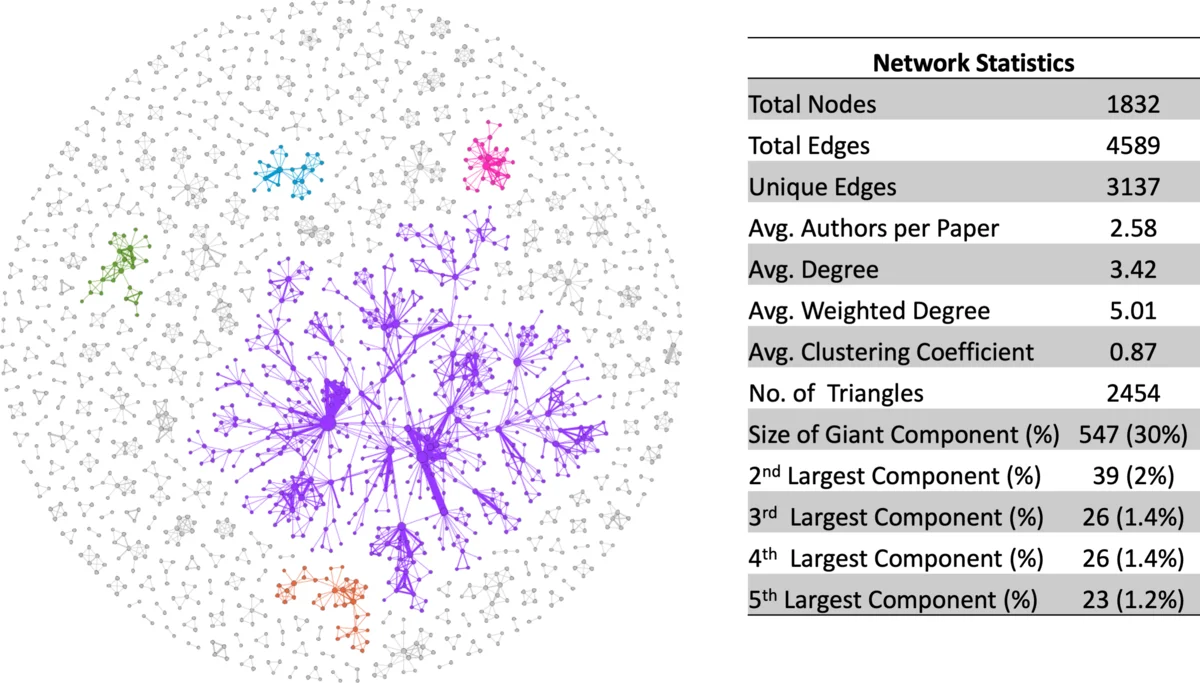
The core of the study is a multi‑level collaboration network analysis. At the author level, a co‑authorship network was constructed with 1,834 unique authors (nodes) and 4,590 undirected weighted edges (collaborations). Single‑author papers were excluded because they do not contribute to the network structure. The network decomposes into several connected components; the largest “giant component” contains roughly 30 % of all authors. Complementary cumulative distribution functions (CCDFs) for node degree and edge weight both follow power‑law distributions, indicating that a small elite of authors engage in many collaborations while the majority have only a few partners. The average clustering coefficient is 0.87, reflecting a highly cohesive structure. Team‑size analysis shows that two‑author papers are most common, with occasional larger teams of up to eight authors; the average team size fluctuates between two and three over the two‑decade span.
Institutional collaboration was examined by mapping authors to their affiliations. Modularity maximization identified 17 distinct communities within the giant component, each largely corresponding to specific geographic regions or research clusters. At the country level, China leads in sheer volume of publications and authorship but exhibits a predominantly domestic collaboration pattern, with international co‑authorship accounting for less than 30 % of its output. In contrast, the United States displays a more balanced profile, with roughly 45 % of its papers involving international partners, indicating a higher degree of global integration. These differences likely reflect national research funding policies, institutional incentives, and historical collaboration cultures.
Network‑wide structural metrics reveal a “small‑world” topology: the average shortest path length across the co‑authorship network is approximately five, and the high clustering coefficient further supports this classification. Small‑world networks are known to facilitate rapid diffusion of ideas and methodological innovations, suggesting that Econophysics benefits from efficient knowledge transfer despite its interdisciplinary breadth.
In conclusion, the study demonstrates that Econophysics has experienced robust growth over the past twenty years, driven by a synergistic blend of physics and economics. Publication and citation trends, together with power‑law distributed collaboration patterns and small‑world network characteristics, paint a picture of a field that is both highly concentrated around a core set of prolific researchers and increasingly interconnected internationally. The contrasting collaboration styles of China and the United States provide actionable insights for policymakers aiming to foster international research partnerships. The authors recommend extending the analysis to more recent data, incorporating additional bibliographic sources, and applying longitudinal network metrics to pinpoint emerging leaders and institutions, thereby deepening our understanding of the mechanisms that shape the evolution of interdisciplinary science.
Comments & Academic Discussion
Loading comments...
Leave a Comment