A symmetric attractor-decomposition lifting algorithm for parity games
Progress-measure lifting algorithms for solving parity games have the best worst-case asymptotic runtime, but are limited by their asymmetric nature, and known from the work of Czerwiński et al. (2018) to be subject to a matching quasi-polynomial lower bound inherited from the combinatorics of universal trees. Parys (2019) has developed an ingenious quasi-polynomial McNaughton- Zielonka-style algorithm, and Lehtinen et al. (2019) have improved its worst-case runtime. Jurdziński and Morvan (2020) have recently brought forward a generic attractor-based algorithm, formalizing a second class of quasi-polynomial solutions to solving parity games, which have runtime quadratic in the size of universal trees. First, we adapt the framework of iterative lifting algorithms to computing attractor-based strategies. Second, we design a symmetric lifting algorithm in this setting, in which two lifting iterations, one for each player, accelerate each other in a recursive fashion. The symmetric algorithm performs at least as well as progress-measure liftings in the worst-case, whilst bypassing their inherent asymmetric limitation. Thirdly, we argue that the behaviour of the generic attractor-based algorithm of Jurdzinski and Morvan (2020) can be reproduced by a specific deceleration of our symmetric lifting algorithm, in which some of the information collected by the algorithm is repeatedly discarded. This yields a novel interpretation of McNaughton-Zielonka-style algorithms as progress-measure lifting iterations (with deliberate set-backs), further strengthening the ties between all known quasi-polynomial algorithms to date.
💡 Research Summary
The paper addresses the long‑standing problem of solving parity games, focusing on the two dominant families of quasi‑polynomial algorithms: progress‑measure lifting and attractor‑based methods. While progress‑measure liftings achieve the best known worst‑case asymptotic runtime, they are inherently asymmetric: they construct a strategy for only one player and ignore the opponent’s perspective. This asymmetry can cause unnecessary work and limits practical performance. Conversely, attractor‑based algorithms (originating from the classic McNaughton‑Zielonka approach) often perform better in practice but historically suffered exponential worst‑case bounds; recent work by Parys and Lehtinen et al. reduced this to quasi‑polynomial time, yet these algorithms still lack a clean strategy‑construction framework and do not fit neatly into the universal‑tree lower‑bound theory.
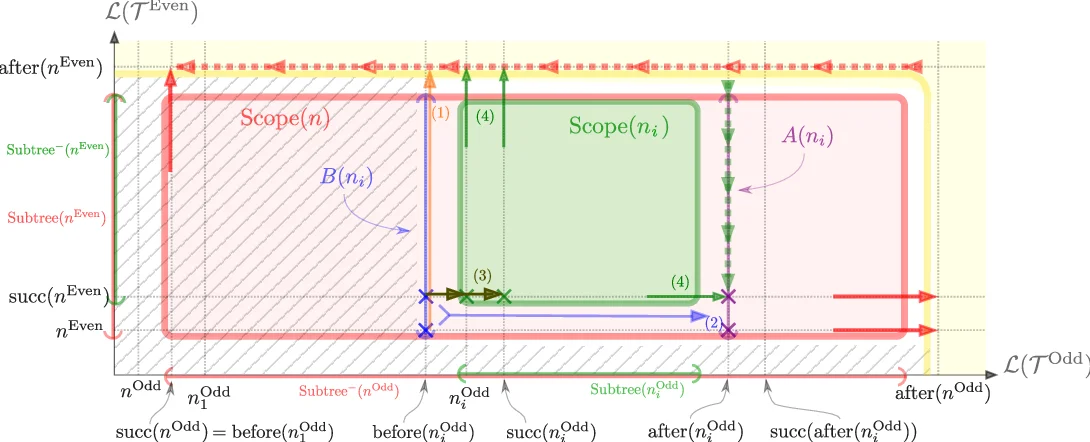
The authors first extend the progress‑measure formalism to handle attractor‑based strategies. They introduce embedded attractor decompositions, a labeling structure that enriches a tree T (an Even or Odd tree of height d/2) into a larger ordered set L(T) by inserting “before” and “after” positions between each node. A labeling µ : V → L(T) maps each game vertex to a position, respecting priority constraints: regular positions must match the vertex’s priority exactly, while lazy positions allow any lower priority. Validity conditions on edges and vertices guarantee that µ encodes a winning attractor‑based strategy for the player whose labeling is considered.
Using this structure, the paper presents Algorithm 1, an asymmetric attractor‑decomposition lifting algorithm that computes the smallest attractor‑based strategy compatible with a given universal tree T. Its runtime is O(|T|·|V|), matching the best known quasi‑polynomial bound for progress‑measure liftings. Moreover, the authors show that this asymmetric lifting can be viewed as a special case of generic progress‑measure lifting when expressed in the “universal graph” language of Colcombet and Fijalkow.
The central contribution is Algorithm 2, a symmetric lifting algorithm. Instead of fixing a single player, the algorithm maintains two labelings simultaneously—one for Even and one for Odd. In each iteration, a lifting step for one player may create new “valid” edges that accelerate the lifting of the opponent, leading to a mutually reinforcing process. This parallelism eliminates the asymmetry of earlier methods while preserving the same worst‑case complexity (still quasi‑polynomial). The authors argue that, in practice, the symmetric algorithm can avoid the redundant work that plagues asymmetric liftings, potentially offering better empirical performance.
To connect with prior work, the paper demonstrates that the generic attractor algorithm of Jurdziński and Morvan (2020) can be reproduced by deliberately decelerating the symmetric algorithm: after certain liftings, the algorithm discards some of the accumulated information, effectively performing a “set‑back”. This deceleration mirrors the behavior of McNaughton‑Zielonka‑style algorithms, showing that they are essentially progress‑measure liftings with intentional setbacks. Consequently, all known quasi‑polynomial algorithms—progress‑measure, attractor‑based, and McNaughton‑Zielonka variants—are unified under a single conceptual framework based on universal trees.
Finally, the authors provide a new, constructive proof of the dominion separation theorem, a key ingredient in Parys’s breakthrough. Their proof leverages the embedded attractor decomposition machinery, giving an algorithmic perspective rather than a purely existential one.
In summary, the paper makes four major contributions: (1) a formal embedding of attractor strategies into a lifting framework, (2) a symmetric dual‑player lifting algorithm that matches the best known worst‑case bounds while removing asymmetry, (3) a reinterpretation of existing attractor‑based and McNaughton‑Zielonka algorithms as decelerated instances of the symmetric method, and (4) a constructive proof of the dominion separation theorem. These results deepen the theoretical understanding of parity‑game solving and open new avenues for practical algorithm design.
Comments & Academic Discussion
Loading comments...
Leave a Comment