Text-Independent Speaker Recognition for Low SNR Environments with Encryption
Recognition systems are commonly designed to authenticate users at the access control levels of a system. A number of voice recognition methods have been developed using a pitch estimation process which are very vulnerable in low Signal to Noise Rati…
Authors: Aman Chadha, Divya Jyoti, M. Mani Roja
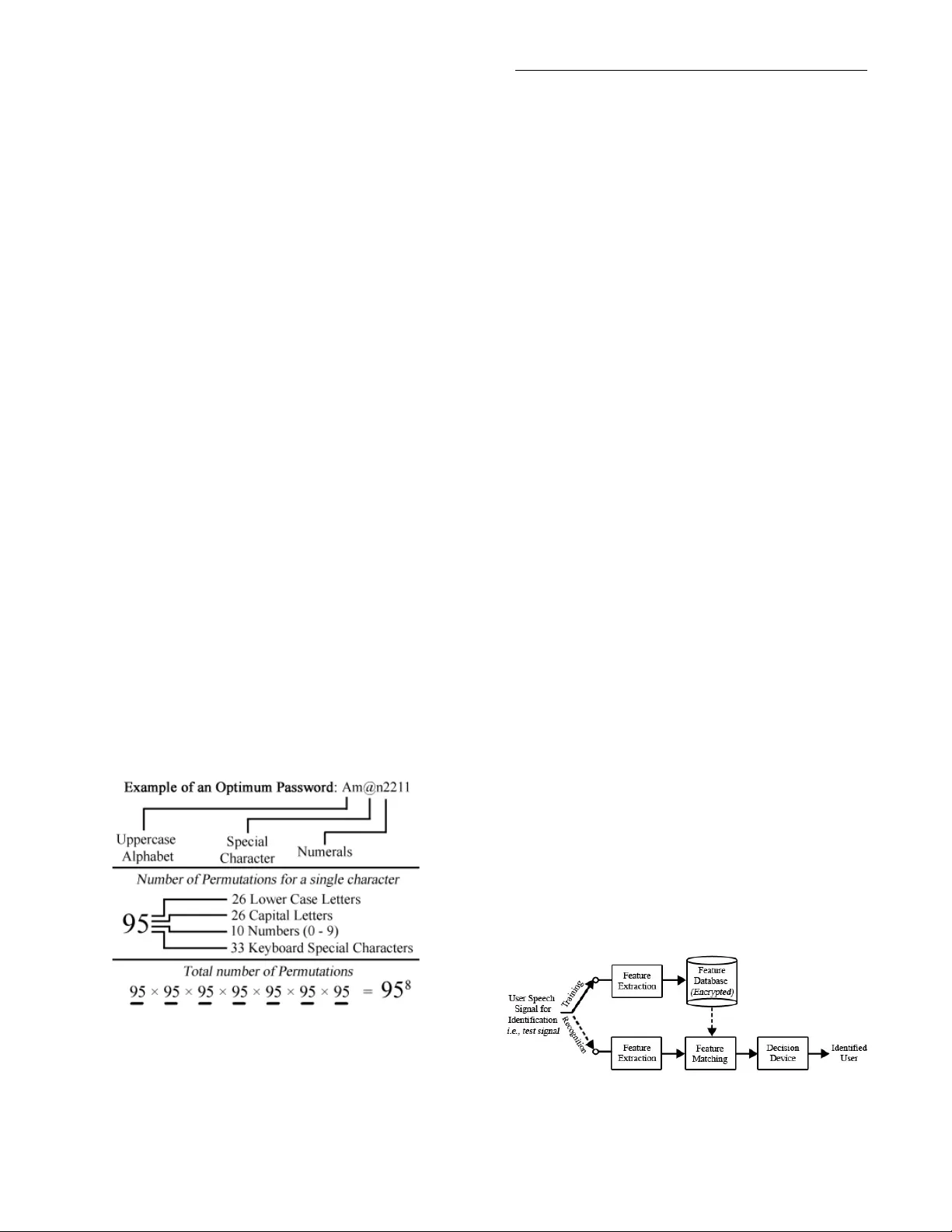
International Journal of Computer Applications (0975 – 8887) Volume 31– No. 10 , October 2011 43 Text - Independent Speak er Recognition f or Low SNR Environments with Encryption Aman Chadha Department of Electronics & Telecommunication TSEC Mumbai, India aman.x64 @gmail.com Divya Jyot i Department of Electronics & Telecommunication TSEC Mumbai, India dj.rajdev@ gmail.com M. Mani Roja Department of Electronics & Telecommunication TSEC Mumbai, India maniroja@ yahoo.com ABSTRACT Recognition systems are commonly designed to authenticate users at the access control levels of a system. A number of voice recognition methods have been developed using a pitch estimation process which are very vulnerable in low Signal to Noise Ratio (SNR) environments thus, these programs fail to provide the desired level of accuracy and robustness. Also, most text independent speaker recognition programs are incapable of coping with unauthorized attempts to gain access by tampering with the samples or reference database. The proposed text - independent voice recognition system makes use of multilevel cryptography to preserve data integrity while in transit o r storage. Encryption and decryption follow a transform based approach layered with pseudorandom noise addition whereas for pitch detection, a modified version of the autocorrelation pitch extraction algorithm is used. The experimental results show that the proposed algorithm can decrypt the signal under test with exponentially reducing Mean Square Error over an increasing range of SNR. Further, it outperforms the conventional algorithms in actual identification tasks even in noisy enviro nments. The recognition rate thus obtained using the proposed method is compared with other conventional methods used for speaker identification. General Terms Biometrics, Pattern Recognition, Security Keywords Speaker Individuality, Text-i ndep endence, P itch E xtraction, V oice Recognition, Autocorrelation 1. INTRODUCTION Humans hav e used body charac teristi cs such as face, vo ice, gait, etc. for thousands of years to recognize each other. Alphonse Bertillon, chief of the criminal identification division of the police department in Paris, developed and then practiced the idea of using a number of body measurements to identify criminals in the m id - 19th century. A wide variety of systems require reliable personal recognition schemes to either confirm or determine the identity of an individual requesting their services. The purpose of such schemes is to ensure that the rendered ser vices are accessed only by a l egitim ate user and thus, disallow unauthorized access [1]. A biometric system is essentiall y a pattern recog nition s ystem that operates by acquiring biometric data from an individual, extracting a fea ture set from the acquired data, and comparing this feature set against the template set in the da tabase. Thus , biomet ric systems fall under the ambit of technology designed and used specifically for measuring and analyzing the unique characteristics of a person. Any physiological and/or behavioral characteristic of a person can be used as a biometric feature as long as the following criteria are taken into account [ 2]: 1) Universality: Each person sho uld have a char acteristi c which is distinct to the person in question; 2) Distinctiveness: Any two people should be sufficiently different in terms of their characteristics; 3) Permanence: The characteristic should be s ufficiently invariant over a reasonable period of time; 4) Collectabilit y: Measuring the characteris tic quantitativ ely should be possible; 5) Performance: This refers to the achievable recognition accuracy and speed, th e resour ces required to achiev e the d esired perf ormance, as well as the oper ational and environmental factors that affect performance; 6) Acceptability: It indicates the extent to which people are willing to accept the use of a particular biometric identifier, i.e., the charac teris tic, in th e ir daily live s; 7) Circumvention: This reflects how easily the system can be bypassed using fraudulent methods. Even though reliable methods of biometric personal identification lik e finger - print analysis and retinal or iris scan do exist, howev er, the validity of forensic fingerprint evidence has recently b een chall enged by a cademics, judges and the med ia. While fingerprint identification was an improvement over earlier systems, the subjective nature of matching, along with the relatively high error rat e of h as made this f orensic pr actice controversial. As far as iris recognition is concerned, it is very difficult to perform at a distance larger than a few meters and depends on the cooperation of the person. The initial investment in setting these s ystem s is relatively high [2]. In contrast, voice recognition systems have the following advantages over other biometric iden tification system s: • Users can enroll themselves over the telephone rather than having them enroll in person to deliver a fingerprint or an iris scan . • The technology also requires no special data - acquisition system, other than a microphone. In case of signat ure verificatio n systems , a speciali zed digital p en tabl et acts as the data acquisition system whereas in iris International Journal of Computer Applications (0975 – 8887) Volume 31– No. 10 , October 2011 44 recognition systems, an Iris reader is deployed. Thus, hardware costs are reduced to a m inimum. • The voiceprint generated upon enrolment is characterized by the vocal tract, which is a unique physiological trait. A cold does not affect the vocal tract, so there will be no adverse effect on accuracy levels. Only extreme conditions such as laryngitis can hinder the optimal performance of the s ystem. • Voice recognition offers relatively low perceived invasiveness as compared to iris recognition, face recognition and signature verifica tion. Speaker recognition is the process of validating a user's claimed identity using characteristics extracted from their voices. No two individuals sound identical because their vocal tract shapes, larynx sizes and other parts of their voice production organs are different. In addition to these physical differences, each speaker has a distinctive manner of speaking, like t he use of a particular accent, rhythm, intonation style, pronunciation pattern, choice of vocabulary etc. [3]. Depending on the context of the application, speaker recognition systems may operate either in verification mode or identification mode. Speaker identification can be further divided into two branches: open- set identification and closed - set identification. Sin ce it is generally assumed that imposters, i.e., those assum ing identity of valid users, are not known to the system, this is referred to as an open - set task. Generally it is assumed the unknown voice must come from a fixed set of known speakers, thus the task is often refer red to as closed - set identification. In this paper, we deal with an instance of closed - set speaker identification. Depending on the algorithm used for the identification, the process can b e categorized as text - d ependent or text - independent identification. If the text must be the same for enrollment and verification this is called text -dependent recognition. In text - dependent systems, suited for cooperative users, the recognition phrases are known beforehand. For instance, the user can be prompted to read a randomly selected sequence of numbers as illustrated in [7]. In text -independent systems, there are no constraints on the words which the speakers are al lowed to us e. Thus, the refer ence and the test utterances m ay have complet ely differ ent content . Text - i ndependent systems are most often used for speaker identification as they require very little, if any, cooperation by the speaker. In fact, enrollment may happen without the user's knowledge, as in the case for man y forensic applications [3]. Most Biometric Recognition systems are used as security gateways which control access to sensitive information. In such programs if a false negative is triggered, it can be corrected in most cases, b y testing again, w hereas a false po sitive ma y have disastrous consequences from the view point of Data Securit y and Integrit y. Thus, the ac curacy rate m ust be calculat ed by taking into account both - samples that the program failed to recognize and samples which were identified incorrectly. Further, in text independent speaker recognition systems, an imposter may gain permissions by the following m eans: 1) A mimicry art ist may b e employe d to imit ate the spe aker's voice and diction. 2) The speaker's voice may be recorded without his or her consent and knowledge, and this sampl e may be p layed to the testing software. 3) The imposter may replace the reference sample of the user i n the database by his or her own voice sample. 4) Easily av ailable voice changer software may be used b y an imposter to mimic the voice of any reference sample if the database is vulnerabl e. All the above scenarios will result in a false positive result due to short comings of a Recognition system based purely on voice. Thus, the paper proposes extensive use of Encryption by means of a private - key which ge nerated from the password selected by the user. This key is then used to seed two level s of Pseudo Random Noise Generators (PRNG) for scrambling the signal sandwiched with Transform - based encryption to increase the robustness of encoding algorithm. The per formance of automatic speech recognizers (ASR) has known to degrade rapidly in the presence of noise and othe r distortions [6]. Speech recognizers are typically trained on clean speech and typically render inferior performance when used in conditions where speech occurs simultaneously with ot her unwarranted sound sources, i.e., distortions and disturbances. Some of these unsolicited sources are as below: • Speech recorded with a microphone or telephone handset is generally vulnerable to environmental noise su ch as computer hum, car engine, door slams, echoing, keyboard clicks, traffic noise, background noise, which adds to the speech wave [10]. • Reverberation adds delayed versions of the original signal to the recorded signal [4]. • The A/D converter adds its own distortion, and the recording device might interfere with mobile phone radio- waves. • If the speech is transmitted through a telephone network, it is compressed using lossy techniques which might have added noise into the signal. To sum up, the speech wave fed to the recognition algorithm is not the same wave that was transmitted from the speaker’s lips and nostrils, but it has gone through several transformations degrading its quality [10]. If samples of the corrupting noise source are available before hand, a model for the noise source can additionally be trained and noisy speech may be jointly decoded using trained models of speech and noise [9]. However, in many realistic applications, adequate amounts of noise samples are unavailable before - hand, and hence training of a noise model is not feasible. Fig. 1 illustrates some additive and convolutive noise sources which occur during the process of speaker recognition. Fig 1 : Error sources during th e proces s of spe aker recognition The Mel -Frequency Cepstral Coefficients (MFCC) are the most evident ex ample of a f eature s et that is ex tensivel y used in speaker recognition. When MFCC front - end is used in speaker recognition system, one makes an implicit assumption that the human hearing mechanism is the optimal speaker recognizer. However, this has not been confirmed, and in fact opposite results exist [10]. In most speaker recognition systems, MFCC International Journal of Computer Applications (0975 – 8887) Volume 31– No. 10 , October 2011 45 has shown to achieve fairly good performance. Conventionally, MFCC features are extracted from the spectral analy sis of 20 to 30 ms long speech frames with an overlap of 10 t o 15 ms [17],[18]. The length of the analysis window and the size of overlap are usually fixed for each system. The drawbacks of a fixed length analysis window have been issued by many rese archers [18],[23]. This paper presents a modified version of the autocorrelation pitch extraction algorithm robust against noise. 2. IDEA OF THE PRO POSED SOLUTIO N The primary objective of this paper is to implement a speaker recognition system sustainable to a great extent, again st noise, i.e., a system offering superior performance under low SNR conditions. Moreover, for the system to offer high levels of security, a robust multi - level e ncryption scheme need s to be implemented. The database used for this proj ect consists of voice samples of 50 subjects. 6 voice samples are take n for each person. Out of these, 3 are used for training and the remaining samples are used for testing. Test voice samples with different tones and volume levels are considered for the experiment. 2.1 Need for Reference Template En cryption Encryption is the process of transforming data into scrambled unintelligible cipher text using a key. The role of Encryption is to secure information when it is stored or in transit. However, it is relativ ely easier to crack single level encryption by brute force or correlation, as compared to a multi - level encryption scheme. Therefore, the program requires a user defined 8 - chara cter password to seed two out of three levels of encryption. The password must have a minimum of one capital alphabet, one numeral and one spec ial charac ter, such as @, >, & etc. Fig. 2 shows how, more than 6.6 × 10 15 permutations are possible. This password is processed further using numeric substitutions in Caesar’s Cipher type of encrypti on and a st ate seed is generat ed. Findings in [5] show that a hacker may take as l ess as 10 minutes to crack each password once a rainbow table has been built, if all passwords are stored internally in a memory hash. Hence, the s ystem is designed t o store no password and the state seed generated on the fly is divided into two keys, each of which is used for further encryption and computation. Fig 2 : Permutations for a password Random numbers can be generated by a random bit generator which can be defined as a device or algorithm whose output is a sequence of statistically independent and unbiased binary digits. Pseudorandom Number Generator (PRNG) [12] is used to generate random bits dependent on the state seed, such that an adversary cannot judge the next bit by cor relating a subset of th e random bits generated. This is ensured by virtue of large number of internal states of the generator which in turn means large period of the random bits generated. For implementing the proposed encryption algorithm, PRNG inbuilt in MATLAB 7 is used which has an average period of 235×16 as total number of internal states are 35 words. In short, on an average t he random sequence will repeat itself only after 235×16 bits, which is m uch greater than the length of the samples required for test ing. PRNG works by taking a state seed s as input and generating the output sequence of random values as f(s), f(s+1), f(s+2), … Here, f is a one way function which can be de fined as an algorithm whose output is a sequence of stat istically independent and unbiased binary digits [12]. Based on the properties of this function f, some output values say, f(s+i), must be discarded to eliminate correlation between subsequent random bits. This approach is actively followed by standardized one- way functions, for e.g., a cryptographic hash function such as SHA - 1 or a block cipher such as DES (x7.4). When the sequence so generated is superimposed with the reference or test voice sampl e, scramb ling takes place and s ignal is r endered nearly ind ecipherable. Yet, th e signal is still in tim e domain and a person may make a correct guess of the scrambling k ey. Thus, the second type of encryption used is Transform based encryption. A transform based encryption changes the domain of the data from say time domain to frequency domain or complex plot etc. It means that the new data which is acquired has no meaning in its previous domain, in this case - time domain. A discrete cos ine transform (DCT) based scheme is used for further scrambling as [11] illustrates the superiority of DCT over four other discrete transform based encryption techniques for analog speech, when compared with respect to a nov el cryptan alytic a ttack. DCT is a well - known transform that decomposes a signal into its frequency components and it un - correlates the sequence of input samples, i.e. DCT coefficients give the frequency domain equivalent of speech data [11]. In fact, for large databases this step may be used to compress the voice signal at the cost of system accur acy. A final l ayer of pseudorandom noise using the second part of the state key generated at run - time is superimposed on the noisy signal DCT coefficients and source side encryption is complete. The sample so obtained is amplified and assumed to be transmitted over an AWGN channel with known Signal to Noise Ratio (SNR). At the testing site, this received sample is decrypted in inverse order of enc ryption and matched with test sample for Speaker Recognition. 2.2 Speaker Recognition P rocess Fig. 3 shows the general structure of the speaker recognition sys tem . Fig 3: General archite cture of a speaker r ecognit ion system International Journal of Computer Applications (0975 – 8887) Volume 31– No. 10 , October 2011 46 This system operates in two modes: training and recognition. In the training mode a new speaker (with a known identity) is enrolled into the database, while in the recognition mode an unknown speaker gives a speech input signal and the s ystem tries to iden tif y the speaker . 1) Feature Extraction: The feature extractor, i.e, the front - end, is the first component in an ASR system. Feature extraction transforms the raw speech signal into a compact but effective representation that is more stable and discrimina tive than the original signal. 2) Databa se: A collection of voice samples has been recorded for evaluation of the proposed system. The recordings were converted to WAV format to facilitate easy analysis and operations using MATLAB 7 . The WAV files were su b jected to a multi - level encryption scheme to foster max imum security. 3) Speaker Modeling: The training phase uses the acoustic vectors extracted from each segment of the signal to create a speaker model which will be stored in a database. 4) Pattern mat ching and decision: The Pattern matching strategy takes all the matching scores from the user pattern to each of t he stored reference patterns into account and searches for the “closest” possible match and thus makes a decision. The steps involved in the entire process can be summarized as follows: 1) The location s of the samples of different users are stored upon encryption them using the proposed multi - level encryption scheme. 2) Various features and para meters of the voice samples such as mean, varian ce, stand ard deviati on, pitch etc. ar e calculat ed. 3) The voice sample of a test speaker is record ed. 4) T he Euclidean distance betw een the features of this sam ple and the samples previously stored in the database is calculated. 5) The Euclidea n distances ar e then arranged in an ascending order, with the first Euclidean distance being the minimum. 6) The sample corresponding to the first Euclidean distance is the sample having the highest resemblance to the sample under test. 3. IMPLEMENTATI ON STEPS Pitch, i.e ., fundamental frequency, is an important parameter of speech signals which is used in speech analysis, synthesis and recognition. Fundamental frequency (F0) as an acoustic correlate is strongly related to prosodic information of stress and intonation. For sp eech recogn ition appl ications, p itch extr action (fundamental frequency estimation) provides the basis for voiced/unvoiced classification decision. However, before pitch extraction and subsequent matching takes place, the Reference voice sample must be encr ypted, transmitted over AWGN channel and decrypted at testing site. Fig. 4 shows the data fl ow at various steps. Fig 4: Sche me for encrypti on and decrypti on The steps involved in the process of generation of the two St ate Keys can be summarized as foll ows: 1) Read an 8 character long password from user. 2) Convert to ASCII equivalent to form an array s ay ‘x’. 3) Apply Caesar’s cipher with a shift of 4, to each ASCII element to form a new array say ‘y’. 4) Concatenate all elements of y to form a single i nteger say ‘z’. 5) Calculate length of ‘z’. 6) If even break into two equal halves two generate two equal length keys – Key1 and Key2. 7) Else break asymmetrically, the longer key is Key1 and shorted key is Key2. Fig 5: An example illustrating generation of keys The steps involved in the process of encryption c an be summarized as follows: 1) Level 1: Key1 is passed as seed to PRNG a nd superimpose the output s equence on referen ce voice s ample to generate a noisy signal say ‘x’. 2) Level 2: Perform DCT on x and save the coefficients in an arra y say ‘ y’. 3) Level 3: Key2 is passed as seed to PRNG a nd superimpose the random sequence obtained on y and save the resultant as an array say ‘z’. 4) z is the signal which is to be transmitted through AWGN ch annels with known SNR. Thus, it is subjected to various SNR levels and the resulting signal is normalized and then dec rypted as follows. The steps involved in the process of decryption c an be summarized as follows: 1) Level 3: Key2 is passed as seed to PRN G and algeb raically subtract the random sequence so obtained from the received signal, save the resultant as say ‘x’. 2) Level 2: Take Inverse DCT of x and s ave the noisy signal so obtained as ‘y’. 3) Level 1: Key1 is passed as seed to PRNG and algebraical ly subtract the random sequence so obtained from x, save the resultant as say, ‘z’. International Journal of Computer Applications (0975 – 8887) Volume 31– No. 10 , October 2011 47 4) T he file ‘z’, recovered after the above steps is the final decrypted version of reference signal, this is sent for pitch extraction along with the test signal and compar ative matching takes place. Fig. 6 and Fig. 7 show the encryption and decryption plots of the sample under test res pectivel y. Fig 6: Original signal (Left), signal after Level 2 (Middle) and signal after Level 2 and AWGN Ins ertion (Right) Fig 7: Received signal (Left), recovered file with h igh SNR (Middle) and recovered file with low SNR (Right) Pitch extraction, also known as, fundamental frequency estimation, plays a vital role in speech processing and has numerous applications in speech related areas. Therefore, several methods to extract the pitch of speech signals have been proposed by researchers. However, such methods are known to be very vulnerable in noisy environments, hence, performance improvement in noisy environments is still desired. For example, this is particularly true in speech enhancement systems, bec ause in su ch systems the acc uracy of pitch extraction is directly related with the quality of s peech after the operations of enhancement. Also, speech communication systems often transmit pitch information. To do this, we have to extract the pitch of speech signals in practical nois y environments. Unfortunately, a reliable and accurate method for pitch extraction in noisy environments is still a subject of scientific inv estigation. Generally, pitch detection algorithms (PDA) use short - term analysis techniques [16]. For every frame x m we get a score f(T|x m ) which is a function of the candidate pitch period T . Such algorithms, in general, offer a rough estimation of the pitch by maximizing the following equation: T m = ( ) arg max | m fT x T (1) A commonly used method to estimate pitch is based on detecting the highest value of the autocorrelation function in the region of interest. The correlation between two waveforms is a measure of th eir sim ilarity. Th e waveform s are com pared at different time intervals , and their sim ilarity is calculated at each interval. The result of a correlation is a measure of similarity as a function of time lag between the beginnings of the two waveforms. One would expect exact similarity at a time lag of zero, with inc reasing dissi milarity as the time l ag increases . The mathematical definition of the autocorrelation function R xx (τ) is shown in (2), for an infinite discrete fun ction x[ n] , and (3) shows the mathematical definition of the autocorrelation R xx (τ) of a finite discrete function x ’ [ n] of size N . ( ) [ ][ ] xx n R xn xn ττ ∞ = −∞ = + ∑ (2) 1 0 '( ) '[ ] '[ ] N xx n R xn xn τ ττ −− = = + ∑ (3) where, x[ n] is the s peech signal; τ is the lag number; n is the time for a discret e signal. Correlation based processing is known to be comparatively robust against noise and may be one which provides the best performance in noisy environments [19],[20],[22]. The autocorrelation function of a signal is actually a non -inverti ble transformation of the signal that is useful for displaying structure in the waveform. Hence for pitch detection applications, i f we assume x (n) = x (n + P) for all n , i.e., x(n) is periodic with period P , then it is easily shown th at: R xx (τ) = R xx (τ + P) (4) Equation (4) basically indicates that the autocorrelation function is also periodic with the same period. Conversely, periodicity in the autocorrelation function indicates periodicity in the original signal. Speech being a non - stationary sig nal, the conc e pt of a long - time autocorrelation measurement as defined in (3) cannot be easily extrapolated for such signals [16]. Thus, it is mandatory to define a short - time autocorrelation function, which operates on short segments of the signal as: [ ] [ ] '1 0 1 ( ) ( )( ) ( )( ) N xx n R x n l wn x n l wn N τ ττ − = = + ++ + ∑ (5) where, 0 ≤ τ ≤ M 0 ; w(n) is an appropriate window for analysis; N is the section length being analyzed; N' is the number of signal samples used in the computation of R xx (τ) ; M 0 is the number of autocorrelation points to be computed; τ is the lag number; l is the index of the starting sample of the fram e. For applications involving pitch estimation, N' is generally set to the value given by the following equation: N ' = N - m (6) This is done so that only the N samples present in the analysis frame, i.e ., x( l), x( l + 1), . . . , x(l + N - 1) are used in the autocorrelation computation. Values of 200 and 300 have generally been used for M 0 and N respec tively corresponding to a maximum pitch period of 20 ms (200 samples at a 10 kHz sampling rate) and a 30 ms an alysis frame size . Correlation based processing also includes the average magnitude difference function (AMDF) method [15],[16],[18]. The AMDF PDA is chosen in our study is bec ause it has International Journal of Computer Applications (0975 – 8887) Volume 31– No. 10 , October 2011 48 relatively low computational cost and is easy to implement. Several types of noise such as babble, car, and street noises with 5 dB, 10 dB, 15 dB and 20 dB S NR are used to evaluate the performance of the proposed system. The noise sources are taken from the NOISEX - 92 database [21], from Carnegie Mellon University, a collection of different noise waveforms which can be used to generate speech waveforms in various noise conditions and with different signal to noise ratio (SNR) values. The AMDF is [13] essentially a variation of autocorrelation function analysis where, instead of correlating the input speech at various delays (where multiplications and summations are formed at each value), a difference signal is formed between the delayed speech and the original, and at each delay value the absolute magnitude is taken [14]. In contrast with the autocorrelation or cross - correlation function, the AMDF calculations require no multiplications, a much sought - after property for real - time applicatio ns. Therefor e, for the purpose of emphasiz ing the true peak pro duced by t he autocorrela tion, i.e., f or measuring the periodicity of voiced speech, we pro pose an autocor relation functio n (AMDF). The AMDF is defined by the following e quation: 1 0 1 () [ ] [ ] N n A M D F xn xn N ττ − = = −− ∑ (7) where, x(n) are the samples of input speech; x(n - τ) are the samples obtai ned by introducing a delay of τ seconds. Equation (7) indicates the characteristic of the AMDF that when x[n] is similar with x[n - τ], AMDF(τ) yields a small value. A difference signal is thus formed by delaying the input speech various amounts, subtracting the delayed waveform from the original and summing the magnitude of the differences between sample values. For zero delay, the difference signal is always zero and is particularly small at delays corresponding to the pitch period of a voiced sound having a quasi -perio dic structure [16]. For each value of delay, computation is made over an integrating window of N samples. To generate the en tire range of delays, the window is “cross differenced” with the full analysis interval. An advantage of this method is that the rel ative sizes of the nulls tend to remain constant as a function of delay, which is mainly because there is always full overlap of data between the two segments being cross differenced. In extra ctors of this type, the limiting factor on accuracy is the inabi lity to completely separate the fine structure from the effects of the spectral envelope. For this reason, decision logic and prior knowledge of voicing are used along with the function itself to help make the pitch decision more reliable. Let us assum e th at x(n ) is a noi sy speech signal composed of the actual speech content and the Additi ve White Gaussian Noise (AWGN). x(n ) is given by the following equation: x(n) = s (n) + w( n) (8) where, s(n) is a clean speech signal; w(n) is t he AWGN. The autocorr ela tion function () xx R τ for this particul ar case, as demonstrated in [15] , is g ive n by: 1 0 1 ( [ ] [ ]) ( [ ] [ ]) N n s n wn s n wn N ττ − = = + ⋅ ++ + ∑ 1 0 ( [] [ ] [] [ ] 1 [] [ ] [] [ ] ) N n snsn snw n wn s n wn wn N ττ ττ − = ++ + = + ++ + ∑ () 2 () () ss sw ww R RR τ ττ = ++ where, R ss (τ) is the autocorrelation function of s[n] ; R sw (τ) is the crosscorrelation function of s[ n] and w[ n] ; R ww (τ) is the autocorrelation function of w[ n] . In [15], the case for large values of N has been de scribed. If the speech signal shows no correlation with the AWGN, then R sw (τ) does not exist, i.e., it yields a zero value. The following equation exists for this case: ( ) ( ) ( ) ...if = 0 xx ss ww R RR τ τ ττ = + (8) Also, if w [ n] is uncorrelated, then R ww (τ) yields a zero value except for τ = 0 . If this is the ca se, the followin g relation hold s true: ( ) ( ) ...if 0 xx ss RR τ ττ = ≠ (9) Based on the above mentioned properties, the autocorrelation function provides robust performance against noise. When the characteristics of the AMDF are plotted, it is found to yield a notch, while the autocorrelation function yields a peak. Thus, the cha racteristics of the AMDF are found to bear similarity with that of the autocorrelation function. However, both functions have the same periodicity. Pitch of the segmented speech is estimated by searching the peak of the resultant function obtained on coupling the autocorrelation function with the AMDF. However, upon deploying the resulta nt function directly, we observe that the accuracy of pitch extracti on is compromised. Therefore, the system uses interpolation based on 3 points around the detected peak [15]. It is kn own that such interpolation on the autocorrelation function is useful for improving the accuracy of pitch extraction. Lagrange’s method is used to perform the interpolation operation. The frequency band selected for searching the pitch peak is from 50 Hz to 400 Hz as it corresponds to the region of the fundamental frequencies of most men and women. The technique of removing the formant structure for reliable pitch detection by center clipping demonstrated by M. Sondhi [8] while still retaining the pitch period information was implemented to reduce the effects of the formant structure on the detailed shape of the short - time autocorrelation function. 4. RESULTS Upon performing Decryption on the signals that were subjected to AWGN, the Mean Square Error (MSE) values thus obtained, are tabulated against SNR as follows: Table 1 . MSE v alues for c orrespondi ng SNR v alues SNR in dB Mean Squa re Error 16 2.83 × 10 -2 17 1.82 × 10 -2 18 2.02 × 10 -3 19 4.11 × 10 -5 20 7.32 × 10 -7 International Journal of Computer Applications (0975 – 8887) Volume 31– No. 10 , October 2011 49 Fig. 8 shows the plot of the MSE values against the SNR values. Fig 8: Plot of MSE against correspondin g SNR To investigate the accuracy of the modified pitch e xtraction method, various experiments were conducted to compare the efficiency of the algorithm with four standard conventional speaker identification methods namely, Statistical Methods (Mean, Moment and Variance), Linear Predictive Coding (LPC), Zero Crossing and Fast Fourier Transform (FFT). Table 2 . Results o btained using t he proposed m odified autocorrelation method and comparison with other method s Algorithm Accuracy Pitch Extraction 92.39 Mean, Moment and Variance 74.87 Linear Predictive Coding 72.42 Zero Crossing 62.35 Fast Fourier Transform 55.49 Fig. 9 shows the plot of accuracy rates of various algorithms. Fig 9: Plot of various algorithms against th eir accuracy rates 5. FUTURE SCOPE The system can be implem ented for r eal time app lications if the database can b e standardi zed online, th is will eli minate the n eed of training samples for the system. Also, the concept of voice recognition using autocorrelation can be tried for a larger database. As the size of the datab ase incre ases, encr yption algorithm could be further strengthened by using longer keys and increasing the period of pseudorandom noise sequences which shall make decryption by brute force near imposs ible and also re duce MSE to a min imum. 6. CONCLUSIO N The primary objective of the paper was to implement a robust and secure voice recognition system using minimum resources offering optimum performance in noisy environments. We have implemented this system using three levels of encryption for data security and autocorrelation based approach to find the pitch of the sample. The resulting system was fo und to reduce significantl y the amount of test data or features to be extracted. By virtue of DCT based scrambling, the system is highly immune to cryptanalytic attacks that target the redundancy of speech. The robustness of the system in adverse conditions such as noisy or channel distorted environments was verified by conducting closed set text - independent speaker identification experiments, and results pointed to improved performance in adverse SNR environments. We conclude that the proposed algorithm is equipped with means to en sure that data security is not compromised at any stage of computation and at the same time high accuracy rate of the pitch detection algorithm makes it very powerful in both clean and noisy environments. 7. REFERENCES [1] A. K. Jain, A. Ro ss, S. Prabh akar, "An i ntr oduction to biometric recognition," IEEE Transactions on Circuits and Systems for Video Technology, Vol. 14, No.1, Jan. 2004, 4- 20. [2] R. Clarke, “Human Identification in Information Systems: Management Challenges and Public Policy Issues,” Information Technology & People, Vol. 7, No. 4, 6 – 37, 1994. [3] T. Kinnunen, H. Lib, “An Overview of Text -Independent Speaker Recognition: from Features to Supervectors,” 1 - 3. [4] X. Huang, A. Acero, and H. W. Hon, Spoken La nguage Processing: a Guide to Theory, Algorithm, and Sys tem Development, Prentice - Hall, New Jersey, 2001. [5] K. Theocharoulis , I. Papaefst athiou, C. Man ifavas, “Implementing Rainbow Tables in High - End FPGAs for Super- Fast Password Cracking,” International Conference on Field Programmable Logic and Applications, 2010, 145 - 150. [6] X. Huang, A. Acero, and H. Hon, Spoken Lang. Process.. Upper Saddle River, NJ: Prentice - Hall, 2001. [7] A. Higgins, L. Bahler, and J. Porter, “Speaker verification using randomized phrase prompting,” Digital Signal Processing 1 (April 1991), 8 9–106. [8] M. Sondhi, “New methods of pitch extraction,” IEEE Transactions on Audio and Electroacoustics, Vol. 16, No. 2, Jun 1968, 262 -266. [9] A. P. Varga and R. K. Moore, “Hidden Markov model decomposition of speech and noise,” in Proc. ICASSP’90, 1990, 845 -848 . [10] T. Kinnunen , Licenti ate’s Thes is, “Spectr al Features f or Automatic Text - Independent Speaker Recognition,” Department of Computer Science, University of Joensuu, December 2003, 5 - 11, 2 -3. 0 0.02 0.04 0.06 0.08 0.1 16 17 18 19 20 Mean Square Error SNR in dB 0 50 100 Pitch Extraction Statistical Methods Linear Predictive Coding Zero Crossing Fast F ourier Transform Accuracy Rates Algorithms International Journal of Computer Applications (0975 – 8887) Volume 31– No. 10 , October 2011 50 [11] B. Goldburg, S. Sridharan, E. Dawson, “Design and cryptanal ysis of transform- based analog speech scramblers ,” IEEE Journ al on Select ed Areas in Communications, June 1993, 735 -744. [12] A. Menez es , P. O orschot , S. Vanstone , R. Riv est, Handbook of Applied Cryptography, CRC Press, 1996, 169- 179, 180 -190. [13] M. J. Ross, H. L. Shaffer, A. Cohen, R. Freudberg, and H. J. Manley, “Average magnitude difference function pitch extractor,” IEEE Transactions on Acoustics, Speech, Signal Processing, Vol. ASSP - 22, Oct. 1974, 353 -362. [14] L. R. Rabin er, M. J. C heng, A. E. Ro senberg, and C. A. McGonegal, “A comparative performance study of several pitch detection algorithms,” IEEE Transactions on Audio, Signal, and Speech Processing 24, 1976, 399 -417. [15] H. Kobayashi and T. Shimamura, "A weighted autocorrelation method for pitch extraction of noisy speech," IEEE International Conference on Acoustics, Speech, and Signal Processing, Vol. 3, 2000, pp.1307 - 1310. [16] L. Tan and M . Karnjanade cha, “Pitch D etection A lgorithm: Autocorrelation and AMDF”, International Symposium on Communications and Information Technologies (ISCIT 2003), 1 - 4. [17] L. R. Rabin er, B.H. J uang, F undamentals of speech recognition, Prentice Hall, 1993. [18] T. F. Quat ieri, Dis crete time speech signa l process ing, Prentice Hall, 2002. [19] S. Jung pa, S. Hong, J. Gu , M. Kim, I. Baek, Y . Kwon, K. Lee, Sun g- I Yang, "New speak er recognition feature using correlation dimension," Proceedings of the IEEE International Symposium on Industrial Electronics, 2001, ISIE 2001, Vol.1, 2001, pp.505 -507. [20] S. Kim , M. Ji, H. Kim , “Robust speak er recogn ition based on filtering in autocorrelation domain and sub - band feature recombination,” Pattern Recognition Letters, Elsevier Science, Vol. 31, No. 7, May 2010, 593 -599. [21] NOISEX - 92 Database, Carnegie Mellon University, http://ww w.speech.cs. cmu.edu /comp.sp eech/Sectio n1/Data/ nois ex.html, July 2011. [22] L. R. Rabiner, “On the use of autocorrelation analysis for pitch detecti on,” IEEE Transacti ons on Acou stics, Sp eech, Signal Processing, Vol. ASSP - 25, No. 1, 24 – 33, Feb. 1977. [23] Y. J. Kim, and J. H. Chung, “Pitch synchronous cepstrum for robust speaker recognition over telephone channels,” Electroincs letters, Vol. 40, No. 3, 207 – 209, 2004. AUTHOR BIOGRAPH IES Aman Chadha (M’2008) was born in Mumbai (M.H.) in India on November 22, 1990. He is currently pursuing his undergraduate studies in the Electronics and Telecommun i cation Engineering discipline at Thadomal Shahani Engineering College, Mumbai. His special fields of interest include Image Processing, Computer Vision (particularly, Pattern Recognition) and Embedded Systems. He has 5 papers i n International Conferences and Journals to his credit. He is a member of IETE, IACSIT and ISTE. Divya Jyoti (M’2008) was born in Bhopal (M.P.) in India on April 24, 1990. She is currently pursuing her undergraduate studies in the Electronics and Telecommunication Engineering discipline at Thadomal Shahani Engineering College, Mumbai. Her fields of interest include Image Processing, and Human - Computer Interaction. She has 4 papers in International Conferences and Journals to her credit. M. Mani Roja (M’1990) was born in Tirunelveli (T.N.) in India on June 19, 1969. She has received B.E. in Electronics & Communication Engineering from GCE Tirunelveli, Madurai Kamraj University in 1990, and M.E. in Electronics from Mumbai University in 2002. Her employment experience includes 21 years as an educationist at Thadomal Shahani Engineering College (TSEC), Mumbai University. She holds the post of an Associate Professor in TSEC. Her special fields of interest include Image Processing and Data Encryption. She has over 20 papers in National / International Conferences and Journals to her credit. She is a member of IETE, ISTE, IACSIT and ACM.
Original Paper
Loading high-quality paper...
Comments & Academic Discussion
Loading comments...
Leave a Comment