Producing 3D Friction Loads by Tracking the Motion of the Contact Point on Bodies in Mutual Contact
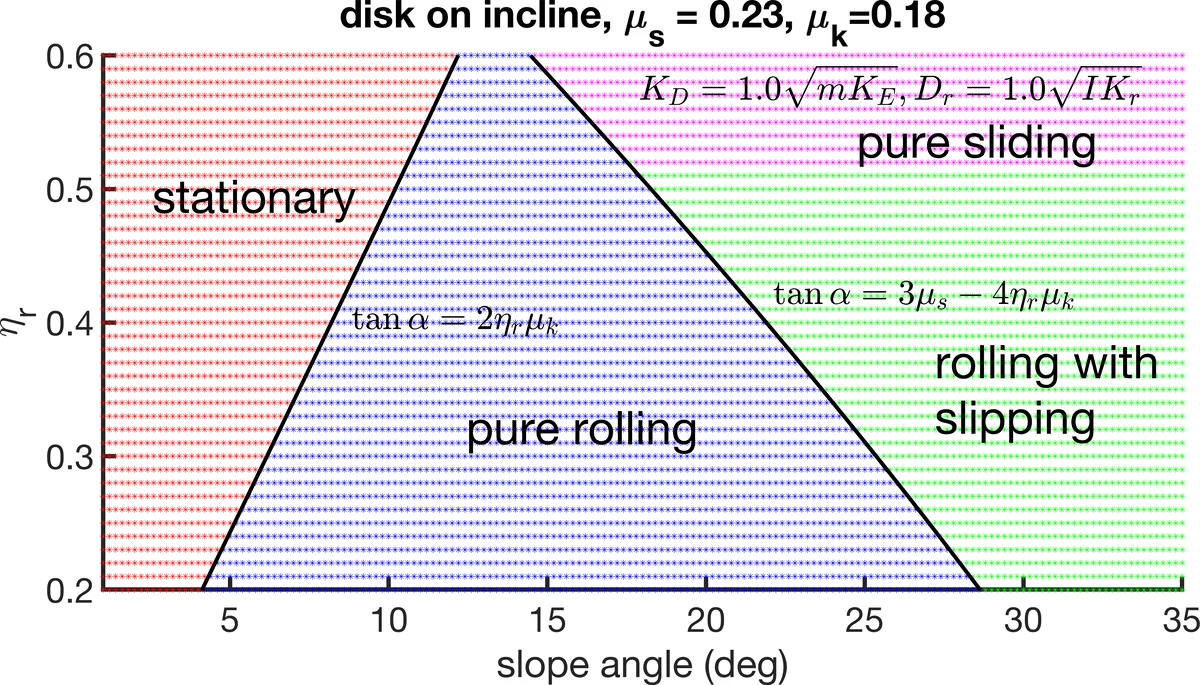
We outline a phenomenological model to assess friction at the interface between two bodies in mutual contact. Although the approach is general, the application inspiring the approach is the Discrete Element Method. The kinematics of the friction process is expressed in terms of the relative 3D motion of the contact point on the two surfaces in mutual contact. The model produces expressions for three friction loads: slide force, roll torque, and spin torque. The cornerstone of the methodology is the process of tracking the evolution/path of the contact point on the surface of the two bodies in mutual contact. The salient attribute of the model lies with its ability to simultaneously compute, in a 3D setup, the slide, roll, and spin friction loads for smooth bodies of arbitrary geometry while accounting for both static and kinematic friction coefficients.
💡 Research Summary
The paper presents a phenomenological friction model designed to compute three-dimensional friction loads—slide force, roll torque, and spin torque—between two bodies in mutual contact. While the motivation stems from the Discrete Element Method (DEM), the approach is general and applicable to any smooth bodies of arbitrary geometry. The core idea is to track the motion of the contact point on each body’s surface over a small time step Δt (typically 10⁻⁶–10⁻³ s). The contact points are represented as a cross on body i and a dot on body j; their positions at the beginning (C₀ᵢ, C₀ⱼ) and end (C₁ᵢ, C₁ⱼ) of the step define arcs sᵢ and sⱼ on the respective surfaces, assumed to follow geodesics. The difference in arc lengths yields a relative slip s, which forms the basis for the slide friction component.
A contact reference frame (n, u, w) is constructed at each step: n is the unit normal pointing into body i, while u and w span the tangent plane. The initial tangent directions (u₀, w₀) are chosen arbitrarily; at the next step, the new directions (u₁, w₁) are obtained by maximizing the dot product with the previous directions, leading to a convex optimization with a unique solution. This procedure defines the smallest rotation ψ required to align the reference frame of body j with that of body i; ψ is the spin angle and is positive for a counter‑clockwise rotation.
The model assumes three independent dissipation mechanisms: (1) relative slip (slide), (2) relative spin, and (3) rolling. For each mechanism an elastic (stiffness) component and a viscous (damping) component are introduced. Slide friction is expressed as
F_f = K_E S_ij + K_D ΔS_ij Δt,
where S_ij is the accumulated slip (memory) and ΔS_ij = p_i – p_j is the incremental slip vector obtained from the projected contact points. The elastic part is capped by static or kinetic thresholds S_s = μ_s N / K_E and S_k = μ_k N / K_E, depending on whether the contact is in stick (static) or slip (kinetic) mode. If the slip exceeds the appropriate threshold, the model scales S_ij by a factor α and switches the mode accordingly. The damping coefficient K_D is treated as a “knob” for energy dissipation; in the absence of experimental data a default value K_D = 2 √(m_ij K_E) is suggested, where m_ij is an average of the two bodies’ masses.
Rolling friction is derived from the arc length |p_i| and the local surface curvatures κ_i and κ_j. Radii of curvature R_i = 1/|κ_i| and R_j = 1/|κ_j| are defined, and an average curvature over the step is used to compute a rolling resistance torque acting in the plane spanned by the normal and the rolling direction. The torque has an elastic term proportional to the change in rolling angle and a viscous term proportional to its rate, analogous to the slide formulation.
Spin friction directly uses the spin angle ψ. The spin torque is τ_s = K_E ψ n + K_D ψ Δt n, representing resistance to relative rotation about the contact normal.
Key assumptions underpinning the model are: (i) small relative displacements and rotations within each Δt, allowing vector treatment of rotations; (ii) decoupling of the three dissipation mechanisms; and (iii) governing of the stick regime solely by micro‑scale elastic deformation, while kinetic friction is capped by Coulomb’s law (μ_k N). The model also respects Amontons’ laws (force proportional to normal load, independence from apparent contact area) and Coulomb’s velocity‑independent kinetic friction.
Numerical experiments (described in the appendix) demonstrate the model’s ability to reproduce realistic energy dissipation for scenarios such as a sphere rolling on a plane, a sphere dragged without rotation, and a spinning top rotating in place. Compared with traditional 2‑D or slide‑only models, the inclusion of roll and spin torques yields more accurate trajectories and better stability in DEM simulations, especially for systems where rotational motion contributes significantly to the dynamics (e.g., bowling balls, tippy tops, granular flows with angular particles).
In summary, the authors provide a unified, geometry‑agnostic framework for 3‑D friction that simultaneously yields slide forces, roll torques, and spin torques, incorporates both static and kinetic friction coefficients, and offers tunable damping for numerical stability. The approach bridges a gap in DEM and multibody dynamics where realistic rotational friction is often neglected, and it opens avenues for further refinement such as coupling the dissipation mechanisms, incorporating temperature or surface roughness effects, and systematic experimental validation.
Comments & Academic Discussion
Loading comments...
Leave a Comment