Dynamic Equilibria in Time-Varying Networks
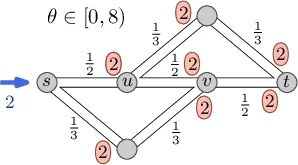
Predicting selfish behavior in public environments by considering Nash equilibria is a central concept of game theory. For the dynamic traffic assignment problem modeled by a flow over time game, in which every particle tries to reach its destination as fast as possible, the dynamic equilibria are called Nash flows over time. So far, this model has only been considered for networks in which each arc is equipped with a constant capacity, limiting the outflow rate, and with a transit time, determining the time it takes for a particle to traverse the arc. However, real-world traffic networks can be affected by temporal changes, for example, caused by construction works or special speed zones during some time period. To model these traffic scenarios appropriately, we extend the flow over time model by time-dependent capacities and time-dependent transit times. Our first main result is the characterization of the structure of Nash flows over time. Similar to the static-network model, the strategies of the particles in dynamic equilibria can be characterized by specific static flows, called thin flows with resetting. The second main result is the existence of Nash flows over time, which we show in a constructive manner by extending a flow over time step by step by these thin flows.
💡 Research Summary
The paper extends the classical “flow over time” model for dynamic traffic assignment to networks whose arc capacities and travel times vary with time. In the traditional setting each arc e has a fixed capacity νₑ and a fixed transit time τₑ; Nash flows over time (dynamic equilibria) are defined as the outcome when infinitesimal particles (vehicles) selfishly choose routes that minimize their arrival times, anticipating the choices of all other particles. Real‑world road networks, however, experience temporal changes such as construction work, school‑zone speed limits, reversible lanes, or flood‑induced closures. To capture these phenomena the authors replace the static transit time by a time‑dependent speed limit λₑ(t) (the inverse of travel time) and keep the capacity as a time‑dependent function νₑ(t). By normalizing all arc lengths to one, the actual travel time τₑ(t) for a particle entering arc e at time t is defined implicitly by the area condition ∫ₜ^{t+τₑ(t)} λₑ(ξ) dξ = 1. This formulation preserves the first‑in‑first‑out (FIFO) property and guarantees that particles never benefit from waiting before an arc, because the speed limit, not the travel time, changes over time.
The authors derive several fundamental properties of τₑ(t): the mapping t ↦ t+τₑ(t) is strictly increasing; τₑ is continuous and almost everywhere differentiable; and the derivative satisfies 1+τₑ′(t)=λₑ(t)/λₑ(t+τₑ(t)). The ratio γₑ(t)=λₑ(t)/λₑ(t+τₑ(t))=1+τₑ′(t) measures how the outflow rate on an empty arc is scaled relative to the inflow rate. When γₑ(t)>1 the outflow is slower (the speed limit has decreased), and when γₑ(t)<1 the outflow is faster.
A feasible flow over time is defined by a pair of locally integrable inflow and outflow rate functions (f₊ₑ, f₋ₑ) for each arc, together with cumulative flows F₊ₑ, F₋ₑ. Feasibility requires (i) flow conservation across the delayed arc (F₋ₑ(t+τₑ(t)) ≤ F₊ₑ(t)), (ii) node balance (Kirchhoff’s law) for all non‑sink nodes, and (iii) that the outflow respects either the instantaneous capacity νₑ(t+τₑ(t)) when a queue exists, or the scaled inflow γₑ(t)·f₊ₑ(t) (capped by capacity) when the queue is empty. The authors also define waiting time qₑ(t) as the length of the time interval needed for the queued volume to be processed at the current capacity, and exit time Tₑ(t)=t+τₑ(t)+qₑ(t). Lemma 2 establishes monotonicity, continuity, and differentiability properties of qₑ and Tₑ, and provides an explicit expression for Tₑ′(t) in terms of inflow, capacity, and γₑ.
Dynamic equilibrium (Nash flow over time) is introduced by treating particles as players in a continuous‑time game. Each particle selects a route that minimizes its own arrival time, given the flow of all other particles. The equilibrium condition requires that for every particle the chosen route yields the earliest possible arrival time among all s‑t paths, i.e., no unilateral deviation can improve its arrival time.
The central theoretical contribution is the characterization of Nash flows via “thin flows with resetting”. A thin flow is a static flow that respects the instantaneous capacities but may contain “reset points” where the flow value jumps, reflecting the moment when a queue empties or a capacity change forces a new regime. The authors prove two complementary statements:
-
Derivatives of Nash flows are thin flows with resetting. For any Nash flow over time, the time‑derivative of the cumulative inflow on each arc yields a static flow that satisfies the thin‑flow conditions, including the appropriate reset behavior at times when queues disappear or capacities change.
-
Construction of Nash flows from thin flows. Starting from the zero flow, one can iteratively extend a feasible flow by inserting a thin flow that is optimal for the current residual time horizon. Each insertion respects feasibility, FIFO, and capacity constraints, and the process converges to a full‑horizon Nash flow. This constructive proof also establishes existence of Nash flows for any time‑varying network with right‑continuous capacity and speed functions.
The paper includes a detailed example illustrating how a sequence of thin flows builds up a Nash flow in a network with a temporary capacity reduction and a speed‑limit change. The example demonstrates the resetting mechanism when a queue clears and how the flow adapts to the new speed profile.
In the discussion, the authors compare their model to prior work on static capacities, multiple sources/sinks, spillback, and instantaneous dynamic equilibria. They argue that their framework retains the essential analytical tractability of the static‑capacity model while capturing realistic temporal variations. Potential applications include traffic management with real‑time speed‑limit updates, evacuation planning under rising flood levels, and analysis of bottlenecks caused by construction.
Finally, the paper outlines future research directions: incorporating spillback (where downstream congestion reduces upstream capacities), handling stochastic or uncertain capacity changes, extending to atomic packet routing games, and studying algorithmic aspects such as efficient computation of thin flows with resetting in large‑scale networks.
Overall, the work provides a rigorous foundation for analyzing selfish routing behavior in temporally dynamic road networks, bridging a gap between theoretical traffic equilibria and the practical realities of time‑varying infrastructure.
Comments & Academic Discussion
Loading comments...
Leave a Comment