Probabilistic One-Dimensional Inversion of Frequency-Domain Electromagnetic Data Using a Kalman Ensemble Generator
Frequency-domain electromagnetic (FDEM) data of the subsurface are determined by electrical conductivity and magnetic susceptibility. We apply a Kalman Ensemble generator (KEG) to one-dimensional probabilistic multi-layer inversion of FDEM data to derive conductivity and susceptibility simultaneously. The KEG provides an efficient alternative to an exhaustive Bayesian framework for FDEM inversion, including a measure for the uncertainty of the inversion result. Additionally, the method provides a measure for the depth below which the measurement is insensitive to the parameters of the subsurface. This so-called depth of investigation is derived from ensemble covariances. A synthetic and a field data example reveal how the KEG approach can be applied to FDEM data and how FDEM calibration data and prior beliefs can be combined in the inversion procedure. For the field data set, many inversions for one-dimensional subsurface models are performed at neighbouring measurement locations. Assuming identical prior models for these inversions, we save computational time by re-using the initial KEG ensemble across all measurement locations.
💡 Research Summary
This paper introduces a probabilistic one‑dimensional inversion framework for frequency‑domain electromagnetic (FDEM) data that simultaneously estimates subsurface electrical conductivity (EC) and magnetic susceptibility (MS). The authors employ the Kalman Ensemble Generator (KEG), an ensemble‑based approximation of Bayesian updating, to avoid the computational burden of full Markov‑chain Monte Carlo (MCMC) sampling. A full‑wave forward model solves Maxwell’s equations for a horizontally layered half‑space, producing both in‑phase (IP) and out‑of‑phase (OP) responses for each ensemble member. Prior information on EC and MS is encoded as a Gaussian distribution with a prescribed mean and covariance; measurement noise is likewise modeled as Gaussian. The KEG updates the prior ensemble using the Kalman gain derived from sample covariances between model parameters and simulated data, yielding a posterior ensemble whose mean provides the best‑fit model and whose spread quantifies uncertainty.
Key innovations include: (1) simultaneous inversion of IP and OP components, which mitigates systematic bias in magnetic environments; (2) a depth‑of‑investigation metric obtained from the decay of ensemble covariances, indicating the depth beyond which data have negligible sensitivity; (3) reuse of a single prior ensemble across multiple spatial locations, dramatically reducing the number of forward‑model evaluations required for large surveys.
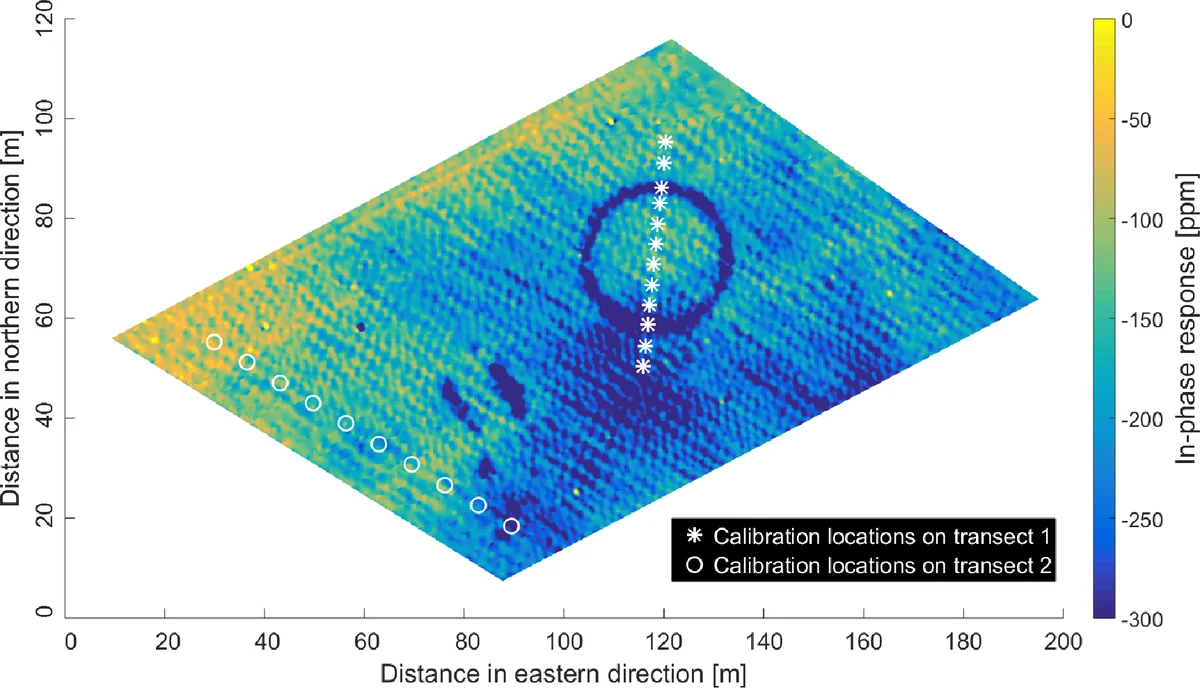
The methodology is demonstrated on synthetic data with vertically varying EC and MS, and on field data collected at an archaeological site in Dorset, UK. In both cases the KEG accurately recovers the true model parameters and provides realistic uncertainty bounds. Compared with MCMC, the KEG achieves comparable accuracy with an order‑of‑magnitude reduction in computational time, as the forward model dominates the runtime and is evaluated for the entire ensemble in a single step.
The authors acknowledge that KEG assumes Gaussian statistics and may be less accurate for strongly nonlinear problems, but argue that its speed and built‑in regularization make it well‑suited for practical FDEM surveys, especially when computational resources are limited. Future work may explore extensions to non‑Gaussian priors or hybrid schemes that combine KEG with MCMC to capture higher‑order posterior features.
Comments & Academic Discussion
Loading comments...
Leave a Comment