Achieving Spatial Scalability for Coded Caching over Wireless Networks
The coded caching scheme proposed by Maddah-Ali and Niesen considers the delivery of files in a given content library to users through a deterministic error-free network where a common multicast message is sent to all users at a fixed rate, independent of the number of users. In order to apply this paradigm to a wireless network, it is important to make sure that the common multicast rate does not vanish as the number of users increases. This paper focuses on a variant of coded caching successively proposed for the so-called combination network, where the multicast message is further encoded by a Maximum Distance Separable (MDS) code and the MDS-coded blocks are simultaneously transmitted from different Edge Nodes (ENs) (e.g., base stations or access points). Each user is equipped with multiple antennas and can select to decode a desired number of EN transmissions, while either nulling of treating as noise the others, depending on their strength. The system is reminiscent of the so-called evolved Multimedia Broadcast Multicast Service (eMBMS), in the sense that the fundamental underlying transmission mechanism is multipoint multicasting, where each user can independently and individually (in a user-centric manner) decide which EN to decode, without any explicit association of users to ENs. We study the performance of the proposed system when users and ENs are distributed according to homogeneous Poisson Point Processes in the plane and the propagation is affected by Rayleigh fading and distance dependent pathloss. Our analysis allows the system optimization with respect to the MDS coding rate. Also, we show that the proposed system is fully scalable, in the sense that it can support an arbitrarily large number of users, while maintaining a non-vanishing per-user delivery rate.
💡 Research Summary
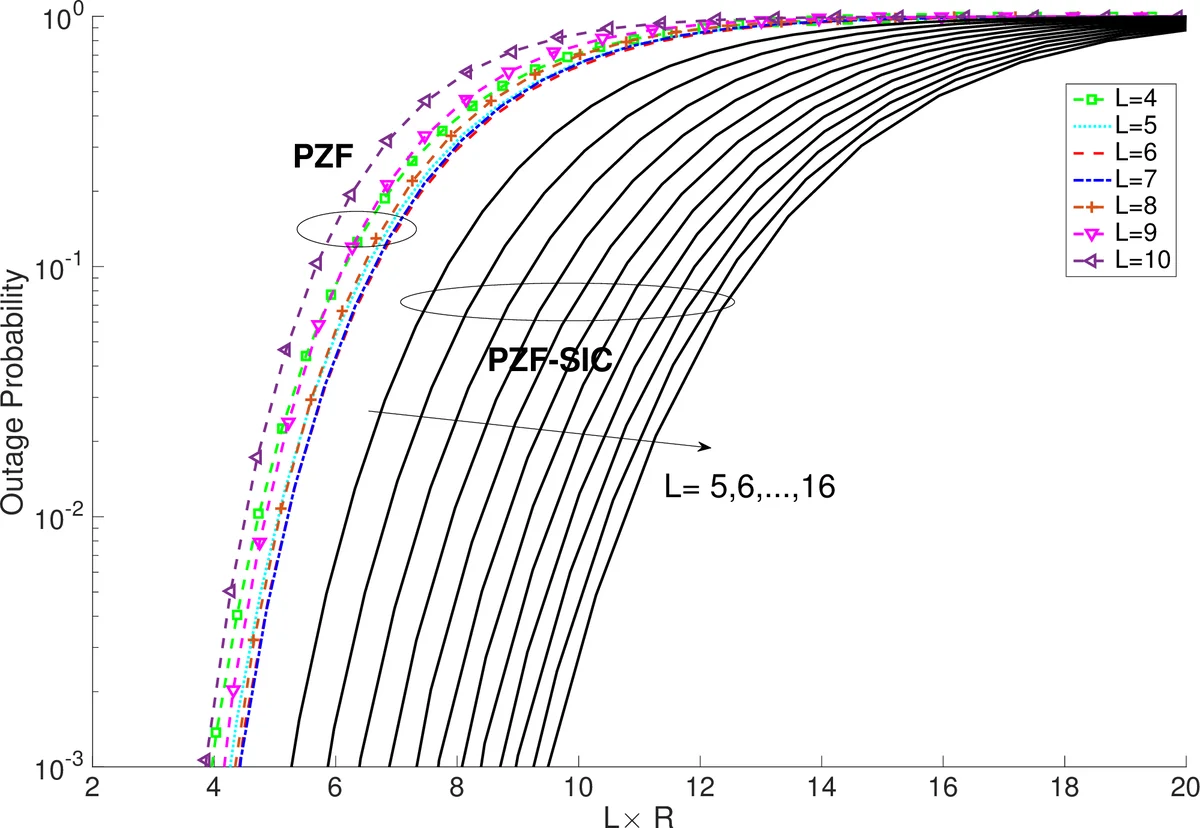
The paper addresses a fundamental limitation of the original Maddah‑Ali–Niesen coded‑caching scheme when it is transplanted from an ideal error‑free shared link to a realistic wireless environment. In a wireless network the common multicast rate inevitably collapses as the number of users grows because of independent Rayleigh fading and distance‑dependent path loss. To overcome this, the authors propose a novel architecture that combines three key ideas: (i) the multicast codeword is first split into L equal‑size blocks and then encoded with an (N_E, L) maximum‑distance‑separable (MDS) code; (ii) the N_E encoded blocks are transmitted simultaneously from N_E single‑antenna edge nodes (ENs) that are spatially distributed; (iii) each user, equipped with n_r antennas, applies a partial zero‑forcing (PZF) receiver that nulls interference only from the L strongest ENs while treating the remaining EN signals as noise. Because MDS coding guarantees that any L out of the N_E blocks suffice to reconstruct the original multicast message, a user only needs to successfully decode the L strongest EN transmissions.
The spatial distribution of ENs and users is modeled as independent homogeneous Poisson point processes (PPPs) with densities λ_EN and λ_U, respectively. Propagation follows a standard power‑law path‑loss model r^{‑η} together with independent Rayleigh small‑scale fading. Assuming an infinitely large network (N_E → ∞) and high‑SNR (noise negligible), the authors derive a tractable expression for the signal‑to‑interference ratio (SIR) of the ℓ‑th decoded stream:
SIR_{k,ℓ}= \frac{r_{k,ℓ}^{‑η}|h_{k,ℓ}|^{2}}{\sum_{j>ℓ} r_{k,j}^{‑η}| \tilde h_{k,j}|^{2}},
where \tilde h_{k,j}=q_{k,ℓ}^{H}h_{k,j} is a complex Gaussian variable independent of the desired channel. This expression enables the calculation of the per‑user outage probability
P_out(R)=\Pr\bigl(\min_{ℓ∈
Comments & Academic Discussion
Loading comments...
Leave a Comment