Fabry-Perot Lasers as Enablers for Parallel Reservoir Computing
We introduce the use of Fabry-Perot (FP) lasers as potential neuromorphic computing machines with parallel processing capabilities. With the use of optical injection between a master FP laser and a slave FP laser under feedback we demonstrate the potential for scaling up the processing power at longitudinal mode granularity and perform real-time processing for signal equalization in 25 Gbaud intensity modulation direct detection optical communication systems. We demonstrate the improvement of classification performance as the number of nodes increases and the capability of simultaneous processing of arbitrary data streams. Extensive numerical simulations show that up to 8 longitudinal modes in typical Fabry-Perot lasers can be leveraged so as to enhance classification performance.
💡 Research Summary
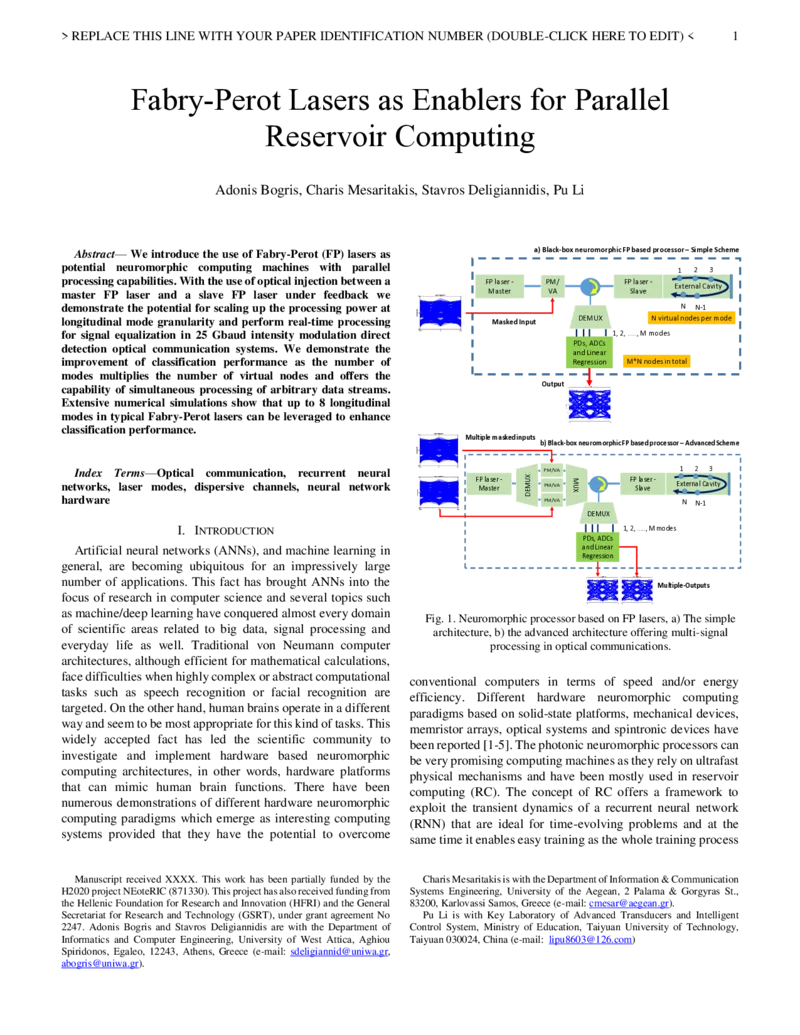
This paper proposes a novel photonic reservoir computing (RC) architecture that exploits the intrinsic multimode nature of Fabry‑Perot (FP) lasers to achieve parallel processing and enhanced computational capacity. The system consists of a master‑slave laser configuration: a master FP laser is phase‑modulated with the incoming 25 Gbaud PAM‑4 signal combined with a random mask, and the resulting optical waveform is injected into a slave FP laser. The slave laser is placed in a short external cavity that provides delayed optical feedback, thereby creating a time‑delay reservoir. Because a typical FP laser supports several longitudinal modes (up to eight in the simulations), each mode can be demultiplexed after the slave laser and detected by an individual photodiode followed by an analog‑to‑digital converter (ADC). Consequently, each mode supplies its own set of virtual nodes, defined by the ratio of the cavity round‑trip time (T) to the node separation (θ ≈ 20 ps). With T ranging from 240 ps to 1 ns, a single mode can host between 12 and 50 virtual nodes; using M = 8 modes yields a total of up to 400 virtual nodes.
The authors model the dynamics of both lasers with standard rate equations for the complex field amplitudes and carrier densities, incorporating differential gain, gain saturation, linewidth enhancement, spontaneous emission noise, optical injection (k_in = 0.75) and feedback (k_f = 0.01). The free spectral range (FSR) of the slave laser is about 125 GHz, and the gain bandwidth is ~10 THz, ensuring that eight longitudinal modes are well separated and can be treated independently. The external cavity is deliberately kept short (≈1 cm) to enable monolithic integration on III‑V platforms.
For performance evaluation, the authors simulate transmission of a 25 Gbaud PAM‑4 signal over 50 km of standard single‑mode fiber using the split‑step Fourier method and the Manakov equations, including thermal and shot noise at the receiver. The distorted signal is injected into the reservoir after being multiplied by the random mask. The responses of all virtual nodes are sampled every θ, quantized with 8‑bit ADCs, and linearly combined using ridge regression. Training uses 60 000 symbols, while validation and testing each use 200 000 symbols organized in batches of 21 symbols to capture channel memory. The number of trainable weights equals M × N_v × 21.
Simulation results demonstrate a clear scaling advantage: with a single mode (M = 1) the bit‑error rate (BER) after RC processing improves from the raw 0.06 to just below the forward error correction (FEC) threshold of 3 × 10⁻³, but cannot reach lower values. When eight modes are employed (M = 8), the BER drops to the order of 10⁻⁴, comfortably surpassing the FEC limit. Moreover, the “advanced” architecture shown in Fig. 1b allows each mode to carry a distinct data stream, enabling simultaneous processing of multiple independent signals—a capability highly relevant for modern wavelength‑division multiplexed (WDM) networks.
The paper also discusses practical considerations. The short external cavity (240 ps round‑trip) corresponds to a physical length of about 1 cm, making on‑chip integration feasible. The required bias currents (30–35 mA) and injection/feedback strengths are compatible with existing semiconductor laser drivers. The authors acknowledge that their model neglects spatial hole burning and four‑wave mixing, effects that become significant for lasers with smaller FSR (<50 GHz); future work will need to incorporate these phenomena for a more accurate prediction.
In summary, the work establishes that Fabry‑Perot lasers, traditionally viewed as simple broadband sources, can serve as powerful neuromorphic processors when their longitudinal modes are harnessed as parallel reservoirs. By multiplying the number of virtual nodes through multimode operation, the system achieves both higher computational throughput and the ability to process several data streams concurrently, all while maintaining a compact footprint suitable for monolithic photonic integration. This contribution advances the state of the art in photonic reservoir computing, offering a pathway toward ultrafast, energy‑efficient, and scalable hardware for real‑time optical signal processing.
Comments & Academic Discussion
Loading comments...
Leave a Comment