Hunting potassium geoneutrinos with liquid scintillator Cherenkov neutrino detectors
The research of geoneutrino is a new interdisciplinary subject of particle experiments and geo-science. Potassium-40 ($^\text{40}$K) decays contribute roughly 1/3 of the radiogenic heat of the Earth, but it is still missing from the experimental observation. Solar neutrino experiments with liquid scintillators have observed uranium and thorium geoneutrinos and are the most promising in the low-background neutrino detection. In this article, we present the new concept of using liquid-scintillator Cherenkov detectors to detect the neutrino-electron elastic scattering process of $^\text{40}$K geoneutrinos. Liquid-scintillator Cherenkov detectors using a slow liquid scintillator can achieve this goal with both energy and direction measurements for charged particles. Given the directionality, we can significantly suppress the dominant intrinsic background originating from solar neutrinos in conventional liquid-scintillator detectors. We simulated the solar- and geo-neutrino scatterings in the slow liquid scintillator detector, and implemented energy and directional reconstructions for the recoiling electrons. We found that $^\text{40}$K geoneutrinos can be detected with three standard deviation accuracy in a kiloton-scale detector.
💡 Research Summary
The paper proposes a novel method to detect potassium‑40 (⁴⁰K) geoneutrinos, which have so far eluded observation, by exploiting the directional information available in neutrino‑electron elastic scattering. Conventional liquid‑scintillator detectors (e.g., KamLAND, Borexino) rely on inverse‑beta‑decay (IBD) and therefore have an energy threshold of 1.8 MeV, making them blind to the sub‑MeV ⁴⁰K neutrinos. The authors suggest using a liquid‑scintillator Cherenkov detector that combines a slow scintillator (pure linear alkylbenzene, LAB) with traditional photomultiplier tubes (PMTs). LAB emits scintillation light with a long rise (12.2 ns) and decay (35.4 ns) time, while still allowing prompt Cherenkov photons (threshold 0.178 MeV) to be separated in time.
A detailed Geant4‑based Monte‑Carlo simulation is performed. Solar neutrinos and geoneutrinos are generated according to standard solar models and Earth radioactivity models, including neutrino oscillations. The elastic scattering cross‑section is applied, and the recoil electron’s trajectory, multiple scattering, and photon production (both Cherenkov and scintillation) are tracked. Optical photons are propagated with an assumed 66.7 % transmission to the PMTs; only photons in the 300–550 nm band are detected with a quantum efficiency of 30 %, yielding an overall photo‑electron (PE) detection efficiency of 20 %.
Energy reconstruction is straightforward: the number of detected PEs is converted to MeV using a calibrated PE/MeV factor (≈ 250 PE/MeV). Direction reconstruction uses a weighted‑center method, averaging the unit vectors of all detected photons. Three cases are examined: (1) using only Cherenkov photons (ideal), (2) applying the 20 % detection efficiency cut, and (3) a realistic scenario where early scintillation photons (first 2 ns) are also present as background. The angular resolution (99 % containment) is about 116° for case 1 and degrades only slightly to ~125° for the realistic case 3, indicating that electron multiple scattering in the liquid dominates the resolution rather than photon statistics. Resolution improves with increasing electron kinetic energy.
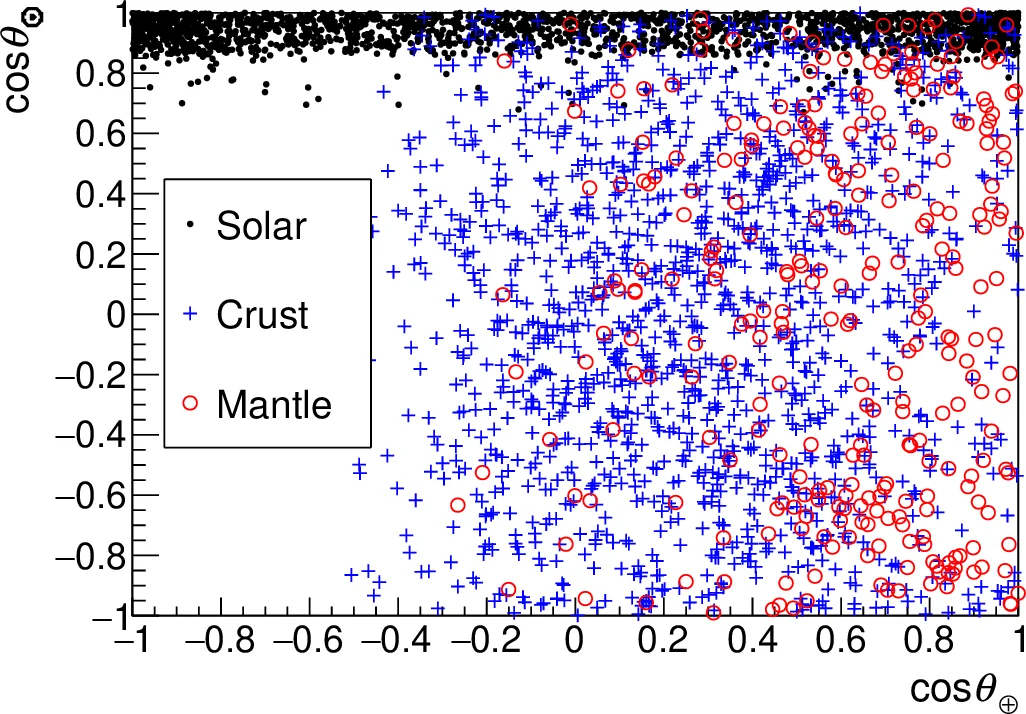
To suppress the dominant solar‑neutrino background, two cuts are imposed. First, an energy window of 0.7–2.3 MeV is selected; below 0.7 MeV the directional reconstruction becomes too poor. Second, the cosine of the angle between the reconstructed electron direction and the solar‑zenith (cos θ⊙) is required to be less than –0.75 (i.e., the electron points roughly opposite the Sun). This angular cut reduces solar‑neutrino events by a factor of ~150, leaving a signal‑to‑background ratio of about 0.1.
Statistical extraction of the ⁴⁰K signal follows N_geo = N_can – ε · N_solar, where ε is the combined efficiency of the energy and angular cuts. Uncertainties include Poisson fluctuations of the candidate sample, a 1 % systematic on the solar‑neutrino flux (anticipated from forthcoming experiments such as Jinping, LENA, THEIA), and a 1 % uncertainty on the detection efficiency (calibrated with deployed beta sources).
Sensitivity studies show that with a 3‑kiloton fiducial mass and 20 years of data taking, a 3‑σ observation of the ⁴⁰K geoneutrino flux is achievable. Scaling up to 20 kt would yield a 5‑σ detection. In contrast, the ²³²Th and ²³⁸U components (energy window 1.1–2.3 MeV) remain limited by statistics despite a more favorable signal‑to‑background ratio.
The discussion emphasizes that the key enabling factors are (i) the temporal separation of Cherenkov and scintillation light in a slow scintillator, (ii) the use of elastic‑scattering directionality to discriminate solar background, and (iii) realistic assumptions about photon transport, PMT coverage, and calibration. The authors note that further improvements in optical attenuation measurements, higher PMT coverage, and refined reconstruction algorithms could enhance angular resolution and lower the detection threshold.
In summary, the study demonstrates that a liquid‑scintillator Cherenkov detector, employing a slow scintillator like LAB, can provide both energy and directional information for sub‑MeV electrons. By exploiting this capability, the long‑standing goal of detecting ⁴⁰K geoneutrinos becomes feasible with a kiloton‑scale experiment, opening a new window onto Earth’s radiogenic heat budget and interior composition.
Comments & Academic Discussion
Loading comments...
Leave a Comment