A short elementary proof of the insolvability of the equation of degree 5
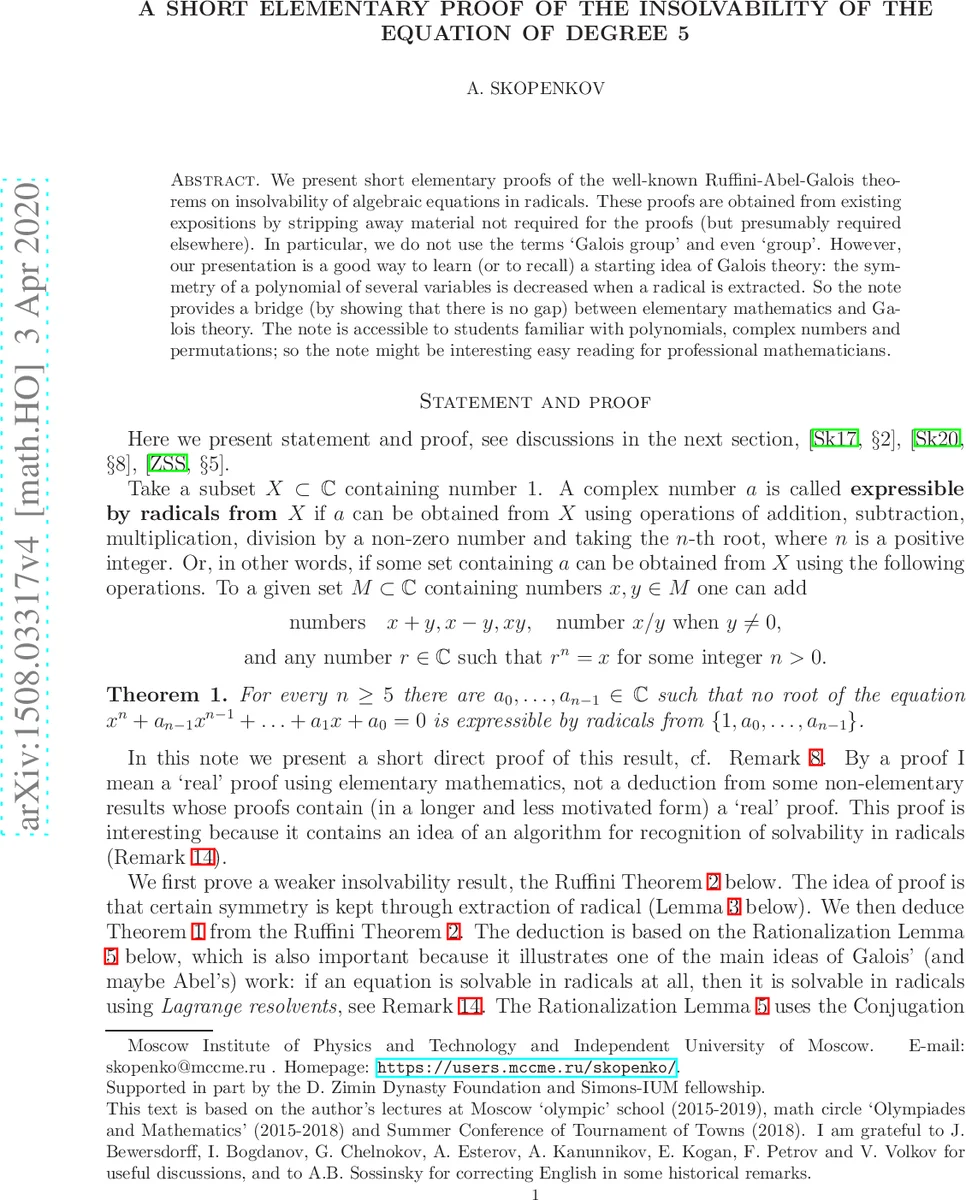
We present short elementary proofs of the well-known Ruffini-Abel-Galois theorems on insolvability of algebraic equations in radicals. These proofs are obtained from existing expositions by stripping away material not required for the proofs (but presumably required elsewhere). In particular, we do not use the terms Galois group' and even group’. However, our presentation is a good way to learn (or to recall) a starting idea of Galois theory: the symmetry of a polynomial of several variables is decreased when a radical is extracted. So the note provides a bridge (by showing that there is no gap) between elementary mathematics and Galois theory. The note is accessible to students familiar with polynomials, complex numbers and permutations; so the note might be interesting easy reading for professional mathematicians.
💡 Research Summary
The paper presents a completely elementary proof of the classical Ruffini‑Abel‑Galois insolubility results for equations of degree five and higher, deliberately avoiding any explicit use of group‑theoretic terminology. The author starts by defining what it means for a complex number to be “expressible by radicals from a set X”: one may apply addition, subtraction, multiplication, division by a non‑zero number, and extraction of n‑th roots (n∈ℕ) to elements of X. With this notion, Theorem 1 states that for any n ≥ 5 there exist coefficients a₀,…,a_{n‑1}∈ℂ such that none of the roots of the monic polynomial xⁿ + a_{n‑1}x^{n‑1}+…+a₁x + a₀ can be obtained by radicals from the set {1,a₀,…,a_{n‑1}}.
The proof proceeds in two major stages. First, the Ruffini theorem (Theorem 2) is established. The key idea is a “symmetry‑reduction” principle: if a rational function P(u₁,…,u_n) satisfies P^k(u)=P^k(u∘(abc)) for a 3‑cycle (abc) and some integer k, then Lemma 3 shows that P itself is invariant under every even permutation of the variables. This captures the fact that extracting a radical cannot increase the symmetry group of a polynomial; rather, the group shrinks. Using a counting argument, the author shows that one can choose algebraically independent roots x₁,…,x_n over the field Q_ε generated by the coefficients and the primitive roots of unity ε_k. Assuming a radical extension Q_ε(a,r₁,…,r_s) contains a root x₁, Lemma 3 is applied inductively to prove each r_j must be the value at (x₁,…,x_n) of an even‑symmetric rational function. Since x₁ itself is not even‑symmetric (the 3‑cycle (123) moves it), a contradiction follows, proving that no such radical extension can contain a root. This yields the Ruffini theorem.
The second stage links Ruffini’s result to the full Abel‑Ruffini theorem (Theorem 4) via a “Rationalization Lemma” (Lemma 5). Lemma 5 states that if a field F contains ε_k and r^k but not r, and if F(r)∩Q_ε(x) is not already inside F, then there exists ρ∈Q_ε(x) with ρ^k∈F and F(ρ)=F(r). The proof relies on Lemma 6, which establishes the irreducibility of z^k−r^k over F (when k is prime) and the conjugation property that any polynomial vanishing at r also vanishes at all its k‑th roots of unity multiples. Using these facts, the author constructs a resolvent polynomial whose coefficients lie in F, shows that its roots are the various conjugates of r, and finally produces the desired ρ. This rationalization shows that any radical extension containing a root can be “normalized” to lie inside the field generated by the coefficients and the roots themselves, i.e., inside Q_ε(x).
Combining Theorem 2 with Theorem 4 yields Theorem 1: for n ≥ 5 there exist explicit coefficient tuples for which no root is obtainable by radicals from the coefficients. The paper also contains extensive remarks comparing the present exposition with classical texts, emphasizing that the proof uses only elementary notions (polynomials, complex numbers, permutations) and that the symmetry‑reduction viewpoint provides an intuitive bridge to Galois theory without invoking groups. Additionally, Remark 14 sketches an algorithmic way to recognize solvability in radicals based on the same symmetry considerations.
Overall, the article demonstrates that the insolubility of the general quintic can be proved with minimal algebraic machinery, making the deep ideas of Galois theory accessible to students who have only encountered basic algebra and permutations. It also clarifies the logical structure of the classical results, showing precisely where the “no‑gap” between elementary reasoning and full Galois theory lies.
Comments & Academic Discussion
Loading comments...
Leave a Comment