Dynamic Point Cloud Denoising via Manifold-to-Manifold Distance
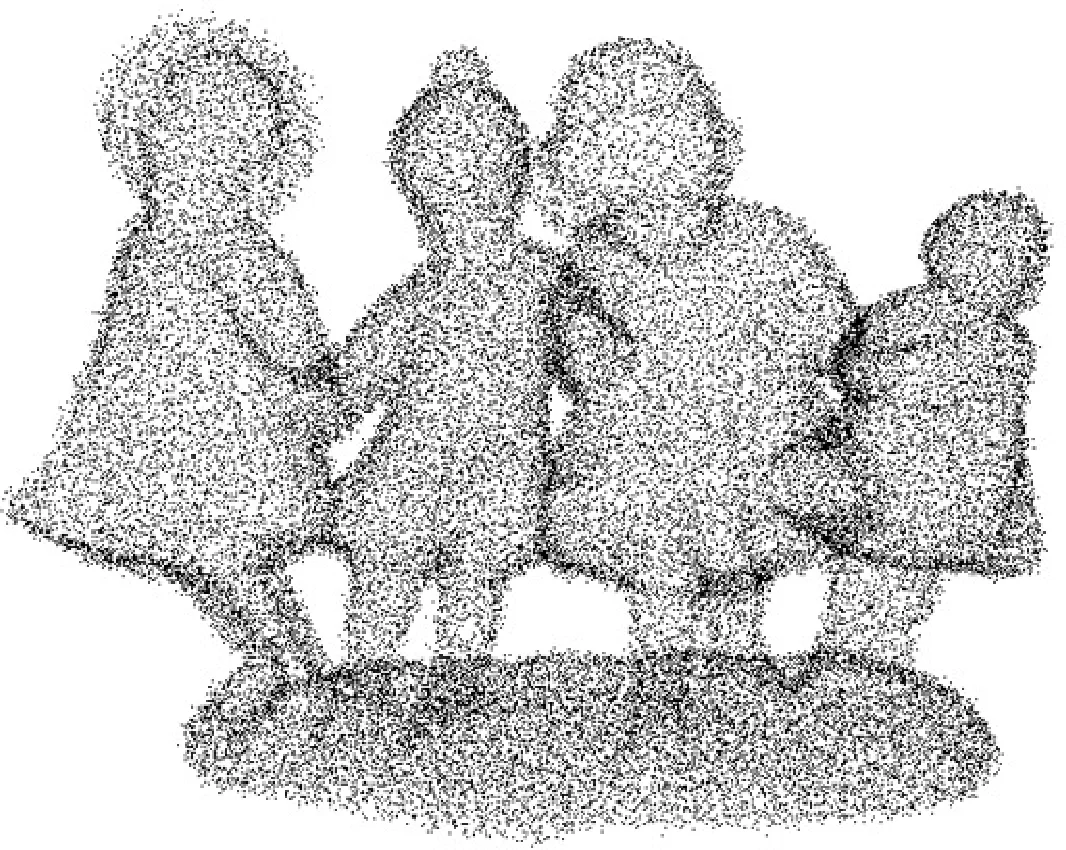
3D dynamic point clouds provide a natural discrete representation of real-world objects or scenes in motion, with a wide range of applications in immersive telepresence, autonomous driving, surveillance, \etc. Nevertheless, dynamic point clouds are often perturbed by noise due to hardware, software or other causes. While a plethora of methods have been proposed for static point cloud denoising, few efforts are made for the denoising of dynamic point clouds, which is quite challenging due to the irregular sampling patterns both spatially and temporally. In this paper, we represent dynamic point clouds naturally on spatial-temporal graphs, and exploit the temporal consistency with respect to the underlying surface (manifold). In particular, we define a manifold-to-manifold distance and its discrete counterpart on graphs to measure the variation-based intrinsic distance between surface patches in the temporal domain, provided that graph operators are discrete counterparts of functionals on Riemannian manifolds. Then, we construct the spatial-temporal graph connectivity between corresponding surface patches based on the temporal distance and between points in adjacent patches in the spatial domain. Leveraging the initial graph representation, we formulate dynamic point cloud denoising as the joint optimization of the desired point cloud and underlying graph representation, regularized by both spatial smoothness and temporal consistency. We reformulate the optimization and present an efficient algorithm. Experimental results show that the proposed method significantly outperforms independent denoising of each frame from state-of-the-art static point cloud denoising approaches, on both Gaussian noise and simulated LiDAR noise.
💡 Research Summary
The paper addresses the challenging problem of denoising dynamic 3D point clouds, where each frame consists of irregularly sampled points and there is no explicit point‑to‑point correspondence across time. While many sophisticated methods exist for static point‑cloud denoising, applying them independently to each frame ignores temporal coherence and often yields inconsistent results. To overcome this, the authors propose a novel framework that jointly exploits spatial smoothness and temporal consistency by representing the entire sequence as a spatio‑temporal graph and by introducing a “manifold‑to‑manifold distance” that measures intrinsic variation between local surface patches across frames.
Manifold‑to‑Manifold Distance
The authors model each local patch (a center point plus its K nearest neighbors) as a discrete sampling of an underlying smooth Riemannian 2‑D manifold (the surface of the object). They define a continuous variation measure on a manifold using the Laplace–Beltrami operator, which captures second‑order changes of normal coordinates. By leveraging the known relationship that the random‑walk graph Laplacian approximates the weighted Laplace–Beltrami operator, they derive a discrete counterpart: the temporal distance is computed by applying the random‑walk Laplacian to the normal vectors of the sampled points. This distance satisfies two desirable properties: it is zero for patches that belong to the same underlying surface (or a rigidly transformed version) and it grows with increasing geometric dissimilarity.
Spatio‑Temporal Graph Construction
Each point in the sequence becomes a node in an undirected graph. Spatial edges connect neighboring points within the same frame, weighted by conventional geometric similarity. Temporal edges are created by matching patches in consecutive frames using the manifold‑to‑manifold distance; the edge weight reflects how closely the two patches represent the same underlying surface region. Thus the graph encodes both local spatial relationships and long‑range temporal correspondences without requiring explicit point correspondence.
Joint Optimization
The denoising problem is formulated as a joint optimization over (i) the clean point positions X and (ii) the graph adjacency matrix A. The objective contains three terms: a data fidelity term that keeps X close to the noisy observations, a spatial smoothness regularizer (graph Laplacian quadratic form) that enforces similarity among spatial neighbors, and a temporal consistency regularizer that penalizes the manifold‑to‑manifold distance between temporally matched patches. The optimization proceeds by alternating minimization:
- Fix the graph – With A fixed, the problem reduces to a linear system involving the graph Laplacian; a closed‑form solution for X is obtained efficiently.
- Update the graph – With X updated, temporal edge weights are recomputed by solving a linear program that minimizes the temporal regularizer under non‑negativity constraints. Spatial edge weights are refined using a feature‑graph learning scheme similar to prior work
Comments & Academic Discussion
Loading comments...
Leave a Comment